In this video Bryan Litz of Applied Ballistics offers tips on Big Bore shooting (i.e. .338 caliber and above). Bryan offers advice on bullet selection and he explains the challenge of handling the blast, noise, concussion, and recoil of big boomers such as the .416 Barrett and .50 BMG.
Bryan goes big … very big, shooting a monster .50 BMG bullpup.
Watch the recoil pulse shove Bryan backwards at 1:40 time-mark:
Big Bore Basics — Tips for Shooting Big Boomersby Bryan Litz
There are some unique things to consider with big-bore shooting. One is bullet design. For long-range shooting you want high-BC bullets. You get high BC from heavy bullets and bullets that have low drag. The interesting trade-off in big calibers is that there are a lot more lathe-turned solid bullets in copper and brass available than there are in the smaller calibers. You’ve got bullets that have slightly lower drag profiles but they are made of materials that are slightly less dense (than lead) so they are relatively light for their caliber. With that trade-off, the BCs might not be as high as you think for big calibers, although the bullets are heavy enough that they carry a lot of energy.
Energy really has a lot to do with shooting these big-caliber rifles. As with any kind of shooting, the fundamentals of marksmanship are the most important thing. However, it can be hard to maintain good fundamentals (e.g. trigger control and sight alignment) when you’re burning 100 grains of powder. There’s a lot of concussion (you want a muzzle brake no matter what your cartridge is above .338). It certainly can be challenging with all the muzzle blast and all the energy coming out of the barrel.
For long-range shooting with big bore rifles, you are still looking for the same things that you want with smaller-caliber rigs. You want a high-performance bullet, you want consistent ammunition, and you want a good fire solution to be able to center your group at long range. Basically you’re just dealing with the challenges that the high energy brings, and being smart about your bullet selection.
In the video above, Bryan is shooting the DesertTech HTI bullpup. This rifle can shoot four (4) big bore chamberings, with barrel conversion kits for: .375 CheyTac, .408 CheyTac, .416 Barrett, and .50 BMG. These can be quickly swapped in the HTI chassis, which employs an internal barrel-clamp system.
Have you recently purchased a new scope? Then you should verify the actual click value of the turrets before you use the optic in competition (or on a long-range hunt). While a scope may have listed click values of 1/4-MOA, 1/8-MOA or 0.1 Mils, the reality may be slightly different. Many scopes have actual click values that are slightly higher or lower than the value claimed by the manufacturer. The small variance adds up when you click through a wide range of elevation.
In this video, Bryan Litz of Applied Ballistics shows how to verify your true click values using a “Tall Target Test”. The idea is to start at the bottom end of a vertical line, and then click up 30 MOA or so. Multiply the number of clicked MOA by 1.047 to get the claimed value in inches. For example, at 100 yards, 30 MOA is exactly 31.41 inches. Then measure the difference in your actual point of impact. If, for example, your point of impact is 33 inches, then you are getting more than the stated MOA with each click (assuming the target is positioned at exactly 100 yards).
How to Perform the Tall Target Test
The objective of the tall target test is to insure that your scope is giving you the proper amount of adjustment. For example, when you dial 30 MOA, are you really getting 30 MOA, or are you getting 28.5 or 31.2 MOA? The only way to be sure is to verify, don’t take it for granted! Knowing your scopes true click values insures that you can accurately apply a ballistic solution. In fact, many perceived inaccuracies of long range ballistics solutions are actually caused by the scopes not applying the intended adjustment. In order to verify your scope’s true movement and calculate a correction factor, follow the steps in the Tall Target Worksheet. This worksheet takes you thru the ‘calibration process’ including measuring true range to target and actual POI shift for a given scope adjustment. The goal is to calculate a correction factor that you can apply to a ballistic solution which accounts for the tracking error of your scope. For example, if you find your scope moves 7% more than it should, then you have to apply 7% less than the ballistic solution calls for to hit your target.
NOTE: When doing this test, don’t go for the maximum possible elevation. You don’t want to max out the elevation knob, running it to the top stop. Bryan Litz explains: “It’s good to avoid the extremes of adjustment when doing the tall target test.I don’t know how much different the clicks would be at the edges, but they’re not the same.”
Should You Perform a WIDE Target Test Too?
What about testing your windage clicks the same way, with a WIDE target test? Bryan Litz says that’s not really necessary: “The wide target test isn’t as important for a couple reasons. First, you typically don’t dial nearly as much wind as you do elevation. Second, your dialed windage is a guess to begin with; a moving average that’s different for every shot. Whereas you stand to gain a lot by nailing vertical down to the click, the same is not true of windage. If there’s a 5% error in your scope’s windage tracking, you’d never know it.”
Verifying Scope Level With Tall Target Test
Bryan says: “While setting up your Tall Target Test, you should also verify that your scope level is mounted and aligned properly. This is critical to insuring that you’ll have a long range horizontal zero when you dial on a bunch of elevation for long range shots. This is a requirement for all kinds of long range shooting. Without a properly-mounted scope level (verified on a Tall Target), you really can’t guarantee your horizontal zero at long range.”
NOTE: For ‘known-distance’ competition, this is the only mandatory part of the tall target test, since slight variations in elevation click-values are not that important once you’re centered “on target” at a known distance.
Applied Ballistics has produced a series of YouTube videos about precision long range shooting. Featuring ace long-range shooter and professional ballistician Bryan Litz, these videos address various topics of interest to long-range marksmen. This featured video looks at Long Range mistakes — Bryan Litz reveals the most common ballistics-related shooting errors at Long Range. And then Bryan explains how to improve your shooting (and wind reading) to eliminate those common errors.
Watch Applied Ballistics Video about Common Mistakes in Long Range Shooting:
Bryan Litz of Applied Ballistics often hears the question: “What are the main reasons people miss their target at long range?” To answer that question, in this video, Bryan explains the most important variables in Long Range shooting. Bryan says: “Probably the number one thing is range — you have to have a [precise] range to your target because your bullet is dropping, and to hit the target you need to correct for bullet drop.” Distance may be indicated on the target bay (or berm), but for open ranges you should ascertain distance-to-target with a quality laser rangefinder. Even when the distance to target is shown with a sign or marker, you may want to confirm the distance with your rangefinder. (You may be surprised — we’ve seen marked target distances at commercial ranges off by 25+ yards!) Bryan says: “Get a good laser range to the target and you’ll be within a couple yards”.
After distance to target, the most important variable is the wind. This is the most challenging factor because the wind is constantly changing. Bryan explains: “After 300 or 400 yards, the wind [will] move your shots off the target if you don’t correct for it. The best way to account for the wind is to measure it at your location with a Kestrel. The Kestrel can give you the speed and direction of the wind at your location, which can baseline your wind call for your long-range shot.” Bryan acknowledges that there will still be variables: “The wind isn’t always blowing the same downrange as at your location… and the wind is always changing”. Bryan notes that you need to account for variances in wind between the time you gauge the wind angle and velocity and the time you actually you take your shot.
At the Berger SW Nationals this week in Phoenix, the nation’s top long-range shooters will try to put all their shots in the 10-Ring at 800, 900, and 1000 yards. A good foundation in ballistics is vital if you want to succeed in the long-range game.
How much do you know about BCs, Bullet Shapes, Trajectories, Wind Drift, and other things in the realm of External Ballistics? You can test your knowledge of basic Ballistics principles with this interactive quiz. The questions and answers were provided by Ballistics Guru Bryan Litz of Applied Ballistics LLC. Bryan is the author of Applied Ballistics for Long-Range Shooting and other popular resources in print, DVD, and eBook format. Have fun with our Quiz.
The Quiz contains ten (10) questions. When you complete all ten questions, you can see your results, along with the correct answers.
Applied Ballistics has created a series of YouTube videos about precision long range shooting. Featuring ace long-range shooter and professional ballistician Bryan Litz, these videos will address various topics of interest to long-range marksmen. In this video, the first in the series, Bryan Litz answers the question, “Just What Is Long Range Shooting?” Bryan discusses how we define “long range” and the key factors shooters need to consider.
Applied Ballistics Video — What Is Long Range Shooting?
Bryan states: “I don’t think there is a clear definition of where Long Range starts.” But he offers this practical guideline: “The way I think of it, any time you’re making major adjustments to your zero in order to hit a target, due to gravity drop and wind deflection, THEN you’re getting into ‘Long Range’. For example, if you are zeroed at 100 yards and need to shoot to 600 yards, you have many feet of elevation [drop] to account for, and to me, that’s where it becomes Long Range.”
Extended Long Range and the Transonic Zone
Bryan adds a second concept, namely “Extended Long Range”. Litz says that: “Extended Long Range starts whenever the bullet slows to its transonic range. As the bullet slows down to approach Mach 1, it starts to encounter transonic effects, which are more complex and difficult to account for, compared to the supersonic range where the bullet is relatively well-behaved.” Bryan notes that bullets start to encounter transonic effects at about 1340 fps, quite a bit faster than the speed of sound, which is about 1116 fps at sea level in normal conditions (59° F).
With the Berger Southwest Nationals coming up soon (Feb. 6-12), we thought we would share some tips from a past Champion who really knows the Ben Avery range in Phoenix. In 2015, Bryan won the F-TR Mid-Range AND Long-Range National Championships hosted at Ben Avery. And at the 2014 Berger SW Nationals (SWN), Bryan took top honors among all sling shooters. If you only know Bryan Litz from his Applied Ballistics Books and DVDs, you may not realize that this guy is a great marksman (along with being an actual rocket scientist). This guy can shoot.
Given his impressive track record at Ben Avery, we asked Bryan if he had any advice for other long-range competitors. First Bryan provided three tips concerning Ballistics, his special area of expertise. Next Bryan offered three more general tips about long-range competition — how to analyze your shooting, how to choose your ‘wind strategy’, and how to avoid the most costly mistakes, i.e. how to avoid the “train-wrecks”.
Here is the sleek F-TR Rig Bryan Litz used to win the 2015 F-TR Mid-Range and Long-Range Championships at Ben Avery:
Litz Ballistics Tips
Ballistics TIP ONE. If you’re having trouble getting your ballistic software to match actual drops, you need to look at a number of possible reasons. Here are some common issues that can cause problems.
Click Values Are Not Exact. Scopes and iron sights don’t always produce accurate adjustments. In other words, if your ballistics program predicts 30 MOA of drop, and you dial 30 MOA but hit low, it might be that your sight actually only moved 28 MOA (for example). To see if your sight is adjusting accurately, shoot a tall target at 100 yards and measure group separation when dialing your sight.
Barometric vs. Station Pressure. This is a commonly misunderstood input to ballistics programs. You can avoid this pitfall by remembering the following: station pressure is the actual measured pressure at your location, and you don’t need to tell the program your altitude when using station pressure. Barometric pressure is corrected for sea level. If you’re using barometric pressure, you also have to input your altitude.
Muzzle Velocity. Chronographs are not always as accurate as shooters think they are — your true MV may be off by 10-20 fps (or more). If your drop is different than predicted at long range, it might be because your muzzle velocity input is wrong.
Mixing Up BC (G1 vs. G7). Knowledgeable long range shooters know that the G7 standard is a more representative standard for modern LR bullets. However, using G7 BCs isn’t just a matter of clicking the ‘G7′ option in the program. The numeric value of the BC is different for G1 and G7. For example, the G1 BC of the Berger 155.5 grain Fullbore bullet is .464 but the G7 BC is .237. If you were to enter .464 but click on G7, the results would be way off.
Ballistics TIP TWO. A properly installed level is absolutely essential for long range shooting. Without a good level reference, your long range wind zero will be off due to minor canting of the rifle from side to side. You can verify that your level is installed correctly on a 100-yard ‘tall target’. Draw a plumb line straight up the target and verify that your groups track straight up this line as you go up in elevation.
Ballistics TIP THREE. If your long range ballistic predictions aren’t tracking, always come back and verify your 100-yard zero. Sometimes a simple zero shift can be misconstrued as errors in long range ballistics predictions.
Litz Competition Shooting Tips
Competition TIP ONE. Improving your scores in long range competition is a constant process of self-assessment. After each match, carefully analyze how you lost points and make a plan to improve. Beginning shooters will lose a lot of points to fundamental things like sight alignment and trigger control. Veteran shooters will lose far fewer points to a smaller list of mistakes. At every step along the way, always ask yourself why you’re losing points and address the issues. Sometimes the weak links that you need to work on aren’t your favorite thing to do, and success will take work in these areas as well.
Competition TIP TWO. Select your wind shooting strategy carefully. For beginners and veterans, most points are typically lost to wind. Successful shooters put a lot of thought into their approach to wind shooting. Sometimes it’s best to shoot fast and minimize the changes you’ll have to navigate. Other times it’s best to wait out a condition which may take several minutes. Develop a comfortable rest position so you have an easier time waiting when you should be waiting.
Competition TIP THREE. Actively avoid major train wrecks. Sounds obvious but it happens a lot. Select equipment that is reliable, get comfortable with it and have back-ups for important things. Don’t load on the verge of max pressure, don’t go to an important match with a barrel that’s near shot out, physically check tightness of all important screws prior to shooting each string. Observe what train wrecks you and others experience, and put measures in place to avoid them.
“Must-Watch” SWN Video has aerial view of Ben Avery plus highlights from Saturday
Christmas is coming soon. Books have always been popular holiday gifts. If you haven’t completed your holiday shopping, here are some recommended titles that should please the serious shooters and firearms enthusiasts on your shopping list. For shooting clubs, books also make great end-of-season member awards. Most of us would rather have a useful book than one more piece of wood to toss in a box in the closet.
Here Are TEN BOOKS Recommended for Serious Shooters:
Glen Zediker’s brand new book, Top-Grade Ammo, is hot off the press. Many folks believe this is Glen’s best book ever. This 314-page resource covers every aspect of the reloading process — component sorting, priming, sizing, bullet seating and more. With 430 photos, Top-Grade Ammo is a richly-illustrated, step-by-step guide to producing high-quality handloads. Unlike many reloading books, Top-Grade Ammo is truly current and up-to-date, so it covers modern practices and the latest precision reloading tools. While Zediker focuses on producing match-grade ammo for competition, this book will also help novice reloaders on a budget. It’s written for all hand-loaders — beginners through advanced. This book features a special “lay-flat” binding so it’s easy to use as a benchtop reference. To view Chapter List and sample pages visit ZedikerPublishing.com.
If you’re a serious long-range shooter, consider adding this book to your library. Relying on extensive ballistics testing, Modern Advancements contains some fascinating research results, including the effects of twist rate on muzzle velocity, BC, and precision. Other sections detail the evolution of modern rifle, bullet, and optics designs. And there is an important comparison test of chronographs. Laser rangefinders and wind measurement devices are explained in detail by contributing author Nick Vitalbo. This book is a valuable resource for anyone who wants to understand the current “state of the art” in today’s shooting world. There is a ton of “hard science” in this book — not just opinions.
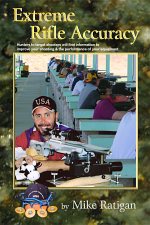
This book should be on the shelf of every short-range benchrest shooter. (Shooters in other disciplines will find the book helpful as well.) Butch Lambert says Mike’s book is “far and away the best Benchrest book written. Very comprehensive, it touches on every aspect of our game.” Mike’s 368-page book is dedicated to getting the most from modern rifle accuracy equipment with an emphasis on shooting 100-200-300 yard group benchrest tournaments. This book covers the most popular hardware plus new equipment offerings are covered, including external mount scopes, actions, triggers, stocks, wind flags, and more. Also covered are rifle handling techniques, note taking, tuning, bullet selection, goals, and match strategies. Mike provides many tips that will help active competitors update their own competitive program.
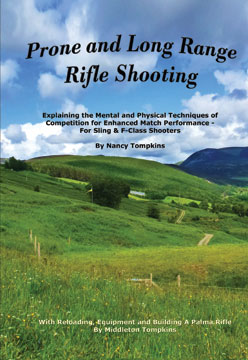
Nancy Tompkins is one of the greatest long-range shooters in American history. She has won five National Long-range Championships. Tompkins’ treatise is a must-read for serious Palma, F-Class, and High Power shooters. The revised Second edition includes F-Class equipment and techniques, and newly updated information. Color pictures. Topics include Mental & Physical training, Reading Wind & Mirage Shooting Fundamentals, International Competition, and Loading for Long Range. Nancy Tompkins is a 4-time winner of the National Long Range Championships, and has won countless other major events. Nancy has been on six Palma Teams (as both a shooter and a coach).
Ryan Cleckner is noted for his ability to explain complex topics in an easy-to-comprehend manner. Now Cleckner has authored a book, the Long Range Shooting Handbook, which expands on the topics covered in Cleckner’s popular NSSF video series. The Long Range Shooting Handbook is divided into three main categories: What It Is/How It Works, Fundamentals, and How to Use It. “What It Is/How It Works” covers equipment, terminology, and basic principles. “Fundamentals” covers the theory of long range shooting. “How to Use It” gives practical advice on implementing what you’ve learned, so you can progress as a skilled, long range shooter. You can view Sample Chapters from Ryan’s Book on Amazon.com.
Tony Boyer, the most successful shooter in the history of short-range benchrest competition, shares many of his match-winning tips in this 323-page book. The book covers all aspect of the benchrest discipline: loading, windflags, rest set-up, addressing the rifle, and match strategies. This is a high-quality publication, filled with valuable insights. Every serious benchrest shooter should read Tony’s book. Boyer has dominated registered benchrest in a fashion that will never be duplicated, having amassed 142 U.S. Benchrest Hall of Fame points. The next closest shooter, Allie Euber, has 47 Hall of Fame points. This handsome, full-color book is 323 pages long, with color photos or color illustrations on nearly every page.
This book by 11-time National High Power Champion David Tubb focuses on position shooting and High Power disciplines. Section One covers fundamentals: position points, natural point of aim, breathing, triggering mechanics and follow-through, sling selection and use, getting started, getting better, avoiding obstacles. Section Two covers mechanics of offhand, sitting, and prone positions. Section Three covers shooting skills, including wind reading and mental preparation. Section Four covers the technical side of shooting, with extensive disuctions of rifle design, load development, reloading barrel maintenance, and rifle fitting. We consider this book a “must-read” for any sling shooter, and there is plenty of good advice for F-Class shooters too.
Bullseye Mind (Mental Toughness for Sport Shooting) by Dr. Raymond Prior, $17.95 (Softcover).
Having a Bullseye Mind means thinking in ways that create confidence and consistency, even under pressure. A “must-read” for competitive shooters, Bullseye Mind is a mental training book written specifically for the shooting sports. The book is well-organized, with handy highlighted lists and key “talking points”. Each chapter concludes with examples from a world-class shooters such as: Matt Emmons, 2004 Olympic Gold Medalist; Vincent Hancock, 2-time Olympic Gold Medalist; Jamie Corkish, 2012 Olympic Gold Medalist; Petra Zublasing, 2014 World Champion/ISSF Shooter of the Year; and Nicco Campriani, 2012 Olympic Gold Medalist, 2010 World Champion. This book has earned rave reviews from competitive shooters who found it really helped their “Mental Game”. One recent purchaser states: “This book is as though you had a coach in your back pocket…”
Many of our Forum members have recommended The Wind Book for Rifle Shooters by Linda Miller and Keith Cunningham. This 146-page book, published in 2007, is a very informative resource. But you don’t have to take our word for it. If you click this link, you can read book excerpts on Amazon.com. This lets you preview the first few chapters, and see some illustrations. Other books cover wind reading in a broader discussion of ballistics or long-range shooting. But the Miller & Cunningham book is ALL about wind reading from cover to cover, and that is its strength. The book focuses on real world skills that can help you accurately gauge wind angle, wind velocity, and wind cycles.
Steven Boelter’s 352-page book is a comprehensive study of all types of rimfire ammunition (including 17s and 22 mags), with over 600 photos. In a remarkable undertaking, Steven Boelter fired every brand and sample of rimfire ammo he could acquire (including .22 LR, 17 Mach 2, 17 HMR and .22 WMR), and recorded all the results. In all, Steven tested 11 brands and 137 different rimfire rounds, firing over 32,000 test rounds.
Nosler recently introduced a new series of high-BC bullets with factory-closed meplats. Bryan Litz’s team at Applied Ballistics is now testing these new Reduced Drag Factor (RDF) projectiles to determine their performance — and specifically to see if the BCs are as high as claimed. Nosler bullet testing is underway this week and Litz hopes to bring the results to the Applied Ballistics Seminar in North Carolina later this week (November 3-4, 2016).
Applied Ballistics Seminar Fall 2016: November 3 – 4, 2016 – Caraway Conference Center
4756 Caraway Mountain Road Sophia, NC 27350; Phone: (336) 629-2374. Seminar Sign-Up.
Bryan notes: “If you live in the Southeast region, this is the last seminar for you for at least a year, possibly longer. We will most likely do the next seminars in regions not yet visited.”
Applied Ballistics Library Update
Bryan Litz is hard at work testing new projectiles: “We are currently in the middle of testing all these new offerings that have recently come out. In fact, the lab is up and running today, with some of the new Nosler RDFs going down range. Bullet measurements have been taken with our state-of-the-art digital comparator which is accurate to within 0.0001″. For example, shown below are the measured dimensions for the new Nosler RDF .308 175 grain projectile. For these new bullets, we will not only have complete BC measurements accurate to ± 1%, but we will have Custom Drag Models (CDMs) coming as well.”
New Data Coming Soon
Bryan hopes to present the new Nosler data at the Seminar this week in North Carolina. In addition, Bryan is developing information for the Hornady ELD bullets, G9 Competition Series solid bullets, some new Sierras, and some other projectiles not currently in the library: “Once we complete testing on all these new offerings, we will then compile the library for the next library update (which will be done across all platforms). We want to make sure that none of these new offerings are left out. For those who want to see some of the early results, come join us at this final seminar of 2016!”
Custom Drag Models
Applied Ballistics has been providing custom drag models for use in trajectory prediction for the past several years. Custom Drag Models (CDMs) for bullets are a more refined way of modeling drag for bullets because you’re not referencing a standard like G1 or G7, rather you’re using the actual measured drag of a specific bullet in a ballistic solver. This results in more accurate trajectory predictions, especially through transonic.
PrecisionRifleBlog.com recently reviewed several video-based rifle training DVD sets. While instructional DVDs will never replace live “hands-on” training, they can be cost-effective ways to sharpen your skills. Watched periodically, these training DVDs can help reinforce the fundamentals.
PRB’s Editor Cal Zant has purchased several rifle training DVDs over the years. His recent Precision Rifle Blog DVD review looks at four different options:
Long Range Made Easy, Two-Volume Set, from Accuracy 1st The Art Of The Precision Rifle, with Todd Hodnett (Magpul Dynamics) Putting Rounds On Target, with Bryan Litz (Applied Ballistics) Rifles Only — Precision Rifle Instructional DVDs, with Jacob Bynum
Cal reports that each of these four titles offers a slightly different approach, with each instructor displaying his own focus, based on his background and expertise.
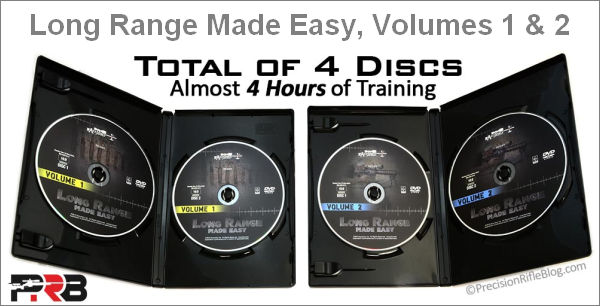
Accuracy 1st’s Long Range Made Easy Two-Volume Set seemed to win PRB’s Editor’s Choice Award. The tagline on the DVD is: “Go from basic to advanced with the guy that has trained our best military snipers for the past 10 years.” That’s a pretty good description. Todd Hodnett is the primary instructor, and Bryan Litz joins him in several segments.
It’s the best of both worlds. Todd Hodnett’s pragmatic “the-bullet-cannot-lie” approach (field-proven by hundreds of the world’s best snipers), is combined with Bryan Litz’s engineering approach and vast knowledge of external ballistics verified with carefully recorded live-fire experiments. The two styles complement each other well, and provide an extremely well-rounded and comprehensive overview.
The DVD set is split into two volumes, each of which includes two discs. All together there are almost four hours of instruction from the most respected guys in the industry. And they cover a lot of ground — you’d never be able to cover this much in a one- or two-day live class. Plus with the DVD you can easily repeat an important point, and watch the whole program more than once.
Cal paid $76.95 out-of-pocket for the Long Range Made Easy, Vol. 1 & 2 Bundle, so his review wasn’t a paid advertisement. He thought this set provides a ton of value, and could help a lot of shooters. Here are key topics covered in Long Range Made Easy:
■ Advice for Gear Purchases
■ Optimal Gun Setup
■ Technique for Position
■ Simple & Quick Wind Formula
■ Using the Applied Ballistics Kestrel
■ Truing Ballistic Algorithms, Drag Scale Factoring, and Custom Drag Models
■ WEZ Analysis
■ Wind Course
If you’re new to the long range game, or you’ve been doing it for a few years and want to learn directly from some of the most sought-after instructors in the world, then check out Cal’s write-up over at PrecisionRifleBlog.com. CLICK HERE for PRB Review of Training DVDs.
On the heels of the announcement that Berger Bullets will join the Nammo group, the following information was posted on the Long Range Hunting Forum by Doc Beech of Applied Ballistics:
I would like to emphasize a couple of things before you read on. The [acquisition of Berger Bullets by Nammo] CHANGES NOTHING. Production will remain in the same facility, by the same people, to the same quality. Berger Bullets will remain the highest-quality bullets on the market. What this merger does, is it gives these companies [the opportunity] to work together, to provide the highest-quality ammunition.
Lapua is well known for its high-quality brass, VihtaVuori makes high-quality powder, and Berger makes high-quality bullets. When you put the three together, you have the possibility of unmatched, premium … factory ammunition. To be clear, this will not affect the quality or way that Berger bullets are produced.
Q & A about Berger Bullets Joining Nammo Group
Q. What are Nammo’s plans concerning Berger Bullets?
A. Nammo plans on operating Berger Bullets as a stand-alone brand with support from the Nammo Group in a number of areas. First, they would like to help Berger improve the availability of many of their bullets that are in high demand.
Q. Are you going to eliminate any specific bullets? In other words, do they need to stock up!
A. We have no immediate plans to discontinue any of our bullets. We will continue as a part of our normal business practice to discontinue bullets that have been replaced by a superior product or those that do not have a demand sufficient to warrant allocating time in our production schedule. This is just what we have always done as part of our process.
Q. Is Bryan Litz still going to be the ballistician for Berger Bullets?
A. Yes. Bryan is an important part of the Berger Bullet team and our plans definitely include keeping Bryan on as our lead ballistician.
Q. Is Eric Stecker going to remain in charge of Berger Bullets?
A. Eric Stecker will continue as President of Berger Bullets
Q. Are the same dealers going to carry Berger Bullets?
A. Yes, we have no plans to change the way we distribute Berger Bullets to the shooting community.
Q. Does this mean ABM Ammo will have direct access to components like powder and brass?
A. Yes.
__________________
Doc Beech – Applied Ballistics
doc.beech@appliedballisticsllc.com
www.abmediaresources.com – www.appliedballisticsllc.com


 Verifying Scope Level With Tall Target Test


 With the