Bryan Litz, 2016 F-TR National Mid-Range Champion, tried his hand at a new discipline recently — tactical shooting. Bryan competed in the Guardian Match, a PRS-type competition hosted by the Marksmanship Training Center in Lake City, Michigan. Though the course of fire was new to Bryan, he did very well indeed, finishing second overall in his first-ever Tactical Match.
Bryan said PRS-type tactical shooting is “totally different” than F-TR competition: “I think the biggest difference (from F-TR) are the time constraints. The time pressure’s totally different. We had just 25 seconds to do one short-range stage, and other stages are 90 seconds, 120 seconds….”
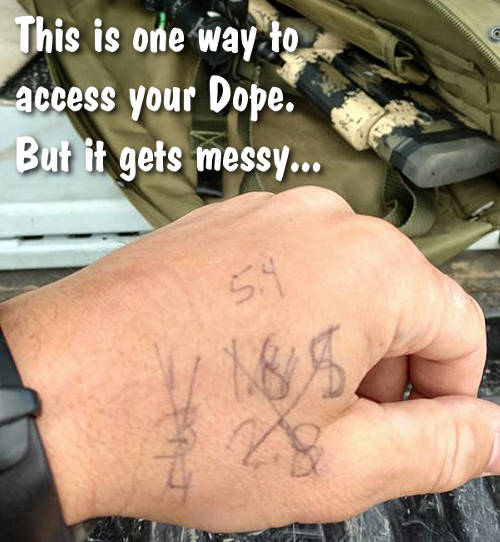
Bryan added: “You’ve got to know your dope for the first shot — no sighters. F-TR is more deliberate, precision-based. This [tactical game] is about accuracy to be sure, but there’s even athleticism — if you’re not flexible, you’re just straight up not going to be able to aim at some of these targets.”
Bryan, who first achieved great success in sling-shooting disciplines, said that tactical matches, with their multiple “on the clock” stages, offer new challenges: “This was a way different experience than I’m used to, mostly due to time pressure and awkward shooting positions. But I enjoyed the problem- solving element. Fellow shooters were very helpful and generous with advice.” Posting on Facebook, former USAMU coach Emil Praslick offered this sarcastic advice: “You need more Velcro and camouflage. That is what is preventing you from winning.”
During his match Brian shot in multiple locations, with a variety of target types, including steel and IPSC movers. There were some unusual challenges including a “Tree-Stand Hunter” stage, and a stage that required moving “Around, Over, and Under a Vehicle” as you can see…
Before the match, Bryan practiced from a tripod, but he wasn’t sure about the best technique: “Seriously, what kind of groups are considered ‘good’ from a position like this? Does 2 MOA suck?” Here’s the recommended technique (from Gunny N.): “Anchor the sling to the front of the rifle but not the back. Wrap sling around leg or center post of the tripod. Place your off hand on the wrap and twist it to tighten up. That will apply down pressure on the forearm. Your shoulder will apply down pressure on butt stock. You’ll tighten groups 25-50%.”
Ballistics Guru Bryan Litz needed all of his wind-reading skills in Lodi, WI. Conditions were challenging!
Bryan Litz of Applied Ballistics won his second straight Mid-Range F-TR National Championship this past weekend. Likewise the Michigan F-TR Team won its second Championship in a row. So it was a heck of a showing by the Michiganders overall. With a strong individual performance, Phil Kelley finished second with his fellow X-Men teammate James Crofts in third. The X-Men Team also garnered second-place in the F-TR Team event. Kelley told us: “It sure is fun to compete with the best in the business — to share the individual overall podium with Bryan Litz and James Crofts is an exciting honor.”
It was a bit cold in Lodi, Wisconsin, photo by K. McSparron.
F-Class Goes High-Tech with Electronic Targets
This was the first-ever F-Class National Championship that used electronic Targets. Litz offers his perspective on the new E-Targets in the Q&A section below — Bryan is mostly positive about the E-Targets but he says there are still some minor bugs to be worked out.
Bryan, a sling-shooter at heart, has really taken to this F-TR game. He won both the Mid-Range and Long Range F-TR National Championships in 2015 and now he has one 2016 title in the bag. Bryan tells us: “Many thanks go out to all those who’ve supported me in winning my second F-TR Mid-Range National Championship. My serious pursuit of F-TR shooting began the day I called John Pierce and requested: ‘John, build me one like yours’. That rifle and others built by Pierce Engineering are at the top of the game. Thanks also to my many great team-mates on the Michigan and U.S. Rifle Teams who have taught me a lot about this sport. As always the competition was stiff and mother nature gave us some drastically different looks. The challenging weather, combined with the introduction of electronic targets to this sport at the national level, required shooters to be highly adaptable. Thanks to the match organizers and technical staff who did a great job.”
John Pierce (left) and Bryan Litz with his Championship-winning Pierce-built F-TR rifle (2014 photo).
Litz Loads Vihtavuori N140 with 215gr Berger Hybrids in his .308 Win
Bryan told us: “Load data is always a common question and I keep no secrets –I’m running the same basic load I shot the past few years with the exception that I’m now burning 43.0 grains of Vihtavuori N140 instead of Hodgdon Varget in new Lapua brass with Fed 210M primers and 215 Berger Hybrids seated about 0.005″ off the riflings. This gets 2520 fps in a 28-inch barrel. I use this same load for both mid-range and long range.”
Team Competition — Michigan Wins F-TR Division with X-Men in Second
Michigan F-TR Team won its second consecutive Mid-Range National Championship. Congratulations to team-mates Al Barnhart, Doug Boyer, Bryan Litz, and John Roethlisberger. Al and Doug are experienced veterans but this is John’s first experience in a national-level event. Michigan actually fielded two teams in this event and the second squad also won a medal in one of the matches. Byran Litz noted that the Michigan F-TR Team “has been working hard to develop our shooters and many have made it onto the U.S. Rifle Team. We have many great sponsors including: Applied Ballistics, Berger Bullets, Bartlein Barrels, Marksmanship Training Center, Nightforce Optics, Pierce Engineering, and Vihtavuori Powder.” Bryan added: “I also thank Team X-Men for the spirited competition. You guys (James Crofts, Tracy Hogg, Phil Kelly, Ian Klemm, and Ken Klemm) are great and make these team matches very fun.”
Bryan Litz with Michigan F-TR team-mates Al Barnhart, John Roethlisberger, and Doug Boyer.
Q & A with the Champ — Litz Talks Targets and Match Strategies
We asked Bryan how the new Electronic Target technology used in Lodi alters the F-Class game. As the Long Range Nationals are underway now, we also asked Bryan to comment on Mid-Range vs. Long Range strategies — what does he do different at 1000 yards vs. 600 yards.
1. How did you like the electronic targets? Did this require/allow a change in your shooting style or rhythm (e.g. can competitors shoot faster now with less wait time between shots)?
LITZ: I really like the E-Targets for many reasons. Not pulling pits is the biggest one but the E-Targets also bring a level of fairness that human pullers could never achieve in the sense that everyone gets the same speed ‘service’.
For the 2016 FCNC in Lodi, WI, all the targets are programmed with a 7-second delay which is equivalent to “very good” target service. The system actually shows your shot value immediately, but doesn’t plot the location of the shot for 7 seconds. So if you want to “machine gun” a shot following an X with the same hold, you can take your chances without knowing where the X was.
The E-Targets require some adaptation from regular pit service. For those with many years of experience on traditional targets, it’s just WEIRD that the target doesn’t go up and down or have a spotter in it. All the information you need is on the tablet. This isn’t better or worse, just different. Occasionally the tablets lose signal for a few seconds and it can be frustrating, but this is not different than when a puller missed a shot and you had to “call for a mark”. I think that very soon the connectivity issues will be fully resolved and the systems will operate flawlessly. I know it would be impossible to get all the shooters through on such a small range any other way. The E-Targets have enabled a medium-sized range like Lodi to host a National Championship.
Q: How is the mid-range F-TR game different than long-range F-TR competition?
LITZ: Usually Mid-Range is about consistent precision — not having any fliers and not dropping any points. Mid-Range matches are usually decided by a narrower point spread than long range. Conditions aren’t typically big enough to move you out of the 10 ring very much at mid-range. The first couple days of the 2016 Mid-Range Nationals was just like this. I won the first two days, dropping only 3 points in total. But then the wind picked up on Day 3 and it was totally different! It became more like a Long Range match with all the points falling like rain and [conditions] very difficult to read. Many more 8s and 7s appeared at 600 yards and the field really spread out. In the end I was able to hold onto my lead and win the tournament.
Q. Why the change to Vihtavuori N140 powder? Was it more available or were you seeing lower ES/SD?
LITZ: I’m seeing the same ES/SDs with VV N140 as what I was using before (Varget) and N140 may burn a little cleaner. Also availability has been improving on the Vihtavuori powders in recent years. We (the Michigan F-TR Rifle Team) are very fortunate to have Vihtavuori as a sponsor and look forward to winning many matches with Vihtavuori products.
Editor’s Note: If any readers have results for the F-Open Mid-Range Nationals, please post in the comments section below and we will update this story.
Today is practice day for the Mid-Range F-Class Nationals, which commence bright and early tomorrow morning in Lodi, Wisconsin. In any shooting competition, you must try to avoid major screw-ups that can ruin your day (or your match). In this article, reigning F-TR National Mid-Range and Long Range Champion Bryan Litz talks about “Train Wrecks”, i.e. those big disasters (such as equipment failures) that can ruin a whole match. Bryan illustrates the types of “train wrecks” that commonly befall competitors, and he explains how to avoid these “unmitigated disasters”.
Urban Dictionary “Train Wreck” Definition: “A total @#$&! disaster … the kind that makes you want to shake your head.”
Success in long range competition depends on many things. Those who aspire to be competitive are usually detail-oriented, and focused on all the small things that might give them an edge. Unfortunately it’s common for shooters lose sight of the big picture — missing the forest for the trees, so to speak.
Consistency is one of the universal principles of successful shooting. The tournament champion is the shooter with the highest average performance over several days, often times not winning a single match. While you can win tournaments without an isolated stellar performance, you cannot win tournaments if you have a single train wreck performance. And this is why it’s important for the detail-oriented shooter to keep an eye out for potential “big picture” problems that can derail the train of success!
Train wrecks can be defined differently by shooters of various skill levels and categories. Anything from problems causing a miss, to problems causing a 3/4-MOA shift in wind zero can manifest as a train wreck, depending on the kind of shooting you’re doing.
Below is a list of common Shooting Match Train Wrecks, and suggestions for avoiding them.
1. Cross-Firing. The fastest and most common way to destroy your score (and any hopes of winning a tournament) is to cross-fire. The cure is obviously basic awareness of your target number on each shot, but you can stack the odds in your favor if you’re smart. For sling shooters, establish your Natural Point of Aim (NPA) and monitor that it doesn’t shift during your course of fire. If you’re doing this right, you’ll always come back on your target naturally, without deliberately checking each time. You should be doing this anyway, but avoiding cross-fires is another incentive for monitoring this important fundamental. In F-Class shooting, pay attention to how the rifle recoils, and where the crosshairs settle. If the crosshairs always settle to the right, either make an adjustment to your bipod, hold, or simply make sure to move back each shot. Also consider your scope. Running super high magnification can leave the number board out of the scope’s field view. That can really increase the risk of cross-firing.
2. Equipment Failure. There are a wide variety of equipment failures you may encounter at a match, from loose sight fasteners, to broken bipods, to high-round-count barrels that that suddenly “go south” (just to mention a few possibilities). Mechanical components can and do fail. The best policy is to put some thought into what the critical failure points are, monitor wear of these parts, and have spares ready. This is where an ounce of prevention can prevent a ton of train wreck. On this note, if you like running hot loads, consider whether that extra 20 fps is worth blowing up a bullet (10 points), sticking a bolt (DNF), or worse yet, causing injury to yourself or someone nearby.
[Editor’s Note: The 2016 F-Class Nationals will employ electronic targets so conventional pit duties won’t be required. However, the following advice does apply for matches with conventional targets.]
3. Scoring/Pit Malfunction. Although not related to your shooting technique, doing things to insure you get at least fair treatment from your scorer and pit puller is a good idea. Try to meet the others on your target so they can associate a face with the shooter for whom they’re pulling. If you learn your scorer is a Democrat, it’s probably best not to tell Obama jokes before you go for record. If your pit puller is elderly, it may be unwise to shoot very rapidly and risk a shot being missed (by the pit worker), or having to call for a mark. Slowing down a second or two between shots might prevent a 5-minute delay and possibly an undeserved miss.
4. Wind Issues. Tricky winds derail many trains. A lot can be written about wind strategies, but here’s a simple tip about how to take the edge off a worse case scenario. You don’t have to start blazing away on the command of “Commence fire”. If the wind is blowing like a bastard when your time starts, just wait! You’re allotted 30 minutes to fire your string in long range slow fire. With average pit service, it might take you 10 minutes if you hustle, less in F-Class. Point being, you have about three times longer than you need. So let everyone else shoot through the storm and look for a window (or windows) of time which are not so adverse. Of course this is a risk, conditions might get worse if you wait. This is where judgment comes in. Just know you have options for managing time and keep an eye on the clock. Saving rounds in a slow fire match is a costly and embarrassing train wreck.
5. Mind Your Physical Health. While traveling for shooting matches, most shooters break their normal patterns of diet, sleep, alcohol consumption, etc. These disruptions to the norm can have detrimental effects on your body and your ability to shoot and even think clearly. If you’re used to an indoor job and eating salads in air-conditioned break rooms and you travel to a week-long rifle match which keeps you on your feet all day in 90-degree heat and high humidity, while eating greasy restaurant food, drinking beer and getting little sleep, then you might as well plan on daily train wrecks. If the match is four hours away, rather than leaving at 3:00 am and drinking five cups of coffee on the morning drive, arrive the night before and get a good night’s sleep.”
Keep focused on the important stuff. You never want to lose sight of the big picture. Keep the important, common sense things in mind as well as the minutia of meplat trimming, weighing powder to the kernel, and cleaning your barrel ’til it’s squeaky clean. Remember, all the little enhancements can’t make up for one big train wreck!
Why You CANNOT Rely on the MV Printed on the Ammo Box!
When figuring out your come-ups with a ballistics solver or drop chart it’s “mission critical” to have an accurate muzzle velocity (MV). When shooting factory ammo, it’s tempting to use the manufacturer-provided MV which may be printed on the package. That’s not such a great idea says Bryan Litz of Applied Ballistics. Don’t rely on the MV on the box, Bryan advises — you should take out your chrono and run your own velocity tests. There are a number of reasons why the MV values on ammo packaging may be inaccurate. Below is a discussion of factory ammo MV from the Applied Ballistics Facebook Page.
Five Reasons You Cannot Trust the Velocity on a Box of Ammo:
1. You have no idea about the rifle used for the MV test.
2. You have no idea what atmospheric conditions were during testing, and yes it matters a lot.
3. You have no idea of the SD for the factory ammo, and how the manufacturer derived the MV from that SD. (Marketing plays a role here).
4. You have no idea of the precision and quality of chronograph(s) used for velocity testing.
5. You have no idea if the manufacturer used the raw velocity, or back-calculated the MV. The BC used to back track that data is also unknown.
1. The factory test rifle and your rifle are not the same. Aside from having a different chamber, and possibly barrel length some other things are important too like the barrel twist rate, and how much wear was in the barrel. Was it just recently cleaned, has it ever been cleaned? You simply don’t know anything about the rifle used in testing.
2. Temperature and Humidity conditions may be quite different (than during testing). Temperature has a physical effect on powder, which changes how it burns. Couple this with the fact that different powders can vary in temp-stability quite a bit. You just don’t know what the conditions at the time of testing were. Also a lot of factory ammunition is loaded with powder that is meter friendly. Meter friendly can often times be ball powder, which is less temperature stable than stick powder often times.
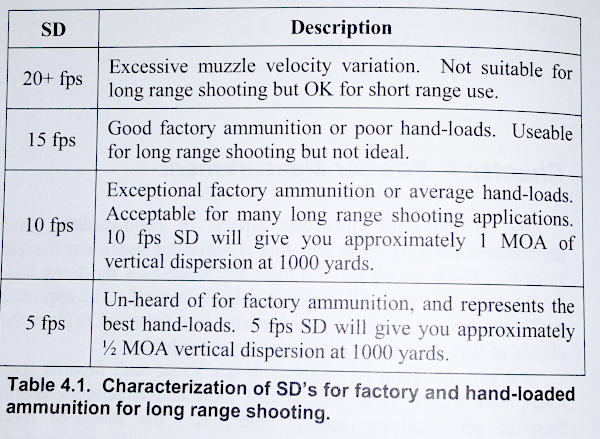
3. The ammo’s Standard Deviation (SD) is unknown. You will often notice that while MV is often listed on ammo packages, Standard Deviation (normally) is not. It is not uncommon for factory ammunition to have an SD of 18 or higher. Sometimes as high as 40+. As such is the nature of metering powder. With marketing in mind, did they pick the high, low, or average end of the SD? We really don’t know. You won’t either until you test it for yourself. For hand-loaded ammo, to be considered around 10 fps or less. Having a high SD is often the nature of metered powder and factory loads. The image below is from Modern Advancements in Long Range Shooting: Volume II.
4. You don’t know how MV was measured. What chronograph system did the manufacturer use, and how did they back track to a muzzle velocity? A chronograph does not measure true velocity at the muzzle; it simply measures velocity at the location it is sitting. So you need to back-calculate the distance from the chrono to the end of the barrel. This calculation requires a semi-accurate BC. So whose BC was used to back track to the muzzle or did the manufacturer even do that? Did they simply print the numbers displayed by the chronograph? What kind of chronograph setup did they use? We know from our Lab Testing that not all chronographs are created equal. Without knowing what chronograph was used, you have no idea the quality of the measurement. See: Applied Ballistics Chronograph Chapter Excerpt.
5. The MV data may not be current. Does the manufacturer update that data for every lot? Or is it the same data from years ago? Some manufacturers rarely if ever re-test and update information. Some update it every lot (ABM Ammo is actually tested every single lot for 1% consistency). Without knowing this information, you could be using data for years ago.
CONCLUSION: Never use the printed MV off a box of ammo as anything more than a starting point, there are too many factors to account for. You must always either test for the MV with a chronograph, or use carefully obtained, live fire data. When you are using a Ballistic Solver such as the AB Apps or Devices integrated with AB, you need to know the MV to an accuracy down to 5 fps. The more reliable the MV number, the better your ballistics solutions.
Many of the world’s best F-Class shooters have traveled to Ottawa, Ontario, Canada this week to compete at the Canadian F-Class National Championships. F-Open ace Shiraz Balolia, who won back-to-back Canadian F-Open Championships in 2015 and 2014, will pursue a “three-peat” at Canada’s Connaught Ranges. There will be plenty of F-TR talent on hand as well, including Bryan Litz, reigning U.S. Mid-Range and Long-Range F-TR Champion. The first challenge for the shooters will be the weather, which can be notoriously wet and windy at Connaught. The weather forecast looks good for today and tomorrow, but thunderstorms (and rain) are predicted for Friday and Saturday.
U.S. F-TR Rifle Team Prepares for the Canadian Championships:
Shown above is the U.S. F-TR Rifle Team, which will compete in the F-TR division. In the America Match, teams from Canada, South Africa, and the United States will battle head-to-head for national honors.
Many Companies Help Sponsor U.S. F-TR Rifle Team
It takes significant resources to field a large shooting team in international competition. The U.S. F-TR Rifle team is fortunate to have many great sponsors helping the team with equipment and financial support. The team’s top-level “Gold Medal” sponsors, are, in alphabetical order: Berger Bullets, Gemtech, Kelbly’s, McMillan Fiberglass Stocks, Nightforce Optics, Pierce Engineering, and 5.11 Tactical. CLICK HERE for a list of all sponsors.
In this video, Bryan Litz of Applied Ballistics talks about Density Altitude and the effect of atmospheric conditions on bullet flight. Bryan explains why you must accurately account for Density Altitude when figuring long-range trajectories.
Bryan tells us: “One of the important elements in calculating a fire solution for long-range shooting is understanding the effect of atmospherics. Temperature, pressure, and humidity all affect the air density that the bullet’s flying through. You can combine all those effects into one number (value) called ‘Density Altitude’. That means that you just have one number to track instead of three. But, ultimately, what you are doing is that you are describing to your ballistics solver the characteristics of the atmosphere that your bullet’s flying through so that the software can make the necessary adjustments and account for it in its calculations for drop and wind drift.”
Bryan adds: “Once you get past 500 or 600 yards you really need to start paying careful attention to atmospherics and account for them in your ballistic solutions”. You can learn more about Density Altitude in Bryan’s book, Applied Ballistics for Long Range Shooting (Third Edition).
General Scientific Definition of Density Altitude
Density altitude is the altitude relative to the standard atmosphere conditions (ISA) at which the air density would be equal to the indicated air density at the place of observation. Density altitude can be calculated from atmospheric pressure and temperature (assuming dry air). Here is the formula:
Air is more dense at lower elevations primarily because of gravity: “As gravity pulls the air towards the ground, [lower] molecules are subject to the additional weight of all the molecules above. This additional weight means the air pressure is highest at sea level, and diminishes with increases in elevation”.*
Both an increase in temperature, decrease in atmospheric pressure, and, to a much lesser degree, increase in humidity will cause an increase in density altitude. In hot and humid conditions, the density altitude at a particular location may be significantly higher than the true altitude.
In this video, Bryan Litz of Applied Ballistics explains how to choose a bullet for long-range shooting and explains what you should be looking for when developing a long-range load. Bryan notes that, with a new rifle build, the bullet you select may actually dictate your gun components. When starting from a “clean slate”, once you select a bullet, you will then pick a barrel, twist rate, and cartridge that are appropriate for that bullet. In choosing a long-range projectile, Bryan recommends you choose a high-BC bullet “that is known for precision”. Then you need to find an ultra-consistent, reliable load.
This video is worth watching. Bryan Litz makes some very good points.
Load Development — Why Consistency is Key (and Half-MOA May Be Good Enough)
After choosing a bullet for your long-range project, then you need to develop a load through testing. Bryan explains: “Once you’ve selected a bullet … and you have selected the components around that bullet, the most important thing to remember in hand-loading is consistency. You’re going to do some testing to see what combination of powder charge, powder type, and seating depth give you the best groups and lowest standard deviations in muzzle velocity.”
Bryan says that if you develop a load that can shoot consistent, half-minute groups in all conditions, you should be satisfied. Bryan says that many long-range shooters “spin their wheels” trying to achieve a quarter-MOA load. Often they give up and start all over with a new bullet, new powder, and even a new cartridge type. That wastes time, money, and energy.
Bryan cautions: “My advice for hand-loaders who are long-range shooters, is this: If you can get a load that is reliable and can shoot consistent, half-minute groups with low MV variation and you can shoot that load in any condition and it will work well, then STICK with THAT LOAD. Then focus on practicing, focus on the fundamentals of marksmanship. The consistency you develop over time by using the same ammunition will mean more to your success in long range shooting than refining a half-minute load down to a quarter-minute load.”
Bryan notes that, at very long range, shooting skills and wind-calling abilities count most: “Your ability to hit a 10″ target at 1000 yards doesn’t improve very much if you can make your rifle group a quarter-minute vs. a half a minute. What’s going to determine your hit percentage on a target like that is how well you can calculate an accurate firing solution and center your group on that target. A lot of people would be more effective if they focused on the fire solution and accurately centering the group on the target [rather than attempting to achieve smaller groups through continuous load development].”
Editor’s Note: We agree 100% with the points Bryan makes in this video. However, for certain disciplines, such as 600-yard benchrest, you WILL need a sub-half-MOA rifle to be competitive at major matches. Well-tuned, modern 600-yard benchrest rigs can shoot 1/4-MOA or better at 100 yards. Thankfully, with the powder, bullets, and barrels available now, 1/4-MOA precision (in good, stable conditions) is achievable with a 17-lb benchgun built by a good smith with premium components.
Berger Twist-Rate Stability Calculator
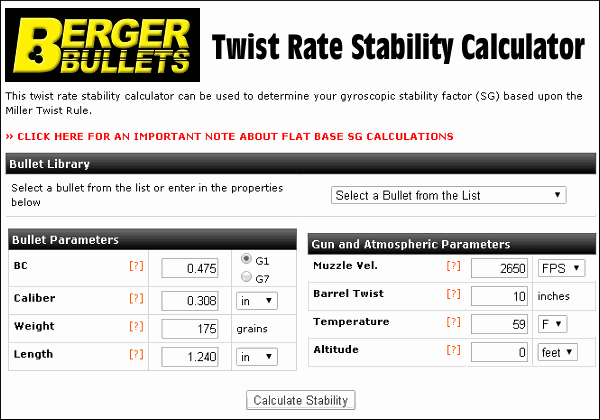
On the Berger Bullets website you’ll find a handy Twist-Rate Stability Calculator that predicts your gyroscopic stability factor (SG) based on mulitiple variables: velocity, bullet length, bullet weight, barrel twist rate, ambient temperature, and altitude. This cool tool tells you if your chosen bullet will really stabilize in your barrel.
How to Use Berger’s Twist Rate Calculator
Using the Twist Rate Calculator is simple. Just enter the bullet DIAMETER (e.g. .264), bullet WEIGHT (in grains), and bullet overall LENGTH (in inches). On its website, Berger conveniently provides this info for all its bullet types. For other brands, we suggest you weigh three examples of your chosen bullet, and also measure the length on three samples. Then use the average weight and length of the three. To calculate bullet stability, simply enter your bullet data (along with observed Muzzle Velocity, outside Temperature, and Altitude) and click “Calculate SG”. Try different twist rate numbers (and recalculate) until you get an SG value of 1.4 (or higher).
Gyroscopic Stability (SG) and Twist Rate
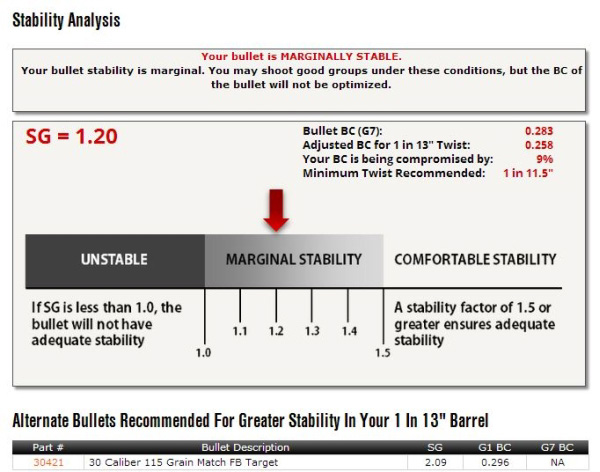
Berger’s Twist Rate Calculator provides a predicted stability value called “SG” (for “Gyroscopic Stability”). This indicates the Gyroscopic Stability applied to the bullet by spin. This number is derived from the basic equation: SG = (rigidity of the spinning mass)/(overturning aerodynamic torque).
If you have an SG under 1.0, your bullet is predicted not to stabilize. If you have between 1.0 and 1.1 SG, your bullet may or may not stabilize. If you have an SG greater than 1.1, your bullet should stabilize under optimal conditions, but stabilization might not be adequate when temperature, altitude, or other variables are less-than-optimal. That’s why Berger normally recommends at least 1.5 SG to get out of the “Marginal Stability” zone.
In his book Applied Ballistics For Long-Range Shooting, Bryan Litz (Berger Ballistician) recommends at least a 1.4 SG rating when selecting a barrel twist for a particular bullet. This gives you a safety margin for shooting under various conditions, such as higher or lower altitudes or temperatures.
Story idea from EdLongrange. We welcome reader submissions.
Extreme Long Range — 2477 Yards
Notably, two Applied Ballistics team shooters made hits at 2477 yards. Just how far is that? Take a look at the photo above — that shows the location of the 2477-yard target with the firing line in the far distance. Now THAT is truly long range!
By Paul Phillips
I wanted to share a video that I made. This was from the King of 2 Miles event held recently in Raton, New Mexico. I was fortunate enough to be apart of an amazing team with Bryan Litz and Mitchell Fitzpatrick. We had some awesome sponsors: Berger Bullets, Nightforce Optics, McMillan Group International, Lethal Precision Arms LLC and Applied Ballistics LLC. Team Applied Ballistics took First, Second, and Fourth places out of 38 teams in this competition. Our Team highlight was working together to make first-round hits on a 24×36 inch plate at 1.4 miles. With me as coach, both Mitchell and Bryan made their first-round hits at 1.4 miles (2477 yards to be exact).
Video Shows Team Accomplishing Hits at 2477 Yards in Raton, NM
This event has been a personal goal of mine for a long time and I wanted to thank Bryan Litz and Mitchell Fitzpatrick for having me on the team. I call them quiet professionals. I also wanted to thank Kelly McMillan for sponsoring our team and being involved. Kelly has been an amazing sponsor and advocate for shooting sports and providing stocks and rifles for our military snipers for the past 40 years. I can’t forget to thank Ian Klemm for loaning me his Vortex Spotting scope with the MOA milling reticle. It worked great and was very fast to make corrections along with good glass.
Mitchell Fitzpatrick won the KO2M finals to earn the title “King of Two Miles”. He had a dominant performance shooting a .375 Lethal Precision Arms LLC rifle loaded with prototype solid 400gr Berger bullets. Mitchell built this rifle himself using a McMillan A5 Super Mag stock. Note: Berger has no current plans to market this .375-caliber bullet — it is still in the prototype stage.
Editor: Paul Phillips asked to make a special dedication, remembering a family member: “My brother Daniel Phillips passed away with brain cancer last year and this event was one that he wanted to video for me. I know he is smiling in heaven.”
Applied Ballistics team dominates the King of 2 Miles match: Mitchell Fitzpatrick (1st Place), Bryan Litz (2nd Place), and Paul Phillips (4th Place).
The King of 2 Miles event has come to an end, the scores have been tallied, and Team Applied Ballistics finished first, second, and fourth. That’s dominance. The “Top Gun” was young Mitchell Fitzpatrick, who blitzed the field with his impressive .375 Lethal Precision Arms LLC rifle shooting prototype solid 400gr Berger bullets. Mitchell built this rifle himself using a McMillan A5 Super Mag stock. Remarkably, Mitchell nailed first- and second-shot hits at the 2477-yard target, a full 1.4 miles away. That’s amazing shooting. The photo below illustrates the vast distance from firing line to target.
Mitchell gave credit to his team-mates: “We had the best ballistic solutions possible thanks to the work done at Applied Ballistics LLC by the one and only Bryan Litz. Bryan is also a world-class wind coach and world champion shooter. Paul Phillips, also a world-class wind coach, world champion shooter, and just an all-around class act. Paul was invaluable to making the wind calls we needed to win this match. One of the most important parts of any rifle system is the projectile… Berger’s new prototype .375-cal 400gr projectile we have been developing gave us a monumental ballistic advantage. [It was] without a doubt, a key to our success.”
Berger Ballistician Bryan Litz took second place shooting a .338 Edge (the only .338 rifle in the Finals). Durvin Wick finished third, while Paul Phillips, shooting Bryan’s rifle, placed fourth overall.
Report by Bryan Litz, Team Applied Ballistics
The 2016 King of 2 Miles event is in the books. Today the Top 10 teams engaged targets at 2011 yards, 2477 yards, and 3375 yards. All three Applied Ballistics teams had hits at 2011 yards, and two out of three of us scored first-round hits at 2477 yards! Note that no competitor (from any team) hit the two-mile (3375-yard) target, but that gives us a goal to shoot for next year. Many factors contributed to the success of the Applied Ballistics shooters in this event:
1. Teamwork. We shoot together on the U.S. Rifle Team. The standardized communication protocols between coaches and shooters was a big advantage in this timed event. We had excellent team-work, and are already discussing ways to improve and adapt our approach to ELR events.
2. Science. Applied Ballistics specializes in the science of accuracy. First round hits in this event are scored highly and you can get more first round hits if you know your ballistics. The top two shooters in this event both had first round hits at 2477 yards today which was key, and is not possible without highly accurate ballistic solutions.
3. Ballistic Performance. The performance of Mitchell Fitzpatrick’s .375 Lethal Precision Arms LLC rifle with the prototype 400 grain Berger Bullets solid is unmatched (G7 BC of 0.56 at over 3000 fps). This performance helped Mitch win the match by a sizable margin. The other two Applied Ballistics teams were shooting Bryan Litz’s .338 Edge with the Berger Bullets 300 grain Hybrid. Despite being a smaller caliber (compared to the .375s, .416s, and .50-calibers), the .338 Cal 300 grain Berger Hybrid proved to be a great performer.
There were quite a few big .50 Cals on the line, but a .375 topped the field. Sheri Judd photo.
Thanks to Eduardo Abril De Fontcuberta, Founder of the KO2M Event
We would like to thank all those who worked hard to make this event happen especially Eduardo Abril De Fontcuberta (shown below with Mitchell Fitzpatrick and Paul Phillips). Eduardo has worked hard to organize a great event that pushes the limits of ELR shooting in a fun and competitive way. We’re very grateful for the chance to participate and look forward to competing in the King of 2 Miles event next year. Also, thanks to Kelly McMillan for his support of our team. Kelly has been an awesome sponsor of our efforts here, as well as the U.S. Rifle Team, and the shooting community in general.




 Train Wrecks (and How to Avoid Them)
 4. Wind Issues. Tricky winds derail many trains. A lot can be written about wind strategies, but here’s a simple tip about how to take the edge off a worse case scenario. You don’t have to start blazing away on the command of “Commence fire”. If the wind is blowing like a bastard when your time starts, just wait! You’re allotted 30 minutes to fire your string in long range slow fire. With average pit service, it might take you 10 minutes if you hustle, less in F-Class. Point being, you have about three times longer than you need. So let everyone else shoot through the storm and look for a window (or windows) of time which are not so adverse. Of course this is a risk, conditions might get worse if you wait. This is where judgment comes in. Just know you have options for managing time and keep an eye on the clock. Saving rounds in a slow fire match is a costly and embarrassing train wreck.