In this video, Bryan Litz of Applied Ballistics focuses on training. Bryan says that training is key for success in Long Range shooting: “Training in the sense that you want to want to refine your fundamentals of marksmanship — your sight alignment, your trigger control. You should practice those things enough that they become second nature and you don’t have to think about them. Keep in mind, it’s not just good enough to train, you have to learn how to train. You need to learn how to practice effectively, to get the most out of everything you do.”
Bryan says that success in Long Range shooting is not just about the hardware. It’s what’s between your ears that really counts: “The most important element in Long Range shooting is your knowledge — your understanding and practice of fundamentals of marksmanship, as well as your understanding of ballistics. You have to be able to fire the rifle, execute good shots that will put your rounds on target, but you also need to make intelligent sight corrections that will accurately account for the effects of gravity drop, and wind deflection, to center your group on those targets”.
Litz Competition Shooting Tips
Competition TIP ONE. Improving your scores in long range competition is a constant process of self-assessment. After each match, carefully analyze how you lost points and make a plan to improve. Beginning shooters will lose a lot of points to fundamental things like sight alignment and trigger control. Veteran shooters will lose far fewer points to a smaller list of mistakes. At every step along the way, always ask yourself why you’re losing points and address the issues. Sometimes the weak links that you need to work on aren’t your favorite thing to do, and success will take work in these areas as well.
Competition TIP TWO. Select your wind shooting strategy carefully. For beginners and veterans, most points are typically lost to wind. Successful shooters put a lot of thought into their approach to wind shooting. Sometimes it’s best to shoot fast and minimize the changes you’ll have to navigate. Other times it’s best to wait out a condition which may take several minutes. Develop a comfortable rest position so you have an easier time waiting when you should be waiting.
Competition TIP THREE. Actively avoid major train wrecks. Sounds obvious but it happens a lot. Select equipment that is reliable, get comfortable with it and have back-ups for important things. Don’t load on the verge of max pressure, don’t go to an important match with a barrel that’s near shot out, physically check tightness of all important screws prior to shooting each string. Observe what train wrecks you and others experience, and put measures in place to avoid them.
This article originally appeared in the Rifleman’s Journal website.
Many of you have doubtlessly read Bryan Litz’s articles in our Daily Bulletin and on his Applied Ballistics website about various current long-range bullets. Bryan’s work carries a great deal of weight in the world of ballistics, so his comments (and mathematical proofs) regarding the benefits of bullet pointing certainly caught my attention. Bullet pointing, like meplat trimming, is an effort to reduce the ballistic inconsistency created by the somewhat jagged tip of the jacket where the bullet forming dies bring it to a point in the manufacturing process. Of course, we could eliminate this problem altogether by shooting closed-tip, open-base bullets like the Lapua D46, but that merely shifts the jacket problem to the other end of the bullet.
In any event, hollow point bullets rule the accuracy world today, so John Whidden, multi-time National Long Range Champion and a talented gunsmith to boot, came up with a very handy tool to let us make those hollow points pointier. Let’s have a look at John’s tool and see how it works.
The Whidden Bullet Pointing Die System uses a Forster bullet seating die body as its basic structure and that’s a good choice given the quality machining Forster does on these. The real heart of the tool comes in two parts: the caliber sleeve and the pointing die that fits inside the sleeve. In fact, to point up different caliber bullets, you only need to change the caliber sleeve, everything else remains the same. The last item is the bullet base that slips into a standard .308 shellholder and supports the bullet as it goes into the die body.
It took me less than five minutes to get everything set up, including changing the caliber sleeve from 6mm to .30 caliber. John’s instruction sheets are well illustrated and clearly written; you should have no problem getting up and running.
Pointing the bullets is as easy as sizing a piece of brass. You can see in the second photo above the difference between a few pointed bullets and a few un-pointed ones. The innermost pointed bullet in the picture was my first attempt and I adjusted the die a little after that, you can see that the others are closed a little more. John even includes a couple of sample bullets so that you can see one done right and one done wrong. That is a nice addition that can help you achieve the desired results.
This YouTube Video Shows the Whidden Bullet Pointing Die in Action
I think Bryan’s work supports the validity of this concept and John’s tool puts it into practice in a simple-to-use manner that makes it just about impossible to do any damage to the bullet. I have shot pointed bullets in various calibers at many matches now. Pointing is not a “miracle cure”, but I believe that pointing bullet tips can produce long-range accuracy gains, through reduced vertical dispersion, for many popular types of match bullets. The Whidden Bullet Pointing Die System retails for $220.00 (with one insert). Additional die inserts are $42.00 each. Extra caliber sleeves are also $42.00. You can purchase directly from Whidden Gunworks, or from Sinclair International.
We know many of our readers aren’t 100% clear on the difference between a secant ogive bullet and a tangent ogive bullet. Add the “blended” or “hybrid” ogive into the design equation and you add to the confusion. In this article, Berger Ballistician Bryan Litz, explains the characteristics of the three popular ogive types: tangent, secant, and hybrid.
In discussions of ballistics, you’ll see references to “tangent” and “secant” bullet shapes. For many readers, these terms can be confusing. To add to the confusion, bullet makers don’t always identify their projectiles as secant or tangent designs. This article provides a basic explanation of tangent and secant designs, to help you understand the characteristics of both bullet shapes.
Tangent vs. Secant vs. Hybrid
Most match bullets produced today use a tangent ogive profile, but the modern VLD-style bullets employ a secant profile. To further complicate matters, the latest generation of “Hybrid” projectiles from Berger Bullets feature a blended secant + tangent profile to combine the best qualities of both nose shapes. The secant section provides reduced drag, while the tangent section makes the bullet easier to tune, i.e. less sensitive to bullet seating depth position.
Berger Bullets ballistician Bryan Litz explains tangent and secant bullet ogive designs in a glossary section of his Applied Ballistics website, which we reprint below. Bryan then explains how tangent and secant profiles can be combined in a “hybrid” design.
How Bullet Ogive Curves are Defined
While the term “ogive” is often used to describe the particular point on the bullet where the curve reaches full bullet diameter, in fact the “ogive” properly refers to the entire curve of the bullet from the tip to the full-diameter straight section — the shank. Understanding then, that the ogive is a curve, how is that curve described?
LITZ: The ogive of a bullet is usually characterized by the length of its radius. This radius is often given in calibers instead of inches. For example, an 8 ogive 6mm bullet has an ogive that is a segment of a circular arc with a radius of 8*.243 = 1.952”. A .30-caliber bullet with an 8 ogive will be proportionally the same as the 8 ogive 6mm bullet, but the actual radius will be 2.464” for the .30 caliber bullet.
For a given nose length, if an ogive is perfectly tangent, it will have a very specific radius. Any radius longer than that will cause the ogive to be secant. Secant ogives can range from very mild (short radius) to very aggressive (long radius). The drag of a secant ogive is minimized when its radius is twice as long as a tangent ogive radius. In other words, if a tangent ogive has an 8 caliber radius, then the longest practical secant ogive radius is 16 calibers long for a given nose length.”
Ogive Metrics and Rt/R Ratio
LITZ: There is a number that’s used to quantify how secant an ogive is. The metric is known as the Rt/R ratio and it’s the ratio of the tangent ogive radius to the actual ogive radius for a given bullet. In the above example, the 16 caliber ogive would have an Rt/R ratio of 0.5. The number 0.5 is therefore the lowest practical value for the Rt/R ratio, and represents the minimum drag ogive for a given length. An ogive that’s perfectly tangent will have an Rt/R ratio of 1.0. Most ogives are in between an Rt/R of 1.0 and 0.5. The dimensioned drawings at the end of my Applied Ballistics book provide the bullets ogive radius in calibers, as well as the Rt/R ratio. In short, the Rt/R ratio is simply a measure of how secant an ogive is. 1.0 is not secant at all, 0.5 is as secant as it gets.
Hybrid Bullet Design — Best of Both Worlds?
Bryan Litz has developed a number of modern “Hybrid” design bullets for Berger. The objective of Bryan’s design work has been to achieve a very low drag design that is also “not finicky”. Normal (non-hybrid) secant designs, such as the Berger 105gr VLD, deliver very impressive BC values, but the bullets can be sensitive to seating depth. Montana’s Tom Mousel has set world records with the Berger 105gr VLD in his 6mm Dasher, but he tells us “seating depth is critical to the best accuracy”. Tom says a mere .003″ seating depth change “makes a difference”. In an effort to produce more forgiving high-BC bullets, Bryan Litz developed the hybrid tangent/secant bullet shape.
Bryan Litz Explains Hybrid Design and Optimal Hybrid Seating Depths
Shooter behind the .375 Lethal Magnum. Check out the size of that suppressor!
Two-Mile ELR Training The Applied Ballistics ELR Team spent the weekend at the NRA Whittington Center in New Mexico training for the upcoming King of 2 Miles event. Former USAMU coach Emil Praslick III was on hand to help with wind calls. The results were impressive — all team members had confirmed hits at 2.05 miles on a 36″x36″ steel target. Bryan Litz even had a 3-shot group that measured 17.5″ x 22″. That’s under 0.6 MOA!
Most guys would be happy with 0.6 MOA at 300 yards. Bryan did it at 3611 yards, shooting Paul Phillips’s .375 Lethal Magnum. When you consider all the variables involved (bullet BC variance, shot velocity variance, wind changes during flight, Coriolis effect etc.), that’s phenomenal.
Report by Paul Phillips
Just got done shooting two days in New Mexico with Recoil Magazine and the Applied Ballistics ELR team. We learned a lot and had great success. Every team member made impacts on target at 2 miles. The best 3-shot group at 3611 yards (2.05 miles) was shot by Bryan Litz with my 375 Lethal Mag. The group measured 17.5 inches tall by 22 inches wide with Cutting Edge bullets. We also had Recoil’s David Merrill shoot at two miles and was laying them in there like a true pro. We had three team members make impacts on the 36-inch plate at two miles within just three attempts in a mock competition. I also increased my personal longest shot by hitting only 15 inches right of center at 3611 yards. 2.05 miles. I did it with a GSL Technology Copperhead Silencer.
Report by Emil Praslick
I participated in the Extreme Long Range training with the Applied Ballistics team at the Whittington Center in Raton, NM. All team members had confirmed hits at 2.1 miles. Components and hardware suppliers included: Berger Bullets, Cutting Edge Bullets, Nightforce Optics, Kestrel, FLIR Systems.
Q: At that distance (2.1 miles), how much do spin drift and the Coriolis effect impact bullet trajectories?
Praslick: At 3613 yards we had to adjust about 1.5 MOA/56″ of Coriolis (up), and 5 MOA/~190″ of right spin drift adjustment. You’d have to come down if facing East. The planet rotates counter-clockwise (from above), so your target would be falling away from you.
Here is a 3-round group at 1898 yards (1.08 Miles) shot with factory ABM Ammo .338 Lapua Magnum loaded with 300 grain Berger Bullets Hybrids. That’s sub-MOA elevation. (The guy calling wind didn’t do too bad, either.)
Report by Bryan Litz
Learning is my favorite part of new ventures and we learned a LOT this weekend shooting extreme range in New Mexico. I connected on a second round hit on a 3-foot square target at 2 miles in simulated match conditions under coaches Emil Praslick and Paul Phillips. In fact all five of our team shooters got on at 2 miles. The Applied Ballistics Extreme Long Range team is in good shape for the King of 2 Miles match later this month, and there is still so much to LEARN!
You need serious equipment for shooting beyond two miles. Who can identify this high-tech hardware?
Any long range shooter knows that wind is our ultimate nemesis. The best ways of overcoming wind are to measure what we can and use computers to calculate deflection. The Applied Ballistics Kestrel is a great tool for this. As good as our tools may be, we don’t always have them at our fingertips, or they break, batteries go dead, and so on. In these cases, it’s nice to have a simple way of estimating wind based on known variables. There are numerous wind formulas of various complexity.
The Applied Ballistics (AB) Wind Hack is about the simplest way to get a rough wind solution. Here it is: You simply add 2 to the first digit of your G7 BC, and divide your drop by this number to get the 10 mph crosswind deflection. For example, suppose you’re shooting a .308 caliber 175-grain bullet with a G7 BC of 0.260 at 1000 yards, and your drop is 37 MOA. For a G7 BC of 0.260, your “wind number” is 2+2=4. So your 10 mph wind deflection is your drop (37 MOA) divided by your “wind number” (4) = 9.25 MOA. This is really close to the actual 9.37 MOA calculated by the ballistic software.
WIND HACK Formula
10 mph Cross Wind Deflection = Drop (in MOA) divided by (G7 BC 1st Digit + 2)
Give the AB wind hack a try to see how it works with your ballistics!
Some Caveats: Your drop number has to be from a 100-yard zero. This wind hack is most accurate for supersonic flight. Within supersonic range, accuracy is typically better than +/-6″. You can easily scale the 10 mph crosswind deflection by the actual wind speed. Wind direction has to be scaled by the cosine of the angle.
Getting started in long-range shooting? Need some pointers on gun set-up and hardware options? Bryan Litz of Applied Ballistics has created a helpful series of videos for the NSSF covering long range shooting. Bryan, a past F-TR Long-Range National Champion and Chief Ballistician for Berger Bullets, knows his stuff. His Applied Ballistics squad was the winning team at the 2016 King of 2 Miles event. Here are four (4) videos, each covering a topic of interest for long-range shooters. Running 3-4 minutes each, these videos can help you get started, and invest wisely when acquiring your next long-range rifle, scope, and accessories.
Long Range Precision — The Keys to Success
TIP for Plotting Long Range Trajectories: You want to know the true, actual ballistic coefficients of your loads. The BCs listed by manufacturers for their projectiles may be somewhat unreliable — the real BC could be higher or lower (and BC can change with velocity). That can result in problems at longer distances. Using sophisticated equipment, Applied Ballistics has measured true BCs for hundreds of projectiles. Plugging these verified numbers into your Ballistics App can improve your hit percentage at long range.
Tools of Choice — Purpose-Built Long Range Rifles
TIP for Choosing a Rifle: When you’re selecting a rifle for long range shooting, it’s important to understand your application and objectives. The applications for long-range shooting can be very refined. You have to select all the details of your application to select the correct rifle. Here are two examples — a semi-auto AR-platform rifle with scope and a bolt-action Fullbore (Palma) rifle with aperture sights. There are many other long range disciplines — F-TR for example. The F-TR rig uses a bipod and rear bag and a scope. To be competitive, a modern F-TR rig should shoot well under half-MOA.
Equipment Advice — Upgrading Your Hardware
TIP for Upgrading Your Rifle: At some point factory rifle owners will recognize weak links in the equipment chain. You can run that factory rifle for quite some time, but the barrel is eventually what’s going to hold you back. The twist-rate may not be high enough to stabilize the high-BC bullets. So the first thing you’re going to want to upgrade is the barrel. You want to get a fast twist-rate barrel with a chamber that is optimized for the bullet you’ll be shooting. A good-quality, custom barrel will be easier to clean, and it will improve the overall accuracy and precision of your shooting.
Big Boomers — Large-Caliber Rifles for Long Range
TIP for Shooting Hard-Recoiling Rifles: Bryan Litz defines “Large Caliber” as .338 caliber and bigger. These rifles can shoot heavy bullets with high BCs. However there are some trade-offs. It can be hard to maintain good fundamentals of marksmanship (trigger control, sight alignment) when you’re fighting heavy recoil and burning 100+ grains of powder. You’re dealing with the challenges that high energy brings. You want a muzzle brake with any cartridge .338 or above. Also, when considering lathe-turned solid bullets, remember that these typically have less sectional density compared to lead-cored bullets with similar profiles. This affects ballistics as well as recoil energy.
There’s a new home on the web for Extreme Long Range (ELR) shooters. Bryan Litz and Applied Ballistics recently launched ELR Central, a new website dedicated to ultra-long-range shooting*. This new site will offer a wide variety of information. Bryan Litz explains: “The most visible element of ELR Central will be a website which will serve to publish and promote all ELR shooting events going on across the country. Although owned and operated by Applied Ballistics, ELR Central will rely heavily on input from the community in order to best serve the sport as a whole.” Along with the ELR Central website, Applied Ballistics has launched a new ELR Central Facebook page.
Content Available on ELR Central
The ELR Central website will eventually offer a comprehensive library of information and activity reports. Bryan and his team plans to build out the website to include all the following:
1. Map of ELR ranges across the USA.
2. List of ELR events with links to the Match Directors’ pages.
3. Technical information and articles for the ELR community.
4. Match results/reports, including equipment lists where available.
5. Analysis of what equipment and shooters are doing well in ELR.
6. Links to other ELR shooting resources such as forums and websites.
On 5/13/17, the Applied Ballistics ELR Team had a successful practice at 3161 Yards (1.8 miles). Bryan Litz reports: “The main goal … was to test how the Berger and Cutting Edge bullets traveled through transonic and subsonic speeds. We all made several hits on target and several within 1 MOA of center.”
Standardized ELR Targets
Another goal of ELR Central is to develop standardized ELR targetry. Bryan explains: “In competitive rifle shooting, standardization of targetry is important. Applied Ballistics, through ELR Central, will provide steel targets to organizations wishing to run ELR matches and/or record-setting events. No one would be required to use these standard targets, we’re simply providing resources to help promote promote some consistency.” The initial standard target, produced by MGM Targets, will be a steel square, 3 feet (36″) per side.
ELR Central is Not A Rule-Making Entity
Bryan was quick to explain that ELR Central is not a governing body, but rather it was created to help advance the sport (and science) of shooting at very long distances, one mile and beyond: “The concept of ELR Central is a result of the ongoing discussions about standardizing ELR matches, records, targets, and more. Although ELR Central will not be enforcing these details, there is a measure of organization which we feel is appropriate, would benefit the sport, and that we are willing to provide. ELR Central is NOT a governing or sanctioning body. We do not have nor seek the authority to dictate how matches are run. For anyone who asks, we can advise on best practices, and what’s generally working, but we’re not here to tell anyone what to do nor how to do it.”
More Information on ELR Competition, per ELR Researcher:
(1) By consensus of the parties involved in the ELR meetings held at SHOT this year, and notwithstanding the names and descriptions of certain “ELR” web sub-forums, “ELR” has been defined as “beyond 1500 yards”.
(2) ELR Central-recognized “ELR” events require that more than one-half of targets must be beyond 1500 yards. Where all criteria are not met an event may be promoted as having “ELR components”.
(3) “ELR Central has published a set of guidelines and standards by which official world records can be established.” CLICK HERE for guidelines/standards.
Story tip from EdLongrange. We welcome reader submissions.
Need a top-notch Ballistics App for your iPhone, iPad, or iPod? Start with Ballistic AE, the number 1 (i.e. most installed) App for iOS systems. Ballistics AE (Advanced Edition) is the most popular iOS ballistics program for many good reasons. Full-featured and easy to use, Ballistics AE has been refined over many years, and it supplies rock-solid solutions derived from JBM Ballistics solver (created by James B. Millard). Unlike some other Apps, Ballistics AE is STABLE on iPhones (with various OS levels). What’s cool is that Ballistics AE is now on sale for $12.99.
We’ve used the Ballistic AE program on an iPhone 5S, iPhone 6, and iPad, and it performed well. Here are some of the features we liked:
1. Mirrors output from online version of JBM Ballistics we often use for initial calculations.
2. Controls are simple to use and (mostly) intuitive.
3. Handy comparison feature lets you compare ballistics for different projectiles side by side.
4. Advanced Wind Kit allows you to account for complex wind situations.
5. Projectile and BC Database is very comprehensive.
6. Software is regularly updated to match Apple OS changes.
Comprehensive Projectile Info and BCs
Ballistics AE has very complete data libraries. The program includes 5,000 projectiles, factory loads, military loads, and performance data points from leading manufacturers, military testing, and performance testing.
Ballistic Coefficient libraries include the latest commercial BC data, plus Applied Ballistics’ (Bryan Litz) custom G7 BCs, plus G7 military coefficients from Aberdeen Proving Grounds.
These Videos Explain How to Set Up and Use Ballistic AE:
There’s a great interview with Bryan Litz of Applied Ballistics on Mia Rhode’s Life Of A Shooter’s Wife Blog. We recommend you read the full interview. Bryan offers many important insights that can benefit any precision shooter. It’s fascinating to learn about Bryan’s background and how he progressed in competitive shooting, starting with very basic equipment. As a “broke high school kid”, he got started on the cheap, paying for gear with wages from McDonald’s. Now he’s a globally-recognized expert in Ballistics and Long Range precision. You’ll enjoy reading the Full Interview. Here are some highlights…
LOASW: When did you first become interested in shooting?
Bryan: My first memories of shooting were at the age of about 9 or 10. Pellet rifle in the back yard. My Dad taught me to shoot, stressing the importance of accuracy. I was driven to hit targets, mostly small targets at long distance. My grandfather was on the All-Army shooting team back in the ‘50s, and was distinguished in both rifle and pistol. Shooting is part of my family’s DNA and I benefited from that from a young age.
LOASW: What sparked your interest in Competitive Shooting and how old were you when you started competing?
Bryan: Hunting groundhogs in the farm-fields of Pennsylvania through high school is where I truly connected with long-range shooting. My Dad heard of a competition range (The Original Pennsylvania 1000 Yard Benchrest Club in Williamsport, PA). So we visited there one summer and I immediately found my trusty 22-250 inadequate for the job of 1000-yard benchrest shooting. So I saved my McDonald’s wages until I could afford a 7mm Remington Magnum and began competing in my first matches at the age of 15.
Learning with Limited Resources…
… It was a huge mis-match to my situation because benchrest is a highly gear-driven sport, and the winners typically have many $1000s of dollars wrapped up in equipment. I was a broke high school kid who needed my parents to drive me to the range my first year, and my second year, I had to rely on fellow competitors to jump start my old pick-up truck that was always breaking down. Nevertheless I enjoyed the hell out of shooting 1000 yards. I can honestly say that I don’t have any more FUN shooting these days with all the best equipment as compared to those bad ‘ol days when I had maybe $900 total wrapped up in all my gear. Those who remember me from those early days might recall the home-made shooting rest and McDonalds French fry box that I carried all my gear in. Later when I picked up prone/sling shooting, my shooting mat was a piece of carpet (pink, no less), and my shooting coat was a military field jacket with belts sewn in it.
Money was probably my biggest challenge when I started out. I had plenty of fun with my budget kit, but was certainly constrained by lack of access to quality gear. I overcame this with hard work and making the most of what I had. Learning how to mitigate the deficiencies of my equipment was an important stepping stone which has been highly valuable even now when I’ve got better stuff. It’s a good skill to have, to be able to spot something about to come unraveled.
LOASW: What advice would you give to someone new to competitive shooting?
Bryan: Find a mentor, someone who lives near you who has experience and is willing to share it. You will cut years off your learning curve if you can get someone to share their experience with you who’s “been there done that”.
You may not realize it… but to get the optimum BC from your bullets (i.e. the lowest aerodynamic drag), you must spin the bullets fast enough. Bullet drag increases (as expressed by lower BC) if the bullet spins too slowly. Bryan Litz of Applied Ballistics explains how BC changes with twist rates…
More Spin, Less Drag
In this article, we look at how twist rate and stability affect the Ballistic Coefficient (BC) of a bullet. Again, this topic is covered in detail in the Modern Advancements book. Through our testing, we’ve learned that adequate spin-stabilization is important to achieving the best BC (and lowest drag). In other words, if you don’t spin your bullets fast enough (with sufficient twist rate), the BC of your bullets may be less than optimal. That means, in practical terms, that your bullets drop more quickly and deflect more in the wind (other factors being equal). Spin your bullets faster, and you can optimize your BC for best performance.
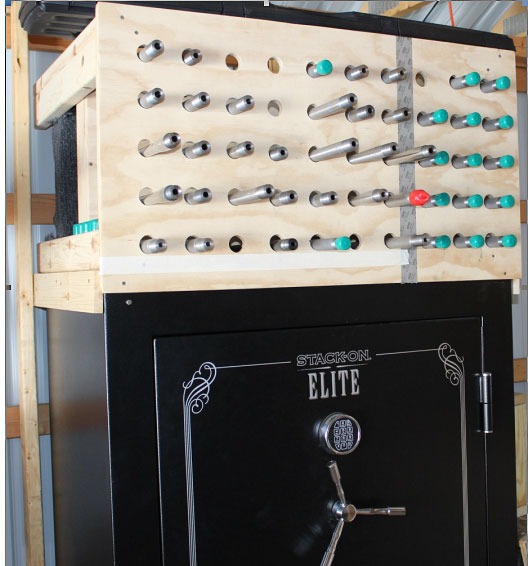
Any test that’s designed to study BC effects has to be carefully controlled in the sense that the variables are isolated. To this end, barrels were ordered from a single barrel smith, chambered and headspaced to the same rifle, with the only difference being the twist rate of the barrels. In this test, 3 pairs of barrels were used. In .224 caliber, 1:9” and 1:7” twist. In .243 caliber it was 1:10” and 1:8”, and in .30 caliber it was 1:12” and 1:10”. Other than the twist rates, each pair of barrels was identical in length, contour, and had similar round counts. Here is a barrel rack at the Applied Ballistics Lab:
Applied Ballistics used multiple barrels to study how twist rate affects BC.
“The Modern Advancements series is basically a journal of the ongoing R&D efforts of the Applied Ballistics Laboratory. The goal of the series is to share what we’re learning about ballistics so others can benefit.” –Bryan Litz
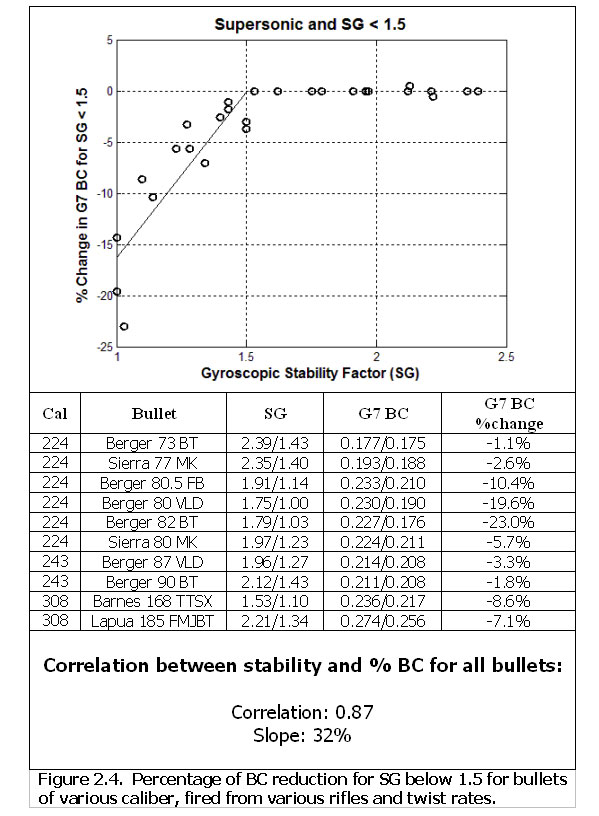
Barrel twist rate along with velocity, atmospherics, and bullet design all combine to result in a Gyroscopic Stability Factor (SG). It’s the SG that actually correlates to BC. The testing revealed that if you get SG above 1.5, the BC may improve slightly with faster twist (higher SG), but it’s very difficult to see. However, BC drops off very quickly for SGs below 1.5. This can be seen in the figure below from Modern Advancements in Long Range Shooting.
The chart shows that when the Gyroscopic Stability Factor (SG) is above 1.5, BC is mostly constant. But if SG falls below 1.5, BC drops off dramatically.
Note that the BC drops by about 3% for every 0.1 that SG falls below 1.5. The data supports a correlation coefficient of 0.87 for this relationship. That means the 3% per 0.1 unit of SG is an accurate trend, but isn’t necessarily exact for every scenario.
It’s a common assumption that if a shooter is seeing great groups and round holes, that he’s seeing the full potential BC of the bullets. These tests did not support that assumption. It’s quite common to shoot very tight groups and have round bullet holes while your BC is compromised by as much as 10% or more. This is probably the most practical and important take-away from this test.
To calculate the SG of your bullets in your rifle, visit the Berger Bullets online stability calculator. This FREE calculator will show you the SG of your bullets, as well as indicate if your BC will be compromised (and by how much) if the SG is below 1.5. With the stated twist rate of your barrel, if your selected bullet shows an SG of 1.5 (or less), the calculator will suggest alternate bullets that will fully stabilize in your rifle. This valuable online resource is based directly on live fire testing. You can use the SG Calculator for free on the web — you don’t need to download software.
Learn More About SG and BC This article is just a brief overview of the interrelated subjects of twist rate, Gyroscopic Stability, and BC. The coverage of twist rates in Modern Advancements in Long-Range Shooting is more detailed, with multiple live fire tests.
Other chapters in the book’s twist rate section include: · Stability and Drag – Supersonic
· Stability and Drag – Transonic
· Spin Rate Decay
· Effect of Twist rate on Precision
Other sections of the book include: Modern Rifles, Scopes, and Bullets as well as Advancements in Predictive Modeling. This book is sold through the Applied Ballistics online store. Modern Advancements in Long Range Shooting is also available in eBook format in the Amazon Kindle store.


 We know many of our readers aren’t 100% clear on the difference between a secant ogive bullet and a tangent ogive bullet. Add the “blended” or “hybrid” ogive into the design equation and you add to the confusion. In this article, Berger Ballistician Bryan Litz, explains the characteristics of the three popular ogive types: tangent, secant, and hybrid.
 Hybrid Bullet Design — Best of Both Worlds?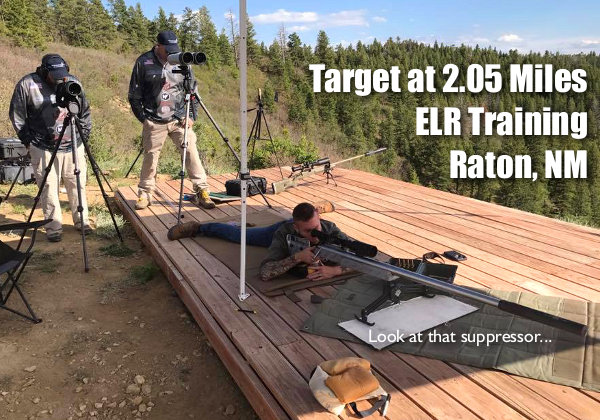
 The Applied Ballistics ELR Team spent the weekend at the NRA Whittington Center in New Mexico training for the upcoming King of 2 Miles event. Former USAMU coach Emil Praslick III was on hand to help with wind calls. The results were impressive — all team members had confirmed hits at 2.05 miles on a 36″x36″ steel target. Bryan Litz even had a 3-shot group that measured 17.5″ x 22″. That’s under 0.6 MOA!


 Standardized ELR Targets


 LOASW: When did you first become interested in shooting?