|
|
February 20th, 2011
 There’s a lot of buzz about ballistics programs for smartphones. Those are handy, to be sure, but most people still need a solid, full-featured program to run on their home computers. Berger Bullets offers a sophisticated ballistics programs for MS Windows computers that works really well, and lets you print out results. Up-to-Date G7 BCs for Berger projectiles are built-in to the program, and the price is right — FREE. There’s a lot of buzz about ballistics programs for smartphones. Those are handy, to be sure, but most people still need a solid, full-featured program to run on their home computers. Berger Bullets offers a sophisticated ballistics programs for MS Windows computers that works really well, and lets you print out results. Up-to-Date G7 BCs for Berger projectiles are built-in to the program, and the price is right — FREE.
CLICK HERE to Download Berger Ballistics Program
The program is basic enough to be easy to use, but flexible enough to allow you to calculate custom ballistics for your rifle and load. The program accounts for all the basic external ballistic parameters including bullet BC and muzzle velocity, atmospherics, uphill/downhill shooting, etc. The output tabulates velocity, energy and time of flight as a function of range. Bullet path and wind deflection are displayed in your choice of inches, centimeters, MOA or MILS.
 Instructions for Program Instructions for Program
On the Berger Bullets Blog (1/26/2010), You’ll find a description of program features and a complete set of instructions. Here are instructions for the bullet variables: “The bullet inputs are straightforward. The BC can be entered in reference to either the G1 or G7 standard. You can find the G1 or G7 BC for your bullet either printed on the bullet box label, or on our products page. For accurate results, you should measure the muzzle velocity with a good chronograph. If you don’t have access to a chronograph, you can estimate the muzzle velocity based on your load data.”
Tips for Best Results
Bryan Litz includes tips on getting the most from the Berger Ballistics program. Some of Bryan’s suggestions will also help you when working with other ballistics software:
G1 vs. G7 BC: The accuracy of the ballistic solution is only as accurate as the inputs you give it. The advertised BCs for Berger bullets are established by actual field firing tests over long range and are very accurate. Using the properly referenced BC (G7 vs. G1) for the bullet you’re modeling is important. For any bullet with a boat tail, we recommend using the G7 BC.
Muzzle Velocity: Knowing your true muzzle velocity is important when calculating external ballistics. It’s best to measure your muzzle velocity directly with a chronograph.
Altitude and Atmosphere: If you want a truly accurate long-range trajectory prediction, you can’t ignore atmospheric effects. This is especially true the farther you get from standard conditions (sea level altitude, 59 degrees Fahrenheit, 0% humidity).
Scope Verification: It’s important to verify the most important link between the calculated ballistics and your point of impact: your scope. If the ballistics program calculates 30.0 MOA of drop for a particular shot, and you dial your scope to 30.0 MOA, are you sure it’s giving you exactly 30.0 MOA? In reality, many scopes have enough error in them to cause misses at long range. It’s important to verify the value of your scope clicks by firing groups at short range.
If you have further questions not answered on Berger’s Blog Page, email Bryan.Litz [at] bergerbullets.com. NOTE: If your computer won’t run the program, please download and install this Java update: http://www.java.com/en/download/index.jsp. This is a Windows PC program. You may have problems trying to run it on a MAC in emulation.
Story sourced by Edlongrange.
February 8th, 2011
Product Preview by Bryan Litz
I’d like to make everyone aware of a new ballistic solver called the Whiz Wheel. The Whiz Wheel, from Accuracy 1st Development Group (Accuracy 1st) is a non-electronic device that calculates ballistic solutions out to transonic range for any small arms bullet. This device, similar to a circular slide-rule, is in the process of being adopted by several military units as a back-up to the electronic PDAs, and even as the primary ballistic solver since it’s faster to get a solution compared to the PDAs.
Whiz Wheel Solver Features include:
- Density altitude calculator
- Meters/MILS or Yards/MOA output
- Trajectory prediction within 0.1 MIL or 0.25 MOA resolution
- Wind deflection for any speed and direction
- Spin drift
- Leads for engaging moving targets
- Corrections for inclined shooting
- Ability to ‘true’ the solution for variations in MV or BC

Use Different Wheels for Various Cartridges and Loads
The tan colored sleeve is universal, meaning it works with all load-specific wheels. The wheels are interchangeable laser-engraved plastic items. Accuracy 1st offers both “standard” wheels for popular factory-loaded ammo types, as well as custom wheels tailored to your specific bullet, MV, sight height, and twist rate. Each wheel provides a full solution for a single cartridge type and load. Different wheels are required for different cartridges/different loads. This is because the wheel’s solutions depend on bullet BC and muzzle velocity.
CLICK HERE for Whiz Wheel Ballistics Solver Instructions PDF.
How to Use the Whiz Wheel
Finding your come-ups (and windage corrections) with the Whiz Wheel is very simple. Start by solving the density altitude (DA) with the small wheel, or getting it from a Kestrel. Then line up the DA with the range, and the wheel outputs drop. The drop can be corrected for incline via the table on the back of the sleeve. The back of the whiz wheel also calculates the lateral solution elements including wind, spin drift, and moving target leads.
 I was heavily involved in the development of the Whiz Wheel and can vouch for the accuracy of the solutions which are generated with a point mass solver and measured G7 BCs. If you have comments or questions about the Whiz Wheel, you can place those in the comments section for this Bulletin post. I’ll try to respond to your questions, time permitting. I was heavily involved in the development of the Whiz Wheel and can vouch for the accuracy of the solutions which are generated with a point mass solver and measured G7 BCs. If you have comments or questions about the Whiz Wheel, you can place those in the comments section for this Bulletin post. I’ll try to respond to your questions, time permitting.
Bryan Litz, author of Applied Ballistics for Long Range Shooting, is the Ballistician for Berger Bullets.
Whiz Wheel Pricing for Standard and Custom Loads
To order the Whiz Wheel go to the Accuracy 1st website. A Whiz Wheel Solver with one (1) custom wheel for your load costs $54.95 for civilians, $44.95 for LEO/Military. Each additional custom solver wheel, set up for your specific load, costs $24.95 for civilians, $19.95 for LEO/Military. If you shoot factory ammo, you can purchase the Whiz Wheel with one standard solver wheel — $49.95 for civilians or $39.95 for LEO/Military. A Standard Ballistics solver wheel (set up for a known production load) costs $19.95 for civilians, $14.95 for LEO/Military. Accuracy 1st also offers a package of Solver Sleeve plus three (3) standard wheels — $69.95 for civilians, $49.95 for LEO/Military.
Accuracy 1st Development Group
310 Indianapolis Rd. Building E-4
Mooresville, IN 46158
Phone: 317-834-5480
E-mail: jeffoverholser [at] accuracy1stdg.com
February 5th, 2011
Bryan Litz, Ballistician for Berger Bullets, has created a fantastic 10-minute video that covers the recent Berger Southwest Long-Range Nationals from start to finish. Bryan, Overall Match Winner in the Sling Division, had his still and video cameras rolling for each phase of the popular event, including the Tuesday training seminars, Wednesday’s mid-range fun match, three days of scored long-range shooting (Friday – Sunday), and the awards ceremonies. The 2011 SW Nationals was a big success, drawing 161 shooters from 12 states and even Canada. There were clear skies with 70° highs every day — welcome weather for the Snow-birds who came down to compete.
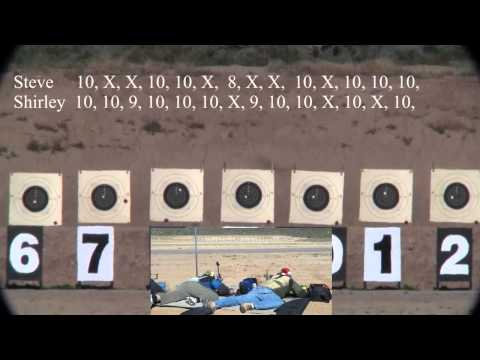
Video Offers “Shooter’s Eye View”
During the score matches, Bryan had multiple cameras running, with one focused through a spotting scope. This allows you to see shooting, shot-marking, and target movement in real time. If you watch carefully, you can also see bullet trace on many shots. Bryan delivers a “Shooter’s Eye View” of the match with these multiple camera sequences.
Bryan covers all the top shooters and winning teams. One of the highlights of Bryan’s video is an interview with Danny Biggs, who set a new National F-Open class record, shooting 200-15X, not once but twice (the second time in really tough conditions). Danny was shooting a 7mm RSAUM with Berger 180gr Hybrid bullets, using a Barnard action and straight-contour 1:9″-twist Krieger barrel. He was loading Hodgdon H4350 in Remington Brass. NF Benchrest scope of course.

Berger Awards 30,000 Bullets and $2,000+ in Cash Prizes
Berger did a great job sponsoring this event. Overall, Berger awarded 30,000 bullets to shooters, along with over $2,000 in cash prizes. Engineer Hat’s off to Bryan for making such a fine video. And remember… Bryan managed to shoot this video, while finishing First Overall in Sling Division. Impressive.

January 19th, 2011
The big news at Berger Bullets for 2011 is the Hybrid. No, Walt isn’t switching to a Prius… but Berger IS committing to the dual-shape hybrid design for a full range of calibers. The hybrid design combines a secant ogive (VLD-style) profile in the front of the bullet, with a tangent profile further back. This gives bullets the high BC of the VLD-style bullets, but the tangent section makes the bullets less sensitive to small variations in seating depth. The tangent ogive is a more gentle curve. Tangent ogive bullets, generally speaking, are more “forgiving” or easier to tune. They also will stay in tune better as a barrel throat erodes.
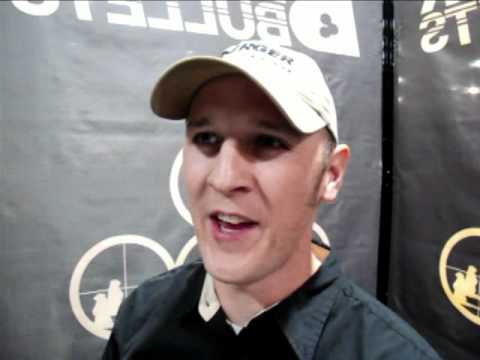
What Berger has done with the hybrid bullet is put an easy-tuning geometry on the part of the bullet that actually engages the rifling, while using a more streamlined front end for improved ballistics. This hybrid design was introduced in 2010 with hybrid 7mm and .338 bullets. Both new hybrid designs proved very successful. The hybrid designs were developed with significant design input from Bryan Litz, Berger’s ballistician. Before Bryan signed on with Berger, he literally worked as a rocket scientist, so he knows something about low-drag shapes. In the video below, Bryan explains why Berger will introduced more hybrid bullets in more calibers, in the months ahead. Bryan also talks about other products Berger has in the works, including its much-awaited reloading manual.
February 14th, 2010
 Bryan Litz, Ballistician for Berger Bullets, is the author of the book Applied Ballistics for Long-Range Shooting. Before joining Berger, Bryan was a missile design engineer working with the U.S. Air Force. An NRA High Master, Bryan also happens to be one of the country’s top long-range shooters. Bryan (aka “bsl135″ in our Forum) has written many ballistics programs and technical papers dealing with long-range flight dynamics of projectiles. Bryan has recorded some very impressive match performances recently. At the 2008 NRA National Championships at Camp Perry, Bryan beat 258 other competitors to win the Palma Individual Trophy Match. Bryan shot a remarkable 450/26x, not dropping a single point. Bryan Litz, Ballistician for Berger Bullets, is the author of the book Applied Ballistics for Long-Range Shooting. Before joining Berger, Bryan was a missile design engineer working with the U.S. Air Force. An NRA High Master, Bryan also happens to be one of the country’s top long-range shooters. Bryan (aka “bsl135″ in our Forum) has written many ballistics programs and technical papers dealing with long-range flight dynamics of projectiles. Bryan has recorded some very impressive match performances recently. At the 2008 NRA National Championships at Camp Perry, Bryan beat 258 other competitors to win the Palma Individual Trophy Match. Bryan shot a remarkable 450/26x, not dropping a single point.
Palma Match — Caught on Video
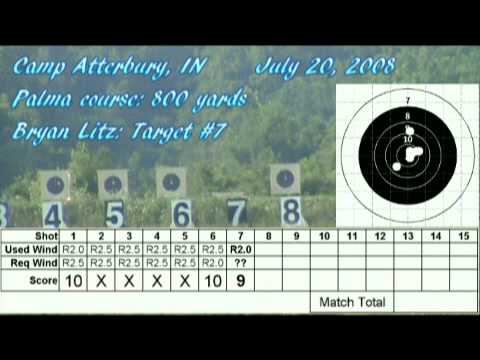
Bryan has crafted a cool video that puts the viewer “in the driver’s seat” as Bryan shoots an 800-yard match with his .308 Winchester, iron-sights Palma rifle. Watch as each shot is marked and scored. Bryan explains: “The inset target at upper right displays each shot location in sequence. The score card shows the windage used for each shot, as well as the windage that was ‘Required’ for that shot to be centered. Wind wasn’t very challenging in this string, only requiring between 2 and 3 MOA right. This particular match is the 800-yard phase of a Palma course fired in the summer of 2008 at Camp Atterbury, IN. NOTE: I’ve had to cut out some ‘pauses’, and speed up the film in order to meet YouTube’s size requirements, so that’s why we sound like chipmunks.”
CLICK SCREEN to WATCH VIDEO. Click Menu Button for High Quality (HQ) Option
Bryan also has his own website with a number of authoritative articles. Topics include: Bullet Design, Meplat Trimming, Gyroscopic and Coreolis Drift, Palma Bullet Analysis, How Ballistics Programs Work, and Ballistic Coefficient Testing. CLICK HERE to visit BRYAN LITZ Website.
|


