|
|
September 5th, 2014
Joe Hendricks of Team Remington is the 2014 NRA High Power National Champion. This is Joe’s first National High Power championship, and he accomplished it through a gutsy, come-from-behind victory on the final day. This was no easy win for Joe, aka “Joesr” on our AccurateShooter Forum.
Here’s the story of Joe’s 2014 victory at Camp Perry. One thing that made Joe’s victory even more memorable was that both Joe’s father and Joe’s son were there to witness the win. Three generations of Hendricks men were at Camp Perry to see his achievement. That’s a great thing for a family.

Down by Too Many Points and Too Many Xs
By Joe Hendricks, Nat’l High Power Champion (2014)
On the last day of the High Power Championship, believe it or not I felt no pressure — because I really didn’t think I had a chance to win it all. I knew the leaders would clean the day and my only hope was that possibly one or two would falter enough to allow me third place. All I was trying to do was shoot Xs, so that I could move past two of the people in front of me and (maybe) secure 3rd place. I started the day tied for third on points with two other competitor, but in fifth place when you figured in X-count.
Yes I was watching the board going into the final day and so many people say “Don’t watch the board!”. However, for me, looking at the board motivates me.
The best I could do at 300 yards was a 200-6X, with nice groups, but not centered. That was not enough Xs and I knew I wasn’t moving up the leader board. I knew that simply shooting a 200 score wasn’t going to cut it and I still had work to do to get onto the podium (i.e. earn third place). At that point I figured I was still tied for third (disregarding X-count).
So I went to the 600-yard line with goal of getting on to the podium. I was shooting for third at that point. I figured maybe with two cleans I could grab third place.
Understand I know my competition and I know I’m shooting against the best High Power marksmen in the world. There were two people who have won this match before and several deserving champions just behind. So at this point, I’m wasn’t giving myself a chance to win — I was hoping to place third.
The first string at 600 yards went well with nothing less than a 10. I shot a normal 200-10X, meaning 10s and Xs were mixed up with no wide shots. Apparently others faltered when I shot clean (all 10s or Xs) — I didn’t know that after the first string at 600 I was actually in the lead….
Click Image to See Full-Size Photo

Pulling it Together: Five Xs for the Final Five Shots
The second string at 600 yards was strange. I shot five Xs in my first 6 or 7 shots and then ran a string of 10s that were either wide or corner shots. So, after 15 shots, I wasn’t getting better, I was getting worse. I needed to get my act together (and right quickly).
I took a moment to regroup and said to myself: “Stop this. We are not doing this today…” (i.e. we are NOT going to break down with just five shots to go). That’s something I heard Ken Roxburgh said to my son during their team match.
That thought process changed my attitude, and it seemed to relieve the pressure, so I was able to concentrate on every shot. I was re-focused and ready to roll. I know Perry, I know the wind at Perry and I had confidence in my 6CM cartridge to shoot 10s through the final five shots.
That confidence paid off — in the final five shots I broke every shot dead center and every shot came up an X!
I don’t care where you place at Perry, if your final shot is an X you have something to take back for next year. Running five Xs in a row to end Perry is special. But, ironically, I can not say that running five Xs in a row to win Perry is a feeling I can actually remember, because, at the time, I thought I had finished third, not first….
After finishing the last string, I had a 1798 point total. I packed up my stuff, went over to the Remington golf cart, and told Ken Roxburgh that I was fairly sure I had placed third overall.
“Down 13… How About You?”
I then walked down the line and I saw Brandon Green from the USAMU congratulating Norm Houle on winning. I paused for a moment and then walked over to Norm and asked him: “What did you shoot?” Norm replied: “I was down 13, how about you?” I then answered “Down 11″. Norm gave me a huge handshake and then it hit me. I had won.
I was a feet away from my father. I went to him and said I think I won. Pricelessly, Dad said “Won what?” Then it hit him. Literally in tears, He called my mother to report the good news.
At that point I realized this Championship wasn’t my life’s work, it was his. THANK YOU DAD!
My son Joe Hendricks Jr. was in the pits and didn’t yet know about my first-place finish. He is 18 and has his own hopes for a rifle championship someday. When he came back from the pits, I said to him: “You don’t know…” He looked at me and said “Know what?”. I said “I won”, and he asked “Won what?”. Then I told him: “The whole thing.” I have never seen him smile the way he did at that moment.
Next we call my wife on the phone (she was staying in Port Clinton, but wasn’t at the range that day). I tell her I won, and she says “Won what?” Again, I reply “The whole thing … I won the whole thing.” I hear only silence on the phone, then she says “Are you serious?” I reply, “Yes I am” and then there is a long pause, after which she says: “Joe, you aren’t messing with me are you?” I tell her: “No, I’m serious, come out here, you’ll see…” She pauses then says, “OK I will… but if you are messing with me YOU WILL PAY.” My girls say she almost wrecked the car driving out to the range.
So my wife finally shows up at the Remington Team trailer. As she was getting out of the car she says “If you are [fooling] with me I will kill you. Did you really win?” In fact, she asked me three times before she believed it had actually happened.
By this time Ken Roxburgh of Remington (my coach) had also called Carl Bernosky. Carl Bernosky has been a huge part of my shooting since I young. Having Carl be so excited about my win means nearly as much to me as the win itself. What a great day!

Joe wanted to thank his sponsors Remington and Berger Bullets. The 6CM Cartridge he shoots is a wildcat based on the .243 Winchester. Joes uses slow-burning H1000 powder and he shot Berger 105gr 6mm Hybrids at Camp Perry this year.
August 21st, 2014
Report by Anette Wachter for 30CalGal.com
Click Here for full article
 I have spent the last two weeks at Camp Perry for the U.S. Long Range and Fullbore Nationals. This year at Perry the format was quite different than in years past. An International Fullbore week was added after the Long Range week. This was meant to act as a practice and tryout for members of the U.S. Rifle Team in preparation for the World Palma Championship in 2015. I have spent the last two weeks at Camp Perry for the U.S. Long Range and Fullbore Nationals. This year at Perry the format was quite different than in years past. An International Fullbore week was added after the Long Range week. This was meant to act as a practice and tryout for members of the U.S. Rifle Team in preparation for the World Palma Championship in 2015.
The Long Range Nationals consist of shooting all matches at 1000 yards and one day of Palma which is fired at 800, 900, and 1000 yards. Each string at 1000 is a separate match in itself and then there is a grand Aggregate of all for the week. Each match has a shoot-off of the top scorers in each relay to determine the winner. In years past I have made it in to at least one shoot-off but I was not so lucky this year. I did however have success in my team events.

All Ladies Team for Perry
Last year I was coached by Nancy Tompkins on a coed team to an overall win. I called Nancy again this year to set up a new team — an all-ladies squad. What a squad it was, with Nancy, her daughters Michelle and Sherri Jo, and Trudie Fay (along with myself). I cherished getting to know all of these ladies better. Sherri Jo Gallagher has been a USAMU shooting super star for many years. She is now a super star Golden Night (U.S. Army Parachute Team member). She took some time off to come back to Perry to shoot for fun and hang out with her family. Our squad had the best time. Lots of laughing. And Xs! We won the Palma division and placed second overall for the Roumanian Trophy. We won overall Palma team for the Agg for the week. Way to go girl power!

Anette came home with four medals. During the Long Range phase, Anette’s all-female team won Open Palma in the Roumanian Trophy and the Silver Medal in the overall of the Roumanian. During the Fullbore phase her team earned the Silver Medal in the Commodore Perry Cup. And then Anette’s 4-person team, U.S. Team Skaret, won a Gold for the Open Palma.
CLICK to READ MORE
August 10th, 2014

 Ben Emms of Australia won the U.S. Fullbore Championship with an 891-114V score. One point back, Nancy Tompkins finished second, earning the Silver Medal with 890-105V. Michigander Charles Hayes won the F-TR division with 807-34V. Ben Emms of Australia won the U.S. Fullbore Championship with an 891-114V score. One point back, Nancy Tompkins finished second, earning the Silver Medal with 890-105V. Michigander Charles Hayes won the F-TR division with 807-34V.
For the “slings and irons” Target Rifle competitors, the individual championship came down to a ten-person Shoot-Off. Americans fared well. Along with Tompkins’ second-place finish, Kelly Bachand placed fifth, Trudie Fay was eighth, Steven Powell finished ninth, and SSG Shane Barnhardt was tenth. Overall, that was a great showing by Americans. This bodes well for the 2015 Fullbore World Championship at Camp Perry.
Today the Fullbore Championships conclude with Palma Team matches. The top shooters are on the firing line, doing their best for their teams and respective countries.
Annette Wachter, aka “30 Cal Gal” offers this report from yesterday: “Here is my Award for most awesome team shirt. Saturday was a crazy morning. I got into position to shoot and there was zero wind. But by the time I took a shot it went to 11 minutes! I Got blown off the target twice. Had to laugh. Nothing I could do. I held great elevation though.”

CLICK HERE for Individual National Fullbore Championship Results, with Shoot-Off.
The Fullbore Championship — Down to the Wire
Competitor’s Report from Kelly Bachand, Kelly’s Gun Sales
Well it all turned out pretty darn well. I was in 7th place in the grand aggregate at the beginning of the day. After the first match of the day I dropped to 10th, and after shooting one of the best strings I’ve ever shot in my life I moved up to 3rd! I then shot in the Top 10 Shoot-Off to determine the final standing and I ended up 5th overall. I’m really quite pleased with this result and I feel very blessed.
Click No Bang — You Have to Load the Rifle!
Going into the final string at 1000 yards I felt myself starting to get a little worked up. I stopped and prayed and really worked at calming myself down. I got in position and got ready to shoot, loaded my first round, made my wind call and took the shot. “Click”. It didn’t go off and worse still I jerked the heck out of the trigger. It’s odd that it didn’t go off, but it happens once in a while, I usually just cock the rifle again and the round goes off on the second try. I line up the sights again, “Click”. Yikes! I jerked the trigger again and there must be something wrong with my rifle! I pull the bolt back and check the end cap, it’s not loose, so I go to eject the round to inspect it and I discover that I never loaded the rifle to begin with! That really calmed me down, quite a lot. I was almost laughing at myself on the line.
Reading the Wind
After the embarassing “click no bang” sequence, I picked an indicator — there was a flag almost pointing at me, and I used it to judge the angle changes. I watched other flags and the mirage for velocity changes and I tried my best to break good shots, and it worked. It was as if God helped me break the right shots at the right time. On a number of occasions I took a shot I called on one side or the other and the wind had either picked up or let off in such a way that if I hadn’t shot it exactly where I did then I would have lost points (calling a shot is just guessing where the shot will be based on how it felt and what it looked like when the gun went off). It was awesome. I ended up with a 75-8V, one of only five 75s that were shot on that string. This means that in 10-15 mph crosswinds, from 1000 yards away, with iron sights, and supported by a sling, I kept 15 consecutive shots inside an area less than two feet across with more than half of them in an area less than one foot across.

The Top 10 Shoot-Off
Since this match is a dress rehearsal for the World Long Range Championships next year there is then a shoot off among the top 10 scoring competitors. Fifteen more shots at 1000 yards and the score from that additional string is added to each shooter’s running total. The overall winner is the one with the most points.
During the Shoot-Off, the wind had picked up a little more, but not much. The biggest challenge I had was that the wind had such a speed that even from prone and with a sling the rifle was no longer steady. Instead the rifle sights were bouncing around as if I was shooting standing. So it was no longer good enough to simply have a good handle on the wind, we now also needed to squeeze the shot off at precisely the right moment. Needless to say some shooters excelled and some did not. Nancy Tompkins impressed everyone present by shooting a 75-7V in these conditions. I had a 70-4V which moved me from 3rd place to 5th place overall.
So I just got 5th place in the U.S. Fullbore Nationals and I’m honestly quite blown away by that result. There were some of the best shooters in the world present. Some of the other countries brought the same shooters who will compete next year in the World Long Range Championships — they were here. This also served as a try-out session for the U.S. Palma Team so many of the best shooters from the USA were present and competing. And then there is me. I’ve shot just two matches this year: a local 1000 yard match back home, and these Nationals. I practiced about half a dozen times and usually at less than 200 yards before coming to Nationals. Yet, despite the many reasons I shouldn’t have done well here, God saw fit to bless me and helped me to shoot very well.
Read Full Report by Kelly Bachand (more details).
August 6th, 2014
Michelle Gallagher is now the 2014 NRA Long Range High Power Rifle Champion. Michelle shot a perfect Palma score to win the multi-match championship. When the dust settled, Michelle edged out her mom, Nancy Tompkins, by a single X. Readers asked about Michelle’s choice of bullets. In the Long Range Championships, Michelle used the Berger .30-caliber 155.5gr Match Fullbore Target bullet (for Palma), as well as the 6.5mm 140gr Match Hybrid Target bullet.
Here are some photos from the Long Range championships, courtesy GONRAMedia.
CLICK HERE to see more GONRAMedia photos from Camp Perry.
John Whidden, a three-time NRA Long Range Champion, had a pair of long-range rifles built on modified Anschutz aluminum small-bore stocks. John’s scoped rig (first photo) features a Kelbly Panda Action. The iron sight version (second photo below) has a Winchester action. John has done these conversions for other shooters.


Long Range is not a man’s world by any means. The top two LR places at Perry were claimed by ladies.

Tubeguns built with Gary Eliseo chassis systems were popular on the firing line.

Yes, that is a John Deere Mirage Band shielding this shooter’s barrel.

This service rifle shooter found a way to shield his sights and remember his loved ones.

This competitor transformed a Sinclair loading block into an elevated ammo caddy. Clever piece of kit!

“Wagons HO!”. Shooters await the long ride to the pits for target duties.


August 6th, 2014
Report by Kelly Bachand, for Kelly’s Gun Sales Blog.
Tuesday, August 5th, was the first day of the actual competition. The weather forecast was for rain with an 80% chance of thunderstorms. We somehow snuck through on that 20% and had great shooting weather all day. We shot 300 yards, 600 yards, and 800 yards on Tuesday with 15 shots at each. For the 300-yard line and part of the 600-yard line the wind came out of the west, as usual. Part way through the 600-yard line it started to switch and for the rest of the day it only came out of the north east or directly out of the east.

Int’l Fullbore Targets — More Challenging Than NRA Targets
The ICFRA (International Confederation of Fullbore Rifle Associations) targets are sometimes smaller than the NRA targets we are used to shooting in the USA. The 300-yard target has an especially small bullseye; it must be just 2.5″ across or something. Interestingly, these targets are also 5-V targets as opposed to our 10-X targets. This means the maximum points that can be scored with each shot is 5 points (instead of 10) and the tie-break ring is called the V-Ring (instead of the X-Ring). As a rehearsal for the 2015 World Long Range Championships, I think the match is off to a great start. There have been some logistical issues that have come up (and they only would have by running this match), so I’m very hopeful that the match directors will have all of their ducks in a row next year.
In a match like this, with the relatively calm wind conditions we had today, the top few shooters will likely go the whole day without dropping a single point and they’ll do it with a pretty high V-count. That means scores of 75 with 10+ Vs at every yard line are likely what it takes to find yourself towards the top (75-15V is the maximum score possible). I had a 75-9V at 300 and I was quite pleased with the group I shot, it must have been just a few inches tall. As one of the previous US Palma Team members, all of my shots in this match are being plotted and evaluated as part of the US Palma Team try-outs. It’s a very good incentive to break great shots.
Trigger Certification Rules
One of the fun things about shooting with ICFRA rules is that after someone shoots a possible (gets all the possible points, like 75 out of 75) they have to immediately get their trigger pull-weight tested. [That’s interesting] because you get to watch your friends come off the line and you immediately know how they did and can quickly give them a thumbs-up and rush over to congratulate them.
There is some really great shooting going on. I saw a lot of high scores shot at 800 yards. One under-25 lady from across the pond (Chloe Evans) spent most of today showing all the rest of us how it is done. It looks like she finished the day with a 225-36V. For the day, I had a 224-30V out of a possible 225-45V. I highly recommend following the scores online:
CLICK HERE for Current Fullbore Match Results from NRA website.
August 3rd, 2014
Story based on report by Lars Dalseide for NRA Blog
 An epic mother-daughter duel came down to a single X, with Michelle Gallagher besting her mom, Nancy Tompkins, by the slimmest of margins. To accomplish that feat, and win the Long Range National Championship, Michelle had to shoot a superb final match at 1000 yards, not dropping a point. Congratulations to Michelle, for her impressive win. An epic mother-daughter duel came down to a single X, with Michelle Gallagher besting her mom, Nancy Tompkins, by the slimmest of margins. To accomplish that feat, and win the Long Range National Championship, Michelle had to shoot a superb final match at 1000 yards, not dropping a point. Congratulations to Michelle, for her impressive win.
Finishing with 1096-66X, Gallagher took the LR title with Tompkins (1096-65X) in second and SSG Brandon Green (1096-59X) in third. Thomas Colyer was forth with 1096-56X. Remarkably, the top four shooters all finished with the same point total, only separated by X count!
Michelle (Left) is ‘all smiles’ with sister Sherri Jo Gallagher (Right), a former National Champion.

900-Yard Phase Cancelled By Lightning Storm
Michelle Gallagher shot a perfect 300-19X in Saturday’s Palma Match to win the 2014 National Long Range Rifle Championship. Beginning the day two points down, Gallagher racked up fifteen 10s at 800 yards along with another fifteen 10s at 1,000. Though Palma traditionally includes a 900-yard phase as well, that portion of Saturday’s match was cancelled due to the morning’s lightning storm.
“Talk about an exciting finish,” said High Power Rifle Match Director Sherri Judd. “She hung in there after dropping a few points in the early rounds and finished strong.”
“After finishing at 1,000, I knew it was going to be close by I had no idea it would be that close,” Gallagher said.
Other notable performances were turned in by Waylon Burbach, James (Jim) O’Connell, and SFC Joel Micholick. Burbach, as a Junior, shot a superb 1091-55X to beat all but six of the 282 competitors. Jim O’Connell, as a Grand Senior, proved he still has what it takes, finishing sixteenth overall with 1086-52X. “Man, that old guy can shoot!” was often heard on the firing line. Micholick proved the capability of the AR platform, recording a 1074-34X with his iron-sighted M110 to be the top Service Rifle shooter.
NRA 2014 National High Power Rifle Long Range Championships
| Competitor |
Score |
Competitor |
Score |
| 1. Michelle Gallagher |
1096-66X |
6. Philip Crowe |
1093-60X |
| 2. Nancy Tompkins |
1096-65X |
7. Waylon Burbach |
1091-55X |
| 3. SSG Brandon Green |
1096-59X |
8. Norman Crawford |
1091-50X |
| 4. SSG Thomas Colyer |
1096-56X |
9. SGT Eric Smith |
1090-58X |
| 5. SSG Shane Barnhart |
1095-60X |
10. John Whidden |
1089-64X |
CLICK HERE for Complete Long Range Championships Results
August 2nd, 2014
by Lars Dalseide for NRABlog.com
There are five days in the NRA’s National Long Range High Power Rifle Championship. Five days of firing round after round at 6’ by 6’ targets up to 1,000 yards away. Five days of Camp Perry’s wind bouncing off Lake Erie while the sun fights to break through the occasional cloud.
This report was filed on Friday, August 1, 2014. CLICK HERE for the latest results.

Two sets of relays have already taken their respective Shooter Shuttles out to the pits, home of those 6’ by 6’ targets. There competitors take their turn at lifting and lowering the behemoth squares with every shot. Once fired upon, the target is lowered, scored, and raised back into place.

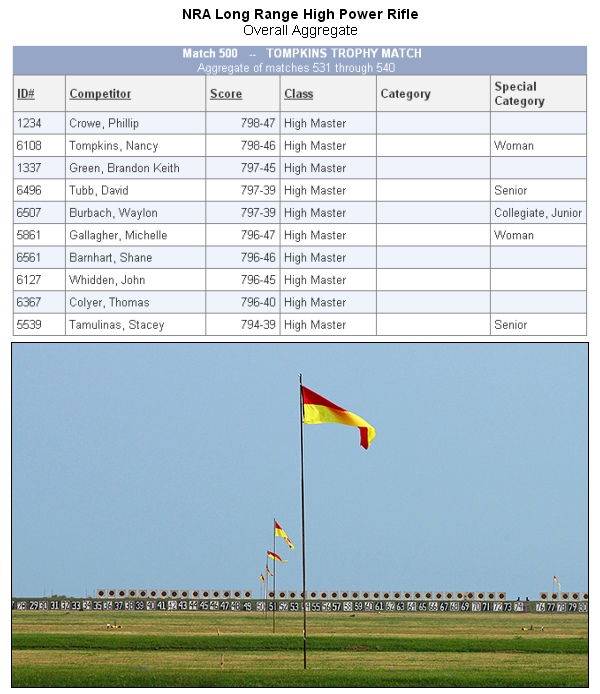
[As of Friday morning], only one round of relays is in the score books. Already, this is shaping up as a tightly-fought match. Only one point (and X-count) separates the top five shooters. Philip Crowe is currently in first with 798-47X. Just one X back, at 798-46X, is past champion Nancy Tompkins. A point behind Nancy are USAMU Shooter SSG Brandon Green, the legendary David Tubb, and Waylon Burbach. Nancy’s daughter Michelle Gallagher is in sixth. The other “Gallagher Girl”, SSG Sherri Jo Gallagher (below) is also competing this year.

CLICK HERE for Latest 2014 Long Range National Championship Results.
Photos courtesy NRABlog.com.
August 1st, 2014
At the 2014 National High Power Championships, Joe Hendricks recorded an inspirational come-from-behind victory that will long be remembered. But during this year’s competition, a 10-time past champion was noticeably absent from the firing line at Camp Perry. “Where’s Carl?” was the question many asked as the High Power Championships began.
Health concerns kept Carl Bernosky from competing at Camp Perry this year — serious health concerns. In fact, Carl is scheduled for back surgery today to deal with chronic pain and related neuro-muscular issues. Carl tells us: “I have had back problems for years but this March my bulging discs and sciatica flared with a vengeance. It was a very difficult time. It made functioning even with everyday tasks hard and shooting impossible. If you include something in your Bulletin please make sure that my friends and shooting competitors know how much I appreciate their kind words, thoughts and prayers. Thank you for thinking of me and hopefully I’ll be back on my feet soon. Please don’t let this in anyway overshadow Joe Hendricks’s well-deserved Championship. Joe shot superbly and I congratulate him on a great performance.”

We know that our Daily Bulletin readers wish Carl well and send their hopes that the surgery is 100% successful and that the healing process goes well. We all want to see Carl pain-free and back on the firing line. Carl is a great marksman — one of the best ever — and an equally great human being. We echo what one of his friends posted yesterday: “Carl is an absolute class act… humble, gracious, and a true gentleman. Heal up fast, Carl.”
In this exclusive interview filmed earlier this year (at SHOT Show), Carl talks about his approach to competition, and Carl offers helpful advice for fellow High Power competitors.
July 30th, 2014
Story Based on Report by Kyle Jillson for NRABlog.com
Joseph Hendricks won the 2014 NRA High Power Rifle Championship with a 1789-76X Score. Hendricks topped a large field of 288 total competitors. In second place, two points behind, was past champion Norm Houle with 1787-85X. Defending 2013 High Power Champion SSG Brandon Green was a close third, with 1786-89X. Green had the high X-Count for the match. The top “Any Sights” competitor was Kenneth Lankford, whose 1780-76X was the eighth-highest total overall.

Great Shooting Takes Hendricks from Fifth to First on Final Day
Dawn on the final day of the 2014 NRA High Power Rifle Championship saw Joe Hendricks sitting in fifth place. But by sundown the Team Remington shooter had become the national champion. What happened in between was a shining example of consistency and perseverance.
Hendricks started the final day (Tuesday) four points down of the leader, tied for third but with a low X-Count. “I assumed everybody would go clean … so I needed to go clean just to maintain my spot,” Hendricks said. And clean he went. All 60 of Joe’s shots on Tuesday fell within the 10-ring. In fact, he hit straight 10s for the last 100 shots of the 180-shot championship. That is an impressive feat.

Three Generations of Hendricks on the Firing Line
Hendricks has the unique privilege to shoot with his son, Joe Hendricks, Jr., and his father, Gary Hendricks. The rest of his family was there to cheer him on as well.
Altered Course of Fire on Final Day
Tuesday’s matches followed an unusual break after severe winds on Monday caused a complete cancellation of the matches. Normally, on the final day of the High Power Championship, competitors shoot matches at 200, 300, and 600 yards. This year, due to the Monday cancellation, competitors did not fire a 200-yard match, but instead fired the 300-yard match and TWO 600-yard matches.
View Photos from 2014 High Power Championships
When everyone found themselves back on the firing line Tuesday morning, the wind had died down. “The winds weren’t too tricky. I shot two nice groups at 300. Not the X-count I wanted, but I got all the points,” Hendricks explained. “When I got back to 600 I just tried to do the same thing. The wind dropped off enough a couple times that if I shot I’d lose points, so I waited until it came back.”
Hendricks finished with 1789-76X, two points ahead of Norman Houle (1787-85X), a three-time High Power National Champion. In third place, with 1786-89X, was SSG Brandon Green, last year’s High Power Rifle Champion.
July 28th, 2014
We are already half-way through the NRA High Power National Championship and SSG Shane Barnhart of the USAMU remains atop the leaderboard, with a score of 1193-64X out of a possible 1200 points. Barnhart shot a 595-28X during Sunday’s Navy Cup, Coast Guard Trophy, and Army Cup matches. Barnhart currently holds a three-point lead over second place SSG Brandon Green (1190-58X), the defending High Power National Champion. Like Barnhart, Green shoots for the USAMU. Kenneth Lankford leads the “any sight” (scopes allowed) division with 1191-54X.
High Power Hardware: The Guns of Perry
We thought our readers would like to see some of the ultra-accurate rifles campaigned by High Power competitors at Camp Perry. Both bolt-action and self-loading rifles are popular. Among bolt guns, Tubb 2000s and Eliseo tubeguns are popular. Semi-auto AR platform “Space Guns” offer some advantages (particularly during rapid-fire and for standing position), and are favored by many of the top marksmen. Many Camp Perry High Power competitors are also shooting less exotic AR service rifles.
Here is your current leader, SSG Shane Barnhart, with an AR Space Gun. Note the side charging handle and tall iron sight set-up.

Tubb 2000 with a shortened handguard, and custom hand support bracket forward of mag well.

The modern AR Space Gun, scoped version. Note the side charging handle, and absence of forward assist. A block fitted under the handguard helps with the standing position. The scope is mounted on a “piggy-back” rail that extends forward of upper receiver’s built-in rail.

Tubb 2000 rifle, left-hand version. Note how the butt-plate is adjusted for cant, angle, and drop.

Look carefully — it appears that a separate fore-arm section is duct-taped to the red free-floated handguard. Perhaps this AR owner experienced some wiggle, and that’s why he seems puzzled?

A countdown timer is attached directly to this shooter’s Tubb 2000 rifle.

This Service Rifle competitor shows how to get some “R & R” between relays.

All Photos courtesy NRA General Operations.
|


