|
|
August 13th, 2015

Congratulations to Ben Emms of Australia for winning the World Fullbore Long Range Championship at Camp Perry. Nigel Ball of Great Britain finished second, while another Aussie, Mattthew Pozzebon, took third. There was some amazing shooting done this past week by the top competitors. Here is a report from Anette Wachter, a member of the U.S. Palma Team.
How Ben Emms Won the World Championship by Anette Wachter (30CalGal.com)
For a while I thought he was not human. Ben Emms of Australia kept powering through every yard line of the Long Range Championship with perfect scores. When the rest of us got pummeled at the 1000-yard line on day 3 he still cleaned the string. He “finally” dropped one point the last day. I guess he is human after all.
But for some dramatic effect he kept us on the edge of our seats during the shoot off. Two crazy shots (a wide two and a low three) were nail biters. His last round for record had to be at least a four to keep the Gold medal from going to second place finisher Nigel Ball from Great Britain. Cheers came from the crowd and especially his team-mates when the final shot came up as a FIVE on the target. Nigel had a beautiful target of centered shots and won the Silver while Matthew Pozzebon also of Australia took the Bronze Medal. Tom Whittaker and Bob Stekettee were also in the Top Ten shoot-off. Tom came home with many awards last night.
The three top Lady trophies went to Sherri Jo Gallagher for the Gold, Trudie Fay with Silver and Jane Messer of GB with the Bronze. We were rooting for Trudie all week as she also was down only one point. Her last string at 1000 was difficult but she still finished in the top 25 in the world. Sherri almost made the shoot-off. She was in 10th place all day until the final results came in at the end and she was pushed to 11th. Although the 11th spot kept her out of the shoot-off, she did stay for the awards ceremony to receive her High Woman Gold Medal and then hit the road for an all night 14-hour trip back to Golden Knights turf for work. Hard core girl!
The Fullbore Team Championships are now underway, with squads from 11 countries competing for national honors. Team USA was ready to go on Day One, hoping to win the Worlds on our “home turf”:

Photos by Anette Wachter from 30CalGal Facebook Page.
August 9th, 2015

The Fullbore (Target Rifle) World Championships are now underway at Camp Perry. Held every four years (like the Olympics), the ICFRA World Target Rifle (Fullbore) Championships event is quite possibly the most important long-range rifle competition on the planet. This year the World Championships take place in the USA, at Camp Perry, Ohio. Teams from 11 countries are competing. Here we have some early reports from the August 8th Opening Ceremony…
Report by Ray Gross, Captain U.S. F-TR Team, 8 August, 2015
The U.S. Army Golden Knights parachuted in as part of the opening ceremony for the World Long Range Championships being held at Camp Perry, Ohio. Three of our sister teams, the U.S. Palma Team, the U.S. Veterans Team and the U.S. Under-25 Team will be competing against teams from around the world. Several members of our team, Ray Gross, Steve Hardin, Bryan Litz, and Lane Buxton, are part of the U.S. Palma Team.

The format is very similar to our own World Championships. Everyone entered in the Individuals will shoot 15 shoots for record at 800, 900, and 1000 yards and they will complete that course of fire three times over the next several days. The team event fires the same course twice.
The main difference from our style of shooting is that they will compete using aperture-type target sights and will be using an arm sling as support compared to the scopes and bipods that we use. The rings on our target are substantially tighter to account for the the greater stability and accuracy of the type of rifles that we use.
Report from Anette Wachter (aka 30CalGal), 8 August 2015
Day One of the World Long Range Championships — we had Opening Ceremonies this morning which had our U.S. Army Golden Knights jumping in and the flag raising of each participating country. Sherri Gallagher, former USAMU shooter and now a Golden Knight, led the team as the first and solo jumper. I was sort of hoping she would land in the prone position with a rifle and start the competition. The rest of the Knights fell from the sky and landed perfectly on the X.

The U.S. Fullbore Nationals consisted of individuals and various team events as well as the biggest event, the America’s Match. The USA has never lost the America’s Match at home. We won it three years ago here at Perry and last summer up in Canada. Yesterday was not in the cards. First let me congratulate Great Britain for some outstanding shooting. They lost a total of 17 points for 8 shooters all day and took the Gold. Australia came in second, South Africa 3rd and the USA in 4th. Very humbling yes. One of our coaches had to leave at the middle of the match for a family emergency as well. So I believe the kinks are done and we can move on successfully for this coming week of Worlds. We have the best shooters in the U.S. on our team. Things will turn around. Three women were in the top 25 of the Fullbore Nationals: Michelle Gallagher, Trudie Fay, and Jane Messer. Our Veterans and Under 25s had their World Championship team events as well. Our Veterans took the Gold and the USA Under 25s took the Bronze. The GB kids shot very well and received Gold and Silver medals.
Click HERE for Full-Bore Nationals Results

August 6th, 2015

Victor Betzold had a Camp Perry experience for the ages. At the 2015 CMP Games, Betzold won the Garand Match, won the M1 Carbine Match (setting a new Record), and took the 3-Gun Aggregate for the second year in a row. Now that’s an impressive performance. Betzhold is no stranger to shooting – beginning in junior high and firing well into college, then taking his love for guns into the Army. After the years went on and work and family became higher priorities, he fell away from the sport he loved. But now that he’s retired at age 60, he’s had time to practice again – practice that has certainly paid off.
During his remarkable showing at the National Games Matches, Betzold won the Carbine Match with a score of 375-6X, setting a new National Record in the process. In the National Garand Match, Betzold fired a score of 290-7X to become the overall winner of a field of 1213 competitors.
“It feels great,” he said. “I’ve been working at this for a long time.” The 60-year-old Betzold was also the top senior for both the Garand Match and the Carbine Match.
With his outstanding performances in the Garand and Springfield Matches, as well as an exceptional seventh-place finish in the Vintage Military Match, Betzold claimed the 3-Gun Aggregate title for the second year in a row — with a combined score of 865-19X.
Lady Competitor at the Garand Match (file photo).

To review complete results for all CMP National Match events at Camp Perry, visit the CMP 2015 Trophy Matches and SAFS Results Page.
August 4th, 2015

Though most of the action at Camp Perry this summer has been outdoors, there was also an important match conducted indoors at the Gary Anderson CMP Competition Center. The AiR-15 Challenge match attracted nearly 200 competitors this year. Shooters used AR-type air rifles, aiming at reduced-size bullseye targets connected to electronic scoring systems.
AiR-15 Match Rifle Based on Anschütz 8001
Creedmoor Sports offers an AR-style air rifle built around an Anschütz 8001 barreled action. This rifle was designed in conjunction with the development of the CMP’s National Match Air Rifle shooting discipline.

Some of the nation’s best marksmen were on hand, including 2015 NRA High Power National Champion SFC Brandon Green, who won the AiR 15 Shoot-Off with an outstanding score of 199-7X. Green’s victory earned him a $700 check from the CMP.

One of the nation’s greatest High Power shooters, SFC Green actually got his start in competitive shooting in sporter air rifle for a JROTC unit in Louisiana. After shooting sporter for a few years, he switched to precision in high school before joining the Army and becoming a member of the USAMU.
“I think, mainly, people come in here to train,” Green explained. “It’s convenient to train and compete – get a little of that match pressure. That’s the reason that I come in to do it. Just to get time on the sights – time on the gun. Plus, it’s exciting to come in and shoot for a little bit of money.”
“Come out and try it,” he added. “It’s a good time.”
The AiR-15 match was part of a series of Air Rifle and Air Pistol Matches held this summer in the Gary Anderson Competition Center, a state-of-the-art indoor facility boasting 80 electronic target-equipped firing points. The center houses classrooms, a large common area, Olympic and other memorabilia and a world-class air range.

August 3rd, 2015

From August 3 through August 14, Camp Perry, Ohio will be the center of the Fullbore (Palma Rifle) universe. From 3-7 August the U.S. Fullbore Championship will take place on the shores of Lake Erie, followed by the ICFRA World Target Rifle (Fullbore) Championships, which runs 8-14 August. The Worlds are a very big deal — just like the Olympics, the ICFRA World Target Rifle (aka Fullbore or Palma) LR Championships event is held every four years. This year the World Championships take place in the USA, at Camp Perry, Ohio. Teams from 11 countries will be competing. The United States won’t host the Worlds again for at least another 25 years.
CLICK HERE for Day-by-Day Match Results from the U.S. Fullbore Championships.

Our friend Anette Wachter (aka 30CalGal) was on hand for the start of the U.S. Fullbore Championships this week. Here are some images Anette posted from Perry. Many foreign shooters are already in the USA, using the U.S. Fullbore Championship as a “tune-up” for the upcoming World Championships. In addition some of the international events are being held this week such as the ICFRA Veterans World Championship Team Match and the ICFRA Under-25 and Under-21 World Team Championships.

Photos courtesy Anette Wachter. Read Anette’s Shooting Commentaries on 30CalGal.com.
August 3rd, 2015
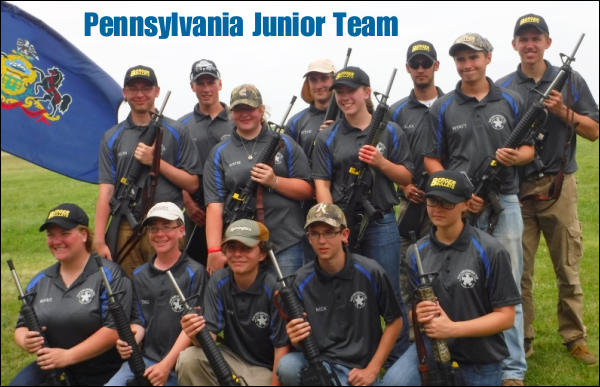
 It’s great to see young people get involved in the shooting sports and achieve success through dedication, practice, and team-work. We congratulate the Pennsylvania Junior Team which took first place in the 6-man and 2-man Junior team matches this year at Camp Perry. Special kudos go to this year’s High Junior, PA team member Matt Lovre, shown at right. It’s great to see young people get involved in the shooting sports and achieve success through dedication, practice, and team-work. We congratulate the Pennsylvania Junior Team which took first place in the 6-man and 2-man Junior team matches this year at Camp Perry. Special kudos go to this year’s High Junior, PA team member Matt Lovre, shown at right.
The winning 6-Man Pennsylvania squad included Jack Graw, Joe Hendricks, Kevin Kerin, Matt Lovre, Alexander Thomas and Wyatt Thomas. Alexander Thomas reports: “Great day, great coach, [Berger] bullets flying true. Conditions were tough, but team members held together to shoot awesome scores and take the number 1 spot at Nationals!”
The Pennsylvania Junior Team’s match load featured .22 cal Berger 77gr OTM bullets pushed by Alliant Reloder 15 powder. The team’s AR-platform rifles were smithed by Dead Center Sports with White Oak upper receivers and Geissele triggers.
August 2nd, 2015

The matriarch of American Long Range Shooting has done it again. The amazing Nancy Tompkins won the 2015 NRA Long Range Championship with an impressive performance. This marks the fifth time Nancy has won the LR Championship. This year’s LR match went down to the wire after many days of shooting. It all came down to X-Count, with two talented ladies tied for score. Shooting a 1242-58X over the multi-day competition, Nancy finished four Xs ahead of SSG Amanda Elsenboss (1242-54X). Both women dropped only 8 points out of 1250 possible. Amanda’s USAMU team-mate, SFC Brandon Green, finished third, one point back, at 1241-75X. SFC Green, the newly-crowned 2015 High Power National Champion, had high X-Count by a wide margin.
CLICK HERE for Complete 2015 NRA Long Range High Power Rifle Championships RESULTS.
This year’s Long Range Championships event was hugely popular, with 321 competitors on the match roster. Many familiar faces ranked among the Special Award winners. Our friends David Tubb (1241-69X) and Jim O’Connell (1235-66X) were High Senior and High Grand Senior, respectively. Tubb finished fourth overall, with the second-highest X-Count. There were also talented newcomers, such as High Junior Charlotte Flanagan, a young Kiwi from far-away New Zealand. Firing a 1236-40X, Charlotte is shooting at an extremely high level for someone so young. As Ken Littlefield noted: “It’s pretty impressive to come into Camp Perry for the first time and win the Junior Championship!” Charlotte could be formidable at the World Fullbore LR Championships slated for 3-9 August at Camp Perry.
Here are the overall Top 10 finishers. Note that Michelle Gallager, Nancy Tompkins’s daughter, made the Top 10, making this a “family affair” for the Tompkins/Gallagher clan:
1. NANCY TOMPKINS (1242-58X), HM, Div. B – U.S. Match ‘Any’ Rifle*, Rule 3.2, 3.7(c)
2. SSG AMANDA ELSENBOSS (1242-54X), HM, USA REG W Div. B – U.S. Palma Rifle, Rule 3.3.1(a)
3. SFC BRANDON GREEN (1241-75X), HM, USA REG Div. B – U.S. Palma Rifle, Rule 3.3.1(a)
4. DAVID TUBB (1241-69X), HM, Div. B – U.S. Palma Rifle, Rule 3.3.1(a)
5. DAVID CALVERT (1241-63X), MA, Palma Rifle (NRA Rule 3.3.3 (b))
6. JANE MESSER (1240-60X), HM, Palma Rifle (NRA Rule 3.3.3 (b))
7. DAVID LUCKMAN (1239-68X), MA, Palma Rifle (NRA Rule 3.3.3 (b))
8. SGT DICONZA (1238-59X), HM, USMC REG Div. B – U.S. Palma Rifle, Rule 3.3.1(a)
9. PHILLIP CROWE (1238-54X), HM, Div. B – U.S. Palma Rifle, Rule 3.3.1(a)
10. MICHELLE GALLAGHER (1237-64X), HM, Div. B – U.S. Palma Rifle, Rule 3.3.1(a)
*The NRA Match bulletin lists Palma Rifle, but Nancy said she shot her “Any Rifle”.
In this photo, Michelle Gallagher is missing … but someone had to take the photo.

Here is Nancy with the Tompkins Trophy. And yes, if you are wondering, that trophy was donated, decades ago, by hubby Mid Tompkins as the top prize for the Long Range High Power Rifle competition.
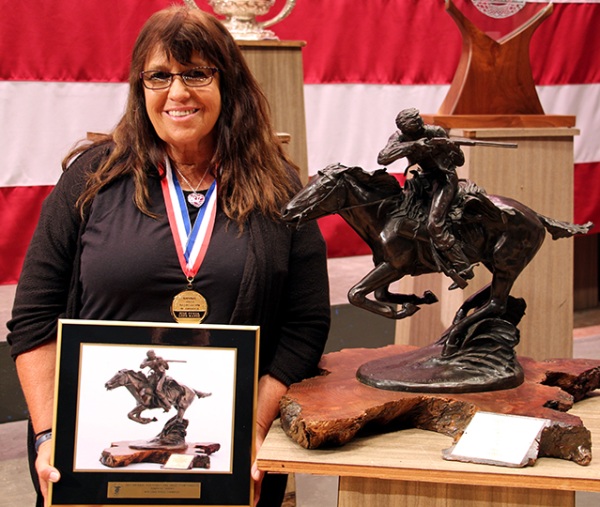
Photo courtesy NRABlog.com.
August 1st, 2015

How good are the best High Power position shooters? Pretty amazing actually. Here are some targets from the 2015 NRA High Power Championship at Camp Perry. Shown above is a 100-10X (literally a perfect score) at 200 yards. This was shot sitting, rapid-fire by 11-time National High Power Champion Carl Bernosky. That’s impressive to say the least. As one Facebook fan noted: “Not bad for an old codger with a bad back….”

File photo of Carl Bernosky from previous competition.
The target below is a 100-0X, shot rapid-fire prone by an unknown sling shooter. That may not seem that impressive at first, but this was fired from THREE HUNDRED yards. It takes a mighty solid hold to produce a nice 10-shot cluster like that without dropping a point.

To put these impressive performances in perspective, Lapua’s Kevin Thomas reports: “For those who aren’t familiar with these targets, the center X-Ring on both of these targets is 3 inches across. The 10-Ring is 7 inches across [including line], roughly the size of a small sandwich plate.”
Target Photos from Facebook by Aaron Perkins.
July 30th, 2015

The NRA High Power Long Range Championships kicked off on the 29th of July. Despite challenging winds there were many impressive performances, including one by newly-crowned NRA High Power Champion SFC Brandon Green. The talented USAMU shooter traded his Across-the-Course Rig for his 7mm RSAUM prone rifle to compete in the series of Long Range matches. Brandon shot very well, finishing with a 100-7X in the final Shoot-Off to win the Mustin Trophy match.
Shown at top is SFC Brandon Green with his long-range rifle. Note: the target in the photo shows the shot position for Brandon’s 10-shot Shoot-Off — all 10s and Xs. However, this is a REDUCED-SIZE target used for shot-marking (display) purposes only. The actual 1000-yard NRA Long-Range Target has a 10″ X-Ring, and a 20″ Ten-Ring. So the group of shots shown is much smaller than Green’s actual shots on the real 1000-yard target. Nonetheless this was a very impressive string for a sling-shooter using iron sights.
If you’re curious about Green’s long-range rifle, it is a 7mm RSAUM with an Anschutz trigger in a Robertson Composites prone-style stock. This rifle features iron sights, but when USAMU shooters participate in scoped “any sights” competitions, they normally use Nightforce NSX scopes, according the USAMU coach SFC Emil Praslick III.
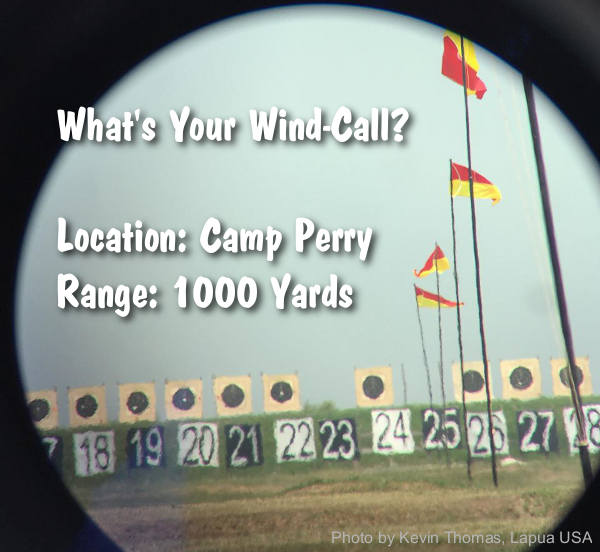
You Call the Wind…
Conditions were far from easy on Day 1 of the Long Range Championships. Here is a shot taken through a 25X spotting scope by Kevin Thomas of Lapua. Take a look at those flags swinging at different angles. Based on what you can see, what’s your wind call?
July 29th, 2015

Congratulations to SFC Brandon Green on winning the 2015 NRA National High Power Championship. Green shot an impressive 2387-140X to earn his second High Power title, finishing ahead of past Champion Norman Houle (2380-126X) and USAMU team-mate SFC Shane Barnhart (2379-127X). Brandon told AccurateShooter.com: “It’s a great honor and privilege to shoot and compete with such great people here at camp Perry. We had a great match this year and I already look forward to seeing everyone next year.”
Over 260 shooters competed in this year’s High Power Championship events. CLICK HERE to view complete match results, with overall rankings, as well as category-specific results.
It was a well-deserved win for Green, who had to over-come the effects of a nasty spider bite on his right arm (see photo). Joe Caley observed: “Our man Brandon Green and his new-found Spiderman powers pulled off another great Championship. Years from now, no one will remember the 2015 Championship [scores], but they will remember Brandon Green’s Spider Bite!”

SFC Green expressed gratitude to all those who assisted his efforts: “I just want to say thank you to all of my friends and family who support and help us do what we love to do. Thank you for all of the hard work, congratulations, and encouraging words. From the USAMU support team to the friends on the range and back home, I feel blessed to be surrounded by such wonderful people. THANK YOU!”
Here are the Top Ten Finishers, ranked by score for all Classifications:
| 1. SFC Brandon Green (HM) |
2387-140X |
U.S. Army, Service Match Rifle |
| 2. Norman Houle (HM) |
2380-126X |
Civilian Match Rifle |
| 3. SFC Shane Barnhart (HM) |
2379-127X |
U.S. Army, Service Match Rifle |
| 4. Rodrigo Rosa (HM) |
2374-106X |
Civilian Match Rifle |
| 5. MSG Robert Mango (HM) |
2372-104X |
U.S. Army Reserve, Service Rifle (NRA Rule 3.1) |
| 6. SGT Lee Bahten (HM) |
2370-116X |
U.S. Army, Service Rifle (NRA Rule 3.1) |
| 7. Joseph Hendricks (HM) |
2369-82X |
Civilian Match Rifle |
| 8. Ronald Zerr (HM) |
2367-112X |
Civilian Match Rifle |
| 9. CPT Samuel Freeman (HM) |
2367-96X |
U.S Army Reserve, Service Rifle (NRA Rule 3.1) |
| 10. Kenneth Lankford (HM) |
2367-95X |
Civilian Match Rifle |
CLICK HERE for Complete Results from NRA 2015 High Power National Championships.


Bernosky Forced to Withdraw Due to Medical Issues
Report by NRABlog.com
This is the second championship for SFC Green, whose first win came two years ago in 2013 after a tie with legendary shooter Carl Bernosky at 2384-126X each. Although both possessed the same point total and X-Count, Green was ultimately awarded the championship after a rulebook-mandated comparison of Xs at each distance gave him the advantage.
Bernosky, a ten-time NRA High Power Rifle champion, withdrew from this year’s competition after the first day (while in sole possession of first place) due to medical complications.
“This win is kind of bittersweet because Carl wasn’t able to be out here. We are pretty good friends and we’re both super competitive people so I wanted to shoot against him,” Green said. “Carl is one of the best competitors I’ve ever seen in this sport, Norm too, and it’s nice to be able to shoot with these guys every year.”
Range photos from 2015 HP Nat’l Championships courtesy NRABlog.com.
|


