Ever wondered what caused a particular bulge or marking on a case? And more importantly, does the issue make the case unsafe for further use? Sierra Bullets Ballistic Technician Duane Siercks offers some insight into various issues and their causes in this article from the Sierra Blog.
Incipient Case-Head Separation
This is a Winchester .308 Win case that has a real issue. This case has a very obvious incipient case head separation in the process of becoming a complete failure.
This is most commonly caused by over-sizing the case causing there to be excess headspace on the case. After a few firings and subsequent re-sizing, this case is just about ready to come completely apart. Proper die adjustment is certainly a requirement here. Of course this case is not safe to reuse.
Excessive Pressure (Load Too Hot)
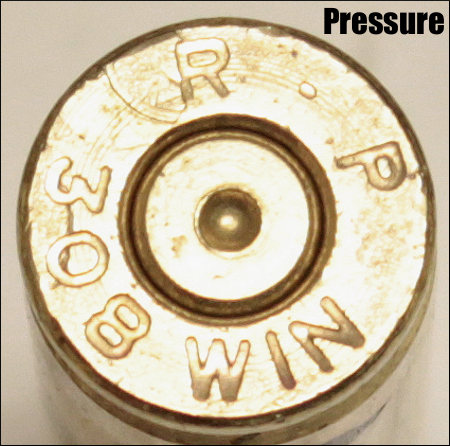
If you will notice in the picture of the case rim, there are two pressure signs to notice. First, look at the primer. It is basically flattened to about the max of what could be considered safe. If this was the only pressure sign noted, I would probably be fine with this load, but would constantly keep an eye on it especially if I was going to use this load in warmer temperatures. This load could easily cross into the “excess pressure” realm very quickly.
There is another sign of pressure that we cannot ignore. If you’ll notice, there is an ejector mark apparent that is located over the “R” of the R-P headstamp. This absolutely tells us that this load would not have been in the safe pressure range. If there were any of these rounds loaded, they should not be fired and should be dis-assembled. This case should not be reloaded.
Split Case-Neck
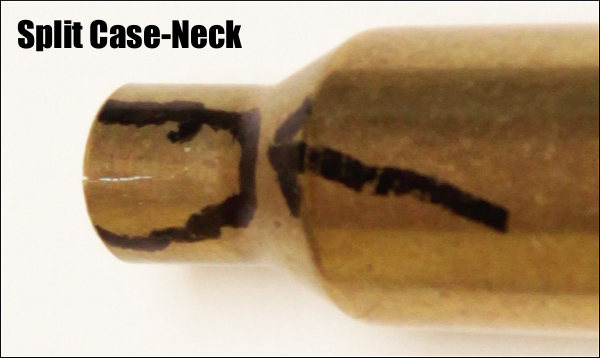
Here we have an R-P .22-250 case that has died the death. Everything looks fine with this case except the neck is split. This case must be tossed.
A split neck is a normal occurrence that you must watch for. It is caused by work-hardening of the brass. Brass cases get harder with age and use. Brand new cases that are stored for a period of time can become hard enough that they will split like this case within one to two firings. I have had new factory loads do the same thing. Then as we resize and fire these cases repeatedly, they tend to get harder and harder. Eventually they will split. The life of the case can be extended by careful annealing practices. This is an issue that would need to be addressed in an article by itself. Of course this case is no longer usable.
In the classes that I teach, I try to use examples like this to let the students see what they should be looking for. As always, if we can assist you, whether you are new to reloading or very experienced, contact us here at Sierra Bullets by phone at 1-800-223-8799 or by email at sierra@sierrabullets.com.
Dented Case Body
Here we have a Lake City 7.62×51 (.308 Win.) case with two heavy marks/dents in the case body.
This one may be a bit of a mystery. It appears as if this case may have been caught in the action of a semi-auto rifle when the firearm jammed or the case failed to clear during the cycling process. I probably would not reload this case just to prevent any feeding problems. This also appeared to be a factory loaded round and I don’t really see any pressure issues or damage to the case.
It is very important to observe and inspect your cases before each reloading. After awhile it becomes second nature to notice the little things. Never get complacent as you become more familiar with the reloading process. If ever in doubt, call Sierra’s Techs at 1-800-223-8799.
The most hotly-anticipated cartridge brass, the new-for-2017 6.5 Creedmoor cases from Lapua, arrived late last week at Graf & Sons. With the strength and uniformity for which Lapua brass is famous, this new brass should definitely “raise the bar” for 6.5 Creedmoor and 6mm Creedmoor shooters. Note — the new Lapua 6.5 Creedmoor brass features a small flash hole and small primer pocket. As of 9:00 am Monday morning this brass is in stock at Grafs.com priced at $119.99 per 100-ct box, with a max order of five (5) boxes.
UPDATE: The 6.5 Creedmoor brass sold out after we posted this story. But there will be more coming. You can ask Graf’s to be notified as soon as the next shipment arrives.
TECH TIP: For those who have been loading Hornady or other-brand 6.5 Creedmoor brass with large primer pockets and large flash holes, you may need to reconfigure your reloading tools. Check your sizing die — you may need to change to a smaller-diameter decapping rod. In addition you’ll need to use a small primer size “pusher” on your priming tool.
Here’s great news for mid-size cartridge fans, and especially PRS and tactical shooters. Lapua just announced it will produce 6.5 Creedmoor cartridge brass, which should be available in the first quarter of 2017. This premium-quality brass features a small primer, and 1.5mm flash hole (as found on Lapua’s 6mmBR, 6.5×47 Lapua, and 220 Russian brass). We expect Lapua’s 6.5 Creedmoor brass will set new standards for accuracy and case life for this popular mid-sized cartridge. Of course Lapua’s new 6.5 Creedmoor brass can also be necked down and loaded in 6mm Creedmoor configuration. With the small primer pocket and proven strength of Lapua brass, we think 6.5 Creedmoor shooters will see enhanced cartridge velocities with the ability to maintain tight primer pockets even with very stout loads. And we expect accuracy to be on a par with Lapua’s excellent 6.5×47 Lapua brass. Taken together, this is an exciting product release. Here is Lapua’s official announcement:
We are happy to announce the addition of the 6.5 Creedmoor case to the Lapua line! Despite a relatively short time on the marketplace, the 6.5 Creedmoor has made a tremendous splash in the field, rapidly becoming one of the most requested cases we hear about from shooters. Lapua’s 6.5 Creedmoor is designed to function in a short action, which is also a plus for hunters, vitally concerned with the rifle’s weight and compactness. In fact, many of the same features which make for a successful competition cartridge, translate nicely to the hunting fields as well.
For most species of mid-size game such as deer or boar, the Creedmoor will prove to be a deadly performer. And while the selection of high grade Match bullets in the 6.5 bore size is tremendous, there’s no shortage of exceptionally good hunting bullets either. The 6.5s as a group have always been known as excellent performers on game.
Made with Lapua’s typical dedication to precision, our new 6.5 Creedmoor case has been refined just a bit, to make it an even better performer. We’ve opted for the small rifle primer, which normally produces an optimized ignition and better accuracy than large primers in mid-sized cartridges like the Creedmoor.
We’ve also incorporated our smaller-diameter flash hole (1.5mm, rather than the industry-standard 2.0mm), which has proven to provide enhanced accuracy, and is used in a number of our other accuracy-oriented cases. In this respect, the new 6.5 Creedmoor joins the ranks of our other dedicated accuracy cartridges such as the .220 Russian (6mm PPC), the 6mmBR Norma, the 6.5×47 Lapua, and the .308 Win Palma cases.
And naturally, the new 6.5 Creedmoor will be made with our well-known Passion for Precision. Strictest control over the metallurgy, the forming and drawing processes, precise annealing all performed under the watchful eyes of our production experts. For you, the handloader, that means the durability for which our cases are famous, combined with consistency and long life. Already proven in competition, we predict that the 6.5 Creedmoor will be a force to be reckoned with for many years to come.
Comment on Lapua’s new 6.5mm Creedmoor
Our British friend Laurie Holland was excited about the new 6.5 Creedmoor brass from Lapua: “With this and Peterson Cartridge on the bandwagon, plus another U.S. brass maker… the Creedmoor’s momentum is becoming impressive.” Laurie observes: “A small primer Lapua-cased 6.5mm Creedmoor is in effect a 6.5X47 Lapua ‘Improved’!” That’s a pretty interesting concept indeed. Which makes us wonder if the .260 Remington has finally been fully eclipsed. With Lapua 6.5 Creedmoor brass you can probably get very, very close to .260 Rem performance in a much more efficient case.
The Nammo Group, parent of Lapua and Vihtavuori, has announced the acquisition of Berger Bullets, one of the USA’s leading bullet makers. With Berger Bullets joining the Nammo Group, this teams America’s ultra-premium bullet-maker with what is arguably the world’s most respected cartridge brass and ammunition-maker. This is huge news. For competition shooters this may be a “marriage made in heaven”. Many top shooters, including champions like Bryan Litz and John Whidden, are already shooting Berger bullets in Lapua brass. This merger will make it easier for the two companies (Berger and Lapua) to optimize the performance of factory ammo, as well as to optimize brass for use with Berger match projectiles.
A spokesman for Lapua said that Lapua will continue to make bullets in Europe while Berger will conduct its regular operations in the USA: “Lapua will still make bullets, and it will be ‘business as usual’ for Berger at this time. There are no plans to change production sites to consolidate product lines. Berger will continue to operate as an independent business, just under the Nammo umbrella.” NOTE: This acquisition will be subject to regulatory approvals by U.S. governmental authorities.
On firearm industry analyst believes this merger is a “win-win” for both Berger and Nammo: “This will help Berger export more product to the European market while it will give Nammo a stronger connection to the huge U.S. firearms market, expanding Nammo’s North American customer base”. Nammo president/CEO Morten Brandtzæg concurred, stating: “Having Berger Bullets on board is the perfect match for Nammo. Their products, which are complementary to our other premium brands, will strengthen our group’s strategic position in the U.S. commercial ammunition market.” This acquistion WILL include Berger’s ABM Ammunition and J-4 Jackets product lines.
Here is the press release issued by the Nammo Group, which is headquartered in Norway and has 2,100 employees in 12 countries:
Ever wondered what caused a particular bulge or marking on a case? And more importantly, does the issue make the case unsafe for further use? Sierra Bullets Ballistic Technician Duane Siercks offers some insight into various issues and their causes in this article from the Sierra Blog.
Diagnosing Problems with Cartridge Brass
by Duane Siercks, Sierra Bullets
I was handed a small sample of .223 Rem cases the other day and was asked if I could comment on some marks and appearances that had been noticed as they were sorting through the cases. I will share what was observed and give you what would seem to be a cause for them. These were from an unknown source, so I have no way of knowing what type of firearm they were fired in or if they were factory loaded or reloaded ammunition.
Example ONE: Lake City 5.56, Unknown Year
Case #1 was seen to have a very rounded shoulder and split. Upon first look it was obvious that this round had been a victim of excess pressure. The firearm (perhaps an AR?) was apparently not in full battery, or there was possibly a headspace issue also. While taking a closer look, the primer was very flat and the outside radius of the primer cup had been lost. High pressure! Then I also noticed that there was an ejector mark on the case rim. This is most certainly an incident of excessive pressure. This case is ruined and should be discarded. See photo below.
Example TWO: Lake City Match 1993
Case #2 appears very normal. There was some question about marks seen on the primer. The primer is not overly flattened and is typical for a safe maximum load. There is a small amount of cratering seen here. This can be caused by a couple of situations.
Cratering is often referred to as a sign of excess pressure. With safety in mind, this is probably something that should make one stop and really assess the situation. Being as there are no other signs of pressure seen with this case, I doubt that pressure was unsafe. That leads us to the next possibility. This can also be caused by the firing-pin hole in the bolt-face being a bit larger than the firing-pin, and allowing the primer to flow back into the firing-pin hole causing the crater seen here. This can happen even with less-than-max pressures, in fact it has been noted even at starting loads. Always question whether pressure is involved when you see a crater. In this situation, I lean toward a large firing-pin hole. This case should be safe to reload.
Example THREE: R-P .223 Remington
Case #3 appears normal with one exception. There are two rings seen about one half inch below the base of the shoulder. These rings are around the circumference of the case, one being quite pronounced, and the other being noticeably less.
As we do not know the origin of the firearm in which this case was fired, it does seem apparent that the chamber of the firearm possibly had a slight defect. It could have been that the reamer was damaged during the cutting of this chamber. I would suggest that the chamber did have a couple of grooves that imprinted onto the case upon firing. This firearm, while maybe not dangerous should be looked at by a competent gunsmith. In all likelihood, this case is still safe to use.
Example FOUR: R-P .223 Remington
Case #4 has no signs of excess pressure. There is a bulge in the case just ahead of the case head that some might be alarmed by. This bulge is more than likely caused by this case being fired in a firearm that had a chamber on the maximum side of S.A.A.M.I. specifications. There is actually no real issue with the case. Note that the primer would indicate this load was relatively mild on pressure.
If this case was reloaded and used in the same firearm numerous times there might be a concern about case head separation. If you were going to use this case to load in an AR, be sure to completely full-length re-size to avoid chambering difficulties. This case would be safe to reload.
It is very important to observe and inspect your cases before each reloading. After awhile it becomes second nature to notice the little things. Never get complacent as you become more familiar with the reloading process. If ever in doubt, call Sierra’s Techs at 1-800-223-8799.
Our good friends Ed and Steve (aka “The 6.5 Guys”) have just released an in-depth product review of the AMP Annealing system. Produced in New Zealand, the AMP (Annealing Made Perfect) unit is a sophisticated, microprocessor-controlled annealing machine that achieves ultra-consistent results through an electrical INDUCTION process.
AMP Annealing Machine Review by the 6.5 Guys:
Ed was so impressed with the AMP annealer that he purchased his own AMP to replace a carousel-type, dual-torch annealer he previously used. Ed tells us that “once you have the correct setting for your brass the AMP’s results are repeatable every time.” By contrast, Ed explained, “with butane torch systems you have to adjust the system when the ambient temperature changes, or even if your butane fuel is slightly different.” Ed says that, with his AMP system, he can anneal a case every few seconds. Yes it does require manually handling each case but “the actual annealing process is so fast, this really isn’t a big issue.”
If you want to extend the useful life of your precious cartridge brass, then you should definitely consider annealing. And if you are in the market for an annealer, the new AMP machine deserves serious consideration. Though not inexpensive, it achieves excellent results according to the 6.5 Guys.
6.5 Guys’ AMP Annealer Review Key Points:
1. The AMP machine provides complete peace of mind that you are annealing properly — there is no guesswork. With a propane machine you have to calibrate dwell times which can be error prone. Even if you don’t change out your cartridge, dwell times will vary with temperature changes as this affects the propane pressure.
2. We noticed that the AMP machine produces brass that is more like factory brass from a hardness standpoint. Despite all our efforts and research around calibrating our propane machines, brass never seemed returned to factory condition and shoulder spring-back would increase with each reloading so we had to adjust our sizing dies. When a cartridge comes out of the AMP it is very, very close to new condition.
3. One of the things we dreaded was setting up our propane machine for different cartridges. With Ed’s OCD he would spend a good 30 minutes making sure everything was perfect. With the AMP machine you simply change out the pilot and select the proper program. It’s really straight-forward.
NOTE: We strongly recommend you read the Full AMP Annealer Review on 65guys.com. It contains a detailed explanation of the machines’ operation and the reviewers explain the pros (and cons) or the machine compared to flame-type annealers.
The current price for the AMP Annealer, with three pilots of your choice, is $995.00 USD. Additional pilots are $20.00 USD. For more info, visit www.AMPAnnealing.com.
Social Media fans take note — Lapua is now on Facebook. Lapua recently launched its official Facebook page focusing on Lapua sport shooting components and ammunition. The page will feature shooting news, match results, product info, shooter profiles, videos, tech tips, and other Lapua-related material. You can follow Lapua on Facebook by visiting www.facebook.com/LapuaAmmunition.
Lapua Products and Company History
Lapua (officially Nammo Lapua Oy), is part of the large Nordic Nammo Group. Lapua’s main products include premium cartridge brass, bullets, small caliber cartridges, rimfire cartridges, and reloading components for civilian and professional use. The Lapua cartridge factory was established in 1923. From a modest and practical beginning, Lapua has grown into one of the most respected brands in the industry. The best shooters in the world choose Lapua cartridges and components. In 2014, Nammo acquired the Vihtavuori smokeless powder factory.
Close-up of the Tri Way cutter with clear plastic chip guard removed.
Tired of trimming and chamfering your cartridge brass by hand? Giraud Tool may have a solution. Giraud, makers of rugged bench-mounted case prep machines, now offers a new case trimmer/chamferer that works with a power drill (or other power source). Giraud’s patent-pending Tri Way Case Trimmer is a self-contained unit powered by your drill or motor. Using a sharp carbide blade it will trim your cases to length, deburr, and cut both inside and outside chamfers — all in one pass. That’s pretty impressive for a $98.00 tool that fits in the palm of your hand.
Product Features
1. Fully adjustable for cartridge length (and depth of chamfer).
2. Tool includes carbide blade that cuts a 15° inside case mouth chamfer and 45° outside chamfer.
3. Case holder supported by sealed ball bearing raceway.
4. Tool includes removable, transparent plastic chip guard.
5. Tool can work in any orientation (vertical, horizontal, or any angle).
The Giraud Tri Way Trimmer is designed to be powered by a portable hand drill, drill press, or other dedicated rotating power source. The tool indexes off the shoulder of your cases, but the blade adjusts so that cartridge overall length (COAL) can be controlled with precision. Constructed out of 6061-T6 aluminum and 303 stainless steel, the Tri Way is rugged. Note: This tool is not universal. The Tri Way is dedicated to a single cartridge and “related” cartridges with similar body dimensions. Thus you need a specific tool for each cartridge family. For example, the .308 Win tool will also trim .243 Win, .260 Rem, and 7mm-08.
Cartridge Sizes Available for Giraud Tri Way Trimmer:
.223 Remington (Also trims .17 Rem, .204 Ruger, .222 Rem, .222 Rem Magnum)
7.62 x 39mm (Russian)
.300 Blackout (Also trims .17 Rem Fireball, .221 Fireball)
.308 Winchester (Also trims .243 Winchester, .260 Remington, 7mm-08)
.30-06 Springfield (Also trims .25-06, .270 Winchester, .280 Remington)
.300 Winchester Mag (Also trims .264 Winchester Magnum, 7mm Remington Magnum)
Product Tip from EdLongrange. We welcome reader submissions.
Norma has released a fascinating video showing how bullet, brass, and ammunition are produced at the Norma Precision AB factory which first opened in 1902. You can see how cartridges are made starting with brass disks, then formed into shape through a series of processes, including “hitting [the cup] with a 30-ton hammer”. After annealing (shown at 0:08″), samples from every batch of brass are analyzed (at multiple points along the case length) to check metal grain structure and hardness. Before packing, each case is visually inspected by a human being (3:27″ time-mark).
The video also shows how bullets are made from jackets and lead cores. Finally, you can watch the loading machines that fill cases with powder, seat the bullets, and then transport the loaded rounds to the packing system. In his enthusiasm, the reporter/narrator does sometimes confuse the term “bullets” and “rounds” (5:00″), but you can figure out what he means. We definitely recommend watching this video. It’s fascinating to see 110-year-old sorting devices on the assembly line right next to state-of-the art, digitally-controlled production machinery.
Video tip by EdLongrange. We welcome reader submissions.
Here’s something you don’t see every day — pistol-caliber Lapua brass. We shoot superior Lapua brass in our rifles, and now you can get the “good stuff” for your 9mm pistols too. It’s nice to know that Lapua 9mm brass is available for those guys who accept “nothing but the best”. Grafs.com received a special order of 9mm Luger (aka 9x19mm or 9mm NATO) pistol brass made by Lapua. It is available right now for $19.99 per 100-count bag or $179.99 per 1000-count box. That’s 38% off the regular 1K box price.
When It Pays to Shoot Premium Pistol Brass
Is this Lapua 9mm brass worth the price compared to the cheaper alternatives (such as once-fired police range pickups)? We think the answer depends on your application. If you shoot a 9mm pistol in Bullseye competition, yes it makes sense to get the Lapua. Or, if you have a 9mm revolver that carries the shells in a moon clip, the Lapua brass may be worth getting. With a 9mm revolver, your brass is not marred by an extractor claw and then ejected on to the ground. If we had the impressive new 8-shot, Miculek Edition Smith & Wesson model 929 9mm revolver (below), we’d definitely shoot Lapua brass.




 Made with Lapua’s typical dedication to precision, our new 6.5 Creedmoor case has been refined just a bit, to make it an even better performer. We’ve opted for the small rifle primer, which normally produces an optimized ignition and better accuracy than large primers in mid-sized cartridges like the Creedmoor.


 Norma has released a fascinating video showing how bullet, brass, and ammunition are produced at the


