We can predict, with some certainty, how long a light bulb will last (in use), or a shingle roof, or even a nuclear reactor. But how about barrels? Is there a way to reliably estimate barrel life based on known characteristics? This article explains one effort to quantify barrel life…
How long will a barrel last before the accuracy “goes south”? There are so many variables involved (powder type, bore diameter, bullet coatings etc.) that it’s hard to predict. You might say “Well, my buddy has a .243 and he got 1500 rounds before the throat was shot out” — those kind of comparisons can be useful, but they’re not very scientific, and they won’t help much if you’ve got a gun in a new chambering (such as the 6.5×47) for which long-term test results are lacking.
Is there a more reliable way to predict barrel life — one that will work for a broad range of calibers? Well, Forum member MikeCr has developed an Excel spreadsheet that accounts for a number of variables, and gives a pretty good estimate of useful barrel life, whether you’re shooting a .223 Rem or a 338 Lapua Magnum. Mike’s program predicts barrel life using five variables: 1) Bullet Diameter; 2) Powder Charge weight; 3) Powder Heat Potential (KJ/kg); 4) Pressure (in psi); and 5) Bullet Coating (yes/no). Mike provides a table with Heat Potential ratings for most popular powder types. The user needs to know the pressure of his load. This can be estimated with QuickLOAD.
You can download the lastest version of Mike’s spreadsheet below. You’ll need Excel or an Excel viewer to open the file.
Shown below is Mike’s Spreadsheet, with variables for a 6BR shooting 105gr “naked” bullets with 30.3 grains of Hodgdon Varget powder. The formula predicts 2401 rounds of barrel life. That corresponds pretty well to what we’d expect for a 6BR — about 2500 rounds.
Mike observes: “There has been alot of discussion lately related to cartridge design and resulting barrel life. This is a really important factor to consider amongst a myriad of choices. Barrel life is controversial, and subjective. There are no clear-cut standards for comparison. But a few years ago, I put together a spreadsheet based on Bart Bobbit’s rule of thumb. It worked pretty good, only occasionally failing some tests when validated against posted barrel lives.
According to Ken Howell, I had to account for pressure. And Henry Child’s powder temperature testing provided another piece needed. So, I’ve tweaked it here and there to pass more tests. From 223rem to 300 UltraMagnum. Another element added, but turned off is shot interval. I would need way more tests to lock in on this. But everyone knows, the faster you shoot, the worse the barrel life.
Anyway, another factor hard to define is ‘accurate’ barrel life. This cannot be quantified without standards. Barrels are replaced when expectations are no longer met. I feel that a [barrel] passes peak potential in a finite period due to throat erosion. But that don’t mean it’s toast, if it still shoots well enough. It’s just as likely that many of us never see that peak potential anyway. It’s a slippery thing. Point-blank BR competitors will toss a barrel when it leaves the 1s. I could get another 4000 rounds from it, and be content with its performance, I’m sure.”
NOTE: Mike says: “This spreadsheet may show a lower barrel life than you prefer. But it pretty well spotlights cartridges to stay away from if you plan much time at the range or in dog town.”
Editor’s Comment: We want to stress that Mike’s spreadsheet is a helpful tool, but it is not a definitive “take-it-to-the-bank” indicator of barrel life. Mike cautions that predicting barrel life involves so many different factors (including how hot the barrel is run), that the task is a bit like predicting tread life on car tires. Still, the spreadsheet is very helpful. It can certainly warn us that some chamberings (such as the 6-284) are likely to be barrel burners. That can help you make a smart decision when choosing a chambering for your next rifle.
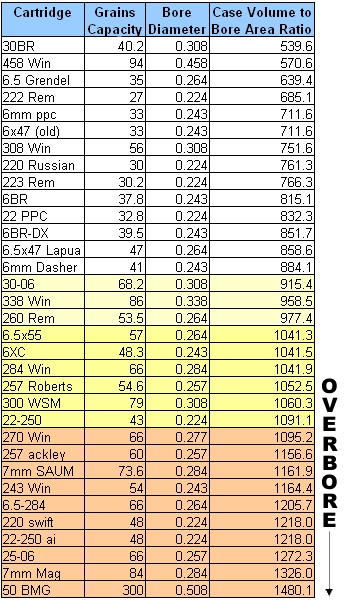
Forum Member John L. has been intrigued by the question of “overbore” cartridges. People generally agree that overbore designs can be “barrel burners”, but is there a way to predict barrel life based on how radically a case is “overbore”? John notes that there is no generally accepted definition of “overbore”. Based on analyses of a wide variety of cartridges, John hoped to create a comparative index to determine whether a cartridge is more or less “overbore”. This, in turn, might help us predict barrel life and maybe even predict the cartridge’s accuracy potential.
John tells us: “I have read countless discussions about overbore cartridges for years. There seemed to be some widely accepted, general rules of thumb as to what makes a case ‘overbore’. In the simplest terms, a very big case pushing a relatively small diameter bullet is acknowledged as the classic overbore design. But it’s not just large powder capacity that creates an overbore situation — it is the relationship between powder capacity and barrel bore diameter. Looking at those two factors, we can express the ‘Overbore Index’ as a mathematical formula — the case capacity in grains of water divided by the area (in square inches) of the bore cross-section. This gives us an Index which lets us compare various cartridge designs.”
OVERBORE INDEX Chart
So what do these numbers mean? John says: “My own conclusion from much reading and analysis is that cartridges with case volume to bore area ratio less than 900 are most likely easy on barrels and those greater than 1000 are hard on barrels.” John acknowledges, however, that these numbers are just for comparison purposes. One can’t simply use the Index number, by itself, to predict barrel life. For example, one cannot conclude that a 600 Index number cartridge will necessarily give twice the barrel life of a 1200 Index cartridge. However, John says, a lower index number “seems to be a good predictor of barrel life”.
John’s system, while not perfect, does give us a benchmark to compare various cartridge designs. If, for example, you’re trying to decide between a 6.5-284 and a 260 Remington, it makes sense to compare the “Overbore Index” number for both cartridges. Then, of course, you have to consider other factors such as powder type, pressure, velocity, bullet weight, and barrel hardness.
Overbore Cases and Accuracy
Barrel life may not be the only thing predicted by the ratio of powder capacity to bore cross-section area. John thinks that if we look at our most accurate cartridges, such as the 6 PPC, and 30 BR, there’s some indication that lower Index numbers are associated with greater inherent accuracy. This is only a theory. John notes: “While I do not have the facilities to validate the hypothesis that the case capacity to bore area ratio is a good predictor of accuracy — along with other well-known factors — it seems to be one important factor.”
We had a chance to try out the new power case trimmer head from Little Crow Gunworks. Dubbed the “World’s Finest Trimmer” (WFT) by its inventor, Dale Hegstrom, this device proved fast, precise, and easy to use. When compared to a Hornady Lock ‘N Load hand-crank trimmer, the WFT processed cases twice as fast, and delivered a more uniform cut length with our test brass.
The WFT features a steel shell-holder, aluminum body, and steel drive shank. You can chuck it into any electric drill or power device that can handle the 3/8″ shank. Unlike most case trimming tools, the WFT indexes off the shoulder datum. This permits you to trim cases very quickly, without fiddling around with rim-grabbing collets, or shell-holders. Watch the videos to see the WFT in action.
WFT is Fast and User-Friendly
Mark LaFevers, our tester, was easily able to trim five (5) cases in under 30 seconds. It took quite a bit longer to trim five cases with the Hornady trimmer he used for comparison. Mark noted that, after just a 20 or so manually-trimmed cases, his arm would start to fatigue. By contrast, he could effortlessly trim 100 or more cases with the WFT. For older folks with a bit of arthritis, the WFT makes life easier. Mark observed that the WFT produces a “nice, square, clean cut”, while offering a “very fast cycle rate”. He tells us, “once you get the hang of it, you probably can trim your brass two, if not three times as fast.”
Mark really liked the WFT tool, and a WFT will be replacing his hand trimmer for big jobs. One downside is that, currently, the WFT is cartridge specific — you normally need to have a different tool for each cartridge type you trim. And there are no swappable inserts allowing you to trim different cartridge types with the same tool. However some WFT versions WILL trim different cartridge types within the same “family”, such as .270 Win and .30-06.*
Hi-Rez Video Shows “Trim-Off” Challenge between WFT and Hornady Trimmer
You should definitely watch the five-minute video below. Mark trims five cases with the WFT, and then five more with the Hornady tool. He times the operation of each device and then measures the trimmed cases. The total variation (in length) of the WFT-trimmed cases was .001. With the Hornady tool, there was a much larger spread: .007″ (seven thousandths). Mark cautioned: “Normally the Hornady tool does a bit better than this — the variance won’t be so large. But getting better results (with the Hornady) might require trimming, measuring, then trimming again. In the video I was trying to move pretty quickly and the measurements were all taken after the initial trim. Possibly, if I slowed down when using the Hornady trimmer, the OAL measurements would have been more consistent. But that just further reinforces the point that the WFT is faster.”
NOTE: If you have a fast connection, we suggest you select 720p (HiRez) and expand to full screen.
In the video below, WFT creator Dale Hegstrom demos his device and shows how quickly it can trim a large quantity of brass. Note how the WFT is attached to a common rechargeable power drill.
“World’s Finest Trimmer” Costs $69.95
The Little Crow Gunworks “World’s Finest Trimmer is available for $69.95 from various vendors including Creedmoor Sports. WFTs index off the shoulder, not the base. The case fits tightly into a steel bearing which has been machined to a specific caliber. This decouples the stationary case from the spinning cutting blade and body, giving you a smooth, exact cut each time. While the WFT makes a nice, square cut, we do recommend chamfering inside and outside after the brass is trimmed to length.
*Most WFTs are cartridge specific. Available sizes include: .204 Ruger, .223 Rem, 22-250, 6mmBR, 6.5 Grendel, 6.5×47 Lapua, 6.5 Creedmoor, 6.5-284 (and 6mm-284), 6.8 SPC, 270 WSM, 7mm Rem Mag (and 300 Win Mag), .308 Win, 300 WSM, .338 Lapua Magnum. There is a ‘5 in 1′ WFT unit that will handle .17 Rem, .221 Fireball, .222, .223 Rem, and .222 Mag. The 6mmRem unit also works with .257 Roberts and 7×57 Mauser. The .30-06 WFT will trim .270 Win, .280 Rem, and .25-06 as well. And the WFT for Ultramags works with 7mm, 300, and .338 Ultramags.
In our Shooters’ Forum a reader recently asked: “How much neck tension should I use?” This prompted a Forum discussion in which other Forum members recommended a specific number based on their experience, such as .001″, .002″, or .003″. These numbers, as commonly used, correspond to the difference between case-neck OD after sizing and the neck OD of a loaded round, with bullet in place. In other words, the numbers refer to the nominal amount of interference fit (after sizing).
While these commonly-used “tension numbers” (of .001″, .002″ etc.) can be useful as starting points, neck tension is actually a fairly complex subject. The actual amount of “grip” on the bullet is a function of many factors, of which neck-OD reduction during sizing is just one. Understanding these many factors will help you maintain consistent neck tension as your brass “evolves” over the course of multiple reloadings.
Neck Tension (i.e. Grip on Bullets) Is a Complex Phenomenon
While we certainly have considerable control over neck tension by using tighter or looser bushings (with smaller or bigger Inside Diameters), bushing size is only one factor at work. It’s important to understand the multiple factors that can increase or decrease the resistance to bullet release. Think in terms of overall brass-on-bullet “grip” instead of just bushing size.
One needs to understand that bushing size isn’t the beginning and end of neck tension questions, because, even if bushing size is held constant, the amount of bullet “grip” can change dramatically as the condition of your brass changes. Bullet “grip” can also change if you alter your seating depth significantly, and it can even change if you ultrasonically clean your cases.
Bullet grip is affected by many things, such as:
1. Neck-wall thickness.
2. Amount of bearing surface (shank) in the neck.
3. Surface condition inside of neck (residual carbon can act as a lubricant; ultrasonic cleaning makes necks “grabby”).
4. Length of neck (e.g. 6BR neck vs. 6BRX).
5. Whether or not the bullets have an anti-friction coating.
6. The springiness of the brass (which is related to degree of work-hardening; number of firings etc.)
7. The bullet jacket material.
8. The outside diameter of the bullet and whether it has a pressure ridge.
9. The time duration between bullet seating and actual firing (necks can stiffen with time).
10. How often the brass is annealed
— and there are others…
Seating Depth Changes Can Increase or Decrease Grip on Bullet
You can do this simple experiment. Seat a boat-tail bullet in your sized neck with .150″ of bearing surface (shank) in the neck. Now remove the bullet with an impact hammer. Next, take another identical bullet and seat it with .300″ of bearing surface in another sized case (same bushing size/same nominal tension). You’ll find the deeper-seated bullet is gripped much harder.
Neck-Wall Thickness is Important Too
I have also found that thinner necks, particularly the very thin necks used by many PPC shooters, require more sizing to give equivalent “grip”. Again, do your own experiment. Seat a bullet in a case turned to .008″ neckwall thickness and sized down .003″. Now compare that to a case with .014″ neckwall thickness and sized down .0015″. You may find that the bullet in the thin necks actually pulls out easier, though it supposedly has more “neck tension”, if one were to consider bushing size alone.
In practical terms, because thick necks are less elastic than very thin necks, when you turn necks you may need to run tighter bushings to maintain the same amount of actual grip on the bullets (as compared to no-turn brass). Consequently, I suspect the guys using .0015″ “tension” on no-turn brass may be a lot closer to the guys using .003″ “tension” on turned necks than either group may realize.
Toward a Better Definition of Neck Tension
As a convenient short-cut, we tend to describe neck tension by bushing size alone. When a guy says, “I run .002 neck tension”, that normally means he is using a die/bushing that sizes the necks .002″ smaller than a loaded round. Well we know something about his post-sizing neck OD, but do we really have a reliable idea about how much force is required to release his bullets? Maybe not… This use of the term “neck tension” when we are really only describing the amount of neck diameter reduction with a die/bushing is really kind of incomplete.
My point here is that it is overly simplistic to ask, “should I load with .001 tension or .003?” In reality, an .001″ reduction (after springback) on a thick neck might provide MORE “grip” on a deep-seated bullet than an .003″ reduction on a very thin-walled neck holding a bullet with minimal bearing surface in the neck. Bushing ID is something we can easily measure and verify. We use bushing size as a descriptor of neck tension because it is convenient and because the other important factors are hard to quantify. But those factors shouldn’t be ignored if you want to maintain consistent neck tension for optimal accuracy.
Consistency and accuracy — that’s really what this all about isn’t it? We want to find the best neck tension for accuracy, and then maintain that amount of grip-on-bullet over time. To do that you need to look not only at your bushing size, but also at how your brass has changed (work-hardened) with time, and whether other variables (such as the amount of carbon in the neck) have changed. Ultimately, optimal neck tension must be ascertained experimentally. You have to go out and test empirically to see what works, in YOUR rifle, with YOUR bullets and YOUR brass. And you may have to change the nominal tension setting (i.e. bushing size) as your brass work-hardens or IF YOU CHANGE SEATING DEPTHS.
Remember that bushing size alone does not tell us all we need to know about the neck’s true “holding power” on a bullet, or the energy required for bullet release. True bullet grip is a more complicated phenomenon, one that is affected by numerous factors, some of which are very hard to quantify.
On his Riflemans’ Journal blog, German Salazar wrote an excellent article about cartridge Case-Head Separation. We strongly recommend that you read this article. German examines the causes of this serious problem and he explains the ways you can inspect your brass to minimize the risk of a case-head separation. As cases get fired multiple times and then resized during reloading, the cases can stretch. Typically, there is a point in the lower section of the case where the case-walls thin out. This is your “danger zone” and you need to watch for tell-tale signs of weakening.
The photo below shows a case sectioned so that you can see where the case wall becomes thinner near the web. German scribed a little arrow into the soot inside the case pointing to the thinned area. This case hadn’t split yet, but it most likely would do so after one or two more firings.
One great tip offered by German Salazar involves using a bent paper clip to detect potential case wall problems. Slide the paper clip inside your case to check for thin spots. German explains: “This simple little tool (bent paper clip) will let you check the inside of cases before you reload them. The thin spot will be immediately apparent as you run the clip up the inside of the case. If you’re seeing a shiny line on the outside and the clip is really hitting a thin spot inside, it’s time to retire the case. If you do this every time you reload, on at least 15% of your cases, you’ll develop a good feel for what the thin spot feels like and how it gets worse as the case is reloaded more times. And if you’re loading the night before a match and feel pressured for time — don’t skip this step!”
One of our Shooters’ Forum readers, Trent from Louisiana, asked for help deciding between a 260 Remington and a 6.5×55 for his latest gun project. In the Forum thread, respected UK gun writer Laurie Holland provided a good summary of the differences between the two chamberings. Laurie writes:
“The 6.5×55 case has 6 or 7% more capacity than the .260s, even more in practice when both are loaded to standard COALs with heavy bullets, which sees them having to seated very deep in the .260 Rem using up quite a lot of powder capacity. So loaded up for reasonable pressures in modern actions, the 6.5×55 will give a bit more performance.
The issue for many is what action length is available or wanted, the 6.5 requiring a long action. So sniper rifle / tactical rifle competitors will go for the .260 Rem with the option of the many good short-bolt-throw designs around with detachable box magazines. If a bit more performance is needed, the .260AI gives another 100-150 fps depending on bullet weight.
Brass-wise, you’ve got really good Lapua 6.5×55 off the shelf that needs minimum preparation, and it’s strong and long-lived. There is an Ackley version too that was popular in F-Class in Europe for a while that isn’t too far short of 6.5-284 performance. If you go for .260 Rem, the American brass isn’t as good but you can neck-up Lapua or Norma .243 Win and trim them (or neck-down .308 Win or 7mm-08). This has the downside that doing so usually creates a noticeable ‘doughnut’ at the case-shoulder junction, that may cause problems depending on how deep bullets are seated.
For purely target shooting, I think I’d go with 6.5×55 if I was making the choice again today for performance and brass-preparation reasons. In fact, I’ve considered going back to the gunsmith to have the barrel rechambered.
You want a multi-purpose rifle though and that makes things trickier depending on the bullet weight(s) you want to use. The [typical] 6.5×55 and 6.5-08 throats are really designed for 140s, so 90-120s make a long jump into the rifling. If you’re always going to use 130s and up, it’s less of an issue. If you want to use the lighter stuff, I’d say go for .260 Rem and discuss the reamer with the gunsmith to come up with as good a compromise as you can depending on the mix of shooting. 1:8.5″ twist is the norm and handles all the usual sporting and match bullets; you can go for a little slower twist if you won’t use the heavies.
Over here in the UK, in Scotland to be precise, we have a top sporting rifle builder (Callum Ferguson of Precision Rifle Services) who almost specializes in .260 Rem usually built on Borden actions. He throats the barrel ‘short’ so it’s suited to varmint bullets, but will still handle the 100gr Nosler Partition which he says is more than adequate for any British deer species including Scottish red stags.
Accuracy-wise, I don’t think there’s anything between them if everything else is equal. The 6.5 has a reputation for superlative accuracy, but that was high-quality Swedish military rifles and ammunition matched against often not-so-high-quality military stuff from elsewhere. Put the pair in custom rifles and use equally good brass and bullets and you’ll be hard pressed to tell them apart.” – Laurie Holland
After Laurie’s helpful comments, some other Forum members added their insights on the 260 Rem vs. 6.5×55 question:
“To me, the .260 Remington has no advantage over the 6.5×55 if one is going to use a long action. Likewise, the only advantage the .260 has in a modern rifle is it can be used in a short-action. There is more powder capacity in the 6.5×55 so you have the potential to get more velocity plus there is a lot of reloading data available to you for loading at lower velocity/pressure if you choose. The Lapua brass is great and Winchester brass is pretty good at low pressures. Having loaded a good bit for both, the 6.5×55 would always get the nod from me. To me, if someone wants to use a short-action, the 6.5×47 Lapua is even a better option than the .260 for a target rifle.” — Olympian
“There is just one small item that has been missing from this conversation — the 6.5×55 has a non standard rim diameter of .479″ vs. the standard .473″ of a .308 and all of its varients. Depending on your bolt this may be an issue, or it may not.” — Neil L.
A unique, comprehensive Cartridge Comparison Guide is now available as both a spiral-bound book and as an online database. The Cartridge Comparision Guide is the product of many years of labor by Andrew Chamberlain, a Utah-based hunter. Andrew says his Guide “compares every factory available cartridge from the 17 calibers up to the 50 caliber cartridges”. (Sorry, most wildcat cartridges are not covered.) Chamberlain’s Guide also compiles cartridge data from major ammunition manufacturers such as Barnes, Federal, Hornady, Norma, Nosler, Remington, Sierra, Swift, Weatherby, and Winchester. It shows the optimal velocity achieved for each bullet weight and calculates bullet energy, recoil, and powder efficiency.
Both print and web versions of the Cartridge Comparison Guide provide data for thousands of cartridge/bullet/velocity combos. Charts provide cartridge ballistics including downrange energy. The Cartridge Comparison Guide offers a firearms lexicon, plus Appendices covering Cartridge Selection for Game Animals, Bullet Selection/Design, Bullet Expansion, Wound Channel Characteristics and more.
Book Costs $24.99 — Online Access is $10.00 with FREE Trial
The Cartridge Comparison Guide book version costs $23.99 plus shipping and tax. Accessing the web-based version requires a $10.00 subscription, but Chamberlain offers a 2-Day free online trial membership. A portion of the proceeds of book purchases go to support Paralyzed Veterans of America. CLICK HERE to order the book, subscribe to the online service, or sign up for the free trial.
Great Resource for Hunters
One of Chamberlain’s main goals in creating the Cartridge Comparison Guide was to help hunters select the “right cartridge for the job.” According to Chamberlain: “This started as a personal project to gather information on the more popular cartridges commonly used for hunting. I began comparing cartridge performance, versatility, bullet selection, powder efficiency, recoil generation vs. energy produced, standing ballistic data for different environments, etc.” Chamberlain adds: “I wanted to find the best all-around performing cartridge and rifle that a guy on a budget could shoot.”
Giant Cartridge Poster for Computer Wallpaper (1665×1080 pixels)
Here’s a great illustration of hundreds of cartridges and shotshell types. For dedicated reloaders, this would work great as desktop “wallpaper” for your computer. CLICK HERE for full-size image.
Review by German Salazar, Contributing Editor Tom Sziler, a very talented machinist and shooter, is now offering handsome billet aluminum loading blocks through CNCshooter.com. I recently bought a set and am very impressed with their quality. You can see I have the cartridge type engraved on my .30-06 block. Tom makes these in all case head sizes and will engrave just about anything you like on the side. Tom’s been a bit backlogged lately, but for a custom product, delivery was more than speedy. I received mine in about three weeks.
2011 Update (By AccurateShooter.com Editor)
Tom has recently expanded his line of CNC-milled loading blocks, which are sold through his website, CNCshooter.com. There are now four price levels for the 50-round blocks: $16.50 for .22LR blocks (Small); $28 for most centerfire cartridges (Standard); $31 for very large cartridges such as .338 Lapua, .45-70, etc. (Large); and $33 for BMG, CheyTac, etc. (Jumbo). Tom also offers an “economy” version of his 50-rd loading block for just $19.00. These are made to the same quality and precision as the original loading block; however, they are crafted from 3/4″ aluminum and have NO engraving.
New Products: 25-round Block and Range Tray
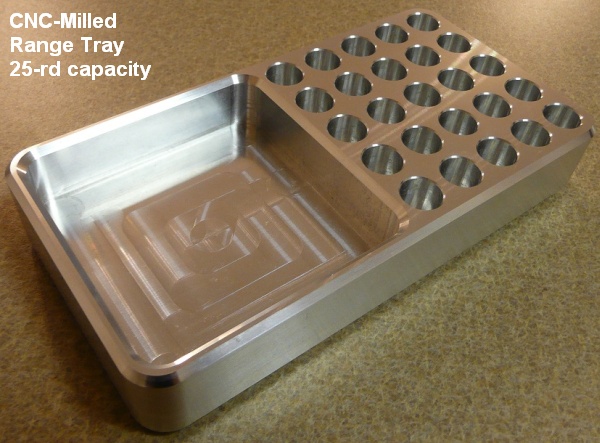
New this year from Tom is a smaller, 25-round loading block, priced at $17.50. This has the same basic design (with engraving) as the 50-rounder, but it is half the length (with half the capacity). This is perfect for low-quantity handloading. Some guys like to use the 25-round ammo block when shooting in competition. It makes for a quick, handy ammo caddy. But even better for competition is Tom’s new Range Tray shown below. It has a milled-out tray for empty brass or small parts. Price is $28.00 for most cartridges up to WSM head diameters.
If you order from Tom, add $5 for shipping up to 2 pieces, or $10 for 3-7 pieces. Loading blocks ship in USPS flat-rate boxes. Tom prefers to receive payment by way of U.S. Postal Money Order. Send money order, order specs and your shipping address to:
Tom Sziler
5521 W 110th Street, Ste 6
Oak Lawn, IL 60453
tom.sziler[at]gmail.com
Here’s a great gift for Father’s Day that any dad with a truck should appreciate. Forum member John Niemi crafts custom hitch covers that look like the end of a cartridge case, complete with head-stamp. Costing $70.50 (delivered), they are made out of solid brass with a stainless steel “primer”. The diameter of the brass is 4 inches and the engraved letters are about half an inch tall. The section that slides over the trailer hitch is aluminum, so you don’t have to worry about rust.
The “headstamp” can include your favorite cartridge-maker and caliber (wildcats too!), or you can include the name of your business. John tells us: “I can engrave any text on one as long as there is enough room for it. Turn around time is usually less then a week after payment. I have sold many of these and everyone has been extremely happy with the quality and workmanship that I put into my product. These make great one-of-a-kind gifts.”
$75.00 Delivered in the USA The current price for brass bullet hitch covers from John Niemi is $75.00 shipped anywhere in the USA. To order, send email to JohnNiemi [at] charter.net or call (503) 440-1954.
Forum member Wayne (aka WAMBO) ordered a custom hitch cover from John, featuring the 30/338 Lapua Improved wildcat he calls the 300 WAMBOMAG. Wayne reports: “The hitch cover is very well made. I’m impressed with the quality. Buy with confidence.”
We’ve seen John’s craftsmanship on many of these hitches, and we can confirm that the hitches are beautifully made, and make a handsome addition to any vehicle. If you order one (or more), be sure to mention you learned about the hitch covers on AccurateShooter.com.
With Copper Exchange prices edging towards $4.00/lb, cartridge brass in any condition is worth saving. (Prices reached $4.50/lb last year!) Even worn-out, split, or Berdan-primed brass with negligible value to reloaders can be worth real money given current scrap metal prices. People commonly leave .22 LR casings on the ground because they can’t be easily reloaded. Nowadays, it may be worth saving brass of any kind. In California, scrap metal dealers are paying $1.75 a pound for used cartridge brass — including buckets of used .22 LR casings.
Of course, if you have good pistol and rifle brass that’s worth reloading, don’t take it to a scrap dealer. You should be able to get more money selling the brass to reloaders via Forum Classifieds or Gunbroker.com. However, if you’ve got buckets of old, split, tarnished brass, .22 LR casings, or Berdan-primed cases and you don’t want to take the time to clean, inspect, and sort your cases… maybe you should just sell ‘em for scrap. For someone with hundreds of pounds of miscellaneous brass, current scrap prices can be attractive. In the past, at ranges, we’ve seen scores of milsurp Berdan-primed cases left on the ground since they are not easily reloadable. Now, we predict those cases will be collected and sold for scrap.


 How long will a barrel last before the accuracy “goes south”? There are so many variables involved (powder type, bore diameter, bullet coatings etc.) that it’s hard to predict. You might say “Well, my buddy has a .243 and he got 1500 rounds before the throat was shot out” — those kind of comparisons can be useful, but they’re not very scientific, and they won’t help much if you’ve got a gun in a new chambering (such as the 6.5×47) for which long-term test results are lacking.



 “World’s Finest Trimmer” Costs $69.95
 In our
  Neck-Wall Thickness is Important Too
 On his

 “The 6.5×55 case has 6 or 7% more capacity than the .260s, even more in practice when both are loaded to standard COALs with heavy bullets, which sees them having to seated very deep in the .260 Rem using up quite a lot of powder capacity. So loaded up for reasonable pressures in modern actions, the 6.5×55 will give a bit more performance.
 After Laurie’s helpful comments, some other Forum members added their insights on the 260 Rem vs. 6.5×55 question:
 A unique, comprehensive
 Great Resource for Hunters




 The current price for brass bullet hitch covers from John Niemi is $75.00 shipped anywhere in the USA. To order, send email to JohnNiemi [at] charter.net or call (503) 440-1954.


