|
|
July 30th, 2014
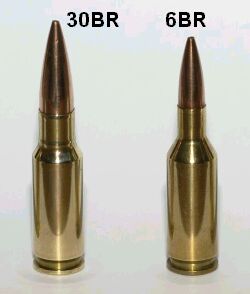 The 30BR is an amazing little cartridge. However, 30BR shooters do have to neck-up 6mmBR brass and then deal with some issues that can arise from the expansion process. One of our Forum members was concerned about the donut that can form at the new (expanded) neck-shoulder junction. Respected bullet-maker Randy Robinett offers tips on how to deal with the “dreaded donut”. The 30BR is an amazing little cartridge. However, 30BR shooters do have to neck-up 6mmBR brass and then deal with some issues that can arise from the expansion process. One of our Forum members was concerned about the donut that can form at the new (expanded) neck-shoulder junction. Respected bullet-maker Randy Robinett offers tips on how to deal with the “dreaded donut”.
The Forum member was concerned about thinning the brass if he turned his 30BR necks after expansion: “Everything I have found on 30BR case-forming says to simply turn off the bulge at the base of the neck caused by the old 6BR shoulder. I expanded my first case and measured the neck at 0.329″ except on the donut, where it measures 0.335″. Looking inside the case… reveals a groove inside the case under the donut. Now, it is a fact that when I turn that neck and remove the donut, the groove is still going to be there on the inside? That means there is now a thin-spot ring at the base of the neck that is .005 thinner than the rest of the neck. Has anyone experienced a neck cracking on this ring?”
Randy Robinett, who runs BIB Bullet Co., is one of the “founding fathers” of the 30BR who help prove and popularize the 30 BR for benchrest score shooting. Randy offers this advice on 30BR case-forming:
While the thinner neck-base was one of our original concerns, unless one cuts too deeply INTO the shoulder, it is not a problem. For my original 30BR chamber, thirty (30) cases were used to fire 6,400 rounds through the barrel. The cases were never annealed, yet there were ZERO case failures, neck separations, or splits. The case-necks were turned for a loaded-round neck diameter of .328″, and, from the beginning, sized with a .324″ neck-bushing.
The best method for avoiding the ‘bulge’ is to fire-form prior to neck-turning (several methods are successfully employed). Cutting too deeply into the shoulder can result in case-neck separations. I have witnessed this, but, with several barrels and thousands to shots fired, have not [personally] experienced it. The last registered BR event fired using that original barrel produced a 500-27x score and a second-place finish. [That’s] not bad for 6K plus shots, at something over 200 firings per case.
Check out the 30BR Cartridge Guide on AccurateShooter.com
You’ll find more information on 30BR Case-forming in our 30 BR Cartridge Guide. Here’s a short excerpt from that page — some tips provided by benchrest for score and HBR shooter Al Nyhus:
30BR Case-Forming Procedure by Al Nyhus
The 30BR cartridge is formed by necking-up 6BR or 7BR brass. You can do this in multiple stages or in one pass. Most of the top shooters prefer the single-pass method. You can use either an expander mandrel (like Joe Entrekin does), or a tapered button in a regular dies. Personally, I use a Redding tapered expander button, part number 16307. This expands the necks from 6mm to .30 cal in one pass. It works well as long as you lube the mandrel and the inside of the necks. I’ve also used the Sinclair expander body with a succession of larger mandrels, but this is a lot more work and the necks stay straighter with the Redding tapered button. This button can be used in any Redding die that has a large enough inside diameter to accept the BR case without any case-to-die contact.
Don’t be concerned about how straight the necks are before firing them the first time. When you whap them with around 50,000 psi, they will straighten out just fine! I recommend not seating the bullets into the lands for the first firing, provided there is an adequate light crush-fit of the case in the chamber. The Lapua cases will shorten from approx. 1.550″ to around 1.520″ after being necked up to 30-caliber I trim to 1.500″ with the (suggested) 1.520 length chambers. I don’t deburr the flash holes or uniform the primer pockets until after the first firing. I use a Ron Hoehn flash hole deburring tool that indexes on the primer pocket, not through the case mouth. — Al Nyhus
October 4th, 2013
 With the price of premium brass topping $90/100 for many popular cartridges, it makes sense to consider annealing your brass to extend its useful life. Forum member Darrell Jones offers a full range of brass prep, brass forming, and brass restoration (annealing, ultra-sonic cleaning) at very affordable prices. Starting at just $15 per 100 cases ($20/100 for magnum cases), Darrell’s company, DJ’s Brass, will anneal your used brass using state-of-the-art Bench-Source annealing machines. Annealing plus ultrasonic cleaning starts at $25.00 per 100 cases ($30 for magnum cases larger than 0.473″ rim). If you just want your cases ultrasonically cleaned (no anneal), that costs $15 per 100 ($20/100 for magnum). With the price of premium brass topping $90/100 for many popular cartridges, it makes sense to consider annealing your brass to extend its useful life. Forum member Darrell Jones offers a full range of brass prep, brass forming, and brass restoration (annealing, ultra-sonic cleaning) at very affordable prices. Starting at just $15 per 100 cases ($20/100 for magnum cases), Darrell’s company, DJ’s Brass, will anneal your used brass using state-of-the-art Bench-Source annealing machines. Annealing plus ultrasonic cleaning starts at $25.00 per 100 cases ($30 for magnum cases larger than 0.473″ rim). If you just want your cases ultrasonically cleaned (no anneal), that costs $15 per 100 ($20/100 for magnum).
Custom Neck-Turning Services
Another great service DJ’s Brass provides is precision neck-turning. Darrell can neck-turn any size case to your specified neck-wall thickness. The price is $0.30 per case (normal size) or $0.40 (magnum size) with a $20.00 minimum order. And if you’ve got a bucket of brass to neck-turn, that’s fine with Darrell — he recently neck-turned 1500 pieces of brass for one customer!

DJ’s Brass can process everything from .17 Fireball all the way up to the big magnum cases. And the job gets done quickly. Darrell has a 10-day turn-around guarantee. For most jobs, Darrell tells us, he gets the processed brass to the Post Office within three business days. DJ’s Brass charges only actual shipping fees, using USPS flat-rate boxes. For more info, visit DJsBrass.com or call Darrell Jones at 205-461-4680. IMPORTANT: Contact Darrell for shipping instructions BEFORE sending any brass for processing. ALL BRASS MUST BE DE-PRIMED before you send it.

• Ultrasonic Cleaning + Annealing ($25.00/100 normal or $30/100 magnum)
• Ultrasonic Cleaning and Polishing ($15.00/100 normal or $20/100 magnum)
• Anneal Case Necks (after checking for splits) ($15.00/100 normal or $20/100 magnum)
• COAL Trim and Chamfer Case Mouths ($0.20 per case, $20.00 minimum order)
• Uniform, Square, and Chamfer Primer Pockets ($0.15 per case, $20.00 minimum order)
• Expand Case Necks and Anneal brass (Call for Price)
• Create False Shoulder for Fire-Forming (Call for Price) |
DJ’s Brass Offers Specialized Custom Services
Darrell tells us: “At DJ’s Brass, we can handle all your brass refurbishing needs. From ultrasonic cleaning to custom annealing for specific wildcat cartridges. We can expand your necks from .22 caliber to .30 caliber and anneal shoulders for consistent bump-back. We can turn your case-necks and trim the brass to your specs. For some cartridge types, I can pre-form cases to assist in fire-forming a wildcat cartridge. We also remove the carbon build-up in muzzle brakes. Don’t lose your accuracy by having carbon build up and close off the clearance required for the most accurate bullet release through a muzzle brake.” Note: Extra charges apply for neck-turning and neck expansion operations, or specialized cartridge-forming operations. Please call 205-461-4680 for special services pricing.
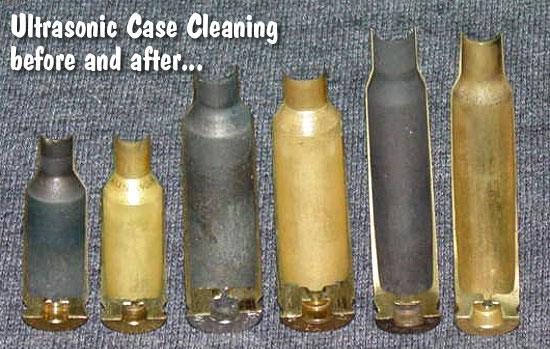
Darrell has cleaned and annealed cases for shooters from across the country. Here are testimonials (this Editor reviewed all the original emails so I can confirm these are real):
“Your services were good with a quick turn-around time. Quality of the case annealing looked great[.]” — Tom, in Alaska
“The [300 Win Ackley] batch you did for me came back looking great.” — Chuck, in Arizona
“Since I started using Lapua brass, I’ve gotten gotten enough reloads out of them to notice that the necks were no longer sealing as well as I’d like. A friend suggested annealing them. I remembered seeing DJ’s ad on AccurateShooter.com and thought I’d give him a try. Not only did my [.308 brass] come back sorted exactly as I had sent them out, all had been so thoroughly cleaned that I realized I had been leaving lube on them after forming. DJ had taken the time to enclose a note cautioning me to brush the inside case necks and do a full-length resize for the first loading. And all 200 cases were back in my hands in DAYS, not weeks! Great service, great price, great follow up.” — Jim, in Alabama
November 13th, 2009
A full-time lawyer, Robert Whitley is also an avid prone, Highpower, and cross-course shooter. Over the past two years, Robert has pioneered a cartridge for these disciplines (as well as long-range varminting) based on the 6.5mm Grendel necked down to 6mm. Robert calls the cartridge the “6mmAR”.

The 6mmAR cartridge has performed very well in AR-based comp guns, both with shorter bullets loaded to mag length, and 105-107gr bullets single-loaded. Robert has complete info about the 6mmAR on his website, 6mmAR.com, including recommended loads and field test results. Robert has also developed a higher capacity version, with the shoulder blown forward and a shorter neck. He calls this the 6mmAR Turbo. This round can drive 105-108gr bullets in the 2850-2900 range, and it has proven very accurate. It is one of the best options for AR-platform space-gun shooters.
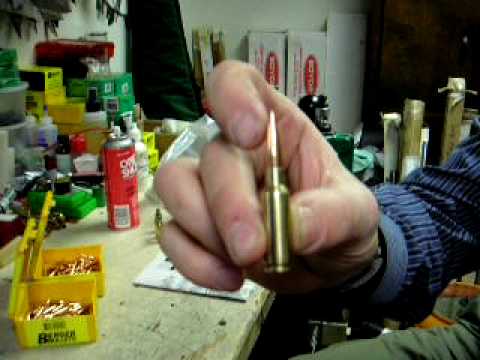
Though making 6mmAR brass from 6.5 Grendel brass is quite straight-forward and simple, Robert receives many questions about forming the brass, so he recently prepared a video. The two-minute video shows how quick and easy the brass-forming process can be:
Robert also builds and sells products for across-the-course shooters, including complete AR uppers, chambered in a variety of calibers, including 6mmAR. Jerry Tierney, 2005 NBRSA 1000-yard champion, has a 6mmAR upper built by Robert and Jerry says the upper “Absolutely shoots great. I love it.” In the past few months, Jerry has broken many NRA senior records with his new 6mmAR-chambered rifle.
CLICK HERE for Feature Article on 6mmAR and Robert Whitley (many photos)
CLICK HERE for 6mmAR LOAD DATA
|


