Eye Protection — LuckyGunner Labs Field Tests
If you’re one of those folks who doesn’t wear eye protection, you need to check out the LuckyGunner Labs Eye Protection Test. For those who DO wear safety glasses — don’t assume that everything is OK. Just because you purchased name-brand “safety glasses” doesn’t mean that you are getting truly effective protection. In fact, many forms of protective eyewear sold today are flimsy, or poorly made. Consequently, they won’t stop even low-energy, slow-velocity fragments.
 Two years ago, LuckyGunner Labs conducted very extensive field tests of 28 types of eyewear, ranging in price from $7 to $220. Remarkably, some of the most expensive safety eyewear performed no better than $10 items. Many of the products failed shockingly — with the lenses coming right out of the frames when hit with pellets. LuckyGunner recorded these kind of failures even with ANSI Z87-“approved” eyewear. The reason is that the Z87 test is not tough enough: “The basic ANSI standard is referred to as Z87, and you’ll see this marked in a number of locations on most eye protection marketed to shooters. However, the Z87 impact standard involves a .25″ steel ball traveling at 150 fps — this is fine for protecting eyes from debris that might fall or be thrown, but is not extremely relevant to shooters, who are dealing with objects traveling at much higher velocities.”
| Standard | Impact speed | Caliber/Size |
| ANSI Z87.1-2003 High Velocity |
150 feet/second 45 meters/second |
0.25″ diameter steel ball (25 caliber) |
| Mil-PRF-31013 Vo ballistic test |
640-660 feet/second 195 meters/second |
0.15 inch diameter steel projectile (15 caliber) |
The testers recommend you select eyewear that meets military specification (above and beyond ANSI Z87). The MIL-PRF-31013 Standard covers projectiles up to 650 feet per second. This is much more stringent. Additionally, you want to replace often-used protective eyewear every year or so. Long-term exposure to UV radiation can weaken polycarbonate and lessen its ability to withstand impacts.
THE GOOD — Eyewear Protects Against Direct Hit with .22 Short Bullet
APEL Revision Sawfly eyewear was shot with a .22 Short, pushing a 29 grain bullet at 710 fps. That’s not powerful by modern firearm standards, but this might be fairly representative of a ricochet bullet fragment. The Sawfly lens stopped this 29gr bullet with minimal damage to the cheek area.

THE BAD — Remington Eyewear Lenses Separate. Right Lens Enters Eye Socket
The most gruesome example was the cheap Remington eyewear which shed both lenses back towards the eyes, one of which embedded itself into the eye socket. The real-world implications of this action are disturbing to say the least.

THE UGLY — Prescription Glasses Failed Miserably
Many ranges don’t see any need for protective eyewear beyond prescription glasses. However, most prescription lenses offer little if any protection. If the prescription lenses are glass, this can create more problems. As shown below, these prescription glasses offered no ballistic protection, and, in fact, proved more dangerous to the eyes due to the flying glass shards.

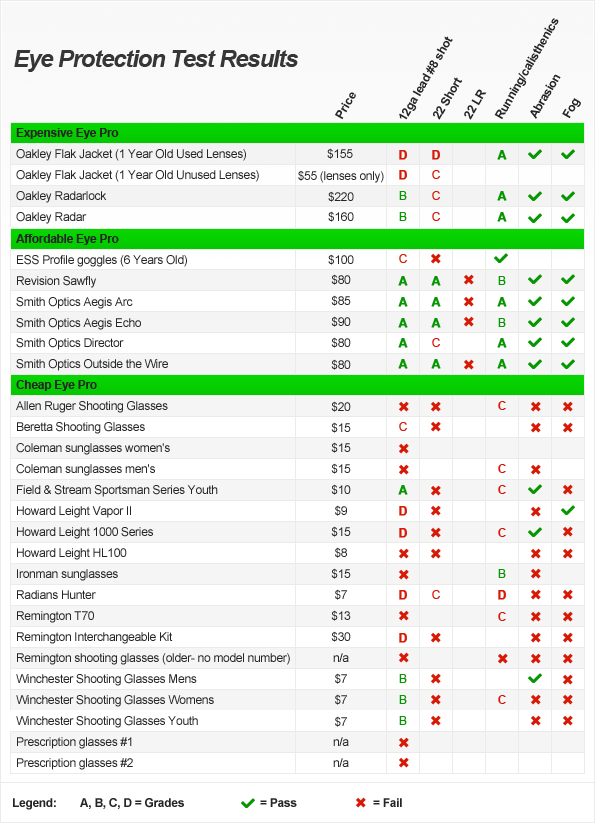
Results Chart, Video Clips, and Photos copyright Luckygunner.com.
Summary and Conclusions:
For faster-moving projectiles such as ricochet fragments, you need high quality, tested eye protection. LuckyGunner recommends eyewear with a single (one-piece) lens for any activity where your face might be struck by small, fast-moving objects. Individual lenses detach from the frames once a certain level of force is reached, and they are driven back into the eye sockets, where considerable damage may be done. There are good examples of protective eyewear with two separate lenses, but a broad, one-piece lens distributes force much better.
A wide, comfortable, and preferably soft rubber nosepiece is critical. Along with good “arms”, this will serve to keep the eye protection in place and will also reduce the chances of the lens being driven down or back into the face with enough force to damage the orbital bones.
A frame that connects across the top of the lens, not individual arms which attach to the outside corners of the lens, is recommended. This will reduce the chances of the lens detaching from the frame under impact (it’s still possible, just less likely). Some types of eye protection actually use the frame to absorb impact and distribute force.
NOTE: Andrew, the author of the LuckyGunner Eyewear report, was a former Navy Corpsman. Accordingly, he is familiar with health and safety matters.