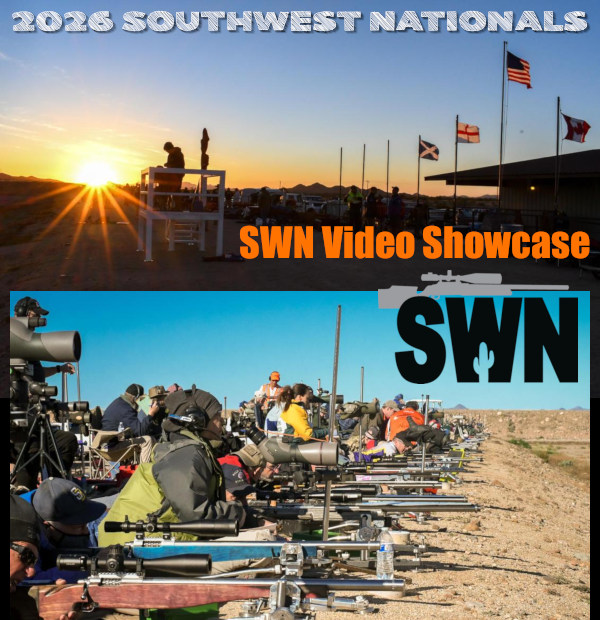
The 2026 Southwest Nationals (SWN), one of the major long-range rifle matches of the year, is underway right now in Arizona for three rifle classes: Sling (“Any Sights” and “Palma”), F-Open, and F-TR. Running from February 11th through 15th, the match started with the Mid-Range 600-yard event on Wednesday, February 11th, and concludes with the 2-day 1000-yard match on Saturday the 14th and Sunday the 15th. On Thursday and Friday there were team and individual Palma-format competitions for all three divisions (Sling, F-TR, F-Open). These are multi-distance matches with targets at 800, 900, and 1000 yards. The match continues today (Saturday) and tomorrow (Sunday) with 1000-yard matches. CLICK HERE for all official 2026 Southwest Nationals results on the Desert Sharpshooters website.
The 2026 Southwest Nationals event continues today and tomorrow (Saturday and Sunday) with individual and team competitions at 1000 yards. CLICK HERE for full 2026 SWN Match Program.
Shown below left are results for the 2026 SWN Nationals 2/13/2026 Individual Palma matches for the three divisions: Sling, F-Open, and F-TR. The Palma match is 15 shots each at 800, 900, and 1000 yards. There were some very impressive performances on Friday the 13th. All the top 10 F-Open shooters did not drop a single point, all finishing with 450 scores (before X-count). Below, to the right of the Palma scores, is a video from ace shooter Brandon Green. This shows the Palma stage at 2026 SWN.
2026 SWN Palma 800/900/1000 Match
Sling Division Top 10
Mark Kelley, 449-31X (Match Winner)
Jerrod McGaffic, 448-28X
Avtar Nanrey, 448-24X
Gary Elesio, 448-23X
Phil Hayes, 448-22X
Vern Conant, 447-32X
Nate Guernsey, 447-26X
Brandon Green, 447-21X
Fazal Mohideen, 447-21X
Ken Foster, 447-20X
Gabriel Rowe, 447-20X
F-Open Division Top 10
Joe Traylor, 450-38X (Match Winner)
Brad Johnson, 450-38X (2d on tie-breaker)
Pat Scully, 450-36X
Henry Ferris, 450-36X
Antun Kovacevic, 450-35X
John Girgis, 450-33X
Roger Mayhall, 450-33X
Barry Holcomb, 450-30X
Peter Johns, 450-30X
Tod Hendricks, 450-29X
F-TR Division Top 10
Tracy Hogg, 450-31X (Match Winner)
Keith Trapp, 450-26X
Brad Sauve, 449-30X
Benoit Vautour, 449-25X
Tom Hubbard, 449-23X
Scott Kyle, 449-23X
Alen Tampke, 449-22X
Oleg Savelyev, 448-30X
Gerry Wiens, 447-25X
James Crofts, 447-24X
Alan Barncroft, 447-24X
Travis Elfgren, 447-24X
2026 SWN Individual Palma Day
Video from Brandon Green
15 shots for record each at 800, 900, 1000 yards.
For this Saturday Showcase, we provide videos from past SWN events, plus informative videos that explain how to prepare for the event and pack your gear for air travel and/or lengthy overland trips.
Tips for New Competitors at the Southwest Nationals
Headed to the SW Nationals for the first time? Never shot at the Ben Avery range before? Then definitely watch this F-Class John video. It provides a series of smart tips for SWN first-timers.
Highlights from 2024 SW Nationals with Past Champ Erik Cortina
This video follows long-range competitors at the 2024 Southwest Nationals. The video shows match preparation and competition. There are interviews with participants and highlights of the challenging conditions. The video concludes with the announcement of class winners. 2024 F-Open winner Jay Christopherson is interviewed starting at 12:18 time-mark.
Analyzing Conditions at 2022 SW Nationals
In this video past SWN Champion Erik Cortina and F-Class John analyze relays from the 2022 match, discussing shot holds for specific wind conditions. You can learn quite a bit from this dialog with two top F-Open shooters. Erik won the F-Open LR SWN event in 2023.
Packing Gear for Air Travel — Tips from F-Class John
It can be very challenging to travel via airline to a major shooting event because of all the gear you’ll need to bring, along with your rifle(s). F-Open shooters must bring a heavy, bulky front rest and rear bag, while F-TR shooters will need a large front tripod and rear bag. Then you’ll need to transport a spotting scope with its adjustable mount, plus a LOT of loaded ammunition. Some shooters will also bring a press and dies to do final seating of their ammo. That’s a lot of gear. In this video, F-Class John shows how to pack rifles, gear, and ammo efficiently so air travel can go safely and smoothly.
Southwest Nationals Video SHORTS
Bird’s Eye Ben Avery — A Look at the Range
If you’ve never visited the Ben Avery Facility north of Phoenix, Arizona, here’s a video that shows the 1000-yard range (including drone footage). The desert range at Ben Avery is something special — check out this “birds-eye view”. This 2016 video also includes an interview with Derek Rodgers, F-TR World Champion, King of 2 Miles, and the only man who who has earned both F-Open AND F-TR USA National titles.
Sling Shooters in Palma Division
For the Palma division, the cartridge of choice is the .308 Winchester (7.62.x51). This versatile cartridge is still capable of extreme accuracy. Never underestimate a skilled sling shooter with a good Palma rifle. Below is multi-time NRA National Long-Range Champion John Whidden in action. John’s rifle features a centerfire action in an aluminum Anschutz small-bore stock.
Ballistics wizard Bryan Litz shoots at the 2015 SW Nationals. Notice how steady he holds his rifle.
This image is from multi-time Nat’l Long Range Champion Nancy Tompkins, author of Prone and Long Range Rifle Shooting. Nancy loves to photograph the Aurora Borealis.
As a Christmas present for our readers, today we showcase eight very informative videos from AccurateShooter Forum member F-Class John. A talented F-Class competitor with a smart, technically-focused mind, John has created a series of videos about reloading and precision loading tools, along with rifle and shooting accessories. Many of John’s product reviews are the most thorough and detailed you’ll find in video format. You’ll find over 840 informative videos on F-Class John’s popular YouTube Channel.
This is a great summary of multiple quality front rests. This is a must-watch video for all F-Open and Benchrest shooters! If you are shopping for a front rest, definitely watch this comprehensive 42-minute video from start to finish. This is probably the most informative video about premium shooting rests available on YouTube. Top F-Class shooter and video-maker F-Class John covers a wide selection of front rests, with some observations about coaxial bipods as well. John covers the impressive new SEB NEO-X, the easy-to-transport SEB Mini-X, the excellent Rodzilla Rest, the innovative 21st Century Hybrid Rest, the sleek Italian Lenzi Rest. At the end of the video John reviews the very affordable Caldwell Fire Control Rest ($269.99 at MidwayUSA), explaining how it can be a decent choice for shooters on a limited budget.
How to Use a Barrel Tuner to Improve Accuracy and Repeatability
In this video, John works with a barrel tuner created by Erik Cortina, a member of Team Lapua/Brux/Borden. A tuner can be useful in modulating barrel vibrations and that can translate to smaller groups on target. Sometimes the positive effects are quite noticeable. Tuners have been popular with short-range benchresters for many years and now they are becoming more common on top F-Class and Long Range rifles.
John says: “I’ve been using Erik’s E.C. Tuner for a while now and I really like what it’s done to help as my final step in load development. Just remember, a tuner is a tool, not a magician. You still need good load development practices, good brass prep, and solid skills but the tuner does help make great loads even better.”
F-Class Rear Bag Setup: Fill Techniques for Ultimate Consistency
In this helpful video, F-Class John shows his process for filling high-quality Dima rear bags (both medium models). John explains how to select fill (based on weight and density preferences). He shows the different funnel systems that work very effectively. If you’re planning to invest in a quality rear bag for competition, this video will be useful, both in choosing appropriate fills and getting the fills into the bag efficiently.
21st Century Hydro Press and Arbor Press — Product Review
Many of the world’s top benchrest, long-range, and F-Class shooters prefer to seat their bullets using arbor-type presses with inline dies. This allows smooth, repeatable bullet-seating with very low run-out. One of the very best arbor-type seating presses ever created is the 21st Century Hydro Press. This offers plenty of leverage driving a precision ram. The Hydro Press also features a hydraulic line to drive a precision seating force gauge. Along with the Hydro Press, John tests 21st Century’s standard arbor press.
Accuracy One Concentricity Gauge — Product review
Every person who makes precision hand-loads should have a quality concentricity gauge to measure run-out of case-necks and loaded rounds. Here John tests one of the best such tools on the market, the Accuracy One Concentricity Gauge. This measures the internal and external neck runout of cartridge cases as well as seated bullet runout. It can also measure the runout of the ogive, bearing surface, and boat-tail of individual bullets and can even measure primer pocket runout. John notes: “I think most precision shooters should have one of these to make sure their ammo is within their specs they’re happy with.”
Henderson vs. Giraud Rifle Power Brass Trimmer Review
After adding the impressive Henderson Gen 3 Powered Trimmer to his inventory of tools. F-Class John became is a Henderson fan. He likes the speed, precision, and repeatability of the $439.00 Henderson machine, which trims-to-length and chamfers the case mouth all in one pass. Unlike some other trimming tools, the Henderson indexes off the overall case length NOT the shoulder. The $575.00 Giraud trimmer is a very different design which indexes off the case shoulder, but it is also very precise. When set up correctly, it can trim brass with amazing consistency. As long as you have fire-formed brass with consistent base-to-shoulder dimensions, you should get very consistent trim lengths.
SuperTrickler vs. AutoTrickler V4 Powder Measure Comparison
This video compares the elite SuperTrickler and AutoTrickler V4. The AutoTrickler system paired with a quality Force Restoration scale, is the “Rolls Royce” of electronic powder dispensing systems, offering unrivaled charge-weight accuracy, great repeatability, and ultra-fast dispensing speeds. If you have the budget — $490 for the V4 plus $720+ for A&D FX-120i scale — the AutoTrickler V4 is a superb system that lets you load extremely accurate, consistent ammo. This detailed F-Class John video compares the AutoTrickler with and all-in-one SuperTrickler scale/dispenser which also performs great. The SuperTrickler ST101 is $775.00 for ST101 Gen2 top unit only or the full unit is $1400.00 complete with FZ-120i scale.
Teslong Rigid 26″ Borescope with 4.5″ Monitor — Product Review
There are a variety of affordable Teslong digital borescopes for inspecting your barrels and diagnosing issues. All Teslongs deliver impressively sharp images/video. Some units plug into a laptop or tablet, while others work via a dongle to communicate wirelessly. Here John tests a 26″ rigid model borescope that comes complete with its own 4.5″ viewing screen. Priced at $149.99 on Amazon, this system is completely self-contained — you don’t need a laptop or smartphone. You don’t have to worry about connections and there are no Apps to install or configure. John says: “Teslong now offers a 26″ rigid rod model with a 4.5″ monitor. This allows you to use the unit without the need for any mobile device or computer.”
L.E. Wilson Case Gage Depth Micrometer Tool Hands-On Tool Review by F-Class John
Are you looking for a better way to measure shoulder bump when sizing brass? When it comes to measuring your shoulder bump there has traditionally been just one way to do it and that’s with a set of calipers and some type of tool attached to a calipers jaw which contacts the case shoulder. While this method has worked well for decades there’s always been some inherent lack of consistency and repeatability. While a minor issue, the inability to get the exact number in completely dependent on the user’s pressure applied and the angle at which the jaws push on the brass.
Enter the L.E. Wilson Case Gage Depth Micrometer with its simple but effective use of Wilson case gauges to ensure a perfect measure of shoulder bump every time. The unit comes with the micrometer top as well as a check gauge which allows you to easily calibrate the micrometer whenever needed. On top of the micrometer unit, you’ll also need to purchase the appropriate case gauges for each of your cartridge types and then you’re ready to go. No other measuring instruments are needed (yep, no calipers are required).
Using the Wilson Depth Micrometer (perhaps a better name is Shoulder Bump Micrometer) is a straightforward process. Simply take your fired brass and insert it into the case gauge and place the micrometer top onto the primer side of the gauge. While holding the micrometer top firmly against the case gauge in one hand, slowly turn the micrometer until you feel it stop. You can back off and turn it again to verify the stop point and once you have it, look at the measurement on the micrometer. Now insert a sized piece of brass and repeat the procedure. Take note of the new number and subtract it from the fired brass number and you now have an exact amount of shoulder bump. Continue to adjust your sizing die until you have the correct amount of shoulder bump and you’re ready to size all your brass.
Watch Video to See how Shoulder-Bump Measuring Micrometer Tool Works
Guys, in this case a VIDEO is worth more than a thousand words. In may not be obvious from the photos how this system works. In fact, it is fast and easy. Drop brass into cartridge-specific case gauge, then put the Micrometer unit on top, and dial to touch. The video shows how this works.
SUMMARY — Tool is Fast, Precise, Repeatable, and Easy to Use — We Like It
The beauty of this tool is the simplicity with which it works. It uses a very accurate micrometer to simply measure how much further your brass is sitting forward inside the case gauge. After a couple uses, you’ll find that this tool is fast, accurate and incredibly repeatable. That gives you confidence that your brass is being sized properly. Ultimately, I found that using the micrometer top really became a joy as I set up a new set of dies and as I sized my brass, I could easily check the consistency as brass came off my press. If you’re looking to improve your sizing game, give the L.E. Wilson Case Gage Depth Micrometer a try. MSRP is $140.00.
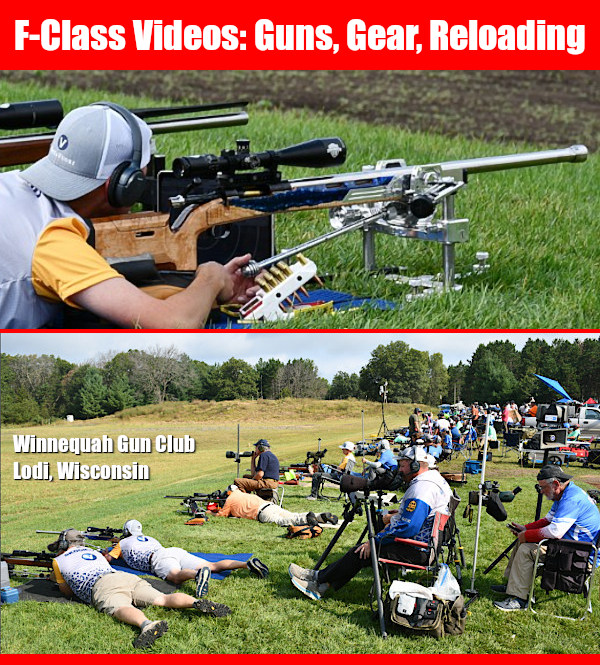
Today’s Saturday movie showcase features eight videos about F-Class marksmanship, gear selection, and reloading methods. The 2025 NRA F-Class National Championships take place next week at the Winnequah Gun Club range in Lodi, Wisconsin. The F-Class Nationals start on August 2nd and run through August 9th. There are two divisions: F-Open and F-TR. The F-Class Championships have two segments, Mid-Range and Long Range. The Mid-Range competition runs August 2-5, while the Long Range competition is scheduled for August 6-9. Competitors can register for the 2025 F-Class Nationals through the NRA Shooters Portal. Learn more about the range at Winnequahgunclub.org.
WICKED WINDS — At Ben Avery with 18-30 mph Winds
Long-range F-Class shooters will tell you that the winds can be the biggest challenge in a match. And things can get pretty wild at times as the Ben Avery range in Phoenix, site of the 2022 NRA F-Class National Championships. In this video, shooters fight through extremely strong 18-30 mph winds at 600 yards. In these kind of extreme conditions, a major unexpected gust can send your bullet off-target.
Wind-Reading for Long-Range Competition
In this excellent video Keith Glasscock, who has finished second overall at multiple F-Class Nationals, explains how to read the wind and even predict wind changes in cycling conditions. Keith notes that you should look at environmental features and mirage, not just wind flags. Keith is one of America’s best wind gurus — he was a team wind coach and he has finished second three times in F-Open division at the F-Class National Championships.
F-0pen rifle at the Berger SW Nationals at the Ben Avery Shooting Facility in Phoenix, AZ.
Load Development Procedures for F-Class — Seating Depth
In this video, 2023 NRA Mid-Range National Champion John Masek (aka “F-Class John”) explains how he does load development in an efficient and reliable manner. He specifically focuses on testing for optimal seating depth. With 318,000 views, this is the most-watched video on F-Class John’s popular YouTube channel. Viewers have praised this video: “This was a great video, really appreciate the explanation about how you bracketed the jump and why you chose the closest.”
Front Rest Options for F-Open (and Benchrest) Competition
If you are shopping for a front rest, definitely watch this comprehensive 42-minute video from start to finish. This is probably the most informative video about premium shooting rests available on YouTube. Top F-Class shooter and video-maker F-Class John covers a wide selection of front rests, with some observations about coaxial bipods as well. John covers the impressive new SEB NEO-X, the easy-to-transport SEB Mini-X, the excellent Rodzilla Rest, the innovative 21st Century Hybrid Rest, the sleek Italian Lenzi Rest. At the end of the video John reviews the very affordable Caldwell Fire Control Rest ($269.99 on Amazon), explaining how it can be a decent choice for shooters on a limited budget.
Reloading for F-Class — Interview with Erik Cortina
In this Precision Rifle Network video, Erik Cortina of Team Lapua-Brux-Borden covers the reloading process for his F-Class rifle. All phases of reloading are noted — brass prep, annealing, primer seating, precision powder measuring (to the kernel), and bullet seating. Erik also talk about load testing and use of barrel tuners. Erik produces the EC Barrel Tuner which is used by many top competitors.
Trigger Trio — Evaluation of Three Trigger Types for F-Class Rifles
In this video, F-Class John evaluates three triggers that are popular with F-Class competitors: Bix’N Andy, Flavio, and TriggerTech Diamond. John talks about the pros and cons of each trigger type and offers advice for mounting and pull-weight adjustment. The Italian Flavio triggers are sold by Bruno Shooters Supply, Bix’N Andy triggers can be purchased from Bullet Central, and the TriggerTechs are offers by MidwayUSA and Area 419.
F-Class Shooting at Bisley Range in the United Kingdom
F-Class competition is popular around the world, and the UK is a major center of F-Class shooting in Europe. The Bisley range is justly famous, with a long heritage of shooting competitions. This video features the European F-Class Championship held at Bisley in 2015.
Building a Modern F-Open Stock for Competition
In this video, our friend F-Class John explains the process for building two custom laminated stocks for his F-Open rifles. John selected handsome, highly-figured African hardwoods, which were then laminated into layers with purple-tinted heart-wood and dark Wenge wood stringers in the middle. The stock-maker then sliced the wood into layers (1:02) and then glued the layers together (1:40). After final cutting, the stocks are shown at 2:00, and then the video shows how the stocks received their final finish. Both stocks are fitted with the R.A.D. recoil-reduction system. See the bedding at 19:00 and the fully finished rifles at 19:12 with barreled actions fitted.
Here is another beautiful F-Open stock, on the firing line at Ben Avery, Arizona with a SEB Mini front rest. Note the metal side-bars on the front of the forearm. These metal fittings extend the stock’s “wheelbase” while also lowering the rifle’s center of gravity.
Today’s Saturday Video Showcase features informative videos about loading at the range. AccurateShooter.com contributor F-Class John shows efficient procedures for load development at the range, testing both powder charge and seating depth. And Ultimate Reloader’s Gavin Gear shows how to load in the field with a mechanical powder dispenser, small scale, and a high-tech hand press. We also include a video from a benchrest competitor in France loading his 6PPC, plus tips for loading at the range by Glen Zediker, author of the Handloading for Competition book.
Reloading at the Range with F-Class John
This excellent 25-minute video covers all aspects of loading at the range — case sizing, powder measuring/dispensing, priming, bullet seating and more. In the video, F-Class John also talks about transport of tools and how to develop loads at the range, as you test different powder charges and seating depths. Viewers have praised this video as one of F-Class John’s best ever. John employs a compact RCBS Summit press and an RCBS ChargeMaster. Highlights by time: 6:14 powder test with grain increments; 14:30 setting depth test; 16:18 test fire seating depth; 18:31 refine seating depth; 20:52 refined seating depth firing; 22:32 “take away” commentary.
Design and Function of Open Front RCBS Summit Press
Unlike other presses, the open front RCBS Summit moves the die up and down while the cartridge case remains stationary. The ambidextrous open-front design allows great access to your cases, and you can quickly change dies very quickly. The Summit has an all-steel linkage and cast iron frame. The Summit also offers compound leverage, a massive 2-inch diameter ram, full access through the front, a press adapter bushing, spent primer catcher, and wide 4.5-inch operating window for convenient access.
Ultimate Reloader Video of Loading at the Range
Sometimes the ONLY practical solution for load development is loading ammunition at the range. In this video Ultimate Reloader’s Gavin Gear demonstrates the loading process from start to finish, and covers what gear is required to “load where you shoot”. This applies to both loading at a covered range and loading in the field. In the video Gavin employs a bench-attached powder thrower and the impressive ($300) Buchanan Precision Machine (BPM) hand press.
Loading Between Matches — Precision Loading at a Pace
In this video, French benchrest competitor Carlos Pacheco loads ammo efficiently between relays at a Benchrest for Group match. He has a single-stage press clamped to a bench, and has a separate arbor press for bullet seating. 6PPC group-shooting competitors commonly tune their loads during the course of the competition, adjusting powder volumes to keep their rifles in optimal tune. Some competitors may also change bullet seating depth, but “tuning” is most commonly done with powder charge. Some benchrest-for-group competitors also believe that best accuracy is achieve with freshly-made ammo loaded before the brass necks take a set.
Loading at the Range — Then and Now
In benchrest shooting for Group, loading at the range has been de rigueur for decades. In the Score discipline, preloading is usually the custom. The main reason is that, in Score competition, only one Aggregate (warm-up match and five record targets) per day is usually shot. That would be less than 50 shots, assuming a few sighter shots. Also, the 30BR, the dominant Benchrest-for-Score cartridge, is very amenable to pre-loading.
By contrast, the Group discipline includes 21 targets (two warm-ups and twenty record targets) over a weekend, usually shot with 6PPC-chambered rifles. Many times, the 6PPC shooters may tweak their loads through the day given changing atmospheric conditions or simply trying to find the correct tune to “dot up”. This term, “Dot up”, means the shots are essentially going through the same hole, or closely so.
Loading at the range was a bit different when benchrest competition was in its infancy. The 1951 book, Modern Accuracy by Bob Wallack, is the best of the early benchrest books. Copies can be found, from time to time, on eBay or Alibris. It is a fascinating survey of benchrest as it existed more than six decades ago. In it, there is a photo of Wallack using the rear bumper of a car at the bench to clamp his reloading tools. Things have come a long way compared to the range loading set-ups of modern shooters. Here you can see Bob Wallack way back in 1950:
Good Article on Reloading at the Range by Glen Zediker
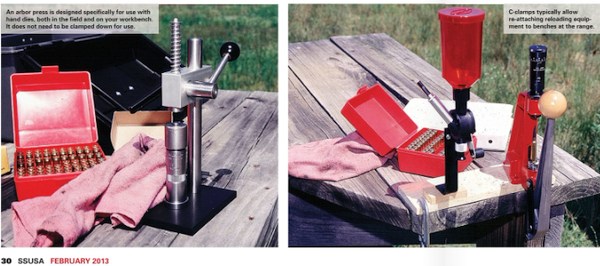
The February 2013 edition of Shooting Sports USA magazine has an interesting feature by Glen Zediker, who sadly passed away in October 2020. In this Transporting Success, Part I article, Zediker explains the advantages of loading at the range when you are developing new loads or tuning existing loads. Glen, the author of the popular Handloading for Competition book, discusses the gear you’ll need to bring and he explains his load development procedure. In discussing reloading at the range, Glen focuses on throwing powder and seating bullets, because he normally brings enough sized-and-primed brass to the range with him, so he doesn’t need to de-prime, re-size, and then re-prime his cases.
Zediker writes: “Testing at the range provides the opportunity to be thorough and flexible. You also have the opportunity to do more testing under more similar conditions and, therefore, get results that are more telling. Once you are there, you can stay there until you get the results you want. No more waiting until next time.”
Zediker starts with three-shot groups: “I usually load and fire three samples [with] a new combination. I’ll then increase propellant charge… based on the results of those three rounds, and try three more. I know that three rounds is hardly a test, but if it looks bad on that few, it’s not going to get any better.”
Glen reminds readers to record their data: “Probably the most important piece of equipment is your notebook! No kidding. Write it down. Write it all down.”
There’s More to the Story…
Editor’s Note: In Zediker’s discussion of loading at the range, he only talks about throwing powder and seating bullets. In fact, Glen opines that: “there is little or no need for sizing.” Well, maybe. Presumably, for each subsequent load series, Zediker uses fresh brass that he has previously sized and primed. Thus he doesn’t need to de-prime or resize anything.
That’s one way to develop loads, but it may be more efficient to de-prime, re-size, and load the same cases. That way you don’t need to bring 50, 80, or even 100 primed-and-sized cases to the range. If you plan to reload your fired cases, you’ll need a system for de-priming (and re-priming) the brass, and either neck-sizing or full-length sizing (as you prefer). An arbor press can handle neck-sizing. But if you plan to do full-length sizing, you’ll need to bring a press that can handle case-sizing chores. Such a press need not be large or heavy. Many benchresters use the small but sturdy RCBS Partner Press, an “O-Design” that costs about $119.99 on Amazon. You may even get by with the more basic Lee Precision Compact Reloading Press, shown in Zediker’s article. This little Lee press, Lee product #90045, retails for under $50.00.
Wind Box Shelters Scales When Reloading at Outdoor Ranges
Beat the Breezes with a Wind Box for your Scale
Forum member Boyd Allen has come up with a smart solution for reloaders who use scales outdoors — a windproof scale enclosure, aka “Wind Box”. Boyd explains: “Many guys have good set-ups for loading at the range, with clamping mounts for powder measure and press. But they lack a good enclosure for a scale. This is vitally important with beam scales because they have a lot of surface area to catch the wind. With much wind at all, the beam can oscillate to the point that is not really very usable. While a low-profile electronic scale may be less wind-sensitive, breezes DO affect weight read-outs on digital scales. And of course you always have the issue of blowing powder particles.”
Boyd Allen has used his Wind Box successfully for many seasons. He explains: “The essence of the idea is to have a scale set up in a box with a clear cover that can be opened and closed. On one side the trickler handle/control emerges through a ‘just big enough’ hole. You raise the cover, add a sub-target-weight thrown charge to the pan, and then close the cover. With the cover secure, the set-up is protected from the wind, and you can now trickle up to your desired charge. It works very well. The scale in the photo is an old Ohaus that I picked up. You can adapt this Wind Box design to any beam scale, or portable electronic scale. Simply adjust the dimensions to fit your particular scale and trickler.”
Saturday Movies range loading story concept and video links by Boyd Allen
Forum member F-Class John is an avid F-Class competitor and expert handloader. John reviews reloading hardware and shooting-related products for his popular F-Class John YouTube Channel, which now boasts 500+ videos. John also does important product testing for AccurateShooter.com. Through his YouTube channel, John has reviewed many of the latest and greatest reloading tools and accessories. For today’s Video Showcase, we selected eight F-Class John product reviews. Products tested include front rests, AMP Annealer, Flavio Fare triggers, AutoDod IDOD power neck-turner, Henderson and Giraud case trimmers, Zero turret press, 21st Century arbor press, and Accuracy One concentricity checker.
If you like these informative videos, consider joining F-Class John’s Patreon Channel for live video meetings, more in-depth videos, and detailed explanations. Join Patreon via Patreon.com/fclassjohn for full length videos, live chats, and more.
SEB NEO-X and Rodzilla Raptor Front Rests
This video covers two outstanding front joystick rests, the SEB Neo-X and the Rodzilla Raptor. Both of these rests work great for both benchrest and F-Class shooters, centerfire and rimfire. Build quality is outstanding for both rests. Tester F-Class John observes: “Both are great units and user preference will really dictate which to get. I own both and find they give me consistent target acquisition.” To learn more about these two excellent front rests, visit TheRodzilla.com and/or SEB Rests USA.
Flavio Fare Triggers Tested
The Flavio Fare triggers are some of the best on the market. These are offered for various action types including Remington clones and custom actions. CLICK HERE for a discussion of these triggers on our Forum. The Flavio Fare Veloce Hunting Trigger (with safety) adjusts from 5 to 25 ounces pull weight and retails for $439.95. The Flavio Fare Whisper 2.1 BenchRest Trigger (no safety) adjusts from 0.7 to 2.8 ounces, and costs $449.95. Reviewer F-Class John says these Flavio Fare triggers are “smooth, crisp, with a wide range of trigger pull weights … I love these things.”
Annealing Made Perfect AMP Mark II DB Annealer
This detailed 9.7 minute review outlines the features of the latest AMP electronic annealing machine, the AMP Mark II DB. This uses a computer control to deliver precise annealing times and temperatures with a profile for your specific lot and brand of brass. One user praised this new AMP machine: “The touch screen is much more intuitive than the old one.” Another stated: “If you want to anneal the best way possible this is it. Does a torch work? Sure it does. The AMP does it far better and far more consistently.” A buyer confirmed this sophisticated new AMP is fast and efficient: “Just got one, a few days ago and it’s so easy to use. Without even trying, I easily anneal eight rounds per minute”.
Bryan Blake, a very clever machinist and gunsmith, has created an ultra-precise and speedy neck-turning machine. Bryan, who runs Blake Machine, Blake Barrel, and F-Class Products has created a system that uses twin precision cutter tips to turn case necks inside and out quickly and efficiently, with superior precision. This advanced IDOD Neck Turning Machine holds cases securely in a precision-machined spindle attached to an electric motor. Twin blades move precisely during the cutting process, milling the necks inside and out. The turned necks come out perfect every time, with the shoulders trimmed exactly (with doughnut removed) as well.
Henderson vs. Giraud Case Powered Case Trimmers
After adding the impressive Henderson Gen 3 Powered Trimmer to his inventory of tools. F-Class John became is a Henderson fan. He likes the speed, precision, and repeatability of the $779.00 Henderson machine, which trims-to-length and chamfers the case mouth all in one pass. Unlike some other trimming tools, the Henderson indexes off the overall case length NOT the shoulder. The Giraud trimmer is a very different design which indexes off the case shoulder, but it is also very precise. When set up correctly, it can trim brass with amazing consistency. As long as you have fire-formed brass with consistent base-to-shoulder dimensions, you should get very consistent trim lengths.
Zero Turret Press with Whidden Sizing Die
The Zero Press from Area 419 is arguably the best turret press ever crafted. It offers unrivaled precision, along with the highest-capacity turret head with NINE die/tool stations. Milled from billet aluminum and stainless steel, this press moves with the help of 14 bearings. In this video, F-Class John shows how to use a Whidden Gunworks full-length sizing die on the Zero Press. And John has two other video reviews of the $1275 Zero Press: 1. Zero Press First Thoughts Video; 2. Loading on a Zero Press.
21st Century Hydro Press and Standard Arbor Press
John notes: “You can’t really talk about precision reloading without taking about inline dies and arbor presses. For my money there’s nothing better than the lineup from 21st Century Shooting. They offer the Hydro Seater which is hands-down the best manual seater out there as well as their standard arbor press which is great for taking on the road to push back bullets as needed.”
Concentricity Checking with Accuracy One Gauge
Every serious hand-loader needs a quality concentricity gauge. The Accuracy One Concentricity Gauge boasts a smart design that delivers precise, repeatable results. We like the unit’s easy adjustability and its ability to work in a variety of configurations. The Accuracy One Gauge measures internal and external neck runout of cartridge cases as well as seated bullet runout. It can also measure the runout of the ogive, bearing surface, and boat-tail of individual bullets. And it can even measure your primer pocket runout. Reviewer F-Class John notes: “I think this is the best concentricity tool on the market. Such a tool is a necessity for new loaders or those who are always setting up new dies.”
The 2025 Southwest Nationals (SWN) in Arizona commence Wednesday, February 12, 2025. We know many of our readers will be flying into Phoenix to attend the SW Nationals — one of the biggest rifle matches of the year. This article offers very important advice for anyone flying with firearms and ammo.
You need to familiarize yourself with current Federal Regulations on gun transport before you get anywhere near an airport. Thankfully, the Transportation Security Administration (TSA) has an official INFO page that states the important requirements for airline passengers traveling with firearms and/or ammunition.
You’ll want to visit the TSA Firearms and Ammunition webpage, and read it start to finish. In addition, before your trip, check the regulations of the airline(s) with which you will fly. Some airlines have special requirements, such as weight restrictions.
We have two other key tips: 1) WEIGH Your Guns and ammo (as packed) BEFORE you get to the airport — so you comply with all airline flight limits without being surcharged; 2) Carry a printed copy of TSA and airline baggage regulations pertaining to firearms — this can help when dealing with airline personnel.
TSA offers this general advice: “You may transport unloaded firearms in a locked, hard-sided container as checked baggage only. Declare the firearm and/or ammunition to the airline when checking your bag at the ticket counter. The container must completely secure the firearm from being accessed. Locked cases that can be easily opened are not permitted. Be aware that the container the firearm was in when purchased may not adequately secure the firearm when it is transported in checked baggage.”
Traveling by Air with Firearms — Advice from Legal Expert
This video by Washington Gun Law President William Kirk explains the key things you need to know to fly safely, and legally, with a firearm in the USA. Kirk, an expert attorney, states: “While many believe this is a complicated formula of various state laws, in actuality TSA regulations govern all travel domestically with a firearm. There are very specific rules which must be followed in order to do this correctly.”
Colion Noir — Air Travel with Packed Firearms
Popular YouTube host and lawyer Colion Noir has created a good video about traveling with firearms. Colion says: “Don’t risk making costly mistakes — get informed and ensure your firearm journey is hassle-free and lawful.” In this video, Colion covers these key points:
1. Bag Check: Learn the crucial pre-flight checklist to avoid any unwanted surprises at the TSA checkpoint.
2. Airline Check: Discover the differences in airline policies and ensure a smooth journey by reviewing your chosen carrier’s firearm guidelines.
3. Law Check: Stay on the right side of the law by understanding the gun regulations in every state you’ll visit during your trip.
4. The Gun Case: Explore the essential details about the TSA-required hard-sided lockable case and find out which one is my top choice.
5. Ammo Transport: Learn the correct way to transport ammunition separately from your firearm, all while staying within the weight limit.
Step-By-Step Guide to Gun Transport — Good Tips
This 18-minute Spiritus Systems video provides some very valuable practical tips for gun owners traveling by air. The host explains what to look for in a rifle case and locking system. He also explains how to pack the rifle and gear efficiently and how to label and track your gun/ammo cases. If you’re new to airline travel with guns, this video is worth watching start to finish. Here are highlights are listed by video times:
00:01 Introduction and Regulations
00:51 Storage Container Options
2:50 Type of Lock You Should Use
6:25 Tape Tip
7:16 Contact Information, and Labeling Your Bag
8:07 Firearm Considerations / Configuration
10:03 Documents
12:30 Tracking Your Bag
13:20 Packing Your Ammo
16:00 Prepping Your Magazines
How to Efficiently Pack Your Rifles and Gear
Our friend F-Class John, who often travels by air to major F-Class matches, will be flying to Phoenix this week. John has learned how to transport valuable match rifles and optics most efficiently and economically. In this video F-Class John shows how to pack your rifles and equipment, and how to employ carry-on bags to secure optics and other non-regulated equipment.
The 2025 Southwest Nationals (SWN), one of the major long-range rifle matches of the year, kicks off next week in Arizona. Running from February 12th through 16th, the match commences with the Mid-Range event on Wednesday, February 12th, and concludes with the 2-day 1000-yard match on Saturday the 15th and Sunday the 16th. On Thursday and Friday there are team and individual Palma Matches at 800, 900, and 1000 yards. CLICK HERE for the official 2025 SW Nationals Program PDF.
For this Saturday Showcase, we provide videos from past SWN events, plus informative videos that explain how to prepare for the event and pack your gear for air travel and/or lengthy overland trips.
Tips for New Competitors at the Southwest Nationals
Headed to the SW Nationals for the first time? Never shot at the Ben Avery range before? Then definitely watch this F-Class John video. It provides a series of smart tips for SWN first-timers.
Highlights from 2024 SW Nationals with Past Champ Erik Cortina
This video follows long-range competitors at the 2024 Southwest Nationals. The video shows match preparation and competition. There are interviews with participants and highlights of the challenging conditions. The video concludes with the announcement of class winners. 2024 F-Open winner Jay Christopherson is interviewed starting at 12:18 time-mark.
Analyzing Conditions at 2022 SW Nationals
In this video past SWN Champion Erik Cortina and F-Class John analyze relays from the 2022 match, discussing shot holds for specific wind conditions. You can learn quite a bit from this dialog with two top F-Open shooters. Erik won the F-Open LR SWN event in 2023.
Packing Gear for Air Travel — Tips from F-Class John
It can be very challenging to travel via airline to a major shooting event because of all the gear you’ll need to bring, along with your rifle(s). F-Open shooters must bring a heavy, bulky front rest and rear bag, while F-TR shooters will need a large front tripod and rear bag. Then you’ll need to transport a spotting scope with its adjustable mount, plus a LOT of loaded ammunition. Some shooters will also bring a press and dies to do final seating of their ammo. That’s a lot of gear. In this video, F-Class John shows how to pack rifles, gear, and ammo efficiently so air travel can go safely and smoothly.
Southwest Nationals Video SHORTS
Bird’s Eye Ben Avery — A Look at the Range
If you’ve never visited the Ben Avery Facility north of Phoenix, Arizona, here’s a video that shows the 1000-yard range (including drone footage). The desert range at Ben Avery is something special — check out this “birds-eye view”. This 2016 video also includes an interview with Derek Rodgers, F-TR World Champion, King of 2 Miles, and the only man who who has earned both F-Open AND F-TR USA National titles.
Sling Shooters in Palma Division
For the Palma division, the cartridge of choice is the .308 Winchester (7.62.x51). This versatile cartridge is still capable of extreme accuracy. Never underestimate a skilled sling shooter with a good Palma rifle. Below is multi-time NRA National Long-Range Champion John Whidden in action. John’s rifle features a centerfire action in an aluminum Anschutz small-bore stock.
Ballistics wizard Bryan Litz shoots at the 2015 SW Nationals. Notice how steady he holds his rifle.
SHOT Show 2025 in Las Vegas concludes today, January 24, 2025. This was an impressive show with thousands of vendors displaying products on 830,000 net square feet of floor space at Caesars Forum and The Venetian EXPO. There were many innovative new products, including new optics, chassis systems, barrels, “smart” guns and much more. For this Friday Day 4 of SHOT Show we offer a showcase of interesting product report videos.
Hodgdon Report — Availability of H4198, H4895 and ENDURON
At SHOT Show 2025, Chris Hodgdon took the time to talk about the availability of some Hodgdon powders for the months ahead. Regarding H4895 he said they hoped to have both powder in stores “Sometime this spring [2025]” so check the Hodgdon.com website for availability.
Regarding Enduron, Chris posted: “Big question here at SHOT show… where is the ENDURON? ENDURON has not been discontinued. We are working diligently with our supplier to get it back in stock. It may be a while before our supplier can produce it.”
Seekins Precision PH3 with Many New Features
In this video True Pearce, Editor of GunsAmerica Digest, reviews the new lightweight hunting rifle from Seekins Precision, the impressive model PH3. This boasts a modern composite chassis with adjustable comb and many notable new features.
Backfire Channel SHOT Show 2025 Highlights
The Backfire channel is one of our favorite gun-centric YouTube services. The host is smart and articulate and he does considerable real-world testing in the field. He has produced 294 videos and now has 961,000 subscribers — that’s impressive. This Backfire SHOT Show 2025 video runs 45 minutes and has already garnered 155,000+ views. It covers a host of products. Here are some highlights:
2:50 New Tikka T3X Ace
5:35 Aarken Outlier Precision Chassis
8:04 Shooters Global Smart Shooting Glasses
9:35 Seekins Precision H3 Rifle
11:24 Interview with Erik Cortina and F-Class John
17:12 MDT Chassis Systems and Bipods
20:18 Palmetto SA — New Hunting and AR-type Rifles
21:48 Interiew with Gavin Gear, Ultimate Reloader
25:45 Horizon Firearms Light Hunting Rifles
27:15 KRG Chassis for Ruger, Savage, Howa, Tikka etc.
31:30 Smith & Wesson — New Revolvers, Pistols, Rifles
33:08 Watchtower Rifle with Lattice Titanium barrel
33:40 RCBS Booth — New Reloading Equipment
35:10 Howa — New Pump-Action AR-style Rifle
36:05 Aero Precision — Tactical Lever-Action Rifle
New Chassis Options for Rem, Savage, Tikka, Ruger and more
The above video features an impressive new lightweight chassis from MDT. This will soon available for a variety of popular actions including Ruger, Remington, Savage and Tikka. This chassis is also featured in the vertical-format video on the right below.
Burris XTR PS Scope with Internal Ballistics Display
The new Burris XTS PS scope combines traditional glass lenses with an internal electronic display that shows hold-over and ballistic data to the shooter. Customizable “data zones” display dial-to-distance, wind hold, wind speed/direction, density altitude, angle compensation, and scope level. The scope features a unique new clickless turret with a digital position sensor for ultra-fast 1/30 MIL elevation adjustments.
MDT SEND-iT Electronic Level — Gen 2
Here’s a cool product that can benefit marksmen in many competitive rifle disciplines. The Generation 2 MDT LRA SEND iT – MV3 Electronic Level provides an instant “green light” visual signal showing that your rifle is level so your shot should land on target. Instead of waiting for a spirit (bubble) level to move, the SEND-iT LEDs are 3-5 seconds faster and are much easier to see.
Handgun Highlights — Walther, SIG, Canik, and HK Pistols
Walther Arms booth PDP Polymer and Steel Frames
SIG Sauer P226 X5 Steel Frame, single action only
NOTE: The SIG Sauer P226 X5 short video is incorrectly labeled “SIG Sauer 225″ — a typo by the creator.
Swarovski offers an impressive BTX Binocular Spotting Scope System. This is available with four different objective lens modules: 65mm, 85mm, 95mm, and 115mm. The image below shows the BTX with the 115mm objective. BTX price, as fitted with this huge 115mm objective, is a whopping $6648.00 MSRP!
Holiday Greetings to Our Readers
Merry Christmas and Happy Holidays to all our readers and especially our 76,400+ Forum Members. This marks our 20th Christmas “in business”, and the site is stronger than ever thanks to our Gold and Silver Forum members and industry sponsors. AccurateShooter.com is now accessed by over 600,000 visitors every month, who enjoy our Shooters’ Forum, Daily Bulletin, Cartridge Guides, and Feature Articles. Part of the reason for that success is the hard work of our dedicated staff and volunteer helpers.
Unsung Heroes Deserve Recognition
We acknowledge those guys who have really helped out the site. Number one is skilled F-Class shooter Praveen K. who serves as our System Admin. Along with being a talented trigger-puller, Praveen is a super-smart computer wizard who has kept our servers running smoothly and helped with vital software upgrades. We also thank Andy B., our Xenforo ace who has contributed vital Forum software solutions.
A huge “thank-you” goes to F-Class John who finds weekly bargains for the Bulletin and tests new products. John, who produces gear/hardware reviews for his popular YouTube Channel, is a top-tier shooter as well as video host — John won the F-Open Mid-Range National Championship last year. We also regularly feature videos from wind wizard Keith Glasscock, and product tests from Gavin Gear of UltimateReloader.com. We thank Boyd Allen and ELR Researcher who supply story leads for the Daily Bulletin. And we wouldn’t be here without Jeff Williams, who handles site donations by mail. We have a great place to test rifles thanks to our valued friend Joe Friedrich. Other important contributors include: Jason Baney of EuroOptic.com, Dennis Santiago, and Hunting Editor Colton Reid. All these men (and many others) have aided the site.
Praise for our Site Sponsors and Advertisers
We also want to thank our major sponsors, without whose support the site could not provide the full AccurateShooter.com experience, with an active Forum, an archive of in-depth articles, and fresh content 365 days a year in our Daily Bulletin. We’re grateful to ALL our sponsors and advertisers.
In particular, we want to acknowledge the major companies which have been strong supporters of this site for many years: Capstone Precision Group (Berger, Lapua, SK, Vihtavuori), Bruno Shooters Supply, Bullet Central, EuroOptic, Graf & Sons, Midsouth Shooters Supply, Powder Valley Inc., PMA Tools, Precision Reloading, Whidden Gunworks, and Zeiss Sports Optics. Their continuing support helps us keep up the flow of information and serve our readers and Forum members.






 There’s More to the Story…


 2:50 New Tikka T3X Ace

 Holiday Greetings to Our Readers


