7mm (.284) remains the caliber to beat in F-Class Open Division (though some shooters have had success with .30-Cal short magnums.) With a standard .284 Winchester, or better yet, a .284 Improved, you can drive the high-BC Berger 180gr and 184gr bullets to competitive velocities.
The straight .284 Win is an excellent cartridge, quite capable of winning F-class matches. However, in most barrels, it can’t push the 180s at 2900-2950 fps velocity levels*. A lot of barrels will top out at about 2850 fps. That’s where the .284 Shehane comes into play.
The .284 Shehane is a slightly modified wildcat that retains the same 35° shoulder as the parent case. However, by blowing the sidewalls out 0.010″, the .284 Shehane picks up about 3.3 grains of extra case capacity. That enhancement makes a BIG difference. The extra boiler room is enough to drive the 180s at 2900-2950 fps with H4831sc. With N560 or Reloder 17 you can go even faster.
Norm Harrold Won 2018 F-Class Open Division Nationals with .284 Shehane Rifle
Norm Harrold (above) won the 2018 USA F-Class Nationals shooting a .284 Shehane. Norm’s F-Open rig features a McMillan Kestros ZR stock and Bartlein barrel chambered for the .284 Shehane, which has a bit more case capacity than a standard .284 Winchester. Norm loaded Berger 184gr 7mm bullets in Lapua brass. Norm revealed his load in an Erik Cortina YouTube Video.
F-Class shooter Erik Cortina notes that the .284 Shehane has a velocity edge over the straight .284 Win because it holds more powder: “The Shehane has more capacity than the .284 Winchester. Ryan is using 54.0 grains simply as a fire-forming load. Typical load for a Shehane is around 57.0 grains of Hodgdon H4831 SC.” By blowing the sidewalls out 0.010″, the .284 Shehane picks up about 3.3 grains of extra case capacity. That enhancement makes a BIG difference. The extra boiler room is enough to drive the 180s at 2900-2950 fps with H4831sc, with long barrels.
Forum member Jim Hardy has shot the .284 with great success. He tells us: “In my humble opinion, the .284 Shehane is the best balanced long-range round there is — bar none. Here is why:
You have to shoot a 30 Cal Magnum with a 240gr bullet to equal the performance of most 7mm chamberings with the 180 Berger VLD. With the .284 Shehane, you have a .308 bolt face, medium action, and Lapua brass. You use less powder than the 7 mags, and have great accuracy and ballistics even while fire-forming. The .284 Shehane shoots inside the 6.5 AND the straight .284, the .300 WSM, and the .300 Win Mag with less recoil. What is not to love about the 284 Shehane? It is a no-brainer for long range — F-Class or Prone or 1000-yard Benchrest.”
Scotland’s Grant Taylor. who used the .284 Shehane to finish third at the 2009 F-Class Worlds in England says the .284 Shehane is “very accurate with superb vertical spreads at 1000 yards. [This] caliber… has awesome accuracy. I’m getting 2930-2950 fps with spreads in the 3-5 fps range. I use Hodgdon H4831sc powder, CCI BR2 primers, and pointed 180gr Bergers.”
.284 Shehane Shines in 1K Benchrest Competition Too
The .284 Shehane has won in Benchrest as well as F-Class competition. In 2013, Henry Pasquet won the IBS 1000-Yard Nationals shooting a .284 Shehane. Henry’s Championship-winning rig is shown below. Note the 5″-wide fore-end which is not legal for F-Class. Henry also runs a combo tuner/muzzle-brake.
Amazing Accuracy When Fire-Forming .284 Shehane
If you look at that 5-round group you might think it was shot with a 6 PPC or maybe a 6mmBR. But no, this was done with heavy 180gr Berger Hybrid bullets and the .284 Shehane. In fact, this impressive sub-quarter MOA group was shot while fire-forming with a very well-worn barrel! Gun builder Ryan Pierce of Piercision Rifles explains: “Here’s a 5-shot 0.191″ group at 100 yards with my .284 Shehane fireforming loads. This barrel has 2200 rounds through it. It had 2000 as a straight .284 Win and then I set it back to .284 Shehane to form brass with. [The load was] 180 Hybrids with 54.0 grains of H4831 SC.”
*Some exceptional barrels chambered in straight .284 Win can reach 2900 fps with the 180s. Ryan Pierce has a 32″ Brux barrel that is delivering 2900 fps with the straight .284. However, Ryan acknowledges that his velocities are not typical: “A lot of .284 Win barrels top out at around 2850 fps with the 180s”.
Gary Costello recently won the Great Britain National League 600-yard Championship in F-Open class. Gary managed that impressive win despite Storm Hannah which caused torrential rain and 40 mph winds during the match, held at the Diggle ranges. Gary, a Forum member, reports that conditions were hellacious: “The weather was terrible, with horizontal rain and winds in excess of 40 mph. In fact, some shooters got blown clean off the target and many complete misses occurred.”
There’s a special story here, as Gary had been battling a life-threatening illness for many months. Gary told us: “This was my first National Competition since September 2018. I contracted a serious heart virus in October 2018. I was critically ill until January 2019. After undergoing treatment and 100% rest I recovered slowly, my focus was the 600-Yard Shoot in April. I am now 70% there and hopefully in another 4-6 months I hope to make a full recovery.” [Editor: Gary, we are glad you are on the road to recovery.]
In today’s Sunday GunDay story, we feature Gary’s American-crafted .300 WSM F-Open rifle. Note that Gary’s rifle has a Ezell barrel tuner and a recoil-reduction system in the buttstock. The .300 WSM does generate quite a kick with those big .30-caliber bullets.
Gary Costello’s .300 WSM F-Open Rifle
BAT M Action and Cerus Stock
This rifle was purchased from Jim Fowler (FalconPilot on the AccurateShooter Forum). This SG Rifles gun, crafted by smith Thomas “Speedy” Gonzalez, is a .300 WSM with BAT ‘M’ action (with nitrided bolt) and Cerus riflestock. Gary owns two other Speedy-built rifles.
Gary tells us: “My BAT ‘M’ action is a multi-port so I feed with my left and it ejects on the right. Speedy has worked on the firing control and timing, and I fitted the roller-cocking piece to aid smoothness and speed.” The fluted shroud is Speedy’s signature for fire control work.
Stunning Lenzi Co-Axial Front Rest
Gary tells us this impressive joy-stick rest “is a superb piece of engineering .. made by my good friend Alberto Lenzi.” Note the large stable base, and the deluxe counter-balance weight on the front end. Gary also uses a very nice leather rear sandbag crafted by Lenzi.
Riflescope — Prototype March 10-60×56 High Master
Gary Costello’s company is the European distributor for March Scopes. Gary was testing this scope as it has a new temperature-tolerant lens system to be released later this year
.300 WSM Load Details — H4350 with Berger 215gr Hybrids
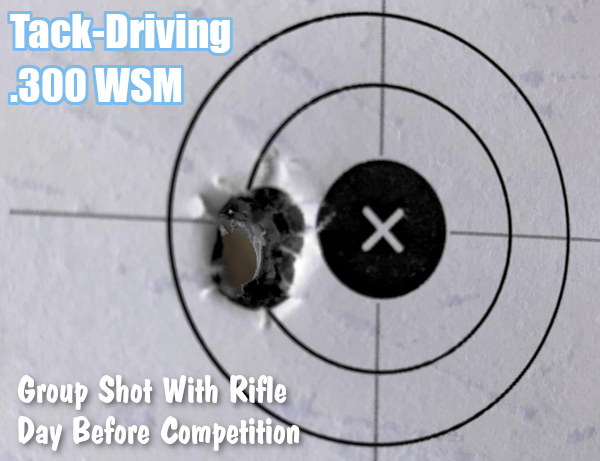
Gary was shooting pointed Berger 215gr Hybrid bullets in Norma .300 WSM cartridge brass. The powder was Hodgdon H4350 with Muron KVB7 primers. Gary say his load runs around 2850 fps, and is very accurate. To demonstrate, here is a three-round, 100-yard test target, with a group measuring in the ones. Pretty impressive for a big bullet and a short magnum cartridge.
The UK has some wonderful places to shoot. This photo was taken at Blair Atholl in the Highlands of Scotland. Gary says “This is one of my favorite ranges and probably the hardest range to shoot in the UK. Due to the topography of the range you have to alter elevation as well as wind for pick-up and let-off. They say ‘Diggle Ranges Bark’ but Blair Atholl Bites!”
Blast from the Past — At Blair Atholl Ranges in Scotland
One of Europe’s very best F-Class competitors, Gary is no stranger to the winner’s circle. Here he is at the Blair Atholl Ranges in Scotland after a major victory a few seasons back. Gary says: “Blair Atholl, in the Estate of Blair Castle, is very scenic. The range is very tricky and is known as the hardest range in the UK to shoot due to the location of the targets cut into the hillside and valley. When the wind is at full value you often have to add one-half MOA elevation to every 1 MOA of wind. So thinking wind and elevation every shot is very difficult. I won this match some time ago and I do not recall the score. However it was a decisive win, and all matches in the competition were held at 1000 yards.” Gary was using a different rifle, but it also was a .300 WSM with a BAT action. His load was Hodgdon H4831 with Berger 215gr Hybrids, Murom primers, and Norma brass.
The event was the first GB National League event of the year, our only short range (600-yard) match. This is actually one month later than usual in hope the weather would be better, sadly that wasn’t the case!
I won the Championship, five points clear of runner-up Ian Boxall. My final score was 241-18V out of a maximum of 250. The course of fire was reduced due to Storm Hannah on Saturday. It was decided by our committee that for safety we should shoot under cover (Diggle has a 600-yard covered firing point). The goal was to get at least one match to allow the competition to continue on the Sunday.
When I saw the condition and the flags I decided I needed to shoot as quick as possible as wind speed and direction were changing in seconds….
So I shot like stink only watching one flag and the other targets and my shot indication on the target screen. My first sighter was a score One left (a FIVE on the U.S F-Class target). But after adjusting, my second sighter was a One right — so there were pick-ups and let offs of about FIVE MOA!
I split the difference and went for score, my first shot was a Four (Nine on USA target) which I then adjusted on and held accordingly for the rest of the string using the other targets as indication and the one flag I had identified, it went pretty well.
Day Two (Sunday) weather was completely different, much better with no rain. We were first up at 0900 and the winds were light with subtle changes. This was a two sighters and 20-shot match, I started well with two V sighters which were converted, my partner Richard Sharman also had a good start and we proceeded through the string shooting Vs and Fives until Richard’s shots started to not register, this happened three times so it was decided I would continue and Richard would shoot again on another target. This caused a lot of delay and disruption. I had lost my path and wind, due to the delay I was allowed a non-convertible sighter which was a Three. It took two further shots to get back into the swing and I then recovered and ended the shoot with a 97-10V.
For the Final Match, the wind had picked up and was causing quite a few lost points and curses. I knew I was three points clear going into this Final Match so I had to play it real safe not to drop shots and lose critical points. I favored a left 4-5 Ring hold so not to get caught on the pick-ups. I use the March MTR-2 reticle, on 40X this reticle is subtended at exactly one-half MOA and brackets the F-class target perfectly. I was not concerned about the V bull at this time, the plan paid off and I dropped two points only.
A carpet is used up front for smoother tracking with the Joy-Pod’s flat, ski-style feet. The arms of the Joy-Pod were painted to match the stock. The rear bag features low-drag material on the ears.
On Sundays, we feature notable rifles that exhibit fine craftsmanship, quality components, and noteworthy shooting accessories. Today we are featuring an F-TR (F-Class Target Rifle) rig that showcases the types of components, and accessories used by top F-TR competitors — including a coaxial bipod and Labradar Chronograph. If you’re considering getting started in the F-TR game, take a close look at this modern F-TR build from Forum member DM.Oakes.
Modern F-TR Rig with Borden Action, Krieger Barrel, and SEB Joy-Pod
This handsome .308 Win F-TR rig features a smooth-running Borden BRM action, 30-inch 1:10″-twist Krieger barrel, and an X-Ring Laminated Wood stock. Up front is a coaxial “Joy-Pod” joystick bipod. This is a state-of-the art, wide footprint bipod used by many competitors at the Worlds in Canada. The long joystick allows the “driver” to quickly adjust both elevation and windage in a smooth, continuous motion. The Joy-Pod can be adjusted so it will hold setting during the shot — you don’t have to “hard-hold” the joystick. Many shooters let the joystick slide through their fingers as the rifle moves back on recoil. With a little practice (and careful placement of the rear sand-bag), the tracking is excellent and you can slide the gun right back to point of aim after each shot.
This F-TR rifle is shown during load testing with a LabRadar chronograph.
» Full LabRadar Field Test/Review by Ray Gross
If you are considering purchasing a LabRadar Chronograph system, we strongly suggest you read the very thorough and informative LabRadar Review by Ray Gross, past Captain of the USA F-TR team. Ray notes: “It takes me about 3 minutes to set up [my LabRadar] at the range. Because there are no downrange screens, I do not have to hold up other shooters on the range like I would when setting up a traditional chronograph. The convenience alone will mean that I will use it more often than my old chronograph. Every time I take it out, I enjoy it a little bit more.”
We know our readers like accurate rifles — the more accurate the better. You guys also love really great craftsmanship and state-of-the art componentry. To satisfy that lust for amazing, accurate rifles, we’re starting a new feature — Sunday GunDay. We’ll try to do this a couple Sundays a month, provided we have some great candidates. For our first Sunday GunDay feature, we are presenting a stunning .284 Win F-Open match rifle owned by David Christian of Team Borden/Brux/Lapua. This impressive rig is as good as it gets in the F-Open game. The write-up is by David’s friend, Forum member F-Class John.
Tips For Competitors from David Christian
1. Tracking is Really Important. I learned this lesson from Bill Brown. Make sure your rifle is tracking exactly on your bags. If you slide the gun back and forth and it does not line up on your original aim point, something is out of alignment with you rear bag or mat and needs to be adjusted.
2. Wind Calls — Be Brave. Don’t be timid with your wind calls. It is better to err with a slight over-correction, rather than miss a change entirely.
3. More Data is Good. Keep track of as much data as you can so that you can learn from it. For example I shoot as much as I can with my chrono and track my load speeds so that I can tell if I am drifting out of my node.
David Christian’s .284 Win F-Open Rig
Report by F-Class John
Here’s match rifle that’s as handsome as it is effective (and accurate!). In its first-ever tournament, this impressive rig took 8th place overall in F-Open at the 2019 Berger Southwest Nationals. This .284 Win hammer was wielded by David Christian, the newest member of Team Borden/Brux/Lapua. David built this .284 Winchester around a Borden BRMXD action with black PVD coating and a Jewell BR trigger. What I found fascinating is that David had built all of this before ever being approached for the team. When I asked him how that worked out, he simply said he picked the components he liked the best and knew would do the job. It was just the universe in action that he’s now on the team that matches his gear and he’s certainly not complaining that he gets to represent them now.
David uses a custom-contour 32″-long Brux 1:8.5″-twist barrel that tapers from 1.35” to 1.25” because he likes the extra stability and weight it brings. It’s all mounted in an amazingly-crafted Cerus Stock (Speedy Gonzales “Spear of Destiny” design). While Will McCloskey built the stock, it was finished to perfection by Devin Wiggett and mounted by Terry Wright of Right Rifle in Oregon. You might also notice that the buttstock features a R.A.D. recoil system which adds the final touch to the system.
Stunning Laminated Maple/Cherry/Walnut/Wenge Cerus Stock
When asked what people comment on when they see his gun, David says it’s the stock, hands down. Having handled this gun myself, I have to agree and believe me when I say the pictures don’t do it justice. The exterior forearms are torrified Maple while the core is made up of Brazilian Cherry, Walnut, and African Wenge wood. It makes for an ultra-strong stock with stunning beauty to match.
David currently tops this beauty with a Kahles K1050 10-50x56mm scope featuring the MOAK reticle. David really likes the 20 MOA per revolution dial as well as the top-mounted parallax adjustment. This is especially helpful for him as David shoots left-handed. Most scopes have a left-side parallax knob which is difficult for him to use during a match.
You can’t have a rifle this good-looking and functional without riding on the right gear. David uses a Protektor DR Bag and a SEB Special Edition NEO coaxial front rest. All told it took nearly six months to get all the parts delivered and assembled but he looks at that as a short term loss and a long term gain. Using Erik Cortina’s load development methods with Berger 180gr Hybrid Target or 184gr Hybrid Target bullets and quality Lapua brass, David has achieved some amazing results. Here’s a representative target from a recent match. That’s mighty fine shooting!
If you want to “hit the ground running” in the F-Open game, this wouldn’t be bad setup to emulate and if you see David at a match, he’s always more than happy to talk to you about it.
Ian Klemm, 2017 F-TR USA National Champion, is one of America’s top F-Class shooters, both shooting individually and in team competition. Ian is known for his consistency, smooth gun handling, and an uncanny ability to shoot well even in the toughest wind conditions. In this Vortex Video, Ian and fellow long-range shooter Niles Richardson, reveal some of their competitive secrets, and wind-reading techniques. This video focuses primarily on F-Class competition but Ian and Niles also talk more broadly about the myriad factors that contribute to rifle accuracy. Topics include: match strategies, wind and mirage reading, barrel harmonics, bipods, and optics.
Vortex Nation Podcast Episode 57 Summary
From Vortex: Our original intent was to have just a podcast about the sport of F-Class shooting, but when you get these brainiacs (Ian Klemm and Niles Richardson) talking about their obsession… er… “Hobby” you better believe it’s going to turn into a full on long range shooting information assault to the brain. Fact of the matter is, in F-Class, the only thing that matters is long range accuracy – and when we say “Accuracy”, we’re talking about sub-MOA groups on paper at 1000 yards with .308 Wins. Every single aspect of an F-Class competitor’s game is completely dialed in for long range accuracy.
We talk about the guns, their bipods, wind, mirage, barrel harmonics and the special scopes F-Class competitors need for their rifles. Ian even goes so far as to tell us how much his rifle has moved prior to the bullet leaving his 30-inch barrel. Just a simple equation involving acceleration, terminal velocity, moment of inertia of the rifle and coefficient of friction of the bipod and rifle on the ground.
On Facebook recently we saw an F-TR rig belonging to Team Michigan F-TR Shooter Dale Lucy. This features a Pierce action and a McMillan XIT stock, customized with an eye-catching Candy Apple Red paint finish. Kelly McMillan observed: “I like seeing what a shooter does to make his stock fit his personality. Dale sanded off the texture and then gave his stock a high-gloss Candy Apple Red paint job — beautiful.”
Dale wrote: “I recently purchased a second XIT stock so that I would have an exact copy as my backup rifle, I painted this one candy red over a black and gold marble base coat.” Dale praised McMillan for helping his team: “Thank you for your sponsorship of the Michigan F-TR team, we really appreciate it. I can attest that since I started to use your stock (XIT), my scores have improved significantly. I placed 10th at the Nationals last fall, and was the 8th place Master at the 2019 Berger SWN. In contrast I finished 10th from the bottom at the 2017 BSWN.” — Dale Lucy, SW Michigan
Gear Upgrade for F-TR Bipods
Here’s a smart upgrade that can improve the tracking and stability of your F-TR competition rifle. And better tracking can translate to higher scores. Kreativ Solutions offers a $55.00 Pivoting Feet Kit for the Phoenix Bipod. Kreativ’s pivoting feet are also offered for the SEB Joystick Bipod for $125.00.
This rifle started life as a factory Remington VSSF in .204 Ruger. With new stock, new barrel, and other upgrades it is now an ultra-accurate .223 Rem competition rifle.
Flames in the Snow…
Forum Member Brandon Schlund (aka “Bois Blanc Boy”), photographed this handsome flame-themed F-TR rifle against the snowy background of Michigan’s Bois Blanc Island. Brandon posted this to our long-running Pride and Joy Rifle Forum thread. He notes: “This is my first F-TR build, which started out as a stock Remington .204 Ruger. I had the action blue-printed, firing pin was bushed by Speedy, and I had a new bolt handle and knob installed by John Pierce.” This rifle is now fitted with a 3-groove Pac-Nor 1:6.5″-twist barrel chambered in .223 Remington to shoot the 90gr Bergers. Other components are: Kelbly KTS stock, Phoenix bipod, and Sightron 8-32x56mm SIII scope. Brandon says: “It took a long time to get this gun where it is now but I’m truly happy with it!” Here’s the “before” photo:
The Transformation — F-TR Comp Rig Made from Rem .204 Ruger Varminter
This rifle started out as a “plain Jane”, factory Remington VSSF II. I shot it on varmint hunts in factory configuration. Then I decided to transform the rifle into a .223 Rem F-TR gun. As the .204 has the same bolt face as a .223 made sense to go in that direction since I would be able to use the gun for varmint hunting as well as F-TR.
While I had shot some F-Class matches with my dad (Joe Schlund aka Bench on AccurateShooter) it wasnt much. When we did a PD hunt in Wyoming I primarily shot my .204 but I decided I wanted a cartridge that could reach out a little further and also do double duty — competition and varminting.
The first step in transforming this rifle was selecting a barrel. We ordered a Pac-Nor, 1:6.5″-twist, 3 groove, 30.5″ heavy Palma contour. This was then chambered with a PTG .223 ISSF reamer with 0.169″ freebore to run the .224 caliber heavies. I went with Pac-Nor because both my father and my brother Mark (aka Labrador2 on AccurateShooter) owned Kelbly-built F-TR rifles with the same barrels. Mark and my father couldn’t be happier with the results. Pac-Nor has great customer service along with a short wait time.
I sent the barrel and the factory Remington 700 action down to Kelbly’s where they did the chambering and cut the threads. While Kelbly’s had my action I had them blueprint it. A Kelbly KTS stock with the three-way buttplate and adjustable cheek piece came next. After getting behind Dad’s rifle and Mark’s gun there was no reason to look any further. With all its adjustments, the KTS stock fits very comfortably.
Loading for the .223 Rem with H4895 and 90gr Bergers
As a .223 Rem, this rifle has proven very accurate — it’s a bullet-hole cutter at 100 yards (low twos easy). Our best load is with Hodgdon H4895, 90gr Berger VLDs, CCI BR4 primers. This load is running at about 2835 FPS but YMMV (remember this is a LONG 30.5″ barrel). The Bergers are loaded .008″ into the lands with base-to-ogive of 2.035″.
Our loading technique may be tedious — with lots of sorting and measuring. But brother Mark, father Joe, and I all enjoy the steps. Our three .223 Rem match guns all love the same load which makes loading much easier. Believe it or not we use a Hornady Lock-N-Load progressive ammo plant, which is great when loading for three guns. Our consistency is fantastic with run-out a mere .001-.0015.
We also turn necks and weigh our primers. Does neck-turning and primer weighing really make a difference? Who knows but we try to eliminate more variables since we have to the time to do it, and we actually enjoy the procedures.
Pierce Engineering Installed Action and Modified Bolt
Being from Michigan, Pierce Engineering has done a lot of work for my family’s guns. For this project the Pierce team bedded the action and glued in a single-shot follower. The stock bolt handle/knob was too short for comfort in the KTS stock. Pierce added a longer handle and tactical knob to the bolt. I then installed a .223 Rem Lapua case base into the knob.
The complete .223 Rem rifle ready to shoot F-TR, as fitted with 8-32X56mm Sightron and Phoenix Bipod, weighs 17 pounds, 15 ounces.
Flame Graphics by Camo Creek Hydrographics
After the action was bedded by Pierce, the stock was sent to Camo Creek Hydrographics in Fenton, Michigan. I selected a flame-style design which Camo Creek applied through hydro-dipping. The stock went back to Pierce’s shop, which applied three coats of clear over the entire stock. The clear-coating really enhanced the flame graphics.
Firing Pin Bushed by Speedy
I sent the bolt to Thomas “Speedy” Gonzalez to have the firing pin hole bushed as otherwise the load could crater the primers pretty bad. Knowing I’d be shooting heavy-weight .22-Cal bullets with a stout load this was a good idea. Speedy also cut his trademark grooves into the bolt shroud which looks amazing. His work is top notch! There is zero cratering now, even with the hottest of loads.
Competition Components — 8-32x56mm Sightron and Phoenix Bipod
For an F-TR rig you need a quality high-magnification optic and a premium, wide-base bipod. I installed a 8-32x56mm SIII Sightron. This was another easy choice because of the attractive price and because my family has four other Sightrons that work great.
I installed a fore-end Picatinny rail to attach a Phoenix Bipod. I extended the Mariners wheel handles by adding short sections from an aluminum arrow shaft. This lets me adjust elevation without stretching forward. I also installed a Calvin Elite Timney Trigger set at 6 ounces.
How much did this all cost? Brandon tells us “I have roughly $2500 into the rebuild of the gun from a .204 Ruger to the .223 Rem.”
Bois Blanc Island in Michigan
Here on Bois Blanc Island we don’t have many amenities, but we do have the ability to shoot 550 yards at our local gravel pit on state land. It’s snow-bound right now as you can see. But later in the year this will be our close-to-home training center.
Winter at Bois Blanc Island, Michigan — Here’s the gravel pit where we can load test during warmer weather. When I took this photo, it was a “balmy” 10-degree day.
The 2019 Berger Southwest Nationals (SWN) are history. It was a great event, with challenging conditions. Forum member Matt Peetz reports: “This year was one of the best — the toughest competitors battling for position in some tough conditions. You never knew how the day was going to end up.” For detailed results and more photos, visit the Desert Sharpshooters Facebook Page.
This Berger SWN brings together sling shooters and F-Class competitors in one of the most popular rifle matches of the year, and definitely the biggest match West of the Mississippi. We congratulate the three divisional champions: Curtis Gordon (Sling), John Myers (F-Open), and Keith Trapp (F-TR)
Keith Trapp won the F-TR division at the Berger SWN with the best overall Aggregate for the week. Keith’s name will be placed on the SWN Nightforce Perpetual Trophy overall. Fellow F-TR Shooter Luke Ramsey won the Berger Trophy for the 600-yard Individual Agg. Phil Kelley said: “It was pretty cool to see good friend Keith Trapp win it all. Our little Butner Club matches just make me smile. That’s 3 SWN champions riding in the same car many days.”
F-TR Top Three
Keith Trapp, 1227-44X; Peter Johns, 1224-40X; Ian Klemm, 1222-51X
(Special Mention: Fritz Braun, 1220-58X, High Senior)
F-Open Top Three
John Myers, 1244-71X; Stephen Potter, 1241-69X; Cody Richardson, 1241-62X
(Special Mention: Sixth Overall and F-Open Palma Match Winner, AccurateShooter System Admin Jay Christopherson, 1239-61X)
Sling (Palma) Top Three
Curtis Gordon, 1241-67X; Kent Reeve, 1241-52X; Oliver Milanovic, 1240-68X
(Special Mention: Tom Whitaker, 1232-55X, High Grand Senior)
F-Open Team Results
Winner: Team Lapua-Brux-Borden, 2375-137X
Alphabetical Order: Jay Christopherson, Erik Cortina (Shooter/Captain), Tod Hendricks, Pat Scully, Bob Sebold (Coach); David Christian (Alt), Steve Harp (Alt)
Second Place: Team Grizzly, 2374-109X
Shiraz Balolia (Shooter/Captain), David Mann, John Meyers, Emil Kovan, Emil Praslick III (Coach)
F-TR Team Results
Winner: Team Texas, 2359-111X
Otis Riffey, Jason Peel, David Parck, Greg Barkley, Randy Littleton, Skip Barkley (Captain), Peter Johns (Coach)
Second Place: Team USA Freedom, 2345-108X
Ian Klemm, Wade Fillingame, Alan Barnhart, Fritz Braun, Kent Reeve (Captain); James Crofts (Coach)
Sling Team Results
Winner: Blazing Saddles, 2347-108X
Thomas Thompson, Andrew Wilde, Mike Kelley (Shooter/Captain), Oliver Milanovic (Shooter/Coach)
Gary Eliseo said: “Congratulations to team Blazing Saddles — Mike Kelley, Tom Thompson, Andrew Wilde, and Oliver Milanovic winners of the gold medal in the team event of the 2019 BSWN matches. Well done!”
Second Place: Team U.S. National Black, 2346-107X
Steffen Bunde, Tony Miller, Yvonne Roberts, Jerry Iliff (Shooter/Captain), Yvonne Roberts (Shooter/Coach)
Friends in Life and on the Podium
Congratulations to Allen Thomas and Gary Eliseo who both shot great in the “Any Rifle” class, a subdivision of the sling division. Both men were shooting Eliseo Chassis Rifles with Pierce Engineering’s new Gen 2 short-cycle Ultra slick actions. Gary noted: “I’m honored to share the podium with my friend and teammate Allen Thomas (first place ‘Any Rifle’) and me (second place ‘Any Rifle’) winners at the 2019 BSWN matches.
The Berger Southwest Nationals is taking place right now at the Ben Avery Range outside Phoenix, Arizona. At the SWN you’ll see prone rifles and tubeguns for sling shooters, F-TR rifles with fancy bipods, and high-tech F-Open rigs. You might also see a few TubeGuns converted to shoot F-Open off front rests. Yes this is an easy conversion thanks to Gary Eliseo’s clever PickleFork forearm attachment.
Forum Member Killick attached PickleForks to his handsome blue Eliseo R1 TubeGun now chambered in .284 Winchester, a top choice for the F-Open discipline. Killick explains: “Behold! An Eliseo R1 F-Classer. This started out as an R1 Long Range sling rifle (6XC) with a Borden TubeGun action. It is now rebarreled in .284 Win with Gary’s PickleFork fore-end adaptor. Props to Gary Eliseo at Competition Machine LLC.”
Killick adds: “I like how the original fore-end indexes off the back side of the front bag. No need for the front bumper attachment.” Check it out below:
PickleForks are rails that fit to the sides of the tubular fore-end/handguard on Eliseo Chassis systems. This allows you to use a pedestal-style front rest for F-Class competition. It also provides a much more stable platform for load testing, varmint hunting, or any kind of rest-assisted precision shooting. These new PickleForks transform a Tubegun into an ultra-stable, straight-tracking rig when used with a competition-style front rest.
Designer Gary Eliseo explains: “Now you can have the same super low-boreline, long wheelbase and vertical sides of our innovative F1 F-Class chassis system for your tube chassis. The PickleForks attach directly to the sides of the F-Class/Tactical fore-ends, no modifications are required. They are very rigid with no flex or twist and make the rifle track like it’s on rails.” The Eliseo Competition Machine PickleForks are offered for a very reasonable $70.00 per pair, with Cerakote finish. You get two metal units, one for each side of the fore-arm. For more info, visit GotXRing.com or call (928) 649-0742.
Today is Day One of the Berger Southwest Nationals, at the Ben Avery Range outside Phoenix, AZ. There will be a 600-yard mid-range match. Many of the nation’s most talented F-Class and sling shooters will be there. But no matter what your skill level, it is still possible to make major mistakes, that can spoil the day and/or put you out of the running for the entire match.
Photo by Sherri Jo Gallagher.
In any shooting competition, you must try to avoid major screw-ups that can ruin your day (or your match). In this article, past F-TR National Mid-Range and Long Range Champion Bryan Litz talks about “Train Wrecks”, i.e. those big disasters (such as equipment failures) that can ruin a whole match. Bryan illustrates the types of “train wrecks” that commonly befall competitors, and he explains how to avoid these “unmitigated disasters”.
Urban Dictionary “Train Wreck” Definition: “A total @#$&! disaster … the kind that makes you want to shake your head.”
Success in long range competition depends on many things. Those who aspire to be competitive are usually detail-oriented, and focused on all the small things that might give them an edge. Unfortunately it’s common for shooters lose sight of the big picture — missing the forest for the trees, so to speak.
Consistency is one of the universal principles of successful shooting. The tournament champion is the shooter with the highest average performance over several days, often times not winning a single match. While you can win tournaments without an isolated stellar performance, you cannot win tournaments if you have a single train wreck performance. And this is why it’s important for the detail-oriented shooter to keep an eye out for potential “big picture” problems that can derail the train of success!
Train wrecks can be defined differently by shooters of various skill levels and categories. Anything from problems causing a miss, to problems causing a 3/4-MOA shift in wind zero can manifest as a train wreck, depending on the kind of shooting you’re doing.
Photo by Sherri Jo Gallagher.
Below is a list of common Shooting Match Train Wrecks, and suggestions for avoiding them.
1. Cross-Firing. The fastest and most common way to destroy your score (and any hopes of winning a tournament) is to cross-fire. The cure is obviously basic awareness of your target number on each shot, but you can stack the odds in your favor if you’re smart. For sling shooters, establish your Natural Point of Aim (NPA) and monitor that it doesn’t shift during your course of fire. If you’re doing this right, you’ll always come back on your target naturally, without deliberately checking each time. You should be doing this anyway, but avoiding cross-fires is another incentive for monitoring this important fundamental. In F-Class shooting, pay attention to how the rifle recoils, and where the crosshairs settle. If the crosshairs always settle to the right, either make an adjustment to your bipod, hold, or simply make sure to move back each shot. Also consider your scope. Running super high magnification can leave the number board out of the scope’s field view. That can really increase the risk of cross-firing.
2. Equipment Failure. There are a wide variety of equipment failures you may encounter at a match, from loose sight fasteners, to broken bipods, to high-round-count barrels that that suddenly “go south” (just to mention a few possibilities). Mechanical components can and do fail. The best policy is to put some thought into what the critical failure points are, monitor wear of these parts, and have spares ready. This is where an ounce of prevention can prevent a ton of train wreck. On this note, if you like running hot loads, consider whether that extra 20 fps is worth blowing up a bullet (10 points), sticking a bolt (DNF), or worse yet, causing injury to yourself or someone nearby.
[Editor’s Note: The 2016 F-Class Nationals will employ electronic targets so conventional pit duties won’t be required. However, the following advice does apply for matches with conventional targets.]
3. Scoring/Pit Malfunction. Although not related to your shooting technique, doing things to insure you get at least fair treatment from your scorer and pit puller is a good idea. Try to meet the others on your target so they can associate a face with the shooter for whom they’re pulling. If you learn your scorer is a Democrat, it’s probably best not to tell Obama jokes before you go for record. If your pit puller is elderly, it may be unwise to shoot very rapidly and risk a shot being missed (by the pit worker), or having to call for a mark. Slowing down a second or two between shots might prevent a 5-minute delay and possibly an undeserved miss.
4. Wind Issues. Tricky winds derail many trains. A lot can be written about wind strategies, but here’s a simple tip about how to take the edge off a worse case scenario. You don’t have to start blazing away on the command of “Commence fire”. If the wind is blowing like a bastard when your time starts, just wait! You’re allotted 30 minutes to fire your string in long range slow fire. With average pit service, it might take you 10 minutes if you hustle, less in F-Class. Point being, you have about three times longer than you need. So let everyone else shoot through the storm and look for a window (or windows) of time which are not so adverse. Of course this is a risk, conditions might get worse if you wait. This is where judgment comes in. Just know you have options for managing time and keep an eye on the clock. Saving rounds in a slow fire match is a costly and embarrassing train wreck.
5. Mind Your Physical Health. While traveling for shooting matches, most shooters break their normal patterns of diet, sleep, alcohol consumption, etc. These disruptions to the norm can have detrimental effects on your body and your ability to shoot and even think clearly. If you’re used to an indoor job and eating salads in air-conditioned break rooms and you travel to a week-long rifle match which keeps you on your feet all day in 90-degree heat and high humidity, while eating greasy restaurant food, drinking beer and getting little sleep, then you might as well plan on daily train wrecks. If the match is four hours away, rather than leaving at 3:00 am and drinking five cups of coffee on the morning drive, arrive the night before and get a good night’s sleep.”
Keep focused on the important stuff. You never want to lose sight of the big picture. Keep the important, common sense things in mind as well as the minutia of meplat trimming, weighing powder to the kernel, and cleaning your barrel ’til it’s squeaky clean. Remember, all the little enhancements can’t make up for one big train wreck!


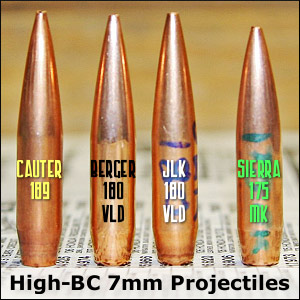 7mm (.284) remains the caliber to beat in F-Class Open Division (though some shooters have had success with .30-Cal short magnums.) With a standard .284 Winchester, or better yet, a .284 Improved, you can drive the high-BC Berger 180gr and 184gr bullets to competitive velocities.




 Flame Graphics by Camo Creek Hydrographics


 Train Wrecks (and How to Avoid Them)

 4. Wind Issues. Tricky winds derail many trains. A lot can be written about wind strategies, but here’s a simple tip about how to take the edge off a worse case scenario. You don’t have to start blazing away on the command of “Commence fire”. If the wind is blowing like a bastard when your time starts, just wait! You’re allotted 30 minutes to fire your string in long range slow fire. With average pit service, it might take you 10 minutes if you hustle, less in F-Class. Point being, you have about three times longer than you need. So let everyone else shoot through the storm and look for a window (or windows) of time which are not so adverse. Of course this is a risk, conditions might get worse if you wait. This is where judgment comes in. Just know you have options for managing time and keep an eye on the clock. Saving rounds in a slow fire match is a costly and embarrassing train wreck.


