We like Do-It-Yourself (DIY) projects. It takes initiative, creativity, and dedication to make your own hardware, and that’s worth acknowledging. For you dedicated DIY guys, here’s a great project that should inspire. Here is an owner designed and crafted F-Open rig, complete with home-built, belt-drive front rest.
Some of our mechanically-skilled readers chamber their own barrels or bed their own stocks. But these are relatively simple tasks compared to the jobs of constructing an entire rifle plus building an advanced front rest from scratch. Well that’s exactly what Forum member Steve B. (aka Essexboy) did a couple seasons back. He built his own rifle and an impressive twin-belt-drive pedestal rest. (Click photo below for large version). And get this, Steve’s home-made rifle was victorious in its first-ever match. Steve reports: “I shot my first Comp with the rifle … and managed to win with a score of 239-21!” (The match was shot at 300/500/600/1000/1100 with English scoring of 5 points for center bullseye).
Do-It-Yourself F-Open Rig from England
Steve, who hails from Essex in the UK, constructed virtually every component of his skeleton-style rifle except the 28″ HV Bartlein barrel (chambered as a 6mm Dasher) and the Tikka 590 donor action. Steve also did all the design and fabrication work on his one-of-a-kind front rest. Steve tells us: “Over the last year or so, I made this rifle stock and rest. I managed to make it all on a little Myford Lathe, as you can tell I’m no machinist but it saved me a load of money — so far I’ve got about $200 invested plus the barrelled action. The stock is aluminum except for the stainless steel bag runner. The rifle came in at one ounce under weight limit for F-Class Open division.” Steve did get help with the chambering and barrel-fitting, but he hopes to do all the barrel work himself on his next project.
The gun is very accurate. Steve notes: “I have shot the rifle to 1100 yards and it shoots well. Last time out the rifle dropped just one point at 1000 yards and 5 points at 1100 yards [English scoring system]. I know it’s not pretty, but it got me shooting long range F-Class for peanuts.” Message to Steve: Don’t worry how it looks. As another Forum member observed: “Any rifle that shoots well at 1100 yards is beautiful….”
Steve started with a Tikka 590 action: “The whole stock was made on a small (6.5×13) lathe and a vertical slide. This caused a few head scratching moments, figuring out how to hold the T6/HE30 alloy for the milling/turning operations, but it did teach me a few things. The hardest parts were clamping the longer sections (such as the fore-end) and keeping it all square. Due to the short cross-slide travel I had to keep re-setting the parts. I managed to keep all measurements to 0.001″ (one thousandth). I’m most proud of the trigger guard (photo below). This took a full day but came out really well, even if I say so myself.”
Belt-Driven Front Rest
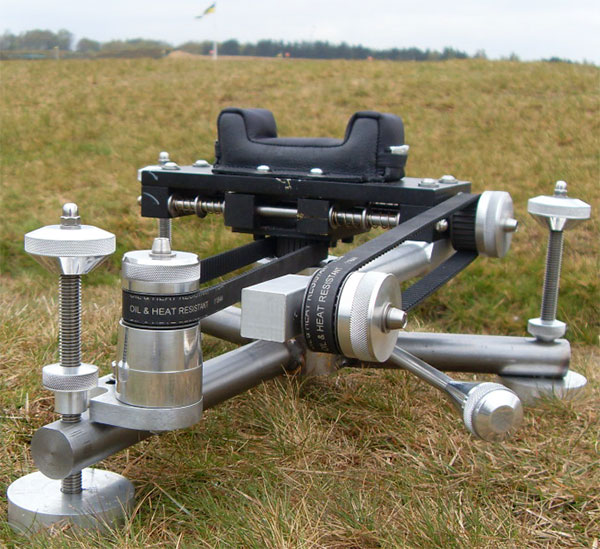
We’re impressed with Steve’s ingenious front rest. Steve explains: “The rest is belt-driven and still in the experimental stage — hence no powder coating or polishing yet. I may have gone over the top as the key moving parts (the pulleys) run on three (3) types of bearings: radial; reamed bush; and a ball race. The main post runs on a radial bearing and the feet even have bearings in them, so when I raise the main body up (for rough height adjustment) the foot stays static.”
Will Steve build another rifle? Steve says he will, and he’s upgraded his tools: “Since building the rifle I have acquired a bigger lathe (Harrison m250) and a milling machine. For the next project I hope to be able to do the barrel work (threading, chambering, crowning) as well.” The next gun might be another Dasher. Steve explains: “After extensive reading on AccurateShooter.com, I chose the 6mm Dasher chambering, as I have a shoulder problem and can’t shoot a rifle with a lot of recoil.”
American shooters have been enjoying Irish hospitality this week in Ireland, while attending attending the Emerald 2018 match at Midlands National Shooting Centre of Ireland (Tullamore). Our friends James Crofts, Phil Kelley, and Aussie Jenni Hausler provided these images from the event — both at the range and off. The Yanks are off to a good start. James reports: “Day one scores are out and Team USA is on top. Madison Bramley topped F-Open and I held on for F-TR. I also won the 1000-yard match. My equipment performed flawlessly — rifle built by Keith Weil of KW Precision, Cerus Stock by Will McCloskey, and BRM action by Jim Borden.”
American Phil Kelley posted: “As always our hosts are outstanding. Man, love this range! Ready for the big match starting tomorrow.”
Phil Kelley enjoyed the Team Match and long-range Clays Fun Match which preceded the main event. Phil posted: “A great day, with a busy line at 1100 and 1200 yards in Ireland. Last fun day included some great competition. Team USA did well. After getting completely destroyed at 1100 yards, I was able to win the 1200 yard match; with a miss! First ever board miss, it’s only 6’ wide. 12-14 mph winds with a lying, heavy mirage.”
The day finished with a fun (and challenging) Clay Pigeon Shoot at roughly 1235 yards. Phil noted: “Ellis Berry, James Crofts and myself were one of only a handful to hit the 4.25″ clay target within 5 shots in these conditions.” Think you can do that? That 4.25″ clay bird represents a mere 0.338 MOA at 1200 Yards! Not easy folks…
Competitors in the Clay Pidgeon Shoot at 1200+ yards.
Posting on Facebook, Mias Nieuwoudt had an interesting observation about the challenge of 1200 yards: “On average it seems the old 308s ran out of steam compared to our F-Open rigs at 1200 yards. Maybe a 40° scope rail with the targets angled backwards at 30° so you can lob the points like mortars!”
Touring the Emerald Isle — Countryside and Castles
On June 5, Phil Kelley observed: “Another great group touring day. A morning stop at Donamass Castle ruins provided incredible Irish views, then on to the town of Kilkenny for the Smithwicks Brewery tour, visit to Kilkenny Castle and a walk on the Medieval Mile.”
Interior of Kilkenny Castle
Nancy Tompkins (left) and Michelle Gallagher (right) give a shout out to friends.
The American contingent — enjoying the good life in Ireland.
Facebook Photo Credits: Jenni Hausler, James Crofts, Phil Kelley, Pat Hunt, the Bramleys.
Jeremy Rowland decided to put together an F-TR rifle for his eldest daughter, who enjoys competitive shooting. For his daughter, Rowland chose the .223 Rem option because it has less recoil and components are less costly than the .308 Win. Here is Rowland’s account of how he developed a .223 Rem load. For more details (with data charts), read Jeremy’s FULL STORY on Sierra Bullets Blog.
Journey to Find a .223 Rem F-Class Load
by Jeremy Rowland, Reloading Podcast
My oldest daughter has been to several matches with me, and has even competed in several, using her .243. I decided this coming season (2016), she would compete with a .223 Rem in FT/R. Looking for a good starter rifle, I settled on the Savage Axis Heavy Barrel since it has a 1:9″ twist. This would be a great little rifle for her to learn on. The rifle was shot unmodified, as it came from the factory. A Sinclair F-Class Bipod w/micro elevation adjustment was fitted to the front.
Next came finding the components I wanted to use for her match loads. After spending hours and hours running numbers on JBM stability calculator as well as in my iPhone Ballistic AE app, the 69 gr Sierra Tipped MatchKing® (TMK®) looked really good. So that’s what I decided to go with. I jumped in head first and ordered a bulk pack of the Sierra 69 gr TMKs. I had settled on Hodgdon CFE 223 since it shows good velocity. I decided to go with once-fired Lake City brass with CCI BR4 primers.
Next came the testing. I decided to run a ladder test (one shot per charge from min to max looking for the accuracy node). The ladder test ranged from 23.5 grains to 25.6 grains, in 0.3 grain increments.
Bullet: 69 gr Sierra Tipped MatchKing®
Case: Lake City (mixed years, sorted by case capacity)
Primer: CCI BR4
Powder: Hodgdon CFE 223 (one round each from 23.5 to 25.6 grains)
Cartridge OAL: 2.378″
Base to Ogive: 1.933″ (.020″ off lands)
After his ladder test, Rowland settled on a load of 25.2 grains of Hodgdon CFE 223. He then fine-tuned his load with different seating depths: “I loaded up 5 rounds each at .020″ off lands, .015″ off lands, .010″ off lands, and .005″ off the lands. Here are the results from the best group for OAL/Ogive fine tuning. As you can see, I think I’ve found a winner in these 69 gr Sierra Tipped MatchKings.”
Non-member price is $1499.99. The “Members price” is $1349.00. Using CODE SK1602 at checkout knocks the final price to $1249.99 (plus tax and shipping).
Here’s a super deal if you need a high-quality, high-magnification zoom scope for F-Class and long-range target shooting. Right now, the Vortex Optics Golden Eagle 15-60x52mm ECR-1 is on sale at Sportsman’s Guide for $1249.99 (member price) with Coupon Code SK1602. That Code gives you a “double discount”. However, it will cost you $39.99/year to join the Buyer’s Club to get member pricing. You can cancel Buyer’s Club membership anytime.
IMPORTANT: The $1249.99 Price is for BUYER’s CLUB only. And you MUST use CODE SK1602!
Still a deal if you’re not yet a member? You bet. This same scope sells elsewhere for around $1500.00. For example the price today, 3/21/2017, at Amazon.com is $1499.00 (see below). If you figure you’ll pay at least $1490.00 elsewhere for this scope and you net out the $39.99 membership cost, we calculate you’ll still save $200.00+ by taking advantage of this deal.
Here is the price on Amazon.com on March 21, 2018:
The Golden Eagle has earned good reviews from our Forum members. This scope features 60X max magnification, sharp lenses, low-dispersion glass, 1/8-MOA clicks, and a reticle that features MOA-based hold-offs and hold-overs subtensions are MOA-based at 40X magnification:
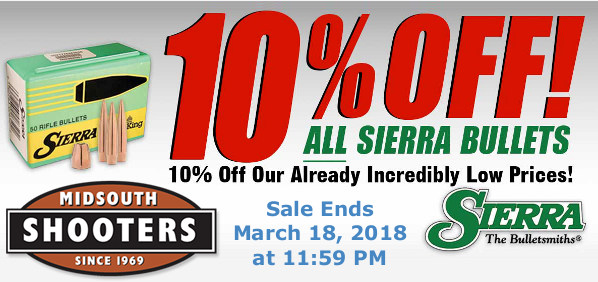
Need bullets for your 2018 High Power Campaign, F-Class Matches, PRS Comps, or Varmint Safaris? Check out this deal at Midsouth Shooters Supply. Now through March 18, 2018 at 11:59 pm, Midsouth has knocked ten percent (10%) off the price off all Sierra Bullets in stock. And Midsouth’s prices were already very competitive. The sale applies to all Sierra projectiles for rifles and pistols: match bullets, hunting bullets, varmint bullets, self-defense bullets.
This is your opportunity to grab some of Sierra’s great new generation MatchKing bullets. Many of these new SMKs come with the bullets “tipped” at the factory for more uniform BC. We have hear very positive comments from shooters running the tipped SMKs in .30 Caliber, 7mm, 6.5 mm, and 6mm. If you are shooting F-Open, you should definitely try the new 197gr MatchKing, with its stellar 0.780 G1 BC. Likewise if you shoot PRS or mid-range benchrest, you should check out the new 110gr SMK. It boasts an impressive 0.617 G1 BC.
More High-BC MatchKings in All Your Favorite Calibers
Sierra now offers very slippery, heavy-for-caliber MatchKings that have raised the BC Bar for their respective calibers. For example, the 150gr 6.5mm bullet really “pushes the envelope”. In past years, 140-142 grains was considered “high end” for a 6.5mm match projectile. Here are Sierra’s BC Leaders for 6mm, 6.5mm, 7mm, and .308 calibers. Many of these New Generation MatchKings now come “tipped” from the factory for more uniform BC.
Heavy-for-Caliber, Ultra-High BC Sierra MatchKings
How would you like to represent the United States in top-level International Shooting competitions? Well, if F-Class is your game, here is your opportunity. F-Class Team USA will be conducting try-outs for the United States squads who will represent our country in F-TR and F-Open divisions (plus Under-25) at the 2021 World Championships. The try-outs are open to any competitive shooter with a class-compliant rifle and the will to win. Team leadership expressly welcomes newcomers.
Initial and primary tryouts are planned during the 2018 U.S. National Championships in Raton, NM, and the 2019 SW Nationals in Phoenix, AZ. There may also be an early 2019 tryout date at Butner, NC.
Dan Bramley Invites Shooters to Team USA F-Class Try-Outs
Official Invitation to Team USA F-Class Try-Outs To the F-Class Community–
On behalf of Team USA 2021, we are pleased to invite the best of USA F-class to consider joining our effort for the 2021 World Championships in Bloemfontein, South Africa. We are reaching out with this invitation to provide some general information on our plans for 2021 and for upcoming try-out dates for the unified Team USA: F-TR, F-Open, and Under 25.
We are moving forward with F-Open, F-TR, and Under 25 unified as one USA F-class 2021 Team. This will allow us to take advantage of each team’s strengths and provide needed purchasing power and coordination for event and logistic costs. We also believe this will help encourage and grow our sport. We will share ideas, event/facility dates and best practices within this unified team, however, individual team segments will make their own decisions. Therefore, please direct your responses and inquiries to the appropriate team leadership.
Being part of Team USA is a major commitment of time and resources. We do have wonderful and sizable sponsorship partners who we thank and rely on for moderating individual team member costs. However, due to the location of this World Championship effort, one can expect to help cover a commensurate level of the costs.
We are now moving into the USA “development team” stage of the process. This team is open to newcomers… there are many newer names showing up on the top of leader-boards and many new teams that are making positive impacts. If you are interested in being part of Team USA, please consider making that commitment. We would like to hear from you by March 23, 2018.
Team Time Expectations
Attendance at SWN and US Nationals will be expected for 2019 and 2020. We will also likely expect the final team to attend the Berger SWN in 2021 or have an alternative site for a final practice prior to our trip. We will try to have afternoon or evening team sessions during these events however we may have team days just prior or after these events to maximize the use of individual travel dollars and time. We will also likely have additional team training dates in 2019 and 2020, likely on east coast ranges to facilitate best availability for all.
Shooting/Coaching Position Opportunities
We are equally passionate about developing coaching/shooting teams for winning gold medal efforts in both the Richardson Cup (8-man) and Rutland Cup (4-man) World Championship Events. Obtaining a shooting or coaching spot on one of these teams is an absolute gauntlet of a commitment and consistent strong results will be required as the USA is blessed with wonderful depth. We encourage all, with proven success in our sport, to test themselves at this highest of levels.
Team Try-Out Dates and Locations
Initial and primary tryouts are planned during the 2018 US National Championships in Raton, NM and the 2019 SW Nationals in Phoenix, AZ. There may also be an early 2019 tryout date at Butner, NC.
If you are interested in further information, please contact our Team USA leadership:
Dan Bramley, Captain USA F-Open
usrifleteam2021fopen [at] gmail.com
Phil Kelley, Jr., Captain USA F-TR
usarifle2021 [at] gmail.com
Rick Jensen, Captain USA U25
U25USAFclass [at] gmail.com
The 2018 Berger SW Nationals are now history. The fun, action, challenges, and rewards now pass into memories. Once again, the Berger SWN was a great shooting match — a great way to advance your shooting skills, reconnect with old friends, and enjoy warm weather. If you are a serious long-range shooter, this is definitely one of the best-managed, most rewarding matches on the planet. In 2018 the match “sold out” in a matter of hours. If you plan to go next year, watch for the registration notices. You don’t want to be left out.
2018 Berger Southwest Nationals Long Range Results
The SWN has three new individual champions. Congratulations to the three divisional Match Winners: Bob Sebold (F-Open), Phillip Kelley Jr. (F-TR), and Allen Thomas (Sling).
Top Five Overall – F-Open
Bob Sebold, 843-49X
Keith Glasscock, 843-38X
Jay Christopherson, 841-45X
Stephen Potter, 841-37X
James Crofts, 841-34X
Top Five Overall – F-TR
Phillip Kelley Jr., 838-35X
Ellis Berry, 837-42X
Niklas Montin, 836-35X
Peter Johns, 835-36X
Edward Shelley, 832-33X
Top Five Overall – Sling
Allen Thomas, 844-37X
Oliver Milanovic, 843-45X
Trudie Fay, 842-32X
Nancy Tompkins, 840-43X
Angus McLeod, 840-43X
The Berger SW Nationals are made possible through the principal support of Berger Bullets and Lapua, both part of the Capstone Precision Group, which also distributes Vihtavuori powder and SK Ammunition in the USA. Berger and Lapua both generously donated product prizes for 2018 SWN competitors.
Today’s Champions… And Tomorrow’s New Talent
Here is the Sling Winner, Allen Thomas, with Bill Gravatt, President of Capstone Precision Group. (Bill was formerly the President of Sinclair International).
Bob Sebold, of Team Lapua/Brux/Borden also won the individual F-Class SWN Title. He’s definitely one of the nation’s top F-Open pilots.
There were a dozen or so talented juniors competing at the Berger SW Nationals. Some of the youngsters posted scores that would put the “old guys” to shame. We definitely expect to see some of these young shooters standing on the podium at future Berger SWN events. We asked them to strike a “cool pose” and the Harris boys delivered…
Berger SW Nationals Gallery — Parting Shots
Does this competitor know something we don’t know. Perhaps he is testing a new “Stealth” rifle stock from McMillan. Or maybe this is some kind of Zen body/mind melding practice. We do advocate “dry firing”, but that normally involves holding a real rifle…
Look carefully and you’ll see quite a lot reflected in this SWN competitor’s shooting eyewear. Can you identify the type of rifle?
Michelle Gallagher — She’s probably smiling at an ‘X’ — or maybe she just nailed a tough wind call. The SW Nationals is a great event because of the hard work and dedication of talented folks like Michelle.
Can you name all the pieces of hardware in this image? We see at least a dozen. Don’t forget the little items like the bubble level and mirage shield.
How do you anchor a SEB MINI coaxial rest in under ten seconds? With MAXI feet of course! These over-size hooves belong to shooter Mark Fairbairn, a very tall, MAXI-sized Australian. Who needs to pound those F-Class feet into the ground with a mallet when you can simply “stand and deliver”.
We think some competitors came to Ben Avery just for the great Barbecue lunches — well that plus the great weather and the amazing prize table. Everyone goes home a winner in one way or another.
Texas gunsmith Richard King showed us the biggest rifle action we’ve ever seen. This 13-lb monster is the BAT .50 BMG Action. Honestly it was HUGE — with the bolt fully extended it was the size of your forearm (to the finger tips). Richard joked “This weighs almost as much as an F-TR rifle (before optic) all by itself”.
Reigning NRA National Long-Range Champion John Whidden in action on the 1000-yard line. John’s rifle features a centerfire action in an aluminum Anschutz small-bore stock.
There are now two more days left for the 2018 Berger SW Nationals, with the competition heating up. From this point on, all shooting will be at 1000 yards. Friday was challenging, with increasing wind velocities over the day. Shifts were harder to figure out, and some talented shooters dropped 8-10 points. Competition was fierce. In the sling division, our friend Gary Eliseo of Competition Machine came out on top via tie-breaker. Gary and Stuart Mackey shot identical scores on Friday at each distance: 150-8X, 150-7X, and 149-8X, both finishing with 449-23X. That’s as close as it gets.
One shot left… will that last bullet end up in the X-ring? We hope so…
Saturday Shooting — Team and Individual Competition at 1000
Today, Saturday 2/10/18, all shooting will be at 1000 yards, with both Individual and 4-person Team competition. The format calls for two, 20-shot matches for both individuals and teams. Good luck to all!
MATCH RESULTS: Complete Daily Scores and On-Going Match Standings are posted on the McMillan Fiberglass Stocks Facebook Page. Here are Top Five in each Division, at day’s end on Friday, 2/9/2018:
Top Five F-Open
Bob Sebold — 449-30X
Danny J. Biggs — 449-26X
Jay Christopherson — 448-28X
Stephen Potter — 448-23X
Ubaldino De Arellano — 448-23X
Top Five F-TR
Ellis Berry — 448-26X
Peter Johns — 448-25X
Philip Kelley Jr. — 448-21X
Doug Boyer — 447-27X
Greg Barkley — 447-23X
Top Five Sling
Gary Eliseo — 449-23X
Stuart Mackey — 449-23X
Bill Vaughn — 448-28X
Curtis Gordon — 448-23X
Nancy Tompkins — 447-30X
No Worries Mate — Mark Swaps Stocks in Mid-Match
Australian Mark Fairbairn performed a “Quick Fix” during Thursday’s match. His F-Open rifle, in a conventional fiberglass stock, was giving him random vertical during one yardage: “I had a bit of a problem with elevation — the stock was hitting somewhere [causing vertical]. I was X-X-X then a shot popped up in the 9 ring with no good reason. So I figured I better put a new stock on it. I got my old aluminium stock I brought from Australia and quickly adjusted it to fit on the Stolle.” Right on the berm he swapped his barreled action into the metal stock of his own design. The clock was ticking… but the story had a happy ending. For the next yardage Mark shot a brilliant 150-7X, not dropping a point. So the “Quick Fix” did the trick. As they say Down Under — “Good on Ya, Mate!”
Patriotic Pair of Stars and Stripes F-Open Rigs
There were two very patriotic F-Open rifles side-by-side on the firing line yesterday. These Stars and Stripes rigs were squadded right next to each other just by chance — but it made for a great show.
Like Father, Like Daughter — The Cortinas
Erik Cortina, member of Team Lapua/Brux/Borden, is one of the nation’s top F-Class shooters. But on Friday he was only the second-best Cortina at 1000 yards. Erik’s daughter, Amberleeana, posted a 147-7X to edge her Dad by 3 Xs (Erik scored 147-4X) from the 1000-yard line.
F-Class is for Everyone – All Ages, Guys AND Gals
F-Class is not just a man’s game. There were many lady shooters on the firing line, in both F-Open and F-TR Divisions. Some shooting instructors says females learn faster than their male counterparts, so they can excel quickly in the shooting sports.
Cool Gadget (Literally) — The BarrelCool Device
The clever BarrelCool is a dual-purpose device that serves as an Empty Chamber Indicator (ECI) while cooling your barrel with a battery-powered fan. This is American ingenuity at its best.
Spotting Scope Support Arm Attached to Front Rest
Texas gunsmith Richard King of King’s Armory had a very clever set-up for his spotting scope. He has fabricated a support arm that holds the spotter very close to his rifle. With this configuration, Richard can view through the spotting scope without shifting his position on the rifle. This puts the spotting scope’s eyepiece just a few inches from his riflescope eyepiece so he can move easily from one optic to the other. This set-up also reduces the amount of gear Richard carries to the line. No separate spotting scope base, stand, or tripod is needed. This is a simple, elegant solution. We bet, with a little tinkering and design work, a similar system could be mounted to a SEB or Bald Eagle front rest
Labor of Love — Do-It-Yourself F-TR Stock Milled from Aluminum
We saw many interesting F-TR rigs. Here’s an one-of-a-kind stock, machined from aluminum billet by shooter/owner Mark Roberts of Lone Star Tumblers. There are a ton of man-hours in this unique stock.
Bird’s Eye Ben Avery — A Look at the Range
If you’ve never visited the Ben Avery Facility north of Phoenix, Arizona, here is a video shot in 2016 that shows the 1000-yard range (including drone footage). The desert range at Ben Avery is something special — check out this “birds-eye view”. This video also includes an interview with Derek Rodgers, the current F-TR World Champion, King of 2 Miles, and the only man who who has earned both F-Open AND F-TR National titles.
Ben Avery by Air — We are repeating this 2016 video here because it has a great aerial view of the Mid Tompkins 1000-yard Range at Ben Avery
Erik Stecker of Berger Bullets visited the match Friday. Here he talks with members of Team Berger Bullets. Eric now oversees operations of Berger, as part of the Capstone Precision Group (Berger, Lapua, SK, Vihtavuori). That’s Walt Berger in the background in the red shirt.
There were plenty of smiles on the firing line — the Berger SW Nationals event offers great weather, great competition, great camaraderie, and a great prize table.
Swap-Meet at Ben Avery
After the matches concluded on Friday, a Swap Meet was held in the Club House. There were some great bargains to be found. Can you name the past National Champions in the background of this photo?
Parting Shot: Glamtactical by Cerus Rifleworks
We spotted a stunning “Glamtactical” rig from Cerus Rifleworks in the Nightforce booth. Believe it or not, Cerus owner Will McCloskey found this stunning wood buried in a “bargain bin”, and snagged the highly-figured walnut blank for under $10. Steal of the year! This rifle features a carbon-wrapped barrel with muzzle brake.
Most bolt-action rifle shooters work the bolt with their trigger-pulling hand. This is because most rifles sold to right-handed shooters come with right-side bolts, while “lefty” rifles come with left-side bolts. This “standard” configuration requires the shooter to take his dominant, trigger-pulling hand off the stock to cycle the bolt, then re-position his hand on the stock, and “re-claim” the trigger. Often the shooter must lift or move his head to work the bolt, and that also requires him to re-establish his cheek weld after each and every shot. Not good.
This really doesn’t make much sense for precision shooting with fore-end support*. There is a better way. If you leave your trigger hand in position and work the bolt (and feed rounds) with the opposite hand, then you don’t need to shift grip and head position with each shot. All this requires is a weakside-placed bolt, i.e. a left bolt for a right-handed shooter or a right bolt for a left-handed shooter. The video below shows a “Lefty” working a right bolt. Note how efficient this is:
As our friend Boyd Allen explains: “If you think about it, if you are going to work with a factory action where your options are left bolt and left port or right bolt and right port, and you are building a rifle that will only be shot from a rest, using the left/left for a RH shooter or using a right/right for a LH shooter works better than the conventional configuration”.
Shoot Like a Champ and Work the Bolt with Your Weakside Hand
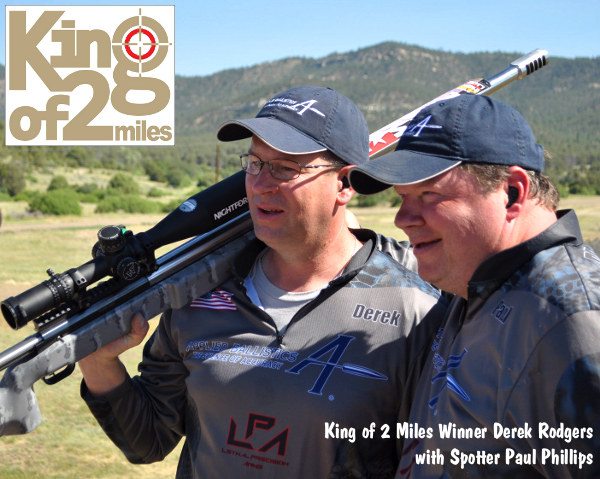
Derek Rodgers, the current F-TR World Champion, the reigning King of 2 Miles, and the only person to have won BOTH F-Open and F-TR U.S. National Championships, runs this kind of “opposite” bolt set-up. Yep, Derek shoots right-handed with a left bolt. Though Derek is a right-hander, he shoots with a Left Bolt/Left Port (LBLP) action. He pulls the trigger with his right index finger, while working the left-side bolt with his left (weakside) hand. This allows him to stay in position, and maintain his cheekweld. He places his right hand on the grip, while manipulating the bolt (and feeding rounds) with his non-trigger-pulling hand.
Current King of 2 Miles (and F-TR World Champion) Derek Rodgers
This is the rifle with which Derek won the 2013 F-TR National Championship.
*For true standing, off-hand shooting (whether in competition or on a hunt), a conventional strongside bolt placement makes sense, since the non-dominant arm must support the front of the rifle all the time. When shooting from bipod or rest, it’s a different story.
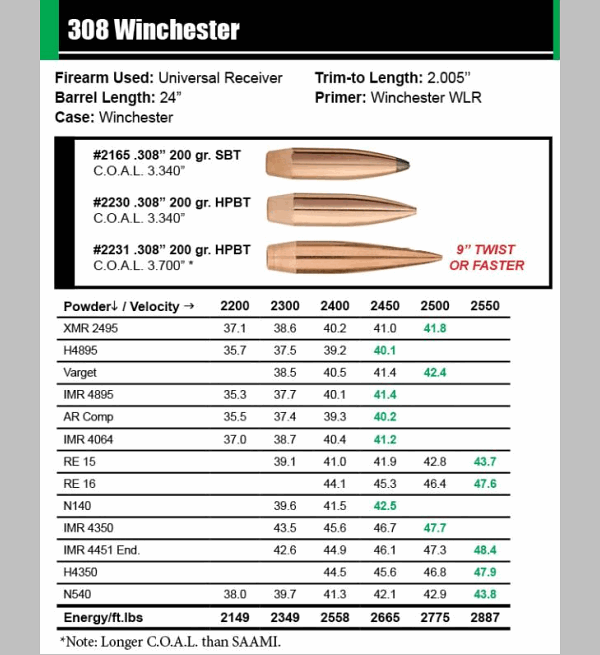
In recent months, Sierra has unveiled four very serious, ultra-high-BC MatchKing bullets in .224, .264 (6.5 mm), and .308 calibers. And just last week Sierra has released initial load data for these four new projectiles. CLICK HERE to get the latest official load data for these four new bullets.
High-BC MatchKings Tipped at Factory
Sierra recently released a new-for-2018, 95-grain .224 projectile, Sierra product #1396, with a claimed G1 BC of 0.600 — mighty impressive for a .22-caliber bullet. Next up is the new 6.5mm (.264 caliber) 150-grainer with an 0.713 G1 BC. This could be a game-changer for the 6.5-284 and new 6.5 PRC short magnum. There are also two new .308-caliber MatchKings, a 200-grainer with 0.715 G1 BC, and a new 230-grainer with a stunning 0.800 G1 BC. Many of these New Generation MatchKings now come “tipped” from the factory for more uniform BC.
Sierra Bullets has LOAD DATA for these four new bullets. If you handload for .223 Remington, 22-250, 6.5 x284 Norma, .308 Winchester, or .300 Winchester Magnum, check out this new reloading data.


 The gun is very accurate. Steve notes: “I have shot the rifle to 1100 yards and it shoots well. Last time out the rifle dropped just one point at 1000 yards and 5 points at 1100 yards [English scoring system]. I know it’s not pretty, but it got me shooting long range F-Class for peanuts.” Message to Steve: Don’t worry how it looks. As another Forum member observed: “Any rifle that shoots well at 1100 yards is beautiful….”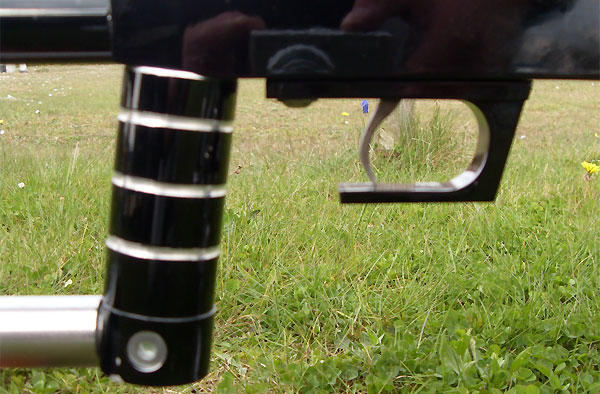






 Being part of Team USA is a major commitment of time and resources. We do have wonderful and sizable sponsorship partners who we thank and rely on for moderating individual team member costs. However, due to the location of this World Championship effort, one can expect to help cover a commensurate level of the costs.