SEB Rests, producers of the SEB NEO rest and innovative JoyPod bipod, have released an all-new, portable tripod-base Co-Axial rest, the SEB Mini. This is a very impressive bit of engineering by Sebastian Lambang. Weighing about 12 pounds, the SEB Mini is easy to transport yet stable and versatile in the field. A joystick lever-arm allows the shooter to move the front head (with sandbag) in any direction with a smooth continuous motion. The Mini delivers about 30 MOA vertical travel by 45 MOA horizontal travel with the same smooth, fluid feel as the NEO rest.
The Mini is now in full production and testers in the USA and UK have returned very positive test results. The Mini combines the smooth controls of a full-size Co-Axial front rest, yet is much easier to transport. Based on reports from testers Dan Bramley and Vince Bottomley, we predict the Mini will become extremely popular with F-Open competitors as well as all shooters currently using pedestal-style front rests for recreational shooting or load testing. Price for the complete unit (with front bag) is $675.00 shipped in the lower 48 states.
Inventor Seb Lambang told us his design goals in creating the Mini, which was named after “Mini” his pet Chihuahua: “The Mini rest is designed to be simple, compact, and light. It has has equal smoothness and MOA travel as the larger NEO rest.”
The new SEB Mini is a joystick (coaxial) rest with a height-adjustable single center column fitted on a base with three foldable legs. The top can be rotated 360 degrees and locked securely by the two adjustable locking levers. The lowest setting is about 6.25″, the highest is just over 10″. The SEB Mini can be used for F-Class shooting, bench rest shooting, varmint shooting, or load development. The joystick handle is compatible with the SEB NEOs and MAX co-axial rests. The Mini ships complete with a one-piece front sandbag in the buyer’s choice of width.
Key Features:
12-lb carry weight
Large Footprint, yet very portable
Legs adjust with individual thumbwheels
Mariner Wheel offers 40mm of Vertical Adjustment
Measures 5″ x 7″ x 16.25″ when folded
Lowest height approx 6.25″, highest 10″ or more
Head can be rotated independent of base assembly (to assist alignment)
Head unit can be purchased separately and fitted to different tripod base.
SEB Mini REVIEW by Dan Bramley:
Sebastian Lambang, the creator of the ever-popular SEB NEO and SEB MAX co-axial front rest, was kind enough to send me a SEB Mini for review. The point of this review is to give a shooter’s perspective. I will just say that the adjustments and movements are plenty sufficient to shoot in F-Class in High Power and rimfire.
Positives: The SEB Mini has all of the fine craftsmanship of the NEO. The fit and finish is excellent. This thing is SOLID! When the screws are all locked down it does not budge. The engineering is excellent and well thought-out. It comes in at 12.0 lbs with sand in bag and ready to shoot. To me this weight appears to be optimal, light enough to travel with but heavy enough to be stable.
Shootability: For me shooting off the SEB Mini was no different than shooting off the SEB NEO. The fluid motion of the coaxial top and stability were consistant with the NEO. Set-up was quick and the ability to set it down in reasonably close alignment and release the clamps on the Acme screw to allow perfect rest alignment was a nice feature. Course adjustment was quick with the large mariner wheel and the joystick has the same size collet as the NEO for those who may have made custom joysticks.
I shot my rimfire off of it at first, on concrete, and it didn’t move at all. No surprise there. So I figured I would shoot my biggest rifle off of it in an attempt to punish this little “Mini”.
Conclusion: This thing is just awesome! It folds up quite compact and would likely fit in a bag, instead of a pelican case, for travel. I have often thought of shooting my open rifle off of a JoyPod when traveling by air but that requires a rail etc. for mounting. I would not hesitate to shoot off this Mini in competition.
Vince Bottomley Tests the New Seb Mini
Our friend Vince Bottomley acquired a Seb Mini and had a chance to test it out in competition at the Diggle Range in the UK. Vince was very impressed with the Mini, which he says is very solid and smooth running, yet easy to set up. Vince used his new Mini to win a match, proving the unit is “competition-ready”: “When you do a range test like this, it’s always great if you can post a decent result and I’m pleased to be able to report that I won Open Class….”
Vince liked the smooth operation and broad windage/elevation adjustment range offered by the Mini:
“The joystick offers plenty of movement at 600 yards so staying on target throughout the shoot was no problem and, more importantly, I could swing onto my competitors’ targets as a final wind-check. Each of the three legs has its own ‘angle’ adjustment — enabling you to obtain a steady, level set-up on the most uneven of firing-points. The center pedestal can be raised and lowered using a mariner wheel and of course, there is the familiar joystick adjustment.”
Vince said it was easy to level the Mini and align the head with his rear bag: “Drop it on the point, then level the bubble using the leg-adjuster thumb-screws (photo right). Because the screws are at the pivot point they move the legs very quickly — as opposed to screwing the feet to level a NEO. Wind up the mariner wheel to get on target, nip up the locking levers and the rest is perfectly aligned, thanks to the swiveling head.”
Vince also liked the fact that the Mini is significantly lighter than a SEB NEO rest, but still stable because it has a wide footprint. See the comparison photo below.
Vince tells us that the Mini is truly easy to transport: “I’ve fixed a strap to my Mini so, by slinging it over my shoulder, I can carry rifle, mat and back-bag with ease — so that’s a big ‘plus’ right off.”
Conclusion: “The SEB Mini lived up to expectations and ticked all the boxes –lighter to carry, easy to set up, plenty of adjustment, very stable. Thank you Seb… You have a winner here!” — Vince Bottomley
Product Information from SEB Rests:
The complete SEB Mini includes Head unit, foldable legs, fore-end stop, aluminum bag bracket (with bubble level), joystick, leveling screws, and front bag. The base features three foldable legs, each of which can be adjusted/tilted for elevation via a thumb screw. We recommend setting the base/legs in the highest position initially, then lowering each leg via the thumb screws.
The Mini is offered in three (3) configurations. The complete Mini with base, foldable legs, and carry case is $800.00, including shipping to the lower 48 States. For considerable less there are two legless options. Option 1 is the Mini without the foldable legs. This could work for customers who may wish to fit the top to a solid base plate. Option 2 includes just the head unit with center post, mariner wheel and needle thrust bearing. Option 2 could suit customers who already have a Bald Eagle or Caldwell base with 1″ diameter center hole/post. However some machining may be required. Call Ernie Bishop at 307-257-7431 for current option prices and availability.
Net weight approx. 5.5 kilograms (12 lbs)
Top can be rotated 360° and locked securely in any position
Measures 5″ x 7″ x 16.25″ when folded
Joystick is compatible with SEB NEO, MAX and JoyPod
Lowest height approx 6.25″, highest 10″ or more
Foldable legs can be individually adjusted up/down with thumb screws
Extra wide footprint, leveling screws are about 17 inches apart
Ambidextrous, and can be used either “Up for Up” or “Up for Down”
Made from 6061 and 7075 aircraft grade aluminum
Head has removable fore-end stop
Standard fold-able base for traveling with tiltable legs
Comes with standard one-piece 3″-wide front bag 3″ wide (Optional bags*: 2-1/4″, wide sporter (for 1.5″-2″ stock), narrow sporter (for 1″-1.5″ stock)
For more information, visit SEBRests.com. The USA dealer is Ernie Bishop:
This article comes from the Sierra Bullets Blog. Visit Sierra’s Blog for a variety of interesting articles about reloading, ballistics, hunting, and competitive shooting.
Shooting F-Class as a Team by Sierra Bullets Product Development Manager Mark Walker
Last [year] I attended the Southwest Nationals for my third straight year. However this was the first year that I had the opportunity to participate in the team shooting events. At the previous matches I was strictly shooting to try and post the best individual scores that I could. This was challenging in its own right and I pushed myself to become a better shooter. During this time I became friends with some other shooters and started to become exposed to the team events. A good friend of mine, Bret Solomon, approached me about shooting with the Spindle Shooters team and I jumped at the chance.
F-Class teams consist of four shooters and a wind coach. As a shooter, you are responsible for the vertical up and down component of each shot. You want to have a rifle that shoots with very little vertical dispersion from shot to shot to give the wind coach as much of the width of the scoring ring to use as possible. The wind coach is responsible for the horizontal component of each shot. The wind will move the bullet from side to side on the target and it is the wind coach’s job to tell the shooter where to aim so each bullet will land in the highest scoring rings in the middle of the target. Everyone has a job and for the team to succeed, everyone must be at the top of their game.
For some people, the stress of having four other people depending on you is a bit daunting. However, that is what makes the team events so fun! Not every string you shoot will be a clean. But there is nothing more exhilarating than when the wind is blowing and you and your coach are having to pick your way through the conditions, and that final shot comes up an X.
Now when I attend matches, I shoot the individual targets to help determine how my rifles are shooting and pick the best one to shoot in the team events. And I have to admit that even my individual scores are improving due to the extra attention that I give the rifles to try and have the best equipment for the team. If you have never tried team shooting, I encourage you to give it a try. At most large matches, there are “pick-up” teams that are looking for shooters. This makes a perfect opportunity to meet new people and get [started]. Once you give it a try, you will be hooked!”
Team Shooters Work Together for a Common Goal. USA F-TR Team member Matt Schwartzkopf excels at F-TR team shooting despite lacking two lower legs. He works as a range manager at Ben Avery. In recognition of his character and determination, at the 2016 SWN, Matt was awarded one of the first Accurateshooter Corinthian Awards. (2015 Photo.)
The movie “The Patriot” gave us the phrase “Aim small, miss small”. While that’s a good mantra, aiming strategies for long-range competition are a bit more complicated, as this article explains…
In our Shooters Forum, one newcomer wanted some advice on selecting a reticle for F-Class optics. He wondered about the advantage of Front (first) Focal Plane (FFP) vs. Second Focal Plane scopes and also wondered if one type of reticle was better for “holding off” than others.
In responding to this question, Forum regular Monte Milanuk provided an excellent summary of aiming methods used in F-Class. For anyone shooting score targets, Monte’s post is worth reading:
Aiming Methods for F-Class (and Long-Range) Shooting — by Monte Milanuk
F-Class is a known-distance event, with targets of known dimensions that have markings (rings) of known sizes. Any ‘holding off’ can be done using the target face itself. Most ‘benefits’ of Front (first) focal plain (FFP) optics are null and void here — they work great on two-way ranges where ‘minute of man’ is the defining criteria — but how many FFP scopes do you know of in the 30-40X magnification range? Very, very few, because what people who buy high-magnification scopes want is something that allows them to hold finer on the target, and see more detail of the target, not something where the reticle covers the same amount of real estate and appears ‘coarser’ in view against the target, while getting almost too fine to see at lower powers.
Whether a person clicks or holds off is largely personal preference. Some people might decline to adjust their scope as long as they can hold off somewhere on the target. Some of that may stem from the unfortunate effect of scopes being mechanical objects which sometimes don’t work entirely as advertised (i.e. one or two clicks being more or less than anticipated). Me personally, if I get outside 1-1.5 MOA from center, I usually correct accordingly. I also shoot on a range where wind corrections are often in revolutions, not clicks or minutes, between shots.
Some shooters do a modified form of ‘chase the spotter’ — i.e. Take a swag at the wind, dial it on, aim center and shoot. Spotter comes up mid-ring 10 at 4 o’clock… so for the next shot aim mid-ring 10 at 10 o’clock and shoot. This should come up a center X (in theory). Adjust process as necessary to take into account for varying wind speeds and direction.
Others use a plot sheet that is a scaled representation of the target face, complete with a grid overlaid on it that matches the increments of their optics — usually in MOA. Take your Swag at the wind, dial it on, hold center and shoot. Shot comes up a 10 o’clock ‘8’… plot the shot on the sheet, look at the grid and take your corrections from that and dial the scope accordingly. This process should put you in the center (or pretty close), assuming that you didn’t completely ignore the wind in the mean time. Once in the center, hold off and shoot and plot, and if you see a ‘group’ forming (say low right in the 10 ring) either continue to hold high and left or apply the needed corrections to bring your group into the x-ring.
Just holding is generally faster, and allows the shooter to shoot fast and (hopefully) stay ahead of the wind. Plotting is more methodical and may save your bacon if the wind completely changes on you… plotting provides a good reference for dialing back the other way while staying in the middle of the target. — YMMV, Monte
F-Class has become one of the fastest-growing types of mid-range and long-range rifle competition. Because of that popularity, a market for specialty equipment has been created, including stocks. McMillan Fiberglass Stocks offers a variety of stocks for both F-TR and F-Open disciplines. Shown above and below is the new Kestros*, McMillan’s upgraded, second-generation F-Open stock. This is an impressive offering, with good stiffness, a torque-taming low-profile design, and good adjustability for the shooter. Our friend Boyd Allen had the chance to test drive a Kestros recently.
McMillan Kestros “First Look” Range Review by Boyd Allen
McMillan’s first-generation F-Open stock was well-received, and this new GEN II Kestros includes some significant improvements, making it even better. To achieve increased stiffness, the fore-end was filled out and its fill density was increased. (F-Open rifles have a rather generous 22-lb. weight limit, so the slight increase in stock weight should not be a problem.)
Because F-Open Shooters typically shoot long, heavy bullets through fast-twist barrels, torque control is an issue, which is why the base of the front section of the fore-end is close to the barrel. This low-profile design counters torque. By maximizing the angle defined by the bottom corners of the stock and the bore’s centerline, this stock geometry increases resistance to roll.
As tested, this Kestros stock features a nice three-way adjustable butt, as well as an adjustable cheek piece. Symmetrical palm swells and the symmetrical cheek piece make the stock truly ambidextrous. We believe that the cheekpiece locking knob can be switched to either side, adapting to both lefties and righties.
Comments by Tester Boyd Allen
Wanting some visual pop for pictures, and knowing that this was to be a range-only rifle, I ordered a tri-color flame pattern gel coat, the most durable of stock finishes, because it is part of the stock rather than being an applied, surface-only finish.
McMillan has been in the stock business for a long time, and when you sit down behind this one, you understand why. This company really knows what it is doing. The Kestros is a real pleasure to shoot, tracking perfectly. As the saying goes, it falls readily to hand.
My test Kestros stock came very accurately CNC-inletted for my action, with the optional aluminum pillars. The fit is so good that I am doing a full load work-up before doing final bedding, so I can see just how much (if any) bedding improves accuracy. For this test I have chosen a 6PPC barrel (yes it does look short with this stock.) because it will allow me to make finer distinctions in this area. Later I will be working with other calibers (and longer barrels). So far I have been very impressed with this stock — ergonomics, tracking, stability, build quality, and inletting have all been excellent.
* The original Kestros (aka “Kestrosphendone” or “Cestrus”) was an ancient Greek military weapon, a type of sling used to hurl heavy, arrow-like finned projectiles.
Forum member Rardoin’s handsome F-Open rig features the new Borden BRM-XD action.
One of the most popular items in our Shooters’ Forum is the ongoing “Pride and Joy” thread. Since 2009, Forum members have posted photos and descriptions of their most prized rifles. Here are some of the most recent “Pride and Joy” rifles showcased in our Forum. Do you have a gun you’d like to see featured there? Just Register for the Forum and you can add your favorite gun to the list.
Bill Goad’s 6PPC Hunter “Ranch Rifle”
Forum member Grimstod tells us: “This is the personal rifle of Bill Goad. He has been experimenting with it on several levels. It is shooting great and has several matches on it now. Please enjoy these photos. More can be found on the website www.PremierAccuracy.com. We like the subtle barbed wire effect on the stock.
Twin-Upper AR with Custom Wood Furniture
This very unique AR belongs to Forum member Nuto-BR. He tells us: “Here are the two uppers I built. The top one is am X-caliber in 20 Practical with 24-inch, 1:11″-twist barrel. The bottom one is a WOA in .223 Rem, with 20″, 1-12″ twist barrel. They both shoot 1/2 MOA or better. Both stocks are laminated Maple and Walnut. I reversed the order of the two woods to tell them apart.”
Two Dashers and a Rimfire for Fun
Courtesy Forum member Dan H., here are two red-stocked Dashers plus an Anschutz 54.30 (Benchrest Stock) to make it a trio. Dan says: “The Anschutz provides good practice in trigger-pulling. It’s amazing what you can learn from a rifle that is as sensitive as this one.”
Dream Hunting Rifle with Custom Camo
Here is Forum member TyDaws’s “Dream Hunting Rifle” in 6.5-280 Ackley Improved. We love the custom paint work by by Melodie Yarbrough. Smithed by West Texas Ordnance, this rifle features a Rem 700 action with fluted bolt, PT&G tapered recoil lug, and Timney 510 2-lb trigger. The barrel is a fluted 26″ 1:8″-twist Bartlein 5R #3 contour. On top is a Huskemaw Blue Diamond 4-16x42mm optic in Warne Maxima rings. That’s an Atlas bipod up front.
Three Guns for Mr. Big
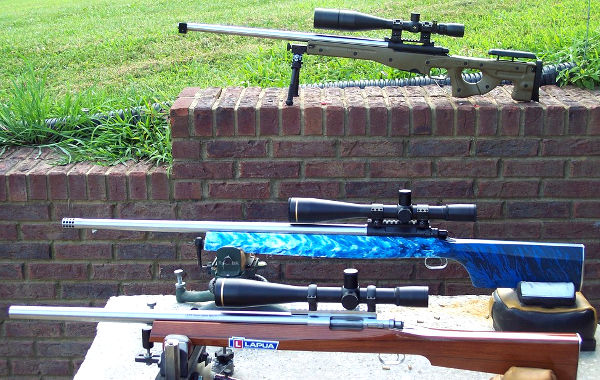
Forum Member Mr. Big offered up another trio of rifles — two bench guns and a tactical rig. Mr. Big says: “Here are the rifles I shoot most: Farley 6mm PPC, Stiller .243 Win, and Rem 6.5×47 Lapua. They will do just about anything I ask them to…” Challenge: Can you identify the makers of the three different stocks shown in this picture (and the different materials used in each)?
Dasher in Robertson Spider Web Stock
Here is Forum member Vahena’s 6mm Dasher. It has a no-turn-neck chamber in a 28″, 1:8″-twist barrel with 1.25″ straight contour. This has an original Robertson fiberglass stock with spider web graphics. This rifle was originally built as a 6.5×284 with a fluted barrel. Now it sports a bigger barrel for a smaller cartridge. The front rest is a SEB Neo with counterweight up front.
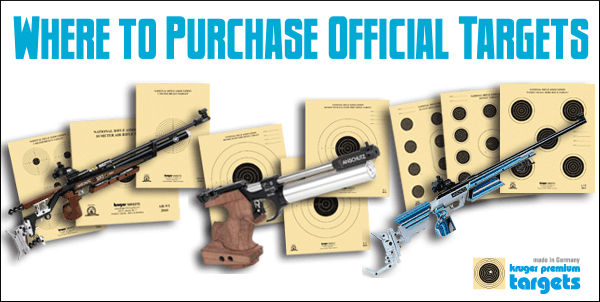
AccurateShooter.com offers dozens of FREE, printable targets for target practice, load development, and fun shooting. We also offer a few of the most popular NRA Bullseye targets. One or more of these printable targets should work for most training purposes. However, some readers have asked: “Where can we get the real targets… exactly like the ones used in NRA, IBS, and NBRSA shooting matches?”
All these vendors carry nearly all the NRA High Power and Smallbore targets, including the new, smaller F-Class targets. Germany’s Kruger Targets sells all the important NRA targets, and international (ISSF) air rifle and smallbore targets too.
Orrville Printing currently sells IBS targets for rimfire (50 yard) benchrest, short-range centerfire Benchrest (100, 200, 300 yards), Hunter BR Rifle (100, 200, 300 yards), plus the official 600-yard and 1000-yard IBS targets. National Target Company also has most of the IBS targets. NBRSA short-range, 600-yard, and 1000-yard benchrest targets are available directly from the NBRSA Business Office. Call (307) 655-7415 to order for the season.
Report by Des Parr
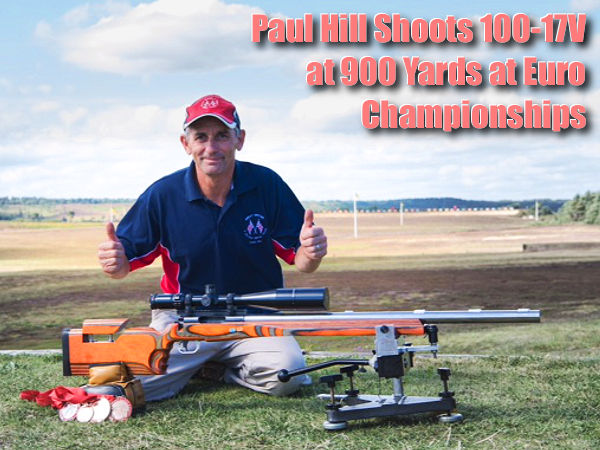
With every new season, standards in the F-Class game are climbing ever higher. Shooter are improving their skills set while equipment and loading techniques are improving (thanks in part to websites such as this). Evidence of the level of improvement in F-Class shooting comes from the UK, where a talented shooter drilled a new GBFCA record score. One of our rising stars on this side of the pond is F-Open shooter Paul Hill. He hails from England’s wide-open flat lands where the wind blows strongly in from the North Sea and where a shooter must soon learn to read the wind.
At the European Championships held in September at the Bisley ranges, Paul set a new record score at 900 yards — a 100-17V! That’s 17 shots placed in a five-inch circle the size of a CD (compact disc) at over half a mile. [NOTE: At Bisley, the maximum score is FIVE points, not ten points. So the maximum score for 20 shots is 100. Also what Americans call an “X” is called a “V” at Bisley.]
Record Set with Slower Pair Firing Method
Bear in mind the style of shooting here in Great Britain is pair-firing. Under this procedure, each of two competitors shoots alternately, taking turns from shot to shot. Each shooter has 45 seconds to get his shot off. Allowing for the target pullers to do their jobs, this means that each shot can take up to one minute. As Paul was pair firing, he had to concentrate for up to 40 minutes to get all 20 shots off! You can imagine how many times the wind changed course in those 40 minutes — pick-ups, let-offs, changes of angle and direction. Paul had to counter each change and still managed to keep 17 shots in that 5-inch circle!
Paul Hill Sets Record with His First-Ever DIY-Chambered Barrel
What makes this new GBFCA record all the more significant is that Paul did it by barreling his own rifle — and for the first time! By simply taking great care and attention he has chambered and fitted a barrel himself to the very highest standards. Paul chambered the Krieger 1:9″-twist barrel for the .284 Winchester cartridge. His action was a Barnard. The stock is by Joe West.
Record Shot with Lapua 180gr Scenars and Russian Primers
We should note that Paul Hill is a very keen fan of Lapua’s 180gr Scenar-L bullet. It has to be said that this bullet doesn’t have the highest BC, yet whatever it lacks in that department it more than makes up for by being remarkably consistent — and consistency counts for a lot. Paul is also a fan of the Russian KVB-7 primers. His achievement is proof that Lapua Scenars and KVB-7 primers are every bit as good as the premium-priced alternatives. The powder was Vihtavuori N160. [Editor: For its 180gr Scenar-L, Lapua lists a 0.661 G1 BC, and a 0.332 G7 BC. Those numbers may not top the charts, but they are still very impressive.]
Records are made to be broken, but we think it will be quite a while before Paul’s 200-17X is surpassed in European competition. If you feel up to that challenge, consider competing in next year’s European Championships in late September 2017.
Sierra has just announced a new, high-BC .30-caliber projectile. This provides a very interesting new option for F-TR competitors and long-range benchrest shooters. The new 195-grain Tipped MatchKing (TMK) boasts an impressive 0.610 G1 Ballistic Coefficient. That compares well with any conventional bullet in this caliber and weight range. The key to the high BC is the green acetal resin tip that lowers drag while making the BC more consistent for every bullet in the box. NOTE: This .30-caliber 195 grain TMK requires a twist rate of 1:10” or faster to stabilize.
The new 30 cal. 195 grain Tipped MatchKing® bullets will be available in 500-ct boxes (product #7795C) with a $243.84 MSRP as well as 100-ct boxes (product #7795) with MSRP of $51.19 per box. Note, this new 195gr TMK is designed for competition use — primarily as a paper-puncher. Sierra says: “Tipped MatchKing® bullets are not recommended for most hunting applications.”
New Product Tip from EdLongrange. We welcome reader submissions.
Here is a very interesting rifle, a true metal/wood hybrid that combines an aluminum front section with figured walnut in the rear half. As you can see, this unique rifle also features a barrel block that allows the Savage action to float. You may be wondering “how is the metal section connected to the wood?” The gun’s owner/builder epoxied a stainless steel tube in the wood and that tube is secured in the aluminum fore-end with set screws.
Forum member Justin V. reports: “Sometime last fall my buddy wanted to build barrel-blocked Bavage. He is a machinist by trade so he was able to build all of the custom components himself. I know he put a ton of time into this thing over the winter, taking his time to get it done right. If you shoot in Cadillac or Midland, Michigan you will probably see him around. He tried to shoot a match this past weekend but was rained out. Hopefully it will stop raining in Michigan so he can see what it can do at 600 yards. Here are the results….” Learn more about this gun in this FORUM Thread.
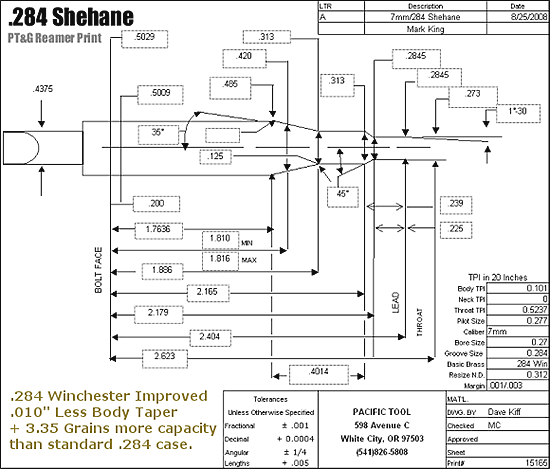
If you look at that 5-round group you might think it was shot with a 6 PPC or maybe a 6mmBR. But no, this was done with heavy 180gr Berger Hybrid bullets and the .284 Shehane, an improved version of the .284 Winchester. In fact, this impressive sub-quarter MOA group was shot while fire-forming with a very well-worn barrel!
Here’s a 5-shot 0.191″ group at 100 yards with my .284 Shehane fireforming loads. This barrel has 2200 rounds through it. It had 2000 as a straight .284 Win and then I set it back to .284 Shehane to form brass with. This was the first five rounds through it after I cleaned it after the last match. [The load was] 180 Hybrids with 54.0 grains of H4831 SC.
Ya, I figured why not I had some old barrels laying around so I just chopped 2″ off the back and 1″ off the front and chambered it up as a Shehane. Had 1000 pieces to fireform and didn’t want to do all that on a brand new barrel.
My fireform loads are going 2765 FPS. I have a 29″ barrel also though since it’s a setback. Once you get it formed I would push it faster than that or I wouldn’t even bother with the Shehane. My old straight .284 load at 2890 fps had ES spread in single digits for 10 shots. I figured if I get it up to 2935-2950 fps that will be a point or two saved in a several day match.
Fellow .284 Shehane shooter Erik Cortina notes that the .284 Shehane has a velocity edge over the straight .284 Win because it holds more powder: “The Shehane has more capacity than the .284 Winchester. Ryan is using 54.0 grains simply as a fire-forming load. Typical load for a Shehane is around 57.0 grains of Hodgdon H4831 SC.” By blowing the sidewalls out 0.010″, the .284 Shehane picks up about 3.3 grains of extra case capacity. That enhancement makes a BIG difference. The extra boiler room is enough to drive the 180s at 2900-2950 fps with H4831sc, with long barrels.


 “The joystick offers plenty of movement at 600 yards so staying on target throughout the shoot was no problem and, more importantly, I could swing onto my competitors’ targets as a final wind-check. Each of the three legs has its own ‘angle’ adjustment — enabling you to obtain a steady, level set-up on the most uneven of firing-points. The center pedestal can be raised and lowered using a mariner wheel and of course, there is the familiar joystick adjustment.”


 F-Class is a known-distance event, with targets of known dimensions that have markings (rings) of known sizes. Any ‘holding off’ can be done using the target face itself. Most ‘benefits’ of Front (first) focal plain (FFP) optics are null and void here — they work great on two-way ranges where ‘minute of man’ is the defining criteria — but how many FFP scopes do you know of in the 30-40X magnification range? Very, very few, because what people who buy high-magnification scopes want is something that allows them to hold finer on the target, and see more detail of the target, not something where the reticle covers the same amount of real estate and appears ‘coarser’ in view against the target, while getting almost too fine to see at lower powers.
 Others use a