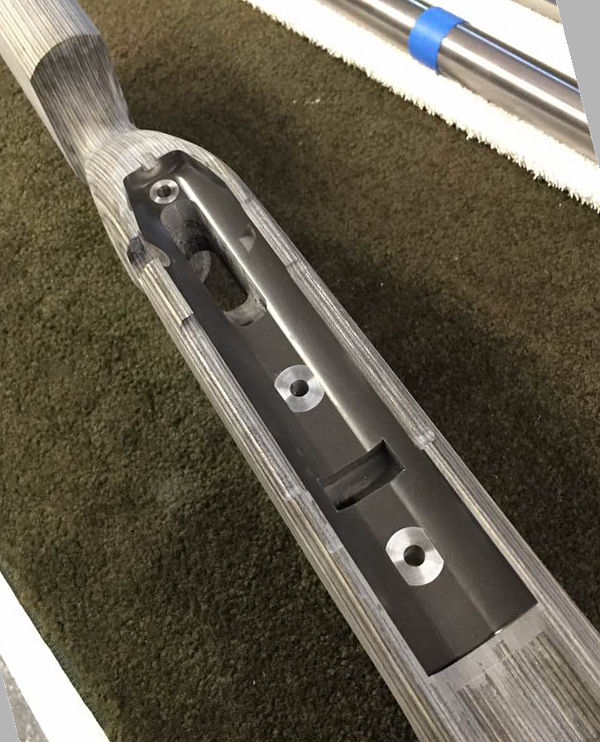
Forum member Keith W. (aka “Cigarcop”) is a talented riflesmith whose projects display outstanding finish work and attention to detail. Keith does some of the best bedding work we’ve ever seen. Recently Keith completed a rifle for tool-maker John Perkins, owner of 21st Century Shooting. John, who recently competed at the F-Class Nationals in Lodi, WI, wanted a new F-Open rifle with top-of-the-line hardware and a sweet-tracking stock. We think John will be impressed with this gun — and we bet it proves to be an tack-driving “hammer”. John will use the 21.5-lb rifle for F-Open competition and some mid-range and long-range benchrest competition in HG class.
This stock sports 12 coats of Urethane, wet-sanded between each coat.
This competition rifle features a melonited BAT “M” action (with Bix’N Andy trigger), a pair of 7mm Brux barrels chambered in .284 Win, and a Precision Rifle & Tool (PRT) Low-Boy stock. As you can see from these photos Keith posted in our Shooters’ Forum, this is a beautifully-finished rifle. If you have questions about this project, direct them to Cigarcop in this FORUM Thread.
Build Details for a Beautiful F-Open Rig
Keith reports: “The rifle is built on a PRT Laminated Low-Boy F-Class Stock with a Bat M Melonited Action, +20 MOA rail, Pillar bedded in Devcon 10110. After bedding and inletting I clear-coated the stock with 12 Coats of a 3-part Urethane finish which was wet-sanded between each coat and sanded out to 2000 before final polishing. John Perkins provided two Brux 1:9″-twist, 1.250″-contour barrels. They are both finished at 31″ and chambered in straight .284 Win with .313″ neck and .213″ freebore to shoot the 180gr Berger Hybrids.
Cigarcop does superb bedding work, as you can see…
John chose the Bix’N Andy trigger after sampling one of Erik Cortina’s rifles at the Berger SW Nationals. “I tried the BNA trigger on Erik’s gun and I was so impressed. It is very light but 100% consistent. After an injury I’ve lost some feel in my trigger finger and the BNA helps because it is so smooth. I would never go back to anything else.”
New Seating Die from 21st Century
While talking about his new rifle, John Perkins revealed that he has developed a very sophisticated new micrometer seating die: “This is something very new, and unlike anything else on the market. Each die is tailored to the dimensions and ogive curve of your particular bullet which we measure with an optical comparator. The customer provides fired, sized brass and sample bullets and we can produce a perfect match.”
John says his new seating dies produce ultra-consistent base-to-ogive load lengths along with exceptionally low run-out. “This new die produces incredibly straight ammo — there are some special features inside the die that help straighten the bullet during the seating process”. That delivers “truly superior concentricity” according to John. 21st Century Shooting will be taking orders soon for the new seating die. Call (260) 273-9909 for more information.
Forum member Alex M. (aka Nando-AS) has crafted some very nice wood Cartridge Caddies fitted with timers. He’s made these for competitors at the F-Class Nationals in Lodi, Wisconsin, and he’s now taking orders for other shooters who might want one. The caddies are made from Oak, hold 25 rounds, and feature a battery-powered shot timer. Price is $75.00 shipped for the 6mm and .308 caddies and $85.00 shipped for the Magnum size. Forum members can contact Alex via our Forum Classifieds Board, or you can email alextek [at] charter.net.
Alex tells us: “Several forum members and shooting buddies suggested that I should make more Cartridge Caddies with Timers, so I made over a dozen to take to Lodi and to offer to Forum members.”
These Caddies are made of solid red Oak and are finished with five coats of clear Polyurethane. Each has 25 holes, which consist of a counter-bore of the appropriate diameter and depth for the cartridge, and a Ø0.40″ through-hole to allow the bullet and/or the neck of the cartridge to fit through. The Timers are a Silver color normally, but Alex has a few in black.
Alex offers three sizes of caddies: 6MM for 6mm cartridges with .308-size rim; 308W for .308 Win/.284 Win size cartridges; and Magnum for 300 WSM and similar magnum diameter cases.
6MM – For 6mm family, which will accommodate 6mmBR, 30BR, 6×47, and other cartridges based on the .308 base. (Counter bore is Ø0.50” x 0.8” deep)
Price: $75 including USPS priority shipping with tracking number provided.
308W – For .308 Win, 6.5-284, .284 Win, and similar cartridges based on the .308 and .284 cases. (Counter bore is Ø0.52” x 1.0” deep)
Price: $75 including USPS priority shipping with tracking number provided.
MAGNUM – For 300WSM, 300RUM and similar cartridges with larger diameter bases.
(Counter bore is Ø0.56” x 1.0” deep)
Price: $85 including USPS priority shipping with tracking number provided.
Ballistics Guru Bryan Litz needed all of his wind-reading skills in Lodi, WI. Conditions were challenging!
Bryan Litz of Applied Ballistics won his second straight Mid-Range F-TR National Championship this past weekend. Likewise the Michigan F-TR Team won its second Championship in a row. So it was a heck of a showing by the Michiganders overall. With a strong individual performance, Phil Kelley finished second with his fellow X-Men teammate James Crofts in third. The X-Men Team also garnered second-place in the F-TR Team event. Kelley told us: “It sure is fun to compete with the best in the business — to share the individual overall podium with Bryan Litz and James Crofts is an exciting honor.”
It was a bit cold in Lodi, Wisconsin, photo by K. McSparron.
F-Class Goes High-Tech with Electronic Targets
This was the first-ever F-Class National Championship that used electronic Targets. Litz offers his perspective on the new E-Targets in the Q&A section below — Bryan is mostly positive about the E-Targets but he says there are still some minor bugs to be worked out.
Bryan, a sling-shooter at heart, has really taken to this F-TR game. He won both the Mid-Range and Long Range F-TR National Championships in 2015 and now he has one 2016 title in the bag. Bryan tells us: “Many thanks go out to all those who’ve supported me in winning my second F-TR Mid-Range National Championship. My serious pursuit of F-TR shooting began the day I called John Pierce and requested: ‘John, build me one like yours’. That rifle and others built by Pierce Engineering are at the top of the game. Thanks also to my many great team-mates on the Michigan and U.S. Rifle Teams who have taught me a lot about this sport. As always the competition was stiff and mother nature gave us some drastically different looks. The challenging weather, combined with the introduction of electronic targets to this sport at the national level, required shooters to be highly adaptable. Thanks to the match organizers and technical staff who did a great job.”
John Pierce (left) and Bryan Litz with his Championship-winning Pierce-built F-TR rifle (2014 photo).
Litz Loads Vihtavuori N140 with 215gr Berger Hybrids in his .308 Win
Bryan told us: “Load data is always a common question and I keep no secrets –I’m running the same basic load I shot the past few years with the exception that I’m now burning 43.0 grains of Vihtavuori N140 instead of Hodgdon Varget in new Lapua brass with Fed 210M primers and 215 Berger Hybrids seated about 0.005″ off the riflings. This gets 2520 fps in a 28-inch barrel. I use this same load for both mid-range and long range.”
Team Competition — Michigan Wins F-TR Division with X-Men in Second
Michigan F-TR Team won its second consecutive Mid-Range National Championship. Congratulations to team-mates Al Barnhart, Doug Boyer, Bryan Litz, and John Roethlisberger. Al and Doug are experienced veterans but this is John’s first experience in a national-level event. Michigan actually fielded two teams in this event and the second squad also won a medal in one of the matches. Byran Litz noted that the Michigan F-TR Team “has been working hard to develop our shooters and many have made it onto the U.S. Rifle Team. We have many great sponsors including: Applied Ballistics, Berger Bullets, Bartlein Barrels, Marksmanship Training Center, Nightforce Optics, Pierce Engineering, and Vihtavuori Powder.” Bryan added: “I also thank Team X-Men for the spirited competition. You guys (James Crofts, Tracy Hogg, Phil Kelly, Ian Klemm, and Ken Klemm) are great and make these team matches very fun.”
Bryan Litz with Michigan F-TR team-mates Al Barnhart, John Roethlisberger, and Doug Boyer.
Q & A with the Champ — Litz Talks Targets and Match Strategies
We asked Bryan how the new Electronic Target technology used in Lodi alters the F-Class game. As the Long Range Nationals are underway now, we also asked Bryan to comment on Mid-Range vs. Long Range strategies — what does he do different at 1000 yards vs. 600 yards.
1. How did you like the electronic targets? Did this require/allow a change in your shooting style or rhythm (e.g. can competitors shoot faster now with less wait time between shots)?
LITZ: I really like the E-Targets for many reasons. Not pulling pits is the biggest one but the E-Targets also bring a level of fairness that human pullers could never achieve in the sense that everyone gets the same speed ‘service’.
For the 2016 FCNC in Lodi, WI, all the targets are programmed with a 7-second delay which is equivalent to “very good” target service. The system actually shows your shot value immediately, but doesn’t plot the location of the shot for 7 seconds. So if you want to “machine gun” a shot following an X with the same hold, you can take your chances without knowing where the X was.
The E-Targets require some adaptation from regular pit service. For those with many years of experience on traditional targets, it’s just WEIRD that the target doesn’t go up and down or have a spotter in it. All the information you need is on the tablet. This isn’t better or worse, just different. Occasionally the tablets lose signal for a few seconds and it can be frustrating, but this is not different than when a puller missed a shot and you had to “call for a mark”. I think that very soon the connectivity issues will be fully resolved and the systems will operate flawlessly. I know it would be impossible to get all the shooters through on such a small range any other way. The E-Targets have enabled a medium-sized range like Lodi to host a National Championship.
Q: How is the mid-range F-TR game different than long-range F-TR competition?
LITZ: Usually Mid-Range is about consistent precision — not having any fliers and not dropping any points. Mid-Range matches are usually decided by a narrower point spread than long range. Conditions aren’t typically big enough to move you out of the 10 ring very much at mid-range. The first couple days of the 2016 Mid-Range Nationals was just like this. I won the first two days, dropping only 3 points in total. But then the wind picked up on Day 3 and it was totally different! It became more like a Long Range match with all the points falling like rain and [conditions] very difficult to read. Many more 8s and 7s appeared at 600 yards and the field really spread out. In the end I was able to hold onto my lead and win the tournament.
Q. Why the change to Vihtavuori N140 powder? Was it more available or were you seeing lower ES/SD?
LITZ: I’m seeing the same ES/SDs with VV N140 as what I was using before (Varget) and N140 may burn a little cleaner. Also availability has been improving on the Vihtavuori powders in recent years. We (the Michigan F-TR Rifle Team) are very fortunate to have Vihtavuori as a sponsor and look forward to winning many matches with Vihtavuori products.
Editor’s Note: If any readers have results for the F-Open Mid-Range Nationals, please post in the comments section below and we will update this story.
Over the past few years, participation in F-Class competition has grown dramatically. At the 2013 SHOT Show we had a chance to talk about F-TR competition with then-U.S. National F-TR Team members Mike Miller and Stan Pate, two of America’s top F-TR shooters. With the U.S. F-Class Nationals underway this week (in Lodi, Wisconsin), we are reprising this interview for readers who may have missed it the first time around. If you shoot F-TR (even if you’re a High Master), we think you’ll learn a few things from this interview.
In this interview, Mike and Stan agreed to share their vast store of knowledge about long-range shooting. In a wide-ranging dialog, we discussed many topics of interest to F-Class shooters: position set-up, bipod shooting techniques (and hardware), gun-handling, and bullet selection. In addition, Mike and Stan offer some great advice on wind reading and precision reloading. These general tips will benefit all competitors, no matter what their discipline.
Watch Video for Tips from past U.S. National F-TR Team Members Mike Miller and Stan Pate
If you shoot F-TR or you are considering getting involved in this fast-growing shooting sport, definitely watch this 14-minute video interview from start to finish. Mike and Stan are true F-TR gurus whose knowledge of the F-TR game has been gleaned from years of top-level competition. If you shoot a .308 from a bipod, we guarantee you can learn much from Mike and Stan. If you follow their advice, we bet you’ll see your scores improve in future matches.
Today is practice day for the Mid-Range F-Class Nationals, which commence bright and early tomorrow morning in Lodi, Wisconsin. In any shooting competition, you must try to avoid major screw-ups that can ruin your day (or your match). In this article, reigning F-TR National Mid-Range and Long Range Champion Bryan Litz talks about “Train Wrecks”, i.e. those big disasters (such as equipment failures) that can ruin a whole match. Bryan illustrates the types of “train wrecks” that commonly befall competitors, and he explains how to avoid these “unmitigated disasters”.
Urban Dictionary “Train Wreck” Definition: “A total @#$&! disaster … the kind that makes you want to shake your head.”
Success in long range competition depends on many things. Those who aspire to be competitive are usually detail-oriented, and focused on all the small things that might give them an edge. Unfortunately it’s common for shooters lose sight of the big picture — missing the forest for the trees, so to speak.
Consistency is one of the universal principles of successful shooting. The tournament champion is the shooter with the highest average performance over several days, often times not winning a single match. While you can win tournaments without an isolated stellar performance, you cannot win tournaments if you have a single train wreck performance. And this is why it’s important for the detail-oriented shooter to keep an eye out for potential “big picture” problems that can derail the train of success!
Train wrecks can be defined differently by shooters of various skill levels and categories. Anything from problems causing a miss, to problems causing a 3/4-MOA shift in wind zero can manifest as a train wreck, depending on the kind of shooting you’re doing.
Below is a list of common Shooting Match Train Wrecks, and suggestions for avoiding them.
1. Cross-Firing. The fastest and most common way to destroy your score (and any hopes of winning a tournament) is to cross-fire. The cure is obviously basic awareness of your target number on each shot, but you can stack the odds in your favor if you’re smart. For sling shooters, establish your Natural Point of Aim (NPA) and monitor that it doesn’t shift during your course of fire. If you’re doing this right, you’ll always come back on your target naturally, without deliberately checking each time. You should be doing this anyway, but avoiding cross-fires is another incentive for monitoring this important fundamental. In F-Class shooting, pay attention to how the rifle recoils, and where the crosshairs settle. If the crosshairs always settle to the right, either make an adjustment to your bipod, hold, or simply make sure to move back each shot. Also consider your scope. Running super high magnification can leave the number board out of the scope’s field view. That can really increase the risk of cross-firing.
2. Equipment Failure. There are a wide variety of equipment failures you may encounter at a match, from loose sight fasteners, to broken bipods, to high-round-count barrels that that suddenly “go south” (just to mention a few possibilities). Mechanical components can and do fail. The best policy is to put some thought into what the critical failure points are, monitor wear of these parts, and have spares ready. This is where an ounce of prevention can prevent a ton of train wreck. On this note, if you like running hot loads, consider whether that extra 20 fps is worth blowing up a bullet (10 points), sticking a bolt (DNF), or worse yet, causing injury to yourself or someone nearby.
[Editor’s Note: The 2016 F-Class Nationals will employ electronic targets so conventional pit duties won’t be required. However, the following advice does apply for matches with conventional targets.]
3. Scoring/Pit Malfunction. Although not related to your shooting technique, doing things to insure you get at least fair treatment from your scorer and pit puller is a good idea. Try to meet the others on your target so they can associate a face with the shooter for whom they’re pulling. If you learn your scorer is a Democrat, it’s probably best not to tell Obama jokes before you go for record. If your pit puller is elderly, it may be unwise to shoot very rapidly and risk a shot being missed (by the pit worker), or having to call for a mark. Slowing down a second or two between shots might prevent a 5-minute delay and possibly an undeserved miss.
4. Wind Issues. Tricky winds derail many trains. A lot can be written about wind strategies, but here’s a simple tip about how to take the edge off a worse case scenario. You don’t have to start blazing away on the command of “Commence fire”. If the wind is blowing like a bastard when your time starts, just wait! You’re allotted 30 minutes to fire your string in long range slow fire. With average pit service, it might take you 10 minutes if you hustle, less in F-Class. Point being, you have about three times longer than you need. So let everyone else shoot through the storm and look for a window (or windows) of time which are not so adverse. Of course this is a risk, conditions might get worse if you wait. This is where judgment comes in. Just know you have options for managing time and keep an eye on the clock. Saving rounds in a slow fire match is a costly and embarrassing train wreck.
5. Mind Your Physical Health. While traveling for shooting matches, most shooters break their normal patterns of diet, sleep, alcohol consumption, etc. These disruptions to the norm can have detrimental effects on your body and your ability to shoot and even think clearly. If you’re used to an indoor job and eating salads in air-conditioned break rooms and you travel to a week-long rifle match which keeps you on your feet all day in 90-degree heat and high humidity, while eating greasy restaurant food, drinking beer and getting little sleep, then you might as well plan on daily train wrecks. If the match is four hours away, rather than leaving at 3:00 am and drinking five cups of coffee on the morning drive, arrive the night before and get a good night’s sleep.”
Keep focused on the important stuff. You never want to lose sight of the big picture. Keep the important, common sense things in mind as well as the minutia of meplat trimming, weighing powder to the kernel, and cleaning your barrel ’til it’s squeaky clean. Remember, all the little enhancements can’t make up for one big train wreck!
The movie “The Patriot” gave us the phrase “Aim small, miss small”. While that’s a good mantra, aiming strategies for long-range competition are a bit more complicated, as this article explains…
The U.S. Mid-Range and Long Range Nationals kick off tomorrow, September 23rd, in Lodi, Wisconsin. Here are some tips that can help F-TR and F-Open shooters aim more precisely, and achieve higher scores. F-Class ace Monte Milanuk reviews reticle choices and strategies for holding off.
In our Shooters Forum, one newcomer wanted some advice on selecting a reticle for F-Class optics. He wondered about the advantage of Front (first) Focal Plane (FFP) vs. Second Focal Plane scopes and also wondered if one type of reticle was better for “holding off” than others.
In responding to this question, Forum regular Monte Milanuk provided an excellent summary of aiming methods used in F-Class. For anyone shooting score targets, Monte’s post is worth reading:
Aiming Methods for F-Class (and Long-Range) Shooting — by Monte Milanuk
F-Class is a known-distance event, with targets of known dimensions that have markings (rings) of known sizes. Any ‘holding off’ can be done using the target face itself. Most ‘benefits’ of Front (first) focal plain (FFP) optics are null and void here — they work great on two-way ranges where ‘minute of man’ is the defining criteria — but how many FFP scopes do you know of in the 30-40X magnification range? Very, very few, because what people who buy high-magnification scopes want is something that allows them to hold finer on the target, and see more detail of the target, not something where the reticle covers the same amount of real estate and appears ‘coarser’ in view against the target, while getting almost too fine to see at lower powers.
Whether a person clicks or holds off is largely personal preference. Some people might decline to adjust their scope as long as they can hold off somewhere on the target. Some of that may stem from the unfortunate effect of scopes being mechanical objects which sometimes don’t work entirely as advertised (i.e. one or two clicks being more or less than anticipated). Me personally, if I get outside 1-1.5 MOA from center, I usually correct accordingly. I also shoot on a range where wind corrections are often in revolutions, not clicks or minutes, between shots.
Some shooters do a modified form of ‘chase the spotter’ — i.e. Take a swag at the wind, dial it on, aim center and shoot. Spotter comes up mid-ring 10 at 4 o’clock… so for the next shot aim mid-ring 10 at 10 o’clock and shoot. This should come up a center X (in theory). Adjust process as necessary to take into account for varying wind speeds and direction.
Others use a plot sheet that is a scaled representation of the target face, complete with a grid overlaid on it that matches the increments of their optics — usually in MOA. Take your Swag at the wind, dial it on, hold center and shoot. Shot comes up a 10 o’clock ‘8’… plot the shot on the sheet, look at the grid and take your corrections from that and dial the scope accordingly. This process should put you in the center (or pretty close), assuming that you didn’t completely ignore the wind in the mean time. Once in the center, hold off and shoot and plot, and if you see a ‘group’ forming (say low right in the 10 ring) either continue to hold high and left or apply the needed corrections to bring your group into the x-ring.
Just holding is generally faster, and allows the shooter to shoot fast and (hopefully) stay ahead of the wind. Plotting is more methodical and may save your bacon if the wind completely changes on you… plotting provides a good reference for dialing back the other way while staying in the middle of the target. — YMMV, Monte
The 2016 F-Class Nationals kick off in nine days. The nation’s top F-Class shooters head to Lodi, Wisconsin for the Mid-Range Championship (Sept. 23-27) followed by the Long-Range Championship (Sept. 27 – Oct. 1). If you want to polish your skills with some last-minute practice at your home range, here’s a handy option for F-Class shooters. Here are some reduced 300-yard target centers that let you duplicate the MOA size of the official F-Class targets, but at closer range.
These reduced-size target centers were created by Forum member SleepyGator, an F-Class competitor who needed practice targets he could use at 300 yards. There is an official reduced-distanced standard for 300-yard F-Class matches. This utilizes the NRA No. MR-63FC – F-Class Target Center which is pasted over the MR-63 target. It provides a 1.42″ X-Ring, 2.85″ 10-Ring, and 5.85″ Nine-Ring. (The dimensions of F-Class targets are found in the NRA High Power Rules, Sec. 22, part 4, page 70 — see sample below.)
To duplicate the 300-yard target, SleepyGator has prepared a printable version of the MR-63FC Target Center, along with a pair of training targets with two bulls and five bulls. The two-bull and five-bull targets mirror the scoring rings on the MR-63FC, but they display only the innermost three rings and two rings respectively. All three targets are Adobe Acrobat (PDF) files that can be easily printed. You may need to adjust the scale (sizing) on your printer to get the dimensions exactly correct. As noted above, when printed, the 10-Ring on all three targets should measure 2.85″. This should provide some handy practice targets you can use between matches. Thanks to SleepyGator for providing these targets. You can download all three as a .Zip archive. After downloading the .Zip file, just click on the .Zip archive to extract the individual targets.
Yes, F-Classers, it’s time for the Nationals. Is your ammo loaded? Scope zeroed? The 2016 NRA F-Class Nationals will be held in Lodi, Wisconsin at the Winnequah Gun Club from September 23 through October 1, 2016. This will be a combined Mid-Range and Long Range event, with the Mid-Range activities running September 23-27, followed immediately by the Long-Range Nationals which conclude October 1, 2016. F-TR and F-Open shooters will compete for both individual and team honors. Here is the schedule:
Electronic Scoring at F-Class Championships This is big news. For the first time ever in the USA, electronic (sonic-sensor) targets will be used for both the Mid-Range and Long Range F-Class National Championships. NOTE: These are NOT like the self-contained Kongsberg target systems at the CMP’s Talladega Marksmanship Park.
At Lodi, Competitors will still aim at conventional paper target faces but sonic sensors on the target frames will allow instant shot plotting and scoring. This target system was developed by Silver Mountain Targets of Canada. The Silver Mountain system uses sonic sensors (essentially high-tech microphones) to triangulate shots with great precision. Monitors will be positioned at each firing station. The Silver Mountain system has been extensively tested and the match directors have hard-wired the target “brains” back to the scoring center to ensure reliable communications. Before the championship, match officials will be conducting a mandatory class on the operation of the electronic target monitors.
Looking downrange at Winnequah Gun Club in Lodi, WI:
2016 NRA F-Class National Championships FEE Schedule:
Mid-Range – Individual entries all individual matches – $230
Mid-Range – Each Team match (pay at range) – $80
Long Range – Individual entries all individual matches – $230
Long Range – Each Team match (pay at range) – $80
Combined Individual entry Mid-Range and Long Range – $400
STATE of the ART — F-TR and F-OPEN
Here is the sleek .308 Win rig Bryan Litz used to win the 2015 Mid-Range AND Long-Range F-TR Championship at the Ben Avery Range in Phoenix.
And here is the 7mm RSAUM F-Open rifle belonging to Kenny Adams. The reigning F-Open World Champion, Kenny will be one of the favorites in Lodi…
Kenny’s World-Beating 7mm RSAUM Load
For his 7mm RSAUMs Kenny loads Hodgdon H4350 powder and Federal 215m primers into Nosler or Norma RSAUM brass. In the RSAUM he runs Berger 180gr Hybrid bullets seated “just touching” the lands. Kenny is very precise with his charge weights. Using a Sartorius Magnetic Force Restoration scale, Kenny tries to hold his powder charges to within 1-2 kernels charge-weight consistency.
Grizzly Industrial and Bullets.com President Shiraz Balolia pulled off a stunning feat of marksmanship recently, winning his third straight F-Open title at the Canadian F-Class National Championships. It wasn’t easy — conditions were tough, as was the competition — there were top shooters from around the world, including many past U.S. Champions. Shiraz had a slim, one-point lead after Day 2, but Balolia ended up tied on total points (and V-Count) with Emil Kovan at the end of the third and final day. But when the cards were compared, a string of Vs on Day 3 secured Shiraz the win via tie-breaker. Thus Shiraz achieved the memorable “three-peat”, winning Canada’s 2016 F-Open National Championship to complement his 2015 and 2014 victories.
Three-Peat at Connaught — 2016 F-Open Canadian Championship
by Shiraz Balolia This trip to Ottawa for the Canadian National Championship was a specially important one. The U.S. Team tryout process and practice was to take place for two days prior to the National Championship as the next F-Class World Championship is going to be held in Ottawa in August of 2017.
Connaught Range is a fantastic range that is very well run. Pullers are provided as part of your entry fee and matches are run at different times of the day, even into the evening. The flags are heavier than the ones we use in USA and are notorious for lying to the shooter. Matches are shot in pair firing mode which means one shooter takes a shot and the other scores. You cannot simply rattle off a shot as soon as the target comes up.
Crazy Hot Conditions at the Connaught Range
The first day the winds were mild, but tricky and the temperature was 102° F. I had never shot in such weather and ended up in the 6th place for the day. The second day had several matches at 900 meters and the wind picked up, with a 105° F recorded temperature, causing havoc with everyone. In one of my matches at 900 meters I took my two sighters and my first shot for record was a 3 (equivalent to an 8 in USA). To top it off I shot another 3 a few shots later. Liar, Liar, flags on fire! Anyway, I dropped 7 points in that match only to find out some very good shooters had dropped over 10! I moved to top position for the two-day Aggregate.
The third and final day was one string of 20 shots with shooters squadded by their two-day Aggregate ranking. So I was paired with Emil Kovan, while the third position shooter was paired with the fourth-ranking shooter et cetera. We all shot in identical conditions.
Après Moi, le Déluge — Not Your Gentle Drizzle
Then came a vicious rainstorm. We waited out the storm for two hours before we shot. The rain was really, really nasty and coming down really hard. We were all huddled under the U.S. Open Team’s tent.
Shiraz and Emil Battle to the End…
Finally, after the long delay, we got back to the firing line. And it went down to the wire. Emil shot a 100 with 3 Vs and I shot a 99 with 12 Vs. When the dust settled, we ended up with the same score and total V-Count (611-61V). The tie would be resolved by a “count-back” procedure. I had a stack of Vs at the end of my string and that won the match. What a fight!
Shiraz told us that this third championship was the toughest: “A while back, I had rotator cuff surgery on my shooting arm and had not shot a match in 9 months. I barely was able to test loads for three weeks before I shipped my ammo and did not know what to expect.” He says that winning “did not even sink in for a few days and looking back, I think this will be something I will cherish forever.”
Shiraz’s win came against very tough competition. Shiraz notes: “The whole U.S. Team, the whole Canadian Team, many South Africans, Germans, British, Ukrainians and others were present. We had several past US National Champions present as well and it was a great honor to shoot with all of them.”
Note: This is a photo from 2013, there may be slight changes in the rifle.
The rifle features a BAT Machine ‘M’ action, with a 31″, 1:10″-twist Bartlein barrel. The scope is a March 10-60x52mm, which sits on a +20 MOA angled rail. The primary stockwork, including fitting of the adjustable cheek-piece and buttplate, was done by Alex Sitman of Master Class Stocks. Shiraz customized the stock with finger grooves, fore-end channel, and a bottom rear slide. Shiraz did the final stock finishing as well.
Gun Components
BAT Machine Action
Master Class Stock, modified by Shiraz
Bartlein Barrel, 1:10″ Twist, 31 inches long
Fitted Barrel Harmonic Tuner
March 10-60x Scope with fine crosshair and 3/32″ dot
Caliber & Load
.300 Winchester Short Magnum (WSM)
215gr Berger Hybrid bullets, 2870 FPS
Norma .300 WSM Cases
H4831SC Powder
Tula (Russian) Primers
NOTE: Shiraz was not running anywhere near max: “I chose a light load for Ottawa due to the range limits as my other accurate node is 100 FPS faster and almost at the range limit.”
Emil Kovan is one of the top F-Class shooters in the world. He won the 2014 United States F-Open Championship. Earlier this month Emil finished second in F-Open Division at the 2016 Canadian National F-Class Championship in Ontario. Emil actually tied Open-class winner Shiraz Balolia for overall score AND “V”-count, but Emil was awarded second on the tie-breaker.
“What are the best components for an F-Open class rifle, and why?” That’s a question that I get asked all the time and will try to answer in this article. Two months ago, I was contacted by Duane, a gentleman I met at the 2015 F-Class Nationals. He was interested in building a rifle with the new Master Class Low Profile F-Open Stock, created by Carl Bernosky and Alex Sitman of Master Class Stocks.
I have known Alex Sitman for many years, and use his stocks exclusively, but was not very familiar with his new Low Profile F-Open stock. After a brief conversation with Alex, I placed an order, and had the stock inletted and bedded at my shop in a month. My first impression was “Wow that’s a long stock” — the forearm is significantly longer than on the original Master Class F-Class prone stock. I bolted the barreled action in, and squeezed the end of the forearm and barrel together, the stock flexed a little bit, but not as much as other designs that I have tested. I think that’s due to having “more meat” in the receiver area. The full stock depth continues farther forward that on some other “low profile” designs. That makes the stock stiffer in the vertical plane, reducing the hinging effect forward of the action. The stock was finished in gloss black per the customer’s request. Interestingly, I found that the multiple layers of paint and clearcoat stiffened the stock up quite a bit.
CLICK IMAGE below for full-screen version
Low Center of Gravity Tames Torque
Compared to the original Master Class F-Open stock, the barrel sits about an inch lower. Lower center of gravity equals less torque, and that is very important when shooting heavy bullets in fast twist barrels. Another significant improvement is that the toe of the stock is flat and parallel to the forearm. I added a 3/4″ track rail in the rear, and milled the underside of the fore-end to create two parallel “rails” in the front to help the stock track better.
One of the biggest reasons why I like Master Class stocks, is the pistol grip. I don’t shoot “free recoil” and a comfortable pistol grip is super important to me when selecting a stock. The new Master Class Low Profile stock shares the same grip as the old model. This allows the stock to accommodate either a “hard hold” style or a more free-recoil style of shooting — whatever the rifle’s owner prefers. This design versatility is one reason I recommend Master Class stocks. Shooters may experiment with either shooting style to find what suits them best.
Cartridge Choice — A 40° .284 Win Improved
Duane decided to have the barrel chambered for my 284 KMR IMP (Improved) wildcat. What is .284 KMR IMP and why choose it over the straight .284 Winchester? Improved by definition means “made better”, I took a great cartridge, and modified it to increase capacity, reduce pressure, and increase brass life.
There are many “improved” variants of the original .284 Winchester: 7mm Walker, .284 Shehane, .284 Ackley and so on. My version, the 284 KMR IMP, shares the .010″ blown-out sidewalls of the .284 Shehane, but I have further increased the case capacity by changing the shoulder angle from 35 to 40 degrees. The 284 KMR IMP allows you to almost match magnum cartridge velocity in a standard-bolt-face action. If you want to run 180gr-class 7mm bullets over 2900 FPS, it is cheaper and more convenient to have a barrel chambered in 284 KMR IMP than to spend $650 for a magnum bolt.
Tuning Loads for the .284 Win Improved Cartridges
The 284 KMR IMP seems to have two nodes, one around 2820 fps and other at 2940 fps. My match load clocks at 2935 fps with single-digit ES. Note –I selected that load based on accuracy, NOT raw speed. A lot of novice (or hard-headed) shooters make the mistake to push their cartridges to the max, and disregard more accurate loads at lower velocity.
The sport of F-Class is rapidly growing, and the equipment used is improving constantly. I remember that only few years ago, an F-Open rifle that could shoot sub-one-inch of vertical at 300 yards was considered competitive. Now, we are pursuing sub-one-inch vertical at 600 yards! It takes a great rifle to approach that goal, but it is also up to the shooter to learn and experiment as much as possible in order to achieve success.
Dies for an Improved .284 Win Cartridge
One of the biggest challenges in campaigning a wildcat cartridge has been obtaining great dies. When searching for custom dies, it almost seems like that the odds are stacked against us. The most common problem is wait-time — custom die orders can take months to be completed. Also, most custom die makers want you to send them two or three cases, each fire-formed three times. I find that funny because if could somehow properly size the cases for three fire-forming cycles, I would not need a sizing die.
Custom-made dies should size the case just right, but sometimes the die’s internal dimensions are slightly off, and this leads to problem number two: dies sizing too much (or even worse) too little. I had a one “custom” die that would not size the bottom of the case enough. This made the extraction of fired cases very difficult. I feel that the best option (if available) for shooters interested in wildcat chambers is to have their gunsmiths make the dies. I offer that die-making service in addition to barrel chambering.
BAT Machine “M” Action
Duane decided to use a BAT M action for this rifle, and I think that he could not have made a better choice. We are blessed with many good match-quality receivers: Barnard, BAT, Borden, Kelbly, Nesika, and Stiller just to mention a few. These are all very well-made and suitable for F-Class. Among BAT Machine Co.actions, I like BAT models M, MB, and 3LL best. I prefer these because because of their size (large bedding footprint) smoothness, timing, options available, and last but not least visual appearance.
Trigger: I recommend and use Jewell triggers. Other good options are: Kelbly, CG Jackson (good 2-Stage) Anschutz (best 2-Stage for Bat and Kelbly actions), Bix’N Andy, and David Tubb.
Barrel: Duane made another good choice here. He decided to go with a Brux 1:8.5″-twist, 4-groove cut-rifled barrel. If you look at the F-Class and Long Range benchrest equipment lists, you will see that cut-rifled barrels are currently dominating. Many records have been shot with both button-rifled, and cut-rifled barrels. I have shot both, and prefer cut-rifled barrels. I am not saying that button-rifled barrels are not capable of shooting as well as cut-rifled barrels, but on average, in my experience, four out of five cut-rifled barrels (from top makers) will shoot well, vs. three out of five buttoned barrels. YMMV, but this is what I’ve observed.
Scope: Duane’s rifle was fitted with a Nightforce 15-55x52mm Competition scope with DDR-2 reticle. This optic is ultra clear, reasonably lightweight (28 oz.), super reliable, and has 1/8 MOA clicks — what you want for long range F-Class competition. In this 15-55X NF model, I like the DDR-2 reticle best, because fine cross hairs (FCH) are hard to see in heavy mirage. The DDR-2 has a heavier horizontal line, with a center dot. March scopes are also very popular and very well-made.
Thanks for reading, and keep ‘em in the middle…
Emil Kovan Competition History:
– 2014 F-Class Open National Champion
– 2016 F-Class Open Canadian Championship, Silver Medal (tied for first on score)
– 2015 F-Class Open National Championship, Silver Medal
– F-Class Open National Championship Teams, 2015, 2014, 2013, Shooting Team Member
– Over 15 wins in Regional and State Championships in Palma, F-TR, F-Open




 Over the past few years, participation in F-Class competition has grown dramatically. At the 2013 SHOT Show we had a chance to talk about F-TR competition with then-U.S. National F-TR Team members Mike Miller and Stan Pate, two of America’s top F-TR shooters. With the U.S. F-Class Nationals underway this week (in Lodi, Wisconsin), we are reprising this interview for readers who may have missed it the first time around. If you shoot F-TR (even if you’re a High Master), we think you’ll learn a few things from this interview.
 Train Wrecks (and How to Avoid Them)
 4. Wind Issues. Tricky winds derail many trains. A lot can be written about wind strategies, but here’s a simple tip about how to take the edge off a worse case scenario. You don’t have to start blazing away on the command of “Commence fire”. If the wind is blowing like a bastard when your time starts, just wait! You’re allotted 30 minutes to fire your string in long range slow fire. With average pit service, it might take you 10 minutes if you hustle, less in F-Class. Point being, you have about three times longer than you need. So let everyone else shoot through the storm and look for a window (or windows) of time which are not so adverse. Of course this is a risk, conditions might get worse if you wait. This is where judgment comes in. Just know you have options for managing time and keep an eye on the clock. Saving rounds in a slow fire match is a costly and embarrassing train wreck.
 F-Class is a known-distance event, with targets of known dimensions that have markings (rings) of known sizes. Any ‘holding off’ can be done using the target face itself. Most ‘benefits’ of Front (first) focal plain (FFP) optics are null and void here — they work great on two-way ranges where ‘minute of man’ is the defining criteria — but how many FFP scopes do you know of in the 30-40X magnification range? Very, very few, because what people who buy high-magnification scopes want is something that allows them to hold finer on the target, and see more detail of the target, not something where the reticle covers the same amount of real estate and appears ‘coarser’ in view against the target, while getting almost too fine to see at lower powers.
 Others use a


 This is big news. For the first time ever in the USA, electronic (sonic-sensor) targets will be used for both the Mid-Range and Long Range F-Class National Championships. NOTE: These are NOT like the self-contained Kongsberg target systems at the CMP’s Talladega Marksmanship Park.


 This trip to Ottawa for the Canadian National Championship was a specially important one. The U.S. Team tryout process and practice was to take place for two days prior to the National Championship as the next F-Class World Championship is going to be held in Ottawa in August of 2017.


 Emil Kovan Competition History:


