The movie “The Patriot” gave us the phrase “Aim small, miss small”. While that’s a good mantra, aiming strategies for long-range competition are a bit more complicated, as this article explains…
The U.S. Mid-Range and Long Range Nationals kick off tomorrow, September 23rd, in Lodi, Wisconsin. Here are some tips that can help F-TR and F-Open shooters aim more precisely, and achieve higher scores. F-Class ace Monte Milanuk reviews reticle choices and strategies for holding off.
In our Shooters Forum, one newcomer wanted some advice on selecting a reticle for F-Class optics. He wondered about the advantage of Front (first) Focal Plane (FFP) vs. Second Focal Plane scopes and also wondered if one type of reticle was better for “holding off” than others.
In responding to this question, Forum regular Monte Milanuk provided an excellent summary of aiming methods used in F-Class. For anyone shooting score targets, Monte’s post is worth reading:
Aiming Methods for F-Class (and Long-Range) Shooting — by Monte Milanuk
F-Class is a known-distance event, with targets of known dimensions that have markings (rings) of known sizes. Any ‘holding off’ can be done using the target face itself. Most ‘benefits’ of Front (first) focal plain (FFP) optics are null and void here — they work great on two-way ranges where ‘minute of man’ is the defining criteria — but how many FFP scopes do you know of in the 30-40X magnification range? Very, very few, because what people who buy high-magnification scopes want is something that allows them to hold finer on the target, and see more detail of the target, not something where the reticle covers the same amount of real estate and appears ‘coarser’ in view against the target, while getting almost too fine to see at lower powers.
Whether a person clicks or holds off is largely personal preference. Some people might decline to adjust their scope as long as they can hold off somewhere on the target. Some of that may stem from the unfortunate effect of scopes being mechanical objects which sometimes don’t work entirely as advertised (i.e. one or two clicks being more or less than anticipated). Me personally, if I get outside 1-1.5 MOA from center, I usually correct accordingly. I also shoot on a range where wind corrections are often in revolutions, not clicks or minutes, between shots.
Some shooters do a modified form of ‘chase the spotter’ — i.e. Take a swag at the wind, dial it on, aim center and shoot. Spotter comes up mid-ring 10 at 4 o’clock… so for the next shot aim mid-ring 10 at 10 o’clock and shoot. This should come up a center X (in theory). Adjust process as necessary to take into account for varying wind speeds and direction.
Others use a plot sheet that is a scaled representation of the target face, complete with a grid overlaid on it that matches the increments of their optics — usually in MOA. Take your Swag at the wind, dial it on, hold center and shoot. Shot comes up a 10 o’clock ‘8’… plot the shot on the sheet, look at the grid and take your corrections from that and dial the scope accordingly. This process should put you in the center (or pretty close), assuming that you didn’t completely ignore the wind in the mean time. Once in the center, hold off and shoot and plot, and if you see a ‘group’ forming (say low right in the 10 ring) either continue to hold high and left or apply the needed corrections to bring your group into the x-ring.
Just holding is generally faster, and allows the shooter to shoot fast and (hopefully) stay ahead of the wind. Plotting is more methodical and may save your bacon if the wind completely changes on you… plotting provides a good reference for dialing back the other way while staying in the middle of the target. — YMMV, Monte
The 2016 F-Class Nationals kick off in nine days. The nation’s top F-Class shooters head to Lodi, Wisconsin for the Mid-Range Championship (Sept. 23-27) followed by the Long-Range Championship (Sept. 27 – Oct. 1). If you want to polish your skills with some last-minute practice at your home range, here’s a handy option for F-Class shooters. Here are some reduced 300-yard target centers that let you duplicate the MOA size of the official F-Class targets, but at closer range.
These reduced-size target centers were created by Forum member SleepyGator, an F-Class competitor who needed practice targets he could use at 300 yards. There is an official reduced-distanced standard for 300-yard F-Class matches. This utilizes the NRA No. MR-63FC – F-Class Target Center which is pasted over the MR-63 target. It provides a 1.42″ X-Ring, 2.85″ 10-Ring, and 5.85″ Nine-Ring. (The dimensions of F-Class targets are found in the NRA High Power Rules, Sec. 22, part 4, page 70 — see sample below.)
To duplicate the 300-yard target, SleepyGator has prepared a printable version of the MR-63FC Target Center, along with a pair of training targets with two bulls and five bulls. The two-bull and five-bull targets mirror the scoring rings on the MR-63FC, but they display only the innermost three rings and two rings respectively. All three targets are Adobe Acrobat (PDF) files that can be easily printed. You may need to adjust the scale (sizing) on your printer to get the dimensions exactly correct. As noted above, when printed, the 10-Ring on all three targets should measure 2.85″. This should provide some handy practice targets you can use between matches. Thanks to SleepyGator for providing these targets. You can download all three as a .Zip archive. After downloading the .Zip file, just click on the .Zip archive to extract the individual targets.
Yes, F-Classers, it’s time for the Nationals. Is your ammo loaded? Scope zeroed? The 2016 NRA F-Class Nationals will be held in Lodi, Wisconsin at the Winnequah Gun Club from September 23 through October 1, 2016. This will be a combined Mid-Range and Long Range event, with the Mid-Range activities running September 23-27, followed immediately by the Long-Range Nationals which conclude October 1, 2016. F-TR and F-Open shooters will compete for both individual and team honors. Here is the schedule:
Electronic Scoring at F-Class Championships This is big news. For the first time ever in the USA, electronic (sonic-sensor) targets will be used for both the Mid-Range and Long Range F-Class National Championships. NOTE: These are NOT like the self-contained Kongsberg target systems at the CMP’s Talladega Marksmanship Park.
At Lodi, Competitors will still aim at conventional paper target faces but sonic sensors on the target frames will allow instant shot plotting and scoring. This target system was developed by Silver Mountain Targets of Canada. The Silver Mountain system uses sonic sensors (essentially high-tech microphones) to triangulate shots with great precision. Monitors will be positioned at each firing station. The Silver Mountain system has been extensively tested and the match directors have hard-wired the target “brains” back to the scoring center to ensure reliable communications. Before the championship, match officials will be conducting a mandatory class on the operation of the electronic target monitors.
Looking downrange at Winnequah Gun Club in Lodi, WI:
2016 NRA F-Class National Championships FEE Schedule:
Mid-Range – Individual entries all individual matches – $230
Mid-Range – Each Team match (pay at range) – $80
Long Range – Individual entries all individual matches – $230
Long Range – Each Team match (pay at range) – $80
Combined Individual entry Mid-Range and Long Range – $400
STATE of the ART — F-TR and F-OPEN
Here is the sleek .308 Win rig Bryan Litz used to win the 2015 Mid-Range AND Long-Range F-TR Championship at the Ben Avery Range in Phoenix.
And here is the 7mm RSAUM F-Open rifle belonging to Kenny Adams. The reigning F-Open World Champion, Kenny will be one of the favorites in Lodi…
Kenny’s World-Beating 7mm RSAUM Load
For his 7mm RSAUMs Kenny loads Hodgdon H4350 powder and Federal 215m primers into Nosler or Norma RSAUM brass. In the RSAUM he runs Berger 180gr Hybrid bullets seated “just touching” the lands. Kenny is very precise with his charge weights. Using a Sartorius Magnetic Force Restoration scale, Kenny tries to hold his powder charges to within 1-2 kernels charge-weight consistency.
Grizzly Industrial and Bullets.com President Shiraz Balolia pulled off a stunning feat of marksmanship recently, winning his third straight F-Open title at the Canadian F-Class National Championships. It wasn’t easy — conditions were tough, as was the competition — there were top shooters from around the world, including many past U.S. Champions. Shiraz had a slim, one-point lead after Day 2, but Balolia ended up tied on total points (and V-Count) with Emil Kovan at the end of the third and final day. But when the cards were compared, a string of Vs on Day 3 secured Shiraz the win via tie-breaker. Thus Shiraz achieved the memorable “three-peat”, winning Canada’s 2016 F-Open National Championship to complement his 2015 and 2014 victories.
Three-Peat at Connaught — 2016 F-Open Canadian Championship
by Shiraz Balolia This trip to Ottawa for the Canadian National Championship was a specially important one. The U.S. Team tryout process and practice was to take place for two days prior to the National Championship as the next F-Class World Championship is going to be held in Ottawa in August of 2017.
Connaught Range is a fantastic range that is very well run. Pullers are provided as part of your entry fee and matches are run at different times of the day, even into the evening. The flags are heavier than the ones we use in USA and are notorious for lying to the shooter. Matches are shot in pair firing mode which means one shooter takes a shot and the other scores. You cannot simply rattle off a shot as soon as the target comes up.
Crazy Hot Conditions at the Connaught Range
The first day the winds were mild, but tricky and the temperature was 102° F. I had never shot in such weather and ended up in the 6th place for the day. The second day had several matches at 900 meters and the wind picked up, with a 105° F recorded temperature, causing havoc with everyone. In one of my matches at 900 meters I took my two sighters and my first shot for record was a 3 (equivalent to an 8 in USA). To top it off I shot another 3 a few shots later. Liar, Liar, flags on fire! Anyway, I dropped 7 points in that match only to find out some very good shooters had dropped over 10! I moved to top position for the two-day Aggregate.
The third and final day was one string of 20 shots with shooters squadded by their two-day Aggregate ranking. So I was paired with Emil Kovan, while the third position shooter was paired with the fourth-ranking shooter et cetera. We all shot in identical conditions.
Après Moi, le Déluge — Not Your Gentle Drizzle
Then came a vicious rainstorm. We waited out the storm for two hours before we shot. The rain was really, really nasty and coming down really hard. We were all huddled under the U.S. Open Team’s tent.
Shiraz and Emil Battle to the End…
Finally, after the long delay, we got back to the firing line. And it went down to the wire. Emil shot a 100 with 3 Vs and I shot a 99 with 12 Vs. When the dust settled, we ended up with the same score and total V-Count (611-61V). The tie would be resolved by a “count-back” procedure. I had a stack of Vs at the end of my string and that won the match. What a fight!
Shiraz told us that this third championship was the toughest: “A while back, I had rotator cuff surgery on my shooting arm and had not shot a match in 9 months. I barely was able to test loads for three weeks before I shipped my ammo and did not know what to expect.” He says that winning “did not even sink in for a few days and looking back, I think this will be something I will cherish forever.”
Shiraz’s win came against very tough competition. Shiraz notes: “The whole U.S. Team, the whole Canadian Team, many South Africans, Germans, British, Ukrainians and others were present. We had several past US National Champions present as well and it was a great honor to shoot with all of them.”
Note: This is a photo from 2013, there may be slight changes in the rifle.
The rifle features a BAT Machine ‘M’ action, with a 31″, 1:10″-twist Bartlein barrel. The scope is a March 10-60x52mm, which sits on a +20 MOA angled rail. The primary stockwork, including fitting of the adjustable cheek-piece and buttplate, was done by Alex Sitman of Master Class Stocks. Shiraz customized the stock with finger grooves, fore-end channel, and a bottom rear slide. Shiraz did the final stock finishing as well.
Gun Components
BAT Machine Action
Master Class Stock, modified by Shiraz
Bartlein Barrel, 1:10″ Twist, 31 inches long
Fitted Barrel Harmonic Tuner
March 10-60x Scope with fine crosshair and 3/32″ dot
Caliber & Load
.300 Winchester Short Magnum (WSM)
215gr Berger Hybrid bullets, 2870 FPS
Norma .300 WSM Cases
H4831SC Powder
Tula (Russian) Primers
NOTE: Shiraz was not running anywhere near max: “I chose a light load for Ottawa due to the range limits as my other accurate node is 100 FPS faster and almost at the range limit.”
Emil Kovan is one of the top F-Class shooters in the world. He won the 2014 United States F-Open Championship. Earlier this month Emil finished second in F-Open Division at the 2016 Canadian National F-Class Championship in Ontario. Emil actually tied Open-class winner Shiraz Balolia for overall score AND “V”-count, but Emil was awarded second on the tie-breaker.
“What are the best components for an F-Open class rifle, and why?” That’s a question that I get asked all the time and will try to answer in this article. Two months ago, I was contacted by Duane, a gentleman I met at the 2015 F-Class Nationals. He was interested in building a rifle with the new Master Class Low Profile F-Open Stock, created by Carl Bernosky and Alex Sitman of Master Class Stocks.
I have known Alex Sitman for many years, and use his stocks exclusively, but was not very familiar with his new Low Profile F-Open stock. After a brief conversation with Alex, I placed an order, and had the stock inletted and bedded at my shop in a month. My first impression was “Wow that’s a long stock” — the forearm is significantly longer than on the original Master Class F-Class prone stock. I bolted the barreled action in, and squeezed the end of the forearm and barrel together, the stock flexed a little bit, but not as much as other designs that I have tested. I think that’s due to having “more meat” in the receiver area. The full stock depth continues farther forward that on some other “low profile” designs. That makes the stock stiffer in the vertical plane, reducing the hinging effect forward of the action. The stock was finished in gloss black per the customer’s request. Interestingly, I found that the multiple layers of paint and clearcoat stiffened the stock up quite a bit.
CLICK IMAGE below for full-screen version
Low Center of Gravity Tames Torque
Compared to the original Master Class F-Open stock, the barrel sits about an inch lower. Lower center of gravity equals less torque, and that is very important when shooting heavy bullets in fast twist barrels. Another significant improvement is that the toe of the stock is flat and parallel to the forearm. I added a 3/4″ track rail in the rear, and milled the underside of the fore-end to create two parallel “rails” in the front to help the stock track better.
One of the biggest reasons why I like Master Class stocks, is the pistol grip. I don’t shoot “free recoil” and a comfortable pistol grip is super important to me when selecting a stock. The new Master Class Low Profile stock shares the same grip as the old model. This allows the stock to accommodate either a “hard hold” style or a more free-recoil style of shooting — whatever the rifle’s owner prefers. This design versatility is one reason I recommend Master Class stocks. Shooters may experiment with either shooting style to find what suits them best.
Cartridge Choice — A 40° .284 Win Improved
Duane decided to have the barrel chambered for my 284 KMR IMP (Improved) wildcat. What is .284 KMR IMP and why choose it over the straight .284 Winchester? Improved by definition means “made better”, I took a great cartridge, and modified it to increase capacity, reduce pressure, and increase brass life.
There are many “improved” variants of the original .284 Winchester: 7mm Walker, .284 Shehane, .284 Ackley and so on. My version, the 284 KMR IMP, shares the .010″ blown-out sidewalls of the .284 Shehane, but I have further increased the case capacity by changing the shoulder angle from 35 to 40 degrees. The 284 KMR IMP allows you to almost match magnum cartridge velocity in a standard-bolt-face action. If you want to run 180gr-class 7mm bullets over 2900 FPS, it is cheaper and more convenient to have a barrel chambered in 284 KMR IMP than to spend $650 for a magnum bolt.
Tuning Loads for the .284 Win Improved Cartridges
The 284 KMR IMP seems to have two nodes, one around 2820 fps and other at 2940 fps. My match load clocks at 2935 fps with single-digit ES. Note –I selected that load based on accuracy, NOT raw speed. A lot of novice (or hard-headed) shooters make the mistake to push their cartridges to the max, and disregard more accurate loads at lower velocity.
The sport of F-Class is rapidly growing, and the equipment used is improving constantly. I remember that only few years ago, an F-Open rifle that could shoot sub-one-inch of vertical at 300 yards was considered competitive. Now, we are pursuing sub-one-inch vertical at 600 yards! It takes a great rifle to approach that goal, but it is also up to the shooter to learn and experiment as much as possible in order to achieve success.
Dies for an Improved .284 Win Cartridge
One of the biggest challenges in campaigning a wildcat cartridge has been obtaining great dies. When searching for custom dies, it almost seems like that the odds are stacked against us. The most common problem is wait-time — custom die orders can take months to be completed. Also, most custom die makers want you to send them two or three cases, each fire-formed three times. I find that funny because if could somehow properly size the cases for three fire-forming cycles, I would not need a sizing die.
Custom-made dies should size the case just right, but sometimes the die’s internal dimensions are slightly off, and this leads to problem number two: dies sizing too much (or even worse) too little. I had a one “custom” die that would not size the bottom of the case enough. This made the extraction of fired cases very difficult. I feel that the best option (if available) for shooters interested in wildcat chambers is to have their gunsmiths make the dies. I offer that die-making service in addition to barrel chambering.
BAT Machine “M” Action
Duane decided to use a BAT M action for this rifle, and I think that he could not have made a better choice. We are blessed with many good match-quality receivers: Barnard, BAT, Borden, Kelbly, Nesika, and Stiller just to mention a few. These are all very well-made and suitable for F-Class. Among BAT Machine Co.actions, I like BAT models M, MB, and 3LL best. I prefer these because because of their size (large bedding footprint) smoothness, timing, options available, and last but not least visual appearance.
Trigger: I recommend and use Jewell triggers. Other good options are: Kelbly, CG Jackson (good 2-Stage) Anschutz (best 2-Stage for Bat and Kelbly actions), Bix’N Andy, and David Tubb.
Barrel: Duane made another good choice here. He decided to go with a Brux 1:8.5″-twist, 4-groove cut-rifled barrel. If you look at the F-Class and Long Range benchrest equipment lists, you will see that cut-rifled barrels are currently dominating. Many records have been shot with both button-rifled, and cut-rifled barrels. I have shot both, and prefer cut-rifled barrels. I am not saying that button-rifled barrels are not capable of shooting as well as cut-rifled barrels, but on average, in my experience, four out of five cut-rifled barrels (from top makers) will shoot well, vs. three out of five buttoned barrels. YMMV, but this is what I’ve observed.
Scope: Duane’s rifle was fitted with a Nightforce 15-55x52mm Competition scope with DDR-2 reticle. This optic is ultra clear, reasonably lightweight (28 oz.), super reliable, and has 1/8 MOA clicks — what you want for long range F-Class competition. In this 15-55X NF model, I like the DDR-2 reticle best, because fine cross hairs (FCH) are hard to see in heavy mirage. The DDR-2 has a heavier horizontal line, with a center dot. March scopes are also very popular and very well-made.
Thanks for reading, and keep ‘em in the middle…
Emil Kovan Competition History:
– 2014 F-Class Open National Champion
– 2016 F-Class Open Canadian Championship, Silver Medal (tied for first on score)
– 2015 F-Class Open National Championship, Silver Medal
– F-Class Open National Championship Teams, 2015, 2014, 2013, Shooting Team Member
– Over 15 wins in Regional and State Championships in Palma, F-TR, F-Open
McMillan Fiberglass Stocks is introducing a new F-Class Open Division stock. This offers a low profile fore-end and parallel geometry for improved tracking. This is similar to McMillan’s previous F-Open stock, but with important enhancements. Here is Kelly McMillan’s report:
“Our new Kestro is … made specifically for F-Class Open competition. Notice we have kept the low profile fore-end while increasing the mass and rigidity. The fore-end is not only ‘dead nuts’ in line with the butt stock, but it is also on an exactly parallel plane so when it recoils there is no rise or lateral shift in the cross hairs.
This model comes with an integral adjustable cheek-piece and can have our standard buttplate or our lightweight 3-way adjustable butt plate. My estimation is that this stock will weigh as light as 4.5 pounds fully dressed, or as much as 8 pounds depending on what you need.
We are currently working on the cheek-piece free model for those of you who don’t put your face on the stock. One more thing, this color combination we call a Tiger Stripe Maple.” Editor’s NOTE: Though “maple” is in the stock color name, this is a reinforced fiberglass stock, not wood.
Many of the world’s best F-Class shooters have traveled to Ottawa, Ontario, Canada this week to compete at the Canadian F-Class National Championships. F-Open ace Shiraz Balolia, who won back-to-back Canadian F-Open Championships in 2015 and 2014, will pursue a “three-peat” at Canada’s Connaught Ranges. There will be plenty of F-TR talent on hand as well, including Bryan Litz, reigning U.S. Mid-Range and Long-Range F-TR Champion. The first challenge for the shooters will be the weather, which can be notoriously wet and windy at Connaught. The weather forecast looks good for today and tomorrow, but thunderstorms (and rain) are predicted for Friday and Saturday.
U.S. F-TR Rifle Team Prepares for the Canadian Championships:
Shown above is the U.S. F-TR Rifle Team, which will compete in the F-TR division. In the America Match, teams from Canada, South Africa, and the United States will battle head-to-head for national honors.
Many Companies Help Sponsor U.S. F-TR Rifle Team
It takes significant resources to field a large shooting team in international competition. The U.S. F-TR Rifle team is fortunate to have many great sponsors helping the team with equipment and financial support. The team’s top-level “Gold Medal” sponsors, are, in alphabetical order: Berger Bullets, Gemtech, Kelbly’s, McMillan Fiberglass Stocks, Nightforce Optics, Pierce Engineering, and 5.11 Tactical. CLICK HERE for a list of all sponsors.
Many Forum members have been looking for a good substitute for Hodgdon H4350 powder, which remains hard-to-find in many parts of the country. One of the best alternatives is IMR 4451, part of IMR’s new Enduron line of powders. Last year, top F-Class shooter Rick Jensen did a comparison between H4350 and IMR 4451, shooting the two powder in a wide range of temperatures. His data suggests that both powders show good temp stability.
Powder Comparison Test: H4350 vs. IMR 4451
Rick Jensen, Captain of the U.S. F-Open Rifle Team, has tested some of the new IMR 4451 powder. Rick and other team members were looking for a good powder that could replace Hodgdon 4350 which is difficult to obtain currently. The makers of IMR 4451 claim that it is not sensitive to temperature and that it delivers competitive accuracy. So far, Rick’s tests, done with a .284 Winchester and 180gr Berger Hybrids, appear to confirm those claims. Rick posts:
“I did a little informal powder comparison of H4350 versus the new IMR 4451. Rifle used was a Kelbly Panda with a 30″, 1:8.75″ twist 5R Bartlein barrel [chambered in .284 Win]. All charge weights were 50.0 grains using CCI BR2 primers. I was very impressed with this new powder and I believe it to be equal to H4350 as far as temperature sensitivity.
I did not test for accuracy but I will tell you my groups were pretty much equal between the two and all were in the .2-.3 MOA range. I will defiantly be shooting more of this powder in the weeks to come, assuming the supply chain will allow. It looks very encouraging to finally have a alternative to H4350 that we might actually be able to buy.”
Chronograph Results with Temps from 23° F to 101°
Here are chronograph results of a comparison test between IMR 4451 and H4350. Rick’s rifle was cleaned and allowed to cool between each test. Five fouling shots were fired before each test. Important: Note that for both Test #1 and Test #2, the powder order is reversed in the mid-temp fields (IMR 4451 first, then H4350). For the low and high temp entries, H4350 is listed first.
Here are the IMR 4451 fired cases, displayed Left to right, coldest to the hottest (in terms of case temp when fired). All charge weights were the same: 50.0 grains.
Multi-time National High Power champion David Tubb has developed an impressive two-stage trigger for Remington 700 rifles, the Model T7T. Priced at $385.00, the T7T Trigger is a true two-stage design: first and second stages are independently adjustable for both weight and feel. Overall (combined stage) trigger pull weight can be adjusted from just under 1 pound to slightly over 3.5 pounds.
The new T7T is a quality product. We’ve used the T7T and it proved crisp, repeatable, and reliable. If you are looking for a two-stage trigger for a precision rifle, this is a good option. We like a two-stage trigger for PRS applications, and the T7T can be adjusted high enough for that role. Or, it can go all the way down to under a pound — low enough to suit most F-Class shooters.
If you are interested in the T7T, watch these two videos. The first shows how to adjust pull-weights for both stages. The second video shows how to modify your stock to provide clearance for the T7T.
This video shows how to adjust the new Tubb T7T two-stage trigger for Remington 700s:
T7T Trigger Installation Tips
While installation of the T7T may require minor modifications to your action, most gun owners with basic mechanical skills can install the T7T by themselves. Note: As installed, the T7T trigger (either Right-Hand or Left-Hand) also requires a companion T7T bolt release, which you can get from DavidTubb.com for $10.00.
This video shows how to modify your stock to fit the T7T trigger:
There are hundreds of cartridge types capable of winning in F-Open. For F-TR you can shoot either the .223 Rem or .308 Win, but you have many load options. This article will focus on proven choices, currently used by the top F-Class shooters in the world. Our discussion will analyze cartridge selection based on the four different F-Class sub-disciplines: Open Mid-Range, Open Long-Range, F-TR Mid-Range, and F-TR Long Range.
Click image to view full-screen photo.
Mid-Range F-Open Cartridges
For starters, a .300 WSM is certainly capable of winning mid-range matches but it is not ideal. So what is ideal, and why? F-Class Mid-Range matches usually are usually shot at 300, 500, or 600 yards — or all three. At those distances the 6mm and 6.5mm cartridges rule. In moderate conditions, the 6mm Dasher is unbeatable. Its low recoil along with its super grouping ability and good ballistics make it my number one choice for Mid-Range.
Best bullets for the 6mm Dasher are: Vapor Trail 103gr, Berger 105 Hybrid, 108 BT, and 105 VLD (hunting). Best powders are: Varget, H4895, and Reloder 15.
Choices for Mid-Range in Tougher Conditions:
We all know that conditions are not always “moderate” that’s why something a little bit bigger will save you a “Nine” or two. The 6.5X47 Lapua was designed for 300-meter competition, but as soon as it was released, it was adopted by F-Class, benchrest, and tactical shooters. It offers great ballistics with very low recoil and big “accuracy window”. Lapua makes great brass for it (no surprise there) and Berger makes great bullets: 130gr VLD, 140gr VLD, 140gr Hybrids. Best powders in most barrels are Varget and H4350, I don’t use double-based powders such as Reloder 17 and the Vihtavuori N500 series because of their unpredictable performance day to day (greater temp sensitivity).
The 6.5X47 Lapua necked down to 6mm is also a great option for mid range matches. I was able to easily get 3200 fps with 105 hybrids and H4350.
Choice for Long-Range F-Open Competition
In Long-Range F-Open Class (out to 1000 yards), the big, high-BC bullets rule. If I had to pick one cartridge for F-Class (both mid- and long-range) I would pick the .284 Winchester or one of its variants. The .284 Win is currently dominating in F-Open competition. It offers great barrel life, it is super-easy to tune and its recoil is very manageable. The best bullets for it by far (in my opinion), are the Berger 180 Hybrids. But Sierra’s new 183gr MK bullet (with factory-uniformed meplats) seems to perform very well as does the Berger 180 VLD. Best powders for the .284 Win are H4350 and H4831SC.
Long-Range Only F-Open Cartridge
As much as I like the .284 Win, for long-range competitions I like the .300 WSM even more. If you look at a .300 WSM and a 6mm Dasher side by side, they appear almost identical in geometry — the .300 WSM looks like an “super-sized” Dasher. Both cartridges are currently the “darlings” of long-range benchrest due to their extraordinary grouping ability and huge “node’’ windows. Big accuracy windows allow loads to perform well in different conditions and geographical locations. That’s obviously very important if you travel to compete. The .300 WSM loaded with Berger 215gr or 230gr Hybrids is very tough to beat at long range, and it is currently my number one choice.
The 7mm RSAUM is another outstanding long-range round. It resembles a 6BR on steroids and it is almost as easy to tune. Best bullets for it are Berger 180gr Hybrids, 195gr EOLs, and Sierra’s 183gr MatchKing. Best powders for the 7mm RSAUM are: H4350, H4831SC, and VV N160.
Top Caliber/Bullet Combos for F-TR
In F-TR competition, the choice is clear — a .308 Win throated for Berger 185gr BTLRs and 200gr Hybrids will win in mid-range AND long-range comps. Many championships have been won, and many records set with those two bullets in the .308 Win. To quote Danny Biggs (a two times FTR National Champion) “The 185 BTLR is the best bullet for .308 Win ever made”.
The Berger 215gr Hybrids have been used to win many competitions including recently the 2015 F-Class Nationals. Bryan Litz won both the Mid-Range and Long-Range 2015 Championships using 215s. Bryan’s rifle is shown below:
I recommend chambers throated for the 185/200 grain projectiles over the 215/230 grain bullets. The reason is that if you have your barrel throated out for the 215s or the 230s, you could have a “slow” barrel and max out on pressure before the desired velocity is reached. Optimum freebore for the 230s is too long for the 185/200s, so you would be limited to using only 215/230gr bullets in that barrel.Furthermore, the recoil increase with heavier bullets is substantial, causing the rifle to be more difficult to shoot.
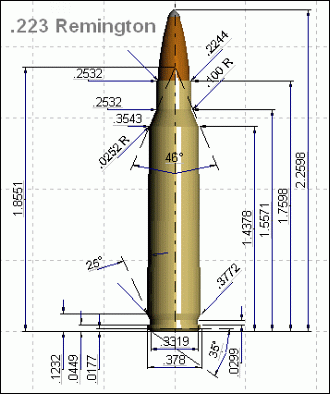
.223 Rem — Not A Competitive Option
I would stay away from the .223 Remington. On paper the 90gr VLD will shoot inside most .308 Win loads even at a 1000 yards. But in reality, on average, the .223 Rem, regardless of what powder/bullet combo is used, cannot compete with the .308 Win. [Editor: The equipment lists at major F-TR matches will confirm Kovan’s conclusion here.]
Conclusion (and Other Options)
This article covers only the (currently) most popular cartridge/bullet combos for F-Class (F-Open and F-TR). As I said in the beginning, many cartridge types are capable of winning but are not listed due to their low popularity, case design, or lack of quality components. All of the above information is based on my personal experience and it is meant to help new shooters choose the right cartridges for F-Class matches. Thanks for reading and good luck — Emil Kovan
Emil Kovan Competition History:
– 2014 F-Class Open National Champion
– 2015 F-Class Open National Championship, Silver Medal
– F-Class Open National Championship Teams, 2015, 2014, 2013, Shooting Team Member
– Over 15 wins in Regional and State Championships in Palma, F-TR, F-Open


F-Class is a known-distance event, with targets of known dimensions that have markings (rings) of known sizes. Any ‘holding off’ can be done using the target face itself. Most ‘benefits’ of Front (first) focal plain (FFP) optics are null and void here — they work great on two-way ranges where ‘minute of man’ is the defining criteria — but how many FFP scopes do you know of in the 30-40X magnification range? Very, very few, because what people who buy high-magnification scopes want is something that allows them to hold finer on the target, and see more detail of the target, not something where the reticle covers the same amount of real estate and appears ‘coarser’ in view against the target, while getting almost too fine to see at lower powers.
Others use a plot sheet that is a scaled representation of the target face, complete with a grid overlaid on it that matches the increments of their optics — usually in MOA. Take your Swag at the wind, dial it on, hold center and shoot. Shot comes up a 10 o’clock ‘8’… plot the shot on the sheet, look at the grid and take your corrections from that and dial the scope accordingly. This process should put you in the center (or pretty close), assuming that you didn’t completely ignore the wind in the mean time. Once in the center, hold off and shoot and plot, and if you see a ‘group’ forming (say low right in the 10 ring) either continue to hold high and left or apply the needed corrections to bring your group into the x-ring.


 This is big news. For the first time ever in the USA, electronic (sonic-sensor) targets will be used for both the Mid-Range and Long Range F-Class National Championships. NOTE: These are NOT like the self-contained Kongsberg target systems at the CMP’s Talladega Marksmanship Park.


 This trip to Ottawa for the Canadian National Championship was a specially important one. The U.S. Team tryout process and practice was to take place for two days prior to the National Championship as the next F-Class World Championship is going to be held in Ottawa in August of 2017.


 Emil Kovan Competition History:


 “I did a little informal powder comparison of H4350 versus the new IMR 4451. Rifle used was a Kelbly Panda with a 30″, 1:8.75″ twist 5R Bartlein barrel [chambered in .284 Win]. All charge weights were 50.0 grains using CCI BR2 primers. I was very impressed with this new powder and I believe it to be equal to H4350 as far as temperature sensitivity.


 .223 Rem — Not A Competitive Option


