Do you shoot with a SEB joystick-equipped bipod, or are you considering acquiring a “Joy-Pod” for your F-TR rifle? Then you should read this article. Here Sebastian (“Seb”) Lambang, the inventor and builder of the SEB joystick bipod, offers tips on shooting with this impressive piece of engineering. Seb explains some techniques that can help with tracking and getting back on target. You can ask SEB questions about his Joy-Pod in this Shooter’s Forum Thread.
Joy-Pod Shooting Tipsby Seb Lambang
1. Be sure that the rear bag is settled before starting to shoot. Tap your stock into the bag. Then move your rifle back and forth, while checking your reticle. If it tracks straight, vertically perfect, and comes back to the original point of aim, it’s fine. If not, re-adjust.
2. If you use the Pod-Pad, be sure it is fully settled before starting to shoot. Tap the top where the feet rides on using your palm — you wan to create a flat top. To be sure the Pod-Pad does not move or slide, remove any gravel or pebbles under the pad — these can act as roller bearings.
3. Be sure your shooting mat is NOT springy or spongy. This is very important. Use a proper mat, or cut it if possible so your rear bag rests directly on the ground. Use a heavy rear bag. You can use a sand-filled doughnut (not a rigid spacer) to stabilize the bag on uneven ground. These doughnuts are relatively inexpensive and really work.
4. Be sure your whole body position is correct, so your shoulder is square. “Follow” the recoil with your shoulder, don’t push “against” it. Don’t move too much. Don’t make unimportant movements during your shooting string. Always be as consistent as you can in all things — how you hold the rifle, even how you breathe before taking the shot.
This young lady shooter is using a first generation Joy-Pod. The newer versions have flat, ski-like feet.
5. Be sure your rifle and rear bag are aligned. You want the slot between the ears of the bag perfectly aligned with your barrel. (You can use a yardstick or a piece of string to help with the alignment).
6. Use a heavy rear bag. The heavier and the more stable, the better.
7. It does not matter (from my own experience) whether you light-hold the joystick or leave the joystick in the air when you shoot (see Darrell Buell video — he shoots “hands off”). I believe the bullet already exits the muzzle before the joystick moves in your fingers. I lightly hold the joystick myself, just as I would hold a billiard stick.
Watch Darrell Buell shooting his .375 CheyTac equipped with a counter-balanced Joy-Pod. Note how the gun comes straight back, and how Darrell can release the joystick before breaking the shot.
SUMMARY — When It All Comes Together
If everything is set up right, and done correctly, your rifle will track beautifully straight and your reticle will come back or very close to the original point of aim, every time. If you have to change the Joy-Pod, rear bag, or your body position after a shot, there could still be something wrong with your set-up, alignment, or body position. When everything is right, you can also see your own score in the scope after every shot you make (after initial recoil). You also should not have to change the bipod’s setting, the height, the cant etc., at all. You only need to adjust for the current condition with the joystick, the joystick will do it all. That’s why we call our bipod the JOY-Pod.
SEB JOY-POD Joystick Bipod, and POD-PAD
Weighing in at just 18 ounces (510 grams), the Gen 2 Joy-Pod is unlike any other bipod on the market. Designed specifically for weight-restricted shooting classes, the Joy-Pod offers smooth and precise joystick-controlled aiming. The Gen 2 model offers up to 14 degrees of cant and an improved design that functions with up to 50 pounds of rifle weight. Each Joy-Pod comes with a Weaver rail adapter. The optional Pod-Pad accessory is designed expressly for the Joy-Pod. It works filled or unfilled with the Joy-Pod’s sleds to bring you back to your shooting position easily. CLICK HERE for more information, or visit SebRests.com.
.308 Win Tactical Rifle fitted with Joy-Pod on Pod-Pad. CLICK HERE for Video.
Our British friend Vince Bottomley has field-tested the brand new Vortex 15-60x52mm “Golden Eagle” riflescope. We first viewed this scope at SHOT Show and were impressed. Now Vince, in a Target Shooter Magazine review, has confirmed that that the scope works great in the real world. It has good glass, excellent tracking, and the image stays sharp even at full magnification. Vince says this 15-60X Vortex will give other high-magnification scopes a run for their money. In fact the Vortex Golden Eagle may be the new Performance-for-Price leader in the category. Price in the USA will be $1500.00.
Vince writes: “The Vortex deserves to line up alongside the competition – namely the March 10-60, the Nightforce 15-55 and the Leupold 7-42. The price is remarkable at [$1500.00 in the USA, under £1500 in the UK]. If you are contemplating the purchase of a scope in this magnification range, the Vortex must be on your shopping list.” This new Vortex features ED glass, and weighs 29 ounces, just one ounce more than the 15-55X Nightforce Comp. Two reticles are available — a Fine Cross-Hair (FCH), and the Vortex ECR-1 reticle with MOA-based windage and elevation hold lines. Turrets have 1/8 MOA clicks.
Precision of Clicks: Does one MOA (i.e. eight 1/8 MOA clicks) on the Golden Eagle’s turret translate to one MOA on the target? Vince fired one shot on target then wound on 20 MOA of elevation and fired another. Vince reports: “The shot-holes should be 20.94″ (20 x 1.047″) inches apart. They actually measured 21.5 inches — an excellent result. I don’t think I’ve ever had a scope better this.”
Elevation Travel: F-TR shooters using the .308 Win will need about 30 MOA to get from a 100-yard zero to 1000 yards. Vince maxed out the Golden Eagle with roughly 22 MOA of “up” elevation. He concluded that “a +20 MOA scope-rail is a ‘must’ if you’re intending to shoot out to 1000 yards. These days, almost everyone uses a 20 MOA scope rail anyway.”
Tracking Test: Vince did a “box test” running the Vortex to the limits of elevation and windage and then back again to verify that the scope returned to the starting zero. Vince observed that the scope tracked great, “with the first and last shots over-lapping. No problem there.”
Glass Sharpness and Clarity: Vince put the the Golden Eagle alongside a 10-60 March, with both scopes mounted on F-TR rifles. Vince was impressed by the optics quality of the Vortex — it held its own vs. the “superb” March: “Firstly, we viewed the target on 40 power, the magnification which seems most popular with F-Class shooters. Both scopes registered bright, crisp images — no difference between the two. I know the March will stay sharp at maximum magnification but will the Golden Eagle? Yes! No loss of crispness in the image at 60X.”
This video includes interviews with Walt Berger and tube-gun builder Gary Elesio. This is our final Berger SW Nationals video for 2016, so enjoy the highlights from Ben Avery — see you next year.
The 2016 Berger Southwest Nationals are now history. This was a great match, with an incredible level of talent. There were numerous “big names” on the line, including reigning F-Open World Champion Kenny Adams, 10-time National High Power Champion Carl Bernosky, past National Long-range Champion John Whidden, current National Mid- and Long-Range F-TR Champion Bryan Litz, and Derek Rodgers, who won the F-TR division at last year’s SW Nationals. With a strong performance this week, Derek topped the F-TR field again, securing his second straight SW Nationals F-TR title.
Top Five Shooters by Class
F-TR Top Five
F-Open Top Five
Sling Division Top Five
Derek Rodgers
James Crofts
Niklas Montin
Bryan Litz
Ian Klemm
John Myers
Larry Bartholome
Jim Murphy
Emil Kovan
Danny J. Biggs
Patrick McCann
Oliver Milanovic
Robert Stekette
Nancy Tompkins
Tom Whitaker
In team competition, the Michigan F-TR Team scored a narrow victory over tough competition from the USA F-TR Team and the X-Men. In the F-Open Division, Team Lapua-Brux shot superbly at 1000 yards to capture the Aggregate title, finishing ahead of Team Grizzly and Team Berger. The Ethnic Fringe Team from the UK had strong performances in the Sling Division Team events.
With his 2016 victory, Derek Rodgers has secured back-to-back F-TR titles at the Berger Southwest Nationals. He says he likes his new McMillan F-TR stock. View yesterday’s feature video for a revealing interview with Derek. In that video, Derek discusses the best bullet and powder choices for F-TR.
Members of the winning Lapua-Brux F-Open team were all smiles. They deserved to be proud — they set a new SWN record in the 1000-yard team match. Left to right: Bob Sebold, Pat Scully, Erik Cortina, Steve Harp.
Here is F-Open Winner John Myers of Texas, along with Berger’s F-Open Perpetual Trophy. John is interviewed in today’s video, linked at the top of this story. John’s F-Open rifle is chambered for the 7mm Walker, a .284 Win Improved similar to the .284 Shehane.
Sling Division (Palma rifle) winner Patrick McCann is congratulated by Bryan Litz of Applied Ballistics. Pat has recently returned to competitive shooting after a lengthy hiatus. Pat’s a great competitor who has won the National XTC Championships Twice. Nancy Tompkins lead the “Any Rifle” Sling category. As Forum member Rheurer observed: “No intro needed for the nicest person in the sport.”
Our friend Vince Bottomley in the UK has written an excellent article for Target Shooter Magazine. Vince offers “solid-gold” advice for new F-TR and F-Open shooters. Vince reviews the cartridge options, and offers suggestions for a shooter’s first (and hopefully affordable) F-Class rifle. Vince also reviews various bipod choices for F-TR and discusses optics options (from $300 to $3000).
F-Class shooting (both F-Open and F-TR) is one of the fastest-growing forms of rifle competition. Each season many new shooters hit the line and attendance at the big matches increases every year. But if you’re new to the game, you may ask “Where can I shoot an F-Class match?”. Well, Forum member Rod V. (aka Nodak7mm) has compiled a useful list of 112 ranges throughout the USA where F-Class matches are held. With venues from Alabama to Wyoming — you should find an F-Class program not too far from home. The list, in Excel spreadsheet format, provides range locations and weblinks (where available). Click the link below to download the F-Class Range List (.xls file):
Note — this list, now in its 19th Revision, is augmented regularly, but info is still being gathered. No claim is made that the list is comprehensive. But it still covers the the lion’s share of the important F-Class venues nationwide. If you know of a range that should be added to the list, please post the location on our F-Class Range List Forum thread. Rod will update the list as new range info is received. Rod writes: “Range information is wanted and welcomed. I would like your help on collecting specific info on Clubs/Ranges where known F-Class matches are held.” Here’s a partial sample from Rod’s list:
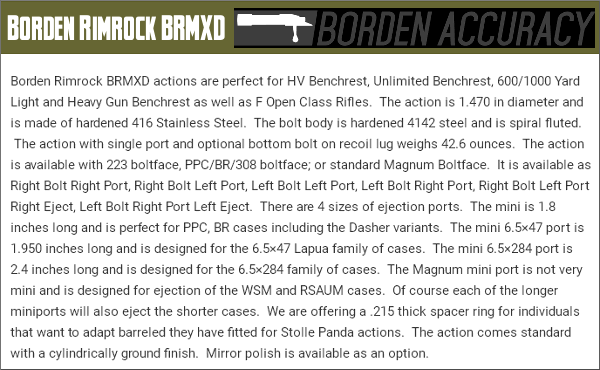
Our friend Erik Cortina told us that Jim Borden of Borden Accuracy has developed a new “wide-body” action, the Borden BRMXD. Erik is building a rifle around this action to shoot at the 2016 Berger SW Nationals. The new BRMXD is Borden’s first venture into action bodies larger than 1.350″ in diameter. The round BRMXD action measures a stout 1.470″ in diameter and comes standard with bottom recoil lug. If the customer prefers, Border can deliver the action with a conventional recoil lug on the front. We like the looks of Borden’s new BRMXD, and we bet this new stainless action will be a smooth runner.
Borden BRM-XD Action Specifications:
• Action: BRM-XD
• Length: 8-1/8″
• Outside Diameter: 1.470″
• Port Length: Single Port: 2.750″
— Dual Port w/ Mini Port for BR / PPC: 2.750″ Loading & 1.8″ Eject Port
— Dual Port w/ x47 Family Port: 2.750″ Loading & 1.9″ Eject Port
— Dual Port w/ .284 Family Port: 2.750″ Loading & 2.4″ Eject Port
• Weight: 42.6 oz for Single Port
• Price: $1325.00 with bottom lug for a single port – $1400.00 for a dual port + shipping
• Price: $1250.00 for no lug (Glue-In Only)
Borden Accuracy will also offer a 0.215″ spacer for shooters who wish to use their current PANDA barrels with a new BRMXD action. This hardened steel spacer will cost $50.00 (introductory price).
Here’s a handy training option for F-Class shooters. Forum member SleepyGator is an F-Class competitor, but it’s not convenient for him to shoot at long ranges close to home. Accordingly, he wanted some “reduced-distance” targets he could use at 300 yards for practice. There is an official reduced-distanced standard for 300-yard F-Class matches. This utilizes the NRA No. MR-63FC – F-Class Target Center which is pasted over the MR-63 target. It provides a 1.42″ X-Ring, 2.85″ 10-Ring, and 5.85″ Nine-Ring. (The dimensions of F-Class targets are found in the NRA High Power Rules, Sec. 22, part 4, page 70 — see sample below.)
To duplicate the 300-yard target, SleepyGator has prepared a printable version of the MR-63FC Target Center, along with a pair of training targets with two bulls and five bulls. The two-bull and five-bull targets mirror the scoring rings on the MR-63FC, but they display only the innermost three rings and two rings respectively. All three targets are Adobe Acrobat (PDF) files that can be easily printed. You may need to adjust the scale (sizing) on your printer to get the dimensions exactly correct. As noted above, when printed, the 10-Ring on all three targets should measure 2.85″. This should provide some handy practice targets you can use between matches. Thanks to SleepyGator for providing these targets. You can download all three as a .Zip archive. After downloading the .Zip file, just click on the .Zip archive to extract the individual targets.
Have Fun with Rifles and Equipment You Probably Already Have….
Forum member Rod Vigstol (aka Nodak7mm) has written a great Introduction to F-Class for shooters getting started in this rewarding discipline. Rod’s article, which originally appeared in the Rifleman’s Journal Blog, covers F-Class basics and addresses concerns that “newbies” may have when trying a new shooting sport. Rod stresses that most guys who own a varmint-hunting or tactical rig likely have nearly all the gear they need to give F-Class competition a try.
Rod explains: “If you’re reading this, you have more than just a general interest in the shooting sports and in the awesome rifles that shoot tiny groups at insane distances. You probably even have friends that enjoy shooting as much as you do. The quandary you may find yourself in is your friends haven’t quite jumped into it head-first like you have and they haven’t spent a lot of money and time obtaining the equipment you have to go shoot these matches. But you know what? Your prairie-dog shooting buddy or coyote-hunter friend can attend these matches and shoot alongside with you. He or she more than likely already has the basic equipment needed to shoot a match.” Most varmint shooters already have a suitable, accurate rifle and the following equipment:
• A variable-power scope in the 4.5-14x range or higher.
• A front bipod like the trusty old Harris 9″-13″, or maybe even a basic pedestal front rest.
• A rear sand-bag or similar sand-sock to rest the butt stock.
• A basic shooting mat from Midway or at least a piece of carpet or canvas to lay on.
Rod also provides a handy checklist of items to bring to the range. These include: Canvas or carpet strip (to set under bipod), Notebook, Kitchen Timer, Cleaning Rod, Camp Chair, Elbow Pads, Shooting Hat, and Open Bolt Indicator (OBI). Along with rifle, bipod (or front rest), rear bag, and ammo, that’s pretty much all you need.
Rod encourages all shooters to give F-Class a try — even novices. Rod explains: “We have all been rookies, newbies, new kids on the block or whatever. So we all have a good idea of what may be going on in your mind, the questions and concerns you may have. I’m telling you this sport is full of fantastic people who deep down find it far more fulfilling to help a new shooter get started than running a clean target. You just have to take the first step to get involved.”
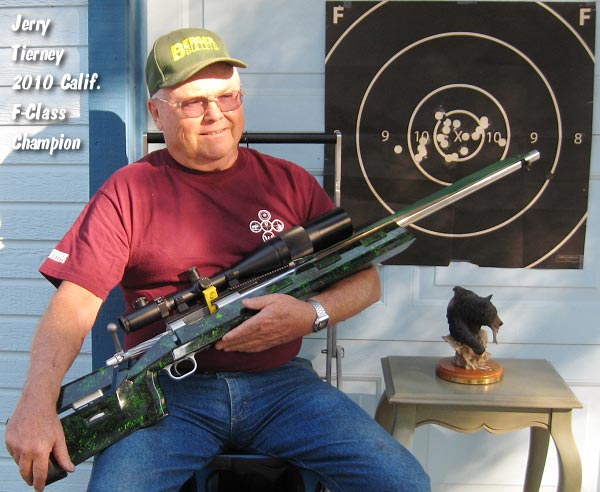
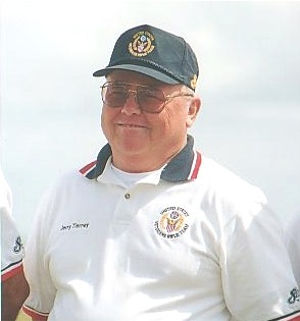
I am very sad to announce that a good friend (and a brilliant shooter) Jerry Tierney, has passed away at age 77. I have worked on this site for 11 years, and Jerry was one of the most helpful and talented men I’ve met along the way. Though he won many championships, Jerry was a modest man who always was there to help other shooters. I will really miss him. AccurateShooter.com owes a debt of gratitude to Jerry. With his technical expertise, he helped me greatly with my understanding of rifle accuracy. Jerry was small in stature, but big in talent. Rest in Peace Jerry. We’ll miss your smarts, your good humor, and your love for the sport. — Paul McM, Editor in Chief.
Jerry Tierney shot competitively for nearly 50 years and won multiple championships in various rifle disciplines. Fellow shooter Donovan Moran noted: “Jerry was the leading member of the NBRSA ‘Long Range Hall of Fame’ — well deserved! He was a very friendly man, a mentor to the sport, and one of the best Long Range competition shooters there’s ever been.”
With great natural talent and the mind of a scientist, Jerry could win events in ways not thought possible. He is certainly the only man I know who won a Benchrest Championship shooting a prone-type tube gun. He pioneered the .284 Win as an F-Open weapon. A self-declared “iron-sight prone guy”, he competed for many seasons in the full-bore and Palma disciplines, but in the last decade he turned his attention to 600-yard and 1000-yard benchrest and F-Class. He won multiple NBRSA Nationals, due in no small part to superb wind-doping skills and mastery of the “mental game”.
A former computer engineer with IBM, Jerry was an extremely bright guy who took a systematic approach to the sport. He made decisions based on hard data. He did things many shooters once considered radical (such as cleaning his barrels infrequently), but he always had the data to back up his methods. He was a forward thinker who wasn’t afraid to depart from conventional wisdom if he found a better way to do things. For me, Jerry Tierney was an important mentor — he showed me how the “state of the art” could be pushed to higher levels with careful experimentation and a willingness to try new things.
We did a lengthy interview with Jerry way back in 2005, when Jerry won the NBRSA 1000-yard Nationals. That performance helped proved the worth of the .284 Win in 1K competition, a cartridge that now is a leading choice for F-Open. Read this interview carefully — even ten years later, Jerry offers many nuggets of advice that can help with your reloading and shooting:
Danny Biggs Remembers Jerry Tierney
Past National F-Class Champion Danny Biggs wrote: “Our long-time shooting friend, Jerry Tierney, left the range last night. Jerry was 77 years old, and was overtaken by bad health over the past year…cancer and other ailments. An accomplished Palma Rifle shooter, his home range was the Sacramento Valley Shooting Center, near Sacramento, CA, and, just 16 miles from his front door, outside Plymouth, CA.
Jerry was a frequent contributor to [Rifle Blogs] in past years. In particular, about 7 years ago, he published considerable results of his testing of the Winchester .284 cartridge. This testing convinced several of us to transition from the venerable 6.5-284 to the straight .284 for both long range ‘sling’ and F-Class Open. Jerry’s testing was primarily in the realm of F-Open; wherein, he fell ‘in cahoots’ with a young F-Open shooter, Charles Ballard, who set an F-Class Open National record that stood for many years. (By the way, Incahoots is the name of Jerry’s favorite restaurant in Plymouth, CA, near his home; where I’ve enjoyed many an evening meal with him.)
Many others have contributed to the legacy of the Winchester .284… but, if you happen to be shooting a .284 in F-Open today, you might just give a thought to Jerry at your next trigger-pull. More than likely, you are shooting some of his data.” — Danny Biggs
Forum Member Killshot added:
“I only new Jerry for a few years, as I began shooting F-Class in 2010 — but he always answered my questions, helped me with my first Wildcat chambering and I never, ever, saw or heard of him ‘Big Timing’ anyone. I’ll miss his gap-toothed grin, like he knew something you didn’t. (and probably did!)
We’re better off for knowing him and worse off for not having him around any longer. So, appreciate your friendships and shoot small… Jerry would.”
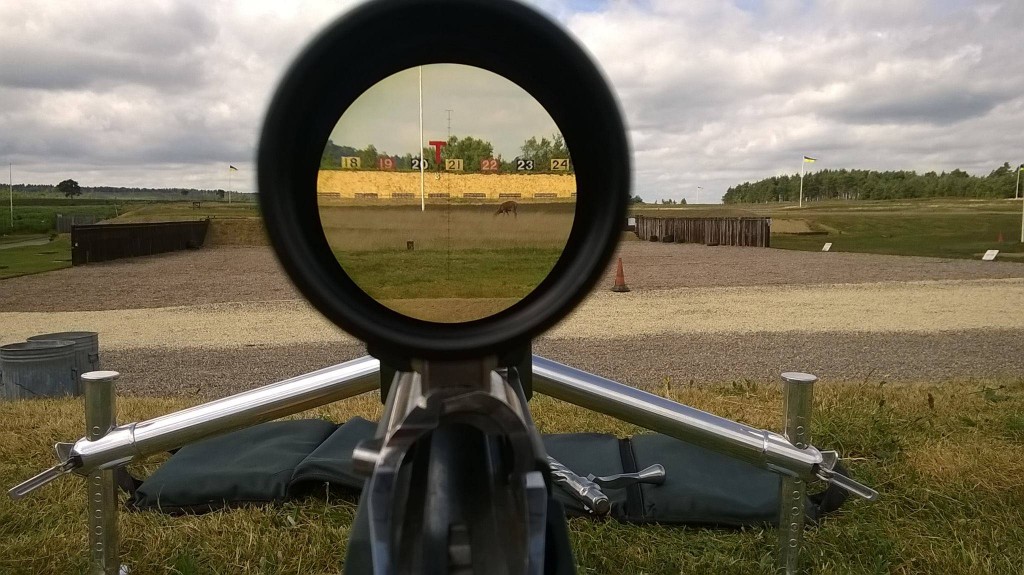
What’s wrong (or right?) with this picture? Does the “F” in F-class stand for “Fauna”? Look carefully at this Bisley Range photo taken by Australian R. Hurley while looking downrange through his March 8-80X scope. The photo was taken earlier this year at the Bisley National Shooting Centre in the UK.
The Story Behind the Photo
British shooter T. Stewart reports: “I was there when this photos was taken. All I can say was that Mr. Hurley was firmly reminded that should said deer accidentally jump in front of his bullet … he would spend five years “At Her Majesty’s Pleasure”. That morning we had five deer moving across the targets, literally blocking the V-Bull. Since we were on the 900-yard Firing Point, and elevated for such, obviously the bullet would pass well above them. But they do NOT move or flinch at the noise or passing bullets since they are not hunted on the Bisley Ranges. Earlier this year we saw a herd of 20 or so deer grazing slowly across the Range.”
More Fauna Findings…
Apparently Bisley is not the only place were “the deer and the antelope play”. In Canada, on the Connaught Ranges near Ottawa, Ontario, shooters often encounter a variety of wildlife. William McDonald from Ontario says: “Animals are a common sight on the Range. Along with deer we see geese, turkeys, and coyotes on a daily basis.”
Likewise, E. Goodacre from Queensland, Australia often sees ‘Roos on his home range: “I shoot at Ripley, Australia, and shooting is regularly interrupted by kangaroos. Our last silhouette match was delayed by an hour while 30 ‘Roos dawdled across — silly buggers!”
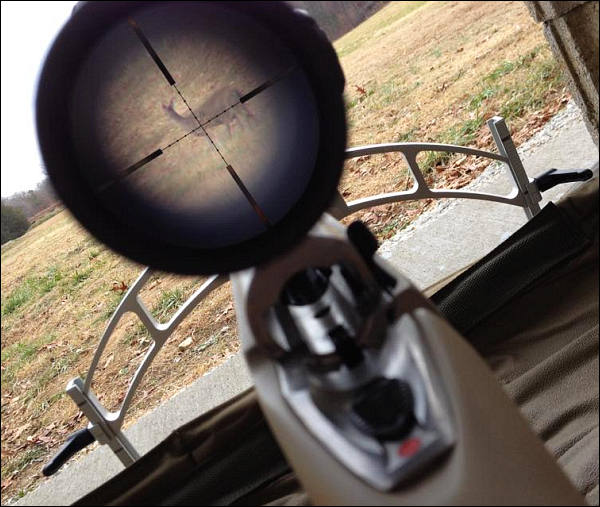
R. Hurley wasn’t the first fellow to view deer through his F-Class rifle’s scope. After seeing Hurley’s photo from Bisley, B. Weeks posted this image, saying: “Been there, done that!”







 Danny Biggs Remembers Jerry Tierney