CLICK HERE to see full-screen version of Wind Plot.
The Battle of Nations begins. Today is Day 1 of international team competition at the 2017 F-Class World Championships (FCWC) in Ottawa, ON, Canada. Talented teams, in their nation’s colors, will be competing for glory and national pride.
Team shooting is very different than individual competition. Typically a team coach makes the wind calls for the shooters. In some cases (where the rules allow), the wind coach even dials elevation and windage changes for the active shooter. For the wind coach to do his job effectively, he must follow the changes in the wind and determine what the correct wind call should have been for each shot. (In other words — what was the “right call”)
Past F-TR USA Nat’l Champ Bryan Litz was wind coach for the winning 4-man LUM F-TR Team at the 2017 Canadian F-Class Championships, which preceded the FCWC Worlds. Here Bryan explains how he uses a Wind Plot to make better wind calls, helping his team-mates maximize their scores.
Wind Plot Methodology by Bryan Litz
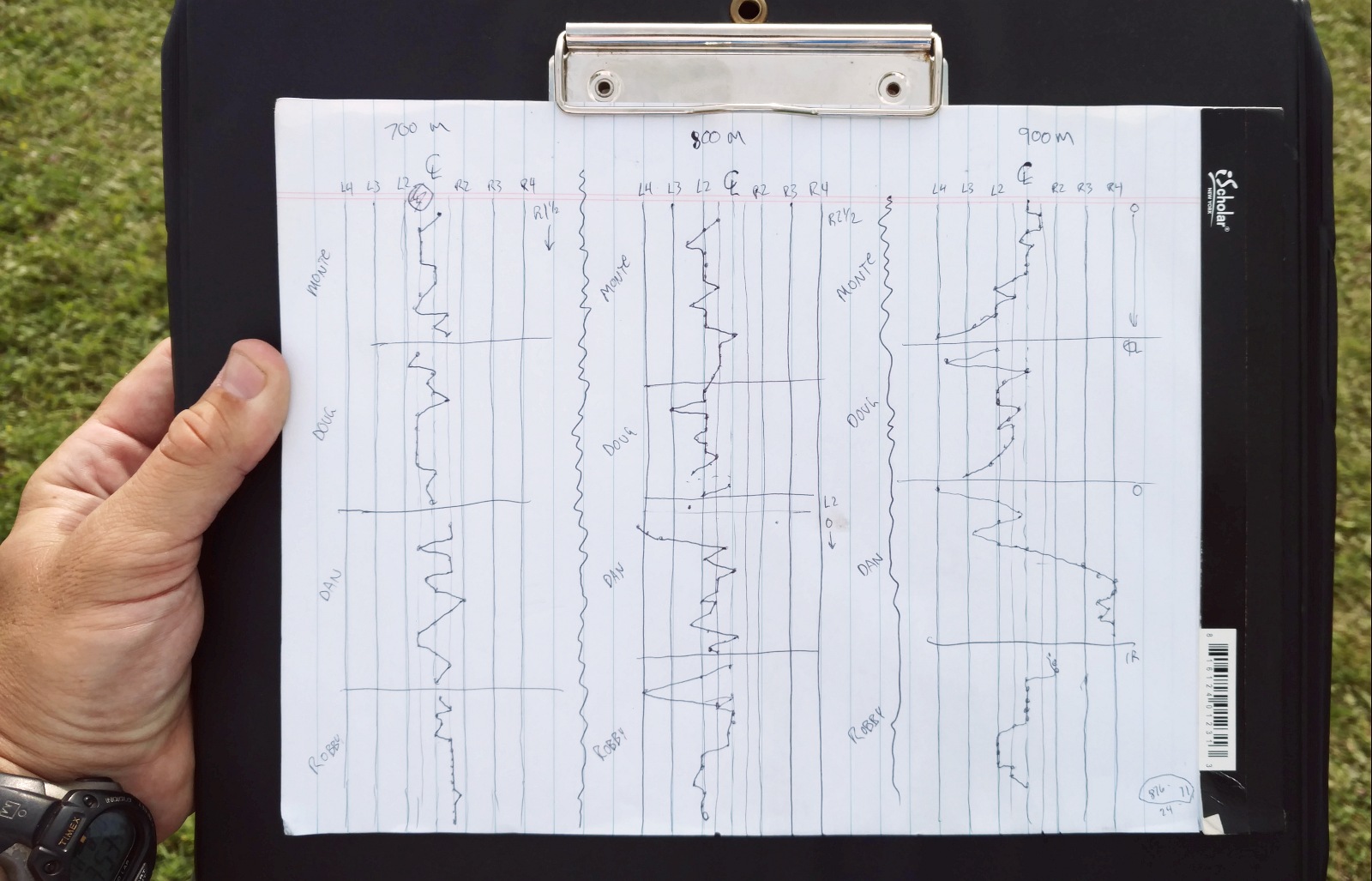
The wind plot I use is a running history of what the correct wind call was for every shot fired. The more you shoot, the more history you have in a condition, and I find that very useful information. This kind of plot IS NOT showing where the bullet hit, and is NOT showing what you held. It’s showing what you should have held to center each shot. IMO, this is the most valuable information to have when guessing where to hold next for each shot. Here are some key points:
1. I always look for blocks of stable conditions to shoot in and wait out the rest.
2. If the wind plot shows drastic changes, either I’m not picking the right time to shoot or it’s just a really unstable wind condition.
3. When you see many shots using the same hold (e.g. Robby’s 700m and 900m strings on plot), it can indicate very fast shooting and fast pit service.
Q. What are the numbers and Markings on this Wind Plot?
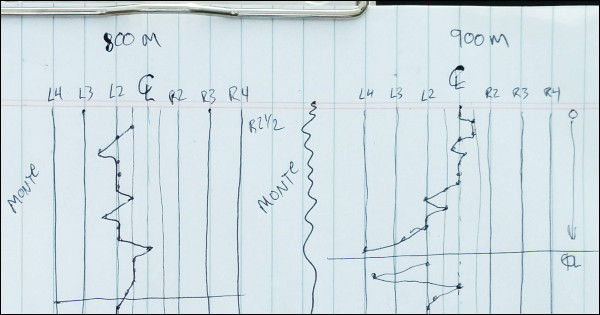
Litz: The wind plot represents the rings on the target. Left 2 for example, is the 5 line on the international target, while Left 2 is the 10 line on the USA target. F-Class shooters and coaches talk about wind holds in relation to these rings. A Left 2 hold isn’t left 2 MOA or 2 MILS, it’s the second ring from center. The vertical lines on the plot represent the rings going out from center, 4 or 5 in each direction. A left or right 5 hold is edge of black on the int’l target.
Q: What Does this Specific Plot Reveal?
Litz: Looking at the plot, from left to right is 700m, 800m, and 900m that we shot progressively through the day. Top to bottom shows each shooter in sequence (shooters names are shown by their blocks). To the right I note what was on the gun for that shooter, and note when it changes. Often times we run the same wind on the gun for several shooters but if it changes, I note what the new windage is and continue on. For example if we’re settled into a condition where we’re shooting Vs with a right 3 hold, I might adjust the scope 1 MOA right because a right 3 hold is equal to 1 MOA. So we can move the scope and start shooting with a center hold.
Q. Are you Plotting Where the Bullet Hits?
Litz: Not exactly. This kind of plot IS NOT specifically showing where the bullet hit, and IS NOT showing what the shooter held. It’s showing what the shooter should have held to center each shot. IMO, this is the most valuable information to have when guessing where to hold next for each shot.
On each shot, the shooter or coach takes a guess about where to hold, and fires the shot. If the bullet hits the center, you plot the point right where you held because it was the correct hold. However, if you miss the call, you plot what hold was required to put that shot in the center. For example if you shoot a right 3 and hit where you held, the correct call would have been “center”. In this way, you’re building a history of what you should have done, which may or may not be what you actually did. This shows you the trends, and brackets which can be used to make future decisions.
Q: Is this Type of Wind Plot Something New?
Litz: I didn’t invent this method, it’s been around a long time. Vertical can be plotted the same way. In team matches, we have a plotter who is advising on elevation trends and suggesting corrections. But, as wind coach, my job is the horizontal so I only keep the wind plot. I have learned lots of strategies from my coaches Emil Praslick and Steve Hardin.
There are many ways to plot and many standard work sheets for this. They’re all tools and the key is to find something that works for you in different situations. I don’t keep a plot when I am personally behind the trigger string firing because I lose more points when I take the time to do it vs. just shooting fast. When pair firing or coaching, I can keep the wind plot without compromising the shooting.
Team Australia used plots and comms linking coaches to help win the 2013 F-Open Team World Championship. We expect other teams will follow suit in Canada in 2017.
Know Your Goal — Keep It Simple
Know your goal of plotting. The simplest plot is where you write the shot number where it hit on a target face. This kind of plotting is useful for evaluating shooter performance because it shows how big the group is (in particular the vertical dispersion). However keeping a plot like this does little to help you figure out the wind. It just shows you what shots you messed up on. It does nothing to help you find the center. [Editor: That’s a whole different matter with many variables.] The wind plot I use is a running history of what the correct wind call was for every shot fired. The more you shoot, the more history you have in a condition, and I find that very useful information.
Wouldn’t it be great if you could have one match rifle that could do double-duty — shoot position matches (with sling), and then function as an F-Open gun with front rest? Now that’s possible with Gary Eliseo’s clever “PickleFork” accessory for his line of tubeguns. This accessory also works great for load testing and varmint hunting.
Competition Machine’s Gary Eliseo is a very smart designer as well as a talented shooter. The inventor/builder of the popular Competition Machine Tubegun chassis systems, Gary has come up with something new, which he calls the PickleForks. These are rails that fit to the sides of the tubular fore-end/handguard on his chassis systems. This allows you to use a pedestal-style front rest for F-Class competition. It also provides a much more stable platform for load testing, varmint hunting, or any kind of rest-assisted precision shooting.
These PickleForks transform a Tubegun into an ultra-stable, straight-tracking rig when used with a competition-style front rest.
Gary explains: “Now you can have the same super low-boreline, long ‘wheelbase’ and vertical sides of our innovative F1 F-Class chassis system for your tube chassis. The new PickleForks attach directly to the sides of the F-Class/Tactical fore-ends, no modifications are required. They are very rigid with no flex or twist and make the rifle track like it’s on rails.” The new Eliseo Competition Machine PickleForks are offered for a very reasonable $70.00 per pair, with Cerakote finish. (You get two metal units, one for each side of the fore-arm). For more information, visit www.GotXRing.com or call (928) 649-0742.
New Product Tip from EdLongrange. We welcome reader submissions.
The F-Class World Championships (FCWC) commence today at the Connaught Ranges outside Ottawa, Ontario, Canada. We wish good luck to all the competitors. Based on the conditions at the recent Canadian F-Class National Championships, conditions could be challenging.
F-Class World Championships EVENT SCHEDULE: Friday, August 11 (REST DAY – RANGE CLOSED)
Competitor Check-In for FCWC; Rifle Inspection; International Teams Reception
Saturday, August 12: Opening Ceremonies; ICFRA FCWC (Individual)
Sunday, August 13: ICFRA FCWC (Individual)
Monday, August 14: ICFRA FCWC (Individual); Awards Prize Giving
Tuesday, August 15: TEAM PRACTICE DAY
Wednesday, August 16: ICFRA FCWC (Teams)
Thursday, August 17: ICFRA FCWC (Teams): Awards Prize Giving & Closing Ceremonies
Tips for Success at the F-Class Worlds — #1, Avoid Train Wrecks
As an assist to all the competitors, we’re repeating an article by Bryan Litz, which many have found very helpful — how to avoid “Train Wrecks” at major championships.
When you have a major, critical problem at a shooting match, i.e. a “train wreck”, this can be the end of your weekend. In this article, Ballistics Guru Bryan Litz talks about “train wrecks” — the big disasters (such as equipment failures) that can ruin a whole match. A recent USA F-TR Champion, Bryan illustrates the types of “train wrecks” that commonly befall competitors, and he explains how to avoid these “unmitigated disasters”.
Success in long range competition depends on many things. Those who aspire to be competitive are usually detail-oriented, and focused on all the small things that might give them an edge. Unfortunately it’s common for shooters lose sight of the big picture — missing the forest for the trees, so to speak.
Consistency is one of the universal principles of successful shooting. The tournament champion is the shooter with the highest average performance over several days, often times not winning a single match. While you can win tournaments without an isolated stellar performance, you cannot win tournaments if you have a single train wreck performance. And this is why it’s important for the detail-oriented shooter to keep an eye out for potential “big picture” problems that can derail the train of success!
Train wrecks can be defined differently by shooters of various skill levels and categories. Anything from problems causing a miss, to problems causing a 3/4-MOA shift in wind zero can manifest as a train wreck, depending on the kind of shooting you’re doing.
Below is a list of common Shooting Match Train Wrecks, and suggestions for avoiding them.
1. Cross-Firing. The fastest and most common way to destroy your score (and any hopes of winning a tournament) is to cross-fire. The cure is obviously basic awareness of your target number on each shot, but you can stack the odds in your favor if you’re smart. For sling shooters, establish your Natural Point of Aim (NPA) and monitor that it doesn’t shift during your course of fire. If you’re doing this right, you’ll always come back on your target naturally, without deliberately checking each time. You should be doing this anyway, but avoiding cross-fires is another incentive for monitoring this important fundamental. In F-Class shooting, pay attention to how the rifle recoils, and where the crosshairs settle. If the crosshairs always settle to the right, either make an adjustment to your bipod, hold, or simply make sure to move back each shot. Also consider your scope. Running super high magnification can leave the number board out of the scope’s field view. That can really increase the risk of cross-firing.
2. Equipment Failure. There are a wide variety of equipment failures you may encounter at a match, from loose sight fasteners, to broken bipods, to high-round-count barrels that that suddenly “go south” (just to mention a few possibilities). Mechanical components can and do fail. The best policy is to put some thought into what the critical failure points are, monitor wear of these parts, and have spares ready. This is where an ounce of prevention can prevent a ton of train wreck. On this note, if you like running hot loads, consider whether that extra 20 fps is worth blowing up a bullet (10 points), sticking a bolt (DNF), or worse yet, causing injury to yourself or someone nearby.
3. Scoring/Pit Malfunction. Although not related to your shooting technique, doing things to insure you get at least fair treatment from your scorer and pit puller is a good idea. Try to meet the others on your target so they can associate a face with the shooter for whom they’re pulling. If you learn your scorer is a Democrat, it’s probably best not to tell Obama jokes before you go for record. If your pit puller is elderly, it may be unwise to shoot very rapidly and risk a shot being missed (by the pit worker), or having to call for a mark. Slowing down a second or two between shots might prevent a 5-minute delay and possibly an undeserved miss.
4. Wind Issues. Tricky winds derail many trains. A lot can be written about wind strategies, but here’s a simple tip about how to take the edge off a worse case scenario. You don’t have to start blazing away on the command of “Commence fire”. If the wind is blowing like a bastard when your time starts, just wait! You’re allotted 30 minutes to fire your string in long range slow fire. With average pit service, it might take you 10 minutes if you hustle, less in F-Class. Point being, you have about three times longer than you need. So let everyone else shoot through the storm and look for a window (or windows) of time which are not so adverse. Of course this is a risk, conditions might get worse if you wait. This is where judgment comes in. Just know you have options for managing time and keep an eye on the clock. Saving rounds in a slow fire match is a costly and embarrassing train wreck.
5. Mind Your Physical Health. While traveling for shooting matches, most shooters break their normal patterns of diet, sleep, alcohol consumption, etc. These disruptions to the norm can have detrimental effects on your body and your ability to shoot and even think clearly. If you’re used to an indoor job and eating salads in air-conditioned break rooms and you travel to a week-long rifle match which keeps you on your feet all day in 90-degree heat and high humidity, while eating greasy restaurant food, drinking beer and getting little sleep, then you might as well plan on daily train wrecks. If the match is four hours away, rather than leaving at 3:00 am and drinking five cups of coffee on the morning drive, arrive the night before and get a good night’s sleep.”
Keep focused on the important stuff. You never want to lose sight of the big picture. Keep the important, common sense things in mind as well as the minutia of meplat trimming, weighing powder to the kernel, and cleaning your barrel ’til it’s squeaky clean. Remember, all the little enhancements can’t make up for one big train wreck!
The 2017 Canadian F-Class Championships have concluded. As the event preceded the 2017 F-Class World Championship (in the same venue) by a few days, many of the world’s best F-Class shooters were on hand at the Connaught Ranges outside Ottawa, Ontario. Competition was fierce — as were the winds at times. The challenging conditions gave shooters a good test in preparation for the FCWC which gets underway in earnest on Saturday, August 12, 2017.
Kevin Chou Wins Second Straight F-TR Canadian Title
Canada’s Kevin Chou (Aurora, ON) shot great to win the F-TR match with a strong 426v30 score. This made was two wins in a row for Kevin, who also took the F-TR Title in 2016. Two Yanks completed the podium, with Jeff Rorer (420v25) taking second place, and Robby Burton (418v25) placing third.
Rhys Ireland Wins F-Open Canadian Championship
The F-Open Championship was a tightly-fought match that went down to the wire. Rhys Ireland won the Individual F-Open Championship with a 434v30. Just one point behind at 433v39 was Australia’s Rod Davies. Third, again just one point back, was Canadian Barry Price (433v30).
Team USA (Litz) Wins F-TR Team Championship
American F-TR Teams managed a clean sweep of the top three places in the 4-shooter LUM Team Match. Team USA Litz secured the team victory with a 875v71 score. Finishing second in F-TR was USA Team Swartzkopf (871v74), followed by Team USA Hardin (870v72).
Who can explain the lines and dots on this shot tracking chart used by Bryan Litz?
F-TR Team USA (Litz) members (alphabetically) Douglas Boyer, Robby Burton, Dan Lentz, Monte Milanuk; Bryan Litz (head coach), Stan Pate (asst.)
Team USA (Nancy) Wins F-Open Team Title
The F-Open 4-shooter Team Competition was also dominated by American squads which finished first and second. Winning F-Open Gold, with a score of 888v98, was Team USA (Nancy), coached by Nancy Tompkins, America’s “First Lady of Shooting”. Finishing second was Team USA (Walker) with 887v100, followed by the Canadian F-Open Team at 887v90.
F-Open Team USA (Nancy) was packed with talent. Shooters were: Shiraz Balolia, Ken Dickerman, James Laney, and Pat Scully. Another American deserves mention, John Myers of the Texas F-Open Team. We believe John’s 225v27 was the high score for the team match, and he was the only competitor to shoot “clean”, not dropping a point.
Sebastian Lambang, inventor/builder of SEB Rests, competed in the Canadian Championships. Over half the competitors used SEB rests — Joy-Pods for F-TR and NEOs and MINIs for F-Open.
Conditions were windy and challenging at the 2017 Canadian F-Class Championships. Will the strong winds continue for the F-Class World Championships (FCWC) starting tomorrow, August 12, 2017. Only the wind gods know for sure. Good luck to all the FCWC competitors from all nations!
The F-Class World Championships are coming up next month in Canada, August 11-17. The world’s top F-TR and F-Open shooters will compete at the Connaught Ranges outside Ottawa, Ontario, Canada. There will be a wide variety of high-end equipment on display. This article covers some of the hardware choices made by the U.S. F-Open team.
Are you trying to decide what components to use for your next F-Class build, or are you looking to upgrade your current rig? Wonder what the “big dogs” in the sport have selected as their hardware? Here’s what United States F-Open team members were using (as of 2016). The most popular chambering is the .284 Winchester, followed by the 7mm Walker (a 40° .284 Winchester Improved). Kelbly and BAT actions were the most popular (but many guys are using Bordens in their latest builds). Nearly all team members are using cut-rifled barrels. A wide variety of stocks are used, with PR&T holding a slight edge over second-place McMillan. NOTE: This survey was taken last year.
Click Image Below for Larger Version:
F-0pen competitor Brett Solomon will be using this stunning Speedy-Built .284 Win. It features a “Spear of Destiny” Flame Maple stock milled by Will McCloskey, with a Melonited BAT action, and a 32″ 7mm Bartlein barrel with Stewart Barrel Tuner.
F-Class World Championships Schedule
Canadian F-Class National Championship
Monday, Aug 7: Competitor Check-In for FCNC (Inspections and Squadded Practice)
Tuesday, Aug 8: Canadian F-Class Nationals
Wednesday, Aug 9: Canadian F-Class Nationals
Thursday, Aug 10: Canadian F-Class Nationals Finals and Awards Prize Giving
F-Class World Championships
Friday, Aug 11 (REST DAY – RANGE CLOSED)
Competitor Check-In for FCWC; Rifle Inspection; International Teams Reception
Saturday, Aug 12: Opening Ceremonies; ICFRA FCWC (Individual)
Sunday, Aug 13: ICFRA FCWC (Individual)
Monday, Aug 14: ICFRA FCWC (Individual); Awards Prize Giving
Tuesday, Aug 15: TEAM PRACTICE DAY
Wednesday, Aug 16: ICFRA FCWC (Teams)
Thursday, Aug 17: ICFRA FCWC (Teams): Awards Prize Giving & Closing Ceremonies
Lapua Scenar-L bullets are superb. We have found these bullets to be extremely consistent in weight and base to ogive measurement. In fact some of the first 6mm Scenar Ls were probably the most consistent factory bullets we’ve ever measured. Scenar-L bullets also shoot great. We have a couple 6mm barrels that prefer Scenars over any other bullet type, including custom projectiles. We think serious shooters owe it to themselves to try a box of Scenar-Ls for their favorite match rifle. And now .224, 7mm (.284), and .308 caliber shooters have the opportunity to grab some great Scenar-Ls for an amazingly low price. Right now Grafs.com is running a SALE on select Scenar-Ls in .224, .284, and .308 calibers. These are priced 46% Off, saving you up to $26.00 per 100-count box!
You better act soon, quantities are limited. We expect the 180gr 7mm Scenar-Ls will sell out right away, followed by the 220gr .308 Scenar-Ls shortly thereafter. These are both outstanding choices for F-class and long-range competition.
Alex Sitman of Master Class Stocks in Pennsylvania is widely considered one of the finest rifle-stock craftsmen in the country, if not the world. Alex’s workmanship and dedication to excellence is top-of-the-line. Alex normally custom-fits each stock to his customer precisely. Many hours are dedicated to stock prep and inletting, and his bedding jobs are flawless. Each stock is exactingly hand-crafted with great attention to detail, and then the stock is “dressed” in the customer’s choice of finishes.
Doing all that takes time — a lot of time. That’s why Master Class Stocks has a long waiting list, and it can take months before a big job is completed. But when Alex is involved, you can count on the final product being a work of stock-making art. Here’s an example. Alex recently stocked an F-Class rifle using eye-popping, exhibition-grade Bastogne walnut. The wood was sourced from Cecil Fredi of GunstockBlanks.com. Alex says: “Cecil’s wood is some of the best I’ve ever used. This blank cost over $1000.00, but it was truly spectacular.” Since the blank was less than 3″ wide, Alex (with assistance from 8-time NRA High Power Champion Carl Bernosky) laminated on the 3″-wide forearm “wings” using spare wood left after the blank was cut. See how Alex and Carl carefully matched the grain of the wood on the forearm. And note how perfectly the adjustable cheek-piece is fitted. If you want a stock like this on your next rifle, contact Alex Sitman at Master Class Stocks, (814) 742-7868.
The Bastogne Beauty — More Construction Details
Eric Kennard tells us: “This rifle was built for Mike Dana in Florida. Kelbly’s did the metal work. [The action is a Stolle Panda F-Class.] Barrel by Brux. Chambering? 6mmBR of course! Mike added a March 10 x 60 scope. Let me tell you this is beyond a work of art! The fit is absolutely perfect! There is not one flaw in the wood-work. The pillar bedding is also perfect! Did you notice the ebony inserts? Or Alex’s custom trigger guard? Alex out did-himself this time. Most of us would not dare to shoot [this gun]!”
There are hundreds of cartridge types capable of winning in F-Open. For F-TR you can shoot either the .223 Rem or .308 Win, but you have many load options. This article will focus on proven choices, currently used by the top F-Class shooters in the world. Our discussion will analyze cartridge selection based on the four different F-Class sub-disciplines: Open Mid-Range, Open Long-Range, F-TR Mid-Range, and F-TR Long Range.
Click image to view full-screen photo.
Mid-Range F-Open Cartridges
For starters, a .300 WSM is certainly capable of winning mid-range matches but it is not ideal. So what is ideal, and why? F-Class Mid-Range matches usually are usually shot at 300, 500, or 600 yards — or all three. At those distances the 6mm and 6.5mm cartridges rule. In moderate conditions, the 6mm Dasher is unbeatable. Its low recoil along with its super grouping ability and good ballistics make it my number one choice for Mid-Range.
Best bullets for the 6mm Dasher are: Vapor Trail 103gr, Berger 105 Hybrid, 108 BT, and 105 VLD (hunting). Best powders are: Varget, H4895, and Reloder 15.
Choices for Mid-Range in Tougher Conditions:
We all know that conditions are not always “moderate” that’s why something a little bit bigger will save you a “Nine” or two. The 6.5X47 Lapua was designed for 300-meter competition, but as soon as it was released, it was adopted by F-Class, benchrest, and tactical shooters. It offers great ballistics with very low recoil and big “accuracy window”. Lapua makes great brass for it (no surprise there) and Berger makes great bullets: 130gr VLD, 140gr VLD, 140gr Hybrids. Best powders in most barrels are Varget and H4350, I don’t use double-based powders such as Reloder 17 and the Vihtavuori N500 series because of their unpredictable performance day to day (greater temp sensitivity).
The 6.5X47 Lapua necked down to 6mm is also a great option for mid range matches. I was able to easily get 3200 fps with 105 hybrids and H4350.
Choice for Long-Range F-Open Competition
In Long-Range F-Open Class (out to 1000 yards), the big, high-BC bullets rule. If I had to pick one cartridge for F-Class (both mid- and long-range) I would pick the .284 Winchester or one of its variants. The .284 Win is currently dominating in F-Open competition. It offers great barrel life, it is super-easy to tune and its recoil is very manageable. The best bullets for it by far (in my opinion), are the Berger 180 Hybrids. But Sierra’s new 183gr MK bullet (with factory-uniformed meplats) seems to perform very well as does the Berger 180 VLD. Best powders for the .284 Win are H4350 and H4831SC.
Long-Range Only F-Open Cartridge
As much as I like the .284 Win, for long-range competitions I like the .300 WSM even more. If you look at a .300 WSM and a 6mm Dasher side by side, they appear almost identical in geometry — the .300 WSM looks like an “super-sized” Dasher. Both cartridges are currently the “darlings” of long-range benchrest due to their extraordinary grouping ability and huge “node’’ windows. Big accuracy windows allow loads to perform well in different conditions and geographical locations. That’s obviously very important if you travel to compete. The .300 WSM loaded with Berger 215gr or 230gr Hybrids is very tough to beat at long range, and it is currently my number one choice.
The 7mm RSAUM is another outstanding long-range round. It resembles a 6BR on steroids and it is almost as easy to tune. Best bullets for it are Berger 180gr Hybrids, 195gr EOLs, and Sierra’s 183gr MatchKing. Best powders for the 7mm RSAUM are: H4350, H4831SC, and VV N160.
Top Caliber/Bullet Combos for F-TR
In F-TR competition, the choice is clear — a .308 Win throated for Berger 185gr BTLRs and 200gr Hybrids will win in mid-range AND long-range comps. Many championships have been won, and many records set with those two bullets in the .308 Win. To quote Danny Biggs (a two times FTR National Champion) “The 185 BTLR is the best bullet for .308 Win ever made”.
The Berger 215gr Hybrids have been used to win many competitions including recently the 2015 F-Class Nationals. Bryan Litz won both the Mid-Range and Long-Range 2015 Championships using 215s. Bryan’s rifle is shown below:
I recommend chambers throated for the 185/200 grain projectiles over the 215/230 grain bullets. The reason is that if you have your barrel throated out for the 215s or the 230s, you could have a “slow” barrel and max out on pressure before the desired velocity is reached. Optimum freebore for the 230s is too long for the 185/200s, so you would be limited to using only 215/230gr bullets in that barrel.Furthermore, the recoil increase with heavier bullets is substantial, causing the rifle to be more difficult to shoot.
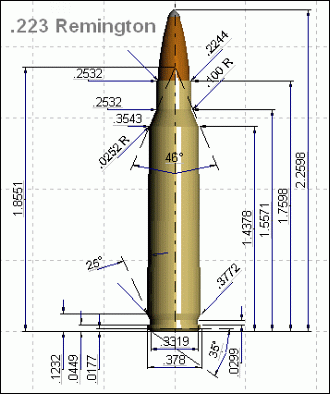
.223 Rem — Not A Competitive Option
I would stay away from the .223 Remington. On paper the 90gr VLD will shoot inside most .308 Win loads even at a 1000 yards. But in reality, on average, the .223 Rem, regardless of what powder/bullet combo is used, cannot compete with the .308 Win. [Editor: The equipment lists at major F-TR matches will confirm Kovan’s conclusion here.]
Conclusion (and Other Options)
This article covers only the (currently) most popular cartridge/bullet combos for F-Class (F-Open and F-TR). As I said in the beginning, many cartridge types are capable of winning but are not listed due to their low popularity, case design, or lack of quality components. All of the above information is based on my personal experience and it is meant to help new shooters choose the right cartridges for F-Class matches. Thanks for reading and good luck — Emil Kovan
Emil Kovan Competition History:
– 2014 F-Class Open National Champion
– 2015 F-Class Open National Championship, Silver Medal
– F-Class Open National Championship Teams, 2015, 2014, 2013, Shooting Team Member
– Over 15 wins in Regional and State Championships in Palma, F-TR, F-Open
It’s great to see two important businessmen give back to the shooting sports. Kelly McMillan and Jim Borden are working together on a project — creating an F-Class Open rifle that can be loaned out to young shooters to help them get started with the sport. Great idea — we need to get more young folks involved in precision shooting. In F-Class (as well as benchrest) it seems we have an “aging population”. Engaging the next generation of shooters is vitally important.
“Big shout out to Jim Borden. He heard I want to build a mid-range/entry level F-Class rifle to be loaned out to new junior shooters interested in finding out whether they like competing in F-Class Open. He contacted me a couple of weeks ago and said he would like to be involved in this project and wanted to send an action on which to build this rifle. Oh boy, it has arrived. Borden’s [operation] has always been synonymous with quality firearms and components but this action is an example of quality craftsmanship in every aspect. Thanks Jim for doing what you do. Hope I can do this thing justice.”
We’d like to see the looks on the faces of the juniors who’ll get to shoot this new rifle Kelly will be building. That’s like a Driver Training student getting to pilot a Ferrari. When this Editor got started in shooting, it was with very well-worn, hand-me-down 22 LRs at a local Boy Scout summer camp. We think it’s great that juniors will be able to sample something built with all-top-quality components.
Every Friday at 11:00 am, Kelly McMillan hosts the Talking Stock Radio Show on the Voice America Network. This week’s show features guest Robbie Barrkman, founder of The Robar Companies and CTI (Coating Technologies Inc.). If you have used any firearm product coated in NP3, you have Robbie to thank for it. Kelly will also interview Extreme Long Range (ELR) shooter Randy Powell from Thunder Ammo & Arms in Oklahoma.
We saw a change in weather on Saturday. It dawned warm and relatively calm, but the winds picked up in the afternoon as clouds rolled in. There wasn’t any rain though, and for shooters who were sunburned after many days in the Arizona sunshine, the overcast was a bit of a relief. On Saturday, Ben Avery hosted both individual and team matches. All three classes (Sling, F-Open, F-TR) shot two 1000-yard individual matches. This was followed by 4-person Team Matches at 1K. Here are the top five performers in Saturday’s individual matches:
Top Five Competitors in Each Class
SLING
Kevan Hoffarth (P), 400-19X
Jerry Iliff (A), 400-18X
John Whidden (A), 399-23X
Peter Church (A), 399-22X
Gary Rasmussen (A), 399-16X
F-OPEN
Dan Bramley, 399-28X
Robert Hoppe, 399-27X
Pat Scully, 399-24X
Erik Cortina, 399-22X
John Meyers, 399-20X
F-TR
Ian Klemm, 394-16X
Bryan Litz, 393-16X
Nancy Tompkins, 392-19X
Peter Ricci 392-13X
Alan Barnhart, 392-9X
In a great individual performance, Kevan Hoffarth, shooting a Palma Rifle, shot clean to beat ALL sling shooters, including those in the “Any Rifle” sub-class. In fact, “Any” shooters took the next four sling places. In the F-Open Division, it was a very tight race, decided by X-Count for the top five places, with Dan Bramley edging Robert Hoppe for the win by one X.
Watch Highlights of Day 4 at the Berger SW Nationals:
What the Berger SW Nationals is All About
When folks usually talk about shooting matches they focus on the obvious — scores and hardware. But the Berger Southwest Nationals (SWN) is about much more than putting holes in paper with bangsticks. We’d say this match has become so popular (with 400 entrants) because it offers the whole experience — fun, challenge, a warm-weather escape, and above all, camaraderie.
Some shooters come to Ben Avery for the swag (the prize table is amazing). Others come for the sunshine (think warm 75-85° weather). And even more folks come to try out their shiny new toys and to test their skills against the nation’s best shooters.
But we’d say the number one reason most folks make the pilgrimage to Ben Avery every year is the camaraderie — the chance to connect with friends, rekindling connections that may go back decades. Fundamentally, then, the Berger SWN is about the people. For this Editor, the chance to meet good friends such as John Whidden, Gary Eliseo, Doan Trevor, Nancy Tompkins, Anette Wachter, Shiraz Balolia, Adam Braverman, Jay Christopherson, Erik Cortina, Scott Harris, and so many others, gives me plenty of motivation to make the 7-hour drive from California.
For many of us, this is the only time of the year when we get a chance to meet fellow shooters from distant corners of the USA. And where else will you find a past NRA President (John Sigler) on the firing line, and have a chance to chat with him during a lunch break. The SWN is very special.
The Brain Trust — Experts Galore
The best minds of the shooting world come to Ben Avery every year. Got a question about ballistics? Well, Ballistics Guru Bryan Litz will be happy to answer your questions between relays. Want some expert advice about wind reading? Seek out Mid Tompkins (usually found hanging around the club-house) or Emil Praslick, one of the most knowledgeable wind coaches on the planet (Emil was shooting and coaching this year). And if you have a gunsmithing question, you’ll find some of the top barrel-fitters and stock makers, including Doan Trevor and Gary Eliseo.
Emil Praslick III heading out to the firing line…
Tubegun Chassis-Maker Gary Eliseo was at the match
Compete against the Best
If you want to test your mettle against some of the best shooters in the world, get yourself to Ben Avery in February. Here you can compete, shoulder to shoulder, against the best Sling and F-Class shooters on the planet. Guys like John Whidden (reigning Long Range National Champion) and Kenny Adams (reigning World F-Open Class Champion). If you want to play with the “Big Boys”, Ben Avery is the place. Having said that, novice shooters will enjoy the experience as well, because you’ll find that these top shooters are (almost universally) happy to share their knowledge.
Learn from Top Talents
If you want to improve your game, this is the place. Walk down the firing line and you’ll stand shoulder to shoulder with many national champions. There is no question that you can improve your techniques by watching top shooters, and you can get ideas about hardware by looking at the rigs campaigned by the best. Where else will you find a half-dozen national F-Class champs seated around a table. Or an 11-time National High Power Champion (David Tubb), hanging out at the Lapua trailer in the parking lot.
2015 F-TR National Mid-Range and Long-Range Champion Bryan Litz helps a Junior shooter
Mid Tompkins at Shooters’ Clinic
Gun Gear Candy Store
If you are thinking about upgrading your match rifle, you’ll find plenty of inspiration at Ben Avery. On the firing line you’ll fine the newest actions from Barnard, BAT, and Borden, the latest/greatest optics (see Vortex Golden Eagle below), and the newest most advanced stocks. F-TR guys will find a wide variety of exotic bipods plus the latest generation of sandwich-construction bipod “mats”. (NOTE: These are becoming rigid, elevated platforms with low-friction tops — will the rules be tightened?).
Warm Arizona Weather
When we arrived in Phoenix on Tuesday it was a relatively mild 76°. By Friday it had warmed to a balmy 84°. We didn’t hear any complaints from the Canadians who fled ice and snow to shoot the match. Even while California was getting soaked with rain it was sunny and warm in Arizona. And you can even have a balloon ride right over the Ben Avery range.
Enjoy a Desert Escape
The Ben Avery Shooting Facility is located in a scenic corner of Arizona, north of Phoenix. Get here early in the morning and watch the balloons take off. Head northwest and you can visit the historic town of Prescott. Two hours north is Sedona, famed for its stunning Red Rock scenery. A few hours south you can visit Tombstone and the OK Corral. There’s a lot to see and do in the Phoenix area that makes the trip worthwhile in addition to the gun fun at the range.





 Train Wrecks (and How to Avoid Them)
 4. Wind Issues. Tricky winds derail many trains. A lot can be written about wind strategies, but here’s a simple tip about how to take the edge off a worse case scenario. You don’t have to start blazing away on the command of “Commence fire”. If the wind is blowing like a bastard when your time starts, just wait! You’re allotted 30 minutes to fire your string in long range slow fire. With average pit service, it might take you 10 minutes if you hustle, less in F-Class. Point being, you have about three times longer than you need. So let everyone else shoot through the storm and look for a window (or windows) of time which are not so adverse. Of course this is a risk, conditions might get worse if you wait. This is where judgment comes in. Just know you have options for managing time and keep an eye on the clock. Saving rounds in a slow fire match is a costly and embarrassing train wreck.


 Alex Sitman of


 .223 Rem — Not A Competitive Option
 Emil Kovan Competition History: