How would you like to represent the United States in top-level International Shooting competitions? Well, if F-Class is your game, here is your opportunity. F-Class Team USA will be conducting try-outs for the United States squads who will represent our country in F-TR and F-Open divisions (plus Under-25) at the 2021 World Championships. The try-outs are open to any competitive shooter with a class-compliant rifle and the will to win. Team leadership expressly welcomes newcomers.
Initial and primary tryouts are planned during the 2018 U.S. National Championships in Raton, NM, and the 2019 SW Nationals in Phoenix, AZ. There may also be an early 2019 tryout date at Butner, NC.
Dan Bramley Invites Shooters to Team USA F-Class Try-Outs
Official Invitation to Team USA F-Class Try-Outs To the F-Class Community–
On behalf of Team USA 2021, we are pleased to invite the best of USA F-class to consider joining our effort for the 2021 World Championships in Bloemfontein, South Africa. We are reaching out with this invitation to provide some general information on our plans for 2021 and for upcoming try-out dates for the unified Team USA: F-TR, F-Open, and Under 25.
We are moving forward with F-Open, F-TR, and Under 25 unified as one USA F-class 2021 Team. This will allow us to take advantage of each team’s strengths and provide needed purchasing power and coordination for event and logistic costs. We also believe this will help encourage and grow our sport. We will share ideas, event/facility dates and best practices within this unified team, however, individual team segments will make their own decisions. Therefore, please direct your responses and inquiries to the appropriate team leadership.
Being part of Team USA is a major commitment of time and resources. We do have wonderful and sizable sponsorship partners who we thank and rely on for moderating individual team member costs. However, due to the location of this World Championship effort, one can expect to help cover a commensurate level of the costs.
We are now moving into the USA “development team” stage of the process. This team is open to newcomers… there are many newer names showing up on the top of leader-boards and many new teams that are making positive impacts. If you are interested in being part of Team USA, please consider making that commitment. We would like to hear from you by March 23, 2018.
Team Time Expectations
Attendance at SWN and US Nationals will be expected for 2019 and 2020. We will also likely expect the final team to attend the Berger SWN in 2021 or have an alternative site for a final practice prior to our trip. We will try to have afternoon or evening team sessions during these events however we may have team days just prior or after these events to maximize the use of individual travel dollars and time. We will also likely have additional team training dates in 2019 and 2020, likely on east coast ranges to facilitate best availability for all.
Shooting/Coaching Position Opportunities
We are equally passionate about developing coaching/shooting teams for winning gold medal efforts in both the Richardson Cup (8-man) and Rutland Cup (4-man) World Championship Events. Obtaining a shooting or coaching spot on one of these teams is an absolute gauntlet of a commitment and consistent strong results will be required as the USA is blessed with wonderful depth. We encourage all, with proven success in our sport, to test themselves at this highest of levels.
Team Try-Out Dates and Locations
Initial and primary tryouts are planned during the 2018 US National Championships in Raton, NM and the 2019 SW Nationals in Phoenix, AZ. There may also be an early 2019 tryout date at Butner, NC.
If you are interested in further information, please contact our Team USA leadership:
Dan Bramley, Captain USA F-Open
usrifleteam2021fopen [at] gmail.com
Phil Kelley, Jr., Captain USA F-TR
usarifle2021 [at] gmail.com
Rick Jensen, Captain USA U25
U25USAFclass [at] gmail.com
Reigning NRA National Long-Range Champion John Whidden in action on the 1000-yard line. John’s rifle features a centerfire action in an aluminum Anschutz small-bore stock.
There are now two more days left for the 2018 Berger SW Nationals, with the competition heating up. From this point on, all shooting will be at 1000 yards. Friday was challenging, with increasing wind velocities over the day. Shifts were harder to figure out, and some talented shooters dropped 8-10 points. Competition was fierce. In the sling division, our friend Gary Eliseo of Competition Machine came out on top via tie-breaker. Gary and Stuart Mackey shot identical scores on Friday at each distance: 150-8X, 150-7X, and 149-8X, both finishing with 449-23X. That’s as close as it gets.
One shot left… will that last bullet end up in the X-ring? We hope so…
Saturday Shooting — Team and Individual Competition at 1000
Today, Saturday 2/10/18, all shooting will be at 1000 yards, with both Individual and 4-person Team competition. The format calls for two, 20-shot matches for both individuals and teams. Good luck to all!
MATCH RESULTS: Complete Daily Scores and On-Going Match Standings are posted on the McMillan Fiberglass Stocks Facebook Page. Here are Top Five in each Division, at day’s end on Friday, 2/9/2018:
Top Five F-Open
Bob Sebold — 449-30X
Danny J. Biggs — 449-26X
Jay Christopherson — 448-28X
Stephen Potter — 448-23X
Ubaldino De Arellano — 448-23X
Top Five F-TR
Ellis Berry — 448-26X
Peter Johns — 448-25X
Philip Kelley Jr. — 448-21X
Doug Boyer — 447-27X
Greg Barkley — 447-23X
Top Five Sling
Gary Eliseo — 449-23X
Stuart Mackey — 449-23X
Bill Vaughn — 448-28X
Curtis Gordon — 448-23X
Nancy Tompkins — 447-30X
No Worries Mate — Mark Swaps Stocks in Mid-Match
Australian Mark Fairbairn performed a “Quick Fix” during Thursday’s match. His F-Open rifle, in a conventional fiberglass stock, was giving him random vertical during one yardage: “I had a bit of a problem with elevation — the stock was hitting somewhere [causing vertical]. I was X-X-X then a shot popped up in the 9 ring with no good reason. So I figured I better put a new stock on it. I got my old aluminium stock I brought from Australia and quickly adjusted it to fit on the Stolle.” Right on the berm he swapped his barreled action into the metal stock of his own design. The clock was ticking… but the story had a happy ending. For the next yardage Mark shot a brilliant 150-7X, not dropping a point. So the “Quick Fix” did the trick. As they say Down Under — “Good on Ya, Mate!”
Patriotic Pair of Stars and Stripes F-Open Rigs
There were two very patriotic F-Open rifles side-by-side on the firing line yesterday. These Stars and Stripes rigs were squadded right next to each other just by chance — but it made for a great show.
Like Father, Like Daughter — The Cortinas
Erik Cortina, member of Team Lapua/Brux/Borden, is one of the nation’s top F-Class shooters. But on Friday he was only the second-best Cortina at 1000 yards. Erik’s daughter, Amberleeana, posted a 147-7X to edge her Dad by 3 Xs (Erik scored 147-4X) from the 1000-yard line.
F-Class is for Everyone – All Ages, Guys AND Gals
F-Class is not just a man’s game. There were many lady shooters on the firing line, in both F-Open and F-TR Divisions. Some shooting instructors says females learn faster than their male counterparts, so they can excel quickly in the shooting sports.
Cool Gadget (Literally) — The BarrelCool Device
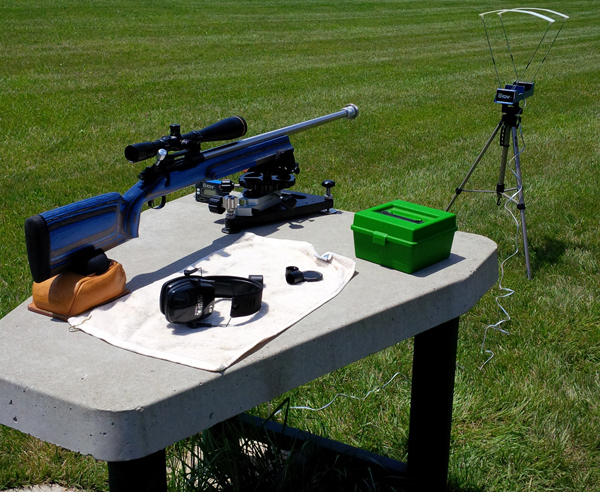
The clever BarrelCool is a dual-purpose device that serves as an Empty Chamber Indicator (ECI) while cooling your barrel with a battery-powered fan. This is American ingenuity at its best.
Spotting Scope Support Arm Attached to Front Rest
Texas gunsmith Richard King of King’s Armory had a very clever set-up for his spotting scope. He has fabricated a support arm that holds the spotter very close to his rifle. With this configuration, Richard can view through the spotting scope without shifting his position on the rifle. This puts the spotting scope’s eyepiece just a few inches from his riflescope eyepiece so he can move easily from one optic to the other. This set-up also reduces the amount of gear Richard carries to the line. No separate spotting scope base, stand, or tripod is needed. This is a simple, elegant solution. We bet, with a little tinkering and design work, a similar system could be mounted to a SEB or Bald Eagle front rest
Labor of Love — Do-It-Yourself F-TR Stock Milled from Aluminum
We saw many interesting F-TR rigs. Here’s an one-of-a-kind stock, machined from aluminum billet by shooter/owner Mark Roberts of Lone Star Tumblers. There are a ton of man-hours in this unique stock.
Bird’s Eye Ben Avery — A Look at the Range
If you’ve never visited the Ben Avery Facility north of Phoenix, Arizona, here is a video shot in 2016 that shows the 1000-yard range (including drone footage). The desert range at Ben Avery is something special — check out this “birds-eye view”. This video also includes an interview with Derek Rodgers, the current F-TR World Champion, King of 2 Miles, and the only man who who has earned both F-Open AND F-TR National titles.
Ben Avery by Air — We are repeating this 2016 video here because it has a great aerial view of the Mid Tompkins 1000-yard Range at Ben Avery
Erik Stecker of Berger Bullets visited the match Friday. Here he talks with members of Team Berger Bullets. Eric now oversees operations of Berger, as part of the Capstone Precision Group (Berger, Lapua, SK, Vihtavuori). That’s Walt Berger in the background in the red shirt.
There were plenty of smiles on the firing line — the Berger SW Nationals event offers great weather, great competition, great camaraderie, and a great prize table.
Swap-Meet at Ben Avery
After the matches concluded on Friday, a Swap Meet was held in the Club House. There were some great bargains to be found. Can you name the past National Champions in the background of this photo?
Parting Shot: Glamtactical by Cerus Rifleworks
We spotted a stunning “Glamtactical” rig from Cerus Rifleworks in the Nightforce booth. Believe it or not, Cerus owner Will McCloskey found this stunning wood buried in a “bargain bin”, and snagged the highly-figured walnut blank for under $10. Steal of the year! This rifle features a carbon-wrapped barrel with muzzle brake.
There are three notable articles in the latest January 2018 Digital Edition of Shooting Sports USA Magazine. F-Class competitors will definitely want to read the report on the 2017 World Championships. And hand-loaders will appreciate the insightful article on the AMP induction annealing machine. The third recommended article provides tips and techniques for sighting in hunting, tactical, and benchrest rifles. Access the entire SSUSA 54-page January 2018 eZine by clicking THIS LINK.
F-Class 2017 World Championships in Canada Story by Larry Bartholome
Fifteen years ago, the very first F-Class World Championships were held in Canada. In 2017, the Championships returned to Canada for the fifth edition of the match. This year there were triple the number of entries, representing the growing popularity of F-Class competition. Notably, this year’s event was preceded by the Canadian F-Class National Championships. This issue contains a full report on the event, written by Larry Bartolome, a past National F-Open Champion. Shown at right above is the new F-TR World Champion, our friend Derek Rodgers from New Mexico.
AMP Annealing Machine — Annealing .30-06 Brass for Vintage Military Rifles Story by Art Merrill
Produced in New Zealand, the AMP (Annealing Made Perfect) unit is a sophisticated, microprocessor-controlled annealing machine that achieves ultra-consistent results using an electrical INDUCTION process. By contrast, with butane torch systems you may have to adjust the system when the ambient temperature changes, or even if your butane fuel is slightly different. In this month’s issue of Shooting Sports USA, Field Editor Art Merrill uses the AMP to anneal .30-06 brass for vintage military rifles. The review shows how to use the AMP and explains the advantages of the Induction Annealing vs. flame-based annealing.
Sighting In Your Rifle — Tips for All Shooters Story by Jim Shults
This month’s “Rifle Issue” of Shooting Sports USA focuses on rifle shooting in various forms. Author Jim Shults has written an lengthy article offering tips and techniques for sighting-in your rifle. Shults says “The trick in effective sighting-in (zeroing) is shot-to-shot consistency”. To achieve that consistency, you must first eliminate driver error. You need a stable set-up. Good ammo is also essential and Shults offers an important tip: “Keep your ammo cool and out of direct sun at the range”. Shults also explains there is a big difference between load testing and zeroing. You want to finalize your zero AFTER you have developed your match or hunting load.
March 48x52mm High Master Scope — Tested in Competition
by Jay Christopherson, AccurateShooter.com Systems Admin
Using a fixed power scope on your F-Class rifle is not only effective, but can save you weight and money — key benefits when it comes to the F-Class game.
I recently tested the March High Master 48x52mm scope on my F-Open rifle in three different matches, including a Long Range Regional match in Montana and the recent 2017 US F-Class National Championships in Lodi, WI. While I’ve long been considering a fixed-power optic, it wasn’t until a recent F-TR build came in over-weight (with a large zoom scope), that I finally decided to give it a fixed-power comp scope a try. The March High Master 48x52mm saved me both weight (10.6 oz. or 300 grams) and money ($800+) compared to a top-end, variable-power March.
Across three matches and multiple conditions (including heavy mirage), I never found myself wishing that I had a variable-power scope on top of my rifle. And I never experienced issues holding rings on the target. A fixed-power scope might not be for everyone. However a serious F-Class shooter who needs to cut some weight, or save a little cash (compared to high-end zoom scope), shouldn’t be worried about being “under-glassed” with a fixed power scope such as the March HM 48x52mm. It can do the job. [Editor: Jay finished second overall in F-Open Division at the 2017 F-Class Nationals.]
The Case for A Fixed Power F-Class Optic
There’s been a thought bouncing around and growing in my head for the past few years while shooting F-Class — Why don’t more guys shoot a fixed power scope in F-Class? Nine out of ten F-Class shooters I’ve polled spend most of their time between 40 power and 50 power, regardless of the conditions. It seemed to me that a fixed power in the 40X – 50X range would be a great option.
I’ll admit, that I’ve long been an advocate of needing a variable-power scope so that I could “dial down to see the rings” on those really heavy mirage relays. There’s even been times when I’ve been successful dialing down to 35X – 25X just for that reason. But still, like most guys, I find that I rarely go above 50X and rarely below 40X – 99% of my time is spent right around 42X – 45X. Having gotten used to shooting high magnification now, it’s been quite a long time since I’ve bothered to dial down below 40X, even in very heavy mirage. But, I held on to that notion that it’s better to have it and not need it, than to need it and not have it.
I recently built an F-TR rifle. I made a slight mistake on the weight. Fully built with my zoom scope, the rig ended up at 8.3kg (8.25kg is the limit for F-TR). That’s not much overweight, but I don’t like to be too close to the limit anyhow. There are lots of ways I could have addressed the issue, but I started thinking again about the scope. I love my current variable-power scopes, but I couldn’t help thinking that a fixed power scope in the 40X – 50X range might solve my issue nicely (and give me a chance to try something new). So I obtained a March High Master 48x52mm fixed-power scope to test. The 48X magnification falls right into my comfort zone. With its 52MM objective, the March HM matched the profile of my existing variable-power scopes nicely. Aesthetics is at least part of the goal and in my opinion, 50MM+ objective scopes look “right” on F-Class rifles. It’s also worth noting that this is the only fixed power scope that I have tried so far and that I have no affiliation with the manufacturer.
There’s the notion out there that fixed power scopes have inherently brighter sight pictures or maybe “clarity” is a better word. This may be due to there being less complex lenses and fewer parts inside. I don’t have any way to quantify that, so I’ll just say that the image clarity is excellent on the 48X March. I also found that the scope weighed 300 grams less than my variable-power scope, which brought me under the F-TR weight limit nicely, as I had hoped.
Fixed-Power Scope at 2017 F-Class Nationals and Other Matches
Because my F-TR rifle was still in load development, I decided to try out the March HM 48x52mm at a couple matches on my F-Open rifle, while I waited on a part for my F-TR rifle. I fitted the 48x52mm scope to my F-Open rifle and used it at three matches: 1) a local 600-yard mid-range match in WA State; 2) the Long Range Regional at Deep Creek in Montana; and 3) the 2017 US F-Class Nationals in Lodi, WI. I ended up using it the entire match at all three matches. With three different matches, all a few weeks apart and in different parts of the country, I got a nice cross-section of light, weather, and mirage conditions to sample. At all three matches, and even in a medium-heavy mirage situation, I never found myself wishing I could dial down the power. In fact, I never thought about variable power at all — the scope was excellent in all of the different conditions. Even with a good deal of mirage present, I never had a problem making out the rings well enough to hold on. For what it’s worth, I used the scope while shooting on two different teams that set (pending) National LR and MR F-Open team records at those matches. If I didn’t have confidence in a fixed-power scope (and the March in particular), I would never have taken a chance shooting it where a team depended on me. [Editor: In individual competition, Jay finished second in F-Open at the Nationals.]
Scope Tracked Great and Click Values Were Right On
In terms of technical details, the scope tracked perfectly on my scope checker (there are several threads on the AccurateShooter forums regarding checking a scope for drift), which meant I felt comfortable using it at the F-Class Nationals. Critically, I spent a good bit of time working on the ocular focus (reticle focus) so that it would be perfectly set-up for my eye. I’ve found that many complaints about parallax and “soft” or “blurry” images can be traced back to the owner never taking this critical step with a new scope. Normally my scopes all have external, tactical-style turrets — the March HM 48×52 has covered turrets. I wondered how this would work for me, but again, I never thought about it while shooting. Once the covers are off, the clicks are extremely tactile and easy to read and it just never became an issue. The parallax adjustment works nicely and the scope tracked well with every adjustment I made, from 600 yards to 1000 yards.
What Could Be Improved
On the con side of things, I find the scale on the elevation turret to be a bit confusing. Most scopes I have used have an incrementing scale on the elevation (and windage) turrets, so that you can count up from zero as you dial up the adjustments. The 48X HM uses a ‘0’ that is centered on the turret travel (see photo above), so that you count down or up on the scale. Here, I would prefer a scale that bottoms out at zero (or that you can adjust to bottom out at zero) and then increments. I think it’s an easier and more consistent way to measure, but your mileage may vary. Other March scopes I’ve used have a color-coded system on the turrets which I also find a little less than useful. Again, I wouldn’t mind at all if March re-thought its system there.
The other con for me is the eye-relief. It’s middle of the road as far as other high-end scopes I’ve used, but for me personally, I still find it a bit on the short side — I would prefer more eye relief.
Save Hundreds Compared to a Premium Zoom Scope
On the plus side (from a cost standpoint), fixed power scopes are generally priced quite a bit lower than equivalent-quality, variable-power optics. The March HM 48x52mm (product # MAR1076) I tested is no exception. Bullets.com sells the HM 48x52mm for $1951.00. That’s $810 less than its variable-power relative, the March HM 10-60x52mm, priced at $2763.00. I consider the 48x52mm’s $1951 price to be very reasonable for such a quality piece of hardware.
Conclusion — High-Quality, Fixed-Power Scopes Are Worth Considering
Overall, if you find that you spend 99% of your time in the 40X – 50X range with your variable-power scope, I’d encourage you to give some thought to a fixed-power scope for F-Class. I’ve only tried one fixed-power optic — the March HM 48x52mm. But having used this excellent, fixed-power scope in several high-level F-Class competitions now, I’d have no qualms about recommending a high-grade, fixed-power optic to anyone shooting F-Class.
This article was written in 2014 for the Sierra Bullets Blog. It describes one method of load development that is commonly used. There are other methods that can work also. Some guys first isolate seating depth and then fine-tune velocity with charge weights. Other guys may aim for a known velocity node (speed range) and then optimize accuracy by adjusting seating depth. Still others look for smallest ES and tightest vertical to minimize 1000-yard vertical dispersion. There are many ways to skin a cat. Different rifles (and even different barrels) can demand different styles of load development.
In this instance the writer achieved desired results seating his bullets .007″ back from max “jam” length. For other applications (and other barrels) you may get the best, most consistent results seating off the rifling by .020″ or more. In disciplines with quick-fire such as PRS, it may be wise to develop loads that “jump” the bullet.
F-Class Long Range Load Development Methodology
by Mark Walker, Sierra Bullets Product Development Manager
Since I just put a new barrel on my F-class rifle… I figured it might be a good time to discuss load tuning for long range shooting. Getting the most accuracy out of your rifle is one of the most important aspects of load tuning. For long range shooting in particular, using a load that produces the least amount of vertical variation is vital. There are several steps to the process that I use, so I will go through the basics of each.
When I first get a new barrel installed, I like to determine what the loaded cartridge “jam” length is. I do this by taking an empty case (no powder or primer) that has been neck sized with the proper bushing (I like to shoot for 0.002 smaller than the loaded cartridge neck diameter) and seat a bullet long in it so that the throat of the rifle will move the bullet back into the case when I close the bolt. I close the bolt several times until the bullet stops moving back into the case at which point I use a comparator with my calipers and get a length measurement on the cartridge. This is what I consider to be the “jam length” for this barrel and chamber. I came up with 3.477″ as the “jam length” for this particular barrel. [Editor: In this instance, Mark is using “Jam length” to mean max seating depth he can achieve without bullet set-back.]
Next, I will fire-form some brass using a starting load of powder and bullets seated to “jam” while breaking in the barrel. My barrel break in process is not very technical; it’s mostly just to get the brass formed and the rifle sighted in. I do clean every 5 rounds or so just because I feel like I have to.
Once I have the brass formed, I use them to load for a “ladder test” to see what powder charge the rifle likes. With a ladder test, you take your starting load and load one round each with a slightly increasing amount of powder until you reach your max load for that cartridge. You then fire each round using the same aiming point to see where the bullets start to form a group. For this barrel and cartridge, I started at 53.3 grains of H4831SC powder and increased the load by 0.3 grains until I reached 55.7 grains. I always seat my bullets to “jam” when doing a ladder test. We will determine the final seating depth in another test later. It’s usually best to shoot this test at a minimum of 200 yards because at closer ranges the bullets will impact too close together making it hard to determine which load works best. I shot this test at 300 yards.
As you can see from the target, the lightest load #1 had the lowest velocity and impacted lowest on the target. Shots #2 and #3 were a little higher and in the same hole. Shots #4 thru #6 were slightly higher yet and all had the same elevation. Shots #7 and #8 were the highest on the target however pressure signs were starting to show. For some reason shot #9 went back into the group and the chronograph didn’t get a reading so I ignored that shot.
When picking a load, I am looking for the most shots at the same vertical location on the target. As you can see that would be shots #4 through #6 so I would pick a powder charge from those shots which would be 54.2 grains to 54.8 grains. As a side note, shots #2 and #3 are only 0.851 lower so I wouldn’t be afraid of using one of those loads either. I settled on 54.5 grains as the load I wanted to use. It’s right in the middle of the group so if the velocity goes up or down slightly, the bullet should still hit in the same place on the target.
Now that we’ve settled on a powder charge, I want to find the seating depth the rifle likes. I usually start at jam length and [shorten the COAL] in 0.003 increments until I get to 0.015 deeper than jam. [Editor: By this he means he is seating the BULLET deeper in the case, NOT deeper into the lands. He ended up at .007″ shorter than his hard jam length of 3.477″.]
I load 3 rounds at each depth using the 54.5 grain powder charge and shoot a group with each depth at 150 yards. As you can see from the target, the first two groups are not good at all. Next one looks good and is the smallest group on the target. The next three are not quite as small but the vertical location on the target is almost the same which indicates a sweet spot which will help keep the vertical stringing to a minimum on target. I went with 3.470″ which is right in the middle once again and should give some flexibility with the seating depth.
So after all of that, my load is 54.5 grains of H4831SC and a cartridge length of 3.470. I plan on loading up enough ammo to shoot five groups of five shots and see exactly how this load works on target as well as what the extreme velocity spreads are over several groups.
I sincerely hope some of this information helps you to get the best accuracy out of your rifle. I do not take credit for coming up with any of this, a whole lot of good shooters use this same method or a variant of it when working up their loads.
For more information about load development, please contact the Sierra Bullets technical support team at 1-800-223-8799 or by email at sierra [at] sierrabullets.com.
Disclaimer: Load data represented here may not be safe in your rifle. Always start low and work up, watching for pressure signs.
Shooter Profile by Des Parr, UK
We have a new European F-Open Champion: Paul Hill from the UK. If he looks familiar, it’s because Paul appeared here 12 months ago when he set a new F-Open record score of 100-17X at 900 yards at last year’s European Championships. There are some factors which make Paul’s victory all the more significant. First, he didn’t employ a top gunsmith to do his work — he’s a real working-class here who did it all himself. To keep costs down he taught himself to do all his own machining and bedding. Paul acquired a lathe, learned how to run it, and then carefully did all his own chambering and fitting. He then taught himself how to bed the rifle too. You have to admire a man who teaches himself how to build Championship-winning rifles.
Another unusual factor is Paul’s choice of components. Paul used the Lapua Scenar 180-grain bullet, the same bullet used to set his 2016 record. The 180gr Scenar is a fairly “old-fashioned” shape, but Paul points them using a “shooting shed” pointing tool. For seating, he uses his own home-made die with a Wilson top. Whatever the Lapuas may lack in BC, they more than compensate for in consistency, and that’s the key to success. As an aside, they compare very favourably in tests on the Juenke ICC machine, indicating that they’re very well made indeed.
Paul Hill Equipment List
Paul shot in the F-Open class firing the 7mm RSAUM cartridge, a short magnum. He ran a 30″ Krieger 1:9″-twist barrel mated to a Barnard Model P action bedded in a Joe West laminated stock. His pushed those Lapu8a Scenar with the relatively new Reload Swiss RS70 powder. Paul rates this RS70 propellant very highly. It may be unfamiliar to shooters in the USA, but RS70 is REACH compliant and is likely to become more popular when many other powders are forbidden from the EU next year. Paul is also a big fan of the Russian KVB-7 primer, a very mild and consistent primer — marketed under “Wolf” in the USA.
It is not just about having the right equipment though, it is also all about the application of skills and techniques and Paul was very keen to acknowledge his debt of thanks to Erik Cortina for his reloading techniques and Brian Litz for his writings on range mind set and diet. There is another, until now, secret factor that may have helped Paul. He is an Apiarist (bee-keeper) and he swears by the beneficial effects of his daily honey on toast. Who knows? Perhaps he’s on to something — nothing sells like success, so Paul’s honey sales may take off now just like his shooting career.
Here’s a good video showing F-Class Shooters at Bisley (FieldSports Channel 2015)
2016 Wasn’t So Bad Either
Paul Hill’s 2017 Championship win followed an impressive performance last year. At the 2016 European F-Class Championships at the Bisley Ranges, Paul set a record score at 900 yards: 100-17V! That’s 17 shots placed in a five-inch circle the size of a CD (compact disc) at over half a mile. [NOTE: At Bisley, the maximum score is FIVE points, not ten points. So the maximum score for 20 shots is 100. Also what Americans call an “X” is called a “V” at Bisley.]
Record Set with Slower Pair Firing Method
The style of shooting in Great Britain is pair-firing. Under this procedure, each of two competitors shoots alternately, taking turns from shot to shot. Each shooter has 45 seconds to take his shot. Allowing for the target pullers to do their jobs, this means that each shot can take up to one minute. As Paul was pair firing, he had to concentrate for up to 40 minutes to get all 20 shots off! You can imagine how many times the wind changed course in those 40 minutes –pick-ups, let-offs, changes of angle and direction. Paul had to counter each change and still managed to put 17 shots in that 5-inch circle!
Here is an interesting project by one of our Forum members. Martin C. (aka “Killick”) modified an Anschutz 1411 Match 54 rimfire prone stock to become a comfortable, great-tracking F-Class Open Division Stock. No Killick didn’t sacrifice a perfectly good rimfire rifle for this project — he bought the Anschutz stock by itself on eBay, then transformed it…
Killick explains: “This project started about seven years ago. I bought the Anschutz prone stock on eBay and whittled it a bit into a Palma rifle with a Barnard action and block and a Doan Trevor cheek piece and scope rail. Then about two years ago I decided to re-task the stock/action assembly into an F-Open rig. With more whittling, gluing, sanding, body fillering, sanding, filling, sanding, more sanding…and sanding, forming, priming, sanding, painting, waiting, painting, painting…painting and before you know it, Bob’s your uncle.”
Here is the eBay-sourced Anschutz 1411 stock, with new high-gloss blue finish, as initially modified for use in Killick’s centerfire Palma rifle. Looks nice!
Next step was the addition of a 3″-wide wood fore-end for F-Open duties with front rest:
Almost done here… just needs priming and final painting:
Here is Killick’s completed F-Open rifle with its much-modified Anschutz stock now finished in fire-engine red lacquer. This image shows the detail of the grip and customized cheekpiece.
“A big congratulations to Bob Mead (1582-68X), who utterly destroyed the competition in tricky wind conditions to take the Gold.” — Jay Christopherson, 2017 F-Open Nationals Second Place.
In this 15-minute video, Team Lapua’s Erik Cortina interviews Robert Mead, the 2017 LR F-Open Champion. Robert (Bob) discusses his wind reading techniques with Erik, and the newly-crowned F-Open Champ explains how to set up a reliable wind zero. Bob also discusses cartridge choices in F-Open. He admits the straight .284 may be the tightest grouping 7mm cartridge, but he has used the 7mm RSAUM for a decade now. He believes the RSAUM may the best cartridge for 1,000 yards in 7mm, all things considered (grouping ability, ballistics): “To me it’s a light magnum, it’s capable of high speed, yet burns less powder than your regular magnums. [But] it’s a finicky cartridge — you’ve got to do a fair amount of load development.”
Every serious F-Class competitor should watch this video start to finish:
Credit Erik Cortina for video and the photo of Robert Mead with trophy above.
“A big congratulations to Bob Mead (1582-68X), who utterly destroyed the competition in tricky wind conditions to take the Gold.” — Jay Christopherson, F-Open Second Place.
The 2017 F-Class National Championships in Lodi, Wisconsin are now history. Hail the new Champions: Robert Mead, F-Open (1582-68X) and Ian Klemm, F-TR (1557-56X). Hosted by the Winnequah Gun Club, the Nationals drew about 75 F-Open shooters and 45 F-TR competitors, down from last year. In F-Open, Robert Mead shot brilliantly in tough conditions to finish 14 points ahead of his closest competitor, AccurateShooter.com’s System Administrator Jay Christopherson. Erik Cortina was just one point behind Jay, but Erik had the high X-Count for the match at 71X.
Photos of Robert Mead and Ian Klemm courtesy Erik Cortina.
In F-TR, Ian Klemm also won by a margin of 14 points. This was an impressive win by Ian, given the challenging winds and weather. F-TR runner-up Todd Sanders also shot remarkably well, considering he is a relative newcomer to F-Class. Forum member KyBountyHunter observed: “Outstanding shooting this week gentlemen, in some of the most challenging conditions that I’ve seen. Congrats to all the winners. Ian — fantastic job taking First Place (well deserved) [and] special congrats to Todd. For this only being his second year in F-TR, he’s going to be force to be reckoned with for a long time!”.
Final Results for F-Open (TOP 10):
1. Robert Mead: 1582-68X HM
2. Jay Christopherson: 1568-59X HM
3. Erik Cortina: 1567-71X HM
4. John Myers: 1558-64X HM
5. Pat Scully: 1558-50X HM
6. Larry Bartholome: 1554-55X HM
7. Robert Sebold: 1554-41X HM
8. Steve Harp: 1553-58X HM
9. Jeff Hopkins: 1551-49X MA
10. Lou Murdica: 1550-46X MA
Final Results for F-T/R (TOP 10):
1. Ian Klemm: 1557-56X HM
2. Todd Sanders: 1543-43X MA
3. Brad Sauve: 1542-44X MA
4. Laura Perry: 1539-46X EX
5. Daniel Pohlabel: 1534-49X MA
6. Josh Moore: 1529-37X EX
7. Ken Klemm: 1528-38X MA
8. Bob Lorenz: 1525-47X EX
9. Raymond Weaver: 1522-36X HM
10. Alan Barnhart: 1521-31X HM
Strong Performances by Members of Team Lapua-Borden-Brux
Jay Christopherson posted: “A big congratulations to Bob Mead (1582-68X), who utterly destroyed the competition in tricky wind conditions to take the Gold. This was a great end to the 2017 competition season for me as I managed to hang on by the skin of my fingertips to win Silver at the 2017 F-Class US National Championships (F-Open).” For the record, Team Lapua-Borden-Brux ended up with all five present members of the team in the Top 8 of the Grand Aggregate.
Jay Christopherson (2nd, 1568-59X, Silver)
Erik Cortina (3rd, 1567-71X, Bronze)
Pat Scully (5th, 1558-50X)
Bob Sebold (7th, 1554-41X)
Steve Harp (8th, 1553-58X)
In team competition, Team Lapua-Borden Brux won the F-0pen Long Range Championship as well as the Mid-Range Championship. Jay told us: “That was some outstanding shooting by great team members. I’m really looking forward to the 2018 season.” Erik Cortina added: “So proud of our team. We conquered the 2017 LR National Championship as well as the Mid-Range National Championship. We could not have done it without our sponsors: Lapua, Borden Actions, and Brux Barrels.”
In the F-TR Team Competition, mighty Team Sinclair triumphed yet again, winning its 10th Long Range National Championship. Team member Paul Phillips offered this interesting factoid: “This year we won with the original four members we had in 2004 plus Dan Pohlabel. It’s pretty awesome to be shooting with the same guys for 13 years! What a great run since 2004.” And those same four also all hail from Midland, Michigan (Midland County Sportsman’s Club). Team Sinclair still holds the 4-man Team 1000-yard National Record. Shown below, L to R, are team members: Daniel J. Pohlabel, Paul Phillips, Raymond Gross (Coach), Brad Sauve, and John Droelle.
All Team Sinclair members use identical hardware: McMillan XiT stock, Kelbly Panda action, Bartlein barrel, Nightforce scope, and Phoenix Precision bipod. All shoot Berger 200-20X bullets in Lapua brass.
The One that Got Away — Almost Matching F-Open 20-Shot Record
Erik Cortina shot a superb 200-16X during the competition (see electronic target scoring screen below). That was just one X shy of the current 200-17X National Record. Erik observed: “So close, yet so far. Almost matched the National Record of 200-17X but shot a ten on my very last shot. Everything felt good but luck was not on my side.”
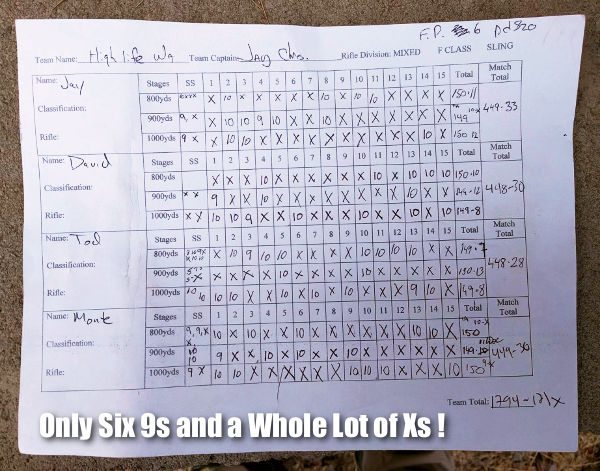
WA Team members, left to right: Tod Hendricks, Jay Christopherson, Monte Milanuk, David Oakes.
F-Class competition continues to evolve, as guns and shooters get better every season. That means records get broken. Yet another record was smashed this month as the “Washington F-Open” team scored 1794-121X, a new pending National Record. That stunning combined team score beats the previous best by five points and more than 20 Xs. We believe the current record is 1789-100X, set at the 2017 Berger Southwest Nationals.
The new 1794-21X team record was set at the 2017 Northern Rockies LR F-Class Regional Match, held September 6-8 at the Deep Creek Range outside Missoula, Montana. This is a three-day, long range regional F-Class match consisting of two individual days and one team day.
Team Member Jay Christopherson, who won the F-Open Division, was proud of his Team’s accomplishment: “We were very excited when our shooting held up at 1000 yards to break the record.” Forum member Pat F., who also shot the match in Montana, said this was a really impressive performance: “I think that record will stand for a while.”
World’s Most Accurate IT Guy Wins F-Open with Brilliant Performance
Our AccurateShooter.com Systems Administrator, Jay Christopherson, won the F-Open Division with a superb 1047-62X individual performance. Remarkably, when you combine that 1047-62X with his 449-33X score in the team match, Jay dropped only four (4) points the entire weekend over 150 shots (105 shots in individual competition and another 45 in the team match). That is a combined percentage 99.73% in the Ten-Ring. Amazing! Jay is definitely “The World’s Most Accurate IT Guy”. Congrats Jay.
Jay was shooting a new F-0pen rifle built with his favorite hardware: a smooth-cycling Borden BRMXD action riding in a hardwood X-Ring stock. The barrel was a 32″-long, 1:9″-twist Bartlein chambered for the .284 Winchester cartridge. All team members were shooting straight .284 Wins with Berger 180gr Hybrid bullets. Jay was using a new scope, a fixed-power 48x52mm March High Master. Jay was impressed with the sharpness, clarity, and reliability of this scope. He said that during the match he never felt the need to dial-down power, so the 48X fixed magnification worked fine.
Jay reports: “Conditions were generally pretty good. Not perfect, but almost… There was enough change to push you out of the 10-Ring if you were not careful, but overall, the conditions were about as consistently good as you can expect. There was also some smoke haze, particularly on Friday and Saturday, that made seeing the target a challenge and looking at mirage was basically impossible. But, for all that, the wind was mostly very, very kind.”
“This is the fourth year I have traveled to shoot this match and as always, it was an excellent match. Jamey Williams does an outstanding job of herding cats and ensuring that the match runs smoothly. Bob Evans ran the line and really did an excellent job of keeping everyone safe and the match moving.”
Here is an aerial view of the Deep Creek Range (Drone video by David Gosnell):
Northern Rockies LR F-Class Regional Match Results
Individual Top Three Shooters (1050-105X Possible)
F-Open Division:
Jay Christopherson, 1047-62X, MW
Tod Hendricks, 1043-61X, 2nd MW
Jim Williams, 1041-51X, 3rd MW
F-TR Division:
Justin Covey, 1030-48X, MW
Tom Hubbard, 1030-41X, 2nd MW
John Van Santford, 1027-36X, 3rd MW
Jay Christopherson, 449-33X
Tod Hendricks, 448-28X
David Oakes, 448-30X
Monte Milanuk, 449-30X
F-TR Winning Team: “Misfits”, 1751-50X
John Van Santford, 436-14X
Beverly Van Santford, 441-13X
Phil Brackenbury, 436-12X
Larry Bandaccari, 438-11X
Course of Fire: The individual days are a 105-shot aggregate, consisting of a 45-shot Palma (800/900/1000) followed by a 20-shot x 1000 (Day 1) and a 40-shot x 1000 match (Day 2). The team match is a 45-shot per team member Palma match (800/900/1000).


 Being part of Team USA is a major commitment of time and resources. We do have wonderful and sizable sponsorship partners who we thank and rely on for moderating individual team member costs. However, due to the location of this World Championship effort, one can expect to help cover a commensurate level of the costs.




 Paul Hill Equipment List