At the Berger Southwest Nationals, innovative F-Class hardware was on display. In F-TR, bipods are continuing to evolve, with new variations at every match. (We saw the Flex bipod in action and it operates very differently than anything else out there). But with F-TR bipods and F-Open front rests having evolved to such a high level, the weak link in the rifle support chain may now be at the rear.
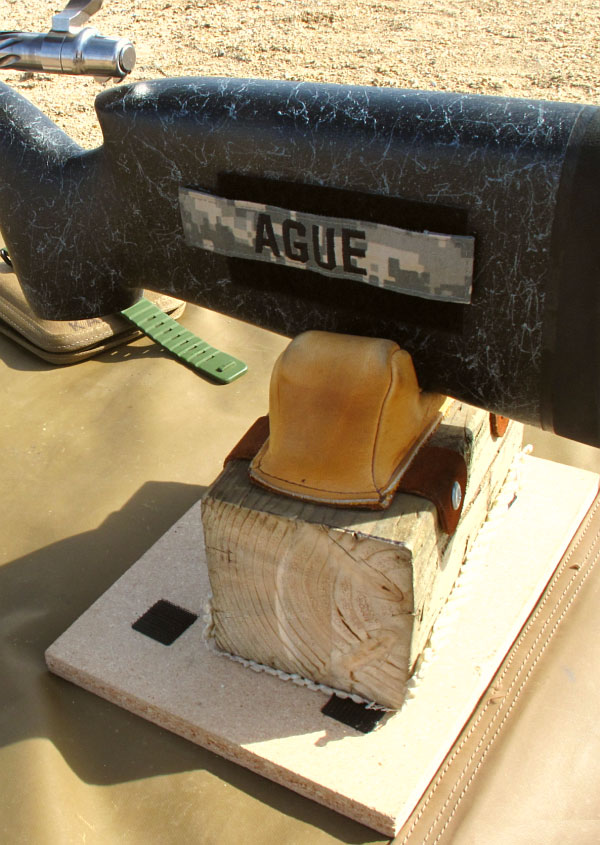
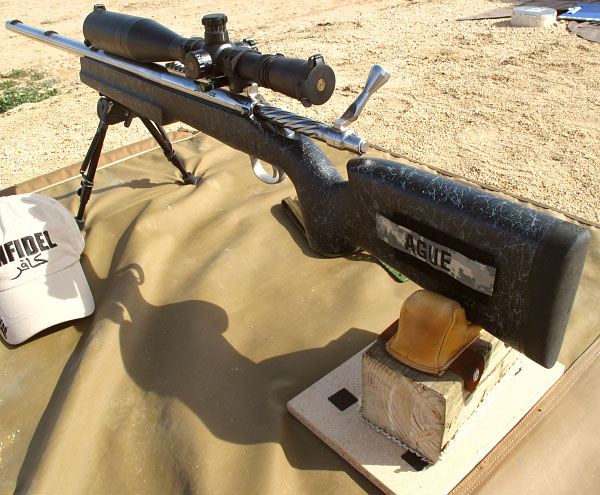
In both F-TR and F-Open, it seems that shooters are turning their attention rearward — devising new ways to stabilize (and elevate) the rear sandbags. We saw a variety of “sub-platforms” designed to give rear bags more lateral stability, and also raise the bags up off the ground. A few shooters have moved away from a conventional rear sandbag to a hybrid support that almost looks more like a front bag attached to a rigid block. Here are a couple rear bag set-ups we saw at Ben Avery in Phoenix. These should give you guys some ideas:
Check out this simple but effective Do-It-Yourself rear rest. The “base” is a large, flat piece of particle board. Above that is a sizable block of wood with carpet tacked to the base. It appears that the carpet may be affixed to small velcro squares on the flat base. The most clever feature is on top. A V-style leather front bag has been adapted to support the rear of the rifle. This solution looks both effective and affordable.
We know you guys like do-it-yourself (DIY) projects. And we also know that our readers like anything that helps a rifle sit more securely in the bags, and track better on recoil. Here’s a little accessory you can make yourself for pennies that will help rifles with conventional (non-benchrest) stocks ride the rear bag better.
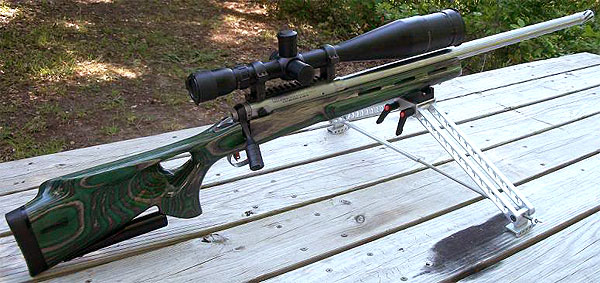
This DIY Bag-Rider is simple in design and easy to make. The invention of Forum member Bill L. (aka “Nomad47″), this is simply a short section of PVC pipe attached to the bottom of a wood stock with a couple of screws. The back half of the PVC tube is cut at an angle to match the lower profile of the stock. Nomad47 painted the PVC Bag-Rider black for sex appeal, but that’s not really necessary.
In the top photo you can see Nomad47’s bagrider attached to a Savage varminter. In the bottom photo, the PVC bag-rider tube is fitted to an F-TR style rig with a green, laminated thumbhole stock. This rifle also features a Savage action with a custom barrel and “wide-track” bipod. (Note: to be legal in F-Class competition, the muzzle brake would have to be removed.)
To learn more about this PVC Bag-Rider and other similar gadgets for the rear of your stock, read this Forum Thread.
Over the past few years, interest in F-Class competition has grown dramatically. At the 2013 SHOT Show we had a chance to talk about F-TR competition with U.S. National F-TR Team members Mike Miller and Stan Pate, two of America’s top F-TR shooters. We are reprising this interview for readers who may have missed it the first time around. If you shoot F-TR (even if you’re a High Master), we think you’ll learn a few things from this interview.
In this interview, Mike and Stan agreed to share their vast store of knowledge about long-range shooting. In a wide-ranging dialog, we discussed many topics of interest to F-Class shooters: position set-up, bipod shooting techniques (and hardware), gun-handling, and bullet selection. In addition, Mike and Stan offer some great advice on wind reading and precision reloading. These general tips will benefit all competitors, no matter what their discipline.
If you shoot F-TR or you are considering getting involved in this fast-growing shooting sport, definitely watch this 14-minute video interview from start to finish. Mike and Stan are true F-TR gurus whose knowledge of the F-TR game has been gleaned from years of top-level competition. If you shoot a .308 from a bipod, we guarantee you can learn much from Mike and Stan. If you follow their advice, we bet you’ll see your scores improve in future matches.
Watch Video for Tips from U.S. National F-TR Team Members Mike Miller and Stan Pate
For 2014, Kelbly’s is introducing a new series of rifles for competition, tactical disciplines and hunting. The Arcas™ Series rifles are complete packages designed with Kelbly’s recommended specifications and top-grade components. Pick your application (Benchrest, F-Open, F-TR, Hunting, Tactical) and Kelbly’s can provide a complete build with all the bells and whistles.
Shown below are the four Arcas competition rifles currently offered. In addition to these four comp guns, the Arcas series includes two tactical-style rifles and two hunting rifles (starting at $2799.00). All these Arcas series rifles will be on display at SHOT Show next week. Let us know (via comments) which Arcas models interest you the most, so we’ll be sure to feature those in our SHOT Show reports.
Every Arcas Series rifle comes with premium components and a wide choice of stock colors. In addition you can have an Arcas rifle customized. For example, the Arcas F-Open rifle shown below can be customized with an extra long barrel ($20 per inch), fluted barrel ($199.00 extra), polished metal (all parts, $249), a GRS Laminated Stock with ergonomic grip (no charge), or a PRT Lowboy stock with high gloss finish ($799 extra).
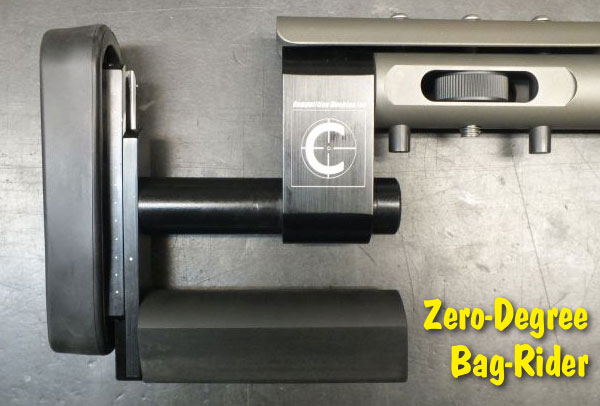
Tube-gunners take note. Gary Eliseo has just introduced a new wider, V-profile rear bag rider for his Competition Machine modular chassis systems. The new bag-rider is a wide V-shape that conforms to the shape and angle of popular rear sandbags. Gary tells us that “The new F-class rear bag rider will be available as an option in 2014. Constructed of Delrin, the new bag-rider is reversible with 0 degree and 5 degree mounting ends. The bottom of the bag-rider is sized to fit 3/4″-wide ear spacing.”
Editor’s Comment — This Kind of Bag Rider Really Works
We have tested a prototype, V-shaped bag-rider on an Eliseo 6mmBR Tubegun. The profile on our wooden prototype is very similar to Gary’s final design crafted from Delrin. We were really surprised at how much better the gun behaved with the wide, V-shaped bag rider, compared to a standard slab-sided skid. With the “V-Rider” the gun felt more “locked-in” with less side-to-side play. There also seemed to be less vertical bounce when shooting F-TR style with a bipod. But mostly the gun felt much more stable, with less tendency to roll. There was noticeably less side to side wobble, and the gun did track better.
The most important thing, is that the V-shaped bag-rider definitely made the gun easier to shoot — at least in the opinion of our three trigger-pullers. When we switched to our wide, V-shaped bag-rider, three different shooters were able to hold smaller groups with tighter horizontal. We saw fewer left/right shot impacts (away from the group center) that may have been attributable to little, last-micro-second movements of the rifle. The gun seemed to settle in the rear bag better, and after each shot, it seemed we could get back on target more quickly. The gun “locks in” to the rear bag faster and more solidly, so you spend less time fiddling with horizontal. With less wobble, the TubeGun feels less top-heavy. Understand that a V-shaped bag rider will not make your rifle more inherently accurate. However, it may help you steer the gun more consistently, and it make help the rifle track more consistently.
Product find by EdLongRange. We welcome reader submissions.
Forum member Jonathan L. (aka ‘Quest-QC’) was a member of the Canadian F-TR team at the F-Class World Championships in Raton, NM this fall. His handsome .308 Winchester rifle features some interesting hardware and a stunning African Padauk-wood stock stiffened with carbon fiber layers. We were impressed by the innovative, adjustable bag-rider assembly Jonathan fitted to the rear of his stock (scroll down for photo). With an Allen wrench, the vertical height and the slope (i.e. fore/aft angle) of the V-shaped bag-rider can be changed easily. This has many advantages. First, Jonathan can set his rifle to the most comfortable height (for his prone position) without using “lifters” under the rear bag. The system also gives him some gross elevation adjustment separate from the bipod. In addition, the angle adjustment allows the bag-rider to better match the geometry of the rear bag. Last but not least, by setting up the bag-rider with some drop (higher in front, lower in back), Jonathan can fine-tune his elevation (while aiming the gun) by simply sliding the rifle fore and aft.
Jonathan says: “This year was my second year shooting at 1000 yards and I managed to find a spot on Team Canada for the FCWC at Raton. Here is the rifle that brought me there…”
The rifle features a Kelbly Panda F-Class RB-LP action, 34″ Bartlein 1:11″-twist, Heavy Palma contour barrel. Fitted to the red-toned Padauk-wood stock is a 23.2 oz., StarShooterCF-SS light weight bipod with custom bench feet. On top is a March 8-80x56mm scope in Kelbly rings. Total weight of the rifle is 18 pounds, 1 oz., complete with the 24 oz. adjustable brass bag-rider at the back. The bag-rider block was modeled in 3D, then machined afterwards to use up the remaining weight available after all the other components. CLICK for StarShooter CF-SS Bipod Video.
African Padauk Wood is Very Stiff
Jonathan chose the red-toned African Padauk Wood because it is stiff for its weight: “The reason for choosing African Padauk is that the weight of the wood is the same as Maple but 45% more rigid.” The downside of Padauk, as Forum member Gstaylorg notes, is that it is a “very oily wood, which can make it somewhat difficult to finish with something like polyurethane. [Padauk] can generate a lot of bubbles and cause cracking problems around joints and/or seams.” Jonathan did note that he has observed a few bubbles in the auto clear coat on his stock. He plans to refinish the stock in the off-season.
Gun Is Extremely Accurate with Berger 200gr Hybrids
Jonathan says this rig was very accurate, at least until his barrel gave up the ghost. He says he has put 15 successive shots in about 1/4 MOA: “I managed to make it twice (1/4 MOA for 15) by taking my time between shots. You don’t want to overheat this barrel. I needed to provide a very strong effort (mentally) to be able to achieve such precision as the rifle is way better than me.” Jonathan shoots Berger 200gr Hybrid bullets (in the lands) with Hodgdon Varget powder, and Federal 205M primers, loaded into neck-turned Lapua .308 Win brass. He has also had good luck with Vihtavuori N150 powder in the past.
In compliance with F-Class rules, the adjustable bag-rider system would not be adjusted “on the fly” during record fire. The bag-rider’s vertical rise and fore/aft slope would be optimized before shooting, then locked in place. The bottom photo offers a good view of the V-shaped profile of the metal bag-rider. We have found that this kind of V-profile, closely matching the triangular profile of the rear ears, makes a rifle more secure in the rear bag and often allows the gun to track better.
Credit Des Parr for providing match details found in this report.
The 2013 European F-Class Championships are now history. Congratulations to new F-Open Euro Champion Joe Melia of Ireland, and new F-TR Euro Champion Paul Eggerman of Germany. Held at the Bisley Ranges in England, the European Championships drew top shooters from all over the Continent, plus the U.K. and Ireland. Following the individual competitions, national teams competed, and Great Britain emerged the big winner. British teams won gold in F-Open, F-TR, and the Rutland Cup. Hail Britannia!
On the GB F-Class Association website, Des Parr authored a great day-by-day account of the Euro Championships. Des writes: “The 2013 European Championships had a little of everything to keep everyone happy — some very light winds to please the trigger pullers, some very strong winds to please the wind-readers and only a little rain to please everyone! Friday was notable for having remarkably calm and steady wind. This enabled everyone to really see what their rifles were capable of in near to ideal conditions. The result was predictable; some very high scores.”
Individual Championships
In F-Open division, senior Irishman Joe Melia shot 457.39 to capture the title. Des Parr notes: “Joe got a rousing cheer from all his fellow competitors, indicative of his good standing. In second, it was another medal for Ireland, this time the fiercely competitive Anthony Dunne used all his experience to rack up 453.38. In third place was the new GB Captain from Wales, David Lloyd with 452.33.”
In F-TR, the Germany’s Paul Eggemann shot a superb score of 447.35 to win the individual title, ten points ahead of his nearest rival. Ukraine’s Sergei Baranov took second with 437.22, while his countryman Sergei Gorban finished third with 436.26.
TEAM COMPETITION 8-Man Event — Top place went to Team GB with 1084.58. Second place was taken by Italy with 1035.46 and in third was BDMP Germany with 1021.32. In F-TR, first place went to Team GB with 1007.32, with Team Italy second (987.31), and Ukraine third (978.26).
4-Man Rutland — There were ten, 4-man teams in the Rutland Competition. In F-Open, Winning Team GB was steered to victory by captain Peter Hobson with a super 524.19. France Open 1 took second with 522.17, while the Europe Open team was third with 497.22.
Irish Teams won silver and bronze in the 4-man Rutland Match at the European Championships.
In related news, Forum member Gary Costello from the U.K. won the GB/Euro National League title for 2013 with a total of 71 points. This multi-match title is based on the best of four (4) League Championship Competitions throughout the year. Gary explains: “We have eight shoots in total, this championship is open to GB F-Class Association members and includes shooters from France, Germany, Ireland, Netherlands, Spain, Ukraine and several other countries. Most of these countries have maximum 300 yards to shoot so the UK is the closest place to compete in long-range competitions. That’s a bit amazing considering the size of the UK to Germany for example.”
Gary used a 300 WSM built by Gunsmith Peter Walker, with a Nesika L action, Benchmark barrel, and a March 8-80x56mm scope. Gary told us that it took some time to master the 300 WSM, which has more recoil than a .284 Win, but in the end, Gary’s choice of caliber helped carry him to victory over a long season of hard-fought competition. Finishing second in League standings was Mark Daish with 70 points, while Des Parr took third place with 64 points. (Point totals based on best four matches.) Complete 2013 GB F-Class League Results are available on the GB F-Class Association website.
F-Class competition will be featured on this week’s episode of Shooting USA television. This week, Shooting USA takes an inside look at the rapidly-growing sport of F-Class shooting, with coverage of both F-TR and F-Open competition at 600 yards and beyond. This show will air three times on Wednesday, October 23rd, on the Outdoor Channel (see air times by region below). This episode will also feature the historic 1907 Winchester, a choice of gangsters in the 1920s.
The Shooting USA Hour on Wednesdays:
AIR TIMES BY TIME ZONE
Eastern Time 3:30 PM, 8:30 PM, 12:00 Midnight
Central Time 2:30 PM, 7:30 PM, 11:00 AM
Mountain Time 1:30 PM, 6:30 PM, 10:00 PM
Pacific Time 12:30 PM, 5:30 PM, 9:00 PM
F-Class Basics
The ‘F’ in F-Class stands for Farquharson. Canadian George Farquharson is credited with founding the sport in the 1990s. Farquharson wanted to create a discipline for fellow older shooters whose fading eyesight made it difficult to compete in traditional iron-sight high power matches. In 2007, the United States NRA officially recognized the prone shooting disciple. Since then the sport has grown rapidly. Over 350 shooters attended the 2013 F-Class Nationals in Raton, NM.
F-Class is similar to High Power rifle shooting, with competitors taking turns in the pits, pulling and scoring targets. Unlike conventional High Power shooting with iron sights, F-Class shooters use scopes (with up to 80x max power, though the most popular scope is still probably the 12-42x56mm Nightforce Benchrest).
All F-Class competition is shot prone. Competitors are classified into two divisions, F-TR (Target Rifle) and F-Open. F-TR rifles must be shot from bipod, and must be chambered for either the .223 Rem or .308 Win cartridges. Max F-TR gun weight is approximately 18.18 pounds, including bipod. In the F-Open division, rifles can weigh up to 10 kg (22 pounds) and front rests can be used (but you may shoot from a bipod if you wish). F-Open competitors may shoot any cartridge which is .35 caliber or under.
Harris swivel-model bipods allow you to adjust the cant of your rifle. This is useful if you are shooting on side-sloping ground. But what if you want to traverse from side to side, say to switch from one critter to another during a prairie dog safari? Well normally you would have to pick up the entire rifle and reposition it to the left or to the right. Now you have an option. The Upriser Arms Bipod Swivel Mount allows you to traverse your rifle left to right, without moving the bipod legs.
Video Shows How Traversing Bipod Mount Works, with Locking Plunger Knob:
This rugged, machined-aluminum bipod mount lets you swing your aim point from side to side without having to reposition the bipod. The rubber-padded Upriser Arms Bipod Mount accepts any bipod that attaches to a forward sling swivel stud. There is also a version that fits on tactical rails.
It is easy to engage or disengage traversing capability via the plunger knob on the front of the unit. When you pull down on the plunger (and twist to lock in “down” position), the rifle can swing smoothly on an internal, precision-bearing pivot. To go back to non-traverse mode, simply center the fore-arm and then twist and release the knob so the plunger pops up, securing the bipod in the “dead-center” position. Note: This unit adds approximately 1¼” to bipod height.
This $69.99 bipod mount comes with a 100% satisfaction guarantee when purchased through Brownells or Sinclair Int’l. User feedback has been positive. One purchaser wrote: “I take this [traversing bipod mount] on all my hunts and it has impressed me immensely. The part is built strong and has improved my shooting. It is really smooth, easy to use, and helps me stay on scope when my game is on the move instead of having a shaky swivel or having to move the whole bipod. I have recommended this product to all of my friends[.] — Adam, Missoula, MT
Many styles of bipods were used by F-TR shooters at the F-Class U.S. Nationals and World Championships recently held in Raton, NM. Most featured angled arms — either left/right arms or parallel pairs of arms on either side. With such designs, vertical height is controlled by adjusting the angle of the arms (and hence the distance between the feet). Widen the track and the gun goes down; narrow the track and the gun goes up. One bipod design, Dan Pohlabel’s FLEX Bipod, was very different than the norm. On the FLEX, there are no angled arms — the main blade is a solid piece of metal. Each leg has independent control for height via adjustable “feet” on either ends of the main piece. A ratcheting locking lever controls the cant.
Click photo below for full-screen version
Monte Milanuk, who tested an early version of the FLEX Bipod, explains: “The FLEX bipod is a very simple design — no Mariner’s wheel for vertical adjustment, no joystick head, no changing width as it goes up and down. And the FLEX bipod is very light (as are most, these days), but also very durable. An added bonus is that it breaks down very flat for airline travel. Once I take the feet off, remove the ratchet lever (with screw), the whole bipod nestles very nicely in the bottom layer of foam in my gun case (with cuts for the head etc. in the foam). If someone bashes the case hard enough to damage what is essentially a plate of spring steel, then I’ve got bigger worries.”
Monte likes the FLEX Bipod, but notes that it works best if you lean into the gun when shooting: “Not everyone wants a bipod that slides around like a hog on ice. Some people manage to get things tracking straight back and forth, almost like it was constrained by a front rest. Personally, I have a hard time doing that in a repeatable fashion. While the FLEX Bipod shoots quite well with a [loose] hold, it was designed for those of us who like to ‘lean’ into the gun a bit. Quite literally, the idea is that you get the feet to dig in slightly, and push against the rifle butt with your shoulder and the bipod will ‘flex’ or bow forward slightly. It is one of those things that sounds wonky until you try it. It may take a few times to get a feel for it, but once you do, it is surprisingly repeatable.”
The FLEX bipod’s designer, Dan Pohlabel, offers these instructions:
The bipod feet are shipped loose. Note there is a left foot and a right foot. Determine the balance point of your rifle and mount the bipod approximately two inches forward of that point. You may want to move it further forward after shooting. Experiment with its placement to minimize movement of the bipod. When setting up, first grab each foot and ‘dig’ them in to the shooting surface, dirt, gravel, grass, carpet — it doesn’t matter. After making sure each foot has a hold, raise or lower the bipod to your target and use the cant adjustment to level your rifle. Loading the bipod with your shoulder is the preferred method of position. For more info, visit Kreativ-Solutions.com or email flex-bipods [at] kreativ-solutions.com .



 Over the past few years, interest in F-Class competition has grown dramatically. At the 2013 SHOT Show we had a chance to talk about F-TR competition with U.S. National F-TR Team members Mike Miller and Stan Pate, two of America’s top F-TR shooters. We are reprising this interview for readers who may have missed it the first time around. If you shoot F-TR (even if you’re a High Master), we think you’ll learn a few things from this interview.
 For 2014, Kelbly’s is introducing a new series of rifles for competition, tactical disciplines and hunting. The Arcas™ Series rifles are complete packages designed with Kelbly’s recommended specifications and top-grade components. Pick your application (Benchrest, F-Open, F-TR, Hunting, Tactical) and Kelbly’s can provide a complete build with all the bells and whistles.




 The Shooting USA Hour on Wednesdays:
 This rugged, machined-aluminum bipod mount lets you swing your aim point from side to side without having to reposition the bipod. The rubber-padded Upriser Arms Bipod Mount accepts any bipod that attaches to a forward sling swivel stud. There is also a version that fits on tactical rails.

 Many styles of bipods were used by F-TR shooters at the F-Class U.S. Nationals and World Championships recently held in Raton, NM. Most featured angled arms — either left/right arms or parallel pairs of arms on either side. With such designs, vertical height is controlled by adjusting the angle of the arms (and hence the distance between the feet). Widen the track and the gun goes down; narrow the track and the gun goes up. One bipod design, Dan Pohlabel’s


