|
|
June 7th, 2013
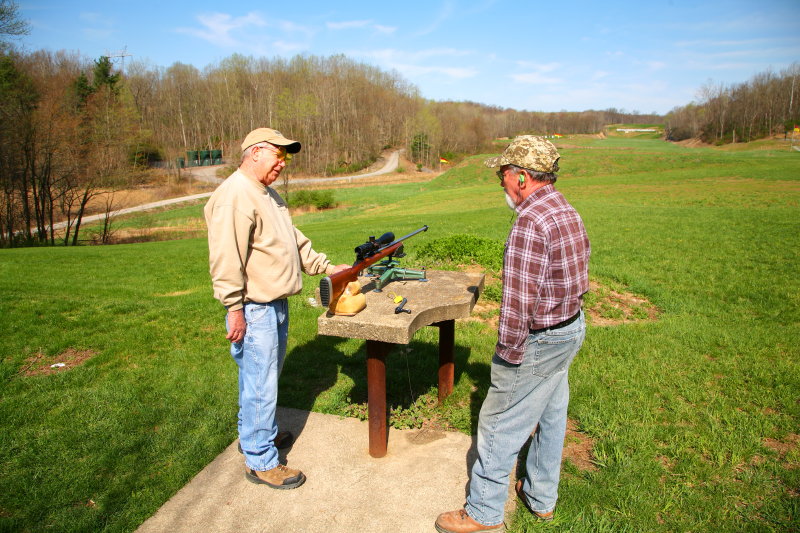
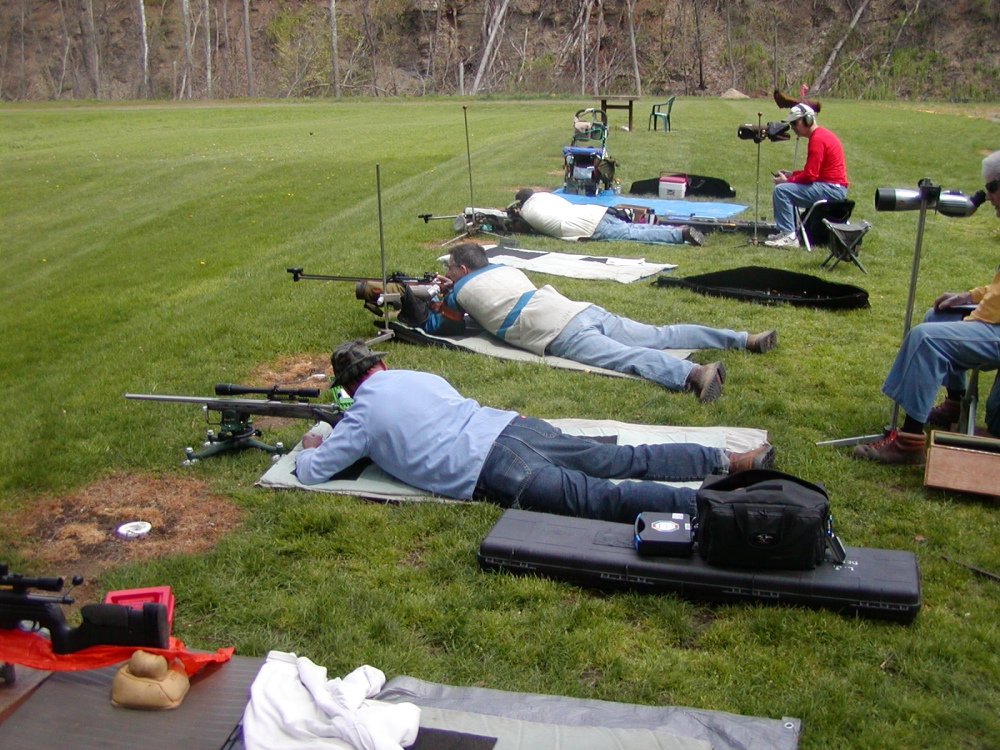
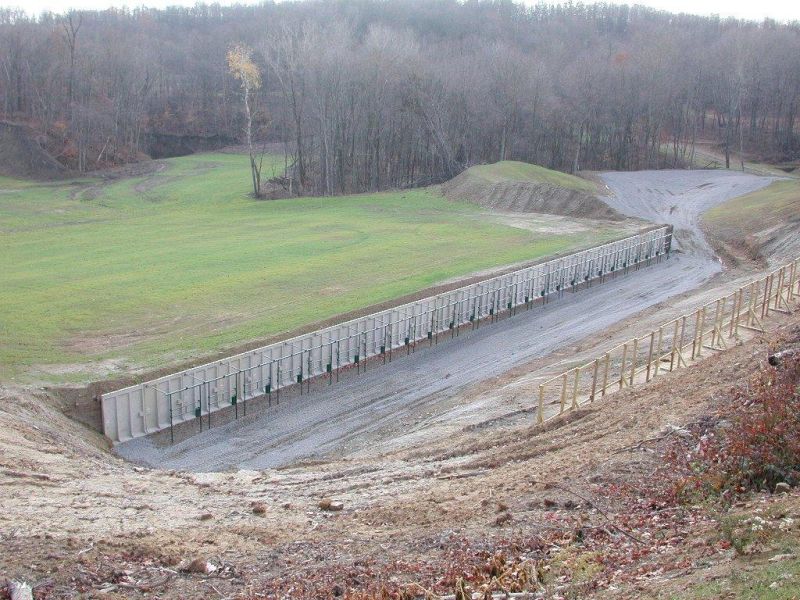
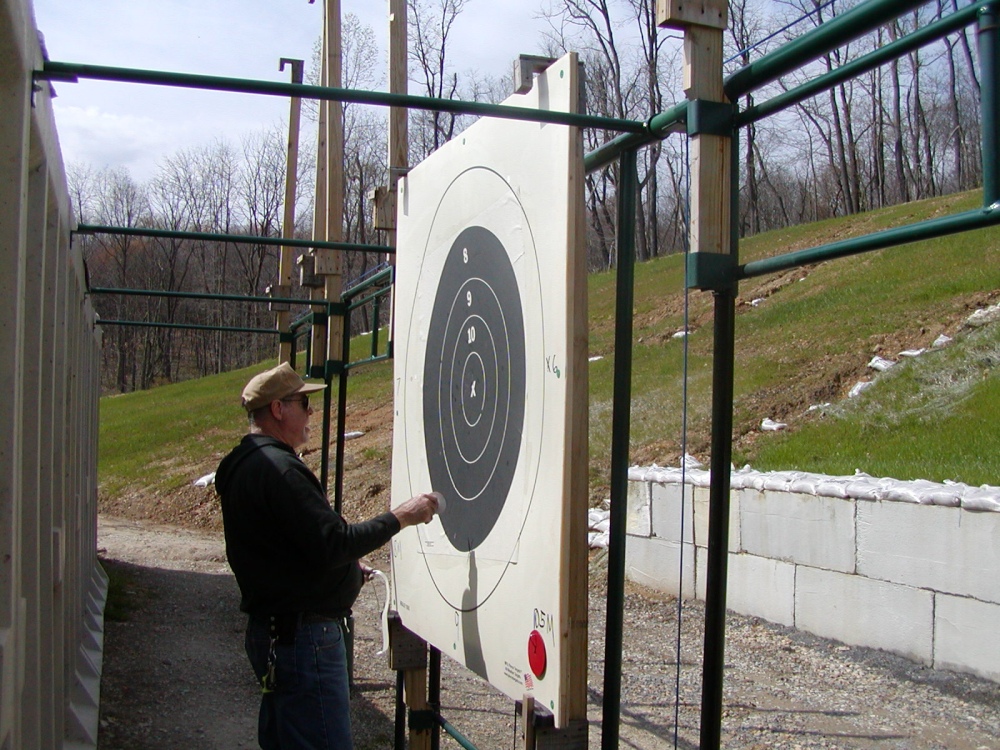
Darrell Buell recently posted a photo of the oh-so-scenic Alliance Rifle Club Range in Malvern, Ohio. This is where Darrell and the U.S. F-TR Team will be practicing this week. Wow — what a beautiful place to shoot. The Alliance Range looks more like a top-flight Championship golf course than a mere shooting range. All that green grass, rimmed by trees, looks like heaven to a Westerner accustomed to ranges that are hard-packed dirt, dust, and gravel. This Editor now has a new item on his “bucket list” — get out to Ohio and shoot a match with the Alliance Rifle Club.


Photos by Darrell Buell and Alliance Rifle Club.
May 17th, 2013
Report based on story by Kyle Jillson in NRABlog.
There will be a new rifle discipline at Camp Perry this year — the NRA National Mid-Range Championships, slated for August 5-9. Created due to the rising popularity of F-Class shooting, the new 3000-point Mid-Range Championships will be shot from distances of 300, 500, and 600 yards and will add yet another fun sport to the annual Remington/NRA National Rifle and Pistol Championships. The new Mid-Range Championship isn’t just for F-Class Open and T/R rifles though. Sling shooters are allowed to compete with Service Rifles and Match Rifles and will be classified accordingly.

F-Class Basics
F-Class is target shooting with scoped sights and artificial support (bipods for F-TR and rests or bipods for F-Open). F-Class shooting is done entirely from the prone position. Originally started among older High Power shooters who were straining to see traditional iron sights and needed a little more support, the sport now includes young shooters as well as experienced shooters looking for a new challenge.
There are two F-Class divisions: Open Class (F-Open) and Target Rifle (F-TR). In F-Open, rifles can weigh up to 22 pounds, fire any caliber under .35 and may be shot off just about any type of rest. F-TR rigs are limited to 18.15 lbs (8.25 kg), must be shot off a bipod, and must be chambered for either the .223 Rem and .308 Win (or 7.62×51) cartridges. For F-TR, the bipods are counted in the weight of the rifle. Other F-class rules are found in the official NRA High Power Rulebook.
The Mid-Range Championships will be held alongside the High Power Rifle Championships August 5-9 at Camp Perry, Ohio. And if your thirst for F-Class has not been sated by then, the US F-Class National Championships are coming to the NRA Whittington Center in Raton, New Mexico from August 18-20. After that the Whittington Center will hold the F-Class World Championships from August 23-27.
April 28th, 2013

It was Christmas in April this weekend, as our new GEN II Joystick Bipod system arrived — thanks to Sebastian (Seb) Lambang of SEB Coaxial. We’re anxious to try this sophisticated new system on a variety of rifles, both small-bore and big-bore. Designed for F-TR shooters, we think the new Joystick bipod (aka “Joy-Pod”) may also prove popular with tactical shooters and varmint hunters who need a lightweight, yet easily-adjustable front support. Like his coaxial front rests, Lambang’s Joystick Bipod controls both horizontal (windage) and vertical (elevation) with a single control arm. In addition, the GEN II “Joy-Pod” offers cant adjustment with its tilting head.
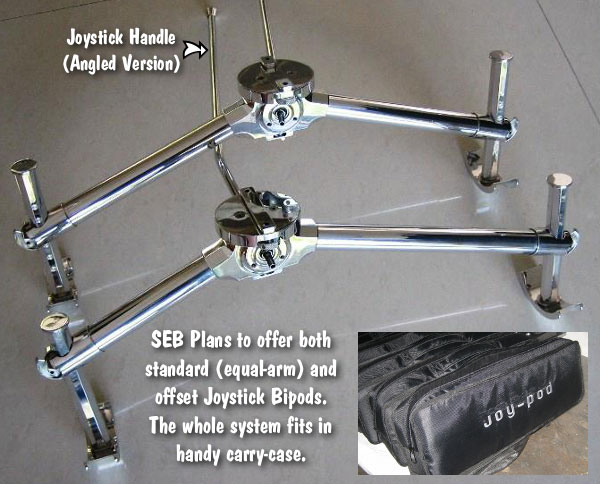
Gross height can be easily adjusted on the vertical legs, both of which feature a column of precision-machined teeth (like on a jack), with a positive quick-adjust locking mechanism. The whole Joy-Pod system weighs about 21 ounces, and SEB even provides a handy nylon storage case.

We’ll be field-testing our new Joy-Pod in the near future and we’ll let you know how it works. SEB is not soliciting advance orders just yet — as there may be some final mods on the production version. Price hasn’t been set yet, but it should be competitive with the popular F-TR wide-base bipods on the market. If you’re intrigued, you’ll find many more hi-rez product photos on Seb Lambang’s Facebook Page.


April 26th, 2013
Following our story on the Sinclair Int’l East Coast Fullbore Nationals, folks wanted to know about the bipods used by the winning F-TR squad, Team Sinclair. Some sharp-eyed readers noticed that three out of four Team Sinclair shooters were sporting a compact, parallel-arm bipod. This nice piece of kit is the ultra-light-weight (17 oz.) Rorer Spec Bipod produced by Duplin Rifles in North Carolina. The Rorer Spec Bipod is sturdy and easily-adjusted, yet it is one of the lightest wide-track bipods on the market.
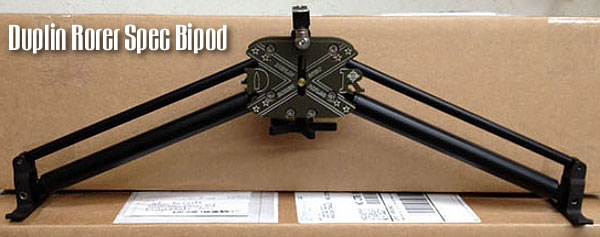
Duplin Rifles — Rorer Spec Bipod
Weight: 1 pound, 1 oz. (17 oz.) | Finish: Clear- or black-Anodized Aluminum
Price: $350.00 delivered in USA | Options: Custom faceplates; Custom mount engraving ($35)

For more information, or to place an order, contact Duplin’s main man, Clint Cooper. You can send email to clint [at] duplinrifles.com or call 910-289-8217.
Duplin Rifles
4527 Hwy 117 South
Rose Hill, NC 28458
April 11th, 2013
Report by Richard King (King’s Armory, Texas; ‘Kings X’ on our Forum)
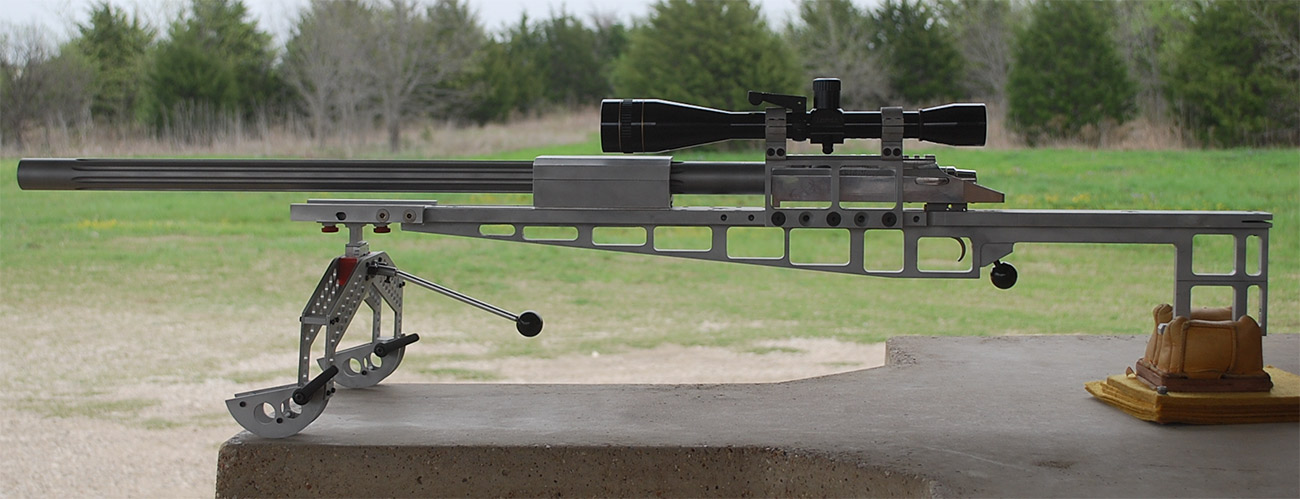
With all the talk from Vince Bottomley in the April issue of Target Shooter about aluminum stocks, I thought you might like to see my latest project. This is my personal gun, built the way I wanted it. I know it’s radical and some may not care for it. But it works.


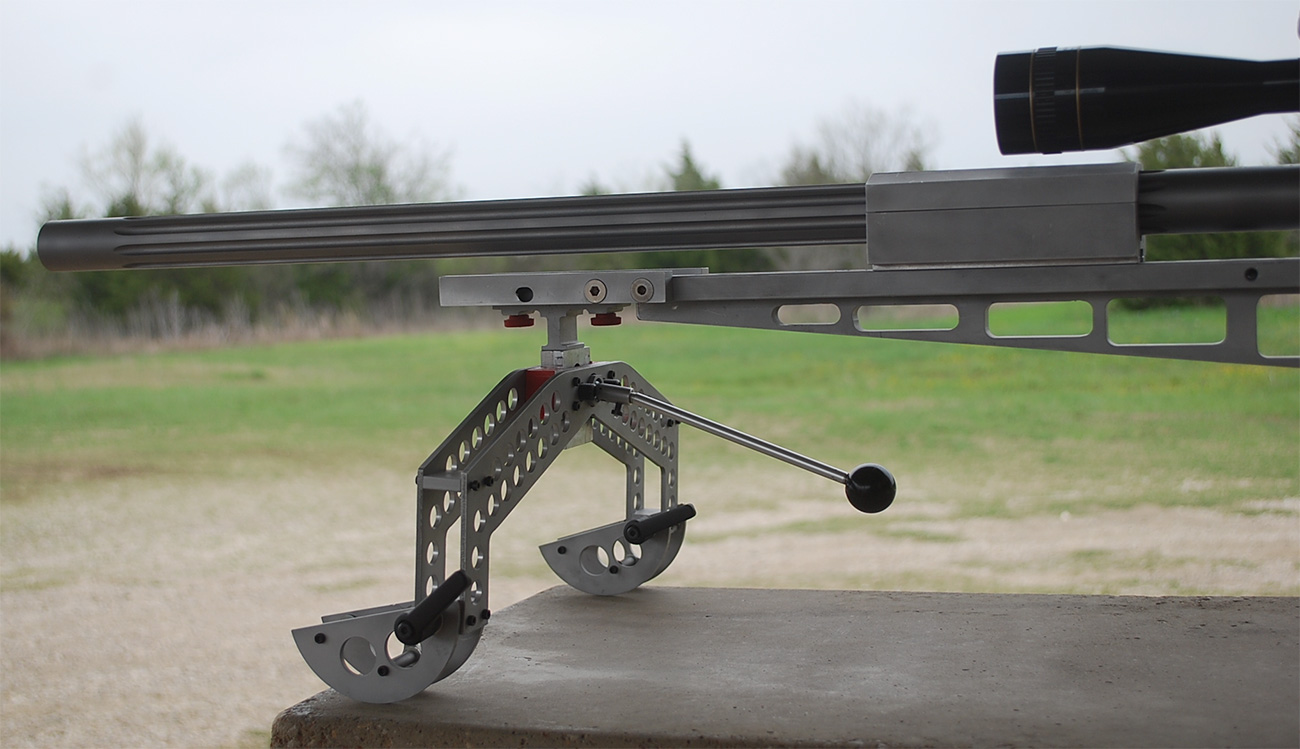
This is pretty much an all-aluminum rifle. The action is a Kelbly F-Class with a Shilen stainless steel competition trigger. The scope is a 1″-tube Leupold 36X with a Tucker Conversion set in Jewell spherical bearing rings. The .223 barrel is Pac-Nor 3-groove, 1:6.5″-twist mounted in a “V”-type barrel block. The bipod has vertical adjustment only via a dovetail slide activated by a stick handle. It works like a joy-stick, but for vertical only. I adjust for windage by moving the rear sandbag.
The 30″ barrel is 1.250″ in diameter. With the barrel block forward, the vibrations should be at a low frequency. Instead of one long rod whipping, I now have two short rods (barrel haves) being dampened. This is my fourth barrel block gun. They work, but so does a good pillar-bedded action. I just do stuff a little different.

The vertical “keel” down the bottom of the stock stops the “spring” of a flat-bar stock. There is little, if any, noticeable flex before or during recoil. The long length of the stock, the fat barrel, and the forward-mounted barrel block work together to keep the gun from rising off the ground. BUT, remember this is a .223 Rem rifle. A .308 Win version might act very differently. I may try a .308-barreled action soon, just to see what happens. But I will stick with the .223 Rem as my choice for match shooting.
 The offset scope idea came from a benchrest “rail” gun. In truth, the whole concept came from a rail gun — just adapted to being shot off a bipod. Sure it isn’t directly over the bore. It is about 1.5″ over to the left. So if you want the scope to be zeroed on the center of the target, you have to adjust for the offset. At 100 yards that is 1.5 MOA. But at 300 it is only 0.5 MOA, at 600 only a ¼-MOA, and at 1000 about 1 click on my scope. The offset scope idea came from a benchrest “rail” gun. In truth, the whole concept came from a rail gun — just adapted to being shot off a bipod. Sure it isn’t directly over the bore. It is about 1.5″ over to the left. So if you want the scope to be zeroed on the center of the target, you have to adjust for the offset. At 100 yards that is 1.5 MOA. But at 300 it is only 0.5 MOA, at 600 only a ¼-MOA, and at 1000 about 1 click on my scope.
What the offset DOES do for me is eliminate any cheek pressure. My cheek never touches the stock. Since this is only a .223 Rem, I don’t put and shoulder pressure behind it. And I don’t have a pistol grip to hang on to, but I do put my thumb behind the trigger guard and “pinch” the two-ounce trigger.
The offset scope placement could interfere with loading a dual-port action from the left. That’s not a problem for me as I set my spotting scope up on the left side very close to the rifle. I have plenty of time to reload from the right side while the target is in the pits being scored.
Again — this is my rifle. It is designed for my style of shooting. It is not meant to be a universal “fit all” for the general public. However, I will say the design is adaptable. I can easily convert the system to run in F-Open Class. I would drop a big-bore barreled action into the “V” block, slide on a heavier pre-zeroed scope and rings, add plates on the sides up front to bring the width to 3”, and maybe a recoil pad. It might be interesting to offset the wings up from to counter torque of the big bullets. But I would also have to offset the rear bag rider to get the gun to recoil straight back.
How the Gun Performs
I have had “T” to the range only twice for load development. It groups like my present barrel-blocked 223 F-TR gun. But it’s much easier to shoot and it only moves about 3/4” — straight back. I tried to build am omni-directional joy-stick bipod but I could not get all the side-to-side wiggle out of it. So I have set it up so it only moves up and down (horizontal movement is locked-out). As it works now, the joystick on the bipod lets me set elevation on the target quickly (with up/down adjustment). Then, to adjust for windage, I slide my rear bag side-to-side as needed. Once set, I just tickle the trigger and smile.
Gun Handling — Shoot It Like a Bench-Gun
I basically shoot the gun with no cheek or body contact. I don’t grip it, other than maybe a pinch on the trigger guard. The scope was offset to the left to help the shooter move off the gun and avoid the possibility of head/cheek contact with the stock.
Listen to Richard King Explain How He Shoots his ‘Texas-T’ Rifle:
[haiku url=”http://accurateshooter.net/Video/RichKingTalks.mp3″ Title=”Richard King Talks”]
CLICK PHOTOS to See Big Size
April 9th, 2013

This August the U.S. National and World F-Class Championships will be held in Raton, New Mexico. The U.S. F-Class Open Team has been working hard to prepare for the Worlds in Raton. This will be the fourth F-Class World Championship and first time it is being held in the USA. Team Captain Shiraz Balolia and his team-mates hope to successfully defend “home turf” this summer. The F-Class World Championships will run August 23 to 27, 2013. Preceding the World Championships, the U.S. F-Class National Championships will be held from August 18 to 22, 2013.
Team Members and Selection Process
 The US F-Class Open Rifle Team consists of the top F-Open shooters in the United States. Some members were on previous teams, but Team Captain Shiraz Balolia explains: “Our try-out process was very stringent and above board, which removed the notion of an ‘old boys club’ and allowed a lot of new blood to try out for the team”. The US F-Class Open Rifle Team consists of the top F-Open shooters in the United States. Some members were on previous teams, but Team Captain Shiraz Balolia explains: “Our try-out process was very stringent and above board, which removed the notion of an ‘old boys club’ and allowed a lot of new blood to try out for the team”.
The selection process was straightforward. Each participant had to have placed in the top 20 of a National Championship or in the top 3 of a regional championship to be able to try out. After that, they had to participate in at least three try-outs over a two-year period. There were about a dozen try-outs at various venues (Houston, Lodi, Raton, Phoenix, Sacramento) which allowed shooters from all over the country to participate. Shooting during all try-outs were conducted at 1000 yards.
The scoring system was based on “Vertical” Score where the goal of the shooter was to hold good vertical elevation with regards to the X-Ring. All try-outs were shot with coaches and the wind calls were the responsibility of the coach. The shooters were not penalized for wide shots if they were on the waterline. The targets had horizontal lines drawn on them and points were deducted for high and low shots.

The targets were photographed and published for the try-out participants to view so everyone knew exactly where they stood. Shiraz notes: “This actually worked really well to raise the overall standard of the team as it increased competitiveness among the shooters”.

From the initial group, the first cut was made to select the Development Team (DT). These DT shooters then continued further try-outs in 2012 with a similar process. The DT group was then culled to the final team members listed below.
| Captain: Shiraz Balolia; Head Coach: Bob Mead; Other Coaches: Trudie Fay, Rick Hunt, Emil Praslick |
Shooters (alpha sort)
1. Charles Ballard
2. Danny Biggs
3. David Gosnell
4. David Mann
5. Dean Morris
6. Don Nagel
7. Emil Kovan
8. Herb Edwards
9. Jim Murphy
|
10. John Dunbar
11. John Gaines
12. John Myers
13. Ken Dickerman
14. Kenny Adams
15. Larry Bartholome
16. Mark Walker
17. Rick Jensen
18. Robert Bock
19. Tony Robertson |
F-Class Insights: Q&A with Team Captain Shiraz Balolia
We did a Q&A session with Shiraz Balolia, F-Open Team Captain. Shiraz offered candid answers to “hot topic” questions of interest to F-Class shooters. He also observed that his team is working very, very hard in preparation for the World Championships. After being beaten by the Brits in 2009, Shiraz says: “We have a score to settle….”

Q: The F-Open Team has switched calibers. What was the thinking behind that move?
Shiraz: After we lost to the Brits in 2009, it became a foregone conclusion that we needed to shoot a 7mm cartridge. Charles Ballard and Jim Murphy were among the first guys in the USA to recognize the virtue of the 7 mm (.284) caliber. The choices we had within the .284 family were: straight .284 Win, .284 Shehane, 7 RSAUM, or 7 WSM variant. After much experimentation and thought we decided on the 7 RSAUM and 7 WSM family of casings which allowed us velocities of around 3000 FPS with a 180gr bullet. With the advent of new 180gr bullets from Berger and Sierra, we were able to get extremely flat-shooting groups (tight vertical) with the velocities that we needed.
Q: Foreign teams won the last two F-Class World Championships. How are you going to beat the Brits and South Africans in 2013?
Shiraz: In the previous World Championship (at Bisley in 2009), the Brits had a huge advantage. Almost all of their shooters lived within a few hours of the Bisley range. The coaches they used knew that range inside out and they were able to practice as a team many times on that range before the World Championships. Plus, they were ahead of us in terms of caliber selection and were shooting 7mm cartridges, as were the South Africans. By contrast, our team came from all over the USA and we had very little time together as a team. Things are different this time… yes, our shooters are still from all over the USA, but the amount of training we have done as a unit, a whole team, is much better than last time around. We have a lot of depth in our team. In other words, our worst shooter is not that far behind our best shooter. I do not believe that there has ever been a long range U.S. Team that has trained this hard and this many times as a unit. We are ready to take on the Brits or any other country!
 |
| Shiraz notes: “We did a lot of training on the range as well as in the ‘classroom’ setting with power point presentations. We had numerous sessions like these…. The behind-the-scenes work to deliver ‘same-day’ power-point results (just hours after the scores were shot) provides immediate feedback.” |
Q: How Does Successful Team Shooting Differ from Individual Shooting?
Shiraz: In individual matches, you are responsible for making all the wind calls, corrections on the scope and paying attention to all conditions before taking a shot. Sometimes the condition can change between the time you review the flags and the mirage, make an adjustment and take a shot.
In a team setting, the shooter is responsible for making a really good shot. He/she must be a really good trigger puller who has good equipment, good ammo, and who can follow directions. The coach makes all the calls, he often makes adjustments on your scope and all the shooter has to do is make the shot when asked by the coach. Shooters who second-guess a coach or think they can read the wind better than the coach did not make the team!
Q: Will Team USA Enjoy a ‘Home Court Advantage’ at Raton, NM?
Shiraz: Other than Trudie Fay, one of our coaches, we do not have any team members from the Raton area. We are a very large nation, in size, and our shooters come from all four corners and everywhere in between. Raton is not exactly “home court”, but we have trained there as a team several times. The Brits and the South Africans are no slouches either. The Brits spent a whole week in Raton last year in August to get a feel for the range, the temperature, the wind etc.; the Brits also tested loads for their team members. The South Africans came to shoot against us in September last year at the Stars and Stripes match and also shot at the US F-Class Nationals. The competition is certainly stiff and we can not let our guard down or be over-confident.
Q. Are there special skills and capabilities needed to be a successful team shooter?
Shiraz: To be a really good team member, the shoooter must have all these qualities:
1. He must be able to think in terms of what is best for the team rather than himself.
2. He must have really good equipment. That means a really good barrel, a smooth, trouble-free action, good optics, trigger, rest, etc.
3. He must have superior reloading skills, and be capable of producing really good ammo with bullets that perform consistently shot after shot.
4. He must possess the ability to take direction and put himself at the disposal of the coaches. What we look for in a shooter is consistency over a long period of time, not just a flash in the pan.
The shooters we have on our team have passed all the tests we have put them through and what we have today is, without a doubt, the best United States F-Open Team ever put together.
Support Need for Team Expenses
The U.S. F-Class Open Team may be about $3000.00 short on funds. Any donation will help. Please endorse checks to “US F-Class Open Rifle Team” and mail to P.O. Box 3110, Bellingham, WA 98227.
March 23rd, 2013
 Canadian Fred Harvey of Star Shooter Precision recently posted photos of an interesting metal-stocked F-TR rifle, fitted with a Star Shooter CF-SS Bipod with carbon-fiber legs. This handsome .308 Winchester rifle features a Barnard S action, 30″ Krieger barrel (1:11.25″ twist), and aluminum stock/chassis from Dolphin Gun Company in the UK. Canadian Fred Harvey of Star Shooter Precision recently posted photos of an interesting metal-stocked F-TR rifle, fitted with a Star Shooter CF-SS Bipod with carbon-fiber legs. This handsome .308 Winchester rifle features a Barnard S action, 30″ Krieger barrel (1:11.25″ twist), and aluminum stock/chassis from Dolphin Gun Company in the UK.
The all-up weight of this rig, including the Star Shooter bipod and mounting rail is 17 pounds, 15 ounces. (F-TR weight limit is 8.25 kgs, approx. 18.15 pounds). Gunsmith was Ian Robertson.


Dolphin Gun Company Aluminum F-TR/Tactical Rifle Stock
Dolphin’s modular, CNC-crafted F-TR/Tactical stocks are fully adjustable. Fore-ends are interchangeable and the pistol grip even adjusts for length of pull. Dolphin offers single shot and repeater inlets for Rem 700-style actions, Barnard S & SM actions, RPA Quadlite actions, plus BAT VR and Savage actions. Three types of fore-ends are available: short tactical style, long F-TR style, and a wide F-Open style. Repeater versions accept AI magazines. Dolphin claims the repeaters “feed faultlessly with any action fitted”. The aluminum Dolphin F-TR/Tactical stock comes with an adjustable buttplate fitted with Morgan Recoil pad. The bag-rider height also adjusts. These stocks sell for £630 (about $960 USD) with either Dura-coat or hard-anodized finish. A variety of anodizing colors are offered.

CLICK HERE for other Dolphin Rifle Company Stocks.
February 20th, 2013

New Nightforce 15-55x52mm Competition Scope — Field Report by Darrell Buell
A few weeks ago at SHOT Show, Nightforce Optics introduced a new Competition Scope. When Nightforce heard about the upcoming U.S. Team practice session in Phoenix, the optics-maker overnighted us two prototype Comp Scopes to wring out under match conditions.
From the start, we were impressed by these new 15-55X Competition Scopes. Darrell mounted one on his personal competition rifle, and the other on a mocked-up action, so people could hold it up safely in a steady fashion behind the firing line. The new scopes acted like magnets, drawing people from all over the Berger SW Long Range Nationals to check them out.
 The new Competition Scope is a 15-55x52mm. The new scope’s ED (extra-low dispersion) glass yields outstanding resolution. Remarkably, the resolution in the Competition scopes is even slightly better than the Nightforce 12-42x56mm NXS, with its larger 56mm objective lens. The color is definitely ‘crisper’ as well. Not surprisingly, the image quality is what most people noted first (see through-the-lens photo at right). The glass is great, and Nightforce included other thoughtful features as well. First is the side parallax adjustment that competitors have been wanting for years (this is one of the draws for the NXS scope in competition). The higher zoom range (with 55X power on tap), and the 60 MOA of vertical travel is also a much-asked-for (and useful) feature. The new Competition Scope is a 15-55x52mm. The new scope’s ED (extra-low dispersion) glass yields outstanding resolution. Remarkably, the resolution in the Competition scopes is even slightly better than the Nightforce 12-42x56mm NXS, with its larger 56mm objective lens. The color is definitely ‘crisper’ as well. Not surprisingly, the image quality is what most people noted first (see through-the-lens photo at right). The glass is great, and Nightforce included other thoughtful features as well. First is the side parallax adjustment that competitors have been wanting for years (this is one of the draws for the NXS scope in competition). The higher zoom range (with 55X power on tap), and the 60 MOA of vertical travel is also a much-asked-for (and useful) feature.
In competition, the high-quality glass in the new Comp Scopes proved very beneficial. The Berger SW LR Nationals took place in Phoenix, in February, so conditions ranged from cold and windy, to warmer with moderate mirage. In some of the heavier mirage conditions (not massive mirage, by any means, but enough that the magnification on a 12-42X NXS would probably have been turned down to 32-35 power), the Competition Nightforce stayed at 45 power and above. The turrets were the usual Nightforce precision, good defined, tactile adjustment clicks (5 MOA per revolution). The only improvement there would be to have the windage turrets adjust in ¼ MOA clicks (yielding 10 MOA per revolution), which Nightforce assures us that will be done for the Team scopes. [Current production 15-55X Competition Scopes have 1/8 MOA windage clicks.]
The Team’s response to the prototype scopes was overwhelmingly positive. Nightforce has generously agreed to provide 10 new Competition scopes for the USA F-Class Team competing in South Africa next month. The Bloemfontein Range will be an excellent test of the new 15-55X scope’s capabilities!


Visit to Nightforce Production Center in Idaho
The prototype scopes had to be returned to Nightforce, and as it wasn’t much of a detour, Team Captain Darrell Buell paid a visit to Nightforce’s Orofino, Idaho production facility. Nightforce rolled out the welcome mat, providing not only a highly detailed tour of the location, but also the opportunity to say a few words in front of a meeting of all of the day shift and evening shift staff. It was good fun for everyone, the staff seemed genuinely fascinated by what the Team was doing with their scopes all over the world, and Darrell was equally interested in the attention and quality that was invested by the staff there in each scope produced.
During the tour Nightforce provided a convincing demonstration of the rugged durability of NF optics. Each assembly station had a steel pillar fixture near the bench; the pillars were covered in a thin layer of rubber padding. As a scope was completed, the technician would grasp it by the ocular end, and strike the objective end (quite sharply) on the rubber-coated pillar three times. The scope would then be placed back on a optical test stand, and the image checked for shifting. This ‘strike test’ was then repeated three additional times (with associated checks), so that the top, bottom, left side, and right side were all tested and checked.
View Larger Map
February 11th, 2013

 The 2013 Berger Southwest Long Range Nationals (at Ben Avery in AZ) have wrapped up, and some divisional results have arrived. (Stay tuned for more complete results — as they are made available.) Congratulations to Grizzly Industrial President Shiraz Balolia, who won the F-Open Division. The 2013 Berger Southwest Long Range Nationals (at Ben Avery in AZ) have wrapped up, and some divisional results have arrived. (Stay tuned for more complete results — as they are made available.) Congratulations to Grizzly Industrial President Shiraz Balolia, who won the F-Open Division.
The F-Open competition was very close right down to the end, and the conditions were unforgiving. Shiraz finished with a 1226-55X score, one point ahead of F-Open runner-up Freddy Haltom (1225-60X), who had high X-count among Open-classers. We’re told that Shiraz was using a “shoulder-busting” .300 Win Short Mag in Phoenix. We’ve been promised photos of Balolia’s winning rig as soon as Shiraz gets back from Arizona.


The Top 10 F-Open shooters are listed in the chart above. Note, the 9th and 10th best Aggregate Scores were shot by two “Masters”, who out-shot dozens of “High Masters” to make the Top 10 overall. Steven Blair, who placed 8th Overall in F-Open, told us: “When conditions and competitors are as tough as they were in Phoenix, the winners deserve our accolades. It was no accident or luck that they finished as they did.” Forum member Kelbro agreed: “Except for the practice days, this was a challenging week. Double congrats to the top dogs. They earned it.”

In the F-TR division, John Hayhurst shot well throughout the Nationals to finish first with 1210-25X. Runner-up Lige Harris had 35 Xs, but ended six points down, finishing with 1204-35X. James Crofts, a past F-TR National Champion, finished third with 1203-24X. In F-TR Team Competition, the new Michigan F-TR team coached by Bryan Litz proved to be a powerhouse, securing an impressive team win. Shooters were: Al Barnhart (captain), Doug Boyer, Bill Litz (Bryan’s father), and Dale Sunderman. The second- and third-place teams were both USA F-TR Development squads. USA Team Blue grabbed second place, while USA Team Red took third. We’re told that USA Team blue set a new F-TR Palma record on Saturday. However, Team Michigan came back with a big win in Sunday’s 1000-yard team match, securing the Team Aggregate title.
In F-Open division, we’re told that Team UHaul finished first, with great shooting by Matt Davis, Herb Edwards, David Gosnell, and David Mann. Team Tex-Mex was second, with strong performances by Bryan Chatwell, Freddy Haltom, Ben Milam, and Cory Bizzel. Team Grizzly ended up third despite a cross-fire in one match. Team Grizzly is composed of F-Open winner Shiraz Bilolia, Emil Kovan, John Myers, and Tony Robertson.
February 8th, 2013
Report by Monte Milanuk
With the proliferation of wide bipods for competitive F-TR shooting, we’ve seen a lot of cool gear hitting the market. Whatever you can imagine, someone is either building now, or working on prototype plans. One new design that seems to have stayed under the radar thus far is the FLEX bipod by Dan Pohlabel.

The FLEX bipod’s designer, Dan Pohlabel, offers these instructions:
The bipod feet are shipped loose. Note there is a left foot and a right foot. Mount them as shown in the diagram above. Determine the balance point of your rifle and mount the bipod approximately two inches forward of that point. You may want to move it further forward after shooting. Experiment with its placement to minimize movement of the bipod. When setting up, first grab each foot and ‘dig’ them in to the shooting surface, dirt, gravel, grass, carpet — it doesn’t matter. After making sure each foot has a hold, raise or lower the bipod to your target and use the cant adjustment to level your rifle. Loading the bipod with your shoulder is the preferred method of position. Contact me with any FLEX bipod questions you may have: danielp123 [at] earthlink.net.
The FLEX bipod is a very simple design — no Mariner’s wheel for vertical adjustment, no joystick head, no changing width as it goes up and down. And the FLEX bipod is very light (as are most, these days), but also very durable. I haven’t actively tried to destructively test it, but so far it’s held up to being tossed in the back of the truck, hauled around to the range and everywhere else in between. It definitely has not been ‘babied’ in any way, and it’s not noticeably any worse for wear. An added bonus is that it breaks down very flat for airline travel. Once I take the feet off, remove the ratchet lever (with screw), the whole bipod nestles very nicely in the bottom layer of foam in my gun case (with cuts for the head etc. in the foam). I’m definitely not worried about it in there. If someone bashes the case hard enough to damage what is essentially a plate of spring steel, then I’ve got bigger worries.

This view (below) shows a bit of the adjustment controls. Each leg has independent control for height, and there is a ratcheting locking lever that controls the cant. Instead of being directly centered like most other designs I’ve seen, this one is off-set a little, allowing a fair amount of movement without allowing it to completely ‘flop’ over to one side. (By contrast, using other bipod designs, I’ve had guns literally flip over as they tipped over too far.) Also having the tilt control relatively close/tight to the bore of the gun helps with the stability as well.

Inventor Dan Pohlebel developed the FLEX bipod for use in his native Ohio, where apparently grassy firing lines are the norm. Here in the Pacific Northwest, I seem to encounter concrete or gravel more often, which is why I usually place a mat under the bipod to keep it from sinking in too far. On Dan’s newest models, the “feet” have teeth to give better traction on hard surfaces such as the hard-pack clay/dirt (beneath a skim layer of gravel) that you’ll find at Raton, NM.
Why would you want more traction? Well, not everyone wants a bipod that slides around like a hog on ice. Some people manage to get things tracking straight back and forth, almost like it was constrained by a front rest. Personally, I have a hard time doing that in a repeatable fashion. While the FLEX Bipod shoots quite well with a [loose] hold, it was designed for those of us who like to ‘lean’ into the gun a bit. Quite literally, the idea is that you get the feet to dig in slightly, and push against the rifle butt with your shoulder and the bipod will ‘flex’ or bow forward slightly. It is one of those things that sounds wonky until you try it. It may take a few times to get a feel for it, but once you do, it is surprisingly repeatable.

The system does have a few quirks to it. Personally, I wish the rail attachment had a ratchet lever like the pivot control. Currently you need a separate tool to take the bipod on/off the gun. Also, the FLEX bipod seems to work better mounted somewhat further back than other designs. Some experimenting may be necessary to find what works best. Then again, we all need more trigger time….
|