|
|
December 2nd, 2012
In our Shooters Forum, one newcomer wanted some advice on selecting a reticle for F-Class optics. He wondered about the advantage of Forward Focal Plane (FFP) vs. conventional scopes and also wondered if one type of reticle was better for “holding off” than others.
In responding to this question, Forum regular Monte Milanuk provided an excellent summary of aiming methods used in F-Class. For anyone shooting score targets, Monte’s post is worth reading:
Aiming Methods for F-Class Shooting — by Monte Milanuk
 F-Class is a known-distance event, with targets of known dimensions that have markings (rings) of known sizes. Any ‘holding off’ can be done using the target face itself. Most ‘benefits’ of forward focal plain (FFP) optics are null and void here — they work great on two-way ranges where ‘minute of man’ is the defining criteria — but how many FFP scopes do you know of in the 30-40X magnification range? Very, very few, because what people who buy high-magnification scopes want is something that allows them to hold finer on the target, and see more detail of the target, not something where the reticle covers the same amount of real estate and appears ‘coarser’ in view against the target, while getting almost too fine to see at lower powers.
Whether a person clicks or holds off is largely personal preference. Some people might decline to adjust their scope as long as they can hold off somewhere on the target. Some of that may stem from the unfortunate effect of scopes being mechanical objects which sometimes don’t work entirely as advertised (i.e. one or two clicks being more or less than anticipated). Me personally, if I get outside 1-1.5 MOA from center, I usually correct accordingly. I also shoot on a range where wind corrections are often in revolutions, not clicks or minutes, between shots.
Some shooters do a modified form of ‘chase the spotter’ — i.e. Take a swag at the wind, dial it on, aim center and shoot. Spotter comes up mid-ring 10 at 4 o’clock… so for the next shot aim mid-ring 10 at 10 o’clock and shoot. This should come up a center X (in theory). Adjust process as necessary to take into account for varying wind speeds and direction.

 Others use a plot sheet that is a scaled representation of the target face, complete with a grid overlaid on it that matches the increments of their optics — usually in MOA. Take your Swag at the wind, dial it on, hold center and shoot. Shot comes up a 10 o’clock ‘8’… plot the shot on the sheet, look at the grid and take your corrections from that and dial the scope accordingly. This process should put you in the center (or pretty close), assuming that you didn’t completely ignore the wind in the mean time. Once in the center, hold off and shoot and plot, and if you see a ‘group’ forming (say low right in the 10 ring) either continue to hold high and left or apply the needed corrections to bring your group into the x-ring.
Just holding is generally faster, and allows the shooter to shoot fast and (hopefully) stay ahead of the wind. Plotting is more methodical and may save your bacon if the wind completely changes on you… plotting provides a good reference for dialing back the other way while staying in the middle of the target. — YMMV, Monte
November 17th, 2012
 There are few master craftsmen who can create a truly “bespoke” wood stock customized for the owner. Ireland’s Enda Walsh is one such talent. Through Gun Stocks Ireland, Enda creates high-quality stocks for hunters, prone shooters, and F-class competitors. Enda first started building stocks in 2001 for himself and friends, and grew the business over a decade. Enda explains: “Demand gradually increased until in 2009 the decision was taken to make it my full-time occupation. In 2010 I obtained my RFD licence and haven’t looked back. My goal with Guns Stocks Ireland is to manufacture precise custom rifle stocks to the highest standard, tailored in every detail to best serve the shooters requirements.” Enda adds: “I started Gun Stocks Ireland to produce custom, individually-tailored gunstocks. I build from hand casts so your gun is genuinely an extension of your arm.”
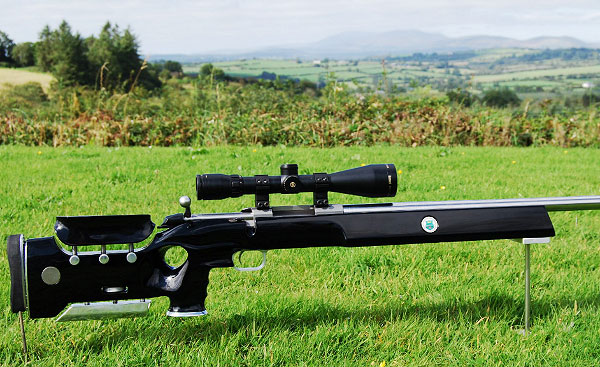


Walsh offers many stock designs, including a wide variety of thumb-hole and vertical grip stocks. Many of these feature hand-relieved grip areas customized for each guns’ owner. The hand-grip section literally fits the shooter “like a glove”. How does Enda create an ergonomically perfect grip for each customer? He actually makes a casting of the customer’s hand: “I send customers a hand cast kit so the shooter can make a plaster cast with his hand in shooting position. Done correctly there will be no tension in the shooter’s hand no matter how tight a hold is employed.” Enda’s stocks aren’t cheap, but they are a good value considering the amount of expert labor involved. Typical price for a fitted, bedded, and finished fully-adjustable F-Class stock is 1500 Euros.
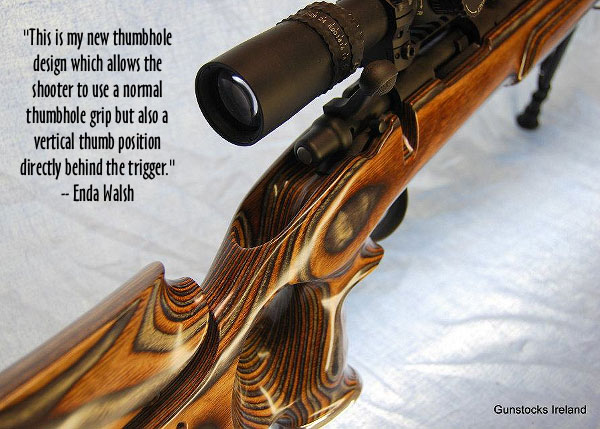

Enda’s stocks, as you can see from the photos, are labors of love. Each stock may require up to 80 hours of work from start to finish. That includes fitting of special features, such as adjustable buttplate, adjustable cheek-piece, and a unique bag-rider that adjusts up and down for elevation control and rifle balance. We think the adjustable bag-rider is a great idea that American stock-makers should emulate.

Vertically Adjustable Bag Rider Permits Easy Elevation Adjustment
“For F-Open shooters the benefit of the [adjustable] bag runner is it allows precise elevation adjustments shot to shot without having to reach forward to adjust the front rest, taking the shooter out of his natural position. For ‘bag squeezers’ it eliminates the variable settlement during a shot causing vertical variances. The adjustable bag runner allows elevation changes to be dialed in easily and precisely with one hand.” — Enda Walsh


This is a .308 Win Savage in a fully adjustable F-TR stock. This rifle always performs well at the LRRAI shoots in Castlemaine Rifle & Pistol Range.
 Enda Walsh Shoots What He Builds
Enda Walsh is a very talented shooter as well as a master stock-maker. He recently won a Silver Medal at 1000 yards at the 2012 European F-Class Championships at Bisley. He also shared a team Gold Medal at 1000 yards, shooting with an Irish F-TR team, and making wind calls as well.
Enda says: “I was very happy to take a silver at Bisley this year. This was my first trip to Bisley and first Euro Championships. The experience gave me some ideas on how to improve things for next year….”
Gun Stocks Ireland
Contact: Enda Walsh
Currabaha – Dungarvan
County Waterford
Ireland
E-mail: info [at] gunstocksireland.com
Phone in Ireland: 011-353-[0]87-661-1993

November 4th, 2012
Wow. If James Bond shot F-TR, we think this is what he might use. You’re looking at the radical new Steve Jennings stock for F-TR competition. This skeletonized stock is crafted to fit the Barnard action. As you can see, there is no conventional fore-arm. Instead a carbon fiber tube extends forward of the action. At the front end of the tube, a fixture hold the beefy, forward-angled, girder-style bipod legs. These legs adjust to two heights, for prone or bench shooting. Large Delrin cylinders at the bottom of the legs provide stability and help resist bipod hop. Cost of the Jennings stock, including bipod legs and bag-rider assembly, is $700.00 at Chesebro Rifles.


The rear bag-rider, which adjusts for height, is also carried by a carbon-fiber tube that runs from the bottom of the pistol grip back to the buttplate. The bag-rider is attached via an eccentric fixture. This way, as you spin it in and out, the vertical position changes. This allows you to get the elevation centered -up on the target, but this system is not designed for fast changes “on the fly”. Small changes in elevation are made by squeezing the bag.

 Mark Chesebro also offers a complete rifle built around the new Jennings stock. Built with a Barnard Action, Trueflite (NZ) barrel, and Barnard trigger, a complete Jennings F-TR rifle costs $2500.00. For more information on the Steve Jennings F-TR stock, or complete rifles built with this stock, visit ChesebroRifles.com or call (805) 280-5311. We hope to get our hands on one of these rigs for testing very soon!
EDITOR’s COMMENT: Now it would be great if Seb Lambang’s joystick bipod head could somehow be adapted to this rig, with the joystick running under the carbon fiber “fore-end”, but still using the forward-angled Jennings girder-style legs and oversize “Coke-Can” bipod feet. That could definitely be a James Bond-worthy F-TR rig.
Product Tip by EdLongrange. We welcome reader submissions.
November 2nd, 2012
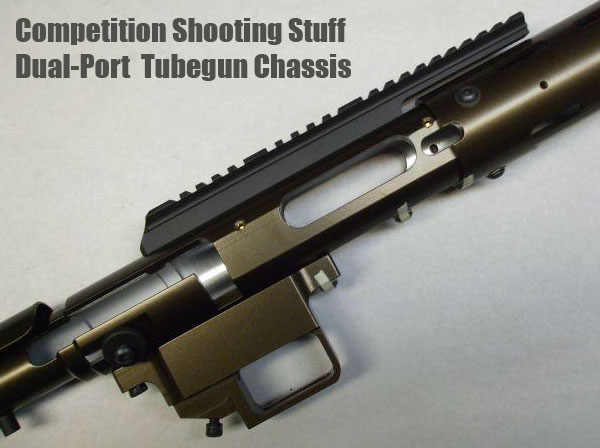
Gary Eliseo’s Tubegun chassis kits, long favored by High Power and prone sling-shooters, are now being used in increasing numbers by F-Class shooters, particularly F-TR competitors shooting from bipod. Here’s good news for the F-TR crew. Gary Eliseo has announced that his B1 and R1 Competition Shooting Stuff (CSS) Chassis kits will now be available with DUAL PORTS, by special order. This allows a right-handed F-TR shooter to load with left hand, with the fired case ejecting on the right. For more information visit www.GotXRing.com or call Gary at (714) 630-5734.
November 1st, 2012
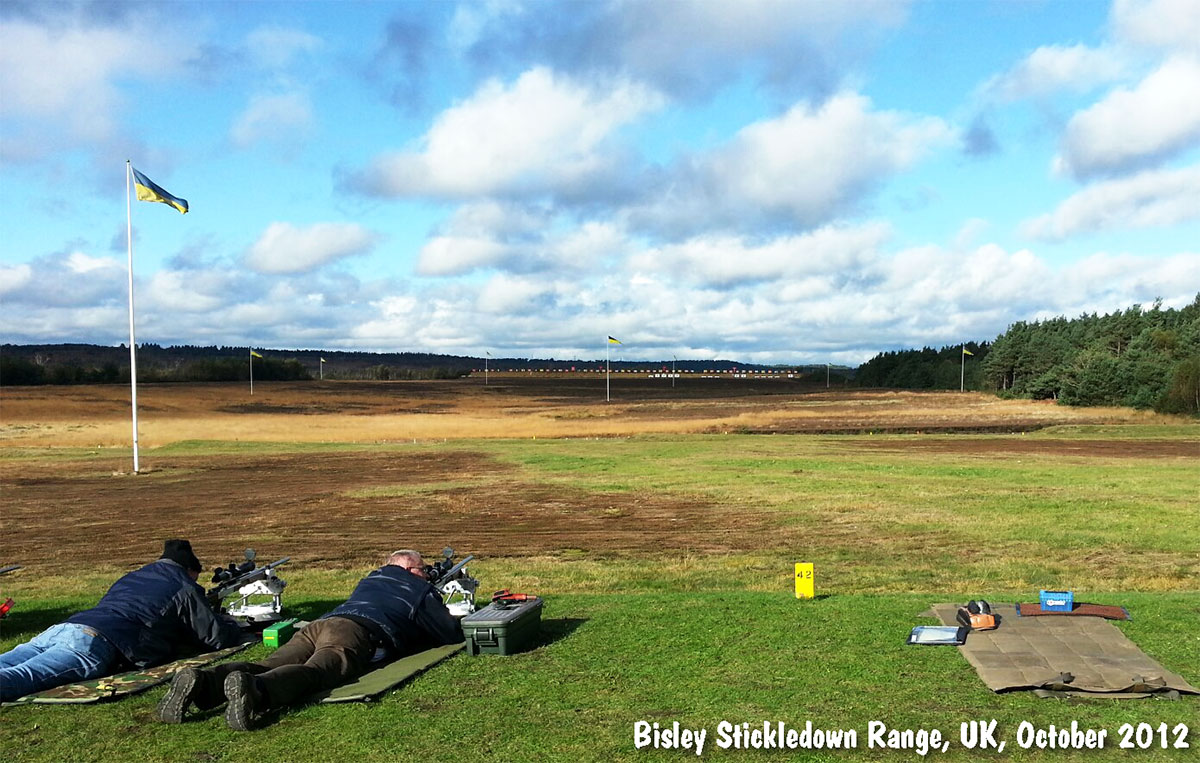
The European F-Class Championship (and British Championship) kick off this weekend (November 2-4) at the legendary Bisley Range in the UK. With 185 entrants, this event should be the largest F-Class competition of the year outside of North America. The Championship matches commence tomorrow, but competitors have already arrived at Bisley and they are getting their F-Class rifles warmed up during practice sessions. Here are some photos from the F-TR Ireland Facebook Page.
F-TR Ireland reports: “Here are photos taken during today’s Practice Day at Bisley on Stickledown Range at 800, 900, and 1000 yards. [We had] a great day’s shooting and excellent camaraderie amongst the team-mates.” The bottom photo shows the 900-yard Firing Line during Practice Day.


Explore Bisley with Google Satellite Image Map
View Larger Map
October 27th, 2012
Last month, the Montana Rifle and Pistol Association (MRPA) hosted the 3rd Annual Northern Rockies Long Range and F-Class Regional at the Deep Creek Range near Missoula, Montana. The match was a sell-out for the third straight year, and three competitors set pending NRA Long Range and F-Class National Records. If the pending records are recognized by the NRA, that will make a total of eight (8) NRA National records set at Deep Creek over the last three years.

This year, the forest fires and resultant smoke conditions in the Intermountain West cast a ominous haze over the event. However, the haze did not prevent outstanding performances by many shooters in both F-class and sling divisions.

All National Guard Shooter, SSG John Coggshall
SSG Coggshall is a member of the Connecticut Army National Guard’s 1-102 Infantry battalion and a member of the All National Guard marksmanship unit. Coggshall used an Eliseo Tubegun set up as a Palma rifle and used factory-loaded ammunition. Coggshall shot great, finishing with a 1091-59X out of a possible 1100 points. This should be a new national record for the Long Range Regional Aggregate in the Service Category. The previous record was set in Missoula by Allen Spiker, former member of the All National Guard team. While Coggshall is new to the Palma game, he has a lot of experience shooting smallbore as well as service rifle. He has been on a winning Whistler Boy team, and has been the High Junior during the President’s 100 at Camp Perry. His Team Coach described him as a hard-holder who can hold half the X-Ring with his iron-sighted Palma rifle.
 Ken Nelson
 also had a record setting performance. Nelson fired a very impressive 1096-71X, as he dropped only four points to smash previous national record in the Senior Category. With this score he not only established a new NRA national record, he squeezed out the tournament win over second place finisher Allen Spiker. Both shooters fired 1096s, but Nelson surpassed Spiker by X-count. Nelson reported that he received some advice from his friend, German Salazar, before the match, and Nelson took that advice to heart. He noted that his thought process between shots really helped him on the line. Nelson splits his time between his native British Columbia and Phoenix, AZ where he shoots at Ben Avery. Nelson only began shooting long range four years ago, after many seasons as a smallbore shooter.
 LTC Donald Erpenbach – Montana ARNG
LTC Erpenbach set two pending F-TR records at the match. Erpenbach shot exceedingly well on day one of the tournament. In the first day’s Palma course Erpenbach shot a 442-14X besting the previous record held by USAMU shooter Sherri Gallagher. Erpenbach was on a roll and in the separate 1000-yard match he fired a 194-7X, edging ahead of the previous record. Erpenbach really put things together well for this match.
SGT Micheal Palagi – Montana ARNG
SGT Palagi received the MRPA’s new “Top M-24” shooter award. This award recognizes Montana Soldiers who shoot an issued sniper rifle with issued M118LR ammo. Palagi’s recent performance was outstanding and he is deserving recipient of the first Top M-24 award.
|
Deep Creek Range
The Deep Creek Range in Missoula, MT is one of the nicest places to shoot in the Intermountain West region. The range is located in the mountains within a few minutes drive of Missoula, and there is camping on-site. When conditions are good at Deep Creek, records get broken. The MRPA host 3 weekends of shooting there every year. To learn more about shooting at Deep Creek, contact Jamey Williams at jameydan[at]gmail.com. |
The MRPA wishes to thank the 2012 Northern Rockies Sponsors:
Barnes Bullets
Berger Bullets
Sierra Bullets
BAT Actions
Bruno’s Shooter Supply
Carl Boettger Scope Mounts
Creedmoor Sports
Competition Machine – Gary Eliseo
USTacticalSupply.com |
October 19th, 2012
 Sebastian (Seb) Lambang of SEB Coaxial, a brilliant designer and fabricator, has created an ingenious joystick bipod. The first coaxial bipod we’ve ever seen, Seb’s new bipod is a superb example of creative design and smart engineering. This unit gives F-TR and other bipod shooters precise, one-handed control of both windage and elevation. Seb’s innovative joystick bipod is yet one more example of the innovative, advanced engineering we’ve come to expect from his company. We think this guy could be building Formula 1 cars if he set his mind to it. We are fortunate that Seb loves shooting, so he applies his talent to designing and building great new products for the shooting sports.
Seb tells us: “I just finished a prototype joystick bipod, i.e. a bipod with joystick (coaxial) elevation and windage control. This patent-pending bipod is my newest project/invention. As far as I know, there is no one that makes this type of bipod… so it’s probably the only one in the world.” We already know some shooters who want to order Seb’s joystick bipod, but Seb cautions: “It’s not for sale yet. It’s still in prototype step. There is always a rough draft before the masterpiece.”

Seb will test and refine the design in the next couple of months before production starts. But Seb is quite satisfied with the design so far: “The rigidity, ease and comfort of use, and compactness, are already OK in my opinion.” Folks in Europe will be able to see the design very soon. The first real-world test of Seb’s new joystick bipod will be at the European F-Class Championship, slated for November 2-3 in the UK. Seb notes: “I won’t be shooting F-TR in the match, but I will ask some fellow F-TR shooters at the Bisley range to test it, and provide feedback.” Seb invites Daily Bulletin readers to look at the photos and provide comments or suggestions on design enhancements.
Technical Description
 At the lowest setting with the adjustable legs, the SEB bipod is approximately 6″ tall. At the highest setting, the unit is about 9″ tall. To smooth upward movement of the rifle, Seb designed the coaxial head with “built-in uplift”. The joystick itself is about 10″ long, with a collet-type head. When folded, the new SEB Bipod is relatively compact, about 9″ long x 5″ wide x 2″ thick. Most parts are made from aircraft grade 7000 series aluminum. The current weight of the prototype is 26 ounces (740 grams). Seb is working on reducing weight for the production models.
Joystick Function and Adjustment Range
As with SEB Coaxial front rests, the joystick function is user-selectable. The joystick handle can operate either ‘up for up’ or ‘up for down’, simply by reversing the unit and the joystick. The bipod’s effective windage and elevation range* is approximately 38 MOA horizontal (windage) and 16 MOA vertical (elevation). Seb explains: “That’s not as much as my other rests, but for F-Class use it should be adequate. The finer the adjustment, the better on the target and the smoother the joystick operation. It’s like using a scope with 1/8 MOA adjustment rather than 1/4 MOA.”
*True vertical travel is about 32 MOA but in the field the rifle stock will limit how far you can lift the joysticK. Note also that the adjustment range varies with your set-up geometry. The shorter the distance between the rear bag and the bipod, the greater the travel in MOA. This means that if you extend the distance between rear bag and bipod, you will lose some MOA travel.
September 28th, 2012
Adding to its undefeated resume, Team Sinclair Int’l racked up an unprecedented fifth Team F-TR National Championship at Raton, New Mexico, last week. The team, consisting of firing members, Paul Phillips, Brad Sauve, Jeff Rorer, Derek Rodgers (Captain) and wind coach, Ray Gross, prevailed over 12 other teams representing the best F-TR shooters from the USA, South Africa, Australia, and Canada.

Boasting the highest attendance of any F-Class Nationals, the 2012 competition was made up of dual 1,000-yard matches, with 800 possible points per match. Team Sinclair scored 1561-48X to win the F-TR championship, finishing ahead of second-place North State X-Men (1542-39X) and third-place Team Savage (1541-47X). Team Sinclair’s Day 1 score of 790-31X topped all other F-TR teams and set a new (pending) U.S. F-TR National record for 1,000-yard F-Class competition.
“We’re grateful for Sinclair International’s support,” said the team in a joint statement. “All of us use Sinclair’s precision shooting components and reloading supplies when preparing for these events. We need products of the highest quality and consistency for us to succeed. We’ve never been defeated, and that’s a testament to Sinclair International.”
CLICK HERE for Complete 2012 F-Class Nationals TEAM RESULTS.
Sinclair’s F-TR Team has been competing since 2007. The newest member, Jeff Rorer, joined the team in 2009. Team Sinclair Int’l remains undefeated in F-TR National Championships. Here’s an interesting factoid about the Team Sinclair shooters. One or more members of the current Sinclair squad have been on the winning F-TR team at every U.S. F-Class National Championships since they were first held in 2004, except for 2010 when Sinclair did not field a team. Brad Sauve has been on the winning F-TR team every year except 2010: Great Lakes Express (2004, 2005 winning team); Team Green (2006 winner); Team Sinclair (2007, 2008, 2009, 2011 winner). Ray Gross and Paul Phillips were also on most of those winning squads.
September 22nd, 2012
The 2012 F-Class Nationals have concluded and the event was a great success. Nearly 200 shooters competed at Raton this year.
Congrats to the new F-Class National Champions: David Bailey (F-Open) and James Crofts (F-TR). Bailey amassed a 1283-59X score to edge F-Open runner-up Bob Sebold (1282-59X) by a single point. Note that Jim and Bob, both AccurateShooter Forum members, had the same X-count. Bob’s excellent X-count placed him ahead of Jim Murphy (1282-50X), who captured third place along with F-Open High Senior Title. High Lady Shooter was Michelle Gallagher with a 1274-51, while Danny Biggs, a past National Champion, was High Senior with 1273-46X.
Forum member James (‘Jim’) Crofts took the F-TR crown with a truly dominating performance. Jim’s 1272-47X was a full six points and 11 Xs ahead of runner-up (and 2011 champ) Jeff Rorer, who finished with 1266-36X. In third-place overall, was High Senior Daniel Pohlable (1264-42X). In fourth overall, was the High Lady shooter Trudie Fay (1259-45X).

Jim Crofts really deserves praise for his marksmanship at Raton. Jim’s F-TR Score of 1272-47X would have ranked him 13th in the F-Open division, ahead of dozens of skilled shooters running ballistically-superior cartridges. In his .308 Win, Jim ran Berger 200gr Match Hybrids at 2600 fps with Hodgdon Varget. Jim’s winning F-TR rifle featured a 30″ Brux barrel and Precision Rifle & Tool (PR&T) stock. And take note — Jim’s barrel had over 3000 rounds though it by the end of the match. Jim wants to thank Ray Bowman at PR&T for smithing a great rifle and providing sponsorship.
CLICK HERE for Complete F-Class Nationals Results with Match by Match Scores
 Interview with Jim Crofts
We had a chance to talk to Jim by telephone this morning, and he was kind enough to answer a few questions for us….
AccurateShooter: Is this your first big win? How did you feel receiving the trophy as National F-TR Champion?
Jim: I won the Berger SW Nationals earlier this year, but this is my first-ever National Championship. I was very relieved once it was over because there were many great shooters right behind me.
AccurateShooter: Did you run any new hardware at the Nationals? Did you alter your load any?
Jim: This is the same combination that I’ve used all year long. I went back to my old faithful PR&T-built rifle and my old faithful load and everything works. I still anneal my cases every firing. You will find this helps maintain consistent bullet seating and it helps lower your extreme spread.
AccurateShooter: Shooters from your neck of the woods have now won the F-TR division two years running — Whats the secret?
Yes, with my win we’ve had back to back F-TR National championships for North State X-Men club members. Jeff Rorer, last year’s F-TR champ [and 2012 runner-up] shoots with us at a local level. That’s who I’ve been chasing since last year’s National Championship. When you shoot against quality competition every week, it makes you strive for perfection.
AccurateShooter: How were conditions during the week? Raton can be windy…
Jim: Actually, conditions were moderate most of the week. However, on the last day, it was calm during the first match, but in the second match it got to be very tricky. There were changes in velocity and angles — I had a hard time keeping up with the velocity changes in the last match.
AccurateShooter: How has the FTR game changed in the last couple years? Is it more competitive than ever before?
Jim: The sport is growing and it’s getting tougher, that’s for sure. This year we had 91 competitors in F-TR. It went up from about 60 last year to 91 this year — a 50% increase. And the competition is really getting tight in F-TR. Not only are the numbers of shooters growing, but the quality of the competition is getting higher every year.
Also at the F-Class Nationals this year, some Eliseo Tubeguns made an appearance. Shown below are Linda Shehan (Team Australia) and Warren Dean (Team USA) with their GC-1 FTR rigs at the nationals. These tubeguns feature actions by Rod Shehan, with an Adam Davies bipod on the left, and Sinclair F-Class bipod on the right.

September 19th, 2012
Congrats to the U.S.A. F-Class Team which triumphed in the 2012 Stars & Stripes Challenge Match held September 16 at Raton, New Mexico. The showcase event in the Stars & Stripes Match is a team competition with 8-man national teams. Team USA finished first with a 3443-107X combined score. In second place was the South Africa Protea Team with 3428-88X. Team Australia came in thirds with 3398-81X, and Team Canada scored 3364-63X to secure fourth place. In the photo below, Team USA members celebrate their victory. Shown (left to right) are: Charles Ballard, Larry Taite, Laura Perry, John Weil, Trudie Fay, Shiraz Balolia (Captain), Bob Mead, Rick Hunt, Jeff Rorer, Darrell Buell, Jim Murphy and Larry Bartholome.


 |
 |
Along with the signature National Team Event, the Stars & Stripes event featured 4-person team matches for both F-Open and F-TR divisions. Winner of the F-Open 4-person event, with a 1757-65X score, was Team Long Shots, captained by Mark Walker and coached by Michelle Gallagher. Team shooters were: David Baily, David Gosnell, Ken Dickerman, and Mark Walker. Finishing first in the 4-person F-TR team event was Team Misfits, coached and captained by Lige Harris. Lige also shot on the team, along with Leslie Jones, Tom Jones, and John Kills. Team Misfits scored 1710-34X to secure a 16-point victory over F-TR runner-up U.S. Development Team #4.
CLICK HERE for Complete Stars & Stripes Challenge Match Results.
|