Emil Kovan is one of the top F-Class shooters in the world. He won the 2014 United States F-Open Championship, and finished second in F-Open Division at the 2016 Canadian National F-Class Championship in Ontario. He is a great shooter and a great gun-builder as well.
“What are the best components for an F-Open class rifle, and why?” That’s a question that I get asked all the time and will try to answer in this article. Two months ago, I was contacted by Duane, a gentleman I met at the 2015 F-Class Nationals. He was interested in building a rifle with the new Master Class Low Profile F-Open Stock, created by Carl Bernosky and Alex Sitman of Master Class Stocks.
I have known Alex Sitman for many years, and use his stocks exclusively, but was not very familiar with his new Low Profile F-Open stock. After a brief conversation with Alex, I placed an order, and had the stock inletted and bedded at my shop in a month. My first impression was “Wow that’s a long stock” — the forearm is significantly longer than on the original Master Class F-Class prone stock. I bolted the barreled action in, and squeezed the end of the forearm and barrel together, the stock flexed a little bit, but not as much as other designs that I have tested. I think that’s due to having “more meat” in the receiver area. The full stock depth continues farther forward that on some other “low profile” designs. That makes the stock stiffer in the vertical plane, reducing the hinging effect forward of the action. The stock was finished in gloss black per the customer’s request. Interestingly, I found that the multiple layers of paint and clearcoat stiffened the stock up quite a bit.
CLICK IMAGE below for full-screen version
Low Center of Gravity Tames Torque
Compared to the original Master Class F-Open stock, the barrel sits about an inch lower. Lower center of gravity equals less torque, and that is very important when shooting heavy bullets in fast twist barrels. Another significant improvement is that the toe of the stock is flat and parallel to the forearm. I added a 3/4″ track rail in the rear, and milled the underside of the fore-end to create two parallel “rails” in the front to help the stock track better.
One of the biggest reasons why I like Master Class stocks, is the pistol grip. I don’t shoot “free recoil” and a comfortable pistol grip is super important to me when selecting a stock. The new Master Class Low Profile stock shares the same grip as the old model. This allows the stock to accommodate either a “hard hold” style or a more free-recoil style of shooting — whatever the rifle’s owner prefers. This design versatility is one reason I recommend Master Class stocks. Shooters may experiment with either shooting style to find what suits them best.
Cartridge Choice — A 40° .284 Win Improved
Duane decided to have the barrel chambered for my 284 KMR IMP (Improved) wildcat. What is .284 KMR IMP and why choose it over the straight .284 Winchester? Improved by definition means “made better”, I took a great cartridge, and modified it to increase capacity, reduce pressure, and increase brass life.
There are many “improved” variants of the original .284 Winchester: 7mm Walker, .284 Shehane, .284 Ackley and so on. My version, the 284 KMR IMP, shares the .010″ blown-out sidewalls of the .284 Shehane, but I have further increased the case capacity by changing the shoulder angle from 35 to 40 degrees. The 284 KMR IMP allows you to almost match magnum cartridge velocity in a standard-bolt-face action. If you want to run 180gr-class 7mm bullets over 2900 FPS, it is cheaper and more convenient to have a barrel chambered in 284 KMR IMP than to spend $650 for a magnum bolt.
Tuning Loads for the .284 Win Improved Cartridges
The 284 KMR IMP seems to have two nodes, one around 2820 fps and other at 2940 fps. My match load clocks at 2935 fps with single-digit ES. Note –I selected that load based on accuracy, NOT raw speed. A lot of novice (or hard-headed) shooters make the mistake to push their cartridges to the max, and disregard more accurate loads at lower velocity.
The sport of F-Class is rapidly growing, and the equipment used is improving constantly. I remember that only few years ago, an F-Open rifle that could shoot sub-one-inch of vertical at 300 yards was considered competitive. Now, we are pursuing sub-one-inch vertical at 600 yards! It takes a great rifle to approach that goal, but it is also up to the shooter to learn and experiment as much as possible in order to achieve success.
Dies for an Improved .284 Win Cartridge
One of the biggest challenges in campaigning a wildcat cartridge has been obtaining great dies. When searching for custom dies, it almost seems like that the odds are stacked against us. The most common problem is wait-time — custom die orders can take months to be completed. Also, most custom die makers want you to send them two or three cases, each fire-formed three times. I find that funny because if could somehow properly size the cases for three fire-forming cycles, I would not need a sizing die.
Custom-made dies should size the case just right, but sometimes the die’s internal dimensions are slightly off, and this leads to problem number two: dies sizing too much (or even worse) too little. I had a one “custom” die that would not size the bottom of the case enough. This made the extraction of fired cases very difficult. I feel that the best option (if available) for shooters interested in wildcat chambers is to have their gunsmiths make the dies. I offer that die-making service in addition to barrel chambering.
BAT Machine “M” Action
Duane decided to use a BAT M action for this rifle, and I think that he could not have made a better choice. We are blessed with many good match-quality receivers: Barnard, BAT, Borden, Kelbly, Nesika, and Stiller just to mention a few. These are all very well-made and suitable for F-Class. Among BAT Machine Co.actions, I like BAT models M, MB, and 3LL best. I prefer these because because of their size (large bedding footprint) smoothness, timing, options available, and last but not least visual appearance.
Trigger: I recommend and use Jewell triggers. Other good options are: Kelbly, CG Jackson (good 2-Stage) Anschutz (best 2-Stage for Bat and Kelbly actions), Bix’N Andy, and David Tubb.
Barrel: Duane made another good choice here. He decided to go with a Brux 1:8.5″-twist, 4-groove cut-rifled barrel. If you look at the F-Class and Long Range benchrest equipment lists, you will see that cut-rifled barrels are currently dominating. Many records have been shot with both button-rifled, and cut-rifled barrels. I have shot both, and prefer cut-rifled barrels. I am not saying that button-rifled barrels are not capable of shooting as well as cut-rifled barrels, but on average, in my experience, four out of five cut-rifled barrels (from top makers) will shoot well, vs. three out of five buttoned barrels. YMMV, but this is what I’ve observed.
Scope: Duane’s rifle was fitted with a Nightforce 15-55x52mm Competition scope with DDR-2 reticle. This optic is ultra clear, reasonably lightweight (28 oz.), super reliable, and has 1/8 MOA clicks — what you want for long range F-Class competition. In this 15-55X NF model, I like the DDR-2 reticle best, because fine cross hairs (FCH) are hard to see in heavy mirage. The DDR-2 has a heavier horizontal line, with a center dot. March scopes are also very popular and very well-made.
Thanks for reading, and keep ‘em in the middle…
Emil Kovan Competition History:
– 2014 F-Class Open National Champion
– 2016 F-Class Open Canadian Championship, Silver Medal (tied for first on score)
– 2015 F-Class Open National Championship, Silver Medal
– F-Class Open National Championship Teams, 2015, 2014, 2013, Shooting Team Member
– Over 15 wins in Regional and State Championships in Palma, F-TR, F-Open
There are hundreds of cartridge types capable of winning in F-Open. For F-TR you can shoot either the .223 Rem or .308 Win, but you have many load options. This article will focus on proven choices, currently used by the top F-Class shooters in the world. Our discussion will analyze cartridge selection based on the four different F-Class sub-disciplines: Open Mid-Range, Open Long-Range, F-TR Mid-Range, and F-TR Long Range.
Click image to view full-screen photo.
Mid-Range F-Open Cartridges
For starters, a .300 WSM is certainly capable of winning mid-range matches but it is not ideal. So what is ideal, and why? F-Class Mid-Range matches usually are usually shot at 300, 500, or 600 yards — or all three. At those distances the 6mm and 6.5mm cartridges rule. In moderate conditions, the 6mm Dasher is unbeatable. Its low recoil along with its super grouping ability and good ballistics make it my number one choice for Mid-Range.
Best bullets for the 6mm Dasher are: Vapor Trail 103gr, Berger 105 Hybrid, 108 BT, and 105 VLD (hunting). Best powders are: Varget, H4895, and Reloder 15.
Choices for Mid-Range in Tougher Conditions:
We all know that conditions are not always “moderate” that’s why something a little bit bigger will save you a “Nine” or two. The 6.5X47 Lapua was designed for 300-meter competition, but as soon as it was released, it was adopted by F-Class, benchrest, and tactical shooters. It offers great ballistics with very low recoil and big “accuracy window”. Lapua makes great brass for it (no surprise there) and Berger makes great bullets: 130gr VLD, 140gr VLD, 140gr Hybrids. Best powders in most barrels are Varget and H4350, I don’t use double-based powders such as Reloder 17 and the Vihtavuori N500 series because of their unpredictable performance day to day (greater temp sensitivity).
The 6.5X47 Lapua necked down to 6mm is also a great option for mid range matches. I was able to easily get 3200 fps with 105 hybrids and H4350.
Choice for Long-Range F-Open Competition
In Long-Range F-Open Class (out to 1000 yards), the big, high-BC bullets rule. If I had to pick one cartridge for F-Class (both mid- and long-range) I would pick the .284 Winchester or one of its variants. The .284 Win is currently dominating in F-Open competition. It offers great barrel life, it is super-easy to tune and its recoil is very manageable. The best bullets for it by far (in my opinion), are the Berger 180 Hybrids. But Sierra’s new 183gr MK bullet (with factory-uniformed meplats) seems to perform very well as does the Berger 180 VLD. Best powders for the .284 Win are H4350 and H4831SC.
Long-Range Only F-Open Cartridge
As much as I like the .284 Win, for long-range competitions I like the .300 WSM even more. If you look at a .300 WSM and a 6mm Dasher side by side, they appear almost identical in geometry — the .300 WSM looks like an “super-sized” Dasher. Both cartridges are currently the “darlings” of long-range benchrest due to their extraordinary grouping ability and huge “node’’ windows. Big accuracy windows allow loads to perform well in different conditions and geographical locations. That’s obviously very important if you travel to compete. The .300 WSM loaded with Berger 215gr or 230gr Hybrids is very tough to beat at long range, and it is currently my number one choice.
The 7mm RSAUM is another outstanding long-range round. It resembles a 6BR on steroids and it is almost as easy to tune. Best bullets for it are Berger 180gr Hybrids, 195gr EOLs, and Sierra’s 183gr MatchKing. Best powders for the 7mm RSAUM are: H4350, H4831SC, and VV N160.
Top Caliber/Bullet Combos for F-TR
In F-TR competition, the choice is clear — a .308 Win throated for Berger 185gr BTLRs and 200gr Hybrids will win in mid-range AND long-range comps. Many championships have been won, and many records set with those two bullets in the .308 Win. To quote Danny Biggs (a two times FTR National Champion) “The 185 BTLR is the best bullet for .308 Win ever made”.
The Berger 215gr Hybrids have been used to win many competitions including recently the 2015 F-Class Nationals. Bryan Litz won both the Mid-Range and Long-Range 2015 Championships using 215s. Bryan’s rifle is shown below:
I recommend chambers throated for the 185/200 grain projectiles over the 215/230 grain bullets. The reason is that if you have your barrel throated out for the 215s or the 230s, you could have a “slow” barrel and max out on pressure before the desired velocity is reached. Optimum freebore for the 230s is too long for the 185/200s, so you would be limited to using only 215/230gr bullets in that barrel.Furthermore, the recoil increase with heavier bullets is substantial, causing the rifle to be more difficult to shoot.
.223 Rem — Not A Competitive Option
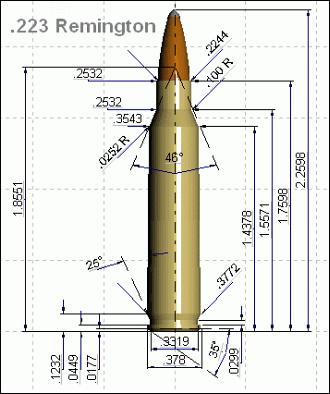
I would stay away from the .223 Remington. On paper the 90gr VLD will shoot inside most .308 Win loads even at a 1000 yards. But in reality, on average, the .223 Rem, regardless of what powder/bullet combo is used, cannot compete with the .308 Win. [Editor: The equipment lists at major F-TR matches will confirm Kovan’s conclusion here.]
Conclusion (and Other Options)
This article covers only the (currently) most popular cartridge/bullet combos for F-Class (F-Open and F-TR). As I said in the beginning, many cartridge types are capable of winning but are not listed due to their low popularity, case design, or lack of quality components. All of the above information is based on my personal experience and it is meant to help new shooters choose the right cartridges for F-Class matches. Thanks for reading and good luck — Emil Kovan
Emil Kovan Competition History:
– 2014 F-Class Open National Champion
– 2015 F-Class Open National Championship, Silver Medal
– F-Class Open National Championship Teams, 2015, 2014, 2013, Shooting Team Member
– Over 15 wins in Regional and State Championships in Palma, F-TR, F-Open
Michelle Gallagher is one of the nation’s top rifle shooters and team coaches. A past Long Range National Champion, Michelle is part of America’s “First Family” of Shooting, being raised by Mid Tompkins and Nancy Tompkins, both rifle champions in their own right.
Michelle, who works for Sierra Bullets, was at the 2019 F-Class National Championships in Raton, New Mexico. At the event, Michelle captured some great photos of the competitors and the New Mexico countryside at the NRA Whittington Center. This year’s Nationals were very challenging competition, with truly brutal winds on some days. Here is Michelle’s Photo Essay on the 2019 F-Class Nationals.
Father Ken Klemm and Son Ian Klemm shot together in F-TR Team Matches. Individually, Ian was second overall in the 1K F-TR Nationals, while Ken finished as High Grand Senior.
Three talented lady shooters: Michelle Gallagher (L), Nancy Tompkins, and Madison Bramley.
The U.S. F-Class National Championships commence September 15 at the NRA Whittington Center in New Mexico. But, across the pond, the European F-Class Championships took place this past week (September 2-8) at the Bisley Range in the UK. Congrats to the big winners, Great Britain’s Dan Lomas, new European F-TR Champion, and Germany’s Ulrich Kwade, new European F-Open Champion. Team Great Britain RED, shown below, took the European F-TR Team Championship, while Team Italy won F-Open.
Team Great Britain RED won the F-TR Team Championship, with Ukraine Second, Great Britain BLUE Third.
Dan Lomas Wins F-TR Title on Home Turf at Bisley
Dan Lomas was excited about his F-TR Championship: “First place in Europe! Just finished five solid days shooting in the European Championships at Bisley. I ended up keeping my head, winning the Europeans 5 points clear! I also was given my first cap shooting for the country and, with my amazing team mates, won gold for GB by a clear 15 points. It was an amazing performance by the two coaches Jon and Ewen and captain David! Thanks, as always, to BorderBarrels/SassenEngineering for the barrel; Vicarage Ballistics for the smithing, Borden Accuracy for the amazing actions and PSE-Composites for one of the most forgiving carbon stocks!”
Germany’s Ulrich Kwade Wins F-Open Division
March Scopes Europe provided this report: “Congratulations to our good friend Ulrich Kwade of Hannover, Germany. Uli won the European F-Class Championship in F-Open class. Ulrich uses a March 10-60x56mm Highmaster scope. Uli mounted a BAT action with a Benchmark barrel chambered in 7mm/270 WSM, fitted by Stuart Anselm of GS Precision. The really amazing thing is this barrel was only delivered on the Tuesday of the competition. Uli had already made his ammo pre-prepared … that is confidence for you!”
Ulrich’s rifle has a cleverly-designed stock which he built from scratch himself. It boasts a recoil reduction system which Ulrich says removes 80% of felt recoil. Ulrich is a very talented engineer and stock-builder. We congratulate him on his win.
The movie “The Patriot” gave us the phrase “Aim small, miss small”. While that’s a good mantra, aiming strategies for long-range competition are a bit more complicated, as this article explains…
U.S. F-Class Nationals Start Sunday, September 15th!
The U.S. Mid-Range and Long Range Nationals kick off September 15th at the NRA Whittington Center near Raton, New Mexico. Here are some tips that can help F-TR and F-Open shooters aim more precisely, and achieve higher scores. F-Class ace Monte Milanuk reviews reticle choices and strategies for holding off.
In our Shooters Forum, one newcomer wanted some advice on selecting a reticle for F-Class optics. He wondered about the advantage of Front (first) Focal Plane (FFP) vs. Second Focal Plane scopes and also wondered if one type of reticle was better for “holding off” than others.
In responding to this question, Forum regular Monte Milanuk provided an excellent summary of aiming methods used in F-Class. For anyone shooting score targets, Monte’s post is worth reading:
Aiming Methods for F-Class (and Long-Range) Shooting — by Monte Milanuk
F-Class is a known-distance event, with targets of known dimensions that have markings (rings) of known sizes. Any ‘holding off’ can be done using the target face itself. Most ‘benefits’ of Front (first) focal plain (FFP) optics are null and void here — they work great on two-way ranges where ‘minute of man’ is the defining criteria — but how many FFP scopes do you know of in the 30-40X magnification range? Very, very few, because what people who buy high-magnification scopes want is something that allows them to hold finer on the target, and see more detail of the target, not something where the reticle covers the same amount of real estate and appears ‘coarser’ in view against the target, while getting almost too fine to see at lower powers.
Whether a person clicks or holds off is largely personal preference. Some people might decline to adjust their scope as long as they can hold off somewhere on the target. Some of that may stem from the unfortunate effect of scopes being mechanical objects which sometimes don’t work entirely as advertised (i.e. one or two clicks being more or less than anticipated). Me personally, if I get outside 1-1.5 MOA from center, I usually correct accordingly. I also shoot on a range where wind corrections are often in revolutions, not clicks or minutes, between shots.
Some shooters do a modified form of ‘chase the spotter’ — i.e. Take a swag at the wind, dial it on, aim center and shoot. Spotter comes up mid-ring 10 at 4 o’clock… so for the next shot aim mid-ring 10 at 10 o’clock and shoot. This should come up a center X (in theory). Adjust process as necessary to take into account for varying wind speeds and direction.
Others use a plot sheet that is a scaled representation of the target face, complete with a grid overlaid on it that matches the increments of their optics — usually in MOA. Take your Swag at the wind, dial it on, hold center and shoot. Shot comes up a 10 o’clock ‘8’… plot the shot on the sheet, look at the grid and take your corrections from that and dial the scope accordingly. This process should put you in the center (or pretty close), assuming that you didn’t completely ignore the wind in the mean time. Once in the center, hold off and shoot and plot, and if you see a ‘group’ forming (say low right in the 10 ring) either continue to hold high and left or apply the needed corrections to bring your group into the x-ring.
Just holding is generally faster, and allows the shooter to shoot fast and (hopefully) stay ahead of the wind. Plotting is more methodical and may save your bacon if the wind completely changes on you… plotting provides a good reference for dialing back the other way while staying in the middle of the target. — YMMV, Monte
F-Class shooting (both F-Open and F-TR) is one of the fastest-growing forms of rifle competition. Each season many new shooters hit the line and attendance at the big matches increases every year. But if you’re new to the game, you may ask “Where can I shoot an F-Class match?”. Well, Forum member Rod V. (aka Nodak7mm) has compiled a useful list of 112 ranges throughout the USA where F-Class matches are held. With venues from Alabama to Wyoming — you should find an F-Class program not too far from home. The list, in Excel spreadsheet format, provides range locations and weblinks (where available). Click the link below to download the F-Class Range List (.xls file):
Note — this list, now in its 20th Revision, is a treasure trove for F-Class shooters. No claim is made that the list is comprehensive. But it still covers the the lion’s share of the important F-Class venues nationwide. If you know of a range that should be added to the list, please post the location on our F-Class Range List Forum thread. Rod will update the list as new range info is received. Rod writes: “Range information is wanted and welcomed. I would like your help on collecting specific info on Clubs/Ranges where known F-Class matches are held.” Here’s a partial sample from Rod’s list:
Here is Tye Sim’s .270 Win Mountain Rifle: “This is off a trued and blue-printed Rem 700 action. I love it.”
For today’s Sunday GunDay feature, we thought we’d present a selection of rifles featuring both cool gear and scenic venues. We’ve got quite a mix — hunting rifles and competition rigs, full customs as well as factory rifles. And there are some interesting calibers including 6.5 Creedmoor, .270 Win, .308 Win, plus a couple WSM variants. Enjoy our Sunday lineup!
To begin, here is the beautiful Blair Atholl range in Scotland. Owner Gary Costello posted: “Great day today, weather was interesting but not as bad as we thought!” Gary, a top F-Class shooter in the UK who often runs a .300 WSM, has been featured in a previous Sunday GunDay spotlight story HERE
Andrew Stone is an F-Class shooter from the Southern USA. Here his F-Open rig is set up for load testing from the bench at his beautiful, tree-lined home range. Targets are at 600 yards. Andrew is using a SEB front coaxial rest and LabRadar chronograph mounted on an aftermarket tripod.
In the photo above is Brian Harder’s handsome .308 Win F-TR rifle. This features a Kelbly action, McMillan stock, and Vortex scope with level. Up front is a SEB Joystick Bipod (Joy-Pod) with accessory ski-type feet. Note that Brian runs a front scope extension tube (sunshade), and a mirage shield on the barrel. These items do make a difference, particularly on hot summer days!
Here’s another British Beauty. This is the 7mm-270 WSM F-Classer belonging to Forum member Ian B. (aka “Elwood”). It features a Stolle Panda F-Class action, 32″ straight-contour Bartlein barrel, and a custom Joe West stock, modified by Ian and then hydro-dipped in brilliant blue by Hydro Graphics in the UK.
Factory rifles can be interesting too. That’s pretty impressive accuracy shown by Steven Castleman’s Bergara B14 HMR chambered in 6.5 Creedmoor. On this day Steve was shooting Hornady factory ammo loaded with 147-grain ELD Match bullets.
Here’s a stunning silhouette of a Savage 6.5 Creedmoor. Ed Whipple posted: “Borrowing a Savage 10 BA Stealth from my buddy Ron. He wanted a 100-yard head shot on a hog. I’m not listening to Ron any more. Federal Fusion bullet ain’t messing around.”
Competitor Warren Dean has employed a hex-end barrel to permit rapid barrel changes on his F-Class rig. Warren wrote: “I have been running what is commonly known as a switch barrel on my F-T/R rifle. Basically it allows for removal and reinstallation of the barrel with basic hand tools and with no, or very minimal, shift in zero. The two gunsmiths that I trust, Larry Racine and John Whidden, both told me that the switch barrel system would return to a very close zero with no problems. [This system] can be a great benefit to the traveling shooter and a money-saver for the shooter wanting to shoot different calibers on the same chassis.” READ Dean Switch-Barrel Report.
Larry Racine Barrel Sytem
Larry Racine is a respected gunsmith based in New Hampshire. He is also a two-time member of the U.S. Palma Team, and a five-time New Hampshire State Highpower rifle champion. Larry, who runs LPR Gunsmithing, has developed a brilliantly simple means of switching rifle barrels with an ordinary spanner or open-end wrench. With this set-up you can switch barrels in the field in seconds without the need for a barrel vise.
For most barrels, Larry mills a hex with six flats on the end of the barrel. This allows a shooter to change barrels quickly at home or on the line with a simple box-head wrench or a socket wrench. Larry says: “You don’t even have to take the barreled action out of the gun. Just set the buttstock on the ground, between your feet, put a wrench on it, hit it with the palm of your hand — and off comes the barrel.” For barrels fitted with a muzzle brake, Larry has a slightly different system. He mills two flats behind the brake so you can use an open-end wrench to do the job.
With either a hex on the end, or two flats for a brake-equipped rifle, the system works with any medium- to heavy-contour barrel with a muzzle-diameter of at least 0.700″. This will even work for high-power rigs using clamp-on sights or bloop tubes. Larry explains: “A lot of us here in New England use clamp-on front sights. The barrel will be turned to 0.750 for the sight, with the hex on the end. A bloop tube can go right over the end, no problem.”
Larry has used this system over the past few years to win a number of matches. In one 600-yard 3 by 20 prone match, Larry used three different barrels, with three different chamberings, on the same Savage rifle. Larry changed the barrels on the line.
Larry was able to do this because the system has little to no loss of zero from one installation of a given barrel to the next installation of that barrel. This lets the shooter start the match with confidence that the first sighter will be on paper. Larry reports that the simple system works great: “To date we have used this system on Savage, Remington, Winchester, RPA, and Nesika actions.”
Varminters Take Note — This Is Great in the Field
If you are a varminter shooting hundreds of rounds in a day, consider this system. We know some guys who bring 3 or 4 rifles into the field because their barrels get hot during long days of prarie dog hunting. With this smart system, you can easily swap barrels in a couple minutes. And no special equipment or barrel vises are required.
Modifying Barrels is Affordable
Racine’s system for rapid barrel removal/changing is very affordable. If Larry does the chamber work on your barrel he charges $45.00 extra to mill a hex or two flats on your barrel. The customer chooses the configuration.
If you only want the hex or flats done, Larry may charge a higher fee — call for current rates. Note this can also work for barrels with muzzle brakes or threads for suppressors. For more info, visit LPRGunsmith.com or call Larry at (603) 357-0055.
A carpet is used up front for smoother tracking with the Joy-Pod’s flat, ski-style feet. The arms of the Joy-Pod were painted to match the stock. The rear bag features low-drag material on the ears.
On Sundays, we feature notable rifles that exhibit fine craftsmanship, quality components, and noteworthy shooting accessories. Today we are featuring an F-TR (F-Class Target Rifle) rig that showcases the types of components, and accessories used by top F-TR competitors — including a coaxial bipod and Labradar Chronograph. If you’re considering getting started in the F-TR game, take a close look at this modern F-TR build from Forum member DM.Oakes.
Modern F-TR Rig with Borden Action, Krieger Barrel, and SEB Joy-Pod
This handsome .308 Win F-TR rig features a smooth-running Borden BRM action, 30-inch 1:10″-twist Krieger barrel, and an X-Ring Laminated Wood stock. Up front is a coaxial “Joy-Pod” joystick bipod. This is a state-of-the art, wide footprint bipod used by many competitors at the Worlds in Canada. The long joystick allows the “driver” to quickly adjust both elevation and windage in a smooth, continuous motion. The Joy-Pod can be adjusted so it will hold setting during the shot — you don’t have to “hard-hold” the joystick. Many shooters let the joystick slide through their fingers as the rifle moves back on recoil. With a little practice (and careful placement of the rear sand-bag), the tracking is excellent and you can slide the gun right back to point of aim after each shot.
This F-TR rifle is shown during load testing with a LabRadar chronograph.
» Full LabRadar Field Test/Review by Ray Gross
If you are considering purchasing a LabRadar Chronograph system, we strongly suggest you read the very thorough and informative LabRadar Review by Ray Gross, past Captain of the USA F-TR team. Ray notes: “It takes me about 3 minutes to set up [my LabRadar] at the range. Because there are no downrange screens, I do not have to hold up other shooters on the range like I would when setting up a traditional chronograph. The convenience alone will mean that I will use it more often than my old chronograph. Every time I take it out, I enjoy it a little bit more.”
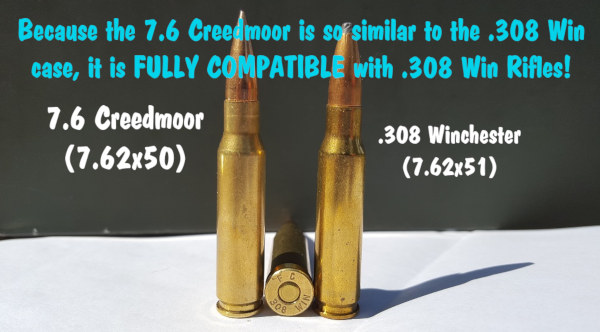
Leveraging the incredible success of the 6.5 Creedmoor cartridge, ammo-makers and rifle manufacturers have teamed up to produce a bigger Creedmoor cartridge — the 7.6 Creedmoor. The latest addition to the Creedmoor line gets its name from its 7.62mm bullet dimension. Yep, that makes it a .30-cal cartridge, but the creators stuck with the metric title for consistency. Makes sense. We like the way “7.6 Creedmoor” sounds and we bet consumers will too. The 6.5 Creedmoor has been a singular success — it is by far the most popular new cartridge introduced in the last decade. We think the 7.6 Creedmoor could become equally successful in short order.
In creating the new 7.6 Creedmoor, the product engineers were primarily concerned with accuracy, reliability, and compatibility. In a brilliant marketing stroke, the 7.6 Creedmoor’s designers crafted this cartridge to be 100% compatible with existing .308 Winchester and 7.62×51 rifles. So you can shoot the 7.6 Creedmoor safely in your existing .308 Win deer rifle or F-TR rig. As one ammo-maker’s marketing manager told us: “The 7.6 Creedmoor gives you everything you liked about the .308 Win, with a trendy name and the undeniable Creedmoor cachet. The 6.5 Creedmoor has become hugely popular. We expect the new 7.6 Creedmoor to do as well, or better!” We agree. Consider this — the 7.6 Creedmoor offers much better barrel life than the 6.5 Creedmoor, along with better bullet selection, particularly for hunters. With these advantages, how could the 7.6 Creedmoor not become a huge hit? The Creedmoor name alone should ensure success.
We discussed the new 7.6 Creedmoor with Dennis DeRille, one of the “founding fathers” of the 6.5 Creedmoor. Dennis said — “The Creedmoor name is synonymous with innovation and tactical success. This new 7.6 should live up to its name as it delivers .308 Win performance in a package for the 21st Century.”
Reassuring .308 Win Ballistics and Die Compatibility
Another great feature of the new 7.6 Creedmoor is that you can use existing .308 Win dies and reloading components. That excited one PRS shooter: “I had all this old .308 brass and .30-Cal bullets sitting around. When I heard about the 7.6 Creedmoor I said ‘Wow this is great, I can use this stuff in a Creedmoor now’. I know it will be accurate based on the name alone. That’s cool — tacticool!”
Because the new 7.6 Creedmoor shares case capacity and design details with the venerable .308 Win, it also shares the .308 Win’s impressive ballistics performance. “Whatever you can do with a .308 Win, you can do with the 7.6 Creedmoor… and then some!” says Hornady. Here is a chart showing projected velocities for the 7.6 Creedmoor with various barrel lengths and bullet weights.
NRA Approves 7.6 Creedmoor for F-TR Competition
Currently, NRA competition rules restrict F-TR rifles to the .308 Win (7.62×51) and .223 Rem (5.56×45) chamberings. But that’s going to change. Starting in June 2019, the NRA will allow 7.6 Creedmoor rifles in all F-TR matches. In addition, the 7.6 Creedmoor can be used in service rifles such as the popular M1A. It’s great to see this old battle rifle updated with Creedmoor accuracy and performance.
USA and Foreign Ammo Makers will Produce 7.6 Creedmoor Ammo
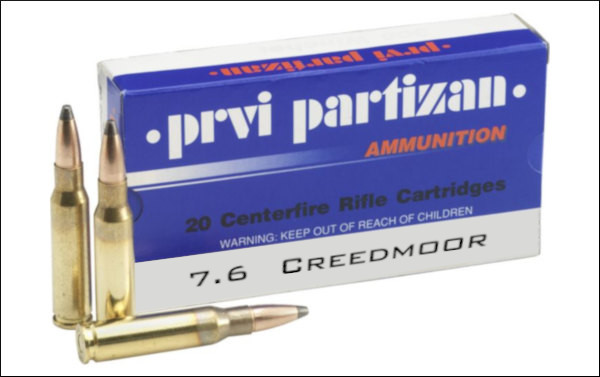
7.6 Creedmoor factory-loaded ammunition will be available from all major USA ammo-makers including Federal, Hornady, CCI, and Remington. As well, foreign ammo-makers Hirtenberger, Sellier & Bellot, and Prvi Partizan have pledged to produce 7.6 Creedmoor ammunition. That’s good news for shooters who want affordable Creedmoor ammo. One ammo-maker told us: “The whole industry is excited about the 7.6 Creedmoor. To be honest, .308 Win ammo sales have been declining for a number of years. Now we can repackage those same great components and market them to a new set of consumers reared on the 6.5 Creedmoor. This is a great deal for ammo-makers, who know how excitable Creedmoor fan-boys can be!”


Emil Kovan Competition History:


 .223 Rem — Not A Competitive Option


 F-Class is a known-distance event, with targets of known dimensions that have markings (rings) of known sizes. Any ‘holding off’ can be done using the target face itself. Most ‘benefits’ of Front (first) focal plain (FFP) optics are null and void here — they work great on two-way ranges where ‘minute of man’ is the defining criteria — but how many FFP scopes do you know of in the 30-40X magnification range? Very, very few, because what people who buy high-magnification scopes want is something that allows them to hold finer on the target, and see more detail of the target, not something where the reticle covers the same amount of real estate and appears ‘coarser’ in view against the target, while getting almost too fine to see at lower powers.
 Others use a


 Larry Racine Barrel Sytem
 Modifying Barrels is Affordable