Mid-Range Competitors Battle Tough Conditions at Ben Avery Report by F-Class John (competing at the Nationals)
The Mid-Range Nationals at Ben Avery in Arizona have been completed, and many competitors are breathing a sigh of relief. Winds were howling and conditions were VERY tough. We congratulate all the competitors who battled the high winds. This year all shooting at the Mid-Range Nationals was done at 600 yards (the simplified course of fire was adopted in 2019). I think I can safely say everyone is excited and ready to move on to Long-Range portion of the championships.
The Top 10 in each division are listed below. New F-Open Mid-range Champion Tim Vaught put together a very impressive performance, dropping just 14 points in very challenging conditions.
The fact that F-Open winner Tim Vaught dropped just 14 points across nine 20-shot relays is INSANE given the incredibly tough conditions. He deserved his title without a doubt. F-TR Mid-Range Champion Andrew Cyr also had an impressive performance, winning by 9 points over a very tough field, including past National F-TR Champions and Nancy Tompkins, past NRA High Power and Long Range Champion.
The F-TR division was won by Andrew Cyr. His gunsmith, Bryan Blake, said this rig has some unusual features, including barrel twist rate. Stay tuned for a full tech report…
Challenging Conditions at F-Class Mid-Range Nationals
Conditions were pretty incredible and by no means typical for Ben Avery for the Mid-Range portion of the USA F-Class National Championships. We started on Sunday with dead calm conditions on relay one and by the end of shooting, it was challenging but certainly not anything outside the normal for most of the people. We woke up Monday to crazy strong winds that just tore apart those who were ‘lucky enough’ to be on the first relay and it throughout the day it went from horrible to manageable and it was just dumb luck if your relay got hit or spared. The uncharacteristically strong winds met us Tuesday morning again for the final day of Mid-Range.
Video has highlights from three days of Mid-Range competition.
Before the first relay I measured gusts that were almost 24 mph with the constant wind hovering in the high teens. It calmed down from there but still remained very challenging until the end. Overall it was quite the fight for first with Tim Vaught earning the F-Open win with Dan Bramley and Tod Hendricks taking a respective second and third place out of a field of 66 High Masters and 13 Masters. These guys all shot superbly in some of the most challenging conditions ever witnessed at the Ben Avery range in Arizona. Mighty impressive…
The 2020 United States F-Class National Championships commence Sunday October 25, 2020 at the Ben Avery Shooting Facility in Phoenix. There’s a “hybrid” format this year. For 2022, the Nationals combine both Mid-Range and Long-Range competitions in one extended mega-match. The Mid-Range U.S. F-Class Nationals take place 25-28 October 2020, with all shooting at 600-yard targets. The Long Range National Championships then run October 29 through November 1st with all matches at 1000 yards. The competition consists of two different divisions: F-Open and F-TR (Target Rifle).
For health reasons, F-Class Nationals competitors will be required to follow a number of important health and safety protocols. This is to reduce the risk of spreading the COVID-19 virus. Here are the 2020 protocols as issued by the host Desert Sharpshooters club:
2020 NRA F-Class National Championships — Safety Protocols
We have had to implement several measures for the 2020 F-Class Nationals due to COVID-19. The Ben Avery Shooting Facility is owned by the Arizona Game and Fish Department, a state government agency. Therefore, all state and local guidelines and measures regarding COVID-19 must be followed on the property. Unfortunately, the local guidelines include a mask mandate, among other measures. We were hoping for the measures to be relaxed as the Nationals grew closer, but that is not the case. The COVID-19 measures that must be implemented during the match are below.
COVID-19 measures for the 2020 F-Class Nationals include:
– Reduce the total number of entries to 180.
– Use every other target for a total of 45 targets.
– Food and drinks, including water, will NOT be provided or for sale.
– Only one person pulling a target.
– Wearing mask/face cover is required when 6 feet distancing cannot be obtained. This includes:
Using the restroom.
During all team matches, except the shooters. Only the shooter and coach will be permitted on the firing line. All other team members must be 6 feet from the shooter and coach.
On the people movers traveling to and from the pits.
Walking up/down the ramps/stairs at the 1000 yard line, or traveling to or from one’s assigned firing point.
– No banquet dinners.
– Award ceremony will be held each day on the firing line, with shooters in the parking lot social distancing.
– While scoring, the scorer will be at least 6 feet from the shooter.
– Shooters on the firing line will set up on each side of their assigned target marker with 6 feet separating them.
– Shooters not pulling targets, scoring, or shooting must remain off of the firing line and in their vehicles or socially distancing in the parking lot.
– Only the scoring and shooting relays will be permitted on the firing line. During pit changes, the previous scoring and shooting relays must vacate the firing line before the next scoring and shooting relays approach the firing line.
– All scores and squadding will be posted online. Those with no access to the internet can obtain their squadding on the bulletin boards on the east and west side of the building. Only one person will be permitted to be at the bulletin board at a time.
– No one is permitted to enter the Berger Building.
– Refunds will be given to those that wish to not participate in the event.
Failure of individuals to follow any of the above guidelines may result in disqualification and being asked to leave. If we do not comply with these regulations, we risk the Ben Avery Shooting Facility canceling the event without prior notice.
We would also like to remind shooters that if they are feeling sick or have any symptoms to please not come to the range, and notify us immediately at fclassnationals@gmail.com.
Located on 1,650 acres in north Phoenix, BASF is one of the nation’s largest publicly operated shooting facilities. A City of Phoenix “Point of Pride,” the facility has received a five-star rating from the National Association of Shooting Ranges.
Firing line at 2015 F-Class Nationals at Ben Avery Shooting Facility.
If you buy one book about Long Range Shooting, this should be it. Based on sophisticated testing and research, this 356-page hardcover from Applied Ballistics offers important insights you won’t find anywhere else. Modern Advancements in Long Range Shooting – Volume II, the latest treatise from Bryan Litz, is chock full of information, much of it derived through sophisticated field testing. As Chief Ballistician for Berger Bullets (and a trained rocket scientist), author Bryan Litz is uniquely qualified. Bryan is also an ace sling shooter and a past F-TR National Champion. Moreover, Bryan’s company, Applied Ballistics, has been a leader in the Extreme Long Range (ELR) discipline.
AUDIO FILE: Bryan Litz Talks about Modern Advancements in Long Range Shooting, Volume 2. (Sound file loads when you click button).
Volume II of Modern Advancements in Long Range Shooting ($39.95) contains all-new content derived from research by Applied Ballistics. Author Bryan Litz along with contributing authors Nick Vitalbo and Cal Zant use the scientific method and careful testing to answer important questions faced by long range shooters. In particular, this volume explores the subject of bullet dispersion including group convergence. Advanced hand-loading subjects are covered such as: bullet pointing and trimming, powder measurement, flash hole deburring, neck tension, and fill ratio. Each topic is explored with extensive live fire testing, and the resulting information helps to guide hand loaders in a deliberate path to success. The current bullet library of measured G1 and G7 ballistic coefficients is included as an appendix. This library currently has data on 533 bullets in common use by long range shooters.
Bryan tells us that one purpose of this book is to dispel myths and correct commonly-held misconceptions: “Modern Advancements in Long Range Shooting aims to end the misinformation which is so prevalent in long range shooting. By applying the scientific method and taking a Myth Buster approach, the state of the art is advanced….”
Bullet Dispersion and Group Convergence
Part 1 of this Volume is focused on the details of rifle bullet dispersion. Chapter 1 builds a discussion of dispersion and precision that every shooter will benefit from in terms of understanding how it impacts their particular shooting application. How many shots should you shoot in a group? What kind of 5-shot 100 yard groups correlate to average or winning precision levels in 1000 yard F-Class shooting?
Chapter 2 presents a very detailed investigation of the mysterious concept of group convergence, which is the common idea that some guns can shoot smaller (MOA) groups at longer ranges. This concept is thoroughly tested with extensive live fire, and the results answer a very important question that has baffled shooters for many generations.
Part 2 of this Volume is focused on various aspects of advanced hand-loading. Modern Advancements (Vol. II) employs live fire testing to answer the important questions that precision hand loaders are asking. What are the best ways to achieve MVs with low ES and SD? Do flash hole deburring, neck tension, primer selection, and fill ratio and powder scales sensitivity make a difference and how much? All of these questions are explored in detail with a clear explanation of test results.
One of the important chapters of Part 2 examines bullet pointing and trimming. Applied Ballistics tested 39 different bullet types from .224 through .338 caliber. Ten samples of each bullet were tested for BC in each of the following configurations: original out of the box, pointed, trimmed, pointed and trimmed. The effect on the average BC as well as the uniformity in BC was measured and tabulated, revealing what works best.
Part 3 covers a variety of general research topics. Contributing author Nick Vitalbo, a laser technology expert, tested 22 different laser rangefinders. Nick’s material on rangefinder performance is a landmark piece of work. Nick shows how shooters can determine the performance of a rangefinder under various lighting conditions, target sizes, and reflectivities.
Chapter 9 is a thorough analysis of rimfire ammunition. Ballistic Performance of Rifle Bullets, 2nd Edition presented live fire data on 95 different types of .22 rimfire ammunition, each tested in five different barrels having various lengths and twist rates. Where that book just presented the data, Chapter 9 of this book offers detailed analysis of all the test results and shows what properties of rimfire ammunition are favorable, and how the BCs, muzzle velocities and consistency of the ammo are affected by the different barrels.
Chapter 10 is a discussion of aerodynamic drag as it relates to ballistic trajectory modeling. You will learn from the ground up: what an aerodynamic drag model is, how it’s measure and used to predict trajectories. Analysis is presented which shows how the best trajectory models compare to actual measured drop in the real world.
Finally, contributing author Cal Zant of the Precision Rifle Blog presents a study of modern carbon fiber-wrapped barrels in Chapter 11. The science and technology of these modern rifle barrels is discussed, and then everything from point of impact shift to group sizes are compared for several samples of each type of barrel including standard steel barrels.
One recent trend in F-TR competition is the use of low-profile, benchrest-type stocks shot with a light hand-hold and little or no face contact. For this method of F-TR shooting to work, you need the right equipment, and practice a “minimalist” shooting technique. One of the pioneers in this style of F-TR shooting is action-maker John Pierce of Pierce Engineering. Above you can see John shooting one of his F-TR rifles at the 2015 Canadian F-Class Championships. Note the straight-line stock and see how the adjustable bipod is set quite low to the ground (in fact the bipod’s arms are almost straight out).
Members of the Michigan F-TR Team, including Bryan Litz, have used similar rigs with success. Bryan said it took a while to adapt his shooting technique to this kind of rig, but there is a pay-off. Armed with a Pierce-built F-TR rifle, Bryan won his first-ever F-TR Match. Bryan explains the technique he uses when shooting this kind of rifle:
“Coming over from sling shooting, I knew there would be unique challenges to F-TR which I wanted to learn prior to (not during) a major tournament. I learned a new shooting position which doesn’t involve drawing the right knee up. For F-TR I get more straight behind the gun rather than at an angle. I found that the rifle shoots best with very light cheek, shoulder and grip pressure, approaching free recoil. This is how Eric Stecker shot his similar rifle into second place in the SW Nationals [with high X-Count by a large margin]. I learned the rifle’s sensitivity to different bipod and rear bag supports, and found the best buttplate position to allow the rifle to track and stay on target after recoil. This set-up shot best with a mostly free-recoil approach, that means ‘hovering’ over the comb, rather than resting your head on the stock. This took some ‘getting used to’ in terms of neck and back muscle tone. These are the kind of details I think it’s important to focus on when entering a new discipline.”
Bryan’s Pierce-built F-TR rig is a tack-driver: “I can certainly vouch for this set-up! In [a 2015] mid-range State Championship in Midland, MI, I shot my Pierce rifle into first place with a 598-44X (20 shots at 300, 500 and 600). Once you get used to the positioning and way of shooting these rifles, they just pour shots through the center of the target.”
Pierce F-TR Rifles with Scoville Stocks
Shown below are three complete Pierce F-TR rifles, along with a barreled action for comparison. The carbon-fiber/composite stocks are built by Bob Scoville. These Scoville stocks are very light, yet very strong and very stiff.
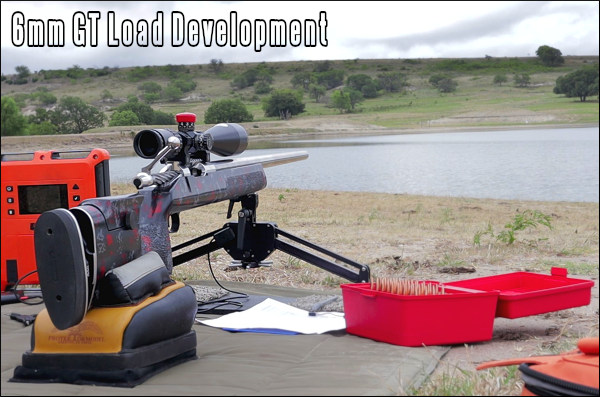
The 6mm GT (aka 6GT) cartridge was conceived as a “bigger Dasher” for PRS and NRL competition. The 6mm GT’s creators wanted 6mm Dasher accuracy and moderate recoil delivered via a cartridge with a slightly longer case body for better mag-feeding, longer neck for seating flexibility, and more moderate pressures. So far the 6GT has performed very well in PRS competition. Today’s story is a bit different — this is about an experiment — running a 6mm GT in an F-TR type rifle. Understand that, under current NRA rules, you may only shoot .223 Rem (5.56×45) or .308 Win (7.62×51), in official, sanctioned F-TR competition, but the 6GT is fine for F-Open. Mike McCasland wanted to see the potential of the cartridge for long-range target shooting, so he put a 6mm GT-chambered Bartlein barrel on a nice custom rifle with McMillan XIT stock and Kelbly F-Class Panda action. The results were impressive.
6mm GT — New Cartridge with Multi-Discipline Potential
Story by Mike McCasland, Texas Precision
The 6mm GT began garnering attention within PRS circles in early 2019. It promised to shoot 105-110gr 6mm bullets at 2950-3000 FPS, yet not suffer from mag-feed issues sometimes found with 6mmBR variants such as the 6 Dasher, 6BRX, and 6BRA. Moreover, since it burned less powder, the 6mm GT promised increased barrel life compared to the 6mm Creedmoor or 6XC. The 6mm GT case size should still work with the accurate powders in the Varget burn-range. I found the 6GT also worked great with H4350.
As someone who aspired to building a repeater and jumping into the PRS game, and had a spare F-TR rifle sitting around, I thought it would be fun to build up a 6mm GT to see if there was any merit to the hype. My smith, Wes Ripley of RIP Precision in Texas, builds a lot of PRS rigs, and already had the reamer on hand (a 0.120″ freebore variant).
Whidden Gunworks had some 6mm GT FL bushing die kits in stock, so I figured why not see what all the fuss was about? At the very least I could play around with the 6mm GT in F-Open Class at local club matches to see how it compared to the 6BRA, 6 Dasher, and other popular 6mm cartridges.
How the Project Got Started with Backup F-TR Rig
My 6mm GT build really started as a project spawned purely from COVID-19 Isolation boredom. This rifle primarily serves as a backup F-TR gun, and it had been relegated to performing some load development on .308 barrels, so I could spin new ones on my main match rifle. The only problem was, I had run out of .308 barrels that needed load development. So, I basically had an ideal test platform just collecting dust in the safe. All I needed was a 6mm GT-chambered barrel, since (like the 6mmBR) the 6mm GT works in a short action with a .308 Win-sized bolt-face.
6mm GT Rifle Specifications:
Action: Kelbly Panda F-Class SA RB/RP
Stock: McMillan XIT with RAD 2A
Barrel: 30″ 5R Bartlein 1:7.5″-Twist, HV Contour
Scope: Vortex Golden Eagle 15-60x52mm
Trigger: Jewell Benchrest, about 2 ounces
Bipod: Phoenix Precision
About the 6mm GT Cartridge
BRASS — The first thing you’ll find is cartridge brass choices for the 6mmGT are rather limited currently. At present, the only commercial options are Hornady and Alpha Munitions. For the die-hard Lapua fans, you can technically make 6mm GT brass from 6.5×47 Lapua, however that process is very labor-intensive.
I have used both Hornady and Alpha brass in this rifle and haven’t noticed much difference between the two. I will say that my batch of Alpha brass was slightly softer than Alpha brass I’ve used in other calibers; you could feel a difference when neck turning cases. I’m unsure if that’s a batch issue, or something specific to their 6mm GT brass as a whole. As far as performance, there was little discernable difference. Oddly enough, the Hornady brass seemed to have slightly less case capacity than the Alpha; with most other cartridges it’s the other way around.
POWDERS — The 6mm GT was designed with Hodgdon Varget in mind, and that popular powder works exceedingly well in this platform. That said, the 6mm GT can work with a wide variety of powders, some yielding better performance than Varget.
I’ve tried a multitude of powders during my initial 6mm GT load development: Varget, Shooters World Precision, RL16, VV N140, H4350, and RL-15 to name a few. In my barrel, Hodgdon H4350 seems to deliver the best velocity/accuracy combination. SD and ES also seemed to be the lowest with H4350.
Load Development for the 6mm GT — Many Powders Tested
BULLETS — The most common 0.120″ freebore chamber allows for the majority of high-BC 6mm projectiles found in both F-Class and PRS. I had good luck with the pointed 107gr Sierra Match Kings (SMK), as well as the 110gr Hornady A-Tips in my rifle. For those looking to run the heavier 112-115 grain 6mm offerings, I believe GAP designed a 0.160″ freebore reamer that gets those bullets out of the neck/shoulder junction. Shown below is the 0.120″ freebore JGS reamer print:
SUMMARY — Good Cartridge with Much Potential
Generally speaking, I think the 6mm GT is a good little round. Some may not subscribe to this theory, but I believe some cartridges are inherently easier to tune than others. I’m not sure the 6mm GT is as easy-to-tune as a 6mmBR, 6 Dasher, or 6 BRA, but I don’t think it lags that far behind.
With relatively little trouble, I was able to find loads with both Varget and H4350 that would consistently shoot very well — 0.2 to 0.3 MOA. Moreover, I found the 6GT cartridge lives up to the velocity claims made by G.A. Precision. I was easily able to push the 110gr A-Tips to 2950 FPS, and the 107gr SMKs to low 3000 FPS range without any pressure signs, or unnecessary wear and tear on the brass.
As a fun test, I ran my 6mm GT rifle in a local 1000-yard F-Class match with the 110gr A-Tips, just to see just how well they would perform. Although wind conditions of the day and some E-Target issues prevented my 6mm GT rig from getting the better of the larger 7mm and .30-Cal rifles, the 6mm GT proved itself an accurate little round at distance. Here is a 1000-yard ShotMarker target:
After putting several hundred rounds through my 6mm GT rifle, I anticipate building another 6GT on a repeater action to give PRS a try. I think if you are looking for a dual-purpose rifle that can run tactical matches (with 100% feeding reliability), and can also be used for mid-range, F-Open Class competition, the 6mm GT would be a very good option.
About the author, Mike McCasland:
Mike McCasland is an avid shooter who competes regularly in F-Class matches. Based in Texas, Mike is the creator of the Texas Precision YouTube Channel. There you’ll find many videos covering reloading, gun projects, and marksmanship. Mike has done some notable product reviews including a comparison test of Micrometer Competition Seating Dies. To access Mike’s YouTube Channel, CLICK HERE.
A multi-time F-TR National Champion, James “Jimmy” Crofts is one of America’s top F-Class competitors. And now this F-TR ace has a stunning new rifle in his arsenal. AccurateShooter Forum member CigarCop, head honcho of KW Precision LLC, recently completed a new F-TR rig for Crofts. This handsome, state-of-the-art rifle features top-tier components: Borden action, twin Brux barrels, Cerus RifleWorks F-TR Stock, and Jewell trigger, all resting on a wide-base Phoenix Bipod.
James Crofts photo by Kent Reeve.
Have a good look at these photos below. Yes, envy is the appropriate reaction. With the smooth operation of the Borden action and the predictable accuracy of Brux barrels, we bet James’s new rig will shoot as good as it looks.
CigarCop actually chambered two barrels for James, with different fluting patterns — conventional linear flutes for one tube, and lines of staggered ovals for the other. Finished length for both barrels is 30″. Yes it looks cool, but the fluting was done mainly to save weight with the 30″-long lengths. CigarCop tells us the complete rifle, without scope and rings, weighs just under 15 pounds. Max allowed weight for an F-TR rifle, with scope, is 18.18 pounds (8.25 kg).
When James Crofts is not shooting his .308 Win F-TR rig,
he often trains with a .22 LR Rimfire rifle. Read on…
Rimfire Training for F-Class Competitors
2014 and 2012 U.S. National F-TR Champion James Crofts is one of America’s top F-Class shooters. A member of 2013 World Championship-winning F-TR Team USA squad, James knows a thing or two about long-range shooting. But you may be surprised to learn how James sharpens his shooting skills at relatively short distances. You see, James often practices with a .22 LR rimfire rifle at distances from 50 to 200 yards. James tells us: “Shooting my F-Class rimfire trainer saves me money and improves my shot process and wind-reading abilities.”
Remington rimfire 40X barreled action in PR&T LowBoy stock with PT&G bolt.
Rimfire Training Teaches Wind-Reading Skillsby James Crofts
Training with the rimfire is extremely useful and can be done from 25 yards out to 200 yards. I am lucky and can shoot 50 yards right off my back deck. That is far enough that any miscue on rifle handling will show up on the target. I use a two dry-fire to one actual shot routine for my practices. This gives me much more positive reinforcement without any negative reinforcement.
Wind reading is extremely important with a .22 LR rifle. I use a set of smallbore flags to aid my wind calls. The smallbore flags are a must and force you to look at the flags and mirage on each and every shot.
This Rimfire rifle features a CMP-sourced Rem 40X barreled action, PR&T Low Boy stock, Jewell trigger, and Phoenix bipod. The gun was built by Ray Bowman of Precision Rifle & Tool. James Crofts told us: “The project turned out awesome — the rifle was a hammer from the beginning even with the stock barrel.”
Rimfire Training Is Cost-Effective
Rimfire ammunition is much less costly than centerfire ammo. Though .22 LR prices have risen, you can still get a 500-round brick of very good .22 LR match ammo for around $75.00. That works out to fifteen cents a round. That’s a fraction of the cost of handloading .308 Win match ammo. The top match-grade, .308-cal centerfire bullets can cost around $60 per hundred. Then you have to figure in brass, primers, and powder. Finally you have to consider your precious centerfire barrel life lost to practice.
The best F-Class and Sling shooters in the nation compete each year at the Berger Southwest Nationals at the Ben Avery range in Arizona. Walk down the firing line and you’ll see the absolute “best of the best” in equipment — from $3500 optics to $2000 stocks and $400 triggers. Berger SWN shooters have some of the best equipment you can buy. In this game, where just 1 or 2 points can separate first from third place (considering X-Count), it’s important to have top-flight equipment. That means a custom action, custom barrel, and high-end stock or chassis system.
Matt Schwartzkopf, a range supervisor at Ben Avery, and member of the USA F-TR Team, has collected comprehensive gear reports from the 2020 Berger SW Nationals. Matt has created charts showing competitors’ choices for Actions, Barrels, Stocks, Riflescopes and Spotting Scopes. In addition, Matt has compiled bullet choice data for all classes and Cartridge rankings for F-Open Division.
There is a discussion of the 2020 SWN Gear Selection in our Shooters’ Forum. CLICK HERE to follow that Forum thread. Many top SWN shooters, including past F-Open National Champion Larry Bartholome, have contributed to this Forum discussion about gear options.
ACTIONS Listed by Division (Sling, F-TR, F-Open)
ACTIONS by Brand (Combined Listing — All Divisions)
BARRELS by Brand (Combined Listing — All Divisions)
BULLETS by Brand (Combined Listing — All Divisions)
CARTRIDGE BRASS by Brand (Combined Listing — All Divisions)
POWDER by Brand (Combined Listing — All Divisions)
STOCKS by Brand (Combined Listing — All Divisions)
RIFLESCOPES by Brand (Combined Listing — All Divisions)
SPOTTING SCOPES Listed by Class (Sling, F-TR, F-Open)
Cartridge Selection in F-Open Division
In addition, Matt produced an interesting listing of cartridge/caliber types for the F-Open division. This is helpful because cartridge choice is unrestricted in the F-Open class. By contrast, the F-TR division is limited to .223 Remington (5.56×45) or .308 Winchester (7.62×51). You can see that the .284 Winchester (and variants) currently dominate F-Open.
A while back, our friend Vince Bottomley in the UK wrote an excellent article for Target Shooter Magazine. Vince offers “solid-gold” advice for new F-TR and F-Open shooters. Vince reviews the cartridge options, and offers suggestions for a shooter’s first (and hopefully affordable) F-Class rifle. Vince also reviews various bipod choices for F-TR and discusses optics options (from $300 to $3000).
Getting Started in F-Class by Vince Bottomley
As membership secretary of a large club, one of the questions I’m frequently asked – “What’s the best way to get started in F-Class?” My club has an F-Class shoot every couple of weeks at ranges from 300 to 1000 yards and, not surprisingly, it’s very popular.
F-TR or Open Class?
From a shaky start way back in 2004, the F-TR Class is now proving as popular as Open Class and, at GBFCA League shoots and club shoots, many shooters choose to start with a 308, shooting off a bi-pod – in other words F-TR. In Open Class, the 7mm WSM soon established itself as the “must have” cartridge – if you wanted to win but, the WSM’s appetite for barrels eventually brought another 7mm cartridge into play – the 284 Winchester. This 50-year-old stalwart was revived a decade or so ago as the 6.5-284 and indeed this cartridge found some favor with F-Class pioneers – before the potency of the WSM was discovered. If you don’t mind shelling out for a couple of barrels per year (barrel life is about 750 rounds with the WSM) go for the 7mm WSM but, if you require a decent round-count, then opt for the .284 Win and learn to read the wind a bit better!
Scopes for F-Class
If you will be shooting 1000 yards then I would recommend at least 32 power and preferably a variable – like the 8-32. The cheapest “usable” scope in this range is the Sightron. It’s a great scope for the money and at under $900 (in the USA) it’s half the price of its nearest competitor. It’s also light – at 1.5 lbs – and there are some great reticles for the F-Class shooter – like the LRMOA.
F-Class shooting (both F-Open and F-TR) is one of the fastest-growing forms of rifle competition. Each season many new shooters hit the line and attendance at the major F-Class matches increases every year. But if you’re new to the game, you may ask “Where can I shoot an F-Class match?”. Well, Forum member Rod V. (aka Nodak7mm) has compiled a useful list of 112 ranges throughout the USA where F-Class matches are held. With venues from Alabama to Wyoming — you should find an F-Class program not too far from home. The list, in Excel spreadsheet format, provides range locations and weblinks (where available). Click the link below to download the F-Class Range List (.xls file):
Note — this list, now in its 20th Revision, is augmented regularly, but info is still being gathered. No claim is made that the list is comprehensive. But it still covers the the lion’s share of the important F-Class venues nationwide. If you know of a range that should be added to the list, please post the location on our F-Class Range List Forum thread. Rod will update the list as new range info is received. Rod writes: “Range information is wanted and welcomed. I would like your help on collecting specific info on Clubs/Ranges where known F-Class matches are held.” Here’s a partial sample from Rod’s list:
The 2020 Berger Southwest Nationals are complete. As expected, it was a hugely successful match that challenged the nation’s top Sling and F-Class shooters. We want to praise all the competitors and congratulate the 2020 SWN Champions in all three classes. The competition was fierce through-out the match. John Whidden won the Sling Division with a 1245-75X score, just one point ahead of runner-up Oliver Milanovic (1244-72X). Bobby Gill was third with 1240-58X.
In the F-TR Division, Peter Johns had a dominant performance with 1242-58X, twelve points ahead of second-place Wade Fillingame (1230-50X) and third-place Ian Klemm (1230-46X). Ian also shot on the winning USA Independence F-TR Team.
Jay Christopherson Wins F-Open
We cheered the F-Open news. AccurateShooter’s own Jay Christopherson, our Systems Administrator, took the 2020 F-Open title with a brilliant 1247-83X score, 11 “Xs” ahead of runner-up Pat Scully (1247-72X). In third place was Tod Hendricks (1245-81X). Jay (photo right) was shooting a Brux-barreled straight .284 Win with Berger 180gr Hybrid bullets. Up front he uses a SEB Mini coaxial tripod rest. Jay also helped carry Team Lapua-Brux-Borden to an F-Open Team victory. Here’s a short video of Jay shooting when he finished second in F-Open division at the SWN a couple seasons back. You can view Jay’s smooth gun-handling and patience waiting for his condition:
Jay Christopherson, AccurateShooter.com’s System Admin, won the F-Open division. Jay’s Brux-barreled .284 Win was superbly accurate all week long. This video was from a past Berger SWN Event.
John Whidden of Whidden Gunworks won Sling division with a 1245-75X score. John really likes this match: “For most of us it’s the first match of the year, a chance to shake off the cobwebs.” John said conditions were “pretty nice on Friday, Saturday and Sunday — most of the changes came slow and conditions were readable from the mirage.” John, a 5-time National Long Range Champion, is always a threat to win at the SWN. John shot a .308 Win in the Palma Class, and then his .243 Win in the Any Rifle division. Both with Berger bullets and Vihtavuori powders. Here’s John at Ben Avery in 2018:
Above is Peter Johns, F-TR Class winner. Peter posted: “I just accomplished one of my goals of winning a national-level F-Class shooting match! I was only able to do with the support of my wife and family. Also I would like to thank Alonzo Custom Rifles for building a great shooting rifle, Kelly McMillan for the best rifle stock for F-TR (Kestros BR) and Vortex for the best riflecope (Golden Eagle) for F-Class.”
Top SWN Team Performances
A new team record was set at Ben Avery this year. In the F-TR Division, Team USA Independence finished with a 2563-113X score. We are told this is the highest-ever F-TR score. Congratulations to Top Scorer Ian Klemm (645-28X) and the other shooters Wade Fillingame, Fritz Braun, and Luke Ramsey. Keith Trap coached and Kent Reeve was Captain.
In F-Open Team Lapua-Brux-Borden continued its dominance, with a fine performance on the final day. The Team finished at 2584-160X, six points ahead of runner-up Team McMillan F-Open (2578-135X).
F-Open Rifle with Barrel-Cool Device on SEB Neo front rest.
Give Credit to the Match Directors and Staff
Emil Praslick III of Capstone Precision Group offered this perspective on the 2020 Berger SW Nationals: “Wrapping up the Southwest Nationals which was amazingly well run by the Desert Sharpshooters. Matthew Schwartzkopf, Michelle Gallagher, Nancy Tompkins, Melesia Cisneros, Scott Fulmer, Mid Tompkins, and everyone else behind the scenes literally work for at least six months to make the event the well-oiled machine that it is.
Moving and managing close to 400 shooters is a Herculean task, and anyone who thinks they can do better should… offer to come down to help out. I shot awful, but it was a pleasure to see the joy of the shooters as they experienced this one-of-a-kind match. Imagine cooking Thanksgiving dinner for 400 relatives with individual dietary needs on a motel hot plate, and you’ll get an idea of the scale involved. Again, thank you Matt and the gang, and we’ll see you next year!”


 Part 2 of this Volume is focused on various aspects of advanced hand-loading. Modern Advancements (Vol. II) employs live fire testing to answer the important questions that precision hand loaders are asking. What are the best ways to achieve MVs with low ES and SD? Do flash hole deburring, neck tension, primer selection, and fill ratio and powder scales sensitivity make a difference and how much? All of these questions are explored in detail with a clear explanation of test results.


 As someone who aspired to building a repeater and jumping into the PRS game, and had a spare F-TR rifle sitting around, I thought it would be fun to build up a 6mm GT to see if there was any merit to the hype. My smith, Wes Ripley of
 BRASS — The first thing you’ll find is cartridge brass choices for the 6mmGT are rather limited currently. At present, the only commercial options are Hornady and

 SUMMARY — Good Cartridge with Much Potential


 In the F-TR Division, Peter Johns had a dominant performance with 1242-58X, twelve points ahead of second-place Wade Fillingame (1230-50X) and third-place Ian Klemm (1230-46X). Ian also shot on the winning USA Independence F-TR Team.


