|
|
December 17th, 2012
How to Set Up Your Full Length Sizing Die
by Ron Dague, Sinclair International Technician
From Sinclair’s Reloading Press Blog
At Sinclair International, we are often asked for a fool-proof method to set up a full-length sizing die, and begin reloading our fired cases. The method used by many target shooters today is to set up your full length die to closely match your rifle chamber and minimally full-length size your cases –as little as .001″ for bolt-action rifles. I prefer to use this method for all of my bolt-action cartridges.
STEP ONE
I like to de-prime five (5) cases (de-prime only, do not full length resize) and measure from the base of the case to the shoulder with our Sinclair Comparator Body (09-1000) and Bump Gage Insert(09-10200). We refer to this as our headspace measurement. Our Electronic Caliper (#MIC-14) works well and may be pre-set at .000” making this headspace measurement easy to capture. The Sinclair Comparator/Gauge Body and Bump Gage Inserts make this task fairly simple. L.E. Wilson Tools & Gages, Hornady Manufacturing, and RCBS all make similar units to achieve your headspace measurement.
 STEP TWO STEP TWO
With your full-length die threaded into your reloading press, loosen the lock ring and run the press ram up toward the full length die with a shell holder in place (with no case). Then, screw the die toward the shell holder until it stops. Back the die out of the press and away from the shell holder one full turn and set the lock ring finger tight.
STEP THREE
Lubricate each of the cases with your favorite sizing lube (my favorite is Imperial Sizing Die Wax) and resize a case. Again, take a headspace measurement from base to shoulder. [When running the case up into the die, be sure the press ram moves the full limit of its upward travel.] If there’s no change in the measurement from the fired dimension, loosen the die lock ring and turn the full length sizing die downward 1/8 of a turn. [Editor’s Note: You’ll need to use smaller turn amounts as you get close to the desired amount of bump. We suggest moving just a few degrees of die rotation at a time once you’ve reached the point where the die hits the shoulder without moving it back.] Now repeat the sizing process with a second lubricated case and take the measurement again. Keep rotating the die downward gradually (in small increments) and repeat the case sizing process until you see approx-imately .001”-.002” reduction to your fired headspace measurement. We prefer a headspace reduction of approximately .001″ – .002″ for bolt action rifles and .003″ – .005″ for semi-auto rifles. You can adjust to your rifle as to what works best. Don’t forget to load 10 rounds or so and try them from the rifle’s magazine to make sure they function properly.
Full-length Sizing vs. Neck-Sizing
Just a quick word on neck sizing…..I have personally never been a big fan of neck sizing. Often times when I put neck sized cases back in the rifle, the bolt would close with some drag, or it would be a bit “snug”. This was mostly recognized with factory rifles. I didn’t have any problems with accuracy, just with cycling the action for a follow up shot. If your rifle is custom chambered with the action straightened and trued, neck sizing will work well on 4-5 firing’s and then you will need to full length size or use a body die to set the shoulders back when the cases begin to “stick”. Hope these tips help make the use of a headspace gauge and full length die set up much easier.
Ron Dague
Sinclair Tech and Reloading Instructor
800-717-8211
rond@sinclairintl.com
Reloading Tip Courtesy Sinclair Int’l; Story Sourced by Edlongrange
November 15th, 2012
 We were recently asked: “What size neck bushing is best for Lapua 6mmBR brass in a ‘no-turn’ chamber?” The questioner planned to purchase a Redding Type ‘S’ full-length sizing die with neck bushings. The quick answer is that one should probably get 0.265, 0.266, and 0.267 bushings and see what works best. We were recently asked: “What size neck bushing is best for Lapua 6mmBR brass in a ‘no-turn’ chamber?” The questioner planned to purchase a Redding Type ‘S’ full-length sizing die with neck bushings. The quick answer is that one should probably get 0.265, 0.266, and 0.267 bushings and see what works best.
Using current “Blue Box” Lapua brass, a loaded 6BR round with an unturned neck will typically run about 0.2680-0.2685 (depending on the bullet). A 0.266 neck bushing, after springback, will give about 0.0015 tension which can work well in a bolt gun. NOTE: With the older “Brown Box” Lapua Brass, the neckwalls are slightly thicker, so you may want to start with a .267 bushing. Remember, however, that with either older or newer Lapua brass you may want to experiment. Some bullets prefer more tension than others. And, you may find that it is useful to tweak neck tension slightly if you make major changes in seating depth during load development. In a gas gun, such as an AR15, you probably want .003 or more tension.
Alternative to Bushings — Honed Full-Length dies
Conventional, non-bushing full-length sizing dies can create ultra-accurate ammo with very low run-out. For some applications, we prefer a non-bushing FL die over a bushing die — so long as the neck tension is correct. But many FL dies have an undersized neck diameter so you end up with excess neck tension, and you work the brass excessively. Forster offers a simple, inexpensive solution — honing the neck diameter to whatever size you want.
If you purchase a Forster non-bushing, full-length sizing die, Forster will hone the neck dimension to your specs for $12.00 extra (plus shipping). This way you can have a FL die that provides the right amount of tension for your particular load. (The max amount of diameter change Forster can do is about .008″) Forster dies are relatively inexpensive so you can afford to have a couple of FL dies with necks honed to different diameters — such as 0.266″ and 0.267″ for a no-turn 6mmBR. The die itself is fairly inexpensive — currently Sinclair Int’l charges $33.99 for a Forster 6mmBR full-length sizing die (Forster Part # 018121).
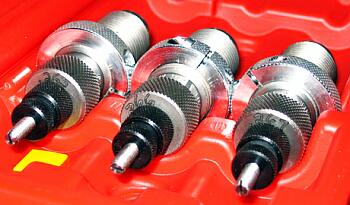
Forster FL dies, necks honed to .265″, .266″, and .267″.
Steve Rasmussen of IowaHighPower.com gave this a try. In fact, he had three dies made — each with a different neck dimension. Here’s his report: “My original Forster 6BR FL die sized the necks down a lot [to about 0.260″]. I sent my die in and asked if they could supply two more FL dies (for three total) to have the necks honed to 0.265″, 0.266″, and 0.267″.” In addition to the purchase cost of two more FL-sizing dies, Steve paid $36 ($12 per die) for the three dies to be honed, plus about $12 for return shipping.
The table below shows the neck diameter range of 10 sized cases using each die. [NOTE: This is with older “Brown Box” Lapua brass!] Brass springback after sizing is running 1 to 1.3 thousandths. My loaded rounds are running 0.2697-0.2699 using Lapua I bought last year. So far the dies are working well. I sized 80 cases with the 0.266″ necked die. The shoulder is running 0.4582″ and 0.300″ up from the base is 0.4684". I spun 20 of ‘em and 16 had a runout of one thousandth (0.001) and the other 4 at 1.5 thousandths (0.0015).”
| Die Diameter |
Sized Brass |
Springback |
Neck Tension |
| 0.267 Die |
0.2683-0.2684 |
0.0013 |
0.0014 |
| 0.266 Die |
0.2672-0.2674 |
0.0013 |
0.0025 |
| 0.265 Die |
0.2659-0.2660 |
0.0010 |
0.0039 |
May 14th, 2012
 Alliant’s Powder for 50-Caliber Applications Alliant’s Powder for 50-Caliber Applications
In 2009 Alliant unveiled Reloder 50, a new powder designed for long-range, 50-caliber rifle shooters. According to Alliant, the burn rate is “a little slower than Winchester 860″ and the powder is showing excellent lot-to-lot consistency. Load density is optimized for the 50 BMG and similar cases. Like Reloder 17, Reloder 50 employs a process which penetrates the kernels with the burn-rate-controlling chemical. This should allow a longer, flatter pressure curve, yielding more velocity than conventional powders can deliver. Alliant says that Reloder 50 offers “superior velocity and the ability to burn cleaner (with less residue).” Reloder 50 comes in both 1-lb (#150527) and 8-lb (#150528) containers.
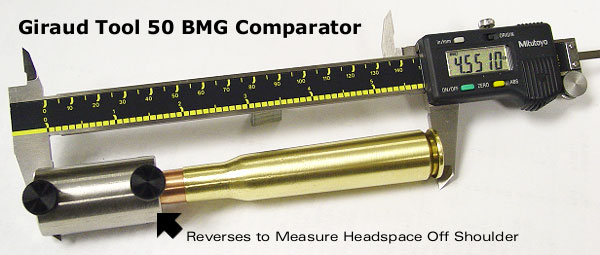
Giraud 50 BMG Case/Bullet Comparator
Giraud Tool makes a comparator for 50-Cal cartridges. The double-ended comparator is quite versatile. In one orientation you can measure base-to-ogive bullet length and also measure cartridge OAL from rim to bullet ogive. When reversed, you can use the comparator to measure cartridge headspace. The $30.00 Giraud 50 BMG Comparator gauge is constructed of 303 stainless and fits most any vernier, dial, or digital caliper. CLICK HERE for more info.
Lyman 50 BMG AccuTrimmer and Forster 50 BMG Trimmer
50 BMG enthusiasts asked for a reasonably-priced 50 BMG case trimmer and Lyman responded with an Accutrimmer designed specifically for that cartridge. Easy-to-use course and fine cut-length adjusters are positioned on the right side (by the handle). The shell head fits into a special holder which centers the case. The unit comes complete the 50-Caliber neck pilot. This case trimmer, including pilot, costs $59.99 at MidwayUSA.com.

Forster Products also makes a dedicated 50 BMG trimmer. Forster’s cutter tip is much sharper than the cutter on the Lyman AccuTrimmer. However, with the Forster tool you will pay more for that superior cutting ability — Forster’s 50 BMG trimmer costs $92.95 at Sinclair International.

March 6th, 2012
We are often asked: “What size neck bushing is best for Lapua 6mmBR brass in a ‘no-turn’ chamber?” The questioner planned to purchase a Redding Type ‘S’ full-length sizing die with neck bushings. The quick answer is that one should probably get both 0.265 and 0.266 bushings and see what works best. With the current “blue box” Lapua brass, a loaded 6BR round with an unturned neck will typically run about 0.268″ (depending on the bullet). A 0.266″ neck bushing, after springback, will give about 0.0015″ tension which can work well in a bolt gun. In a gas gun, we recommend running .003″ (or more) neck tension.

Alternative to Bushings — Honed Full-Length dies
Conventional, non-bushing full-length sizing dies can create ultra-accurate ammo with very low run-out. For some applications, we prefer a non-bushing FL die over a bushing die — so long as the neck tension is correct. But many FL dies have an undersized neck diameter so you end up with excess neck tension, and you work the brass excessively. Forster offers a simple, inexpensive solution — honing the neck diameter to whatever size you want.
If you purchase a Forster non-bushing, full-length sizing die, Forster will hone the neck dimension to your specs for about $10.00 extra. This way you can have a FL die that provides the right amount of tension for your particular load. Forster dies are relatively inexpensive so you can afford to have a couple of FL dies with necks honed to different diameters — such as 0.265″ and 0.266″ for a no-turn 6mmBR. The die itself is very affordable — currently Sinclair Int’l charges $33.95 for a Forster 6mmBR full-length sizing die (item FP6BRFL).
Forster FL dies, necks honed to .265″, .266″, and .267″.
Steve Rasmussen of IowaHighPower.com gave this a try. In fact, he had three dies made — each with a different neck dimension. Here’s his report: “My original Forster 6BR FL die sized the necks down a lot, less than 0.260″, .256″ if I recall correctly. I sent my die in and asked if they could supply two more FL dies (for three total) to have the necks honed to 0.265″, 0.266″, and 0.267″. The cost was $10 for my supplied die and $38.50 plus $10.00 honing fee for each additional die. Return shipping was $11.00 via USPS Priority Mail.”
The table below shows the neck diameter range of ten (10) sized cases using each die. Brass springback after sizing runs 1 to 1.3 thousandths. Steve was using the older, “brown box” Lapua brass with thicker necks so he needed the .267″ bushing. The older Lapua 6mmBR brass measures about 0.2695″ with bullet in place. Steve explained: “My loaded rounds are running 0.2697-0.2699 using [brown box] Lapua 6BR brass. So far the dies are working well. I sized 80 cases with the 0.266″ necked die. The shoulder is running 0.4582″ and 0.300″ up from the base is 0.4684″. I spun 20 of ‘em and 16 had a runout of one thousandth (0.001) and the other 4 at 1.5 thousandths (0.0015).” That shows that these honed Forster FL dies produce exceptionally straight sized cases.
| Die Diameter |
Sized Brass |
Springback |
Neck Tension |
| 0.267 Die |
0.2683-0.2684 |
0.0013 |
0.0014 |
| 0.266 Die |
0.2672-0.2674 |
0.0013 |
0.0025 |
| 0.265 Die |
0.2659-0.2660 |
0.0010 |
0.0039 |
January 21st, 2010
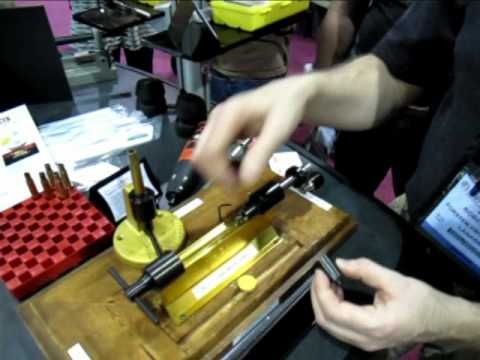
We saw a cool new product at the Forster Products booth. Forster has introduced a new 3-in-1 Carbide cutting tool that works with all existing Forster case trimmers. This unit does three jobs at the same time. It trims the case to length, it puts a 14-degree chamfer on the INSIDE of the neck, AND (last but not least), it cuts a 30-degree chamfer on the OUTSIDE of the neck. It does this all quickly and efficiently — in a matter of a few seconds. We tested the new tool ourselves on a few cases. The tool is solid and well made. The carbide cutting tips do perform a very clean cut. Be aware, however, if you have turned your necks already, you may have to reset the blade positions before you start trimming your brass.

Forster’s CFO, Robert Ruch, demonstrates the 3-in-1 case trimming/chamfering tool in the video below. As you can see, the tool turns very smoothly (no chatter) and the job is finished in a few seconds. The actual cutting time, per case, is just a few second. The tool has an MSRP of $70.00, but we expect it to sell for around $50.00 at major vendors. It can be fitted on Forster trimmers and other hand lathes with a .490″ shaft diameter.
|


