by Gavin Gear, UltimateReloader.com
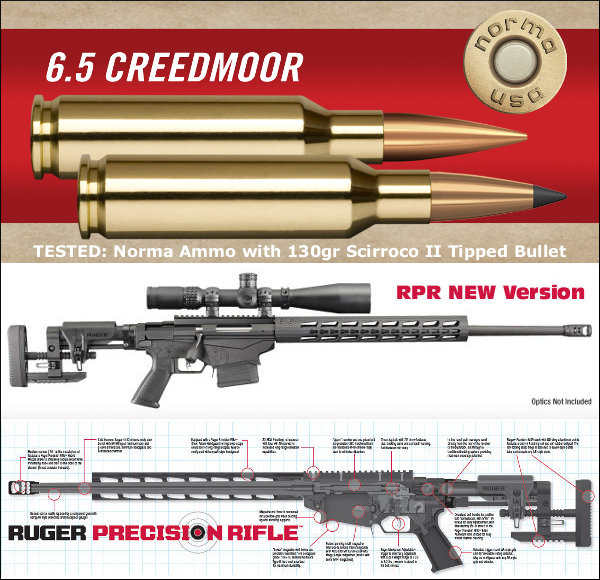
Norma is known for its high-quality brass and ammunition. I’ve used Norma brass for precision reloading in calibers like .30-06 with great results. Recently, I saw that Norma had announced a new addition to their Professional Hunter lineup of ammunition: in 6.5 Creedmoor! I thought I should try some out with the Ruger Precision Rifle, and that’s what I’ll cover in this post.
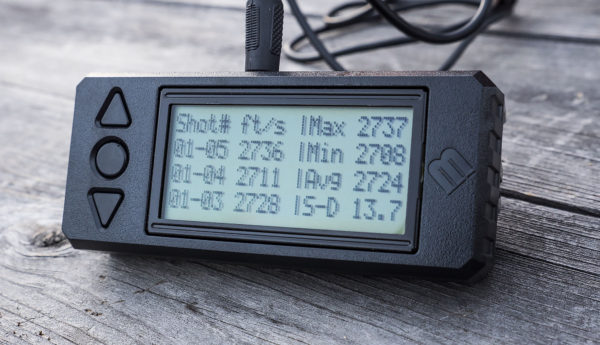
As you saw in the video, this ammunition behaves more like match ammunition than it does hunting ammunition — I really wish it was deer season! Here are the chronograph results:
This article comes from the Midsouth Shooters Blog. You’ll find other helpful gear reviews, reloading tips, and technical articles at www.MSSBlog.com.
With an SD of 13.7 FPS, this ammunition is very consistent in terms of velocity. It’s not surprising that the first four shots went into a .5″ group. This new ammunition is built around the Swift Scirocco II 6.5mm Bullet, and here’s more info about this precision-oriented hunting projectile:
Technical Information
Caliber: 264, 6.5mm
Bullet Diameter: 0.264
Bullet Weight: 130 Grains
Bullet Length: 1.350″
Bullet Style: Polymer Tip Spitzer Boat Tail
Bullet Coating: Non-Coated
Ballistics Information:
Sectional Density: .266
Ballistic Coefficient:.571
This is certainly a great choice of ammunition if you are hunting medium game with a rifle chambered in 6.5 Creedmoor. Can’t wait to sit down again with this ammunition to see if I can get that 3/8″ 5-shot group I know this ammo is capable of! If you want to try this Norma 6.5 Creedmoor Professional Hunter ammo yourself, you can purchase this excellent ammunition at Midsouth Shooters Supply.
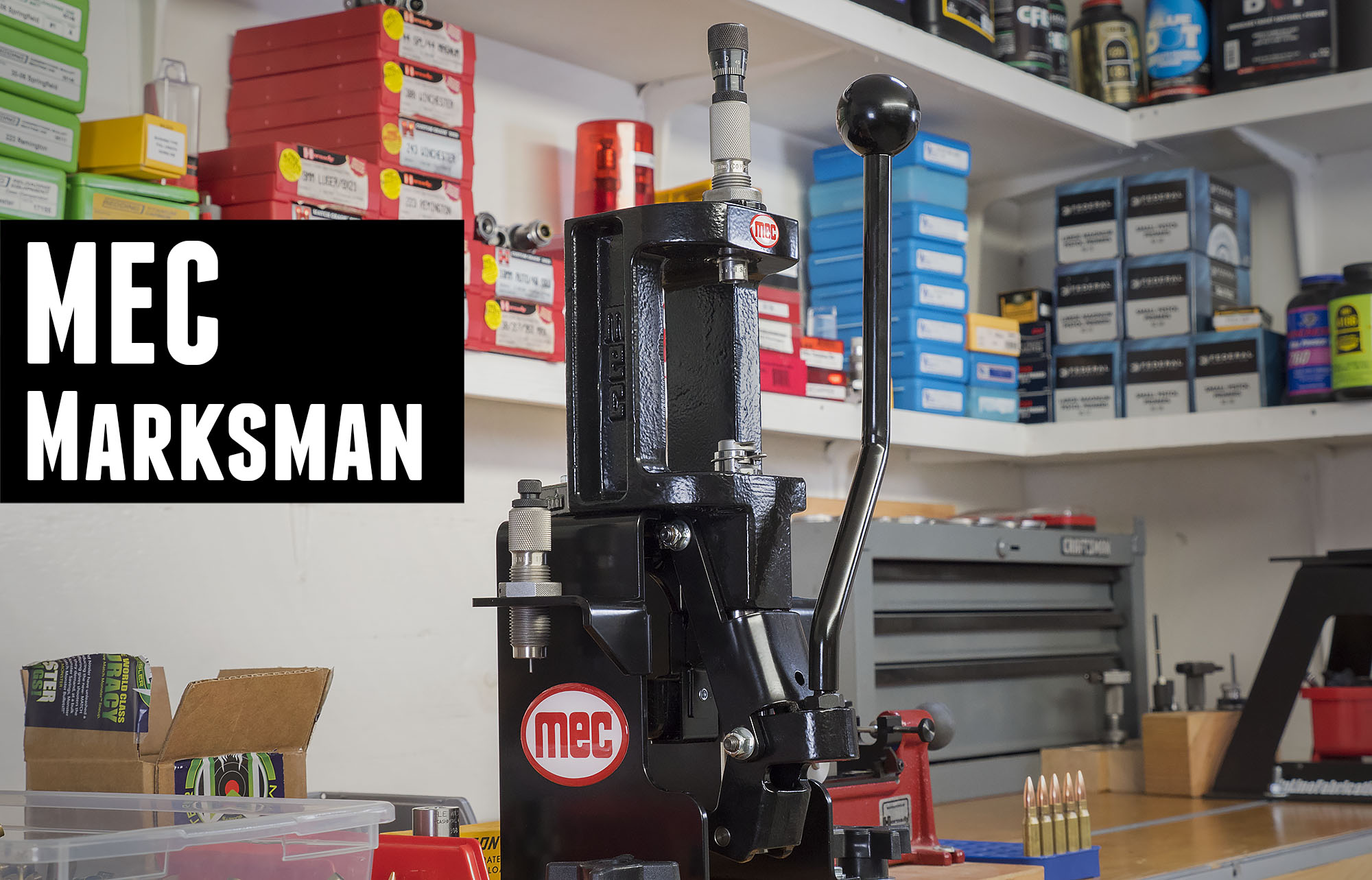
We were impressed when we first saw the new MEC Marksman press. Created by the makers of the popular MEC shotshell reloading systems, the new Marksman combines a sturdy cast-iron frame with a modern open-front design. With a $225.00 MSRP it is more expensive than an RCBS Rock Chucker, but it offers some distinct advantages — such as the open front plus a floating shell-holder system.
Our friend Gavin Gear got his hands on a MEC Marksman press and put it through its paces. He came away impressed with the product, saying it delivers excellent performance, and has many impressive features. Gavin tells us: “Cast iron tools and machines are a lifetime investment. The made-in-USA MEC Marksman features ductile cast-iron construction, an open-front frame design for easy cartridge access, a new floating shell-holder design with a unique retention system, and ambidextrous handle setup.”
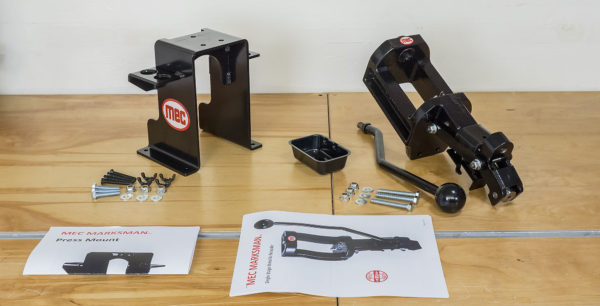
Gavin liked the Marksman’s system for holding spent primers. A tray sits behind the ram to catch spent primers exiting from a hole near the bottom of the ram. This is more foolproof than the plastic primer cups on some other single-stage presses. Expect less spent primer “spillage”.
The Marksman is sold as a stand-alone unit. However MEC also offers a very nice steel mount/riser for the Marksman. Gavin tested the Marksman with this riser, and he says it was sturdy and well-built. Gavin liked the riser. He said that elevating the Markman press up above the benchtop made it easier to handle cases and to operate the handle. You also get extra left- and right-side die-holders.
Gavin Gear of UltimateReloader.com recently reviewed Lee Precision’s new lever-operated, bench-mounted priming tool. The Lee Auto Bench Prime features a hopper-style primer feeder set at an angle. Gavin likes the tool, reporting that primers feed well and seat fully with very little effort. And switching from large to small primer size (or vice-versa) is quick and easy. Overall, Gavin says the Lee Auto Bench Prime has earned a place in his reloading room: “This is now my tool of choice for off-press priming. The Lee Auto Bench Prime is easier to use than a hand priming tool, and more efficient.”
Watch UltimateReloader.com’s Lee Auto Bench Prime Gear Review
Gavin tells us that the system worked well: “All in all, I’m really liking the LEE Auto Bench Prime. In the video, I prime both small primer .223 Rem brass and large primer .308 Win cases. I was impressed with how easy it was to seat the primers, and how quickly the process goes.”
How the Lee Auto Bench Prime Performs
Gavin had three important “take-aways” from his initial loading sessions with the Lee Auto Bench Prime:
1. I was surprised by the low effort needed to prime cases — it’s pretty amazing.
2. You can quickly and easily install shellholders and change primer sizes.
3. The folding primer tray works very well. It’s a great setup from my testing so far.
Are there any negatives with the tool? Gavin noted that, in the course of loading 100+ rounds, once or twice he had to tap the triangular tray to get the primer to feed: “That’s not a big deal, and may smooth out with time”.
Tool Costs Under $30.00
Available at Grafs.com for just $28.59, the Lee Auto Bench Prime tool is very affordable. It costs much less than competitive bench-mounted priming tools from Forster and RCBS.
NOTE: this tool requires dedicated Auto Prime shell holders (sold separately), but that’s a relatively small added expense. A set of Lee shell-holders (shown at right) costs less than $20.00 (street price).
The Ruger Precision Rifle (RPR) has been a hot seller since it was first released. All versions (.243 Win, 6.5 Creedmoor, and .308 Win) have been in high demand, with the 6.5 Creedmoor probably being the hardest to find. The RPR represents a solid value, and it is the logical “default” choice for the new Production Class in the Precision Rifle Series. (NOTE: If you spend around $1400 for the RPR, then add a $950.00 6-24x50mm Viper PST, you’re still well under the $3000.00 Production Class price limit for rifle and optic combined.)
In this video, Gavin Gear of UltimateReloader.com, along with Ed and Steve of 6.5Guys.com, review the Ruger Precision Rifle (RPR) in 6.5 Creedmoor. This particular rifle was fitted with the Vortex Viper PST 6-24x50mm scope. Together, Gavin and the 6.5 Guys give their opinions on the rifle, the 6.5mm chambering, and the Vortex optic. They provide candid evaluations (of rifle and optic) based on field tests with targets from 100 to 1000 yards.
Gavin tells us: “The Ruger Precision Rifle is a great rifle platform. I’ve had some great groups right out of the box, and have had no problems staying on target at ranges of 1000 yards and beyond. To me, the Ruger Precision Rifle is an ‘easy buy’ for the new competitive shooter or practical field shooter. But what about optics? It can be very confusing and overwhelming when shopping for ‘just the right scope’. There are so many great scopes on the market it can be staggering to take in all of the options. We wanted to give you some hands-on impressions of one of the most popular picks for optics for the Ruger Precision Rifle and similar rifles in the ~$1000 price range: the Vortex Viper PST 6-24×50 riflescope.”
Gavin was very pleased with the Vortex Viper PST: “Having used this scope in a variety of scenarios, ranges, and over the course of more than 1/2 of a year, I’m confident with not only the scope itself, but the entire package: Rifle + Scope + Mount (rings).”
Our friend Gavin Gear of UltimateReloader.com got his hands on Hornady’s all-new, pyramid-style Lock-N-Load Iron reloading press. This single-stage press features a unique, open-front design that makes it easier to place and remove cases during reloading processes. The compact footprint of this Iron Press also allows for a variety of placement options.
This video shows the new open-front Hornady Iron Press:
Gavin installed the Iron Press on his bench which features horizontal metal channels (for placement flexibility). Gavin reports: “The arrival of this press is great in its timing. I’m just about to move from progressive loading of 6.5 Creedmoor (for the Ruger Precision Rifle) to single-stage precision reloading. This will be the perfect press for that task! Based on the feedback and questions I’ve gotten recently, I’ll compare the consistency between progressive presses and single-stage presses.”
To raise the Iron Press higher, Gavin used an Ultramount from Inline Fabrication: “I was hoping to make slight modifications to the Ultramount in order to adapt it for use with my Ultimate Reloader bench system, and that worked out just fine! Here’s a picture of the Ultramount bolted down: I can easily slide it side to side to make room for other items on my bench.” NOTE: After taking the pictures shown here, Gavin rotated the Ultramount 180 degrees. This moved the whole press forward (towards the operator), providing more bench clearance for the Iron Press linkage and handle.
Do you have some old, tired brass that needs a thorough cleaning — inside and out? Consider using an ultrasonic cleaning machine. When used with the proper solution, a good ultrasonic cleaning machine can quickly remove remove dust, carbon, oil, and powder residue from your cartridge brass. The ultrasonic process will clean the inside of the cases, and even the primer pockets. Tumbling works well too, but for really dirty brass, ultrasonic cleaning may be a wise choice.
Our friend Gavin Gear recently put an RCBS Ultrasonic cleaning machine through its paces using RCBS Ultrasonic Case Cleaning Solution (RCBS #87058). To provide a real challenge, Gavin used some very dull and greasy milsurp brass: “I bought a huge lot of military once-fired 7.52x51mm brass (fired in a machine gun) that I’ve been slowly prepping for my DPMS LR-308B AR-10 style rifle. Some of this brass was fully prepped (sized/de-primed, trimmed, case mouths chamfered, primer pockets reamed) but it was gunked up with lube and looking dingy.”
UltimateReloader.com Case Cleaning Video (7.5 minutes):
Gavin describes the cleaning exercise step-by-step on UltimateReloader.com. Read Gavin’s Cartridge Cleaning Article to learn how he mixed the solution, activated the heater, and cycled the machine for 30 minutes. As you can see in the video above, the results were impressive. If you have never cleaned brass with ultrasound before, you should definitely watch Gavin’s 7.5-minute video — it provides many useful tips and shows the cleaning operation in progress from start to finish.
The RCBS ultrasonic cleaning machine features a large 3-liter capacity, 60 watt transducer, and 100 watt ceramic heater. The RCBS ultrasonic machine can be found under $140.00, and this unit qualifies for RCBS Rebates ($10 off $50 purchase or $50 off $300.00 purchase). RCBS also sells 32 oz. bottles of cleaning concentrate that will make up to 10 gallons of Ultrasonic Solution.
Gavin Gear tests .308 ammo with his DPMS LR-308B, AR10-type rifle.
Our friend Gavin Gear of UltimateReloader.com owns a DPMS LR-308B, an AR10-type semi-auto rifle. Gavin finds that his DPMS has a healthy appetite for ammunition. So, he set up his Hornady Lock-N-Load progressive press to produce .308 Win ammo. This video shows the process of press set-up and operation, complete with Hornady’s automated Case Feeder and Bullet Feeder. Employing elevated rotary hoppers, the case feed and bullet feed systems really speed up production. The automated feeders allow the operator to produce cartridges without ever touching case or bullet with his hands.
If you need large quantities of .308 Win ammo for 3-Gun matches or tactical games, and if you value your time, a progressive press may be a wise investment. The progressive can load a complete round with every cycle of the press handle. With Case Feeder and Bullet Feeder in place, the Hornady L-N-L can easily crank out a new .308 round every 3-4 seconds (watch video at 5:25). Conservatively speaking, that’s 15 rounds per minute sustained production (and some guys can go even faster).
Get updates from UltimateReloader.com via Gavin’s twitter feed: @UReloader. To learn more about the Hornady Lock-N-Load Progressive Press (with case/bullet feed options), and to see a list of the dies and accessories Gavin uses, click the link below:
What do you hope Santa delivers this Christmas? Our friend Gavin Gear over at UltimateReloader.com has some gift ideas that hand-loaders can add to their “wish lists”.
Special Tools — My Dad used to say: “You’ve got to use the right tool for the job”. I agree, and some times that means having a collection of special tools. There’s nothing more satisfying to me than the efficiency, effectiveness, and precision of having the right tool.
Here are some of my most frequently used “reloading special tools”:
General Items — There is no shortage of “reloading things” to ask for. Here are some additional ideas:
▶ Extra 6″ Digital Calipers (good idea to have spare calipers)
▶ Industrial Ziplock Plastic Bags (for brass storage)
▶ Tumbling Media (pet stores have ground walnut shells)
▶ Reloading Manuals
▶ Ammo Boxes (bulk styrofoam with cardboard boxes are great.)
▶ Digital Scale for sorting bullets and brass (jeweler’s scales from Amazon will work)
There’s some ideas for you. Get your “wish lists” sent off while there’s still time for your presents to get ordered and shipped!
Service Rifle shooters and varminters burn through a lot of ammunition. If you’re shooting more than 250 rounds of ammo a month, you may want to consider getting a progressive press — at least for your practice and varmint ammo. New technologies have made today’s progressives more efficient than ever. RCBS has developed a rifle-bullet feeding system that works with the RCBS Pro 2000 Progressive. The bullet-feeder can also be fitted to some Dillon units with modifications. There are four main components to the RCBS rifle-bullet feeder system: 1) base and two-piece adjustable column; 2) collator (bowl and motor); 3) drop tube and shutoff assembly; and 4) bullet feed die assembly.
Our friend Gavin Gear has tested the RCBS bulet feeder on an RCBS Pro 2000 for his UltimateReloader.com website. You can see his hands-on video review above. I’m pleased Gavin did this review because I have a Pro 2000 myself, and I can confirm that it is a very good machine. It is sturdy, the rotary-style powder measure is very precise, and the strip primer system works great. (I can change from small primer feeding to large primer feeding in a couple of minutes — honest.) I’ve also found the strip primer system virtually foolproof — so long as you insert the strips in the right direction! I haven’t used the Bullet Feeder yet, but you can see the Pro 2000 in action with the feeder in Gavin’s video above.
On UltimateReloader.com, Gavin puts the RCBS Bullet Feeder through its paces. Gavin writes: “As you can see from this picture (at left), the RCBS Rifle Bullet Feeder adds quite a bit of overall height to the progressive reloader.This is the case with all bullet feeders that use a collator (some add more than others). One of the reasons that these units are tall is to allow for a sufficient ‘buffer’ of dropped bullets so that the collator can keep up with fluctuations in loading speed and to allow enough ‘stack weight’ on the column of bullets so that they drop/feed correctly.” As fitted to the Pro 2000, Gavin says the bullet feeder system achieves “very efficient loading with excellent COL consistency and bullet concentricity.”






 Our friend Gavin Gear has tested the RCBS bulet feeder on an RCBS Pro 2000 for his


