Smart gun owners know they need a good, solid gun safe. But when choosing a gun safe, what kind of lock should you select — electronic or mechanical? Both types have their advantages and disadvantages. This article will help you make the right choice for your needs and also get the most reliable performance from either type.
Gunsafes can be fitted with either an electronic keypad-style lock, or a conventional dial lock. In our Gunsafe Buyer’s Guide, we explain the important features of both dial and electronic lock systems. Many safe-makers will tell you that consumers prefer electronic locks for convenience. On the other hand, most of the locksmiths we’ve polled believe that the “old-fashioned” dial locks, such as the Sargent & Greenleaf model 6730, will be more reliable in the long run. CLICK HERE to learn more about the Pros and Cons of Mechanical (dial) Lock vs. Electronic (keypad) safe locking systems.
One safe supplier, The Safe Keeper, notes that mechanical (dial) locks tend to be more reliable over long periods: “When it comes to reliability, a mechanical lock is the way to go. Anything electronic is designed to fail sooner or later. For every 20 broken electronic locks we will get one mechanical. Bottom line is, it’s not that complicated to input a combination on a mechanical lock. Those extra 7 seconds just might save you from being locked out and having your safe drilled opened.”
This Liberty Safe video compares Mechanical (dial or key) vs. Electronic (keypad) safe locking systems.
Here is the opinion of RFB from Michigan. He is a professional locksmith with over two decades of experience servicing locks and safes of all brands and types:
What a Professional Locksmith Says:
For the convenience of quick opening, the electronic locks can’t be beat. However, for endurance and years of trouble-free use, the electronics can’t compare with the dial lock.
I’ve earned my living, the past 22 years, servicing locks of all types. This includes opening safes that can’t otherwise be opened. I do warranty work for several safe manufacturers (including Liberty). What I’ve learned in all those years is that manual dial locks have very few problems. The most common is a loose dial ring which can shift either left or right, which will result in the index point being in the wrong place for proper tumbler alignment. This is simple to fix.
Electronic locks, however, can have all kinds of issues, and none (except bad key-pad) are easy to fix, and when one goes bad, it must be drilled into to open it. IMO, it’s not a matter of ‘if’ an electronic lock will ultimately fail, but a matter of ‘when’ it will fail. Over the past 10 years or so, since electronics have become more and more prevalent, I’ve had to drill open bad electronic locks vs. bad manual dial locks on a ratio of about 20-1.
My professional opinion is to get the manual dial lock, unless you’ve got a good friend who is a locksmith/safecracker.
How Secure is Your Lock?
RFB tells us that both dial and electronic locks offer good security, provided it’s a good quality lock made by LaGard, Sargent & Greenleaf, Amsec, or Kaba/Ilco. However, RFB warns that “Some of the ‘cheaper’ locks (both manual and electronic) however, are very simple to bypass.
An electronic lock that’s glued or ‘stuck’ to the door with double-sided tape, and has its ‘brain’ on the outside of the lock in the same housing as the keypad, and merely sends power to an inner solenoid via a pair of wires through the door, is a thief’s best friend. The good ones have the brain inside the safe, inaccessible from the outside.
No amateur can ‘manipulate’ either a good manual or electronic lock. Both give you a theoretical one million possible combinations. I say ‘theoretical’ because there are many combinations that cannot, or should not, be used. You wouldn’t set your combo on a dial lock to 01-01-01 etc., nor would you set an electronic to 1-1-1-1-1-1, or 1-2-3-4-5-6.”
Tips for Dial Locks
RFB notes that “The speed, and ease of use, of a manual dial lock can be improved upon, simply by having your combo reset using certain guidelines. Avoid high numbers above 50. Having a 1st number in the 40s, 2nd number anywhere from 0-25, and 3rd number between 25 and 35 will cut dialing time in half, without compromising security. (For mechanical reasons I won’t get into here, the 3rd number of a good manual dial lock cannot — or should not — be set to any number between 95 & 20).”
Tips for Electronic Locks
Electronic locks can have the combination changed by the user much more easily than dial locks. That should be a good thing. However, RFB explains: “That can be a double-edged sword. More than a few times I’ve had to drill open a safe with an electronic lock that has had the combo changed incorrectly by the user, resulting in an unknown number that nobody can determine. Also, don’t forget that electronic locks have a ‘wrong-number lock-out’. I would NOT rely on the normal quickness of an electronic 6-number combo in an emergency situation. If for any reason (panic etc.) you punch in the wrong number several times, the lock will shut down for a 5-minute ‘penalty’.
Combo Manual and Electronic Locking Systems
Forum member ELR Researcher notes that some companies offer Combo Electronic and Manual lock systems: “You can get BOTH on the same safe[.] That said, I have ALWAYS been able to just change batteries on the very rare occasion when I forgot to replace a battery, and I’m right into my safe. Securam also offers a SafeLogic Xtreme model that has both types in one unit — see Securamsys.com. This offers “Push button access for everyday use [and] SpinDial Access for Xtreme situations.”
Replace Electronic Lock Batteries Every Year
To get the most life out of any electronic (keypad Lock), you should always change the battery at least once a year, whether it needs it or not. With some systems you should replace every 6 months! Low voltage won’t necessarily shut down the lock, but using it in a low voltage situation is bad for the electronics, and eventually will cause lock failure. So, If you do nothing else to maintain your digital-lock safe, replace the battery every year.
And get a fresh battery (with a release date) from the store — don’t just pull a battery out of a storage bin, even if it’s never been used. Old batteries can lose “juice” and physically degrade, even when in storage.
This article is Copyright 2025 AccurateShooter.com. No reproduction on any other website is authorized without payment of licensing fees or liquidated damages.
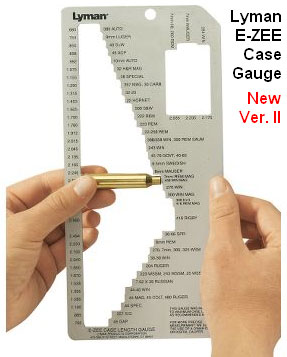
Lyman’s popular E-Zee Case Length Gauge II is now bigger and better. The latest version of Lyman’s Case Gauge is much larger than the original version. The Case Gauge II now measures more than 70 cartridge types — way more than before. This tool is a metal template with SAAMI-max-length slots for various cartridge types, including modern cartridges such as the Winchester Short Magnums. This tool allows you to quickly sort brass or check the dimensions. If you have a bucketful of mixed pistol brass this can save you hours of tedious work with calipers. You can also quickly check case lengths to see if it’s time to trim your fired brass.
If you load a wide variety of calibers, or do a lot of pistol shooting, we think you should pick up one of these Lyman Case Gauge templates. They are currently available for $24.99 at Brownells, $25.99 at MidwayUSA, and $30.53 on Amazon. The E-Zee Case Gauge has long been a popular item for hand-loaders.
NOTE: For years the E-Zee Case Gauge had a silver finish with black lettering, as shown above. Some of the most recent production of E-Zee gauges have a new “high contrast” look, with white lettering on a black frame. You may get either version when you order online — Brownells and MidwayUSA show silver, while Amazon shows black. We actually prefer the older silver version. Below is the black and white variant.
Lyman Case Gauge Should Last a Lifetime
Easily measure the case length of over 70 popular rifle and pistol cases with Lyman’s E-Zee Case Length Gauge. This really is a “must-have” piece of kit for any gun owner who hand-loads numerous pistol and rifle calibers.
This precisely-made metal gauge makes sorting or identifying cases fast and accurate. The template is machined with SAAMI max recommended case lengths. Made from metal, with no moving parts, the E-Zee Case Gauge should last a lifetime. The Lyman E-Zee Gauges offered by Brownells are silver with black lettering, while other Case Gauge models are black with white lettering.
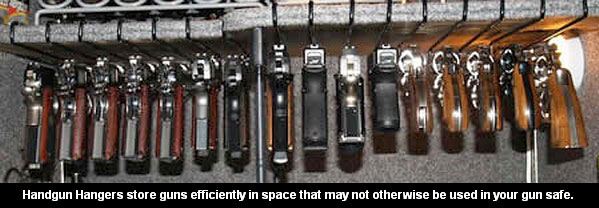
If you’re looking for a space-saving handgun storage system, consider the Easy Use Gun Hangers from AmeriGun Club. These vinyl-coated, wire hangers organize handguns below the shelves in your gunsafe, freeing up storage space above the shelves. To use the handgun hangers, simply slide each hanger on the shelf and then slip your pistol’s barrel over the lower rod. Handgun Hangers are intended for guns with an overall length of 10 inches or shorter. They will fit shelves that are at least 11 inches deep and 5/8-1 inch in thickness. Handgun Hangers will hold handguns .22 caliber and up, though the fit is a bit snug on .22s. A four-pack of AmeriGun Club Handgun Hangers costs $9.99.
WARNING — ALWAYS Make Sure Handgun is UNLOADED when using Handgun Hangers!!
Boomstick also offers Over-Under Hangers that hold two handguns — one above the shelf, and one below. A two-pack of Over-Under Hangers (capable of holding four handguns) costs $9.99 on Amazon. This may be a good solution for you. This Editor personally prefers standard hangers which place pistols BELOW the shelf. That way I can use the upper surface of the shelf to hold odd-shaped items such as cameras, binoculars, and miscellaneous valuables.
With the increase in crime in major cities, home security is more important than ever. A large, heavy conventional safe is still the best way to store your full firearms collection. However, when seconds count, a rapid-access system may be a smart option. Using RFiD technology, and a spring-loaded door, this kind of rapid-access vault lets you instantly get your hands on your primary defensive rifle or shotgun.
For home use, we like this RAPiD Safe AR Gunlocker from Hornady. The spring-loaded door opens instantly when activated by the owner’s personal RFID devices. The AR Gunlocker ($389.99 on Amazon) also has a keypad so you can enter a combination if your RFID “key” is not around. Or you can use the supplied manual barrel-style metal key. Watch the video to see how the system works:
The RAPiD Safe AR Gunlocker RFID safe secures long guns in a steel-walled vault that can be stored in a closet, under a bed, or even in your vehicle. This will hold an AR and a shotgun with foam inserts. There are several options for entry: 1) Radio Frequency IDentification (RFID) tag system; 2) KeyPad; 3) Manual barrel-style metal key.
Provided Access Devices
For the AR Gunlocker, Hornady provides one RFID Wristband, one RFID Key Fob, and two RFID “stickers”. As a secondary entry method, you can program a four- to six-digit security code. Finally, you can use a manual lock if all power fails.
RAPiD Safe AR Gunlocker Specifications:
Exterior: 42″ Wide x 15.25″ Deep x 6.75″ High
Interior: 40.5″ Wide x 13.5″ Deep x 5.5″ High
Weight: 55 pounds
Power: 12-volt DC (with transformer from AC wall outlet) or four (4) AA batteries.
If you’re looking for a space-saving handgun storage system, consider the Easy Use Gun Hangers from USA GunClub, sold on Amazon. These vinyl-coated, wire hangers organize handguns below the shelves in your gunsafe, freeing up storage space above the shelves. To use the handgun hangers, simply slide each hanger on the shelf and then slip your pistol’s barrel over the lower rod. Handgun Hangers are intended for guns with an overall length of 10 inches or shorter. They will fit shelves that are at least 11 inches deep and 5/8-1 inch in thickness. Handgun Hangers will hold handguns .22 caliber and up, though the fit is a bit snug on .22s. A four-pack of Handgun Hangers costs $8.99 on Amazon. This product has been an Amazon Best Seller among handgun storage accessories.
WARNING — Always Make Sure Handgun is UNLOADED when using Handgun Hangers!!
USA GunClub also offers an Over-Under Hanger that holds two handguns — one above the shelf, and one below. A two-pack of Over-Under Hangers (capable of holding four handguns) costs $9.99 on Amazon. This may be a good solution for you. This Editor personally prefers the standard model, so I can use the upper surface of the shelf to hold odd-shaped items such as cameras, binoculars, and miscellaneous valuables.
If the battery on your safe’s electronic lock is more than a year old, or if it is not giving you the right voltage, replace it today!
Check Your Gun Safe Batteries
We’re into Q2 of 2024 already. Hey guys — when was the last time you replaced the batteries in your gun safe? Has it been more than a year? If so, it’s time you get a new battery (or two) for that safe. The electronic keypad won’t work with an insufficient charge, and the lock system could potentially lose its combination memory if you wait too long.
IMPORTANT: If you have a safe with an electronic keypad, you should replace the battery every year as a precautionary measure. Trust us, you don’t want to come back in a few months and find that the keypad memory is kaput, and you’re locked out. That can lead to frustration and an expensive locksmith visit.
Here’s a true story. I have one safe with a Sargent & Greenleaf (S&G) keypad. A couple years back, in early December, I went to get into the safe. I punched in the correct combination, but all I got was a rapid “beep, beep, beep, beep” after I finished the last combination entry. I tried again to ensure I entered the combination correctly (I did). But again, the locking system responded with multiple rapid beeps indicating something was wrong. And the safe would not open. Now I was worried….
I popped out the battery holder (which slides in from the bottom of the keypad housing on the door). I removed the battery and tested it with a volt-meter. The 12-month-old Duracell 9-volt battery only registered 6.1 volts.
Low voltage was the problem. I went down to the store and got a couple new 9V batteries. I tested the new batteries and both measured 9.4 volts output. I slipped one of the new 9V batteries into the keypad housing, punched in the combination and everything worked OK again. Eureka.
Most electronic locks for safes WILL “remember” the combination for a period of time even when the battery is low (and the keypad’s “brain” should retain the combination when you remove the battery for replacement). However, a dead battery, or extended periods of low voltage can give you problems. Don’t rely on wishful thinking…
Everyone should have a heavy-duty, thick-walled steel gunsafe for their firearms and valuables. Ideally this should weigh 400+ pounds and offer fire protection for the contents. However, a gun owner may also want more rapid access to defensive arms and security items, in a different part of the home. That is where the “hidden in plain sight” concept comes into play.
Freedom Cabinet Holds Long Arms and Pistols — RFID Access
The unique Freedom Cabinet, shown above, is a patriotic, wall-mounted Stars & Stripes Flag-themed concealment unit. Available in Wood, Steel, or Carbon Fiber, each secure Freedom Cabinet features inlaid steel and Invisible RFID or Biometric locking systems. The Freedom Cabinet regularly costs $229.95. Along with this flip-up Freedom cabinet, there is a “Slider” version priced at $284.95.
Get the 20% discounts this Memorial Day week with CODE “THANKYOU20″. Later, for Father’s Day week, save 20% with CODE “DAD20″
Tactical Walls Shelf Secure Storage Unit
TacticalWalls.com, producers of home security/concealment products, offers clever furniture item that hold defensive arms. We like the big model 1242 Top Locking Shelf. This will hold a long gun plus a pistol and other items, which can be accessed rapidly with magnetic keys. The foam-lined secret compartment measures 12″ Deep x 42″ Wide. Price starts at $540.00.
Tactical Walls also have a smaller model 825 Top Locking Shelf that holds two pistols and some small accessories. This model 82 has a 8″ x 25″ W foam-lined hidden compartment accessed by magnetic keys. The model 825 locking Shelf retails for $473.00 – $405.00, depending on wood choice.
If the battery on your safe’s electronic lock is more than a year old, or if it is not giving you the right voltage, replace it today!
Check Your Gun Safe Batteries
We’re halfway through 2023. Hey guys — when was the last time you replaced the batteries in your gun safe? Has it been more than a year? If so, it’s time you get a new battery (or two) for that safe. The electronic keypad won’t work with an insufficient charge, and the lock system could potentially lose its combination memory if you wait too long.
IMPORTANT: If you have a safe with an electronic keypad, you should replace the battery every year as a precautionary measure. Trust us, you don’t want to come back in a few months and find that the keypad memory is kaput, and you’re locked out. That can lead to frustration and an expensive locksmith visit.
Here’s a true story. I have one safe with a Sargent & Greenleaf (S&G) keypad. A couple years back, in early December, I went to get into the safe. I punched in the correct combination, but all I got was a rapid “beep, beep, beep, beep” after I finished the last combination entry. I tried again to ensure I entered the combination correctly (I did). But again, the locking system responded with multiple rapid beeps indicating something was wrong. And the safe would not open. Now I was worried….
I popped out the battery holder (which slides in from the bottom of the keypad housing on the door). I removed the battery and tested it with a volt-meter. The 12-month-old Duracell 9-volt battery only registered 6.1 volts.
Low voltage was the problem. I went down to the store and got a couple new 9V batteries. I tested the new batteries and both measured 9.4 volts output. I slipped one of the new 9V batteries into the keypad housing, punched in the combination and everything worked OK again. Eureka.
Most electronic locks for safes WILL “remember” the combination for a period of time even when the battery is low (and the keypad’s “brain” should retain the combination when you remove the battery for replacement). However, a dead battery, or extended periods of low voltage can give you problems. Don’t rely on wishful thinking…
In recognition of June as National Safety Month, the NSSF reminds guns owners that their most important responsibility is to store their firearms securely when not in use. New and long-time gun owners sometimes underestimate the danger of leaving firearms unsecured, which can potentially lead to such risks as: A child getting into a bedside table or closet and finding a loaded gun; A criminal stealing an unsecured firearm from one’s home or vehicle; or a teen at risk for suicide obtaining an adult’s firearm.
With schools closing soon for the summer and kids spending more time at home, firearms safety is more important than ever. Given that fact, the NSSF reminds gun owners to keep their guns locked up so they cannot be accessed by children. The NSSF urges gun owners to keep firearms safety a top priority. All gun owners must remember that it is vital to use gun locks and secure storage at all times.
We also know that stolen firearms contribute to violent crime in the U.S. Gun thefts from cars, in particular, are a persistent source of stolen guns. This means that gun owners—if they fail to secure their firearms in their vehicles—could have their gun stolen and potentially used in a crime—and no one wants their gun used by a criminal.
That’s why it’s so important, as a responsible gun owner, to make sure you’re practicing secure firearm storage and to encourage fellow gun owners to do the same. You have many choices of safety devices to fit your needs and lifestyle — from free Project ChildSafe® cable gun locks available at local law enforcement agencies to lockable gun cases, lock boxes, and full-size safes.
Firearms Security and Safety in Vehicles
“More parents are assuming the role of educators in their homes, so it’s a good to time have a talk with your kids about gun safety, even if you don’t own a gun”, states Joe Bartozzi, NSSF President and CEO. “If you do own a firearm, be sure your family understands the safety rules regarding firearms in your home, and always store guns responsibly when not in use.”
If you’re looking for a space-saving handgun storage system, consider the Easy Use Gun Hangers from USA GunClub. These vinyl-coated, wire hangers organize handguns below the shelves in your gunsafe, freeing up storage space above the shelves. To use the handgun hangers, simply slide each hanger on the shelf and then slip your pistol’s barrel over the lower rod. Handgun Hangers are intended for guns with an overall length of 10 inches or shorter. They will fit shelves that are at least 11 inches deep and 5/8-1 inch in thickness. Handgun Hangers will hold handguns .22 caliber and up, though the fit is a bit snug on .22s. A four-pack of Handgun Hangers costs $9.99. This product has been Amazon’s #1 Best Seller among handgun storage accessories.
WARNING — ALWAYS Make Sure Handgun is UNLOADED when using Handgun Hangers!!
Gun Storage Solutions offers an Over-Under Hanger that holds two handguns — one above the shelf, and one below. A two-pack of Over-Under Hangers (capable of holding four handguns) costs $17.95. Boomstick also sells an over-under two-pack for $9.49. Over-under hangers work well. However, this Editor personally prefers the standard handgun hangers (shown above), so I can use the upper surface of the shelf to hold odd-shaped items such as cameras, binoculars, and miscellaneous valuables.


 Gunsafes can be fitted with either an electronic keypad-style lock, or a conventional dial lock. In our Gunsafe Buyer’s Guide, we explain the important features of both dial and electronic lock systems. Many safe-makers will tell you that consumers prefer electronic locks for convenience. On the other hand, most of the locksmiths we’ve polled believe that the “old-fashioned” dial locks, such as the Sargent & Greenleaf model 6730, will be more reliable in the long run. CLICK HERE to learn more about the Pros and Cons of Mechanical (dial) Lock vs. Electronic (keypad) safe locking systems.
 Tips for Dial Locks
Replace Electronic Lock Batteries Every Year

 Lyman’s popular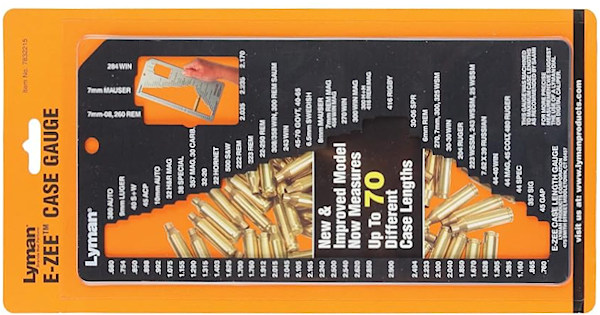


 The popular AmeriGun Club


 Check Your Gun Safe Batteries


 Check Your Gun Safe Batteries
 In recognition of June as National Safety Month, the NSSF reminds guns owners that their most important responsibility is to store their firearms securely when not in use. New and long-time gun owners sometimes underestimate the danger of leaving firearms unsecured, which can potentially lead to such risks as: A child getting into a bedside table or closet and finding a loaded gun; A criminal stealing an unsecured firearm from one’s home or vehicle; or a teen at risk for suicide obtaining an adult’s firearm.


