Notice the narrow configuration of the Harry Jones Range. The 1000-yard targets are located below the tree line in the rear center of the picture.
Report by Jack Mulroy for IBS
This year’s IBS 1000-Yard National Match was held August 29-30 at the Harry Jones Range in Fairview, West Virginia. Attendance was good — there were 74 Light Gun shooters and 66 Heavy Gun competitors. After a tune-up day, the 1000-Yard Match for record started on Friday, August 29, and finished on Saturday, August 30, 2014. The 1000-Yard National Match is a three target Aggregate. You shoot three times for Light Gun and three times for Heavy Gun. I guess the reason you shoot at three targets is because anybody can get “lucky once” (such as a blind squirrel finding a nut). Shooting luck happens “when preparation and hard work meet opportunity”.
Mike Gaizaukas, World Record Shooter at Harry Jones Range on August 29, 2014
The overall Two-Gun Champion and match winner was Steve Waldrep with 32 rank points. Close behind, with 33 rank points, was Jim Bauer, who finished second overall. Waldrep dominated the Heavy Gun (HG) division, posting the best HG score and winning HG overall. Waldrep shot a .300 WSM Heavy Gun featuring Lawton action, Bartlein barrel, Byers stock, and Nightforce scope. Waldrep’s Light Gun was also chambered in .300 WSM. It had a Remington action, Bartlein barrel, McMillan stock, and Weaver scope. Jewell triggers on both guns.
Overall Winner Steve Waldrep (Left) with assist from Stanley Taylor (right)
In Light Gun division, James Isaacson put on an impressive show, winning LG overall and posting smallest LG group. Jim Bauer (second overall in the Two-Gun), posted the top LG score.
Top Shooters by Division
Two Gun Overall——— Steve Waldrep
Heavy Gun Overall——- Steve Waldrep
Heavy Gun Score——— Steve Waldrep
Heavy Gun Group——– Mike Gaizaukas
(1000-Yard World Record/2.871 inches)
Light Gun Overall——– James Isaacson
Light Gun Group——— James Isaacson
Light Gun Score——— Jim Bauer
World Record 2.871″ HG Group by Gaizaukus
Mike Gaizaukus shot the small HG group for the match — a stunning 2.871″ ten-shot group. Pending approval, Mike’s group should be a new IBS 1000-yard world record. Congrats to Mike for his record group. Mike’s record-setting gun featured a 1:10″-twist Krieger barrel chambered by Mark King in .300 WSM. Mike shot Berger 210gr VLDs with CCI BR2 primers.
The Harry Jones Range
Founded in 2008, this facility was named in memory of the former property owner Harry Jones who passed away a few years ago and is buried on top of the hill next to the range. Presently the property is being administered by Harry’s daughter, Jean Dawson. The property has been in the family since 1840. The 1000-yard shooting facility is a covered pavilion that has 13 shooting positions with ambidextrous concrete bench tops sitting on a concrete floor. Behind the pavilion is a covered ready line where the relays-in-waiting can stage their equipment. (For this shoot only 12 benches were used.)
Very Narrow Range — “Like Shooting Up a Holler”
The Harry Jones range is very unique — it’s very narrow in width, approximately 100 feet wide, and runs slightly uphill to the targets. As they say in West Virginia, “It’s like shooting up a Holler”. If there is such a thing as a “Wind God,” he’s alive and well at the Harry Jones Range. Some very good scores and groups have been recorded at this range (including a world record 2.871″ 10-shot group in this very match.) A longtime shooter friend of mine, Ralph, used to say when I would complain about the wind, “Jack, there is no such thing as wind, just sight adjustments”. Ralph was right, no matter what range you are shooting at, you have to deal with the wind through sight adjustments. Looks like Mike was “Right On” when he made his adjustments.
The management and membership of this range have come a long way in developing this range over the last few years. Trees had to be removed, gravel put down, buildings built, creek flow re-routed, target areas built, and shooting benches installed. But the effort was worth it — Harry Jones has become a very serviceable range that is a great place to shoot.
The Harry Jones range is not blessed with much “elbow room,” due to the configuration of the range, but through thoughtful placement of the firing line and ready area, the range is doable. At this match, there were 74 light gun and 66 heavy gun shooters. This match was well managed and ran smoothly, but parking space was at a premium. In my estimation the 2014 1000-Yard Nationals were at capacity with the number of shooters registered.
$27,000 Prize Table (with Lots of Scopes)
Roughly $27,000 worth of prizes were awarded at this year’s 1000-Yard match. Valuable prizes included Nightforce scopes, stocks, rests, bullets and more. Two of the nicest gifts presented at the match were a pair of quilts made by property owner Jean Dawson. Thanks Jean! That was a very generous gift that a shooter and his family will treasure for years. Many thanks should go to Stanley Taylor from Douglas Barrel for his time and energy in acquiring most of the prizes presented at the match.
Serious Artillery on Display — Rick Murphy’s Metal-Stocked Heavy Gun
The prettiest gun and gun rest at the match belonged to Rick Murphy of Adamsville, Tennessee. The barrel was originally 36 inches long, but was shortened to 30 inches. The gun now shoots much better after the reduction in barrel length. This Heavy Gun and rest set-up were probably the most expensive pieces of equipment at the 1000-Yard match. Rick has been working on this rig for the last three years and has put countless hours into the production of his gun and gun rest. Rick placed 13th in the Heavy Gun overall.
Report by Samuel Hall (AccurateShooter.com Field Editor)
July 13th was a great day for breaking records. Three shooters have potentially broken four IBS 600-yard records (pending final approval) at the Piedmont Range in Rutherfordton, NC. Conditions were excellent and three shooters had outstanding multi-target performances. Mike Hanes, Chad Jenkins, and Randy Peele were tuned in and took advantage of the great weather. The entire day was overcast with a slight 3-5 MPH breeze, misting rain at times. It was one of the only days I can remember we could see bullet holes all day!
Chad Jenkins Shoots a 199 Four-target Score at 600 Yards
In Light Gun, Chad Jenkins posted a 199 Score Agg, just one point shy of a perfect 200 score for four targets. Consider this — at 600 yards, Chad put 19 out of 20 shots into a circle 2.8″ in diameter, dropping just one shot out of the 10-Ring on four consecutive targets. That’s impressive. We believe this is the highest 4-target Score Agg ever shot with any rifle. (In Light Gun, Stephen Hall posted a 198 in 2012, and in Heavy Gun class Eric Wilson had a 198 in 2011). Chad took advantage of the good conditions to post his 199 score (with 1.954″ group size tie breaker). Chad was shooting a standard (not improved) 6mmBR with no-turn necks. Chad’s Light Gun features a BAT MB dual-port action, Shehane ST-1000 stock, Krieger 1:8″ twist barrel, and Leupold 45X scope. Chad has several hundred rounds on this rifle and has one other record with it. Chad has done a lot of winning the last couple of years with his 6BR. He shoots Berger 105gr Target VLDs in blue box Lapua brass, pushed by 30.3 grains of Varget and CCI 450 primers. Chad shoots with a modestly-priced Caldwell joystick front rest. Chad proved that you don’t need the most exotic equipment to set records.
Mike Hanes Sets New Light Gun and Two-Gun Group Agg Records
Mike potentially broke the Light Gun (LG) four-target group aggregate record with a 1.496 Agg, bettering the old record of 1.5009 shot by Chad Jenkins in 2012. Mike also potentially broke the eight-target, Two-Gun (LG and HG) Group Agg record with a 1.7885 Aggregate. The old record was 1.8120 shot by Charlie Macke in 2012. In LG Mike was shooting a no-turn-neck 6 Dasher with a Brux 1:8″ twist barrel and Shehane ST-1000 stock. On his Light Gun, Mike was using one of the new Nightforce 15-55x52mm Competition scopes. I looked through it and I will have to say it is great glass! Mike’s load was: Berger 105 VLDs, with 32.7 grains of Reloder 15 powder sparked by CCI 450s. In Heavy Gun class, Mike shot a 6mm Dasher in a true heavy chassis — a 55-pound aluminum Gary Alvey stock formerly owned by Mike Davis. (See this beast below. This same stock had set a record in the hands of Mike Davis.)
Randy Peele Ties Heavy Gun 4-Target Score Record
Later in the afternoon in the Heavy Gun division, Randy Peele was on fire. Randy posted a first in group (1.894″) and a first in 4-target score (198) against some fierce competition. This ties the HG score record and is just off the tie-breaker group by a few thousandths. It will be submitted to the IBS Record Committee also. Congratulations of some fine shooting guys!
Readers said they enjoyed our write-up of an innovative, offset-stocked Heavy Gun that set three multi-match Aggregate IBS records last year. If you’re a fan of “Heavy Artillery” here’s an impressive rifle from Forum member ‘Straightpipes’ that we spotlighted last year. If you missed it the first time — check out this engineering Tour De Force, complete with a custom-built, joy-stick REAR rest. We’re mightily impressed by the cutting-edge design and superb metal-work displayed by this “home-built special”. ‘Straightpipes’ certainly proved that American “know-how” and creativity is still alive….
Coaxial (joy-stick) rests allow both vertical and horizontal movement with a single control. If you want to make a diagonal shift in point of aim, you can do this with one, smooth, continuous movement. Until now, this advantage has been limited to front rests. Well there’s some new technology in the benchrest world. Forum member ‘Straightpipes’ has created a coaxial rear joystick rest. He built this simple, compact rear rest in his home workshop for use with his 40-lb Heavy Gun. In combination with a vertically adjustable front rest, this new rear joystick rest allows aiming to be controlled from the rear, with your left hand in a comfortable position.
Straightpipes Rear Coaxial Rest — Design and Features
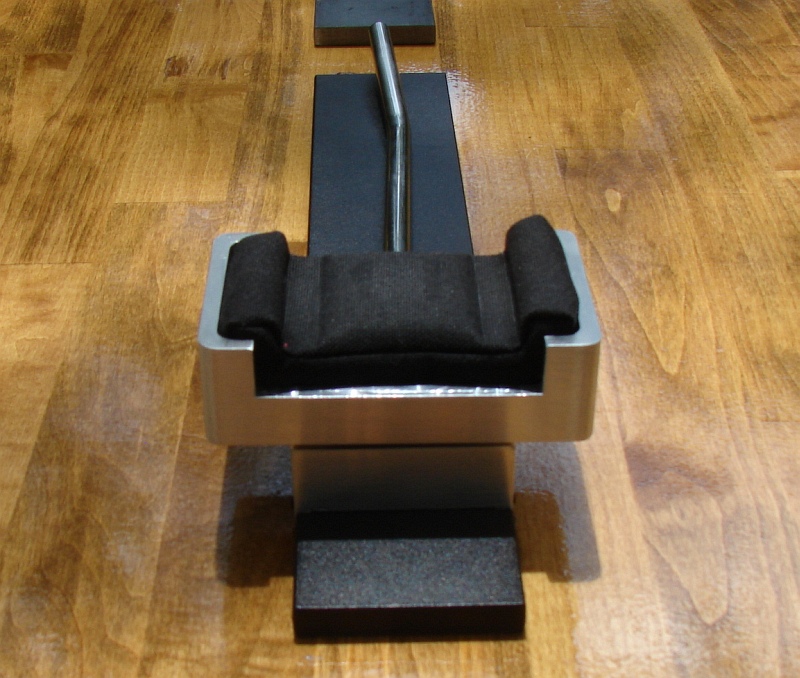
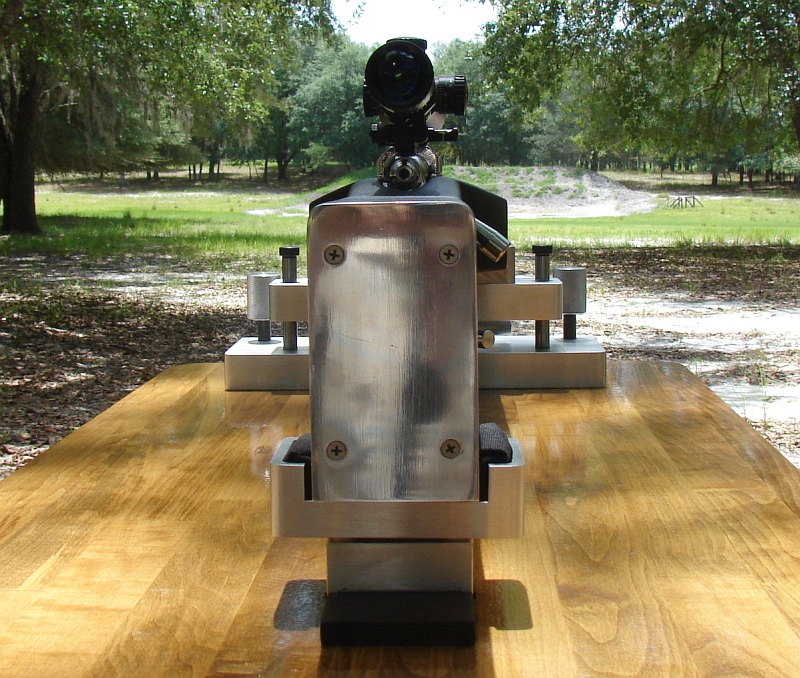
The rear rest is crafted from aluminum with a stainless steel forward-pointing joystick. Total weight, including the long, stabilizing base foot, is about 10 pounds. Though the rear rest doesn’t seem to have a large movement range, the system offers plenty of “on-target” travel. At 100 yards, the rest offers 10 MOA left, 10 MOA right, 5 MOA up, and 5 MOA down adjustment. That’s plenty of range for most targets, once you center the Point of Aim vertically using the captain’s wheel on the front rest, which Straightpipes also crafted himself. Click Square Photos Below to see Large Images.
Inside the rear cradle sits a Protektor rear sandbag, with Cordura fabric filled with ordinary sand. This fits the 3″-wide bottom of Straightpipes’ 40-lb heavy gun. There are some sophisticated components you can’t see in the photos. The rear rest can pivot (right or left slightly) to stay aligned with the front rest (as adjusted to level the cant of the rifle). Straightpipes says: “With the pivot, whatever I do to the front, the rear follows.” The basket (cradle) also employs a 20-lb bias spring system to handle the weight of the Heavy Gun. This prevents the co-axial system from binding, so it is fluid and easy to operate. Even with 20 pounds of gun weight on the rear, the joystick can be easily manipulated with a light touch of thumb and fore-finger.
Video Shows Rear Coaxial Rest in Action
Watch the video below to see how the joystick controls the rear rest. Total joystick movement is about a 2.5″ sweep. This gives 20 MOA total windage adjustment at 100 yards, and about 10 MOA vertical.
About the Straightpipes Front Rest
The coaxial rear rest is designed to work with the massive front rest as a system, though they are NOT connected, so as to comply with IBS Heavy Gun rules. The 30-lb front rest supports exactly half the weight of the rifle and is used to set gross elevation. Windage and fine elevation is controlled in the rear. Straightpipes also designed and built his beefy front rest himself. As with his rear coaxial unit, the front rest pieces were all shaped by hand on a belt sander after being milled out. Straitpipes even “finish-sculpted some pieces with hand files the old craftsmen way.” The main center support column was milled with extremely fine threads. This allows the captain’s wheel to turn with little effort and no locking mechanism is required. Straightpipes does not need to fuss with locking knobs when he sets gross elevation. To help keep the unit from binding, there are stainless guide shafts on the left and right. These shafts slide in oil-impregnated bronze bushings.
40-lb Barrel Block Heavy Gun with Savage Action
Straightpipes built this beautiful set of rests to work with his 40-lb Heavy Gun. Chambered in 7mm WSM, the gun features a Savage Target Action, and a Brux 32″, 1.300″ straight-diameter barrel fitted with a custom barrel nut. The barrel is clamped forward of the action in a 9″-long barrel block. This allows the Savage action to free-float. The block, also built by Straightpipes, looks fairly standard, but it has some clever design features. Between the barrel and the block there is sleeve that is slightly compressed when the block’s bolts are tensioned. This sleeve, made of a proprietary material, eliminates metal to metal contact between barrel and block. Straightpipes believes this enhances accuracy and provides some damping. Other shooters with barrel-block guns have used epoxy between block and barrel, but that makes disassembly difficult. The sleeve system on Straightpipes’ gun allows the barreled action to be easily removed from the stock. In addition, the compressed sleeve system is very stable — Straightpipes doesn’t have to fiddle with the bolt torques on his block.
‘Black Beauty’ Stock Made from Resin-Soaked Laminated Wood, with Rust-Oleum Finish
Straightpipes built the beefy stock himself. It is made from “red oak” wood soaked in resin and then laminated together with JB Weld. The rear section features a polished aluminum buttplate and twin metal “runners” on the underside, where the stock rides the Protektor Cordura bag. Straightpipes says the stock is very stable: “it absolutely does not flex or warp with changes in temp or humidity”. We asked Straightpipes about the stock finish. To our surprise, “Pipes” revealed he used inexpensive Rust-Oleum fine texture outdoor furniture paint. “Pipes” told us: “I’ve been using this stuff for years. It’s abrasion proof and tough as nails — the bags won’t wear it off. It’s solvent-proof, won’t get soft or bubble up. It cleans up with a damp cloth, just rub it down and it looks like new.”
As designed and crafted by Straightpipes, this Heavy Gun rest system is impressive. The rear rest is brilliantly simple, and beautifully finished. But the important question is: “how does it shoot?”. Straightpipes reports that the whole system exceeds his expectations: “The rear rest actuation is smooth and positive. It works smoothly in conjunction with the front rest. Everything is working together — there’s nothing that’s fighting another element of the system. The gun tracks straight. When it returns to battery, the thing is pretty much waiting for you shot after shot.” The rear rest’s small footprint allows the “driver” to sit comfortably behind the rig. Straightpipes reports: “Shooters can ‘address the rifle’ just like a Light Gun — you’re not straining to wrap your arm around something overly massive. Anybody can shoot this, it’s a very easy gun to shoot.”
Is it accurate? In a word, “Yes”. Straightpipes doesn’t want to make claims before the rig has been tested in competition, but he says it has “shot groups at 600 and 1000 yards that would be very competitive.” We promised not to publish group sizes yet, but we can tell you that at 600 yards in good conditions it drilled some “scary small” 5-shot groups, well, well under 1/4 MOA.
Match Report by Mike Wallace for the IBS, with photos by Hillary Martinez and Dean Breeden. This is the first in a series of in-depth match reports published jointly by the IBS and Accurateshooter.com.
The Bridgeville Rifle and Pistol Club (Bridgeville, DE) held 600-yard IBS matches on March 16 and 17 — a separate match on each day. These two matches were the final competitions counting towards Bridgeville’s 600-yard Shooter of the Year honors. Turn-out was strong, with 21 Light Gun (LG), 17 Heavy Gun (HG), and 1 Factory Class competitors. On Day 1, weather (for Bridgeville) was good, with temperatures as high as 54° F, winds less than gale force, periods of overcast and bright sun. On the 17th the shooters braved more challenging conditions. Temps ranged from the low 30s to as high as 40 degrees, with more wind than the previous day and snow flurries in the afternoon.
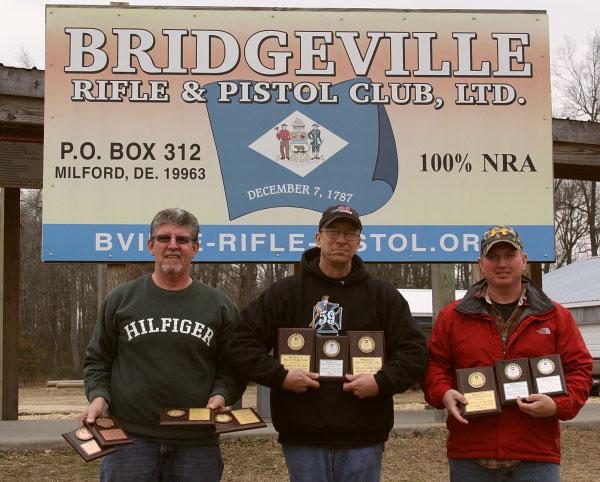
Topping the podium on March 16th for the Two-Gun Aggregate were Dewey Hancock (1st), Roy Hunter (2nd), and Craig Rowe (3rd). Top performers by Class were Dewey Hancock (2.3855 HG Group), Carey Lamb (196-2X, HG Score), Craig Rowe (2.2703 LG Group), Michael Wallace (189-2X, LG Score), and Robert Jones (4.9845, Factory Group; 172-2X Factory Score).
On March 17th, Craig Rowe, Roy Hunter, and Dewey Hancock finished first, second, and third respectively in the Two-Gun Agg. Class Winners were Jerry Ware (2.7213, HG Group), Roy Hunter (189-3X, HG Score), Dewey Hancock (2.1359, LG Group), and Craig Rowe (188-1X, LG Score). Robert Jones again won for group (6.9494) and score (159-0x) in the Factory Class.
Shooters L to R Craig Rowe, Roy Hunter, Dewey Hancock.
Competition is very keen at Bridgeville. Richard Timmons, Match Director, said, “It can be challenging….it can cause you to talk to yourself!” Rookies and those interested in taking up the sport are gladly welcomed and mentored. When asked his advice for new shooters in the sport, Richard said, “Factory Class is the best place to start for beginning shooters. There are some good factory guns out there that will shoot 600 yards.”
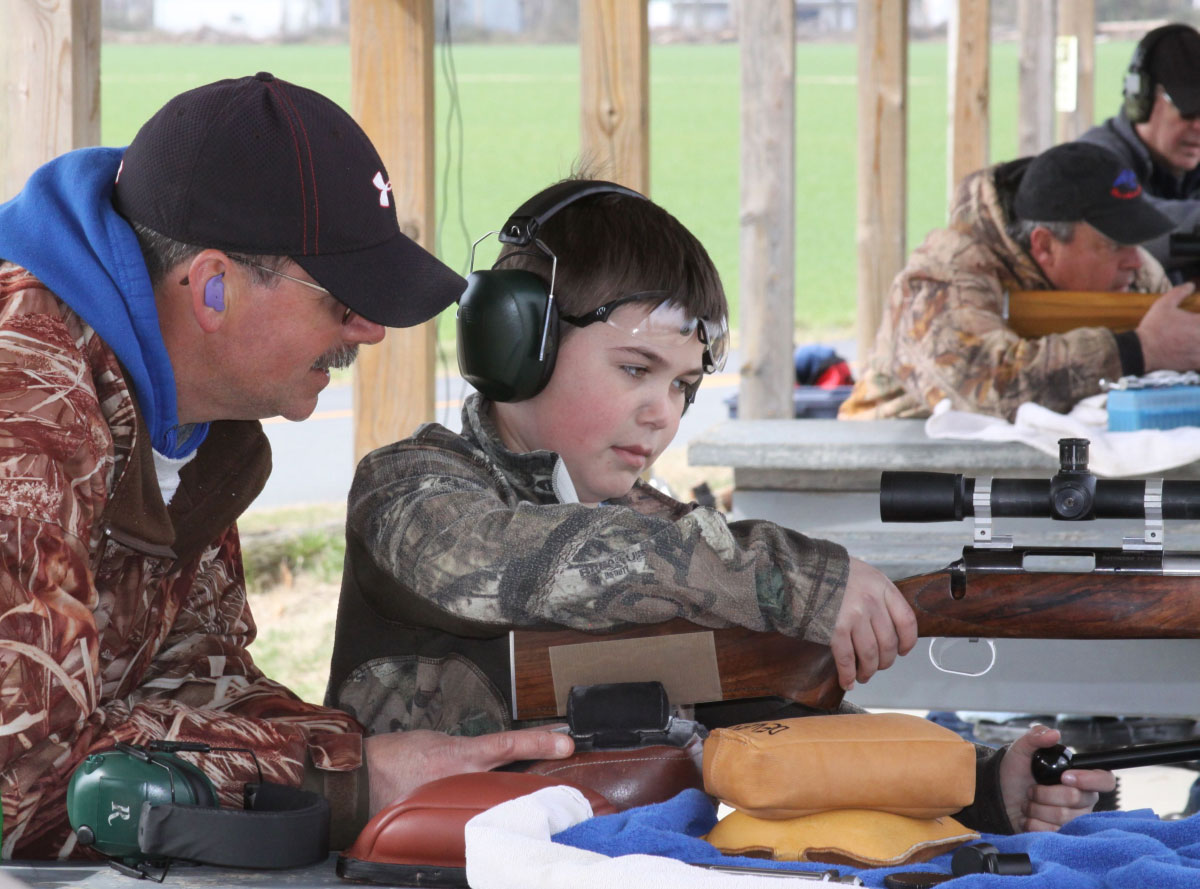
The Bridgeville matches showcased a bright, young talent. 12-year-old Kevin Donalds Jr., the youngest competitor at the two-day event, is already a shooter to be reckoned with — Kevin placed 2nd in Light Gun Group (2.5343) at the March 17th Match. Woe unto many of us later because Kevin plans on staying in the sport a long time!
Like Father, like Son… Kevin Donalds Sr. and Kevin Donalds Jr.
At this match, Bridgeville honored its 600-yard Shooters of the Year (SOY). Earning hard-fought SOY honors were the following shooters (listed 1st, 2nd and 3rd place for each Class).
Bridgeville Rifle & Pistol Club 600-Yard Shooters of the Year
Heavy Gun
1. Roy Hunter
2. Dewey Hancock
3. Bobby Mallory
Factory Class
1. Robert Jones
2. Terry Balding
3. Charles Thuet
Two-Gun
1. Dewey Hancock
2. Roy Hunter
3. Craig Rowe
Shooting at Bridgeville is Fun and Challenging Dewey Hancock is a rookie in his second year in the sport and is making a mark as you can see from match results and Shooter of the Year standings at Bridgeville R&P Club. He advises, “Good bench handling, good equipment, a good gunsmith, and good loading practice — these things will make you shoot with the good guys. You want to stay consistent in this game and that will eventually get you some wins.” When asked who his biggest competitor is, he smiled and said, “The wind!”, but then slipped in Roy Hunter’s name for 600 yards and Dean Breeden for the short range game. Dewey also stated what many of us in the sport know – “It is fun and the whole family can do it.”
Craig Rowe, in the sport for seven years shooting 600 yards and Score, said: “Bridgeville is a great place to shoot – great people – great food – and lots of great competition.” Craig cautions: “Don’t think you’re going to come here, walk in and steal the show, because there are a lot of good shooters.”
About the Bridgeville Club
The Bridgeville Rifle & Pistol Club, Ltd. was established over 50 years ago. The primary activity was NRA High Power Rifle competition at 200, 300 and 600 yards. There are 12 firing points on the High Power range. The Club recently opened its 1000-yard range, which also has firing points at 800 and 900 yards and is used for NRA Long Range Competition (Conventional, Fullbore, Palma, and F-Class) and IBS matches. The Club also has a multi-purpose range with a covered, concrete firing line with 15 benches and impact areas at 100, 200 and 300 yards. A pistol range has covered, concrete firing points and backstops at 25 and 50 yards. Another pistol range is open with five shooting lanes. This range is used for IDPA-style shooting, SASS (Cowboy Action) and Action Pistol. One 600-yard HG Score record has been set by Hal Drake at Bridgeville. For more information, visit www.Bville-rifle-pistol.org.
[haiku url=”http://accurateshooter.net/Video/samhallmax.mp3″]Click PLAY to hear Sam TALK about SEB MAX coaxial joystick rest.
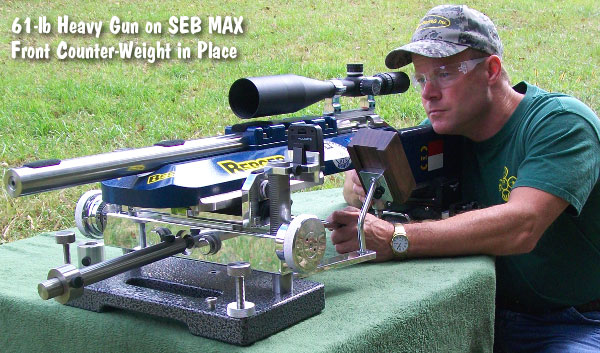
“It’s a keeper” — that’s what Sam Hall, 4-time IBS 600-yard Shooter of the Year, told us after he test-drove the new SEB MAX coaxial front rest. Over the past two months, Sam has been testing the new SEB MAX with his competition benchrest rifles, with a variety of forearm widths from three inches to eight inches, and weights from 17 to 61 pounds.
Did Sam like the SEB MAX? He did indeed — in fact he was so impressed with the MAX rest that he is selling his current front rest and he will be using the SEB MAX for both LG and HG matches.
In designing the SEB MAX rest, Sebastian (“Seb”) Lambang set out to build a rest that would handle true heavy guns up to 45kg and also adapt to lighter rifles with a variety of forearm widths. This was quite a challenge, but he pulled it off. The SEB MAX quickly adapts to fit narrow, medium, and wide forearms, with a simple adjustment of the side plates on the three-piece front bag. You can change from 3″ to 5″ to 8″ width in seconds. If you prefer a conventional one-piece front sand-bag, SEB offers one-piece bags sized to fit various forearm widths from 2.5″ to 8″.
The SEB MAX also adapts to different rifle weights through the use of a front counter-weight for the heavy big boomers. With a standard 17-lb Light Gun, you can run the MAX with no counterweight. The joystick control movement is very smooth and with the internal springs tuned right, you can shoot with your hand off the joystick. When you want to switch to a true Heavy Gun, simply attach the counterweight arm to the front of the gun. SEB can supply custom counter-weight “donuts” tuned to your specific Heavy Gun. Sam Hall reviews the features of the SEB MAX in the video below.
Watch SEB MAX Video Review (Part 1 — Light Gun)
Does the SEB MAX retain its smooth movement even with a true Heavy Gun on the front bags? Absolutely. Sam reports that “When shooting my 61-pounder, with the counter-weight in place, the joystick movement is smooth and predictable — it feels just like the Light Gun”.
To prove how well the counter-balancer works with a true Heavy Gun, Sam put his 61-lb Maxi-Tracker on the SEB MAX, attached the appropriate counterweight, and then shot a group at 600 yards without touching the joystick during a four-shot string. To Sam’s amazement, the gun produced a 4-shot group under 1.5″. Sam says: “That was in mid-day with some mirage. That’s about the best this gun can do in those conditions. It was impressive to be able to run a string with a 61-pounder and not touch the joystick.” You can see this in the Part 2 Video below.
Watch SEB MAX Video Review (Part 2 — Heavy Gun)
Superior Build Quality, Unique Versatility, and Outstanding Performance
Sam had high praise for the workmanship, fit, and finish of the SEB MAX: “This rest is a work of art. I’m not easily impressed by most products, but this is one fine machine.” Sam added that the SEB MAX is not just pretty — everything functions very well: “The sideplates have quick-release handles so you can change widths quickly. The course elevation control is very smooth and easy to use. With the course elevation locked, there is plenty of vertical travel (elevation) and plenty of side-to-side travel with just the joystick.” Sam was also impressed with how well the 61-pounder tracked on the SEB MAX: “I’ve been playing with it… and the gun seems to track perfect.”
Sam also praised the micro-fiber fabric SEB uses for both the three-piece and conventional one-piece front bags: “This micro-fiber is great. You don’t need to use any silicon or powder or anything to slick it up, yet the forearm slides on it better than anything I’ve ever seen.”
Sam likes the modular construction of the SEB MAX. Sam found that, when he was just shooting a Light Gun, he could remove the rear foot, making the rest easier to move around. Like the SEB NEO rest, the MAX rest breaks down into flat modules so it packs more compactly for shipping.
SEB MAX rests are currently in the final stages of production. Price for the USA market has not yet been set. You can get on the pre-order waiting list by contacting Ernie Bishop in Gillette, Wyoming. Call (307) 257-7431, or email ernieemily [at] yahoo.com. For other markets consult dealer list on www.SebCoax.com.
Weight: The MAX weighs approximately 18.4 kg (40.5 lbs) without the counter-weight, with bags empty. Sam’s rest with full bags and counter-weight is about 45 pounds.
Rest Size: Side to side footprint (center to center of leveling screws) is approximately 13.78″. Dimension from back to front is about 14.17″.
Coaxial (joy-stick) rests allow both vertical and horizontal movement with a single control. If you want to make a diagonal shift in point of aim, you can do this with one, smooth, continuous movement. Until now, this advantage has been limited to front rests. Well there’s some new technology in the benchrest world. Forum member ‘Straightpipes’ has created a coaxial rear joystick rest. He built this simple, compact rear rest in his home workshop for use with his 40-lb Heavy Gun. In combination with a vertically adjustable front rest, this new rear joystick rest allows aiming to be controlled from the rear, with your left hand in a comfortable position.
Straightpipes Rear Coaxial Rest — Design and Features
The rear rest is crafted from aluminum with a stainless steel forward-pointing joystick. Total weight, including the long, stabilizing base foot, is about 10 pounds. Though the rear rest doesn’t seem to have a large movement range, the system offers plenty of “on-target” travel. At 100 yards, the rest offers 10 MOA left, 10 MOA right, 5 MOA up, and 5 MOA down adjustment. That’s plenty of range for most targets, once you center the Point of Aim vertically using the captain’s wheel on the front rest, which Straightpipes also crafted himself. Click Square Photos Below to see Large Images.
Inside the rear cradle sits a Protektor rear sandbag, with Cordura fabric filled with ordinary sand. This fits the 3″-wide bottom of Straightpipes’ 40-lb heavy gun. There are some sophisticated components you can’t see in the photos. The rear rest can pivot (right or left slightly) to stay aligned with the front rest (as adjusted to level the cant of the rifle). Straightpipes says: “With the pivot, whatever I do to the front, the rear follows.” The basket (cradle) also employs a 20-lb bias spring system to handle the weight of the Heavy Gun. This prevents the co-axial system from binding, so it is fluid and easy to operate. Even with 20 pounds of gun weight on the rear, the joystick can be easily manipulated with a light touch of thumb and fore-finger.
Video Shows Rear Coaxial Rest in Action
Watch the video below to see how the joystick controls the rear rest. Total joystick movement is about a 2.5″ sweep. This gives 20 MOA total windage adjustment at 100 yards, and about 10 MOA vertical.
About the Straightpipes Front Rest
The coaxial rear rest is designed to work with the massive front rest as a system, though they are NOT connected, so as to comply with IBS Heavy Gun rules. The 30-lb front rest supports exactly half the weight of the rifle and is used to set gross elevation. Windage and fine elevation is controlled in the rear. Straightpipes also designed and built his beefy front rest himself. As with his rear coaxial unit, the front rest pieces were all shaped by hand on a belt sander after being milled out. Straitpipes even “finish-sculpted some pieces with hand files the old craftsmen way.” The main center support column was milled with extremely fine threads. This allows the captain’s wheel to turn with little effort and no locking mechanism is required. Straightpipes does not need to fuss with locking knobs when he sets gross elevation. To help keep the unit from binding, there are stainless guide shafts on the left and right. These shafts slide in oil-impregnated bronze bushings.
40-lb Barrel Block Heavy Gun with Savage Action
Straightpipes built this beautiful set of rests to work with his 40-lb Heavy Gun. Chambered in 7mm WSM, the gun features a Savage Target Action, and a Brux 32″, 1.300″ straight-diameter barrel fitted with a custom barrel nut. The barrel is clamped forward of the action in a 9″-long barrel block. This allows the Savage action to free-float. The block, also built by Straightpipes, looks fairly standard, but it has some clever design features. Between the barrel and the block there is sleeve that is slightly compressed when the block’s bolts are tensioned. This sleeve, made of a proprietary material, eliminates metal to metal contact between barrel and block. Straightpipes believes this enhances accuracy and provides some damping. Other shooters with barrel-block guns have used epoxy between block and barrel, but that makes disassembly difficult. The sleeve system on Straightpipes’ gun allows the barreled action to be easily removed from the stock. In addition, the compressed sleeve system is very stable — Straightpipes doesn’t have to fiddle with the bolt torques on his block.
‘Black Beauty’ Stock Made from Resin-Soaked Laminated Wood, with Rust-Oleum Finish
Straightpipes built the beefy stock himself. It is made from “red oak” wood soaked in resin and then laminated together with JB Weld. The rear section features a polished aluminum buttplate and twin metal “runners” on the underside, where the stock rides the Protektor Cordura bag. Straightpipes says the stock is very stable: “it absolutely does not flex or warp with changes in temp or humidity”. We asked Straightpipes about the stock finish. To our surprise, “Pipes” revealed he used inexpensive Rust-Oleum fine texture outdoor furniture paint. “Pipes” told us: “I’ve been using this stuff for years. It’s abrasion proof and tough as nails — the bags won’t wear it off. It’s solvent-proof, won’t get soft or bubble up. It cleans up with a damp cloth, just rub it down and it looks like new.”
As designed and crafted by Straightpipes, this Heavy Gun rest system is impressive. The rear rest is brilliantly simple, and beautifully finished. But the important question is: “how does it shoot?”. Straightpipes reports that the whole system exceeds his expectations: “The rear rest actuation is smooth and positive. It works smoothly in conjunction with the front rest. Everything is working together — there’s nothing that’s fighting another element of the system. The gun tracks straight. When it returns to battery, the thing is pretty much waiting for you shot after shot.” The rear rest’s small footprint allows the “driver” to sit comfortably behind the rig. Straightpipes reports: “Shooters can ‘address the rifle’ just like a Light Gun — you’re not straining to wrap your arm around something overly massive. Anybody can shoot this, it’s a very easy gun to shoot.”
Is it accurate? In a word, “Yes”. Straightpipes doesn’t want to make claims before the rig has been tested in competition, but he says it has “shot groups at 600 and 1000 yards that would be very competitive.” We promised not to publish group sizes yet, but we can tell you that at 600 yards in good conditions it drilled some “scary small” 5-shot groups, well, well under 1/4 MOA.
Sebastian Lambang, creator of the original SEB Coaxial Rest and the SEB NEO Rest, has a new product in the works. Seb has modified and upgraded his superb NEO rest, so that it can handle heavy, long-range benchrest rifles with ultra-wide forearms. Seb calls his super-sized front rest the SEB “MAX”. As you can see in the photo below, the MAX looks like a NEO but with a wider stance and more substantial rest top. Spring rates are optimized to handle rifle weights up to 45kg (99 pounds), using appropriate counterweights. Seb hopes to complete production of fifty (50) SEB MAX rests by late August 2012.
MAX Rests Use Counter-Weights to Handle Very Heavy Rifles
When configured for use with true Heavy Guns, SEB MAX rests will be supplied with adjustable counter-balance weights in load-specific sizes. For example, a 1.8-lb counter-weight is used for a 40-lb gun, a 2.3-lb counter-weight is used for a a 60-lb gun, while a 2.6-lb counter-weight is fitted for a 70-lb gun. The basic counter-weight can be augmented with additional steel sections. Seb tells us: “The basic ‘default’ counter-weight is a 1″-diameter shaft, about 7″ long. Additional 2.5″-diameter SS ‘rings’ can be fitted on the main shaft to balance the action. When people order the MAX, they must provide the weight of their gun. I will then craft the appropriate ‘rings’ in various sizes to properly balance the weight of the customer’s particular gun and thereby make the action smooth to operate.”
Watch SEB MAX Prototype Used by Stuart Elliot
In this video, Aussie Stuart Elliot uses a prototype SEB MAX with his .300 Win Mag Heavy Gun at a 1K benchrest match in Brisbane, Australia. Stuart, who runs BRT Shooters Supply, recently won the Australian 500m Fly Shoot Nationals shooting a .300 Win Mag.
New SEB MAX Rest Based on Successful NEO Rest Design
Below is the standard SEB NEO rest. The MAX is wider and will hold a rig up to 45kg. The MAX represents an evolution of the original NEO design. As anyone who has had the pleasure of using one knows, the NEO is very smooth to operate and has a huge range of vertical and horizontal travel. In addition, the NEO can be quickly dis-assembled to store flat. The new SEB MAX can likewise be dis-assembled for easier storage and transport. Photo by R.J.Hamilton.
Sebastian Lambang has a website at www.SebCoax.com, but you won’t find info on the SEB MAX there yet. If you have specific questions, send email to: sebastianlambang [at] yahoo.com.
For USA price list and to place orders, please contact:
Ernie Bishop
306 West Flying Circle Drive
Gillette, WY 82716
ernieemily [at] yahoo.com
Phone: (307) 257-7431
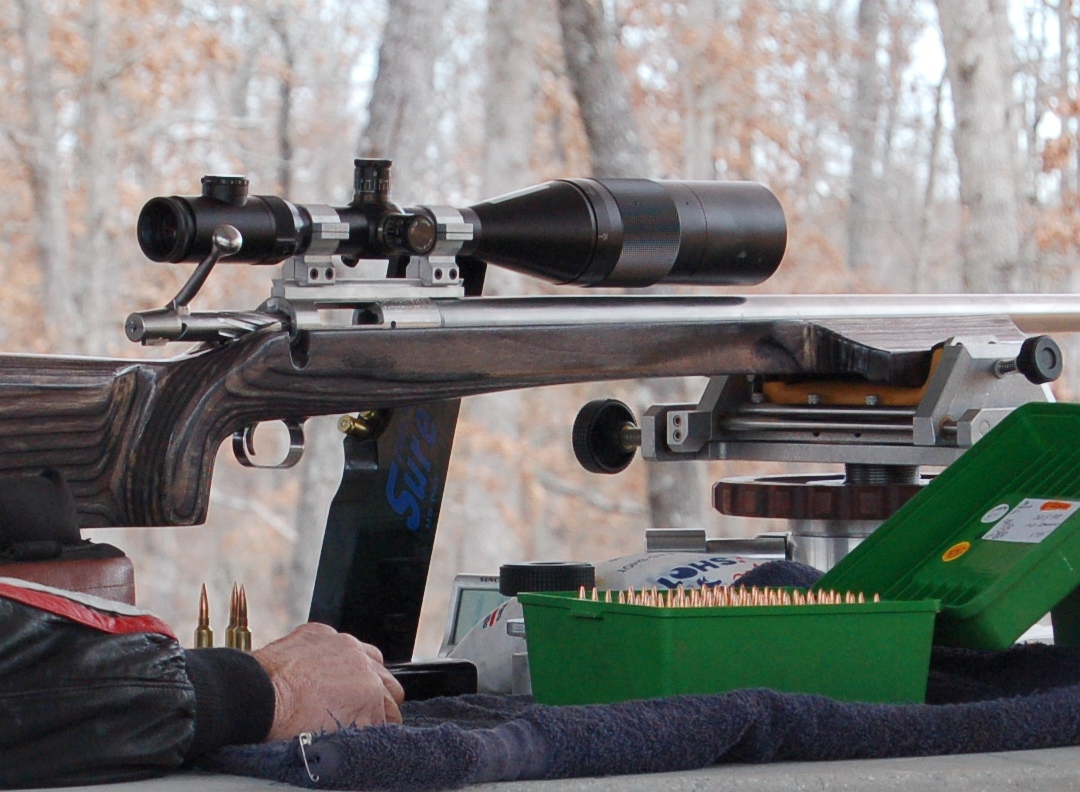
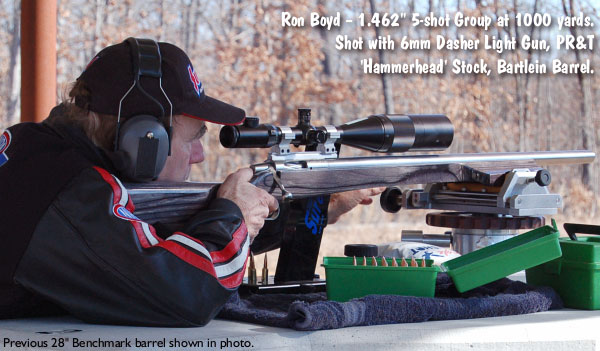
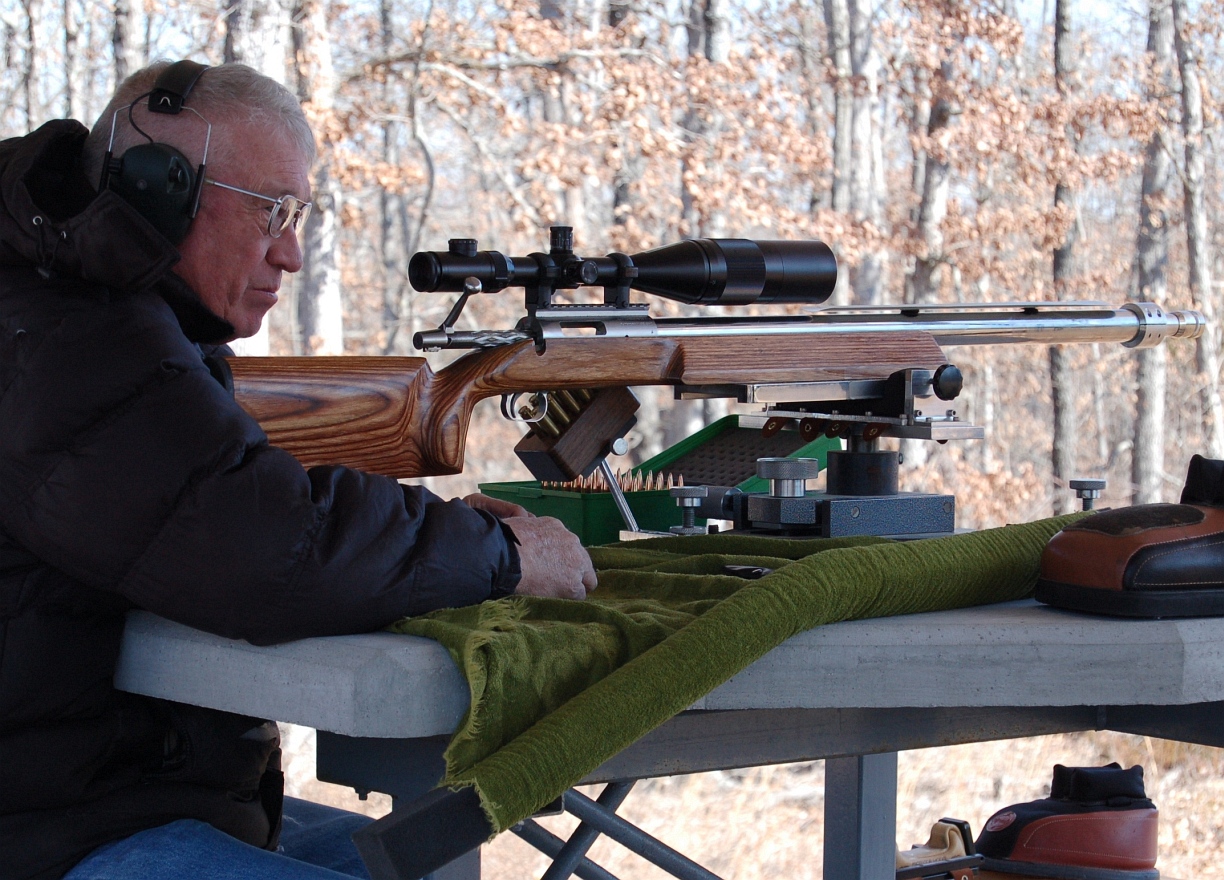
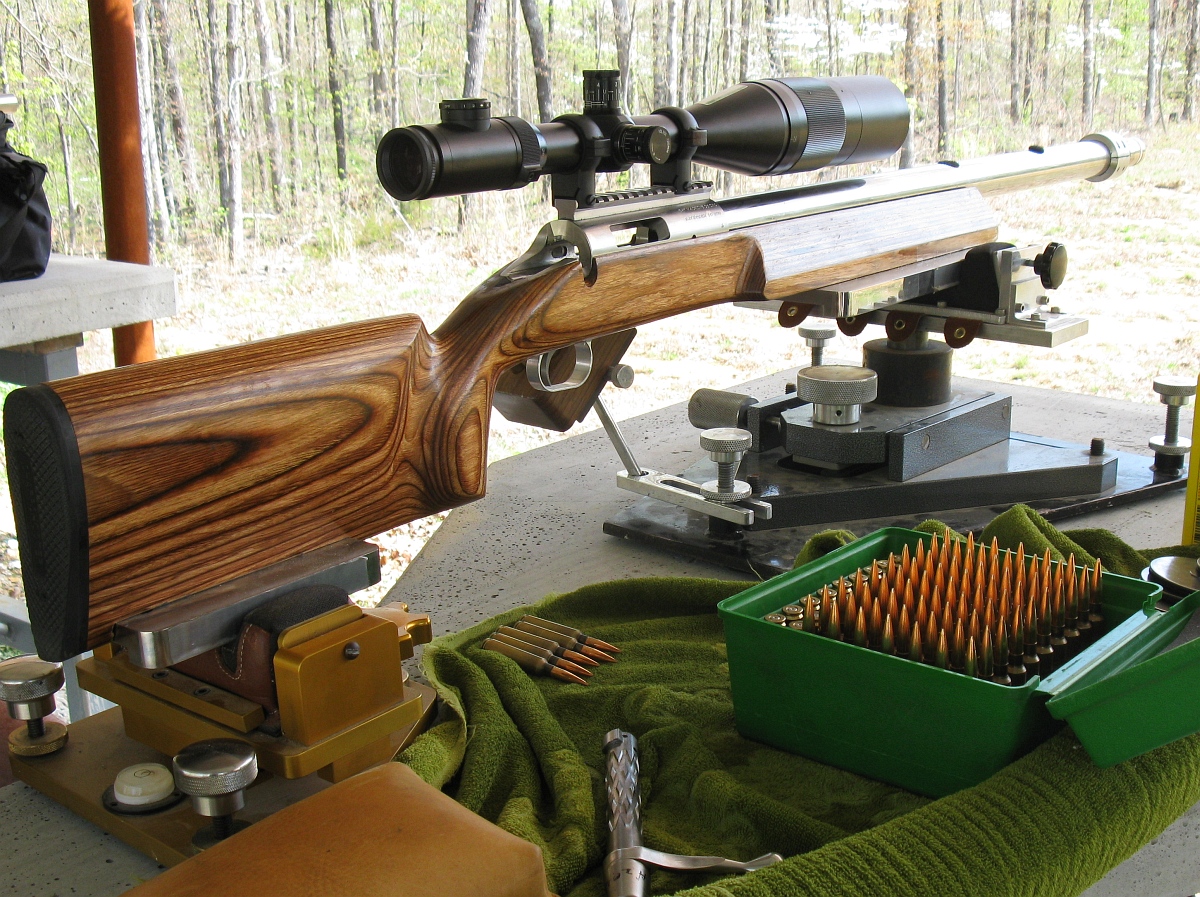
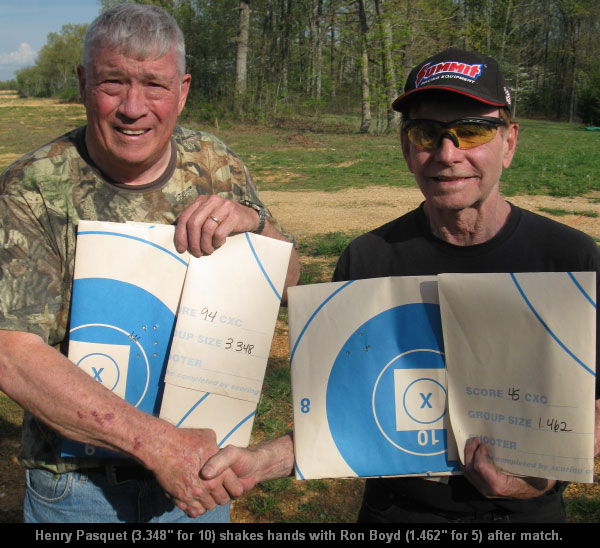
After we ran our Bulletin news item about Ron Boyd’s amazing 1.462″ 5-shot group at 1000 yards, many readers wanted to see some close-up photos of Ron’s rig. Thanks to Robert Ross of the MidWest Benchrest Club, we have some photos of Ron with his ultra-accurate 6mm Dasher 17-lb Light Gun. This rifle features a BAT SV action, Precision Rifle & Tool (PR&T) “Hammerhead stock” with 5″-wide front wings, Nightforce 12-42 Benchrest scope, and Jewell trigger. Ron had just added a 30″ 1:8″-twist Bartlein barrel to the gun before shooting the 1.462″ group. That barrel only had about 40 rounds through it when it produced the near-record group. The barrel in photos below was a 28″ Benchmark, recently replaced with the new Bartlein. Ron’s ultra-accurate 6 Dasher load consists of surplus Long Range Match powder, with Spencer 103gr bullets. Ron also anneals his Dasher brass after every firing.
CLICK Small gallery photos to view full-size images
Henry Pasquet’s .284 Win Heavy Gun
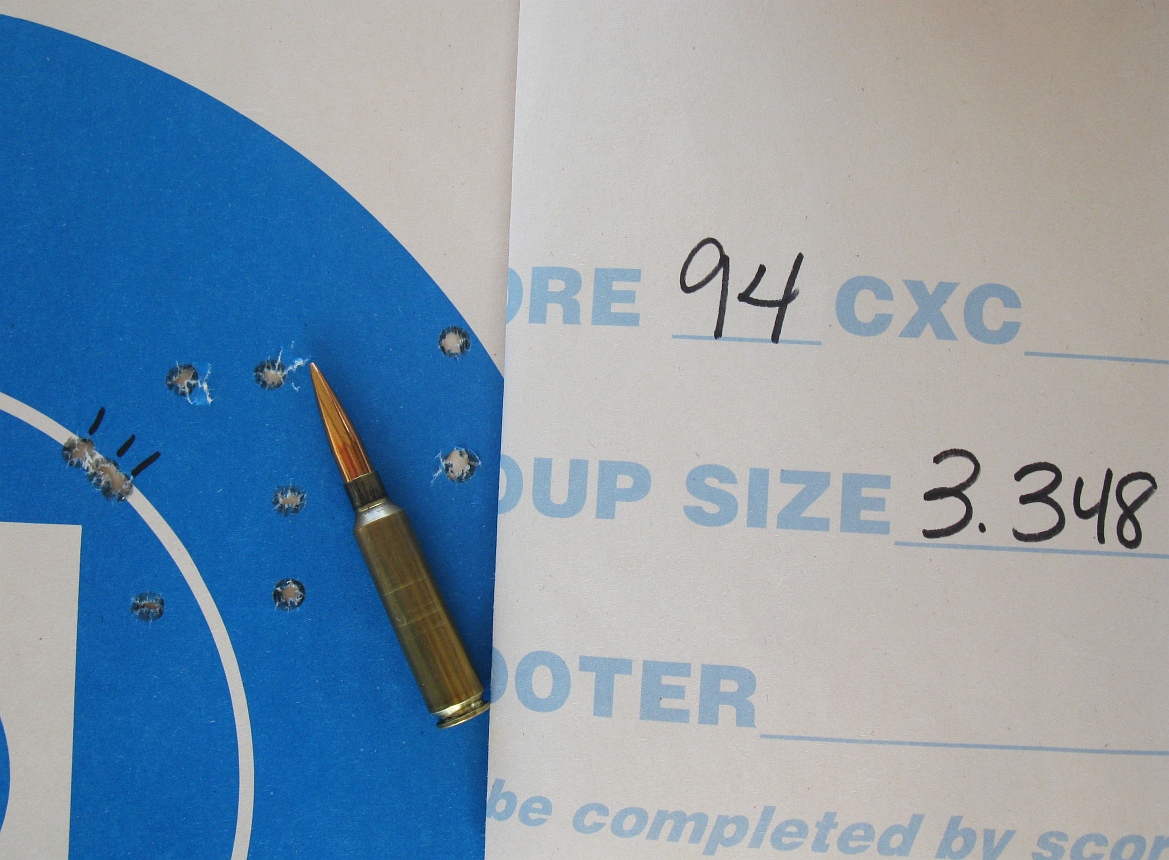
At the same Midwest Benchrest Club IBS match where Ron shot his small five-shot group, Henry Pasquet drilled a very impressive 3.348″ ten-shot group. This group was just .304″ off the IBS 10-shot Heavy Gun record of 3.044″ shot by Joel Pendergraft in 2009. We are told that Henry was running a straight .284 Winchester. You can see in the inset photos below that Henry uses a tuner on his barrel. He also has fitted an extra-wide front sled and a machined rear “keel” to reduce torque and improve tracking. Henry can adjust windage and elevation with BOTH his Fulghum front rest (from Randolph Machine) and his adjustable rear rest.
CLICK Small gallery photos to view full-size images
Editor’s NOTE: Though the product has some shortcomings, we wanted to show you guys the Hyskore Bench Beast Coaxial Competition Rest because it has some interesting engineering features (such as the scissors-jack primary elevator). The front bag holder won’t accept very wide fore-ends, and the high sides of the rear rest compromise your ability to get in close to the gun and work the rear controls while aiming. Still, there are few integrated front/rear rests on the market, so we thought you’d want to see this new offering from Hyskore.
At SHOT Show 2012, Hyskore unveiled an combined front/rear mechanical rest system appropriately named the Bench Beast. The front rest has a coaxial-type control activated by a long, angled joystick. Hyskore claims the joystick control provides 110 MOA adjustment for both windage and elevation.
For gross elevation changes, this contraption uses a scissors-jack type lift in the front that is definitely industrial in origin. In fact, the Bench Beast looks like something made in a Latvian tractor factory. But this may be useful for someone who wants a linked front and rear mechanical rest that can support a very heavy rifle (50 lbs. or more). It looks like the max width in the front is limited to 3″ so this would not work with a super-wide stock without modification. Too bad. Moreover, the front bag supplied with the Bench Beast is designed for narrow, hunter-style fore-ends. Even to run a 3″-wide gun, you’ll need to purchase an aftermarket bag. While Hyskore calls this a “competition rest”, the Bench Beast is not really set up for competition rifles.
About $500.00 for Combined Front and Rear Rests
The front and rear units can be purchased separately. Exact pricing is not yet set, but the front section should cost about $300, with the rear priced about $200.00. People should note, however, that, if you have full windage and elevation adjustment in the rear, you really only need gross height control in the front (to get on target). With a good rear rest, all the fine windage and elevation adjustment can be done from the rear, and, because of the geometry, a little bit goes a long way. It would be interesting to combine the Bench Beast’s rear unit with a simple (non-joystick) front pedestal rest.
Design Concerns
We’re intrigued with the Bench Beast’s rear unit, since there are few mass-produced, mechanical rear rests on the market. However, we have some concerns about the footprint, height, and overall size of the rear unit (SEE video 1:00-1:10). Ideally, a rear mechanical rest should allow the shooter to tuck in comfortably beside the gun. The Bench Beast has fat control knobs and tall support shafts placed far out from the centerline, on the extreme edges of the rear base.
While the wide rear base provides a solid platform, the outboard support columns and control knobs, we believe, make it difficult for the shooter to position his upper body close to the gun.
The main rear rest control knobs are also not conveniently placed. Look at the video carefully. Better rear rests have the controls further forward and closer to the centerline where they can be easily reached by the shooter’s non-trigger-pulling hand, in a comfortable shooting position. That way a right-handed shooter can easily use his left hand to work the controls while viewing the target through the scope, and holding the rifle grip with his right hand. We like the idea of an affordable rear mechanical rest, but we think the rear section of the Bench Beast would benefit from a major redesign.
Ransom recently introduced the Ransom Rifle Master ‘SL Mega Rest’, a large, modular rest system for FSCA, NBRSA, and IBS shooters and other shooting disciplines that allow a rest system. We persuaded accomplished NBRSA point blank and long range shooter John Crawford to check out this system and share his experiences. This article is Part One of a two-part series.
Ransom’s SL Mega Rest: Part One (First Impressions) by John Crawford
Upon receiving the Ransom SL Mega Rest, the first thing I noticed was how well the rest was packaged. There were two boxes, a large box holding the two base plates and a small box holding all of the small parts for the rest. The large box is double-walled, cardboard construction. It held up well to the rigors of shipping, keeping the two rest halves, each in their own inner box, in perfect shape.
Unpacking the Ransom SL Mega Rest one could not help but notice the weight of each half and their very attractive, black, Rhino coating. [Rhino coating is a heavy, extremely durable and tough, textured polyurethane coating commonly sprayed in the bed area of pickup trucks to protect the bed from damage.] Unpacking the small parts, which were all packaged separately for protection, gave me a good chance to note their excellent fit and finish. The small parts are made of steel and have a black oxide finish, including the ½:20-threaded legs which have nicely knurled knobs and lock rings. The black oxide finish compliments the bases.
Front Section
The front base and post, used exclusively for elevation adjustment, are well built and have some very nice features. The post, which is 1.25″ in diameter, has a keyway and key in the front to keep it from turning, and the lockdown bolt has a carbide ball in the end to lock the post in place. The mariner’s wheel has a cogged rubber belt on the outside (fits into a groove) and makes adjusting height easy and comfortable without hand slippage. The post assembly can be located, front-to-rear, in one inch increments, to provide a center-of-front-rest-base-to-center-of-rear-rest-base distance of from 24″ to 32″, thus accommodating an 8″ difference in stock length.
The Ransom SL Mega Rest’s elevation rest top is a modular system. The base for the rest top broke tradition and has two bolts, side by side, to hold it to the post, a welcome change from having a single bolt to hold the top on. With two bolts you reduce the stress when putting a heavy rifle on the rest. The front post is mounted to a plate that bolts down to the rest base. The rest base has a series of tapped holes that allows one to adjust the front rest location, front-to-rear, to fit different stock lengths.
Rear Section
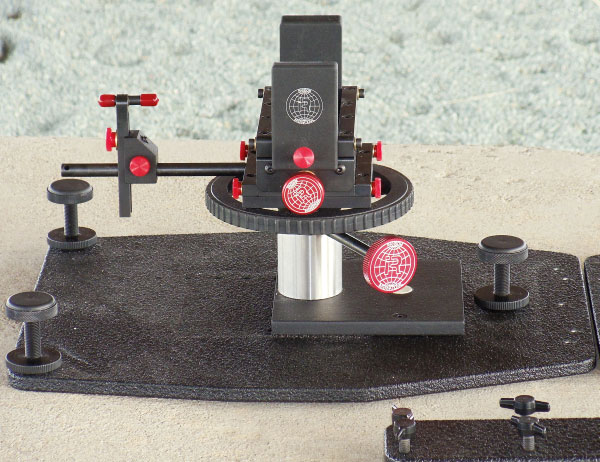
The rear rest, used exclusively for windage adjustment, has the rest top holder bolted in place. As a modular system, you can put the elevation rest top bag holder or windage top bag holder in either the front or rear rest as needed. You could also have a few different elevation rest tops or windage tops for different rifles. Both front and rear rests have a bubble level.
The Ransom SL Mega Rest’s windage top and bag holder are also modular. You can put the windage top and bag holder, or just the bag holder, in either the front or rear rest by removing four thumb screws and changing the tops. You can buy different width rest tops and swap them out in a few minutes, a nice feature for different stock length and width configurations. The windage top has a dovetail fit with a center bolt to hold the top in place and has no perceivable side play or movement, nice and tight and the windage adjusts easily.
The forearm stop is well thought out and fully adjustable for height and length to accommodate different front bag heights and stock lengths/positions. It can be adjusted forward about 4″ and, in height, from 1-1/2″ to 3-1/2″. It easily adjusts with two thumb screws.
83 pounds of Steel Solidity
The bridge plate between the front and rear rests is also black Rhino-coated, matching the bases. There are four dowel pins in the bridge plate for alignment and six 5/16-18 bolts that securely hold the bridge plate in place. The rest can be shot with the bridge plate in place, as a one-piece rest system, or the bridge plate can be removed, making it a two-piece rest system.
The rear rest with windage top weighs 38 pounds and the front rest weighs 45 pounds, for a total weight of 83 pounds. This is without sand bags or sand. Overall the all-steel-construction, Ransom SL Mega Rest is well thought out, nicely finished, and made to the standards and quality you would expect from the Ransom Company. The MSRP for the whole unit (everything except sand bags) is $1,330.00. This includes front heavy bag plate, and rear windage-adjustable bag plate. Additional plates (for different sized bags) start at about $90.00. Next step is to fill my sand bags and do some field testing. We’ll cover that in Part Two of this review, later this spring.




 Competition is very keen at Bridgeville. Richard Timmons, Match Director, said, “It can be challenging….it can cause you to talk to yourself!” Rookies and those interested in taking up the sport are gladly welcomed and mentored. When asked his advice for new shooters in the sport, Richard said, “Factory Class is the best place to start for beginning shooters. There are some good factory guns out there that will shoot 600 yards.”
 Dewey Hancock is a rookie in his second year in the sport and is making a mark as you can see from match results and Shooter of the Year standings at Bridgeville R&P Club. He advises, “Good bench handling, good equipment, a good gunsmith, and good loading practice — these things will make you shoot with the good guys. You want to stay consistent in this game and that will eventually get you some wins.” When asked who his biggest competitor is, he smiled and said, “The wind!”, but then slipped in Roy Hunter’s name for 600 yards and Dean Breeden for the short range game. Dewey also stated what many of us in the sport know – “It is fun and the whole family can do it.”





 Design Concerns
 Rear Section


