Here’s an AR configuration suited to the new AR Mid-Range Prone Discipline: Moderate-length barrel, Harris Bipod, Leupold Mark AR MOD 1 4-12x40mm scope. Photobucket image by Ingo1978.
The NRA has created a new mid-range, target-shooting discipline for AR owners. The provisional rules for the new AR Mid-Range Prone Competition will allow calibers from .22 up to .308. Rifle weight will be limited to 14 pounds. Competitors may use Harris (or similar) compact, “tactical” bipods, and optics up to 12-power will be allowed (but iron sights can also be used). The goal of this new competition is to get the many AR owners to the range to compete.
The NRA’s Information Sheet for the new mid-range discipline explains: “These rifles are of the ‘AR-Platform’ variety, semi-automatic, chambered in any caliber from .223 cal./5.56mm. up to and including .308 cal./7.62mm. The courses of fire will be the same courses of fire currently used for other NRA Mid-Range (Prone) High Power Competition (300, 500, and 600 yards) and are designed to be fired concurrently with other forms of Mid-Range competition. The targets will be the same targets that are used for Service Rifle, Match Rifle, and Palma Rifle Mid-Range Prone competition. Mid-range telescopic sights will be allowed, but not required. Because this is prone competition, shooters may use tactical front rests such as Harris-type bipods and limited rear rests of the type one might find used in military or police tactical situations.”
A very prominent NRA member who works with the Competition Committee recently posted this explanation of the new AR discipline on our Forum:
NRA Mid-Range (Prone) Tactical Rifle (AR)
For those clubs and match directors who have members with ARs who want to shoot Mid-Range Prone but who don’t want (or can’t afford) to shoot traditional “sling” or F-Class, we have a new opportunity to get those ARs out of the closet and onto the range with very little in the way of additional costs:
It’s called Mid-Range Tactical Rifle (AR). A copy of the description and the Rules (Provisional) are attached as a PDF file and should be published by the NRA very soon. CAUTION — these are NOT official — but I think they are accurate:
In brief, here’s how it works:
1. The event will be fired concurrently with any other Mid-Range event, alongside of F-Class and “sling” divisions.
2. The Event will be fired on the “sling targets”.
3. AR Rifle General Standards:
Calibers: 223/5.56 up to and including .308/7.62mm
Weight: Overall weight not more than 14 pounds
Support: Harris-type “tactical bipod” (no large F-Class bipods).
Optics: Scope not more than 12X
Barrel: Not more than 20″
Trigger: Trigger pull not less than 4.5 pounds
4. This is NOT F-Class — this is designed to be closer to “tactical”. F-Class competition gear is generally illegal; competition stocks are generally illegal. [The event] is designed to attract more law enforcement and/or military (maybe local National Guard?) and other “tactical shooters” out to the range shooting for precision. For more info, check out the attached PDF file.
You’ll find a discussion of this new AR Mid-Range discipline in our Shooters’ Forum, HERE: AR Mid-Range Match Forum Thread. Here are some interesting comments from that thread:
“Opening up mid-range matches for ARs is a great idea. I’m not an AR guy myself, but I have lots of shooting friends who are. They tend to have a lot of ideas what their guns are capable of out to 600 yards, but most don’t take many opportunities to shoot them at those ranges, and none of the existing High Power disciplines are very appealing. Until now. I hope it doesn’t become an equipment race. A 185/200 is a respectable score even with a 12″ 10 ring. I hope everyone is supportive — helping get these guys on the paper and providing positive feedback even for scores that seem modest by F-Class standards.” — Comment by Berger.Fan222
“It looks like the recommended targets will be the same as conventional shooters use (i.e. ~1 MOA X-ring). Given the specifications for rifles/bipods/scopes/etc., I think this would be an appropriate level of difficulty to start. It will be challenging, particularly at 600 yards, but by no means impossible. Of course, at 600 yards, anyone shooting an AR15 (.223/5.56) will be at a disadvantage to ballistically-superior calibers unless they come up with a good way to load 80+ grain bullets that will mag-feed. Personally, I’d like to see this limited strictly to .223 ARs. Almost everyone has one and the mag feed requirement would really keep things even across the board. The inclusion of other calibers will allow this to become a ‘caliber race’ in that .223 will have a very hard time keeping up with other, better calibers at 600 yards.” — Comment by gstaylorg
“Looks like a great new addition. The PDF document says rule 7.20 for course of fire which is mid-range slow fire. I believe all slow fire is currently ‘one round loads’. The PDF explicitly states 10-, 20- or 30-round magazines and no sleds. Does anyone know if this new discipline would be fired from magazine or one-round loads? Shooting from magazine would be keeping with the ‘tactical’ aspect and enforcing mag-length loads. But it does not seem to jive with the ‘one round load’ currently stipulated for slow fire?” — Comment by Highpower-FClass
As a visual treat for our Daily Bulletin readers, we went back to our Gun of the Week archives to showcase a very special rifle. This humdinger could be the prettiest prone rifle we’ve ever seen. Commissioned for Forum member Corbin S., this is one handsome rifle, built with all-premium components and a stunning Curly Maple thumbhole stock with adjustable cheekpiece. The rifle is chambered in .243 Winchester. It features a custom stainless RBRP action Nesika R action, with keycuts in the bottom instead of recoil lug. A Grünig & Elmiger trigger has been specially modified (milled and pinned) to work with the Nesika action. The barrel is a 30″ Broughton 5R Palma-contour tube, and there is another 30″ Broughton 6BR barrel that Corbin uses at shorter ranges. The trigger guard, fore-arm rail, cheek adjuster, and 4-way adjustable butt assembly are all custom metal, designed by Dan Gleason. The stock is cut from exhibition-grade fiddleback maple (from Cecil Fredi Gunstocks in Las Vegas) with a Gaboon Ebony tip wood and butt-plate spacer.
Very Accurate with Fast-Flyin’ Berger 105s
Corbin tells us the gun will put five shots into the size of a quarter at 300 yards “when he does his part.” Corbin shoots pointed Berger 105gr VLDs and 45.5 grains of H4831SC. That load runs 3180 fps. He can push it faster, but “that’s where the node was and where it shoots best”, according to Corbin.
Forum member Jim Hardy has seen (and shot against) this beautiful rifle. He reports:
“A casual observer might think that the trigger guard, cheek plate and butt plate hardware are Anschutz — as the stock takes on the Anschutz prone pattern. However, this is ALL custom metal. The G&E trigger breaks like a glass rod and will makes my BR triggers feel inferior at best. I had the pleasure of holding, shouldering, and lusting over this gun at Camp Perry last year, and it is even more impressive in person. The killer is that there is yet ANOTHER one in a beautiful, dark figured walnut owned by Corbin’s shooting partner. BTW, both guns will hammer at 1000 yards prone.”
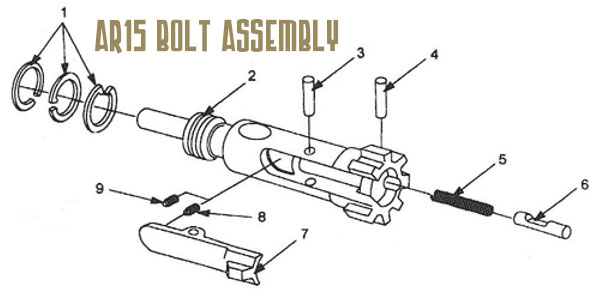
AR-platform rifles can be maintenance-intensive beasts. But some AR owners make the situation worse by not regularly cleaning important small parts, or by using too much oily/greasy lubricants in the wrong places. A properly maintained and lubricated AR15 can shoot hundreds of rounds (between cleanings) without a problem. If you learn where (and where not) to apply lubricant, you’ll find that your AR will run more reliably and the task of cleaning the bolt and bolt carrier will be less of a burden.
Here is a good video that explains AR-15 Cleaning and Maintenance. In this 30-minute NSSF video, Gunsite Academy instructor and gunsmith Cory Trapp discusses the proper way to clean and maintain the AR-15 carbine. Very knowledgeable, Trapp provides rock-solid advice for AR owners. Along with cleaning producedures, this video explains how to inspect key components and how to function-test your AR before each shooting session.
Newly-issued CMP and NRA competition rules now allow Service Rifle competitors to use optics with a max magnification of 4.5X. That’s right, Service Rifle shooters can now use scopes, not just iron sights. These rule changes have created a need for a new type of riflescope, one optimized for today’s “optics-allowed” Service rifle discipline.
March Optics has just introduced a brand new 1-4.5x24mm scope designed for Service Rifle competition and tactical applications. With ultra-sharp ED glass, this new March scope should set the standard for AR-friendly 4.5X optics. This compact variable-power scope offers ideal eye relief for AR-type rifles, along with plenty of windage and elevation range. The new March 1-4.5x24mm scope is a second focal plane optic with 1/4-MOA clicks. Weight, without caps, is 18.7 ounces. The scope comes standard with a speed lever for quick zooming throughout the magnification range.
The optics experts at March tell us: “This scope was specifically designed for the Service Rifle match shooter. New rules were announced in October 2015 that allow scopes with magnification up to 4.5X power. This 1-4.5x24mm scope also makes a great optic for SWAT work as well as for a sporting rifle. Oversized tactical turrets allow for easy windage and elevation adjustments. The high quality ED lenses provide superior image resolution that make March the best in its class”. The MSRP of this high-end scope is $2750.00. March is offering a 15% OFF special now for regular purchasers*. This scope will be on display at SHOT Show Booth 549.
* March offers a 20% off MSRP price on this scope for Law Enforcement/Military members (current and retired), Pros, and U.S. Team members.
Creedmoor Sports is having a big sale on printed books. On sale now are many of the most popular training and competition books. If you are looking for some good reading material this winter, check out the Creedmoor Book Sale. Gun books also make great holiday gifts for your shooting buddies.
Many shooters prefer to use padded soft cases for their guns. These weigh less, take up less room in vehicles, and store more easily. Unfortunately most soft rifle cases on the market are too short (or not tall enough) to handle scoped rifles with 29″ or longer barrels, particularly if a muzzle brake or extended front site hanger is attached. You can find long soft cases designed for shotguns or long-barreled black powder rifles, but these typically do not have enough clearance (top to bottom) to handle bulky target scopes. Where can you find a quality soft case for a scoped F-Class or Palma rifle with 30″ or longer barrel, making the rifle at least 50-51″ in overall length? Here are some suggestions.
55″ Bald Eagle Match Rifle Case
A good combination of features and value is the 55″-long Bald Eagle soft case from Bullets.com. This case was designed for match competitors with long-barreled rifles (with barrels from 29″ to 32″). This case fits both scoped and iron-sight rifles, and has quality zippers and heavy-duty padding. Large, zippered storage compartments hold log books, chamber flags, and other gear. Available in two popular colors, red and black, this case measures 55″ long, 13″ tall on back end and 6″ tall on front end. It is currently on sale for $57.95. Bullets.com also sells 60″ soft cases, and 50″ soft cases to fit rifles with both longer and shorter OALs.
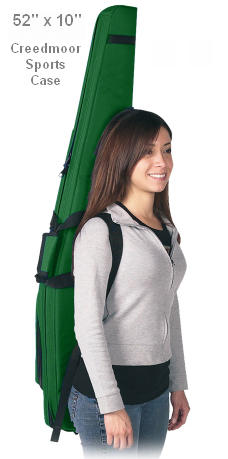
52″ Creedmoor Sports Soft Case
At the request of many High Power shooters, Creedmoor Sports has created a high-grade 52″x10″ softcase. That’s tall and long enough to fit a Tubb 2000, or AR-based spacegun with long barrel. The Creedmoor case is one quality offering, with nice 1″ thick close-cell foam padding plus tough Cordura nylon on the outside and nylon pack cloth on the inside. Both materials are urethane-coated for water proofing. Another nice feature are the integral backpack straps (see photo left). These free your hands to carry rests, spotting scopes or other gear.
The Creedmoor 52″x10″ case comes in Forest Green ($66.95, N152A), and Royal Blue ($76.95, N152C). Creedmoor also offers a similar, slightly smaller 48″x12″ case for Service Rifles in Green or Blue.
52″ Midsouth Gun Case
For those on a tight budget, Midsouth Shooters Supply offers an Extreme 52″ padded gun case for just $23.00 (item #208-BD240-52). This thickly-padded case is high enough in the center to fit most scoped rifles — even with big Nightforce scopes. Made by Bulldog Cases, the all-black Extreme 52″ case features a soft faux-fur inner lining, an external accessory pocket, and a removable shoulder strap.
Larry Racine is a respected gunsmith based in New Hampshire. He is also a two-time member of the U.S. Palma Team, and a five-time New Hampshire State High Power rifle champion. Larry, who runs LPR Gunsmithing, has developed a brilliantly simple means of switching rifle barrels with an ordinary spanner or open-end wrench. With this set-up you can switch barrels in the field in seconds without the need for a barrel vise.
For most barrels, Larry mills a hex with six flats on the end of the barrel. This allows a shooter to change barrels quickly at home or on the line with a simple box-head wrench or a socket wrench. Larry says: “You don’t even have to take the barreled action out of the gun. Just set the buttstock on the ground, between your feet, put a wrench on it, hit it with the palm of your hand — and off comes the barrel.” For barrels fitted with a muzzle brake, Larry has a slightly different system. He mills two flats behind the brake so you can use an open-end wrench to do the job.
With either a hex on the end, or two flats for a brake-equipped rifle, the system works with any medium- to heavy-contour barrel with a muzzle-diameter of at least 0.700″. This will even work for high-power rigs using clamp-on sights or bloop tubes. Larry explains: “A lot of us here in New England use clamp-on front sights. The barrel will be turned to 0.750 for the sight, with the hex on the end. A bloop tube can go right over the end, no problem.”
Larry has used this system over the past few years to win a number of matches. In one 600-yard 3 by 20 prone match, Larry used three different barrels, with three different chamberings, on the same Savage rifle. Larry changed the barrels on the line.
Larry was able to do this because the system has little to no loss of zero from one installation of a given barrel to the next installation of that barrel. This lets the shooter start the match with confidence that the first sighter will be on paper. Larry reports that the simple system works great: “To date we have used this system on Savage, Remington, Winchester, RPA, and Nesika actions.”
Racine’s system is very affordable. If Larry does the chamber work on your barrel he charges $45.00 extra to mill a hex or two flats on your barrel. If you only want the hex or flats done, Larry charges $55.00. For more info, visit LPRGunsmith.com or call Larry at (603) 357-0055.
How good are the best High Power position shooters? Pretty amazing actually. Here are some targets from the 2015 NRA High Power Championship at Camp Perry. Shown above is a 100-10X (literally a perfect score) at 200 yards. This was shot sitting, rapid-fire by 11-time National High Power Champion Carl Bernosky. That’s impressive to say the least. As one Facebook fan noted: “Not bad for an old codger with a bad back….”
File photo of Carl Bernosky from previous competition.
The target below is a 100-0X, shot rapid-fire prone by an unknown sling shooter. That may not seem that impressive at first, but this was fired from THREE HUNDRED yards. It takes a mighty solid hold to produce a nice 10-shot cluster like that without dropping a point.
To put these impressive performances in perspective, Lapua’s Kevin Thomas reports: “For those who aren’t familiar with these targets, the center X-Ring on both of these targets is 3 inches across. The 10-Ring is 7 inches across [including line], roughly the size of a small sandwich plate.”
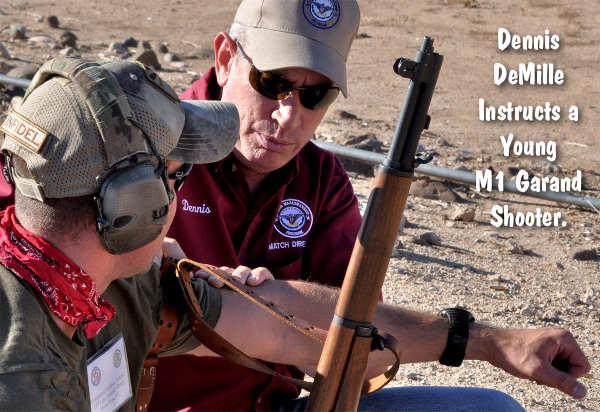
Dennis DeMille is a past Camp Perry National Champion, and he still one of the nation’s top Service Rifle shooters. Since retiring from the U.S. Marine Corps, Dennis has served as the General Manager of Creedmoor Sports. Some years back we had the chance to interview Dennis at the old Creedmoor offices in Oceanside, California. With his decades of competitive experience, Dennis has a wealth of knowledge. In this 3-minute interview, Dennis shares insights into the High Power shooting game. He discusses the most effective ways to train for competition, the fundamentals of good marksmanship, and how to recognize and perfect your natural point of aim. Dennis also offers solid advice on how to get the best “bang for your buck” when choosing shooting accessories for High Power and Across the Course competition.
This week, many of the world’s top marksmen have been competing at the National Long Range High Power Rifle Championships, held 29-31 July, 2015 at Camp Perry. The distances are great (1000 yards maximum) as are the challenges — the fickle winds blowing off Lake Erie can be unpredictable.
This year is extra special. The USA hosts the World Fullbore Long Range Championships next week at Camp Perry. The World Championships are held every four years, but any country may only host the event every 25 years. That means the next Fullbore Worlds in the USA could not take place before 2040. This year, teams from 11 countries will compete for national honors (and serious bragging rights). Many top international shooters have already arrived, and they are using the NRA Long Range High Power Championships as a “prelim” for the Fullbore Worlds next week.
Ace ISSF 300m shooter Reya Kempley shoots a hybrid rig with a Stolle Panda Action in an Anschütz smallbore-type metal stock.
Here’s the same rifle, as fitted with hand rest for position shooting. CLICK to Zoom:
British Palma Shooter David Luckman hung tough after suffering a dissappointing 8 (low right) on his first record shot. After serving up that 8 at 4 o’clock, David fought back, shooting all tens and Xs for the rest of his 10-shot string. (Orange stickers show record shots — the yellow dots mark sighters.) David doesn’t crack under pressure — he won the 2012 Long Range Championship at Camp Perry, and he is the reigning ICFRA World Long Range Fullbore (Palma) Rifle Champion.
Those targets are placed a long way off. Now imagine trying to shoot half-MOA with iron sights.
Past Long-Range Champion John Whidden shows good form. John runs a centerfire action in an Anschütz metal smallbore stock. He smithed this rig himself. John favors the ergonomics and adjustability of the Anschütz stock. He also really likes the small-diameter, rounded forearm on this design. “This stock suits me really well”, John told us.
This competitor has an Eliseo (Competition Machine) Tubegun in Patriotic Stars and Stripes Livery.
This U.S. Marine Corps shooter campaigned a classic “Battle Rifle” in the LR Championship, firing a semi-auto version of the M14. It looks like he named the rifle “Lucy”.
Photos from 2015 NRA Long Range High Power Rifle Championships courtesy NRABlog.com.




 52″ Creedmoor Sports Soft Case
 Larry Racine is a respected gunsmith based in New Hampshire. He is also a two-time member of the U.S. Palma Team, and a five-time New Hampshire State High Power rifle champion. Larry, who runs