Need a gun safe? Well now there’s a modular vault option from “Big Red”, Hornady Manufacturing. Hornady has acquired SnapSafe, manufacturer of modular safes. Delivered in sections and assembled on site, SnapSafe vaults combine steel-walled security with ease of mobility and installation. The heaviest segment of a SnapSafe is typically under 100 pounds so one adult male can lift and move the safe sections up stairs (or anywhere else). SnapSafe vaults feature 9-gauge steel walls, 8 chrome steel 3/4″ locking bolts, and a one hour (2,300°) fire rating.
SnapSafe modular gun vaults are delivered on a pallet right to your door and can be assembled in minutes. The assembly process is illustrated in the video above. Basically the safe bolts together — it’s a bit like assembling an IKEA cabinet. In addition to conventional safes, SnapSafe also manufactures lock boxes and auxiliary safes that can be stored in trunks, under beds, or in walls. SnapSafe products will be on display at booth #2119 at Shot Show, January 19-22. For more information on SnapSafe products, visit www.Snapsafe.com.
At the request of our readers, we have launched a “Deals of the Week” feature. Every Monday morning we offer our Bargain selections. Here are some of the best deals on hardware, reloading components, and shooting accessories. Be aware that sale prices are subject to change, and once clearance inventory is sold, it’s gone for good. You snooze you lose.
1. Cabelas.com — Rock Chucker Supreme Reloading Kit
Everything you see above can be yours for just $225.00, after manufacturer’s rebate. Right now, Cabela’s is selling the Rock Chucker Supreme Master Reloading Kit for $300.00. That’s a good deal as this Reloading Kit sells elsewhere for up to $360.00. But he’s the real incentive — if you spend $300.00 on RCBS products in 2016, RCBS will send you a $75.00 rebate. That reduces your net cost to just $225.00 for the entire Kit.
2. Bullets.com — Bald Eagle Rest with Windage Top
Bullets.com is offering aluminum-base front rests, with flex-shaft remote windage adjustment, for just $165.00! These front rests originally retailed for over $400.00 (with windage drive). But Bullets.com is having an “overstock” sale so you can get blow-out pricing on these rests.
Bigger isn’t always better when it comes to spotting scopes. For hunters, compact size and light weight are advantages. This little Minox MD 50 has sharp lenses yet weighs just 22 ounces. The max 30X magnification is plenty for seeing shot markers or watching mirage. Right now this compact Minox is on sale at Amazon.com for just $250.00. No it won’t match a $2300.00 Kowa Prominar, but for basic viewing tasks (and hunting duties) it will do a good job. It’s also an excellent choice for bullseye pistol shooters who need a lightweight, affordable spotting scope.
4. Hornady — 500 Free Bullets with Gear Purchase
Hornady has announced its “Get Loaded” Promotion for 2016. If you buy any of the qualifying products (listed above), you get 500 free bullets. We’ve taken advantage of these promos in the past. It’s a pretty good deal if need a reloading press, case prep center, or large ultrasonic cleaning machine. We’re impressed with the new pyramid-frame, open front iron press. 500 bullets is a nice incentive.
5. CDNN Sports — Remington .22 LR Bulk Ammo
Chose from a 525-round box for $54.88 or a jumbo 1400-round “bucket ‘o ammo” for $139.88. Both offerings feature 36-grain hollowpoint bullets. With the big bucket you get ammo for under ten cents ($0.10) per round. Yes we’d say that’s affordable .22 LR plinking ammo!
6. Brownells — Hornady V-Max Bullets on Sale
Here’s a super deal on plastic-tipped V-Max bullets — a favorite for varmint hunters. V-Max bullets are accurate and deliver plenty of “pop” on ground squirrels, prairie dogs and other small varmints. Brownells has clearance pricing on many types of V-Max bullets. For example, for just $14.98 per hundred, you can get the excellent 40-grain, .20-caliber V-Max or the equally good 50gr or 53gr, 22-cal V-Max. That’s a great price.
7. Natchez — CCI Blazer 9mm ammo, $9.99 for 50 Rounds
This is the best price we’ve found this week on newly-manufactured 9mm pistol ammunition. And this is quality, CCI made-in-USA ammo with reloadable, brass casings. We have used this CCI-made Blazer 9mm ammo in Sig, HK, and Glock pistols and it performed very well. This stuff won’t last long at this price (less than $0.20 per round). If you need 9mm practice ammo, order soon.
8. Amazon — Best-Selling Nano LED Mini-Flashlight
This handy Nano Keychain Light, an Amazon BEST SELLER, has a super-bright 5mm LED with a 100,000 hour lifetime. Verified purchasers say the Nano is “well-constructed” and “super-bright for its size”. Weighing just 0.36 ounces and measuring 1.47″ long, the Nano stows easily. A handy snap hook is included. Streamlight offers a limited lifetime warranty. Read the Amazon Reviews — people love this keychain Nano Light. It’s great for campers, and it’s a smart addition to a house emergency kit.
We’ll here it is folks — “Black Friday”, the biggest selling day of the year. Many of our favorite vendors have put up some very special deals. CLICK HERE for the Special Black-Friday Deals from Midsouth Shooters Supply. All sale prices begin Friday 11/27/2015 at 12:01 am CDT and run through Midnight on Cyber Monday, 11/30/2015.
Black Friday X-Travaganza Contest — Enter to Win
Along with the special deals, Midsouth is running a Sweepstakes. You can enter via email, Facebook, or Twitter. Winners will be chosen on December 1, 2015. Prizes include a Hornady Lock-N-Load Progressive Press Package, and a Lyman/Sierra Bundle with digital Borescope, Ultrasonic Cleaning machine, and 1000 Sierra Bullets. To enter, CLICK HERE and then scroll to the bottom of the page.
At the request of our readers, we have launched a new “Deals of the Week” feature. If this proves popular, we’ll try to run this every Monday. Here are some of the best deals on hardware, reloading components, and shooting accessories. Be aware that sale prices are subject to change, and once clearance inventory is sold, it’s gone for good. You snooze you lose.
1. Sportsmans Superstore — .30-06 Ruger American Rifle, $299.99
Want a quality deer rifle for under three hundred bucks? Look no further. Here’s an awesome deal for the hunting season. This long-action .30-06 Ruger American Rifle costs just $299.99 this week. If you prefer a short action, Sportsmans Outdoors Superstore has the same rifle in .308 Win for $319.41 (camo stock) or $339.88 (black stock).
2. Bruno Shooters Supply — Leupold Competition Scopes $999.99
Here’s a good deal for benchrest shooters. Bruno’s is offering Leupold 35X and 40X Competition Series scopes for $999.99. That’s $100.00 less than we’ve seen anywhere else currently. And, for a limited time, Bruno’s is offering free shipping on Leupold scopes. Other Leupold scopes are 5% off regular prices while this sale is in effect.
3. Burris – $100 Off Burris Eliminator III LaserScope
Now through December 31st (2015), you can get $100 back on any Eliminator III with a mail-in rebate. The Burris Eliminator III combines a medium-powder zoom scope with a built-in laser rangefinder. We’ve used an Eliminator and it ranged successfully on steel plates out to 600 yards. We think this is a good product for a varmint hunter — it quickly returns yardages and shows the correct hold-over with an illuminated dot. Just put the dot on the target and “send it”. CLICK HERE for Rebate FORM.
4. Cabelas — FREE Shipping on orders of $99 or more
For the next two days, through midnight on 11/3/2015, Cabela’s is offering FREE Shipping on orders of $99.00 or more. Yes this applies to ammo sales as well (though not to firearms or hazmat items). To qualify, use code “115HOT” during checkout. NOTE: Shipping charges may apply to large or heavy items. Act quickly, this offer expires soon.
5. Midsouth Shooters Supply — Hornady Progressive Press on Sale
The Hornady Lock-N-Load AP Progessive Press is on sale at Midsouth this week for $389.99. That’s $70.00 off the regular price. To further sweeten this deal, press purchasers can get 500 free bullets through Hornady’s “Get Loaded” promotion. We have used this press. It is strong and reliable. We favor Hornady’s easy-to-adjust, rotary-type powder measure over Dillon’s sliding-bar system.
Like the RCBS ChargeMaster, this Lyman Gen6 Powder System will automatically dispense and weigh powder charges. This unit features a touch screen, rapid warm-up, anti-static/anti-drift technology, and electronic shielding to resist interference from other electronic devices. It’s a good deal at $202.49.
7. Amazon.com — Lee Universal Shell Holder Set
Every hand-loader needs one of these Lee Universal Shell Holder Sets. The kit contains 11 shell-holders for most popular rifle and pistol cartridge types. This editor bought one of these kits 25 years ago, and I still use it every week. Even if you prefer more expensive Redding shell-holders, this 11-piece kit serves as a valuable back-up. Right now the Shell Holder Set is on sale at Amazon.com for $26.99, with free shipping on orders over $35.00. Get two kits and they’ll ship for free.
Hornady has introduced an innovative new single-stage press with some very impressive features. The new-for-2016 Hornady Iron Press™ features a super-strong, pyramid-style cast-iron frame with an open front. A very clever optional “automatic” priming system shuttles primers from a vertical tube in the back to the shell-holder in the front. We’ve never really seen anything quite like this before. You really should watch the video — it shows the patented auto-priming system in action. This system appears to be a very smart piece of engineering — good job Hornady.
Watch this Video to See Gravity-Fed Shuttle Priming System (00:45, 01:00):
The broad top of the beefy (26-lb.) Iron Press can hold case prep tools (such as chamfer tool and case-neck brush) and/or a box for bullets or brass. NOTE: This is NOT a turret press — you can only use one die at a time. However, Hornady offers an accessory “Die Caddy” (sold separately) that can hold up to three (3) more dies. That way you can quickly switch from a sizing die to a seater die (or vice-versa). What Hornady calls the “Accessory Mounting Deck” gives quick access to items such as trays for bullets or cases, chamfer and deburr tools, case neck brushes, primer pocket cleaners and other accessories. The Iron Press comes with the Lock-N-Load® bushing system which allows for rapid die changes.
Optional Automatic Priming System
The optional auto-priming system is a real selling point for this new press we think. When you move the press handle rearwards, a horizontal bar toggles back to pick up a primer from the column in the rear of the press. Then this same bar move forwards to place the fresh primer in the center of the shell-holder. Hornady explains: “The available gravity-fed Automatic Priming System (sold separately or with the Lock-N-Load® Iron Press™ Reloading Kit), combined with the Accessory Mounting Deck, increases reloading efficiency by allowing more processes to occur simultaneously. The Iron Press™ is the first of its kind to allow the ability to deprime, pause, and remove the case to chamfer & deburr … then replace and prime.” Do watch the video to see the priming system in action.
In 2016, Hornady will introduce new hunting and match bullets with high-tech, heat resistant tips. Hornady developed the new “Heat Shield” bullet tips after Doppler Radar testing showed that the Ballistic Coefficients (BCs) of old-style tipped bullets were degrading in flight in an unexplained manner. Hornady’s engineers theorized that the old-style plastic bullet tips were deforming in flight due to heat and pressure. Hornady claims this problem occurred with high-BC (0.5+ G1) tipped bullets from a variety of manufacturers. Hornady’s testers believed that, after 150 yards or so, the tips on high-BC bullets were actually melting at the front. That enlarged the meplat, resulting in increased drag.*
Consequently, Hornady developed a new type of bullet tip made from a heat-resistant polymer. Further long-range Doppler Radar testing seemingly confirmed that bullets equipped with the new tips did not suffer from the BC loss previously found. This allowed the bullets to maintain a higher, more consistent BC during the entire trajectory. The end result is a bullet with reduced vertical dispersion at long range (or so Hornady claims).
New Hornady ELD-X Hunting Bullets
For 2016, Hornady will bring out two lines of projectiles using the new tips. The first line of bullets, designed for hunting, will be called ELD-X, standing for “Extreme Low Drag eXpanding”. These feature dark red, translucent, heat-resistant tips. With interlock-style internal construction, these hunting projectiles are designed to yield deep penetration and excellent weight retention. Hornady will offer seven different ELD-X bullet types, ranging in weight from 143 grains (6.5mm) to 220 grains (.30 Cal):
NOTE: We don’t know if the stated BC values are based on drag models or actual range testing. These new ELD-X hunting bullets will be loaded into a new line of Precision Hunter Ammo for a variety of popular hunting cartridges.
New Hornady ELD Match Bullets
Along with its new hunting bullets, Hornady is coming out with a line of ELD Match bullets as well. Hornady’s engineers say the new molded “Heat Shield Tip” should be a boon to competitive shooters: “You can’t point up that copper [tip] as consistently as you can mold a plastic tip. With the ELD Match line, and the Heat Shield Tip technology… we now have a perfected meplat. These bullets allow you to shoot groups with less vertical deviation, or less vertical stringing, because the bullets are exact in their drag [factor].” There are currently four bullets in the ELD Match line:
Hornady will offer factory ammunition loaded with ELD Match bullets, starting with 6.5 Creedmoor ammo loaded with the 140gr ELD, and .338 Lapua Magnum ammo loaded with the 285gr ELD.
Better Tips Make a Difference — But other Factors Are Important
Hornady claims that its new Heat Shield Tips are more uniform than the meplats on conventional jacketed, hollow-point bullets. This, Hornady says, should provide greater bullet-to-bullet BC consistency than is possible with conventional, non-tipped bullets.
We have heard such claims before. Plastic tips are good, so long as they are inserted perfectly in the bullet. But sometimes they are crooked (off-axis) — we’ve seen that with various brands of tipped projectiles. Other factors will affect bullet performance as well, such as bullet weight, bullet diameter, and bullet bearing surface length. Even with perfectly uniform bullet tips, if bullet weights or diameters are inconsistent across a sample, you can still have accuracy issues (and pressure-related velocity variances). Likewise, if the bearing surface lengths vary considerably from one bullet to the next, this can increase velocity spread and otherwise have a deleterious effect on accuracy.
So, overall, we think Hornady has probably engineered a better bullet tip, which is a good thing. On the other hand there are many other factors (beyond tip uniformity) involved in long-range bullet performance. It will be interesting to test the new ELD Match bullets to see how they compare with the best hollow point jacketed bullets from other manufacturers.
MORE TECHNICAL DETAILS
* Hornady’s Chief Ballistician Dave Emary authored a technical report based on the Doppler Radar testing of a variety of tipped Bullets. CLICK HERE for Emary Report. Here are some of the report’s key observations and conclusions:
After early testing of prototype bullets it was observed that all currently manufactured tipped projectiles’ drag curves were convex, not concave and that abnormally low ballistic coefficients were being observed over long ranges. The drag was rapidly increasing at high velocities.
At this point extensive testing was done with all types of commercially-available tipped projectiles. They all exhibited this behavior to a greater or lesser extent depending on their ballistic coefficient and launch velocity. Most projectiles exhibited BCs relatively close to published values for 150 to 200 yards of flight. Beyond these distances they all showed BCs substantially below published values.
It was obvious that something was changing in the tipped projectiles to cause a rapid increase in drag at higher velocities. The drag increases were most noticeable from 100 to about 500 yards. Drag increases stopped at velocities below approximately 2,100 fps. This behavior was not observed with hollow point or exposed lead (spitzer) style designs. The problem magnified as the velocity was increased. The problem was worse for heavier, higher-BC projectiles that maintained higher velocities longer. After some consideration the answer was obvious and one that several people had wondered about for some time but had no way to prove their thoughts.
The tip of a bullet at 3,000 fps will see temperatures as high as 850 degrees F and decreasing as
the bullet slows down. These temperatures on the tip were a known fact. What wasn’t known was how long it would take at these peak and decreasing temperatures for the polymer tips to begin showing effects, if at all. As it turns out it is within the first 100 yards of flight. Currently-used polymers in projectile tips begin to have properties like rubber at approximately -65 to 50 degrees F and will melt at 300 to 350 degrees F, depending on the exact polymer.
All current polymer-tipped projectiles have tips that are at best softening and deforming in flight and under many circumstances melting and badly deforming. To cut through a lot of technical discussion the problem becomes worse at higher ambient air temperatures (summer) and higher launch velocities. Projectiles that have a high BC and retain velocity well see higher stagnation temperatures for longer lengths of time and have greater degradation of the tip. Simply put it is a heat capacity problem –temperature times time. This makes BCs for current tipped projectiles a rough average over some distance, dependent on atmospheric conditions and muzzle velocity, and does not allow the accurate prediction of downrange ballistics much beyond 400 yards.
At the request of our readers, we have launched a new “Deals of the Week” feature. If this proves popular, we’ll try to run this every Monday. Here are some of the best deals on hardware, reloading components, and shooting accessories. Be aware that sale prices are subject to change, and once clearance inventory is sold, it’s gone for good. You snooze you lose.
1. McGowen Barrels — Halloween Deal 20% Off Barrels
As a “Spooky Savings” promotion for AccurateShooter.com readers, McGowen Barrels is offering 20% off Custom and Pre-fit barrels (not valid on other products/services). This discount is good through October 31, 2015. To save 20% visit McGowenBarrel.com and use CODE “OCTOBER” at check-out.
2. Bullets.com – Bald Eagle Rest with Windage Top
Bullets.com is offering aluminum-base front rests, with flex-shaft remote windage adjustment, for just $165.00! These front rests originally retailed for over $400.00 (with windage drive). But Bullets.com is having an “overstock” sale so you can get blow-out pricing on these rests.
3. Grafs.com – Hornady Lock-N-Load Classic KIT
On sale this week at Grafs.com, this Hornady Reloading Kit comes with everything you need to turn out accurate handloads: Lock-N-Load single stage press, L-N-L Powder Measure, Digital Scale, Rotary Powder Measure, Powder Trickler, 7th Ed. Reloading Handbook, three (3) L-N-L die bushings, Hand Priming Tool, Reloading Block, chamfer/deburring Tool, Primer Flip plate, and One Shot Case Lube.
4. Mr. Gun Dealer — Savage A17 Rifle (17 HMR)
Savage’s new A17, chambered for the 17 HMR cartridge, is accurate and tons of fun. The model we tested was 100% reliable and ran like a sewing machine. Some of the early production models need a little attention to the trigger (and some fluff ‘n buff) — but nothing major. We think this is the most significant semi-auto rimfire of the decade. And now you can snag one for under $365.00!
5. Amazon.com – 8x30mm Military Marine Binoculars, $239.99
Your editor has used Steiner Military Marine Binoculars on many ground squirrel and prairie dog adventures. What I really like about these Steiners is that you don’t have to fiddle around with the focus. Once you set the eyepieces correctly, everything from about 25 yards to infinity is in focus. Honest. That’s great when you’re glassing a P-Dog field all day long. The armor is also very tough. Downside? Well with 30mm objectives, the Steiners can’t possibly match the low-light performance of true high-end ($1500+) binoculars. But then the Steiners cost a mere $239.99.
6. PrecisionReloading.com – MTM Range Box
This versatile MTM Shooting Range Box is on sale for just $28.69 at PrecisionReloading.com. It sells elsewhere for $42-$50. This box has a removable top section with small compartments for jags, patches, and small parts. Snap-in cradles provide a secure support for cleaning your rifle. NOTE: The MTM Range Box on sale is RED (though the photo also shows a green box).
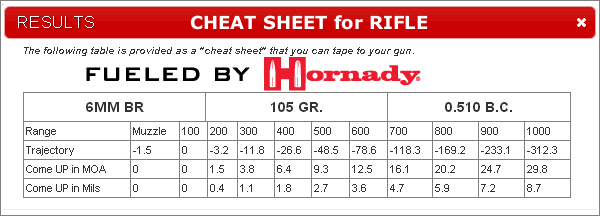
Need a simple, easy-to-use drop chart for your rifle? Something you can tape right to the buttstock? Then check out Hornady’s handy Online Ballistics Calculator. This user-friendly calculator will compute your drops accurately, and output a handy “Cheat Sheet” you can print and attach to your rifle. Simply input G1 or G7 BC values, muzzle velocity, bullet weight, zero range and a few other variables. Click “Calculate” and you’re good to go. You can select the basic version, or an advanced version with more data fields for environmental variables (altitude, temperature, air pressure, and humidity). You can also get wind drift numbers by inputing wind speed and angle.
Conveniently, on the trajectory output, come-ups are listed in both MOA and Mils — so this will work with either MOA clicks or Mil-based clicks. There are more sophisticated ballistics solvers available on the web (such as the outstanding Applied Ballistics Online Calculator), but the Hornady Calculator is very simple and easy to use. If you just want a basic drop chart, you may want to check this out.
Legendary shooter Jerry Miculek holds multiple world records, and has amassed over 80 major championship titles. He is considered “one of the fastest trigger fingers” on the planet. In this video, Jerry puts his skills to the test, using a Barrett m82A1 .50 BMG in a timed speed run. Watch the video, starting at the 1:20 mark, to see this amazing speed run.
Watch Miculek Shoot .50 BMG Offhand. Action Starts at 1:20:
Jerry shoots six (6) .50 BMG rounds in under one second (0.98 to be precise). And Jerry did that standing (offhand) without a rest. What can you say… the man is a beast.
If you look carefully, in this frame you can see a .50-Cal bullet in flight forward of the muzzle brake.
Jerry was a bit apprehensive at first: “This is by far the most horsepower I’ve had in my hands ever in my life. So the learning curve is going to be kind of really abrupt.” But as he shoulders the big Barrett and gets ready to punch six rounds on the clock, Jerry gets enthusiastic: “This is going to be fun guys … six rounds .50 BMG … Time to rock and roll!”
After filming this video, Jerry did more drills with the Barrett and he actually brought down his split times. Jerry reports: “I managed to get it down to 0.16 splits and I outran the bolt a few times. You can actually see that in the closing slow-motion footage. You just can’t expect such a massive gun to cycle as quick as a 1911 or your M&P/ Glock type pistols unfortunately.”
Need name-brand bullets? Here’s a way to save 10% on Nosler, Sierra, Hornady, and Speer Bullets. Here’s how it works — this weekend only (August 28-31, 2015) Wideners.com is offering 10% off ALL Nosler, Sierra, Hornady, and Speer bullets in stock (some other bulk-brand bullets are on sale as well).
NOTE: Widener’s says “The discount will not appear on the website or on your order at checkout but will be applied when we process the order”. We suggest you print out your order and compare that with the actual charge(s) on your credit card to ensure that Widener’s did, in fact, apply the 10% discount. As they say: “Trust, but verify“. The Sale ends at 5:59 am Eastern Standard Time 8/31/15. That’s very early in the morning on Monday so we advise you to place your orders before midnight, before you go to bed on Sunday, 8/30/2015.
Sale Tip from EdLongrange. We welcome reader submissions.