|
|
July 4th, 2010
 Texan Jackie Schmidt, using a 13.5-lb 30BR Heavy Varmint rifle, has shot a pending NBRSA world record 5-target, 5-shot-per-target Aggregate at 100 yards. Jackie’s 5x5x100 Agg measured 0.1118! How small is that? To help our readers visualize this, the illustration at right shows what a SINGLE 0.111″ 5-shot group (with .30-cal holes) would look like. Jackie’s actual measured group sizes for his five-target Aggregate were: .153, .093, .120, .100, and .093. Texan Jackie Schmidt, using a 13.5-lb 30BR Heavy Varmint rifle, has shot a pending NBRSA world record 5-target, 5-shot-per-target Aggregate at 100 yards. Jackie’s 5x5x100 Agg measured 0.1118! How small is that? To help our readers visualize this, the illustration at right shows what a SINGLE 0.111″ 5-shot group (with .30-cal holes) would look like. Jackie’s actual measured group sizes for his five-target Aggregate were: .153, .093, .120, .100, and .093.
If this record is certified, it will be the best 5×5 100-yard Agg ever shot in history by a bag gun in competition. Jackie’s Agg may also beat the “Unlimited” (Rail Gun) 5x5x100 records, but we’re still researching that. Remarkably, Jackie shot his 0.1118″ Agg with a stout-recoiling 30 BR (not a PPC), he did it in howling winds, and he did it with brass that had been fired 30 times! He also shot the entire Agg without cleaning his barrel.
We know it may be difficult for some readers to understand how hard it is to average 0.1118 for 25 shots on FIVE targets. To help demonstrate this, we’ve created an illustration that shows a SINGLE 0.111″ five-shot group. Jackie shot five groups that averaged this size. And he wasn’t “machine-gunning”. He took 6-7 minutes to shoot each target, firing on a “angle transition” in the conditions. Jackie explained: “The wind was switching, but I wasn’t shooting the dominant condition. I would wait for the transition and then shoot when the flags came around to about 15 degrees.”
Jackie gave credit to his rifle: “Though I usually use this rifle for score shoots, this 30BR is the most accurate rifle I have in terms of shooting small groups. I was lucky and hit the perfect tune. There was absolutely no vertical. You can’t shoot [an Agg] like this unless you have a rifle tuned to the hilt.” Jackie recognizes that this performance was a “once in a lifetime type experience.” He told us: “Today everything was right. The rifle was shooting impeccably, I had a good handle on the conditions, and just didn’t make a mistake.” Jackie added: “These days are few and far between — you just have to cherish the moment.”
Jackie’s 5-target Agg was so good that many experts predict it will stand as a record for a long time. On Benchrest Central, respected BR gunsmith Mike Bryant wrote: “The current record … was still Rex Reneau’s .1399 Agg from 1982. With Jackie’s Agg, I’m sure that it will easily beat Rex’s record when measured by the records committee. It’s just too far under the current record for it not to hold up… [and] to do it with a .30 BR is even more amazing. That should put to rest the notion that the .30 BR is a score cartridge only.”
Many people are surprised this pending Agg record was shot with a 30BR rather than a 6 PPC. When asked if he thinks the 30 BR can rival the 6PPC in group competition, Jackie told us: “In the 13.5-lb Heavy Varmint class, a good 30 BR is every bit as accurate as a good PPC, and possesses an equal Agging capability.” It’s different in the 10.5 classes, Jackie acknowledged: “in the LV/Sporter 10.5-lb classes, the 30 BR can get a little aggravating over the course of a match due to its greater recoil.”
Jackie’s Aggregate May Be Best in Benchrest History
Shooting in a Midland, Texas BR for group match, Jackie battled shifty, 15-20 mph winds in what may well be the greatest single-day display of “pure accuracy” in the history of the shooting sports. To put this accomplishment in perspective, Jackie’s 5-target Agg was better than any other 5×5 100-yard Aggregate ever shot in a registered benchrest match by a bag-gun. And according to the published records we could find on file with the NBRSA and IBS, Jackie’s 0.1118″ also beats even the existing rail-gun 5x5x100 Aggs. So, this could potentially be the smallest 5-target Agg ever shot in history, by any gun, in any registered match, at any time. Below are the current IBS and NBRSA World records listed on the Internet:
| Current Benchrest 100-yard World Records (5 Targets, 5 shots per target) |
| 5-5-100 Aggregate (NBRSA)
Unlimited: .1283″ Steve Kostanich 8/10/2003
Heavy Varmint: .1399″ Rex Reneau 9/6/1982
Light Varmint: .1500″ Jeff Fowler 6/11/1994
Sporter: .1573 (na) Dick Katchmar 4/14/1985 |
5-5-100 Aggregate Records (IBS)
Unlimited HB: .1386 (na) R. Howell 12/3/04
Heavy Varmint: .1407″ Tony Boyer 8/3/07
Light Varmint: .1599″ B. Goad 8/13/08
Sporter: .1592″ R. Boop 8/13/08 |
 Gun Specs: Jackie was shooting a 13.5-lb 30 BR that he chambered and assembled himself. The barrel is a 4-groove, 1:18″ twist, HV-taper Krieger, fitted with a 5.5-oz. “snubber” barrel tuner made by Jackie. The action is a cast Farley, “glued and screwed” into the stock and fitted with a Jewell trigger. The stock is a Robertson Composites BRX, built with extra weight to make the gun a dedicated 13.5-pounder. The scope is a 50-power March. Gun Specs: Jackie was shooting a 13.5-lb 30 BR that he chambered and assembled himself. The barrel is a 4-groove, 1:18″ twist, HV-taper Krieger, fitted with a 5.5-oz. “snubber” barrel tuner made by Jackie. The action is a cast Farley, “glued and screwed” into the stock and fitted with a Jewell trigger. The stock is a Robertson Composites BRX, built with extra weight to make the gun a dedicated 13.5-pounder. The scope is a 50-power March.
Record Load: Jackie was running a stout load of Hodgdon H4198 powder, Federal 205M primers, and BIB (Robinette) 112gr flat-base bullets seated about .003″ into the lands. Load is “tuned for 3020 fps”. Cases are formed from Lapua 6mmBR brass using a dedicated forming barrel that blows the necks out to 0.330″ in one step. Trim length is 1.540″, longer than most 30 BRs. Jackie turns the necks for a total of .002″ clearance.
June 13th, 2010
On June 12, 2010, at the Piedmont Range in Rutherfordton, NC, Sam Hall, shooting a 6mm Dasher, set TWO new pending IBS 600-yard world records with a stunning 0.686″ five-shot group. The group was centered up in the Ten Ring for 50 points with two doubles! This group should give Sam both the single target IBS Light Gun small group record AND the Light Gun score record. Sam’s 0.686″ beats Paul Wagoner’s 0.711″ previous small-group record set in 2008 with a 6 BRX. Larry Isenhour previously held the IBS score record with a 50-3X (0.944″) group shot in August, 2007, also with a 6 BRX. NOTE: Sam had only one X, but the official tie-breaker for the score record is group size, not X-count. Therefore, if approved, Sam’s 0.686″ group establishes both new group size and score records. (We wish the IBS had some other official recognition for high X-count.)


Record-Setting Chambering, Load, and Hardware
Sam was shooting a 6mm Dasher with 32.0 grains of Norma 203B powder, Berger 105gr VLD bullets (unpointed), CCI 450 primers and Lapua brass, neck turned to 0.266″ for a 0.268″-necked chamber. Regarding the choice of powder, Sam says Reloder 15 gives the same accuracy and speed as 203B but he “just happed to have 8 pounds of [203B] and decided to use it in this rifle.” Interestingly, Sam was jumping his 105s about forty thousandths. That’s right, .040″ OFF the lands. The record gun has a BAT MB action, Shehane Tracker stock, and Krieger 29″, .237″ bore, 1:8″ twist HV barrel.
Here is Sam’s report from Piedmont:
Shooting the Record — Conditions and Strategy
The afternoon was slightly overcast with mild mirage. Winds were running left to right at approximately 5 mph. During the afternoon I noticed the wind would stay in one direction for several minutes then would make a complete reversal. On my record round I had made four (4) shots when I noticed the wind picking up in intensity slightly from left to right. I knew this because I saw my wind flag Daisy wheels start spinning faster. For the fifth shot I held left one inch from my previous four shots and let it fly. I was shooting the string as fast as I could and stay smooth. I was expecting a reversal because the wind has stayed constant for too long — it was about time for a reversal.
Evidently holding off was smart — otherwise the group might have been a 1.686″! This year I have been concentrating on learning more on wind and mirage reading. This game is getting more competitive every year. I figure the only way I can stay ahead is to work on my wind reading. If you don’t read the wind, you are eventually going to get bit.
About my Light Gun
I was shooting a BAT 1.550″ round, dual-port MB action with non-fluted bolt. The stock is a Shehane fiberglass ST-1000, pillar-bedded by Tom Meredith. Tom epoxied lead shot in the butt to bring it up to 16.94 lbs. with a Leupold 40x competition scope. The barrel is a 29″, 8-twist, .237″, HV contour Krieger with a Vais muzzle brake. This barrel, purchased three years ago from Brunos, came off the Terry Leonard-stocked rifle that earned me a lot of Shooter of the Year (SOY) points in 2009. It has about 700 rounds on it. It started life as a 6BR, but my reamer had gotten dull and left a rough chamber. So I gave the barrel to Mike Davis and told him this was a perfect excuse for me to try a 6mm Dasher. The barrel is now chambered as a 6mm Dasher with a .268″ neck with .124 freebore, the same as my Maxi-Tracker 6 Dasher.

Load Details — Yes I Was Jumping Berger VLDs a Country Mile
Last year, I could not get the Berger 105 VLDs to shoot like I wanted in this barrel, so I used Berger 108 BTs, jumped .015″. After last season, I tried the 105 VLDs again. I think they have a slight advantage in the wind compared to the 108s. But again the 105s would not shoot well at 600 jammed in the rifling as I normally do. I noticed this barrel was shooting better off the rifling. I kept backing the bullets off the rifling. I found a sweet spot 40 thousandths off the rifling. The gun was shooting 1 to 1.5 inch groups pretty consistently at 600 yards at my home range. The day I shot the record was the first time I had shot this load and rifle in competition. I believe it is a keeper! — Sam Hall
March 1st, 2010
IBS 600-yard National Champion and recent 600-yard Shooter of the Year Sam Hall has been hard to beat when he’s got his 6BR or his Dasher dialed in. Sam recently told us that he’s been experimenting with the 6.5×47 Lapua cartridge, thinking that a larger, higher-BC bullet might perform better in the wind.


Sam’s competitors are probably hoping we’ll report that Sam is struggling with the new cartridge, and can’t get his new 6.5×47 to shoot. Well, guys… no such luck. Sam recently took his 6.5×47 Heavy Gun out in some fairly windy conditions, but still returned a spectacular four-shot group at 600 yards. Sam measured the group at 0.357 inches. We measured it at 0.371″ with OnTarget software, but that was going off a photograph, which can be less precise. Either way, 4 shots in well under 0.4 inches at 600 yards is spectacular.
As Sam told us, however, “I just wish I’d shot that in competition… with a fifth shot of course.” Even though Sam’s group was shot in practice, it’s still an amazingly small group — one that suggests that the 6.5×47 Lapua may have great potential as a Benchrest cartridge. The group size, in MOA, is 0.059!

Sam’s load was 37.0 grains of Reloder 15 with 130gr Berger VLDs and CCI BR4 primers. The gun is a Bat-actioned, 47-lb “true heavy” built by Leonard Baity using a McMillan 50BMG stock. The barrel is a 29.5″ Brux, 1.25″ straight contour, with a 1:8.5″ twist. Sam reports:
The gun has a BAT MB 1.55″ round action. The reamer was a Kiff (PTG) .290 neck with .160 freebore. The loaded round is .288 at the neck. I made a mistake labeling the target. The primers were CCI BR4s, not 450s. The 130gr Bergers VLDs are lot 0225 (the early ones). They are in the rifling as far as I can get them (jam). I use a .287 Redding bushing in my Redding “type S” FL dies. I seat with a Wilson seater. The stock is a McMillian Light 50 BMG stock full of lead from McMillian. With the 40x Leupold it weighs 47 pounds. The fore-end is 3.5 inches wide. Leonard Baity did the complete rifle. I had him to put a rail (3 inches wide) on the back so I could use my adjustable rest Leonard made me a few years ago for my Shehane Maxi-Tracker stock. Even though this rifle is only 14 pounds lighter than the 61-pound aluminum stock Maxi-Tracker 6mm Dasher I shot last year, it feels like it is 25 pounds lighter. It is much, and I mean MUCH more manageable carrying this rifle around than the Maxi-Tracker. I can actually use my Farley, joy-stick rest with the rifle. I just replace the 3 inch bag with a 3.5 inch wide bag. I can make adjustments much faster with the Farley than I can twisting knobs.
The reason I built the 6.5×47 Lapua is to try to beat the wind we have here in NC in the spring. Plus, the fact I love to shoot and experiment. The 6.5 bullets are not affected as much by the wind as the 6mms. I started shooting 600-yard competiton with a 6.5-284. I could predict where the bullet was going to hit much better with it than the 6mms I shoot now. In windy conditions, the 6mms seem to “dance around” when sighting in. The heavy 6.5 seems to say on track and Point of Impact is more predictable. In 600-yard competition, score is half the game. I figured if I could get a 6.5 shooting somewhere close to a 6BR or 6BR Improved, I would be ahead of the game in the wind. So far this rifle is agging at 600 yards pretty close to my Dasher and BRX, but not better. After I found this load that shot the 0.357 inch 4-shot group, I went out and shot four more, 4-shot groups in some wind of 10-20 mph and the rifle agged 2.08 inches.
I am still haunted by a “flier” in each group. I am still trying to work that out. The 0.357 group I will say was a fluke because it is the only group I have shot that did not have a flier. The rifle sure won’t group like that every time, but that one time sure was pretty! You may ask why I shoot 4-shot groups during load development and practice. Three is not enough, but four will tell you what the rifle will do, plus I can shoot more groups before the barrel gets too warm.
Our first match is next month at Piedmont. I am going to give this rifle a try. Time will tell if I will stick with this round for serious 600-yard competition or back to the 6mms. — Samuel Hall
February 26th, 2010
Jeff Stover, President of the IBS (International Benchrest Shooters) just sent us the final rules and safety guidelines for AR benchrest competition under the IBS. Jeff noted: “Shooters should understand that the ranges and clubs will determine whether to allow AR rifles in their particular IBS benchrest matches.” This program is not mandatory, and each club will decide, based on its own priorities, whether ARs will be allowed to compete. When they ARE “invited”, AR-platform rifles will run in their own separate class.

Click the links below to download two .PDF files:
DOWNLOAD: IBS AR Benchrest Final Rules
DOWNLOAD: IBS AR Benchrest Safety Checklist
February 1st, 2010
Many of our readers know Joel Kendrick, one of America’s top mid-range shooters. Joel is a two-time IBS 600-yard Shooter of the Year, and we have featured Joel’s match-winning 6×44 as one of our Guns of the Week. Joel now works with MMi-Trutec, specializing in the salt-bath nitriding process. This is a surface-hardening procedure for steel that creates a super-hard, low friction layer for the top 10-20 microns of the metal. Barrels treated with salt-bath-nitriding show much improved wear resistance and reduced friction.
For match rifles, varmint rifles, and hunting rifles, the most significant benefits of salt-bath nitriding are enhanced barrel life, and easier cleaning. Joel’s own F-Class rifle has a nitrided stainless barrel with over 5000 rounds — and it still holds 1/4 MOA at 100 yards. Other well-known shooters, such as John Whidden, have observed that nitrided barrels can shoot longer strings of fire between cleanings, with no reduction of accuracy. What is the cost of nitriding? As Joel explains in the video below, nitriding a single barrel costs $60.00, but there is a minimum first-time lot charge of $200.00. If you submit multiple barrels at the same time, the price per barrel can be reduced significantly. For more info, visit the MMI-Trutec website or contact Joel Kendrick by phone (704) 616-6442, or via email: joelkndrck [at] aol.com .
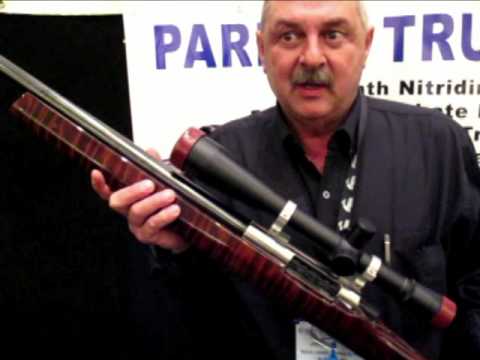
Is there a downside to nitriding? First, the nitriding process results in a BLACK matte or satin finish. If you like the natural silver finish of stainless steel, you shouldn’t nitride your barrel. Second, and most importantly, the salt-bath-nitriding process creates a surface so hard that you can NOT re-cut the chamber with normal reaming tools. Therefore, before nitriding, the barrel must be finished chambered. Basically the barrel should be fully finished, crowned, chambered and headspaced before nitriding. NOTE: MMi Trutec CAN mask the crown during nitriding so that the barrel can be re-crowned at a later time.

January 29th, 2010
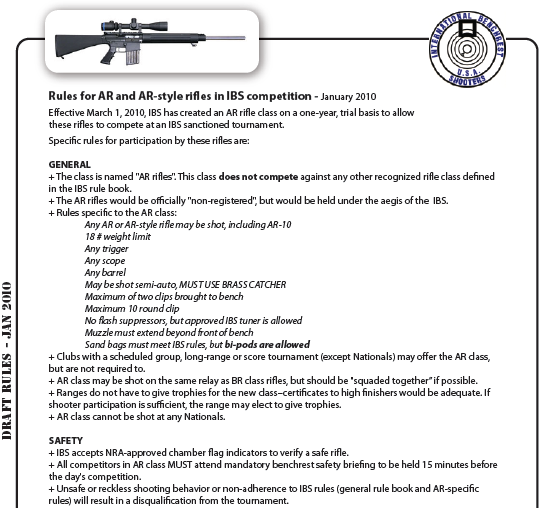
 Defying its reputation as a stodgy, conservative organization, the IBS will allow AR-style rifles to compete in their own class at IBS benchrest matches next year. Both AR15-platform and AR10-platform rifles can compete in this new, provisional class. Defying its reputation as a stodgy, conservative organization, the IBS will allow AR-style rifles to compete in their own class at IBS benchrest matches next year. Both AR15-platform and AR10-platform rifles can compete in this new, provisional class.
This will NOT displace any of the current classes (e.g. Sporter, LV, HV, Unlimited), nor change any rules for current classes. The “AR Experiment” will last for one year and then the IBS will determine whether to make the class permanent. IBS President Jeff Stover stressed three points:
1. This is an experiment for a one-year trial.
2. Clubs MAY have an AR class, but they are not required to do so.
3. The IBS Nationals are NOT affected — there will be no ARs at any Nationals
The IBS has distributed proposed draft rules, and the IBS plans to adopt final rules on March 1, 2010. Here are some of the key proposed rules:
December 27th, 2009
AccurateShooter.com offers dozens of FREE, printable targets for target practice, load development, and fun shooting. We also offer a few samples of the most popular NRA Bullseye targets. One or more of these printable targets should work for most training purposes. However, some readers have asked “where can we get the real targets… exactly like the ones used in NRA, IBS and NBRSA shooting matches?”
Sources for Official Shooting Competition Targets
Here are six (6) sources for official match targets: ALCO Target Company, American Target Company, National Target Company, Orrville Printing, Pistoleer.com, and U.S. Target Company. All five of these vendors carry nearly all the NRA High Power and Smallbore targets, including the new, smaller F-Class Targets. Most sources also have international 300m and 300m-reduced-to-300-yards targets.
National Target and Orrville Printing currently sell IBS targets for rimfire (50 yard) benchrest, short-range centerfire Benchrest (100, 200, 300 yards), Hunter BR Rifle (100, 200, 300 yards), plus the official 600-yard and 1000-yard IBS targets. However, this year the IBS designated Orrville Printing as the official source for IBS 100-200-300-600 group and score targets. Orrville Printing was selected after an extensive review of available target papers in 2008. Clubs hosting IBS registered shoots may use up old stock, but new purchases should be from Orrville Printing.
We are told that National Target supplies NBRSA matches. One other NRA-licensed target vendors is Central Target Company (Kentucky), (502) 895-3390, but it appears that Central Target doesn’t maintain a web site.
| Available Official Competition Targets |
| Vendor |
NRA High Power |
F-Class |
NRA Smallbore |
Air Rifle/Pistol |
IBS |
NBRSA |
Other |
ALCO Target
Company |
Yes, All |
No |
Yes |
Yes |
No |
No |
Archery, IDPA, IPSC, Police, Realistic, Shoot-N-C, Silhouette, Fun Targets, Pasters. |
American Target
Company |
Yes, All |
Yes |
Yes, All |
Yes |
No |
No |
USBR, Sight-in, Muzzle-Loading, Police Silhouette |
National Target
Company |
Yes, Nearly All |
Yes |
Yes, All |
Yes |
Yes* |
No |
IDPA, IPSC, FBI, Police Silhouette, Sight-in, Target Backers, Pasters |
| Pistoleer.com |
Yes |
Yes |
Yes, most and color training |
Yes |
Yes |
No |
Bianchi, FBI, IBS, IDPA, IPSC, Silhouette, Archery, Pasters |
| U.S. Target, Inc. |
Yes |
Yes |
Yes, All |
Yes |
No |
No |
Bianchi, FBI, Police Silhouette, IPSC, Realistic Silhouette, Varmint |
| *National Target Co. is allowed to sell off remaining IBS Target inventory. |
ALCO Target Co., Ph: (626) 358-4814, 2048 Central Ave., Duarte, CA 91010
American Target Co., Ph: (877) 733-0433, 1328 South Jason St., Denver, CO 80223
National Target Co., Ph: (800) 827-7060, 3958-D Dartmouth Ct., Frederick, MD 21703
Orrville Printing Co., Ph: (330) 682-5066, 1645 N. Main St., Orrville, OH 44667
Pistoleer.com, Ph: (618) 288-4588, 12 Schiber Court, Maryville, IL 62062
U.S. Target Inc., Ph: (800) 746-6836, 16472 Common Rd., Roseville, MI 48066
Alternate NBRSA Target Source
NBRSA 600-yard and 1000-yard targets are also available from Karl Huntstiger, wfo13 [at] aol.com, 2901 E. Cortez Street, Phoenix, AZ 85068.
December 25th, 2009
Sam Hall of Boonville, North Carolina is “King of the Hill” when it comes to the 600-yard benchrest game. He is the 2009 IBS 600-yard Shooter of the Year, and he won the IBS 600-yard Nationals two years in a row. When Sam talks, people listen… if they’re smart. Sam was recently asked to compare the performance of Berger’s 6mm 108gr boattail vs. Berger’s 105gr VLD bullet. As Sam explains, both bullets have the potential to shoot really well, so your barrel and the conditions may dictate which projectile works best.
Berger 105gr VLDs vs. Berger 108gr BT by Sam Hall
I shot the 108gr Bergers (and 108 BT BIBs for a few matches) all last year in my Light Gun (LG) and Heavy Gun (HG) in 600-yard IBS competition, but switched to Berger VLDs during the Nationals because of the extreme winds in South Dakota.

When I started loading for the 108s, I quickly learned they are much easier to tune than VLDs. In the two barrels in which I shot the 108s, they did not seem to be sensitive to seating depth or powder charge like the 105 VLDs. I could not see much difference in groups at 600 yards during tuning. But, with the 108s, you will need to drop about one grain in powder compared to the VLDs due to longer bearing surface and extra weight. It seemed that the 108s show a consistent round-pattern group, where the VLDs many times have flyers. By this I mean, if both the 108s and 105 VLDs shoot a two-inch, 5-shot group at 600, the 108s will be evenly distributed in the two-inch circle. Conversely, the time the VLD’s will often have 3 or 4 shots in one inch but 1 or 2 flyers expanding the group to two inches. But when the VLDs don’t have a flyer, look out! That’s when most of the World Records have been set and VLD shooters have come from behind and won the match. (Yes, I am talking to you Mike Davis).
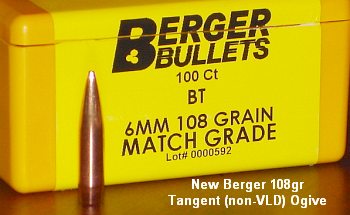 Mike Davis and I talked about the Berger 108s vs. 105s last year. The 108gr BTs are great until the wind gets up. They seem to get blown around more than the VLDs. A half-inch extra at 600 yards these days means the difference between winning or ending up middle of the pack. So, ideally, a shooter would have two loads. One would use the 108s for mild days, and the second would use the 105gr VLDs for those windy days. Mike Davis and I talked about the Berger 108s vs. 105s last year. The 108gr BTs are great until the wind gets up. They seem to get blown around more than the VLDs. A half-inch extra at 600 yards these days means the difference between winning or ending up middle of the pack. So, ideally, a shooter would have two loads. One would use the 108s for mild days, and the second would use the 105gr VLDs for those windy days.
If you don’t have time to tune the 105gr VLDs (tuning them can be difficult and time-consuming), I suggest you stick to the 108s. They will save you a lot of headaches and will stick close to the VLDs in most conditions.
How Temp and Humidity Affect Performance
I almost forgot to mention. As the temperature and humidity got up in the summertime last year in North Carolina, the 108s did not perform for me as well as they did during the cooler, less humid months. I tried developing a new, hot-weather load for the 108s, but I never got the 108s to perform as well in the summer as I did in the winter and spring — even when there was no wind. I don’t know why the 108s prefer cooler, less humid conditions, except maybe because they have more drag than the 105gr VLDs. High humidity may have had more of an effect on the 108s than we’d expect from the slight BC difference between the two bullets. The VLDs seem to drill through the wind and humidity better than the 108gr Bergers. NOTE: These findings are my own opinion based on many, many groups shot tuning and in competiton, while using several barrels of various manufacturers.
I hope this helps and does not further complicate your load development process. Try both bullets before you buy a large quantity of bullets. Your rifle will let you know which projectile it prefers. We have often found that a particular barrel will shoot one bullet design well but not the other. A few barrels will shoot BOTH bullet types really well.”
September 20th, 2009
 After scanning the equipment list for the recent 600-yard IBS Nationals, one of our readers noted how the 6mm Dasher dominated the Top 10 list in both Light Gun and Heavy Gun Classes. But Sam Hall won the Grand Agg with a straight 6BR, Mike Davis won the Heavy Gun Agg with a 6BRX, and Richard Schatz won the Light Gun Agg with a 6mm Dasher. So which cartridge should you pick? What’s the best for the 600-yard game — 6BR or Dasher or BRX? After scanning the equipment list for the recent 600-yard IBS Nationals, one of our readers noted how the 6mm Dasher dominated the Top 10 list in both Light Gun and Heavy Gun Classes. But Sam Hall won the Grand Agg with a straight 6BR, Mike Davis won the Heavy Gun Agg with a 6BRX, and Richard Schatz won the Light Gun Agg with a 6mm Dasher. So which cartridge should you pick? What’s the best for the 600-yard game — 6BR or Dasher or BRX?
Sam Hall, 2008 IBS 600-yard Shooter of the Year and back-to-back 2009/2008 IBS 600-yard National Champion, offers this advice:
“I shot a Dasher most of this year at IBS 600-yard matches and shot a no-turn BRX in a couple of shoots. I even tried a BRDX (40° improved with a longer neck than Dasher) in a practice barrel. By looking at the results on my target, I would never have been able to tell the difference between any of them if I did not already know what cartridge I was shooting. The 6BR or an improved version are just downright inherently accurate. They are all easy to load for and tune. I do believe the 6-6.5×47 Lapua is harder to get tuned than the 6BR. There are always the exceptions though. I have been beaten a few times this year by one exceptionally good shooting 6-6.5×47.
My next step is to try a no-neck-turn 6BR. I have been beaten by some a few times. I am now wondering if neck-turning is worth the time. A lot of the top BRX and Dasher shooters are not turning their necks and doing extremely well.

In my opinion pick your favoite BR or improved version, learn it well, practice, and don’t deviate. If someone you know shoots a BRX (or Dasher) and has a lot of experience with it — that is a good head start for loads. You can then compare what shoots good and what does not. I sure did not learn everthing on my own. I got some good load info here on this website (AccurateShooter.com) and I used to hound Terry Brady to death for loads to find out what he was winning with. Don’t be afraid to ask questions! I still do! Good luck and have fun.”
– Samuel Hall
September 18th, 2009
Sam Hall did it again. The 2008 IBS National Champion and 2008 Shooter of the Year captured his second straight National Championship, winning the 2-Gun Grand Agg shooting a standard 6BR in both Light Gun (LG) and Heavy Gun (HG) classes. It was an impressive victory in challenging conditions at the Varmint Hunter Assn. (VHA) range in Pierre, South Dakota. But this was a very close match. Mike Davis, runner-up in the Grand Agg, tied Sam in 2-Gun points, but Sam was awarded the title based on 2-Gun Small Group tie-breaker. Richard Schatz was just one point behind Sam and Mike. All three men shot superbly and any of the three could have won it all. Davis won the HG Overall Agg (with Hall second), while Schatz won the LG Overall Agg, with Hall again placing second. Both Davis and Schatz shot 6BR Improved cartridges in both LG and HG — Davis shooting the 30°-shoulder BRX, while Schatz campaigned a 40° Dasher. Rodney Wagner (6BRX) and John Griswold (6 Dasher) tied with 27 points in the 2-Gun overall, with Wagner earning 4th place overall on the tie-breaker.
Horrendous Conditions on Friday — Many DQs
Sam Hall said the conditions on Friday were “horrendous” with 25 to 35-mph gusts. Conditions were among the worst ever seen by the VHA rangemasters, and a third of HG competitors (17 of 48) DQ’d because the wind blew shots off paper. Luckily, conditions moderated for the Saturday relays, with mild 10 mph winds. Regulars at the VHA range said Saturday’s conditions were “about as good at it gets in Pierre.”
Complete Results are posted under Long Range Match Results on the IBS Website.
Equipment — Still dominated by 6BR and 6BR Improved
A quick look at the equipment lists for both LG and HG classes showed the 6mm as the preferred caliber, with a 6mm Dasher or 6mm BRX the most popular cartridge (though Hall won it all with his standard 6BR). Despite the windy conditions, the mid-sized cases such as the 6-6.5×47 Lapua couldn’t outshoot their smaller brothers. Notably, Sam Hall used a plain vanilla 6BR to win LG Agg with a 2.852″. Shooting a 6BRX, Mike Davis won HG Agg with a 2.492″, with Hall’s 6BR only .054″ behind.
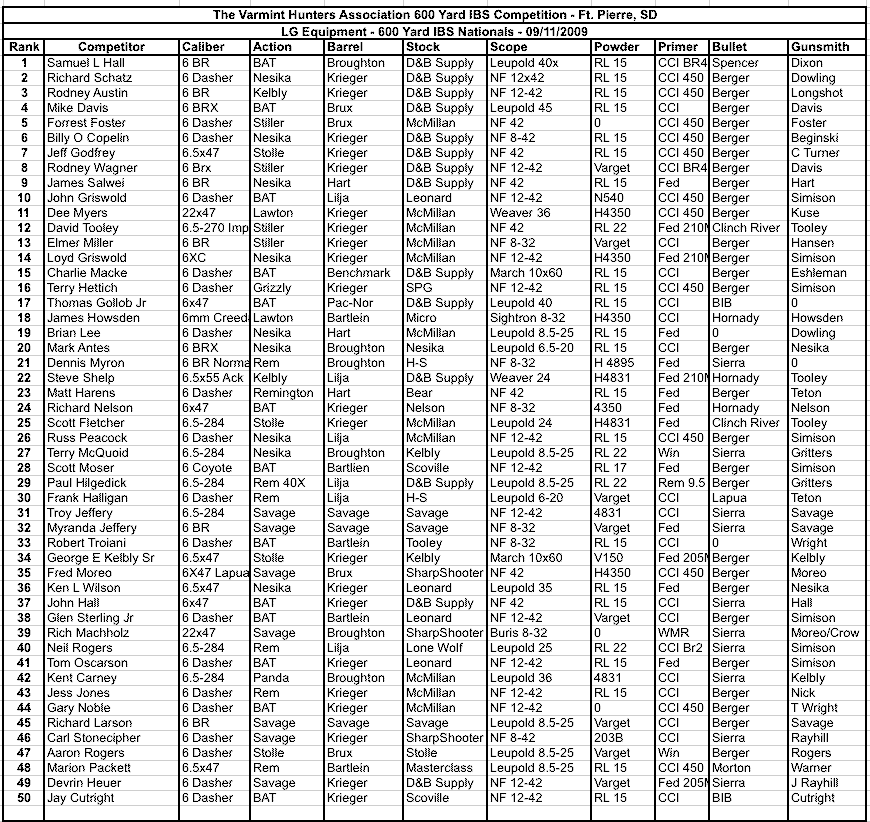
LG Equipment List

HG Equipment List

Calibers: 17 of the top 20 in LG shot 6mms, mostly Dashers (but Hall won LG with a standard 6BR). There was one .22 and two 6.5s. In HG it was pretty much the same story, 16 of 20 using 6mms, with a couple 6.5s, a .308 Baer and a 30 BooBoo (not “39” as stated in equipment list).
Barrels: Sam Hall won LG Group Agg with a Broughton button-rifled barrel, but otherwise cut-rifled barrels from Brux, Krieger, and Bartlein dominated the Top 20 in both classes. In HG, Mike Davis shot a Brux to finish #1. NOTE: Sam Hall had a Lilja barrel on his second-place, 28-lb Heavy Gun, not a Brux as shown on the official equipment list.
Bullets: Sam Hall used Spencers in LG, and Steve Shelp shot BIBs in his 30 BooBoo Heavy Gun. Otherwise it was “all yellow box”, with Berger filling the Top 10 equipment rankings for both LG and HG. It’s fair to say Berger Bullets dominated the match.
Powder/Primers: Alliant Reloder 15 and CCI 450s (usually pushing Berger 6mm bullets) composed the preferred combo in both LG and HG. Sam Hall did use CCI BR4s, however. Rodney Wagner was the only Dasher shooter to use Hodgdon Varget, but he finished fourth overall in the 2-Gun Aggregate.
Optics: While ace shooters Sam Hall and Mike Davis both used Leupold Competition Scopes in both LG and HG classes, Nightforce scopes, (mostly 12-42 BR models) dominated the Equipment Top 20 lists. To our surprise, there were only a couple March Scopes in the Equipment Top 20 in HG, and just one in LG.
Stocks: Shehane (D & B Supply) stocks were used by 8 of the Top 10-ranked LG Shooters, and 5 of the Top 10 in HG rankings. The Trackers, both ST 1000 and MBR Tracker, remain hard to beat. We did see some “true maxies” in this match.

Hall Reveals Shooting Secrets in Home-Made Video
If you’re interested in 600-yard competition, or just want to shoot more accurately and consistently from the bench, you should watch a video Sam Hall put together last year. Because of wind noise, the audio is pretty bad at first, but be patient. Sam delivers some invaluable advice in the video. His tips on body positioning, gun-handling, and follow-through can earn you some points in your next match.
|