|
|
December 25th, 2009
Sam Hall of Boonville, North Carolina is “King of the Hill” when it comes to the 600-yard benchrest game. He is the 2009 IBS 600-yard Shooter of the Year, and he won the IBS 600-yard Nationals two years in a row. When Sam talks, people listen… if they’re smart. Sam was recently asked to compare the performance of Berger’s 6mm 108gr boattail vs. Berger’s 105gr VLD bullet. As Sam explains, both bullets have the potential to shoot really well, so your barrel and the conditions may dictate which projectile works best.
Berger 105gr VLDs vs. Berger 108gr BT by Sam Hall
I shot the 108gr Bergers (and 108 BT BIBs for a few matches) all last year in my Light Gun (LG) and Heavy Gun (HG) in 600-yard IBS competition, but switched to Berger VLDs during the Nationals because of the extreme winds in South Dakota.

When I started loading for the 108s, I quickly learned they are much easier to tune than VLDs. In the two barrels in which I shot the 108s, they did not seem to be sensitive to seating depth or powder charge like the 105 VLDs. I could not see much difference in groups at 600 yards during tuning. But, with the 108s, you will need to drop about one grain in powder compared to the VLDs due to longer bearing surface and extra weight. It seemed that the 108s show a consistent round-pattern group, where the VLDs many times have flyers. By this I mean, if both the 108s and 105 VLDs shoot a two-inch, 5-shot group at 600, the 108s will be evenly distributed in the two-inch circle. Conversely, the time the VLD’s will often have 3 or 4 shots in one inch but 1 or 2 flyers expanding the group to two inches. But when the VLDs don’t have a flyer, look out! That’s when most of the World Records have been set and VLD shooters have come from behind and won the match. (Yes, I am talking to you Mike Davis).
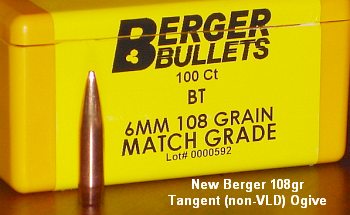 Mike Davis and I talked about the Berger 108s vs. 105s last year. The 108gr BTs are great until the wind gets up. They seem to get blown around more than the VLDs. A half-inch extra at 600 yards these days means the difference between winning or ending up middle of the pack. So, ideally, a shooter would have two loads. One would use the 108s for mild days, and the second would use the 105gr VLDs for those windy days.
If you don’t have time to tune the 105gr VLDs (tuning them can be difficult and time-consuming), I suggest you stick to the 108s. They will save you a lot of headaches and will stick close to the VLDs in most conditions.
How Temp and Humidity Affect Performance
I almost forgot to mention. As the temperature and humidity got up in the summertime last year in North Carolina, the 108s did not perform for me as well as they did during the cooler, less humid months. I tried developing a new, hot-weather load for the 108s, but I never got the 108s to perform as well in the summer as I did in the winter and spring — even when there was no wind. I don’t know why the 108s prefer cooler, less humid conditions, except maybe because they have more drag than the 105gr VLDs. High humidity may have had more of an effect on the 108s than we’d expect from the slight BC difference between the two bullets. The VLDs seem to drill through the wind and humidity better than the 108gr Bergers. NOTE: These findings are my own opinion based on many, many groups shot tuning and in competiton, while using several barrels of various manufacturers.
I hope this helps and does not further complicate your load development process. Try both bullets before you buy a large quantity of bullets. Your rifle will let you know which projectile it prefers. We have often found that a particular barrel will shoot one bullet design well but not the other. A few barrels will shoot BOTH bullet types really well.”
September 20th, 2009
 After scanning the equipment list for the recent 600-yard IBS Nationals, one of our readers noted how the 6mm Dasher dominated the Top 10 list in both Light Gun and Heavy Gun Classes. But Sam Hall won the Grand Agg with a straight 6BR, Mike Davis won the Heavy Gun Agg with a 6BRX, and Richard Schatz won the Light Gun Agg with a 6mm Dasher. So which cartridge should you pick? What’s the best for the 600-yard game — 6BR or Dasher or BRX?
Sam Hall, 2008 IBS 600-yard Shooter of the Year and back-to-back 2009/2008 IBS 600-yard National Champion, offers this advice:
“I shot a Dasher most of this year at IBS 600-yard matches and shot a no-turn BRX in a couple of shoots. I even tried a BRDX (40° improved with a longer neck than Dasher) in a practice barrel. By looking at the results on my target, I would never have been able to tell the difference between any of them if I did not already know what cartridge I was shooting. The 6BR or an improved version are just downright inherently accurate. They are all easy to load for and tune. I do believe the 6-6.5×47 Lapua is harder to get tuned than the 6BR. There are always the exceptions though. I have been beaten a few times this year by one exceptionally good shooting 6-6.5×47.
My next step is to try a no-neck-turn 6BR. I have been beaten by some a few times. I am now wondering if neck-turning is worth the time. A lot of the top BRX and Dasher shooters are not turning their necks and doing extremely well.

In my opinion pick your favoite BR or improved version, learn it well, practice, and don’t deviate. If someone you know shoots a BRX (or Dasher) and has a lot of experience with it — that is a good head start for loads. You can then compare what shoots good and what does not. I sure did not learn everthing on my own. I got some good load info here on this website (AccurateShooter.com) and I used to hound Terry Brady to death for loads to find out what he was winning with. Don’t be afraid to ask questions! I still do! Good luck and have fun.”
– Samuel Hall
September 18th, 2009
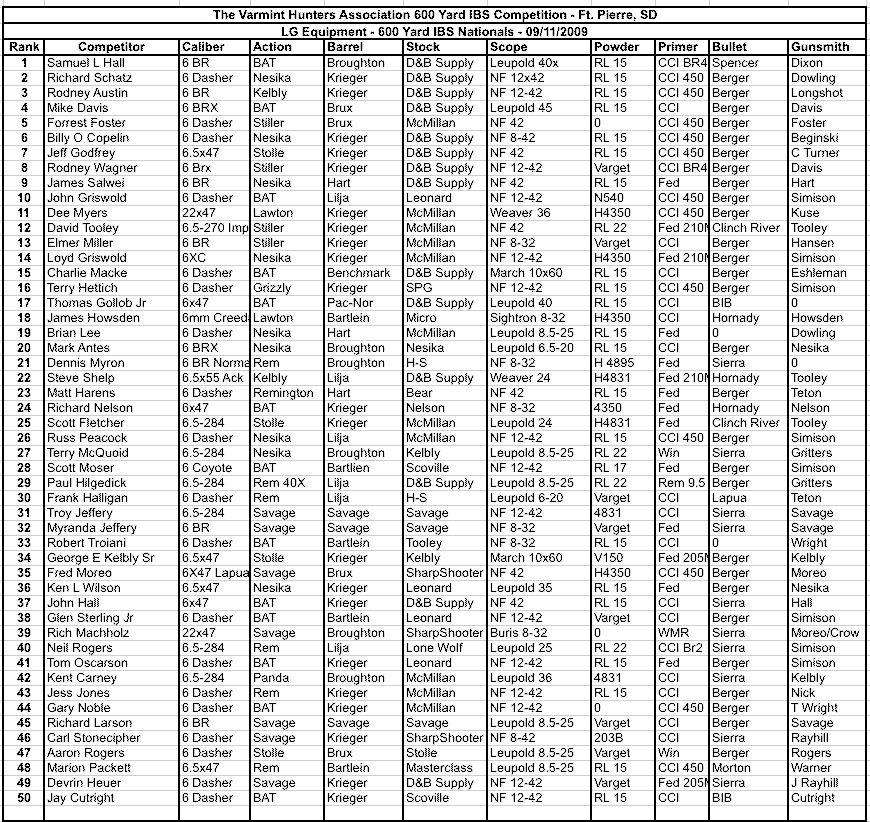
Sam Hall did it again. The 2008 IBS National Champion and 2008 Shooter of the Year captured his second straight National Championship, winning the 2-Gun Grand Agg shooting a standard 6BR in both Light Gun (LG) and Heavy Gun (HG) classes. It was an impressive victory in challenging conditions at the Varmint Hunter Assn. (VHA) range in Pierre, South Dakota. But this was a very close match. Mike Davis, runner-up in the Grand Agg, tied Sam in 2-Gun points, but Sam was awarded the title based on 2-Gun Small Group tie-breaker. Richard Schatz was just one point behind Sam and Mike. All three men shot superbly and any of the three could have won it all. Davis won the HG Overall Agg (with Hall second), while Schatz won the LG Overall Agg, with Hall again placing second. Both Davis and Schatz shot 6BR Improved cartridges in both LG and HG — Davis shooting the 30°-shoulder BRX, while Schatz campaigned a 40° Dasher. Rodney Wagner (6BRX) and John Griswold (6 Dasher) tied with 27 points in the 2-Gun overall, with Wagner earning 4th place overall on the tie-breaker.
Horrendous Conditions on Friday — Many DQs
Sam Hall said the conditions on Friday were “horrendous” with 25 to 35-mph gusts. Conditions were among the worst ever seen by the VHA rangemasters, and a third of HG competitors (17 of 48) DQ’d because the wind blew shots off paper. Luckily, conditions moderated for the Saturday relays, with mild 10 mph winds. Regulars at the VHA range said Saturday’s conditions were “about as good at it gets in Pierre.”
Complete Results are posted under Long Range Match Results on the IBS Website.
Equipment — Still dominated by 6BR and 6BR Improved
A quick look at the equipment lists for both LG and HG classes showed the 6mm as the preferred caliber, with a 6mm Dasher or 6mm BRX the most popular cartridge (though Hall won it all with his standard 6BR). Despite the windy conditions, the mid-sized cases such as the 6-6.5×47 Lapua couldn’t outshoot their smaller brothers. Notably, Sam Hall used a plain vanilla 6BR to win LG Agg with a 2.852″. Shooting a 6BRX, Mike Davis won HG Agg with a 2.492″, with Hall’s 6BR only .054″ behind.
LG Equipment List


HG Equipment List

Calibers: 17 of the top 20 in LG shot 6mms, mostly Dashers (but Hall won LG with a standard 6BR). There was one .22 and two 6.5s. In HG it was pretty much the same story, 16 of 20 using 6mms, with a couple 6.5s, a .308 Baer and a 30 BooBoo (not “39” as stated in equipment list).
Barrels: Sam Hall won LG Group Agg with a Broughton button-rifled barrel, but otherwise cut-rifled barrels from Brux, Krieger, and Bartlein dominated the Top 20 in both classes. In HG, Mike Davis shot a Brux to finish #1. NOTE: Sam Hall had a Lilja barrel on his second-place, 28-lb Heavy Gun, not a Brux as shown on the official equipment list.
Bullets: Sam Hall used Spencers in LG, and Steve Shelp shot BIBs in his 30 BooBoo Heavy Gun. Otherwise it was “all yellow box”, with Berger filling the Top 10 equipment rankings for both LG and HG. It’s fair to say Berger Bullets dominated the match.
Powder/Primers: Alliant Reloder 15 and CCI 450s (usually pushing Berger 6mm bullets) composed the preferred combo in both LG and HG. Sam Hall did use CCI BR4s, however. Rodney Wagner was the only Dasher shooter to use Hodgdon Varget, but he finished fourth overall in the 2-Gun Aggregate.
Optics: While ace shooters Sam Hall and Mike Davis both used Leupold Competition Scopes in both LG and HG classes, Nightforce scopes, (mostly 12-42 BR models) dominated the Equipment Top 20 lists. To our surprise, there were only a couple March Scopes in the Equipment Top 20 in HG, and just one in LG.
Stocks: Shehane (D & B Supply) stocks were used by 8 of the Top 10-ranked LG Shooters, and 5 of the Top 10 in HG rankings. The Trackers, both ST 1000 and MBR Tracker, remain hard to beat. We did see some “true maxies” in this match.

Hall Reveals Shooting Secrets in Home-Made Video
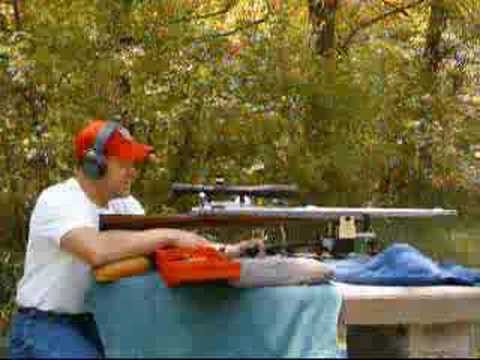
If you’re interested in 600-yard competition, or just want to shoot more accurately and consistently from the bench, you should watch a video Sam Hall put together last year. Because of wind noise, the audio is pretty bad at first, but be patient. Sam delivers some invaluable advice in the video. His tips on body positioning, gun-handling, and follow-through can earn you some points in your next match.
August 2nd, 2009
 Tony Boyer is, without question, the greatest short-range Benchrest for Group shooter who has ever lived. In a rare interview for the August 2009 issue of Precision Shooting magazine, Tony shares many of his “secrets of success” with his friend (and fellow benchrester) James Mock. James also interviews Tony’s wife Faye, a superb shooter in her own right.
This Boyer interview is now, for a limited time, available online. CLICK HERE to READ INTERVIEW. Every short-range and mid-range benchrest shooter should read this article word for word, at least twice. Tony reveals insights that may surprise you, and will certainly enlighten you. You may be surprised that Tony is now shooting a .268″ neck.
And in the article Tony challenges many commonly-held ideas. For example he doesn’t think vertical is mostly load-related: “Most shooters think that vertical groups are caused by too light a powder charge. This may be true, but more often than not, the rifle has more to do with this than the load. If the rifle is muzzle heavy, this can cause vertical. Also, the way the action is set in the stock can cause vertical as can handling problems…such as shouldering the rifle.”
Barrel Quality is All-Important
What is the main secret to Benchrest accuracy? Throughout the interview, Boyer stresses the importance of barrel quality. Tony can quickly identify barrels with winning potential. He has “developed a system that takes no more than 30 rounds to determine if it is going to shoot”. Tony needs that kind of efficiency because he burns through barrels very quickly: “Contrary to what many say, I rarely shoot a barrel more than 600 rounds in competition. I can remember only one barrel that exceeded 1200 rounds.”
When asked if there was one paramount “secret” he could share to help new shooters, Tony replied: “If you have the means, buy as many barrels as possible. A great barrel is the real secret of this game. There are barrels out there that shoot better than they should. They have been given the name ‘hummer’. I can assure you that they exist.”
July 14th, 2009
This past weekend, Sam Hall of Booneville, NC, set a new IBS Heavy Gun Score Aggregate record, 197 out of 200 (four, 5-shot groups, maximum 10 points per shot). That’s remarkable shooting by Sam, who holds multiple IBS records and was the IBS 600-yard Shooter of the Year in 2008. Sam’s 197 represents the highest Score Aggregate ever shot in either Light Gun or Heavy Gun IBS 600-yard competition. Sam was shooting a 6mm Dasher in a Shehane Maxi-Tracker stock with a Brux cut-rifled barrel.

Sam told us: “Here are pictures of my IBS 600-yard 6mm Dasher. With this 197 HG Score Agg, now Brux holds both the Score and Group Heavy Gun IBS Aggs. Mike Davis set the Heavy Gun IBS 600-yard Group Agg two months ago, also using a Brux barrel.”


May 4th, 2009
 Polish up your PPCs boys, the Super Shoot is coming up real soon! The Firearm Industry Super Shoot (FISS), the largest short-range benchrest match in North America, runs for four days, May 20-23, 2009 at the Kelbly range in North Lawrence, Ohio. This is a LV/HV match only. Here’s the shooting schedule: May 20 10.5-lb 100 yards; May 21 13.5-lb 100 yards; May 22 13.5-lb 200 yards; May 23 10.5-lb 200 yards.
Some Slots Still Available
The Super Shoot attracts 320 or more shooters every year. For more information, go to Super Shoot Info Page, or click the links below. The competition is limited to 420 shooters. But it’s not too late to register. The Kelblys tell us “there are still places available if you get your registration in soon.” Note: after May 10, 2009, registration fees are $120.00 per gun. No exceptions.

Location:
7222 Dalton Fox Lake Road
North Lawrence, OH 44666
Phone: (330) 683-4674
Registration Form (.pdf file)
General Information
Map to Range
April 19th, 2009
 Yesterday, April 18th, Joel Pendergraft of Durham, NC put 10 shots into 3.048″ to set a new IBS 1000-yard Heavy Gun World record. Competing at Hawks Ridge, NC, Joel set the record with his big, 300 Ackley Improved HG fitted with an unusual water-cooled 12-twist, 4-groove Krieger barrel. Joel shot BIB 187gr flat-based bullets in Norma brass, pushed by a “generous amount” of Alliant Reloder 25 and Federal 210M primers.
This 3.048″ 10-shot group was a remarkable accomplishment, breaking one of the longest standing 1000-yard World Records. Bill Shehane commented: “This tops the NBRSA, IBS, and Original Williamsport Clubs’ all-time 10-shot Heavy Gun group records. Took a long time to do it and I for one know Joel did not back into it — he has worked harder than most the last 10 years to break this record. And just like John Voneida of the Original Williamsport Club who held this most prestigous record for so long, Joel is a super nice guy and a great competitor.”

Pendergraft’s fellow 1K competitors were quick to praise his accomplishment. Dave Tooley observed: “I still remember the day I suggested flat-based bullets to Joel and the laugh I got. Well he was laughing today. Couldn’t have happened to a nicer guy. Glad I was there to see it.” Posting on Benchrest Central, “4Mesh” wrote: “Couldn’t happen to a nicer guy! That gun showed some serious promise last year at the World Open and anything that cranks off targets like the one you shot there, has what it takes.” Jim Hardy added: “The new record is great but no better than the fine man who shot it. Everyone who knows Joel will say the same thing — he is one of the finest men you will ever meet. He lives the life, and walks the walk and has paid his dues in the 1000-yard BR game to get the record.”


Pendergraft was modest after his notable achievement: “Some of the words spoken are too kind. What makes this so very special is to be able to celebrate the accomplishment with all of my shooting friends[.] A good friend once said that records are shot when preparation and opportunity meet. I feel blessed to have personally had the opportunity. The preparation we can individually work on and acheive but the opportunity only comes to a few. Those of you that compete in longe range competition will know what I mean.”

April 10th, 2009
 On the eve of the new competitive shooting season, the rulemakers of the International Benchrest Shooters (IBS) issued two decisions that will affect the short-range benchrest game.
On March 31st, the IBS Executive Board took the following actions:
Modification of Bolts-Out Rule
In order to safely allow competitors to check seating depth, et. al. in the loading area, the E-Board voted to allow the allow insertion of bolts in the loading areas. However, placing the bolt in the gun while in the loading area is permitted ONLY under the following circumstances (read carefully).
1. Competitor strips the bolt of the fire control system.
2. Competitor uses a dummy round without primer or powder.
3. Competitor inserts a NRA “chamber flag” or other IBS-approved indicator inside the bare bolt.
4. Competitor displays all of these items to those around him.
NOTE: Violation of the above rules will result in an immediate disqualification from the tournament. According to the IBS Executive Board: “The change in the bolts-out rule will not take effect until we establish the exact type of bare bolt indicator that will be readily available to competitors. A likely date of inception is June 1, 2009. Until that time, the existing ‘bolts-out rule’ applies.”
Approval of Current Beggs Stock
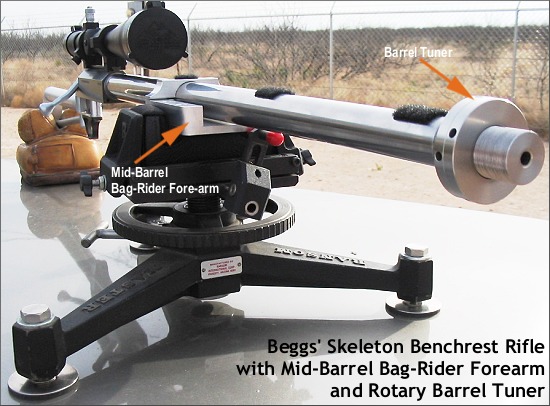
An IBS member asked the Executive Board to rule on the legality of the Gene Beggs’ modular stock for competition. This stock (shown below) features a separate, clamped bag-riding forearm rather than a conventional one-piece stock. The Excutive Board determined: “After consulting the Group and Score Committees there was a consensus among board members that the rules really did not envision a stock of this type. In the interest of not inhibiting innovation, the E-Board approved the Beggs Stock as currently configured, for HV, LV, SP, and VFS (as appropriate) competition in 2009. So that similar innovations can be more readily assessed, the Executive board will do a comprehensive review of the stock configuration rules prior to the July 1 deadline for agenda item submission.”
|