How’d you like to score a check for $25,000? That’s the winner’s pay-out for the 2017 NRA World Shooting Championship (WSC), which runs September 14-16 at the Peacemaker National Training Center in Glengary, WV. This event offers over $250,000 in cash awards and product prizes, making the WSC the richest combined shooting event in the USA (if not the world).
WSC Highlight Video with Competitor Interviews:
You can still Register for the WSC — though remaining spots are filling up fast. It ain’t cheap — Pros pay $395 while amateurs and juniors pay $325. Keep in mind though that all guns and AMMO are supplied. This unique 3-day multi-gun match tests competitors’ skills across twelve challenging stages involving nearly every major shooting discipline for rifles, shotguns, and pistols. REGISTER HERE.
All the Equipment is Supplied
“What makes this event very unique, especially to a professional shooter, is all the equipment is supplied. You have to leave your ego at home and just try to adapt as best you can to the equipment that you have supplied.” — Jerry Miculek
This major match attracts both sponsored Pros and “regular Joes”. For 2017, shooters will be split into two groups: a Professional Division for sponsored shooters, and the Amateur Division for non-sponsored competitors. All firearms, optics, and ammo will be provided by match sponsors for both divisions. “This year the NRA is going back to basics and returning the match to the original format of two divisions for professionals and amateurs, putting everyone on an even playing field”, said Cole McCulloch, NRA Competitive Shooting Director.
Video Shows 2014 World Shooting Champion SFC Daniel Horner in 3-Gun Stage
Cash Awards, Huge Prize Table, and New Random Drawings
The NRA World Shooting Championship will offer $250,000 in cash and prizes. Along with the $25,000 winner’s pay-out, there will be fat cash prizes for second and third place overall, High Lady, and High Amateur Junior. Then there are the prize tables — a real treasure trove. The designated Amateur prize table by itself will offer products and certificates topping $100,000 in value.
NEW Random Drawings — The WSC has added a new type of prize for 2017. Ten (10) Random Draw Prize Winners of $400 will be chosen during the WSC Awards Banquet. These random drawings give every competitor a chance to win cash, no matter what their event ranking.
Match entry fees are $395 for Professionals, $325 for Amateurs and Juniors. All firearms and ammunition are provided, and entry fees include one awards banquet ticket. For more information, visit WSC.NRA.org, call the WSC Coordinator at 703-267-1479, or email NRAhighpower@nrahq.org. On the official WSC.NRA.org you’ll find descriptions fo the 12 WSC stages. In addition, there is information about Peacemaker National Training Center and nearby lodging options.
How to Win the World Shooting Championship
“The format at the NRA World Shooting Championship is unique in that you don’t know what you have to shoot until you show up, so training for the event is a little difficult. My advice is to pack some good eye and ear protection, bring an open mind, be prepared to listen to the stage descriptions, figure out the best way you can take the guns they provide, and post the best score you can. When the match supplies all the guns and ammo, all you have to do is deal with ‘the performance’. This is the most level playing field in the shooting sports — anyone from around the world can come and play.” — Bruce Piatt, 2015 NRA World Shooting Champion
Competitors can register in one of two divisions: professional and amateur. The pro division is reserved for shooters who possess sponsorships, receive financial support for their competitive shooting or those who have been part of specialized firearms teams. All other shooters register in the amateur division. The playing field is completely level — every competitor uses the same guns, optics and ammunition. No competitors are allowed to bring their own gear, so everyone starts the match on equal footing.
Three Shots Standing at 400 Yards in 4.37 Seconds Could you hit a silhouette target at 400 yards, shooting offhand? Probably, with a little practice. Now try doing that three times in just 4.37 seconds, including picking up/mounting the rifle! Not possible? Watch the legendary Jerry Miculek do that in this impressive demonstration of rapid-fire rifle shooting.
Jerry Miculek — that name is synonymous with revolvers. But Jerry is also one heck of a rifleman, as he demonstrates in this video. Grabbing his rifle from the top of an oil drum, Miculek proceeds to put shots on three different steel targets at 400 yards — all in under 4.4 seconds. Most of us would be lucky to make one successful shot in that time limit. Miculek hits all 3 targets (and makes it look easy).
In this video, Jerry hits not one but THREE c-zone targets at 400 yards. And — get this — he does this in under 4.4 seconds starting with his rifle laying on a support (plywood on top of a barrel). It took Jerry two tries (on his first run he hit 2 out of 3 in 4.65 seconds). On the second attempt (see video starting at 2:19), it takes Jerry just 4.37 seconds to shoulder his rifle, aim, and fire three shots, each hitting a separate steel target. Wow. That’s truly remarkable. Most of us would need ten seconds (or more) just to get the scope on the first target.
Trust us folks, this ain’t easy. It takes remarkable marksmanship skills to shoot with this kind of precision at this kind of pace. As Jerry would say himself, “Not bad for an old guy who needs glasses”.
How’d you like to score a check for $25,000? That’s the winner’s pay-out for the 2017 World Shooting Championship (WSC), which runs September 14-16 at the Peacemaker National Training Center in Glengary, WV. This event offers over $250,000 in cash awards and product prizes, making the WSC the richest combined shooting event in the USA (if not the world). This unique 3-day multi-gun match tests competitors’ skills across twelve challenging stages involving nearly every major shooting discipline for rifles, shotguns, and pistols.
This major match attracts both sponsored Pros and “regular Joes”. For 2017, shooters will be split into two groups: a Professional Division for sponsored shooters, and the Amateur Division for non-sponsored competitors. All firearms, optics, and ammo will be provided by match sponsors for both divisions. “This year the NRA is going back to basics and returning the match to the original format of two divisions for professionals and amateurs, putting everyone on an even playing field”, said Cole McCulloch, NRA Competitive Shooting Director.
WSC Highlight Video with Competitor Interviews:
What the Competitors Have to Say:
“We’ve been waiting all our lives for a match like this, so we can come over (from the UK) [and] shoot guns that we can’t even own in the UK, because of the laws. What the NRA has done is really great — this is a ground-breaking type of match.” John C., Amateur Competitor (UK)
“The main reason I signed up is just the ease of it… I don’t have to have thousands of dollars worth of guns. It’s a good way to try out all the different events.” — M.J., Amateur Competitor
“What makes this event very unique, especially to a professional shooter, is all the equipment is supplied. You have to leave your ego at home and just try to adapt as best you can to the equipment that you have supplied.” — Jerry Miculek
Video Shows 2014 World Shooting Champion SFC Daniel Horner in 3-Gun Stage
Cash Awards, Huge Prize Table, and New Random Drawings
The NRA World Shooting Championship will offer $250,000 in cash and prizes. Along with the $25,000 winner’s pay-out, there will be fat cash prizes for second and third place overall, High Lady, and High Amateur Junior. Then there are the prize tables — a real treasure trove. The designated Amateur prize table by itself will offer products and certificates topping $100,000 in value.
NEW Random Drawings — The WSC has added a new type of prize for 2017. Ten (10) Random Draw Prize Winners of $400 will be chosen during the WSC Awards Banquet. These random drawings give every competitor a chance to win cash, no matter what their event ranking.
Match entry fees are $395 for Professionals, $325 for Amateurs and Juniors. All firearms and ammunition are provided, and entry fees include one awards banquet ticket. For more information, visit WSC.NRA.org, call 703-267-1479, or email NRAhighpower@nrahq.org.
How to Win the World Shooting Championship
As first published in the NRA Blog, here are competition tips from 2015 NRA World Shooting Champion Bruce Piatt, and Dianna Muller, the top female competitor at the 2015 WSC:
“The format at the NRA World Shooting Championship is unique in that you don’t know what you have to shoot until you show up, so training for the event is a little difficult. My advice is to pack some good eye and ear protection, bring an open mind, be prepared to listen to the stage descriptions, figure out the best way you can take the guns they provide, and post the best score you can. When the match supplies all the guns and ammo, all you have to do is deal with ‘the performance’. This is the most level playing field in the shooting sports — anyone from around the world can come and play.” — Bruce Piatt
“The [WSC] is such a different breed — it’s really a difficult match for which to prepare! You are tackling disciplines outside your expertise and using guns you aren’t familiar with, and that can really rattle your nerves if you don’t prepare for that mental challenge. But you can use this match design to your advantage. Remove all expectations, because, who is great at ALL the disciplines (besides Jerry Miculek)?! Give yourself some room to be ‘not so great’, focus on the fundamentals and try to enjoy the match. It is kind of liberating throwing everything to the wind and seeing how you stack up against all kinds of shooters!” — Dianna Muller
Let’s face it, AR-platform rifles run dirty, at least compared to typical bolt-action rifles. The AR15 works by piping gas from the barrel back into the bolt carrier, causing the bolt to unlock and the carrier to move the bolt backward. The “exhaust gas” from the barrel contains soot and carbon. The carbon will form hard deposits on the bolt. In addition, the carbon can combine with lube on the bolt carrier to make a nasty, paste-like sludge. This can be particularly problematic when the black paste pollutes the ejector and extractor recess.
This Editor has inspected dozens of ARs over the years. Other than mag-related malfunctions, the most common cause of AR cycling problems I found was oily gunk in the extractor and ejector areas. Many AR owners overlook these critical areas. Look at an AR that hasn’t been cleaned properly and you’ll probably find black gunk (and small brass shavings) in the ejector and extractor recesses.
If you want to keep your black rifle running smoothly and reliably, you must clean it regularly and follow the correct maintenance procedures. Here are three videos that explain how to properly disassemble and clean AR-platform rifles.
Take-Down and Full Cleaning of AR15 by Jerry Miculek
Here ace shooter Jerry Miculek takes down and cleans an AR-platform rifle belonging to his daughter Lena. This is a good video because Lena’s rifle was “run hard and packed up dirty” so you can see where carbon and grease build up. This 35-minute video is very thorough. Jerry is one of the nation’s top action carbine shooters, so listen carefully to his advice on cleaning and lubrication.
How to Clean Your AR-Platform Rifle
This is a good basic video that shows the take-down and cleaning procedure for a typical AR15. It uses some fast-motion sequences to speed up the story. Check out this video if you don’t have the time to sit through the Miculek video above.
Cleaning and Lubricating AR15 Bolt Carrier Group
This video offers very specific advice on the bolt carrier group, which receives the dirty gas directly from the barrel. Be sure to check the extractor and ejector recesses. That’s where old lube, brass shavings, and carbon accumulate. Follow the directions in this video for lubrication, and don’t over-lubricate the bolt carrier — that will only capture more carbon.
Today, AR-platform rifles are hugely popular. Dozens of manufacturers sell AR-type rifles, in a wide variety of configurations and calibers. But before there were M16s and AR-15s, ArmaLite produced a 7.62×51 caliber rifle, the AR-10. Yes before there were millions of 5.56 black rifles, there was a .30-caliber big brother with reddish-brown furniture. Invented by Eugene (‘Gene’) Stoner for the Armalite company in the late 1950s, this is the father of all of today’s AR-platform rifles. Way ahead of its time, this remarkable, select-fire battle rifle weighed just 7.25 pounds as first developed.
If you’re curious about the AR-10, in this video, Jerry Miculek puts an original 1957-vintage AR-10 through its paces on the range. This extremely rare, early-production rifle was provided by Mr. Reed Knight and the Institute of Military Technology. (The gun in the video was actually produced in the Netherlands under license, see video at 4:40.) This AR-10 is the direct ancestor of the AR-15, M16, and many of the modern sporting rifles that we use today.
The AR-10 was slim and light, weighing in at around 7 pounds. Some folks might argue that the original “old-school” AR10 is actually better that some of today’s heavy, gadget-laden ARs. The AR-10’s charging “lever” was under the carry handle — that made it easier to manipulate with the gun raised in a firing position.
You’ll notice there is no “forward assist”. Inventor Gene Stoner did not believe a separate “bolt-pusher” was necessary. The forward assist was added to solve problems encountered in Viet Nam. Some critics say the forward assist “only takes a small problem and makes it a big problem.” For today’s competition ARs (that are never dragged through the mud) the forward assist probably is superfluous. It is rarely if ever needed.
Note also that the handguards are fairly slim and tapered. Today, six decades after the first AR-10 prototypes, we are now seeing these kind of slim handguards (made from aluminum or lightweight composites) used on “full race” ARs campaigned in 3-gun competition.
History of the AR-10
The AR-10 is a 7.62 mm battle rifle developed by Eugene Stoner in the late 1950s at ArmaLite, then a division of the Fairchild Aircraft Corporation. When first introduced in 1956, the AR-10 used an innovative straight-line barrel/stock design with phenolic composite and forged alloy parts resulting in a small arm significantly easier to control in automatic fire and over one pound lighter than other infantry rifles of the day. Over its production life, the original AR-10 was built in relatively small numbers, with fewer than 9,900 rifles assembled.
In 1957, the basic AR-10 design was substantially modified by ArmaLite to accommodate the .223 Remington cartridge, and given the designation AR-15. ArmaLite licensed the AR-10 and AR-15 designs to Colt Firearms. The AR-15 eventually became the M16 rifle.
AR-10 photos from Arms Izarra, a Spanish company specializing in de-militarized, collectible firearms. Interestingly, this particular AR-10 was produced in the Netherlands under license.
Here’s a cool Christmas Gift item — a high-quality 70-page coloring book featuring firearms. If you have kids or grandkids that enjoy shooting or hunting, this could be a fun, interactive gift. (Heck we know some adults who would enjoy it too.) Offered by Top Shot Champ Dustin Ellermann, Full Metal Coloring features quotes from famous people and shooting tips from ace shooters such as Jerry Miculek and Bryan Zins. The WideOpenSpaces Blog says: “Forget abstract designs or run-of-the-mill shapes. Instead, get your hands on this cool coloring book full of guns.” The price is $11.99.
Product Description: Filled with humor, history and iconic images, Full Metal Coloring appeals to military, veterans, shooting sports athletes and hunters. Amusing quotes by Aristotle, Walter Cronkite, Wyatt Earp and more. Shooting tips by Jerry Miculek, Brian Zins, Jim Henderson and more!
If you like 3-Gun shooting, definitely check out this video, a complete 22-minute episode of the Hot Shots TV series. This Hot Shots Season Three episode features three of the greatest action shooters in the world: Max Michel, Jerry Miculek, and Clint Upchurch. This superstar trio demonstrate their skills with a variety of rifles, pistols, and shotguns. You’ll see the latest “full-race” ARs, ultra-high-capacity scatterguns, and high-end pistols.
Click to Watch Full 22-Minute Episode from Hot Shots Season Three:
In this game it’s all about speed on target — matches are decided by fractions of a second. You’ll see Max Michel training with a pistol — and his speed is truly amazing. He gets six shots on target in under 4 seconds including draw. This season-opening episode of Hot Shots finds Max in Arizona tuning up against his fiercest rival, Jerry Miculek and family. You’ll also see competition footage from the West Coast Steel Championship and Clint playing host to a hometown 3-Gun match.
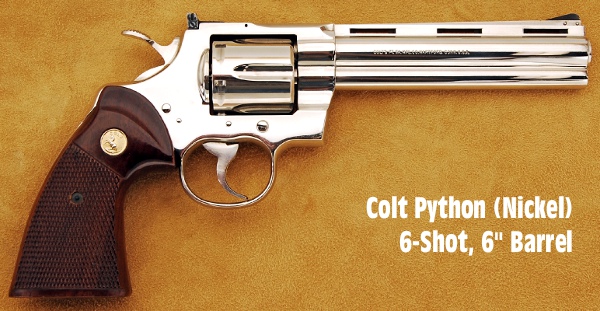
If you are considering acquiring a revolver for fun shooting, self-defense, or competition, you should definitely watch this YouTube video. In this 23-minute presentation, legendary shooter Jerry Miculek puts three .357/.38 SPL wheelguns through their paces. Jerry, one of the greatest revolver shooters in history, hosts a “Revolver Showdown” with three popular wheelguns: 1) S&W L frame (3″ bbl); 2) Colt Python (6″ bbl); and 3) Ruger Speed Six (2.75″ bbl).
Smith & Wesson Model 686 Plus, L-Frame, 7-rd .357 Magnum/38 SPL, 3″ Barrel.
Testing at 10 Yards and 50 Yards
In the video, Jerry shoots all three revolvers rapid-fire, double-action at 10 yards. Then he shoots the three guns single-action, slow-fire at 50 yards (starting at time mark 7:19).
After his range session, Jerry examines nine medium frame revolvers, comparing and contrasting design features. Jerry considers these factors:
1. Accuracy
2. Balance and Handling
3. Speed and Sureness of Trigger Return (watch video at 3:45″ re Colt.)
4. Reliability
5. Barrel Twist Rate
6. Strength of Construction/Durability
The National Shooting Sports Foundation is pleased to announce that registration is now open for its 2016 Fall Shooting Sports Fantasy Camps in Tulsa, Oklahoma. There will be two (2) sessions this October, each with 33 spots available.
Watch Highlights from the First-Ever Shooting Sports Fantasy Camp in Las Vegas:
The NSSF 2016 Fall Shooting Sports Fantasy Camp will take place at the world class United States Shooting Academy in Tulsa, Oklahoma. Two date options will be offered:
NSSF has lined up seven of our country’s top professional shooters for this premier event, including the first family of shooting, Jerry and Kay Miculek and Lena Miculek-Afentul, world class professional shooter, Bruce Piatt, 3-Gun pro couple Dianna and Ryan Muller, and Top Shot Season 4 winner Chris Cheng.
In addition to learning from today’s best shots, you’ll also be provided all meals, hotel accommodations, a swag bag full of premium shooting gear and more! You will need to provide your own travel arrangements and the camp registration fee of $3,495.
Camp Placements Will Sell Out Soon
If you are interestested, we recommend that you register soon — don’t delay. NSSF’s first Fantasy Camp (held this past spring in Las Vegas) sold out immediately. There are only 33 slots available for each date choice. For more information visit www.shootingsportsfantasycamp.com.
We had a chance to meet with Jerry Miculek and his wife Kay at SHOT Show. These are very nice people who also happen to be superb shooters. They are great ambassadors for the shooting sports. We talked about Jerry’s many titles and match wins over recent decades. He explained: “It didn’t come easy… the winning comes after years of hard work”. Jerry’s name is synonymous with revolvers. But Jerry is also one heck of a rifleman, as he demonstrates in this video.
Three Shots Standing at 400 Yards in 4.37 Seconds
For those of use who usually shoot from the bench, hitting a silhouette target at 400 yards from an standing position (unsupported) would be a big challenge. Here Jerry Miculek makes it look easy.
In this video, Jerry hits not one but THREE c-zone targets at 400 yards. And — get this — he does this in under 4.4 seconds starting with his rifle laying on a support. It took Jerry two tries (on his first run he hit 2 out of 3 in 4.65 seconds). On the second attempt (see video starting at 2:19), it takes Jerry just 4.37 seconds to shoulder his rifle, aim, and fire three shots, each hitting a separate steel target. Wow. That’s truly remarkable. Most of us would need ten seconds (or more) just to get the scope on the first target.
Trust us folks, this ain’t easy. It takes remarkable marksmanship skills to shoot with this kind of precision at this kind of pace. As Jerry would say himself, “Not bad for an old guy who needs glasses”.





 Testing at 10 Yards and 50 Yards


