The science behind annealing during the manufacture of new cases is well-established. What happens after that, when we repeatedly reload and anneal those same cases, has always been somewhat of a “dark art”. To help separate scientific fact from fiction, the creators of the Annealing Made Perfect (AMP) Annealer machine have conducted detailed studies of cartridge brass. The AMP Team’s studies offer some remarkable insights, while disproving a number of myths about annealing. Will annealing tighten your groups? The evidence of these studies shows it could.
The test results are fascinating. The team compared brands of brass, sectioning brass to examine both alloy composition and thickness from case mouth to case-head (bottom). They also examined how carbon build-up affects next tension. And they determined how brass changes over multiple loading cycles. They even did a series of bullet-pull tests to analyze factors affecting neck tension. Here are some of the key subjects in the reports:
Brand by Brand Analysis — How the cartridge brass alloy varies among different manufacturers. Bullet Release and Neck Tension — Tensile Bullet-Pull tests show factors affecting neck tension. Neck Tension and Carbon — How carbon build-up inside the neck affects “neck tension”. SS Tumbling and Hardness – How tumbling with stainless media affects brass hardness. Case Cleaning (Ultrasound and Tumbling) — How case cleaning affects annealing. Multiple Loadings — How brass performs when annealed every reload over 10+ cycles.
You really should read the reports — there are some fascinating revelations. The AMP team made longitudinal sections of various cases to show different case wall thicknesses and head geometry. These examples also show how the hardness of the case varies from the case mouth to the case-head. Both virgin and used, annealed cases were examined.
Bullet-Pull Tests — Using advanced tensile test equipment, AMP experimented with different combinations of dies, reloading sequences, and neck hardness to ascertain the best practice.
Carbon Inside Your Case-Necks May Be a GOOD Thing
AMP’s testers found carbon in necks can be beneficial: “Even with identical interference fit and neck hardness, as the carbon layer increased (microscopically), the force to draw the bullet decreased. It would appear the carbon acted as a lubricant. Interestingly, the [pull force] standard deviation also improved, i.e. the case to case variation in the force required to draw the bullets decreased.”*
Read the Full Test Reports
The AMP team’s objectives were to clarify some misconceptions on just what annealing does and does not do, and also to establish the best practices for consistent results. They have consulted with three independent certified metallurgy laboratories to produce some definitive information. So far, the Stage 1 and Stage 2 reports have been released. The studies include a report on the general physical properties of cartridge brass, including grain structures, hardness scales, time/temperature annealing information, and what can cause de-zincification.
The FULL REPORTS, including comprehensive appendices, are found here:
Examining Different Brands of Brass — What the Tests Revealed
Is Lapua brass harder than Norma? Is Lake City better than Remington? You’ll find answers to these and other questions in AMP’s annealing studies. One of the key findings in Stage 2 of Amp’s research is that brass from different manufacturers does vary in the distribution of material in the walls of the case.
Stage Two Conclusions:
— Different brands of the same cartridge cases can require different annealing power settings due to differing case wall thickness in the neck and shoulder region. The greater the mass of brass to be annealed, the greater the power requirement. Lot to lot variation within the same brand can occur for the same reason.
— The bushing die used in this set of tensile bullet pull tests gave significantly more consistent results than the standard neck die with expander ball.
— Cases should be annealed every reload in order to get the best repeatability.
Case Variations: Brand to Brand, and Lot to Lot
Here is a sample from AMP’s test report:
Analyzing Different Brands of Brass
In our Stage One report, we demonstrated that there is insufficient variation in alloy composition between brands to account for the variations we experience when annealing different brands of the same cartridge case. We therefore sought to confirm that it is the mass of brass to be annealed which accounts for the difference. Below are sectioned samples of four different brands of .223 Remington cases.
Both the Lapua and Norma neck walls are 314* microns (0.01236”) at the mouth. The Lapua neck wall thickens to 348 microns at the junction of the neck and shoulder, and the Norma neck thickens to 325 microns. Through the shoulder, however, the walls of both cases thicken to 370 – 380 microns. Once past the shoulder, they both taper back to 314 microns, before starting to thicken again, moving towards the case head.
The Lapua case requires AMP Program 47 to anneal correctly. It is the heaviest of the four cases tested through the shoulder region. The Norma case, which is only slightly lighter through the same region, needs Program 43.
The Remington case is very similar to the Lapua and Norma cases in the neck region, but it actually thins fractionally through the shoulder and front section of the body. The AMP program setting for Remington 223R is P32.
The Lake City case is the thinnest throughout of all four samples. It only requires Program 28.
The above samples clearly demonstrate that the mass of brass to be annealed is critical to the power requirement for correct annealing.
To see how the AMP Induction Annealing Machine works, watch this video:
* However, in Stage Two of AMP testing, the testers experimented with clean, carbon-free necks with dry lube. There was some indication of greater tensile pull consistency with dry-lube, but AMP plans to do more testing.
Each Wednesday, the U.S. Army Marksmanship Unit publishes a reloading “how-to” article on the USAMU Facebook page. This week’s “Handloading Hump Day” article covers two basic case prep chores — uniforming primer pockets and deburring flash-holes. Visit the USAMU Facebook page for other tips.
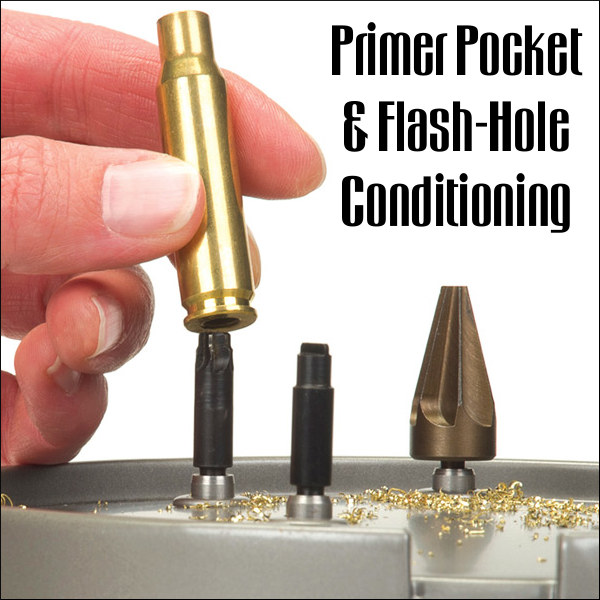
Primer Pocket & Flash-Hole Conditioning
This week, we’ll address a question that frequently arises: “Do you uniform primer pockets and deburr flash-holes?” As we tailor our handloading methods to the specific needs of each instance, the answer, not surprisingly, is “Sometimes!” However, don’t flip that dial just yet, as what determines our approach may be helpful in deciding how to address one’s own techniques. Moreover, we have a buried “Easter Egg” morsel that may bring a chuckle, as well as useful safety information!
Generally, the USAMU Handloading Shop does not uniform primer pockets (PP) or deburr flash holes (FH) of our rifle brass. We’re certainly not against it… Rather, this reflects the very high volume of ammunition we load, the fact that very few cases are ever re-loaded for a second firing, and the types of brass we use. However, as a need is perceived, we DO deburr flash holes. Of interest, we have fired many very small, 1000-yard test groups and aggregates using weight-selected, domestic brass that had not had PPs uniformed or FHs deburred.
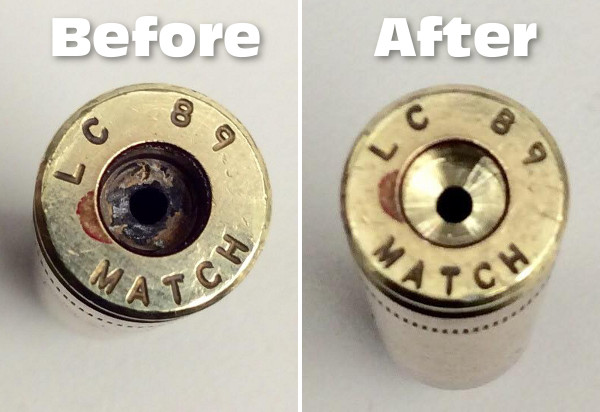
Before and After — On the left is a fired, deprimed 7.62×51 case with primer residue intact. On the right the primer pocket has been uniformed to SAAMI specs. Note the shiny finish at the bottom of the pocket — evidence of the the removal of metal when uniforming the primer pocket.
As to the type cases we use, many thousands of our long-range 5.56mm cases come to us from the arsenal with the primer of our choice pre-installed and staked-in, per usual practice. Obviously, we cannot uniform either FHs or PPs on this live, primed brass. However, after careful sorting, inspection and preparation, we do obtain match-winning results with it.
Shooters who reload their brass several times may decide to uniform PPs and deburr FHs, especially on their “300-yard and beyond” brass. Here, they will use the cases many times, while the uniforming is performed only once. Also, most handloaders only process moderate amounts of brass, compared to our multi-thousand round lots.
Having high quality Long Range (LR) brass helps. Many of the better brass manufacturers install their flash holes so that no burrs are created. Still, it does pay to inspect even THESE manufacturer’s products, as occasional slips are inevitable. Very rarely, some of the best makers will have a significant burr in, say, 1 per 1000 or 2000 cases, and it’s worth catching those.
Exceptions can always be found. Recently, we began processing a large lot of match brass from a premier manufacturer. We were startled to find that every case had a significant burr in the FH — something we’d never before seen from this maker. We then broke out the FH deburring tools and went to work.
Some observers have noted that it can be difficult to truly verify the contribution to accuracy of these procedures — particularly when firing from the shoulder, in conditions. Members of this staff, as individual rifle competitors, do often perform these operations on their privately-owned LR rifle brass. One could ascribe this to the old Highpower Rifle maxim that “if you think it helps, then it helps.”
However, a World Champion and Olympic Gold/Silver medalist here commented on his own handloading (for International competition, which demands VERY fine accuracy). He noted that he did seem to see a decline in accuracy whenever he did not uniform FHs, deburr FHs and clean primer pockets before each reloading. (One might be tempted to counter that only a truly World Class shooter could reliably detect the difference.) However, with the wisdom of decades experience, our Champion also remarked that “It could have been that I just wasn’t shooting as well that day.”
For those who do opt for these procedures, note that various tool models may have adjustable depth-stops; pay attention to the instructions. Some FH-deburring tools (which enter the case mouth, not the primer pocket) are dependent upon uniform case length for best results.
Above is a flash-hole deburring tool on an RCBS powered case-prep unit. These case prep machines can save a lot of pain and misery, helping one perform various functions quickly and efficiently.
At the request of our readers, we provide select “Deals of the Week”. Every Monday morning we offer our Best Bargain selections. Here are some of the best deals on firearms, hardware, reloading components, and shooting accessories. Be aware that sale prices are subject to change, and once clearance inventory is sold, it’s gone for good. You snooze you lose.
Here’s a great deal if you’re looking for a GEN2 6.5 Creedmoor Ruger Precision Rifle for PRS events or other bolt-action tactical applications. The 6.5 Creedmoor is the hot ticket for this rifle, and RPRs with this chambering have been in short supply. You’ll find many sellers charging $1400.00+ for this rifle, if they have it at all.
This week you can get a GEN2 Ruger Precision Rifle in 6.5 Creedmoor for just $1168.01 from Kentucky Gun Company, with FREE Shipping to boot. The “Cash Price” price is even cheaper, $1133.99. And GunPrime.com also has the 6.5CM RPR for $1199.00 this week. Curious about the differences between the GEN2 Ruger Precision Rifle and the original Model? CLICK HERE for a complete spec comparison and a video (scroll down landing page).
2. Midsouth — Norma Tac-22 .22 LR Ammo, $3.99/box
This Norma .22 LR ammo shoots WAY better than you’d expect given the low price — just $3.99 per 50ct box at Midsouth. These test targets come from Champion Shooters Supply. That vendor reports: “We have found this to run very well in Ruger rifles, handguns, and target pistols. These are 5-shot groups at 50 yards with an Anschutz 1913 rifle. This is an incredible value.” We suggest you grab some of this Tac-22 while you can at these rock-bottom prices.
3. Natchez — Surplus SKB 5041 Transport Cases, $129.99
Natchez has obtained a supply of British MOD Surplus SKB 5041 rifle cases. These were ordered as mine detector cases, but were never issued. Natchez has removed the foam cut for the detectors and replaced it with new 2-piece convoluted foam. Interior dimension of the case is 50″x14.5″x5″ so this will hold long-barrel match rifles comfortably. These are extremely high-quality cases, very tough and rugged, waterproof with gaskets. These cases feature four SKB patented trigger latches, four reinforced padlock locations, and inline wheels. Though in excellent condition, some case may have minor exterior scuffs. You won’t find a better case at anywhere near the price. These normally retail for $299.99.
4. Sportsmans Outdoor — S&W M&P9 Shield, $239.99 after Rebate
Here’s an awesome deal on a popular Smith & Wesson 9mm carry pistol. The M&P9 Shield (with thumb safety) is priced at just $314.99 at Sportsmans Outdoor Superstore. But it gets better — Smith & Wesson is offering a $75.00 Rebate. That lowers your net cost to just $239.99. That’s half what you might pay for a similar 9mm Glock. Good reason to buy American, and S&W’s warranty is rock solid. NOTE: This same M&P9 pistol without thumb safety is offered by Brownells for $359.99, or $284.99 after mail-in rebate.
This is a very good spotting scope for the price. Yes it gives up some low-light performance to a spotter with an 80mm objective, but otherwise it is a good performer, and we can’t think of much that will touch this Vortex Diamondback spotting scope for anywhere near the $399.99 sale price. Choose from angled or straight version for the same $399.99 price, which includes the 20-60X zoom eyepiece.
6. Amazon — Frankford Arsenal Master Tumbler Kit, $67.99
This Master Tumbler Kit contains everything you need to tumble rifle or pistol brass. Now on sale for $67.99 with free shipping, this Kit contains: Vibratory Tumbler, Rotary Media Separator, Plastic Bucket, 3 lbs. Cleaning Media, and 4 oz. Brass Polish.
7. Powder Valley — Reloder 16 Powder, 1-pound and 8-pound
Powder Valley now has Alliant Reloder 16 (RL16) in stock in both 1-lb ($23.95) and 8-lb ($178.95) containers. If you’re not familiar with this relatively new propellant, we can tell you that RL16 may be the best replacement yet for hard-to-find Hodgdon H4350. Burn rate is very similar to H4350, and RL16 is extremely temp-stable. Most importantly, our Forum members are reporting outstanding accuracy with Reloder 16. It is well suited for mid-sized cartridges such as 6XC, 6mm Creedmoor, 6.5 Creedmoor, 6.5×47 Lapua, and .260 Remington. If you like H4350, we recommend you try a pound of Alliant’s impressive Reloder 16.
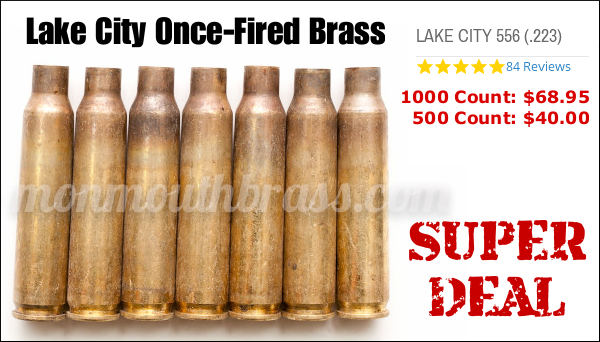
8. Monmouth Reloading — 500 Lake City 5.56 Cases, $35.00
500 pieces of Lake City brass for just thirty-five bucks? Yep, that’s a great deal for anyone who needs .223/5.56 brass for varmint safaris and tactical comps. Monmouth Reloading is selling genuine, once-fired Lake City 5.56x45mm brass sourced direct from the U.S. Military. NOTE: CLICK HERE and then select 500-ct pack — the 1000-ct is out of stock. Monmouth reports: “Our current stock of Lake City 5.56 looks to be all newer year Lake City head stamp but may contain a small percentage of other NATO headstamps. Lake City is a popular, reliable brass, normally capable of many reloads.” Monmouth includes 1% overage to account for any damaged brass. NOTE: Brass has crimped primers, so the pockets will need to be reamed or swaged prior to reloading.
9. Amazon — Howard Leight Electronic Muffs, $31.11
Every shooter should own a pair of Electronic muffs, even if you prefer shooting with earplugs and/or standard muffs. Electronic muffs are great when you are doing spotting duties or are working near the firing line. They allow you to hear ordinary conversations while still providing vital hearing protection. Right now Amazon.com has the Howard Leight Impact Sport Electronic Muffs on sale for just $31.11, with free Prime Shipping. This is good deal — these NRR 22 muffs are currently Amazon’s #1 seller in the category.
What’s the next best thing to a stockpile of gleaming, freshly-loaded ammo? How about a movie showing gleaming, freshly-loaded ammo being made — from start to finish? The five-minute video below shows the ammunition production process at the Lake City Army Ammunition Plant, a division of ATK. Lake City is the largest producer of small arms ammunition for the U.S. military, producing roughly four MILLION small-caliber rounds every day.
This promotional video does go overboard at times (too many smiling employees gushing about quality control). Still, it is fascinating to watch the process of creating cartridges — from the drawing (or extrusion) of raw brass into casings to the placement of projectiles and primers.
Quick History of Lake City Ammunition Plant Lake City Army Ammunition Plant (LCAAP) is a 3,935-acre government-owned, contractor-operated facility in Independence, Missouri that was established by Remington Arms in 1941 to manufacture and test small caliber ammunition for the U.S. Army. The facility has remained in continuous operation except for one 5-year period following World War II. As of July 2007, the plant produced nearly 1.4 billion rounds of ammunition per year. Remington Arms operated the plant from its inception until 1985, when operations were taken over by Olin Corporation. Since April 2001, it has been operated by Alliant Techsystems (ATK).
At the request of our readers, we have launched a “Deals of the Week” feature. Every Monday morning we offer our Bargain selections. Here are some of the best deals on hardware, reloading components, and shooting accessories. Be aware that sale prices are subject to change, and once clearance inventory is sold, it’s gone for good. You snooze you lose.
1. RCBS — Buy Green, Get Green Rebate
RCBS is running a very attractive Rebate Program currently. If you spend $300.00 on qualifying products you get a $75.00 rebate. Spend $50 and get a $10.00 Rebate. This program is limited to one (1) rebate redemption per calendar year, with a maximum of $75.00. CLICK HERE for more information. NOTE: To qualify, you must supply completed RCBS rebate coupon, original UPC barcodes from package, and original cash register receipt and/or dated, itemized sales invoice.
2. Monmouth Reloading — 1000 Lake City 5.56 Cases, $68.95
1000 pieces of Lake City brass for under seventy bucks? Yep, that’s a deal and a half. Monmouth Reloading is selling genuine, once-fired Lake City 5.56x45mm brass, thick-walled and sourced direct from the U.S. Military. Monmouth reports: “Our current stock of Lake City 5.56 looks to be all newer year Lake City head stamp but may contain a small percentage of other NATO headstamps. Lake City is a popular, reliable brass, normally capable of many reloads.” Monmouth includes 1% overage to account for any damaged brass. NOTE: Brass has crimped primers, so the pockets will need to be reamed or swaged prior to reloading.
3. Grab A Gun — Remington PSS with 20″ Heavy BBL, $589.00
Remington’s Heavy Barrel PSS model established a reputation for excellent accuracy. This .308 Winchester version features a 20″ heavy barrel threaded for a suppressor. The action is secured in a strong, pillar-bedded Hogue Overmolded ghillie green stock. The trigger is the X-Mark Pro externally-adjustable model set at 3.5 pounds. Weight, without rail or optic, is 7.3 pounds. NOTE: This PSS Rifle may also qualify for a $50.00 rebate from Remington. Inquire before you order.
4. Optics Planet — Leupold Mark AR MOD 1 1.5-4x20mm
Scopes for Service Rifles. Starting next year, under proposed new NRA Competition Rules, Service Rifle shooters will be able to use optical sights with a max magnification of 4.5X (fixed power or variable). At one-third the cost of a 4X ACOG, the Leupold 1.5-4X Mark AR is a good scope choice for the new optics-legal Service Rifle Class. Optics Planet currently has this on Sale for $299.99. With a Duplex reticle, this is also a fine hunting scope.
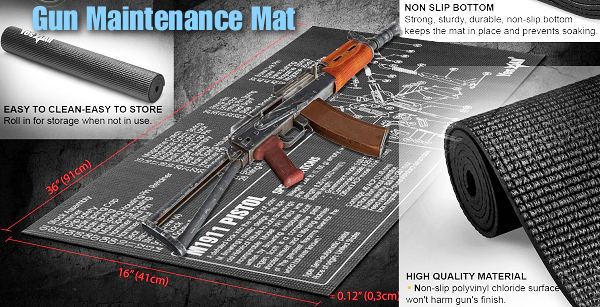
Every gun owner should have a work mat to protect valuable firearms during cleaning and maintenance operations. Right now you can get a quality 36″x16″ mat for under ten bucks. The non-slip polyvinyl chloride (PVC) surface won’t harm gun’s finish, and its absorbent features keep the fluids from going through your work surface. This week Amazon is offering the Printed Version (shown above) for $9.99 and a Plain Black Version for just $8.09. That’s an excellent value either way.
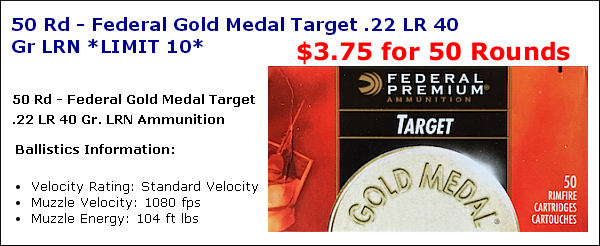
6. AmmoMen — Federal .22LR Target Ammo, $3.25/50 Rounds
This Federal Gold Medal Target ammo is MUCH better than common bulk rimfire ammo, yet with this deal, it is only 7.5 cents per round — that’s cheaper than pretty much anything else you can buy according to Ammoseek.com. Right now you can get up to ten (10) boxes of this .22 LRrimfire ammo for just $3.75 a box from AmmoMenLLC.com. If you need rimfire ammo, don’t delay — we expect this ammo to sell out very quickly at this price.
7. Walmart — Multi-Purpose Work Bench with Light, $69.95
This 4 foot-wide bench can serve many functions in your work room. We don’t recommend mounting reloading presses to it, but it can hold your tools on the backboard, along with dies and small parts in the drawers. Place bulky items (such as media separators) on the lower shelf. This bench features built-in lighting on the underside of the upper shelf.
Weight Capacity: Bench Top 220 lb, Bottom shelf 200 lb, Top Shelf 44 lb.
Dimensions: 47.4″ (L) x 23.8″ (W) x 61.6″ (H)
8. Bullets.com — Handgun Safe $49.95
This pistol safe keeps your handguns secure while still permitting instant “push-button” access. The three-button lock can be personalized with 3- to 8-digit codes, and there is a key override. This safe will hold two (2) full-sized pistols and can also store passports, cash, or other valuables. The spring-loaded door gives you near-instant response. The all-steel case also includes mounting holes for fixing the safe to floor or shelf.
“Once-fired, lot-number-traceable Lake City 7.62×51. This has been de-primed, pocket-swaged, small base body die’d, full-length sized, trimmed with a Gracey Trimmer, and tumbled. Now it’s shiny again. It’s like gourmet macaroni for shooters!” — Dennis Santiago
Our friend Dennis Santiago shoots a variety of disciplines, including Vintage Military Rifle. He burns through a lot of brass, some of it run through gas guns, so he often saves money by acquiring once-fired Lake City Arsenal brass. But that stuff is often pretty ugly when it arrives. For his “previously-owned” Lake City Brass, Dennis does a complete case prep operation and a thorough cleaning/tumbling operation. Special attention is paid to the primer pockets — they are swaged to remove the military crimp. The cases are trimmed and chamfered in one operation using a Gracey Powered Case Trimmer.
Dennis likes once-fired Lake City brass for some applications. The price is right, and with proper attention to detail during case prep, Lake City brass can shoot exceptionally well indeed. You may want to sort Lake City brass by weight. To remove the military crimp you have a variety of options — you can swage it out with a special tool like Dennis does, or you can ream out the crimp. For Wilson trimmer owners, Wilson makes a special Primer Pocket Reamer to remove military crimps. It works very well, as shown below:
Case Processing with the Gracey Trimmer
Designed by Doyle Gracey 30 years ago, the Gracey machine trims, deburs and chamfers in one operation, indexing off the case shoulder. The manufacturer claims the Gracey will process 20 cases per minute while holding .002″ tolerances on trim length. Two steel cutters are employed — one cutter trims the case to length and puts a chamfer on the inside of the case mouth. The second cutter removes the burr from the outside of the case-mouth. A 1/15 hp motor turns 1550 rpm. Interestingly, a clamped rubber hose serves as the “drive shaft” to turn the cutting head.
“This model may have a piece of wood for a base, no on-off swith and a piece of bent sheet metial to contain brass shavings — but it does trim, debur and chamfer with great speed and accuracy at a nice price. The [Gracey] two-bladed cutter requires a little more patience to adjust than the one-piece cutter on the Giraud, but it gets the job done superbly. [The Gracey] does the job for less money, if you’re willing to tinker with the cutter blade adjustment.” Gracey machines are still available new from MatchPrep.com for $335.00 (or $235.00 without motor).
What’s the next best thing to a stockpile of gleaming, freshly-loaded ammo? How about a movie showing gleaming, freshly-loaded ammo being made — from start to finish? The five-minute video below shows the ammunition production process at the Lake City Army Ammunition Plant, a division of ATK. Lake City is the largest producer of small arms ammunition for the U.S. military, producing roughly four MILLION small-caliber rounds every day.
This promotional video does go a bit overboard at times in a self-congratulatory sense. But the video is definitely worth watching — it is fascinating to watch the process of creating cartridges — from the drawing (or extrusion) of raw brass into casings to the placement of projectiles and primers.
Quick History of Lake City Ammunition Plant Lake City Army Ammunition Plant (LCAAP) is a 3,935-acre government-owned, contractor-operated facility in Independence, Missouri that was established by Remington Arms in 1941 to manufacture and test small caliber ammunition for the U.S. Army. The facility has remained in continuous operation except for one 5-year period following World War II. As of July 2007, the plant produced nearly 1.4 billion rounds of ammunition per year. Remington Arms operated the plant from its inception until 1985, when operations were taken over by Olin Corporation. From April 2001 through the present, it has been operated by Alliant Techsystems (ATK), which in February 2015 split into two separate companies, Orbital ATK and Vista Outdoors.
You probably know by now that the ATF is seeking comments on a proposed regulation that would ban the importation and sale of M855 steel-core 5.56x45mm ammunition. The ATF has proposed banning this “green-tip” ammo (and similar products) on the grounds that it is “armor piercing”.
Nobody knows whether the proposed ban will actually go into effect. The ATF is solicting comments through March 16, 2015. The mere possibility of a ban has spurred a feeding frenzy of ammo sales. If you are looking for genuine M855-type Green Tip ammo, suitable for use in AR-platform rifles, Creedmoor Sports recently obtained a large supply. Creedmoor just located quantities of Lake City-produced, American Eagle-brand XM855 in cardboard boxes: “Our team found another source for 5.56 mm XM855F Federal Lake City Green Tip Ammo. This ammo is becoming almost impossible to source the closer we get to the [March 16th end] of the ATF comment period.”
Lake City M855 5.56 62gr Green Tip Ammunition (300 Rounds)
Product Description
High-quality 5.56x45mm ammo made in the USA by Lake City. This is “XM855″ ball ammo with a steel penetrator in the core, surrounded by a copper jacket. The projectile is color-coded with a green-painted tip as is traditional with US-made M855.
Product Specifications:
* Manufacturer: Federal / Lake City
* Model: XM855
* Caliber: 5.56 NATO (5.56x45mm)
* Grain Weight: 62 Grains
* Type: Full Metal Jacket with Penetrator
* Units per Case: 300 (in two 150ct boxes)
Each Wednesday, the U.S. Army Marksmanship Unit publishes a reloading “how-to” article on the USAMU Facebook page. Yesterday’s “Handloading Hump Day” post covered preparation of once-fired 5.56x45mm brass. This article, the first in a 3-part series, has many useful tips. If you shoot a rifle chambered in .223 Rem or 5.56x45mm, this article is worth reading. And visit the USAMU Facebook page next Wednesday for the next installment.
This week, Handloading Hump-Day will answer a special request from several competitive shooters in Alaska. They asked about procedures for morphing once-fired GI 5.56mm brass into accurate match brass for NRA High Power Rifle use. The USAMU has used virgin Lake City (LC) 5.56 brass to win National Championships and set National Records for many years. In this 3-part series, we’ll share techniques proven to wring match-winning accuracy from combat-grade brass.
Preparing Once-Fired GI 5.56 Brass for Reloading (Part 1 of 3)
Assuming our readers will be getting brass once-fired as received from surplus dealers, the following steps can help process the low-cost raw material into reliably accurate components.
1. Clean the Brass
First, clean the brass of any dirt/mud/debris, if applicable. Depending on the brass’s condition, washing it in a soap solution followed by a thorough rinsing may help. [This step also extends the life of the tumbling media.] Approaches range from low-tech, using gallon jugs 1/2 full of water/dish soap plus brass and shaking vigorously, to more high-tech, expensive and time-consuming methods.
2. Wet-Tumbling Options (Be Sure to Dry the Brass)
When applying the final cleaning/polish, some use tumblers with liquid cleaning media and stainless steel pins for a brilliant shine inside and out, while others take the traditional vibratory tumbler/ground media approach. Degree of case shine is purely personal preference, but the key issue is simple cleanliness to avoid scratching ones’ dies.
If a liquid cleaner is used, be SURE to dry the cases thoroughly to preclude corrosion inside. One method is to dump the wet brass into an old pillow case, then tilt it left/right so the cases re-orient themselves while shifting from corner to corner. Several repetitions, pausing at each corner until water stops draining, will remove most water. They can then be left to air-dry on a towel, or can be dried in a warm (150° F-200° F max) oven for a few minutes to speed evaporation.
Shown below are Lake City cases after cleaning with Stainless Media (STM). Note: STM Case cleaning was done by a third party, not the USAMU, which does not endorse any particular cleaning method.
3. Inspect Every Case
Once dry, inspect each case for significant deformation (i.e., someone stepped on it), damaged mouths/necks and case head/rim damage. Some rifles’ ejectors actually dig small chunks of brass out of the case head — obviously, not ideal for precision shooting. Similarly, some extractors can bend the case rims so badly that distortion is visible when spinning them in one’s fingers. These can be used for plinking, but our match brass should have straight, undamaged rims.
Dented case mouths are common, and these can easily be rounded using a conical, tapered tool, [such as a .223 expander mandrel. A dummy 7.62 or .30-06 cartridge with a FMJ spitzer can also work.] If most of your brass is of one headstamp, this is a good time to cull out any odd cases.
4. Check the Primers Before Decapping
Your clean, dry and inspected brass is now ready for full-length sizing, decapping and re-priming. Historically, primer crimps on GI brass have caused some head-scratching (and vile language) among handloaders. Our next installment will detail efficient, easy and practical methods to remove primer crimp, plus other useful handloading tips. Until next week, Good Shooting!
NOTE: The USAMU Handloading (HL) Shop does not RE-load fired 5.56 brass. We use virgin LC brass with our chosen primer already staked in place. However, our staff has extensive personal experience reloading GI brass for competition, which will supplement the Shop’s customary steps. In handloading, as in life, there are many ways to accomplish any given task. Our suggestions are note presented as the “only way,” by any means. Time for loading/practicing is always at a premium. Readers who have more efficient, alternative methods that maintain top accuracy are invited to share them here.
When we first ran this story a while back, it generated great interest among readers. By popular request, we’re reprinting this story, in case you missed it the first time around. — Editor
Precision shooters favor premium brass from Lapua, Norma, or RWS. (Lake City also makes quality brass in military calibers.) Premium brass delivers better accuracy, more consistent velocities, and longer life. Shooters understand the importance of good brass, but many of us have no idea how cartridge cases are actually made. Here’s how it’s done.
The process starts with a brass disk stamped from strips of metal. Then, through a series of stages, the brass is extruded or drawn into a cylindrical shape. In the extrusion process the brass is squeezed through a die under tremendous pressure. This is repeated two or three times typically. In the more traditional “draw” process, the case is progressively stretched longer, in 3 to 5 stages, using a series of high-pressure rams forcing the brass into a form die. While extrusion may be more common today, RWS, which makes some of the most uniform brass in the world, still uses the draw process: “It starts with cup drawing after the bands have been punched out. RWS cases are drawn in three ‘stages’ and after each draw they are annealed, pickled, rinsed and subjected to further quality improvement measures. This achieves specific hardening of the brass cases and increases their resistance to extraordinary stresses.” FYI, Lapua also uses a traditional draw process to manufacture most of its cartridge brass (although Lapua employs some proprietary steps that are different from RWS’s methods).
After the cases are extruded or drawn to max length, the cases are trimmed and the neck/shoulder are formed. Then the extractor groove (on rimless cases) is formed or machined, and the primer pocket is created in the base. One way to form the primer pocket is to use a hardened steel plug called a “bunter”. In the photos below you see the stages for forming a 20mm cannon case (courtesy OldAmmo.com), along with bunters used for Lake City rifle brass. This illustrates the draw process (as opposed to extrusion). The process of draw-forming rifle brass is that same as for this 20mm shell, just on a smaller scale.
River Valley Ordnance explains: “When a case is being made, it is drawn to its final draw length, with the diameter being slightly smaller than needed. At this point in its life, the head of the draw is slightly rounded, and there are no provisions for a primer. So the final drawn cases are trimmed to length, then run into the head bunter. A punch, ground to the intended contours for the inside of the case, pushes the draw into a cylindrical die and holds it in place while another punch rams into the case from the other end, mashing the bottom flat. That secondary ram holds the headstamp bunter punch.
The headstamp bunter punch has a protrusion on the end to make the primer pocket, and has raised lettering around the face to form the headstamp writing. This is, of course, all a mirror image of the finished case head. Small cases, such as 5.56×45, can be headed with a single strike. Larger cases, like 7.62×51 and 50 BMG, need to be struck once to form a dent for the primer pocket, then a second strike to finish the pocket, flatten the head, and imprint the writing. This second strike works the brass to harden it so it will support the pressure of firing.”
Thanks to Guy Hildebrand, of the Cartridge Collectors’ Exchange, OldAmmo.com, for providing this 20mm Draw Set photo. Bunter photo from River Valley Ordnance.





 What’s the next best thing to a stockpile of gleaming, freshly-loaded ammo? How about a movie showing gleaming, freshly-loaded ammo being made — from start to finish? The five-minute video below shows the ammunition production process at the Lake City Army Ammunition Plant, a division of ATK. Lake City is the largest producer of small arms ammunition for the U.S. military, producing roughly four MILLION small-caliber rounds every day.




 Preparing Once-Fired GI 5.56 Brass for Reloading (Part 1 of 3)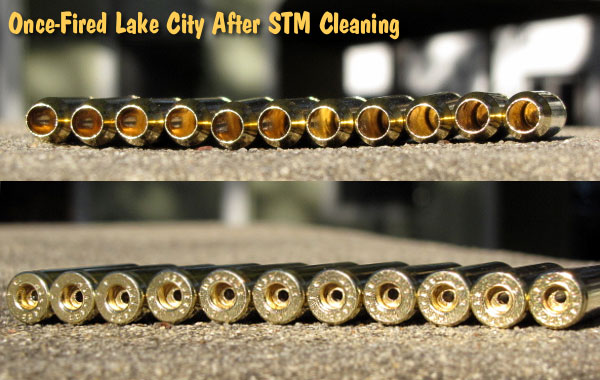
 Precision shooters favor premium brass from


