SFC Daniel Horner, now a civilian, is the best multi-gun competitor this Editor has ever met and seen in action. Horner is masterful with pistols, ultra-fast and accurate with rifles, and amazing with shotguns. Horner’s multi-gun aiming and transition speeds defy belief. Even with his world-beating skills, Horner is also respectful and humble. As a leading member of the U.S. Army Marksmanship (USAMU) team, Horner was never a show-boat, he was just (nearly always) the fastest guy on the range. I’ve seen him beat other top-level shooters by 10 seconds or more in a single stage. He’s that good. And now he’s turned PRO, having joined the SIG Sauer Shooting Team.
As a soldier with the USAMU, Horner was a true phenom with rifle, pistol, and shotgun, winning multiple 3-Gun titles against tough competition. When he was on his game, no one on the planet was better in the 3-Gun arena. His record of major multi-gun championships may never be rivaled. He has won over 125 major events/titles at the world, national, regional, and state level and he’s still a young man! Consider Horner’s amazing list of World and National titles:
10-Time USPSA Multi-Gun National Champion
4-Time 3-Gun Nation Pro Series Champion
2014 NRA World Shooting Championship Winner
2-Time IDPA National Champion
2-Time Int’l Sniper Competition Team Winner
IPSC Shotgun National Champion
Horner Highlights on Video
Here are some of our favorite Daniel Horner competition videos. You can see why he won so many major championships, including all the top multi-gun competitions.
Horner Shreds 3-Gun Nation Night-Time Stage
Horner Blazes in Rocky Mountain 3-Gun Shoot (Great Scenery!)
Horner Rips Night-Time Stage at 3-Gun Nation 2016 Pro Finale
How to Hammer Like Horner
In this USAMU Video, SFC Daniel Horner talks about grip, hold, stance, and body position. The proper hold/stance speeds up target transitions and keeps the muzzle on target for faster follow-up shots.
Champion 3-Gun Ace Daniel Horner has joined the SIG Sauer Professional Shooting Team — Team SIG. Horner recently left the service of the U.S. Army where he rose to the rank of Sergeant First Class (SFC). Horner served with the U.S. Army Marksmanship Unit, becoming one of the most successful shooters in team history. Horner also helped coach the USAMU Action Shooting Team.
Horner’s History — Rising to World Champion After Starting at Age Six
“I started shooting at six years old when I would go to the range with my Dad. When I was twelve years old I shot my first IDPA match, at sixteen I won my first IDPA National title, and at eighteen I enlisted in the U.S. Army to join the AMU. For basically my entire life I have been shooting competitively, and for as long as I can remember it’s been a lifelong goal of mine to shoot professionally. To have this opportunity to … join Team SIG is really a dream come true and I can’t wait to start working with the company and competing.”
Horner will compete primarily in multi-gun matches, and long-range rifle competition as a member of Team SIG. Horner’s first competition with Team SIG will be the SIG Sauer Fort Benning Multi-Gun Challenge next month (November 15-18, 2018). Horner will campaign a P320 X-Five full-size pistol, and a SIG M400 SDI Comp rifle with a TANGO6 1-6x24mm second focal plane scope.
This story appears courtesy NRABlog.com.
Looking to get started in Multi-Gun competition? The NRA Outdoors 3-Gun School is a two-day course covering all the skills you’ll need to compete in the 3-Gun game. The course, hosted at Peacemaker National Training Center in West Virginia, provides hands-on training for pistol, rifle, and shotgun. Participants experience a fast-paced mix of lessons and firing drills, including actual 3-Gun stages. For 2018, two sessions are scheduled: April 21-22, and June 16-17, 2018.
Video Shows Highlights from NRA Outdoors 3-Gun School Training Sessions:
You don’t even have to bring guns or load your own ammo. The NRA Outdoors 3-Gun School includes everything you need with the $1600.00 price of admission. You don’t need to bring any guns, ammunition or gear! The NRA Outdoors 3-Gun School provides all firearms, ammo and equipment used for the course, including Armalite AR-pattern rifles, Benelli shotguns customized by Hayes Custom Guns, SIG Sauer pistols, and Vortex Optics.
3-Gun Comps — What the Multi-Gun Game is All About
Most 3-Gun matches consist of 8 to 12 stages, with shooters engaging as many as 35 targets per stage. You’ll shoot at paper silhouettes as close as 10 feet away, and steel targets as far out as 600 yards. Time is of the essence — all stages are “on the clock”. You’re racing from station to station, your synapses firing as your transition from shotgun to rifle to pistol, close to long range, around corners, and over barriers.
You’ll encounter spinner wheels, swinging bowling pins and zooming clay pigeons, all while rushing through and around a bevy of walls, barrels, windows and even vehicles. Some 3-Gun matches are shot at night (see above), where the artificial illumination creates an entirely different set of challenges.
How to Participate
You can register now for the NRA Outdoors 3-Gun School. The first class of the year is scheduled for April 21-22, 2018, with another session later in mid-June. If you’re interested, register soon — these programs fill quickly.
CLICK HERE for more information about the NRA Outdoors 3-Gun School. Learn about other training courses by visiting the NRA Outdoors website or call (844) 672-6883.
Hardware for 3-Gun Competition — Guns & Gear
In this NSSF video, Top Shot Finalist Chris Cerino reviews the hardware you’ll need for multi-gun matches. Chris talks about carbine configurations — including barrel, handguard, and optics options. Cerino also demonstrates pistol techniques and explains the key features of a belt/holster rig.
Here Todd Jarrett nails three steel targets and a pop-up orange clay bird. Watch full video below.
If you are a fan of 3-Gun competition, tune in to Shooting USA this week. The latest episode, which airs Tuesday October 3 and Wednesday October 4, features the 2017 USPSA Multi-Gun Nationals in Boulder City, Nevada. You can see many of the nation’s top 3-Gun shooters attacking some very challenging stages with pistols, rifles, and shotguns. CLICK HERE for TV Schedule.
Multi-gun competition has evolved considerably since it started 30 years ago. The firearms are more sophisticated, the optics are better, and the stage times are much faster. Still, the challenge remains the same: How fast can you shoot multiple targets, with the score determined by speed and accuracy? For the best in the sport, the answer is very fast indeed, but Match Director Pete Rinsing has a few tricks up his sleeve to challenge competitors on never-before-seen courses of fire at the USPSA Multi-Gun Nationals held in April 2017.
Todd Jarrett highlights from 2017 USPSA Multi-Gun Nationals. Check out 300-yard prone rifle at 00:30, and blazing rifle-pistol-shotgun transitions at 00:50:
Most people compete in the Tactical Division, including 8-time Champion, SFC Daniel Horner of the U.S. Army Marksmanship Unit. Competitors in that division are not allowed a bipod, so many competitors utilize structures on the stage to stabilize their long gun. Regardless of division, the USPSA Multi-Gun Nationals is a true test of manipulating three different weapons, under pressure, on run-and-gun courses of fire. And the pressure is definitely on when a National Championship is on the line.
How’d you like to score a check for $25,000? That’s the winner’s pay-out for the 2017 NRA World Shooting Championship (WSC), which runs September 14-16 at the Peacemaker National Training Center in Glengary, WV. This event offers over $250,000 in cash awards and product prizes, making the WSC the richest combined shooting event in the USA (if not the world).
WSC Highlight Video with Competitor Interviews:
You can still Register for the WSC — though remaining spots are filling up fast. It ain’t cheap — Pros pay $395 while amateurs and juniors pay $325. Keep in mind though that all guns and AMMO are supplied. This unique 3-day multi-gun match tests competitors’ skills across twelve challenging stages involving nearly every major shooting discipline for rifles, shotguns, and pistols. REGISTER HERE.
All the Equipment is Supplied
“What makes this event very unique, especially to a professional shooter, is all the equipment is supplied. You have to leave your ego at home and just try to adapt as best you can to the equipment that you have supplied.” — Jerry Miculek
This major match attracts both sponsored Pros and “regular Joes”. For 2017, shooters will be split into two groups: a Professional Division for sponsored shooters, and the Amateur Division for non-sponsored competitors. All firearms, optics, and ammo will be provided by match sponsors for both divisions. “This year the NRA is going back to basics and returning the match to the original format of two divisions for professionals and amateurs, putting everyone on an even playing field”, said Cole McCulloch, NRA Competitive Shooting Director.
Video Shows 2014 World Shooting Champion SFC Daniel Horner in 3-Gun Stage
Cash Awards, Huge Prize Table, and New Random Drawings
The NRA World Shooting Championship will offer $250,000 in cash and prizes. Along with the $25,000 winner’s pay-out, there will be fat cash prizes for second and third place overall, High Lady, and High Amateur Junior. Then there are the prize tables — a real treasure trove. The designated Amateur prize table by itself will offer products and certificates topping $100,000 in value.
NEW Random Drawings — The WSC has added a new type of prize for 2017. Ten (10) Random Draw Prize Winners of $400 will be chosen during the WSC Awards Banquet. These random drawings give every competitor a chance to win cash, no matter what their event ranking.
Match entry fees are $395 for Professionals, $325 for Amateurs and Juniors. All firearms and ammunition are provided, and entry fees include one awards banquet ticket. For more information, visit WSC.NRA.org, call the WSC Coordinator at 703-267-1479, or email NRAhighpower@nrahq.org. On the official WSC.NRA.org you’ll find descriptions fo the 12 WSC stages. In addition, there is information about Peacemaker National Training Center and nearby lodging options.
How to Win the World Shooting Championship
“The format at the NRA World Shooting Championship is unique in that you don’t know what you have to shoot until you show up, so training for the event is a little difficult. My advice is to pack some good eye and ear protection, bring an open mind, be prepared to listen to the stage descriptions, figure out the best way you can take the guns they provide, and post the best score you can. When the match supplies all the guns and ammo, all you have to do is deal with ‘the performance’. This is the most level playing field in the shooting sports — anyone from around the world can come and play.” — Bruce Piatt, 2015 NRA World Shooting Champion
Competitors can register in one of two divisions: professional and amateur. The pro division is reserved for shooters who possess sponsorships, receive financial support for their competitive shooting or those who have been part of specialized firearms teams. All other shooters register in the amateur division. The playing field is completely level — every competitor uses the same guns, optics and ammunition. No competitors are allowed to bring their own gear, so everyone starts the match on equal footing.
For sheer “Fun with Firepower” it’s hard to beat a 3-Gun match at Raton, New Mexico. You get to play with lots of guns — rifles, pistols, and shotguns — while enjoying great views in one of North America’s most scenic shooting facilities. This past weekend many of the nation’s top 3-Gun aces were in Raton for the 2017 Rocky Mountain 3-Gun World Championship. This was held August 10-13 at the Whittington Center facility. Stages were conducted both on the designated rifle ranges as well as nearby hillsides.
In 3-gun matches, all stages are “on the clock”. Competitors need to be FAST and accurate.
There was a lot of Army black and yellow on the top of the podium, with USAMU shooters winning two divisions, along with the Team Event. SSG Joel Turner won the Open Division and SSG Tyler Payne won the Heavy Metal Scope Division. SFC Daniel Horner placed second in the Tactical Scope Division, while SFC Kyle McMaster finished second in the Tactical Irons Division. All four soldiers teamed up to win the Team Relay Shoot-Off competition to close out the event.
High-tech AR platform rigs are the rifles of choice for 3-Gun matches.
Who wouldn’t like a chance to shoot at the Whittington Ranges? What a backdrop!
Run ‘N Gun at 6000 feet
The Rocky Mountain 3-Gun (RM3Gun) is an action shooting match in the natural terrain of the NRA Whittington Center near Raton, NM. The riverbeds, mountains, trees and rocks provide props for the stages. There are 5 divisions: Open, Tactical Scope, Tactical Iron, He-Man Scope, and He-Man Iron.
RM3Gun is a very physical match, and Whittington’s 6000′ altitude makes things even tougher. The pace, thin air, and terrain challenge competitors’ fitness levels. The match has a healthy amount of long range rifle shooting. The match organizers state: “We try to strike a balance between rifle, shotgun and pistol, but you will definitely have lots of rifle because it’s one of the only places you can shoot as far in such a beautiful environment. Usually, we have some moving/aerial targets for the shotgun as moving targets are what the gun is designed for.”
On Ammoland.com, there’s an interesting article about the NSSF’s recent 3-Gun Fantasy Camp in Las Vegas. Author Duncan Johnson attended the Camp last month and wrote an “after action report”. He said the Camp was a great experience, and his shooting improved greatly with the expert tutoring from top pros: “If you have ever wanted to try a 3-Gun competition, just go do it, you will quickly find out why this is the fastest-growing shooting sport today. If you are new to shooting and or just getting started in 3-Gun, I 100% recommend you attend the NSSF Fantasy Camp.”
Here are Four Tips/Observations Duncan learned during the 3-Gun Fantasy Camp:
1. Use a Zoom Rifle Optic – “The LWRC 3-Gun ready rifle [provided for the Camp] was topped with a Leupold Mark 6 1-6x20mm riflescope, which made distance shooting much easier than the AimPoint optic [on my own AR]. 3-Gun competitions have rifle stages that can involve distance shooting out to ranges of 500 yards or more. For that reason, most shooters in the 3-Gun TacOps and Practical divisions use magnified riflescopes like the Leupold Mark 6 or the Vortex Strike Eagle.”
2. Use Your Quads and Core Muscles — “There are also a lot of little things that the pros teach you… For instance, some shooters instinctively bend their knees to enter their stance, but once they start firing they tend to follow the recoil with their shoulders and end up leaning back. In order to avoid that, use your quad muscles in your legs to get a solid stance that will absorb more recoil. Also use your core muscles to maintain a strong stance, especially in shotgun stages. The combination of strong quad and core muscles will contribute to controlling muzzle flip and moving onto your next target more easily.”
3. Vision-Based Target Transitions — “Another pro tip from Randi Rodgers on transitioning from target to target with a pistol was using your eyes rather than your sights to switch targets. So imagine it as pull the trigger, the slide starts to come back, using your eyes find the next target, then point with the front sight, find the sight picture, fire, and repeat.”
Editor’s Note: A few seasons back, I attended an action shooting seminar taught by Randi, and she explained the “move your eyes” technique. For multi-target stages, this really works. Move your eyes from target to target, and you’ll find your arms automatically “pull” the handgun into position. You still need to get the sights on target, but this method yields create smoother, faster stage runs.
4. Trigger Control and Use of Support Hand — If you don’t have good trigger control and pull straight back, you can move your sights during the shot. This is a common problem with novice pistol shooters. The solution is lots of dry fire training. Duncan found out he needed work: “In my case, the biggest area where I need improvement was shooting my pistol. There were two different things I was doing that will guarantee a missed shot every time with a handgun. When I pull/squeeze/depress my trigger I have a tendency to also pull the gun off target, resulting in a miss to the low left of a target. I [also] over-apply pressure with my shooting hand. According to the pros, pistol grip should be 40% shooting hand, and 60% supporting hand.”
This article originally appears on Ammoland.com, reprinted here under Creative Commons License.
If you want to see the world’s best multi-gun shooters in action, head to Henderson, Nevada this weekend. Henderson’s Pro Gun Club hosts the 2016 SureFire World Multi-Gun Championships, a challenging day + night, high-round-count match with 16 fast and furious stages. Earlier this week fun matches were held at Henderson, but the main event kicks off Friday, October 21st and runs through Sunday, October 23rd. The main match, with 16 grueling stages, is a real test of shooter and equipment. This unique match combines various Multi-Gun and 3-Gun competition shooting styles, with stages influenced by USPSA Nationals stages, speed stages, outlaw stages, large Ironman-style stages, open-terrain stages, and even low-light night stages (as shown below).
With an extensive prize table and some of the top competitors in the world, this will be one of the most important multi-gun matches of the year. For more match information, visit www.Surefirewmg.com. Match photos and results will be posted on the Surefire Multi-Gun Championship Facebook Page.
While this is an impressive photo of Matt Loganbill shooting last year’s night stage, Surefire lights might actually do a better job illuminating the stage.
Here are two stage maps for this year. Note the number and variety of targets! CLICK to ZOOM.
Ammo A-Plenty — 780 Rounds To Be Fired By Each Competitor Over Course of 16 Stages
The 2016 course of fire includes sixteen (16) stages. All three guns will be used on almost all the stages, except for the night stages. There will be plenty of ammo sent down range this year. Each competitor will be shooting roughly 780 rounds of rifle, pistol, and shotgun ammo:
Rifle: 260 rifle rounds, some 50-yard shots and a spinner. In addition there will be 20 rounds of rifle over the berms with two shots past 350 yards. Pistol: 280 pistol rounds, but there will be many paper and steel options. Shotgun: 200 normal shotgun rounds, plus 15-20 slugs.
The 2016 NRA World Shooting Championship (WSC) takes place September 15th through 17th, 2016 at the Peacemaker National Training Center in Glengary, West Virginia. The richest multi-gun event in North America, boasting $250,000 in cash and prizes, the WSC attracts the world’s best multi-gun shooters. This unique 3-day multi-gun match tests competitors’ skills across twelve stages sampling nearly every major shooting discipline (rifle, shotgun, and pistol). To be honest, the WSC is mostly a “run and gun” speed game, but competitors still must engage small targets at long range, so genuine marksmanship skills are required.
This year there will be three divisions: Open Professional, Stock Professional, and Amateur. Stock Professionals and Amateurs will use provided guns and ammo. But a 2016 WSC Rule change allows Open Pro competitors to bring their own firearms and ammunition for the match. Allowing the top Pros to shoot their own, optimized match guns should produce faster times and higher scores (plus fewer complaints about off-the-shelf guns that aren’t zeroed or don’t run right).
How to Win the World Shooting Championship
As first published in the NRA Blog, here are competition tips from reigning overall NRA World Shooting Champion Bruce Piatt, and Dianna Muller, the top female competitor at the 2015 WSC:
“The format at the NRA World Shooting Championship is unique in that you don’t know what you have to shoot until you show up, so training for the event is a little difficult. My advice is to pack some good eye and ear protection, bring an open mind, be prepared to listen to the stage descriptions, figure out the best way you can take the guns they provide, and post the best score you can. When the match supplies all the guns and ammo, all you have to do is deal with ‘the performance’. This is the most level playing field in the shooting sports — anyone from around the world can come and play.” — Bruce Piatt
“The NRA World Shooting Championship match is such a different breed — it’s really a difficult match for which to prepare! Over the past two years, I’ve learned to relax. I focus on relaxing in my own sport, because when you focus on the expectations over the procedure, it usually never works out in the shooter’s favor. The same goes for this match. You are tackling disciplines outside your expertise and using guns you aren’t familiar with, and that can really rattle your nerves if you don’t prepare for that mental challenge. But you can use this match design to your advantage. Remove all expectations, because, who is great at ALL the disciplines (besides Jerry Miculek)?! Give yourself some room to be ‘not so great’, focus on the fundamentals and try to enjoy the match. It is kind of liberating throwing everything to the wind and seeing how you stack up against all kinds of shooters! Coming from such a gear intensive sport as 3-Gun, I really enjoy walking up to 12 different stages and shooting guns and ammo that are provided. Although there may be issues with that format, it’s a great way to level the playing field, get down to brass tacks and see who is the most well rounded world champion shooter!” — Dianna Muller
This Wednesday, July 6th, Shooting USA features End of Trail, the Cowboy Action World Championship. Hosted annually at the SASS Founders Ranch in New Mexico, End of Trail attracts over 700 shooters, hailing from 50 states and many foreign countries. The event is part shooting competition, part family reunion, and part Wild West jubilee. SASS, the Single Action Shooting Society, is one of the most popular shooting organizations on the planet, having issued over 90,000 member badges. This special Shooting USA broadcast of the 2016 End of Trail airs at 8:00 PM, 11:30, and 2:00 am (Thursday) Central Time on the Outdoor Channel. This year’s End of Trail took place June 16-26, 2016.
Past Champions Randi Rogers (“Holy Terror”) and Spencer Hoglund (“Lead Dispencer”)
If you like multi-gun competition, you’ll enjoy watching Cowboy Action Matches. The top male and female shooters are experts with three kinds of firearms: Lever Rifle, Single-Action Revolver, and Shotgun (which can be a double-barrel side-by-side, or a pump, or even an 1887 lever-action). Generally speaking the guns must be originals or reproductions of pre-1900 designs to be used in competition (however 1911-style pistols are allowed in “Wild Bunch” side matches). A typical stage will require 5 shots from each of two six guns, ten rounds from the rifle, chambered in a pistol caliber, and 6 to 8 shotgun rounds.
24 Rounds from Four Guns in under 13 Seconds
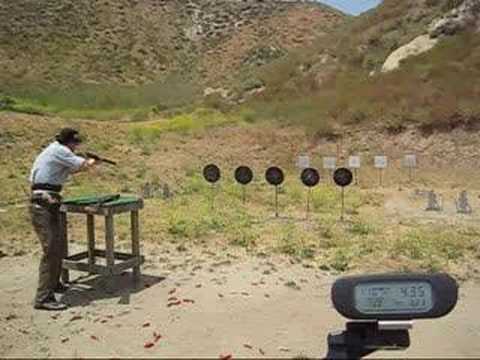
To give you an idea of the action you can see on Shooting USA, here is a video of past world Champion Spencer Hogland, aka “Lead Dispencer”. In this video, Spencer fires 24 rounds, with four guns, in just 12.81 seconds (look at the timer in lower right corner). Spencer shows blazing speed with his lever gun and note how quickly he loads his shotgun. Fast loading is key to a successful stage run. Unlike modern multi-gun comps, normally Cowboy Action Shooters must start with empty shotguns.
The 20th Annual MGM Ironman Match was held in Parma, Idaho earlier this month. Over 250 shooters vied for honors at this ultra-challenging event. The “OLHOT” (Open, Limited, Heavy Optics, and Trooper) classes competed June 5-7, while a Scoped Tactical Match followed June 9-11. Present were top pros, privateers, juniors, ladies, plus elite military and LEO teams. This very demanding 3-Gun event features ten tough, high-round count stages, including a signature zip-line descent from a tower. Without question, the MGM Ironman is one of the toughest shooting matches on the planet.
Watch POV view of the Zipline Stage at 2016 MGM Ironman:
Father and Son Duo Dominates 2016 Event
This year’s OLHOT match was definitely a “family affair” for the Gibson clan. In the Trooper Division, 17-year-old Wyatt Gibson won convincingly, finishing 138 points ahead of the next-best shooter. Meanwhile Wyatt’s father Travis Gibson won the Open Division. In true ‘Like father, like son’ fashion, Travis dominated the Open field, finishing 121 points ahead of his closest Open-class competitor.
This year’s aptly-named Ironman was particularly tough with triple-digit temps and strong winds. Over the course of three grueling days, competitors completed ten tough stages, shooting in excess of 1100 rounds per shooter over the course of the match. EVERY stage required the use of ALL three guns with 100 or more rounds. The average time spent shooting on each stage was about seven minutes. The Ironman is long, intense, and you shoot till you drop! Mike Gibson, the founder of MGM Targets, and the “inventor” of the Ironman, has said: “This match isn’t for weenies or crybabies”.
The week-long Ironman event is broken into two, 3-day sessions, with five different divisions. The OLHOT (Open, Limited, Heavy Optics, and Trooper) sessions ran June 5-7. During the second segment, held June 9-11, 120 Scoped Tactical shooters took on the same demanding course.
MGM Ironman Has Unique Stage Designs
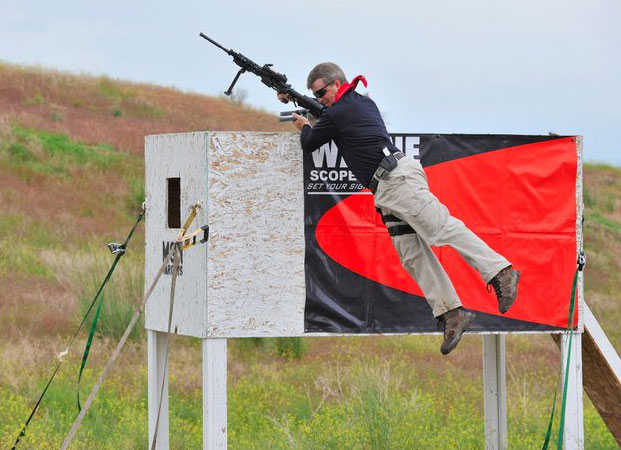
The MGM Ironman is an intense test of both shooter and equipment. Participants shoot a variety of classes and various scenarios including shooting from the back of a moving vehicle, from a 20-foot tower, while driving a golf cart, and while carrying a dummy.
Of course there are plenty of MGM-made reactive targets (photo right). The MGM Ironman regularly offers unique and demanding stages including firing a pistol from a zip line, and plunging down a steep slide from a 30 foot tower, rifle in hand. One stage involves carrying an 80-lb dummy over 100 feet and lifting it to the top of a six-foot platform before climbing it to engage rifle targets at distance. With creative and challenging stage designs and high round counts, he Ironman is truly a unique match.
Here is a video from the 2010 MGM Ironman. It shows many of the multi-gun stages, including the Zipline stage, filmed from multiple camera angles.


 10-Time USPSA Multi-Gun National Champion





 “The NRA World Shooting Championship match is such a different breed — it’s really a difficult match for which to prepare! Over the past two years, I’ve learned to relax. I focus on relaxing in my own sport, because when you focus on the expectations over the procedure, it usually never works out in the shooter’s favor. The same goes for this match. You are tackling disciplines outside your expertise and using guns you aren’t familiar with, and that can really rattle your nerves if you don’t prepare for that mental challenge. But you can use this match design to your advantage. Remove all expectations, because, who is great at ALL the disciplines (besides Jerry Miculek)?! Give yourself some room to be ‘not so great’, focus on the fundamentals and try to enjoy the match. It is kind of liberating throwing everything to the wind and seeing how you stack up against all kinds of shooters! Coming from such a gear intensive sport as 3-Gun, I really enjoy walking up to 12 different stages and shooting guns and ammo that are provided. Although there may be issues with that format, it’s a great way to level the playing field, get down to brass tacks and see who is the most well rounded world champion shooter!” — Dianna Muller






 MGM Ironman Has Unique Stage Designs


