The Rimfire Challenge is just about the most fun you can have with .22 LR pistols and rifles. This week Shooting USA TV features the 2017 Rimfire Challenge World Championship hosted at the Cavern Cove Rimfire Range in Woodville, Alabama. This major match attracts hundreds of competitors from around the nation. It’s fast and fun with instant feedback from ringing plates indicating hits. The Rimfire Challenge Championship is family-friendly event that’s great for all skill and experience levels.
Shooting USA TV Airs Wednesday Night on the Outdoor Channel:
9:00 PM Eastern and Pacific; 8:00 PM Central
The 2017 Rimfire Challenge World Championship brought 350 competitors to Alabama from as far as California and Washington State to shoot .22 LR rimfire pistols and rifles on 14 challenging stages, all with steel plate targets. The Challenge is designed to attract first-time competitors. “Our mission is to promote, protect and preserve hunting and the shooting sports. And to see all these young kids out here with their parents and their families all shooting together and enjoying the shooting sports. That’s what it’s all about, ” says Tisma Juett with the NSSF.
The Challenge offers plenty of action, with fourteen (14) stages of fire — each with a wide variety of steel plates. There is no set pattern or design, so each stage is different. You need to be fast AND accurate — you get penalty points for missing any plates. Scores are based on time for each stage, with add-ons for penalties. As with most action shooting games — it’s always best to shoot “clean” (no misses), even if you slow down a little bit.
At the 2016 NSSF Rimfire Challenge Championship Smith & Wesson was on hand with demo rifles and pistols. See the action in the S&W-produced video above. Competitive shooting is one activity in which entire families, both oldsters and youngsters, can come together in a supervised setting to enjoy the spirit and camaraderie of competition.
NSSF Rimfire Challenge Basics
The Rimfire Challenge is a two-gun event so you need a rifle and a handgun (which can be either a semi-auto pistol, or revolver). There are two divisions: 1) Open — Any firearm (pistol or revolver in handgun class) with scopes, optical sights, light gathering scopes, battery powered optics or lasers; and 2) Limited — Pistols and rifles with iron sights, adjustable metallic sights, and/or fiber optic. Bolt-action rifles and lever-action rifles are allowed, but self-loading (semi-auto) rifles are most popular because they can shoot quickly.
Many different stage designs can be employed at Rimfire Challenge matches. Here are two examples from the Rimfire Challenge Suggested Courses of Fire:
Rimfire Rifle of Choice: S&W M&P 15-22
If you want to shoot both Limited and Open class, a very good rifle choice rifle is the Smith & Wesson M&P 15-22. The feel, weight, and controls will be familiar to any AR owner. These 15-22s have been refined over the years and now are very reliable. Shoot it in Limited Class with the standard iron sights. Then fold down the sights and attach a 1-4X optic to shoot Open Class.
Rimfire Challenge Organizational Change for 2018
The National Shooting Sports Foundation (NSSF) announced that, starting in January, 2018, the NSSF Rimfire Challenge will be transitioned to a new organization: the Rimfire Challenge Shooting Association. Originally developed by Ruger’s Ken Jorgenson, TV host Michael Bane and the late Nelson Dymond, the program was first known as the Ruger Rimfire Challenge. NSSF took over the the program in 2014, changing its name to the NSSF Rimfire Challenge. The new organization will be led once again by Ken Jorgensen and Michael Bane.
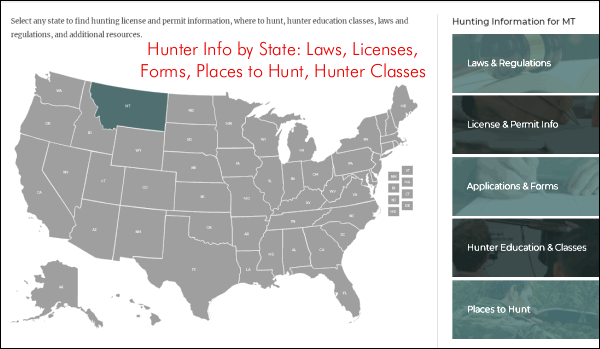
Click Map to launch interactive webpage with info for all 50 states.
Going hunting this year? Need to find out about hunting licenses, deer tags, local regulations, and the best hunting areas? Then visit WheretoHunt.org. This website has an interactive map of the country. Simply click on a state to find the info you need. For all 50 states, the NSSF has compiled information about hunting license and permits, where to hunt, hunter education classes, laws and regulations and more. For each state you’ll also find a link for required applications and license forms. Have a safe and productive hunt this year.
During August, Alabama will offer free shooting at five public ranges, with free instruction, free ammo, plus eye and ear protection provided.
Here’s a program we like, and we wish more states conducted something similar. The state of Alabama is offering FREE Shooting this month at five public shooting ranges. The state will even provide targets, ammo, eye/ear protection, and FREE instruction. This is the kind of promotion that will help grow our sport. We commend Alabama’s state leaders.
During the FREE events, new shooters can work with certified instructors at five of the state’s most popular public shooting ranges: Barbour, Cahaba, Delta, Etowah, and Swan Creek. These ranges are primarily located in Wildlife Management Areas (WMA) throughout the state.
The Alabama Department of Conservation and Natural Resources (ADCNR) invites recreational shooters to five public ranges during Alabama’s Free Range Days on August 11, 18, and 25. During these events, license and shooting range permit requirements will be waived. What’s more, equipment, ammunition, and hearing and eye protection will be provided free of charge at the five ranges listed below (during event hours only). Shooters are welcome to bring their own firearms.
Alabama’s Free Range Days will run from 8 am to 12 pm, but shooters are welcome to stay and shoot the remainder of the day on August 11, 18, and 25
CLICK HERE for more information on Alabama’s public shooting ranges. To learn more about Free Range Days, contact WFF Hunter Education Coordinator Marisa Futral at 334-242-3620 or email Marisa.Futral@dcnr.alabama.gov. The ADCNR’s Division of Wildlife and Freshwater Fisheries (WFF) has partnered with the National Shooting Sports Foundation to provide the Free Range Days as part of National Shooting Sports Month — August, 2018. NOTE: License and permit requirements will remain in effect for all other ADCNR public shooting ranges throughout August.
The NSSF has declared August to be National Shooting Sports Month (NSSM). To celebrate this, retailers and shooting clubs are hosting nearly 700 events around the country. These events, which include classes, shooting demos, competitions, and special sales, are listed in a searchable online database. There is also an August sweepstakes for National Shooting Sports Month.
Hundreds of August Events Listed in NSSF Database
Visit LetsGoShooting.org to find August events near you. You can search the database by state, event type, and range name. Nearly 700 events are listed in chronological order, with more being added daily. Here’s a partial sample of the NSSM events taking place over the next few days.
Trigger Time Sweepstakes
As part of National Shooting Sports Month, the NSSF is running a Trigger Time Sweepstakes. Register to win valuable prizes — no purchase necessary. The Grand Prize package, worth $5247.00, includes a Remington 700 6.5 Creedmoor rifle, a Nightforce ATACR 7-35x56mm FFP/Mil scope, and a case of Barnes Match 6.5 Creedmoor ammunition, plus accessories. In addition to the big prize package, there will be dozens of other prizes awarded each week in August. CLICK HERE for Sweepstakes INFO.
The National Shooting Sports Foundation (NSSF) has produced a very useful educational resource, a video explaining “How to Talk to Your Kids about Firearm Safety”. The video, starring champion shooter Julie Golob, encourages parents to have “the talk” about firearm safety with their kids sooner rather than later, and provides tips for how to have a helpful discussion.
“As a mother, I know full well how challenging this conversation can be,” Golob said. “It’s crucial that parents set an example and teach their kids about firearm safety so children don’t learn about guns solely from what their friends say or what they see on video games and TV.”
“Too often, children don’t know what to do if they find a gun,” said Steve Sanetti, President and CEO of NSSF, which developed and sponsors the Project ChildSafe firearm safety education program. “This video opens a door for honest conversation and empowers parents to be the authority on gun safety for their kids, whether they have guns in their homes or not.”
The “How to Talk to Your Kids about Firearm Safety” video was created as a resource to start positive and constructive conversations by encouraging discussion rather than lecture, and helps parents responsibly demystify the subject of guns. For more information, visit Projectchildsafe.org.
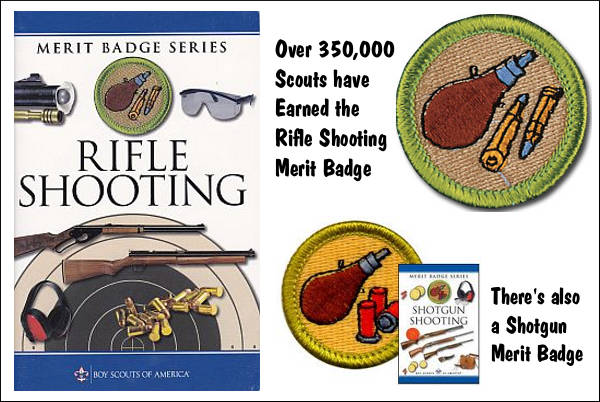
Comment: If we want the shooting sports to survive (and thrive), we need to bring young shooters into this sport. Many of our readers, as well as this Editor, got started in shooting through the Boy Scouts. I shot rimfire rifles at scout camps and earned my Marksmanship Merit Badge. AccurateShooter.com strongly supports the Scouts, and we commend the NSSF for providing grants to regional BSA Councils. This article explains how regional BSA Councils can apply for funding.
The National Shooting Sports Foundation (NSSF) has kicked off its annual grant program for the Boy Scouts of America Councils. Through this partnership, BSA Councils can receive a portion of $100,000 in NSSF grant funds to develop or expand their troop activities in target shooting and marksmanship. Target shooting programs continue to rank among Scouting’s most popular activities, teaching firearms and range safety, teamwork building and fundraising skills.
2018 marks NSSF’s eighth year supporting the BSA Council Grant Program, underscoring the time-honored practices of firearms safety, marksmanship training and shooting sports participation with the Boy Scouts. Additionally, the BSA’s recent decision to allow young females to join its ranks, though controversial, does provide an entirely new audience for BSA marksmanship training.
“Safety and marksmanship training through the Boy Scouts is a time-honored introduction to the shooting sports. We’re looking forward to increased participation from Scouts pursuing [merit] badges in these activities and then taking those new skills afield for a lifetime of enjoyment”, said Zach Snow, NSSF Range Services Director.
How Scouting Groups Can Apply for Grants
BSA Councils should review the grant guidelines and application procedures on the NSSF Website. Councils awarded NSSF funds must use those grants to purchase shooting sports equipment/supplies from NSSF Member Retailers. Qualifying purchases include: ammunition, eye and ear protection, firearms, targets, and shooting vests.
In a helpful NSSF video, Ryan Cleckner explains why you normally should avoid canting your rifle — rotating it clockwise or counter-clockwise. Cleckner explains that canting the rifle in one direction or another will change the point of impact: “When you rotate the rifle, not only does the [POI move] in the direction that you’re rotated, [but] it also loses some of its elevation as it rolls down.” This, Cleckner explains, can make you miss on one side or the other:
Cant to the Left — You’re going to miss low and left.
Cant to the Right — You’re going to miss low and right.
In this video, starting at the one-minute mark, Cleckner shows the effect of rifle canting when engaging a 600-yard target. A few degrees of cant (either to the left or to the right), moves the shot POI completely off the steel silhouette target. The POI change occurs mainly because you are lowering (and laterally shifting) the scope sight-line relative to the bore axis, effectively changing your zero.
David Tubb has explained: “Every 1 degree you are off on a cant, is about six inches of difference laterally at 1000 yards”.
Position Shooting with Sling — Rifle Cant Considerations
Cleckner’s discussion assumes that the scope or sights are set to hit center with the rifle level and plumb. That works for most situations when shooting prone off bipod, front mechanical rest, or front sandbag. However, many sling shooters, including David Tubb and John Whidden, do tilt or cant their rifles slightly inward because this allows a more comfortable hold with sling, or allows better eye-to-sight alignment. Holding the rifle at an angle can work — but the angle of cant must be consistent for every shot. Canting the rifle is not a sin by itself. However, after you confirm your zero on your target, the degree of cant must be the same for EVERY shot. You must maintain that exact same degree of rotation on each shot or you will experience the shot POI movement Cleckner illustrates. Consistency is the key.
John Whidden, 5-time Nat’l Long Range Champion, holds a Palma rifle. John now shoots a match rifle with an Anschutz stock which he holds more upright, but still with some counter-clockwise cant. John also installed his iron sights at an angle so that the adjustments are correct (and plumb) even with his canted hold: “While it may not be obvious in the picture, the sights on my rifle are set up so that they’re straight vertical and horizontal while I hold the rifle canted. Making sure your adjustments (scope or sights) are vertical and horizontal is a critical piece of the pie.”
Inexpensive Dual-Diameter Scope-Mounted Bubble Level
The best way to avoid inconsistent rifle canting is to use a bubble level fitted to rail or scope. One very affordable and versatile product is the Jialitte Scope Bubble Level. This features a 30mm milled inside diameter, plus an inner insert ring so it will also fit 1″-diameter main tubes. The Jialitte unit is nicely radiused, and has a low profile in the middle. User reviews have been very positive. You could easily pay $35.00 or more for a 30mm scope level. This costs just $10.99 on Amazon.
The National Shooting Sports Foundation (NSSF) has published a Q & A Page about FFL transfers and other FFL-related matters. The NSSF’s experts provide answers to common questions to ensure that neither FFLs nor their customers get caught in regulatory traps. Here are some of the recent questions and answers:
1. Purchase of Firearm by Parent for Child.
Q: May a parent or guardian purchase firearms or ammunition as a gift for a juvenile (under 18 years of age)?
Yes. However, possession of handguns by juveniles (less than 18 years of age) is generally unlawful. Juveniles generally may only receive and possess handguns with the written permission of a parent or guardian for limited purposes (e.g., employment, ranching, farming, target practice or hunting), and that permission slip must be carried by the juvenile while possessing the handgun. [18 U.S.C. 922(x)]
2. May an FFL Transfer a Firearm by Way of a “House Call”?
Q: I have an elderly customer who cannot leave his home. I have a gun in my store that he wants to buy. Can I go to his house, have the Form 4473 completed, call for a background check and deliver the gun to him, providing that all the background checks clear?
A: Federal Firearms Licensees (FFLs) are required to conduct business from their licensed “business premises.” The Form 4473, Part 1, is for an over-the-counter transaction. The buyer must appear in person at the FFL premises. Licensees may not conduct firearms transactions from locations other than their licensed premises, with the exception of gun shows or other events dedicated to the sporting use of firearms and held in the state where the FFL’s premises is located. An FFL who locates purchasers by other means must complete the transaction and all required paperwork at the business premises indicated on the FFL’s license.
3. Can the Spouse of a Transferee (Buyer) Pick Up a Firearm?
Q: A customer filled out a Form 4473 on a shotgun. The NICS background check reply was delayed, but the following day NICS approved the purchase. The customer could not get back to my store during open hours, however, so he sent his wife to pick it up. May I transfer the shotgun to her?
A: The shotgun may not be transferred to the customer’s wife, as she is not the intended transferee. The customer must return to the store himself and complete the ATF Form 4473 to receive the firearm. He must recertify that his answers in section A are still true, correct and complete by signing and dating Section C on the ATF Form 4473.
4. What Is the Procedure for an Older Firearm with No Serial Number?
Q: I have received a firearm on trade. It was made before 1968 and has no serial number. I must note the physical markings on the firearm in my records. What do I do in this case?
A: Unfortunately, marking requirements that existed before 1968 did not apply to all firearms. Many of the firearms manufactured and imported prior to 1968 bear no serial numbers or other markings. Licensees who receive these firearms should note in each descriptive column in the acquisition record the physical markings that appear on the firearms. If no serial number was placed on the firearm, it should be specifically noted that “Firearm has no serial number” or recorded “NSN.” Remember, however, it is illegal to remove or alter a firearm’s serial number, and a licensee should report such a firearm to the nearest ATF office. Refer to the ATF P 3317.2, Safety and Security Information for Federal Firearms Licensees.
5. What Should Be Done if an FFL Finds a Firearm That Was Previously Reported Lost?
Q: I’ve reported a lost firearm. I’ve done all the necessary paperwork and notifications. Now, I’ve found the firearm. What is my course of action?
A: FFLs who report a firearm as missing and later discover its whereabouts should advise the ATF, as well as their local law enforcement agency, that the firearms have been located. The ATF can be contacted at 888-930-9275. In addition, once the firearms are located, they must be re-entered into the Acquisition and Disposition (A&D) record as an acquisition entry.
Utah Monument photo by DOI. Inset graphic from Ammoland.com, DOI source.
U.S. Secretary of the Interior Ryan Zinke has announced the newly-appointed members of the Hunting and Shooting Sports Conservation Council (HSSCC). The Council, established on January 9, 2018, is intended to provide the Secretary of the Interior and the Secretary of Agriculture with advice regarding the establishment and implementation of existing and proposed policies and authorities with regard to wildlife and habitat conservation. The Advisory Council will meet at least twice a year.
The Council will also examine ways to benefit wildlife resources; encourage partnership among the public, the sporting conservation organizations, state, tribal, territorial, and federal government; and benefit recreational hunting and recreational shooting sports.
“We have assembled here some of the best conservationists in America,” Secretary Zinke said. “Over a century ago, Teddy Roosevelt established the American conservation ethic — best science, best practices, greatest good, longest term. These sportsmen carry on the American conservation ethic in the modern day. Bringing these experts together will be key to ensuring the American tradition of hunting and shooting, as well as the conservation benefits of these practices, carries on.”
Secretary Ryan Zinke (left) believes we can learn important conservation lessons from President Theodore Roosevelt (right), an avid hunter.
“America’s hunters and recreational shooters have a champion in Secretary Ryan Zinke,” said Chris W. Cox, executive director of the NRA’s Institute for Legislative Action. “Zinke is fighting for our sportsmen and women to have greater access to our public lands. I am pleased to work with the Trump Administration’s new Hunting and Shooting Sports Conservation Council to make it easier for Americans to enjoy our public lands.”
“Comprised of national leaders throughout the hunting and recreational shooting communities, the HSSCC is widely regarded as one of the most effective and productive federal advisory committees across the federal government,” said Lawrence Keane, NSSF Senior V.P. and General Counsel.
“What an exciting time for our hunting and shooting sports! This Shooting Sports Council is yet another way Secretary Zinke and staff is making the expansion of our great American heritage a priority,” said Smith & Wesson Pro Shooter Julie Golob.
“President Trump and Sec Zinke continue to make major positive structural changes to America’s land and wildlife conservation systems,” said Sportsmen for Fish and Wildlife Founder Don Peay. “This new Council, made up of the most accomplished hunter/conservationists in North America, will assist in revitalizing conservation of our nation’s natural treasures for generations!”
“I am very pleased and honored to be appointed to this Council by Secretary Zinke,” said Rocky Mountain Elk Foundation Chief Conservation Officer Blake Henning. “I look forward to representing the interests of big game and big game hunters as this Council does important work.”
“I am honored to be asked by Secretary Zinke to serve on the federal advisory council,” said Bob Model, Chairman of the Boone and Crockett Club. “Sportsmen and women are vital stakeholders in federal land management.”
Members of the Hunting and Shooting Sports Conservation Council are listed below
MEMBER NAME
ORGANIZATION
Mike Budzik
Retired Chief of the Ohio Department of Natural Resources
Chris Cox
Executive Director of the NRA’s Institute for Legislative Action (NRA-ILA)
Jeff Crane
President of Congressional Sportsmen’s Foundation (CSF)
John Devney
Vice President of U.S. Policy for Delta Waterfowl
Dan Forester
Vice President and Chief Conservation Officer, Archery Trade Association
Ward “Trig” French
Chairman of the Hunter’s Leadership Forum
Julie Golob
World and National Shooting Champion, Team Smith & Wesson
John Green
CEO of Crossroads Strategies and Board Member of the Congressional Sportsmen’s Foundation
Dale Hall
CEO of Ducks Unlimited and former Director of the USFWS
Blake Henning
Chief Conservation Officer for the Rocky Mountain Elk Foundation
Graham Hill
Principal and Founding Partner, Ice Miller Strategies LLC. NRA Board of Directors member
Larry Keane
Senior V.P. for Governmental and Public Affairs, Asst. Sec. and General Counsel for National Shooting Sports Foundation (NSSF); General Counsel, Sporting Arms and Ammunition Manufacturers Institutes (SAAMI)
Bob Model
Former President of the Boone & Crockett Club; President/CEO of Mule Deer Foundation; previous Deputy Director of Utah’s Div. of Wildlife Resources
Collin O’Mara
President and CEO of the National Wildlife Federation
Donald Peay
Founder and Former CEO of Sportsmen for Fish and Wildlife (SFW)
Eva Shockey
Co-Host of Jim Shockey’s Hunting Adventures on Outdoor Channel
David Spady
President of the Liberty and Property Rights Coalition
For this chart, HowMuch.net analyzed data from the NSSF’s 2017 Firearms and Ammunition Industry Economic Impact Report to estimate gun industry output and jobs in each state.
The firearms industry is an important element of our nation’s economy. Manufacturing products for shooting, hunting, and LEO/military applications employs hundreds of thousands of workers and contributes billions of dollars to America’s GNP. The mainstream media demonizes firearms and attempts to ridicule gun-owners, but the fact remains that guns and ammo are an important part of American culture and a key element of our economy.
Guns America recently published an article showing the economic impact of the firearms industry on a state-by-state basis. This features a “money map” of the USA created by HowMuch.net based on data from the National Shooting Sports Foundation. The number one state is Texas, with $3.83 Billion of economic impact and 23,070 jobs. That may not surprise you, as many quality companies such as Shilen are based in the Lone Star state. However, you may be surprised by the number two state, California, given that jurisdiction’s liberal legislature, and anti-gun policies. But there are still plenty of guns, shooting accessories, and ammo produced in California, generating $3.64 Billion in firearms industry economic activity and over 20,000 jobs. Given that job number, perhaps California’s politicians should think twice before they enact more misguided anti-gun laws.
Weatherby is relocating from California to Wyoming, citing California’s high corporate taxes and hostile business regulations.
Here are Top Ten States, ranked in order:
1. Texas: $3.83B and 23,070 jobs
2. California: $3.64B and 20,610 jobs
3. Minnesota: $2.43B and 11,650 jobs
4. Florida: $2.39B and 14,850 jobs
5. Illinois: $2.18B and 10,681 jobs
6. North Carolina: $1.98B and 11,427 jobs
7. Pennsylvania: $1.94B and 12,436 jobs
8. Massachusetts: $1.86B and 7,116 jobs
9. New York: $1.84B and 8020 jobs
10. Ohio: $1.61B and 11,772 jobs
Ranking third overall is Michigan with $2.43 Billion in economic activity, followed by Florida close behind in fourth place with $2.39 Billion. The NSSF’s data reveals some surprising trends, notes Guns America: “While pro-gun states like Texas ($8.83B) boast a large firearms industry that employs thousands of people, states with stricter firearms regulations like California ($3.64B), Minnesota ($2.43B), Illinois ($2.18B), and Massachusetts ($1.86B) also incorporate relatively large gun industries.”
Looking at that list, it is noteworthy that, along with California, another anti-gun state, New York, has made the Top Ten. New York’s Governor Andrew Cuomo has attacked the firearms industry and the NRA, and the N.Y. State Department of Financial Services has pressured Banks and Insurance companies to stop doing business with gun industry firms. One wonders if Governor Cuomo and his minions have considered the full consequences of their anti-gun activism. Guns America observes: “it is notable that gun makers can survive at all in states like New York, California, and Massachusetts. Attacking firearm makers and sellers is one of the most common anti-gun tactics, but some companies still manage to scrape by despite increasing regulations and public hostility.”
Though it has moved much of its production to Alabama, Remington retains production facilities in New York state. The Remington enterprise was founded in 1816 by Eliphalet Remington in Ilion, New York, as E. Remington and Sons. Remington is America’s oldest gun maker and is still the largest U.S. producer of shotguns and rifles.



 During August, Alabama will offer free shooting at five public ranges, with free instruction, free ammo, plus eye and ear protection provided.
 Alabama August Free Range Days


 The
The 


 The
The 


