Editor’s Comment: For the shooting sports to thrive, we need to add new participants — get new people involved in marksmanship and competitive shooting. Unless we add new shooters, we can expect more range closures, and more political attacks on our gun rights. The NSSF is starting a “Plus One” (+ONE) campaign to help build the ranks of shooters. The idea is basic — make a commitment to act as a MENTOR and encourage at least ONE new person to get involved. We think this is a worthwhile objective. As the NSSF says: If just one in three of America’s recreational shooters adds one new person to the shooting sports, we’ll secure a strong future for generations to come.”
The +ONE Movement — The Mission
In response to studies showing millions of people want to know more about hunting and target shooting, the National Shooting Sports Foundation (NSSF) has announced a new mentorship initiative called the +ONE Movement. “We all know that getting involved in hunting and the shooting sports can be a challenge for people who have never gone before,” said NSSF President Joe Bartozzi. “Having a mentor at your side makes it much easier for someone to get started. With the +ONE Movement, we’re challenging every hunter and target shooter in America to introduce at least one new person to the sports we love.”
A major barrier for people wanting to learn about hunting and target shooting is that basic knowledge of these pastimes is not passed down from adults to youth as commonly as it once was. That’s where mentoring programs can make a huge difference. Watch this video to learn how you can become a shooting sports mentor:
This Video Explains How to Get New Shooters Involved:
Learn more abou the NSSF’s +ONE Movement at LetsGoShooting.org and LetsGoHunting.org. Those sites offer how-to articles and videos, along with tips on getting folks involved in the shooting sports (and hunting). But honestly, the websites are only an invitation. For this program to succeed, each of us needs to make a commitment to mentoring a new shooter in 2019.
MENTORS — SHARE THESE TIPS WITH YOUR +ONE INVITEES
1. Always Keep the Muzzle Pointed in a Safe Direction:
Simply put: Never point a gun at anything you don’t intend to shoot—even when dry firing.
2. Keep Firearms Unloaded When Not in Use:
Never load a gun until you are ready to shoot. When not in use, store firearms and ammo separately.
3. Don’t Rely on a Gun’s Safety:
Treat every gun as though it can fire at any time. Safeties are mechanical devices that can become inoperable without your knowing.
4. Be Sure of Your Target and What’s Beyond It:
No target is so important that you can’t take the time before pulling the trigger to be certain of where your shot will stop.
5. Use the Correct Ammunition:
Using improper or incorrect ammunition can destroy a gun and cause serious personal injury. Always double-check your ammo.
6. If the Gun Fails to Fire, Handle with Care:
If nothing happens when you pull the trigger, keep the muzzle pointed downrange, unload the gun, and dispose of the faulty cartridge.
7. Always Wear Eye and Ear Protection:
Exposure to a firearm’s report can damage hearing; adequate vision protection is essential at all times while shooting.
8. Be Sure the Barrel is Clear of Obstructions:
Before loading a firearm, open the action, check that there’s no ammo in the chamber or magazine, and make sure the barrel is clear.
9. Don’t Alter or Modify a Gun, and Service Regularly:
Any alteration or change made to a firearm after manufacture can make the gun dangerous. Also, follow the manufacturer’s service recommendations.
10. Learn the Mechanical and Handling Characteristics of the Gun:
Every firearm is different. Never handle a gun without first familiarizing yourself with it and the way it works.
Many people who may not be interested in target shooting or competitive shooting may find hunting appealing. Bring new people into the ranks of hunters will also help protect our gun rights.
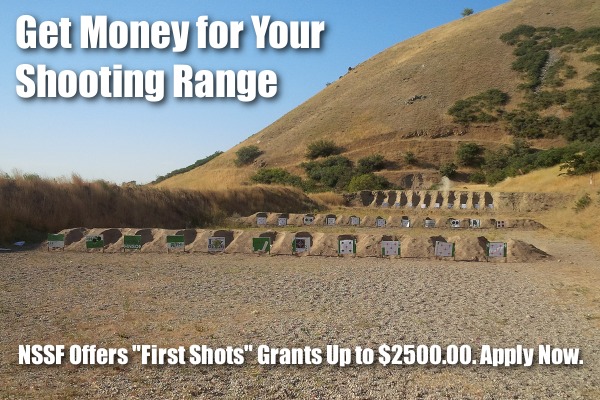
The National Shooting Sports Foundation (NSSF®), the trade association for the firearms industry, is pleased to announce that it has established a $100,000 grant program to be used by firearms ranges in support of their NSSF First Shots® introductory shooting programs. Grants up to $2500.00 will be awarded to help shooting clubs offer introductory “First Shots” events. These First Shots events serve the dual purpose of providing a safe, fun and educational introduction experience for people new to firearms and shooting while fostering community outreach and developing a new customer base for member ranges.
The grant program is now open for application by shooting ranges and organizations. Applicants may apply for grants of up to $2,500 to be used to create or enhance marketing and advertising efforts for First Shots events held preferably before April 1, 2019, or within 90 days of receiving the grant. They can also apply a portion of their funds for any necessary equipment purchases such as loaner firearms. The grant program is open to current and former NSSF Member First Shots host ranges and organizations, as well as those ranges just getting started with or that plan to start hosting First Shots events for the first time. New and former First Shots host ranges will be given Grant award priority.
“First Shots is well-established as a program that connects people interested in learning about firearms safety and target shooting with the ranges and instructors in their communities, and it’s proven to not only get these people to the range for their first shots but to keep them coming back,” said Zach Snow, NSSF Director, Shooting Range Services. “We expect this grant program, along with the additional program support we offer our First Shots host ranges, will go a long way towards improving shooting sports safety training, participation numbers and enhancing the viability of our Member ranges.”
Ranges and organizations that wish to apply for the First Shots Grant Program are encouraged to do so at their earliest opportunity. For more information, contact Ann Gamauf, NSSF Retail & Range Business Development Coordinator, at agamauf [at] nssf.org or CLICK HERE .
The Rimfire Challenge is just about the most fun you can have with .22 LR pistols and rifles. This week Shooting USA TV features the 2017 Rimfire Challenge World Championship hosted at the Cavern Cove Rimfire Range in Woodville, Alabama. This major match attracts hundreds of competitors from around the nation. It’s fast and fun with instant feedback from ringing plates indicating hits. The Rimfire Challenge Championship is family-friendly event that’s great for all skill and experience levels.
Shooting USA TV Airs Wednesday Night on the Outdoor Channel:
9:00 PM Eastern and Pacific; 8:00 PM Central
The 2017 Rimfire Challenge World Championship brought 350 competitors to Alabama from as far as California and Washington State to shoot .22 LR rimfire pistols and rifles on 14 challenging stages, all with steel plate targets. The Challenge is designed to attract first-time competitors. “Our mission is to promote, protect and preserve hunting and the shooting sports. And to see all these young kids out here with their parents and their families all shooting together and enjoying the shooting sports. That’s what it’s all about, ” says Tisma Juett with the NSSF.
The Challenge offers plenty of action, with fourteen (14) stages of fire — each with a wide variety of steel plates. There is no set pattern or design, so each stage is different. You need to be fast AND accurate — you get penalty points for missing any plates. Scores are based on time for each stage, with add-ons for penalties. As with most action shooting games — it’s always best to shoot “clean” (no misses), even if you slow down a little bit.
At the 2016 NSSF Rimfire Challenge Championship Smith & Wesson was on hand with demo rifles and pistols. See the action in the S&W-produced video above. Competitive shooting is one activity in which entire families, both oldsters and youngsters, can come together in a supervised setting to enjoy the spirit and camaraderie of competition.
NSSF Rimfire Challenge Basics
The Rimfire Challenge is a two-gun event so you need a rifle and a handgun (which can be either a semi-auto pistol, or revolver). There are two divisions: 1) Open — Any firearm (pistol or revolver in handgun class) with scopes, optical sights, light gathering scopes, battery powered optics or lasers; and 2) Limited — Pistols and rifles with iron sights, adjustable metallic sights, and/or fiber optic. Bolt-action rifles and lever-action rifles are allowed, but self-loading (semi-auto) rifles are most popular because they can shoot quickly.
Many different stage designs can be employed at Rimfire Challenge matches. Here are two examples from the Rimfire Challenge Suggested Courses of Fire:
Rimfire Rifle of Choice: S&W M&P 15-22
If you want to shoot both Limited and Open class, a very good rifle choice rifle is the Smith & Wesson M&P 15-22. The feel, weight, and controls will be familiar to any AR owner. These 15-22s have been refined over the years and now are very reliable. Shoot it in Limited Class with the standard iron sights. Then fold down the sights and attach a 1-4X optic to shoot Open Class.
Rimfire Challenge Organizational Change for 2018
The National Shooting Sports Foundation (NSSF) announced that, starting in January, 2018, the NSSF Rimfire Challenge will be transitioned to a new organization: the Rimfire Challenge Shooting Association. Originally developed by Ruger’s Ken Jorgenson, TV host Michael Bane and the late Nelson Dymond, the program was first known as the Ruger Rimfire Challenge. NSSF took over the the program in 2014, changing its name to the NSSF Rimfire Challenge. The new organization will be led once again by Ken Jorgensen and Michael Bane.
Click Map to launch interactive webpage with info for all 50 states.
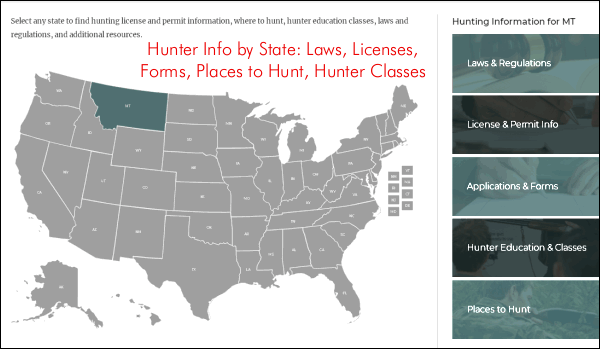
Going hunting this year? Need to find out about hunting licenses, deer tags, local regulations, and the best hunting areas? Then visit WheretoHunt.org. This website has an interactive map of the country. Simply click on a state to find the info you need. For all 50 states, the NSSF has compiled information about hunting license and permits, where to hunt, hunter education classes, laws and regulations and more. For each state you’ll also find a link for required applications and license forms. Have a safe and productive hunt this year.
During August, Alabama will offer free shooting at five public ranges, with free instruction, free ammo, plus eye and ear protection provided.
Here’s a program we like, and we wish more states conducted something similar. The state of Alabama is offering FREE Shooting this month at five public shooting ranges. The state will even provide targets, ammo, eye/ear protection, and FREE instruction. This is the kind of promotion that will help grow our sport. We commend Alabama’s state leaders.
During the FREE events, new shooters can work with certified instructors at five of the state’s most popular public shooting ranges: Barbour, Cahaba, Delta, Etowah, and Swan Creek. These ranges are primarily located in Wildlife Management Areas (WMA) throughout the state.
The Alabama Department of Conservation and Natural Resources (ADCNR) invites recreational shooters to five public ranges during Alabama’s Free Range Days on August 11, 18, and 25. During these events, license and shooting range permit requirements will be waived. What’s more, equipment, ammunition, and hearing and eye protection will be provided free of charge at the five ranges listed below (during event hours only). Shooters are welcome to bring their own firearms.
Alabama’s Free Range Days will run from 8 am to 12 pm, but shooters are welcome to stay and shoot the remainder of the day on August 11, 18, and 25
CLICK HERE for more information on Alabama’s public shooting ranges. To learn more about Free Range Days, contact WFF Hunter Education Coordinator Marisa Futral at 334-242-3620 or email Marisa.Futral@dcnr.alabama.gov. The ADCNR’s Division of Wildlife and Freshwater Fisheries (WFF) has partnered with the National Shooting Sports Foundation to provide the Free Range Days as part of National Shooting Sports Month — August, 2018. NOTE: License and permit requirements will remain in effect for all other ADCNR public shooting ranges throughout August.
The NSSF has declared August to be National Shooting Sports Month (NSSM). To celebrate this, retailers and shooting clubs are hosting nearly 700 events around the country. These events, which include classes, shooting demos, competitions, and special sales, are listed in a searchable online database. There is also an August sweepstakes for National Shooting Sports Month.
Hundreds of August Events Listed in NSSF Database
Visit LetsGoShooting.org to find August events near you. You can search the database by state, event type, and range name. Nearly 700 events are listed in chronological order, with more being added daily. Here’s a partial sample of the NSSM events taking place over the next few days.
Trigger Time Sweepstakes
As part of National Shooting Sports Month, the NSSF is running a Trigger Time Sweepstakes. Register to win valuable prizes — no purchase necessary. The Grand Prize package, worth $5247.00, includes a Remington 700 6.5 Creedmoor rifle, a Nightforce ATACR 7-35x56mm FFP/Mil scope, and a case of Barnes Match 6.5 Creedmoor ammunition, plus accessories. In addition to the big prize package, there will be dozens of other prizes awarded each week in August. CLICK HERE for Sweepstakes INFO.
The National Shooting Sports Foundation (NSSF) has produced a very useful educational resource, a video explaining “How to Talk to Your Kids about Firearm Safety”. The video, starring champion shooter Julie Golob, encourages parents to have “the talk” about firearm safety with their kids sooner rather than later, and provides tips for how to have a helpful discussion.
“As a mother, I know full well how challenging this conversation can be,” Golob said. “It’s crucial that parents set an example and teach their kids about firearm safety so children don’t learn about guns solely from what their friends say or what they see on video games and TV.”
“Too often, children don’t know what to do if they find a gun,” said Steve Sanetti, President and CEO of NSSF, which developed and sponsors the Project ChildSafe firearm safety education program. “This video opens a door for honest conversation and empowers parents to be the authority on gun safety for their kids, whether they have guns in their homes or not.”
The “How to Talk to Your Kids about Firearm Safety” video was created as a resource to start positive and constructive conversations by encouraging discussion rather than lecture, and helps parents responsibly demystify the subject of guns. For more information, visit Projectchildsafe.org.
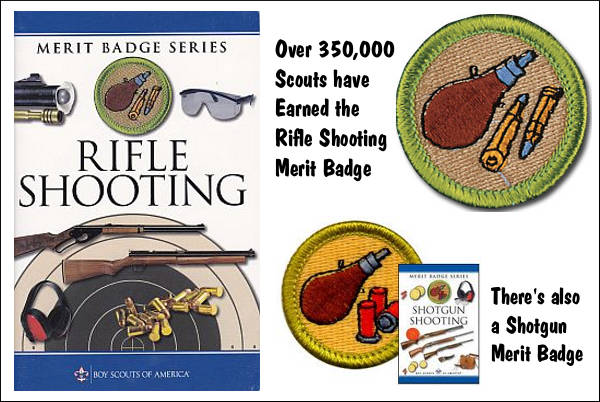
Comment: If we want the shooting sports to survive (and thrive), we need to bring young shooters into this sport. Many of our readers, as well as this Editor, got started in shooting through the Boy Scouts. I shot rimfire rifles at scout camps and earned my Marksmanship Merit Badge. AccurateShooter.com strongly supports the Scouts, and we commend the NSSF for providing grants to regional BSA Councils. This article explains how regional BSA Councils can apply for funding.
The National Shooting Sports Foundation (NSSF) has kicked off its annual grant program for the Boy Scouts of America Councils. Through this partnership, BSA Councils can receive a portion of $100,000 in NSSF grant funds to develop or expand their troop activities in target shooting and marksmanship. Target shooting programs continue to rank among Scouting’s most popular activities, teaching firearms and range safety, teamwork building and fundraising skills.
2018 marks NSSF’s eighth year supporting the BSA Council Grant Program, underscoring the time-honored practices of firearms safety, marksmanship training and shooting sports participation with the Boy Scouts. Additionally, the BSA’s recent decision to allow young females to join its ranks, though controversial, does provide an entirely new audience for BSA marksmanship training.
“Safety and marksmanship training through the Boy Scouts is a time-honored introduction to the shooting sports. We’re looking forward to increased participation from Scouts pursuing [merit] badges in these activities and then taking those new skills afield for a lifetime of enjoyment”, said Zach Snow, NSSF Range Services Director.
How Scouting Groups Can Apply for Grants
BSA Councils should review the grant guidelines and application procedures on the NSSF Website. Councils awarded NSSF funds must use those grants to purchase shooting sports equipment/supplies from NSSF Member Retailers. Qualifying purchases include: ammunition, eye and ear protection, firearms, targets, and shooting vests.
In a helpful NSSF video, Ryan Cleckner explains why you normally should avoid canting your rifle — rotating it clockwise or counter-clockwise. Cleckner explains that canting the rifle in one direction or another will change the point of impact: “When you rotate the rifle, not only does the [POI move] in the direction that you’re rotated, [but] it also loses some of its elevation as it rolls down.” This, Cleckner explains, can make you miss on one side or the other:
Cant to the Left — You’re going to miss low and left.
Cant to the Right — You’re going to miss low and right.
In this video, starting at the one-minute mark, Cleckner shows the effect of rifle canting when engaging a 600-yard target. A few degrees of cant (either to the left or to the right), moves the shot POI completely off the steel silhouette target. The POI change occurs mainly because you are lowering (and laterally shifting) the scope sight-line relative to the bore axis, effectively changing your zero.
David Tubb has explained: “Every 1 degree you are off on a cant, is about six inches of difference laterally at 1000 yards”.
Position Shooting with Sling — Rifle Cant Considerations
Cleckner’s discussion assumes that the scope or sights are set to hit center with the rifle level and plumb. That works for most situations when shooting prone off bipod, front mechanical rest, or front sandbag. However, many sling shooters, including David Tubb and John Whidden, do tilt or cant their rifles slightly inward because this allows a more comfortable hold with sling, or allows better eye-to-sight alignment. Holding the rifle at an angle can work — but the angle of cant must be consistent for every shot. Canting the rifle is not a sin by itself. However, after you confirm your zero on your target, the degree of cant must be the same for EVERY shot. You must maintain that exact same degree of rotation on each shot or you will experience the shot POI movement Cleckner illustrates. Consistency is the key.
John Whidden, 5-time Nat’l Long Range Champion, holds a Palma rifle. John now shoots a match rifle with an Anschutz stock which he holds more upright, but still with some counter-clockwise cant. John also installed his iron sights at an angle so that the adjustments are correct (and plumb) even with his canted hold: “While it may not be obvious in the picture, the sights on my rifle are set up so that they’re straight vertical and horizontal while I hold the rifle canted. Making sure your adjustments (scope or sights) are vertical and horizontal is a critical piece of the pie.”
Inexpensive Dual-Diameter Scope-Mounted Bubble Level
The best way to avoid inconsistent rifle canting is to use a bubble level fitted to rail or scope. One very affordable and versatile product is the Jialitte Scope Bubble Level. This features a 30mm milled inside diameter, plus an inner insert ring so it will also fit 1″-diameter main tubes. The Jialitte unit is nicely radiused, and has a low profile in the middle. User reviews have been very positive. You could easily pay $35.00 or more for a 30mm scope level. This costs just $10.99 on Amazon.
The National Shooting Sports Foundation (NSSF) has published a Q & A Page about FFL transfers and other FFL-related matters. The NSSF’s experts provide answers to common questions to ensure that neither FFLs nor their customers get caught in regulatory traps. Here are some of the recent questions and answers:
1. Purchase of Firearm by Parent for Child.
Q: May a parent or guardian purchase firearms or ammunition as a gift for a juvenile (under 18 years of age)?
Yes. However, possession of handguns by juveniles (less than 18 years of age) is generally unlawful. Juveniles generally may only receive and possess handguns with the written permission of a parent or guardian for limited purposes (e.g., employment, ranching, farming, target practice or hunting), and that permission slip must be carried by the juvenile while possessing the handgun. [18 U.S.C. 922(x)]
2. May an FFL Transfer a Firearm by Way of a “House Call”?
Q: I have an elderly customer who cannot leave his home. I have a gun in my store that he wants to buy. Can I go to his house, have the Form 4473 completed, call for a background check and deliver the gun to him, providing that all the background checks clear?
A: Federal Firearms Licensees (FFLs) are required to conduct business from their licensed “business premises.” The Form 4473, Part 1, is for an over-the-counter transaction. The buyer must appear in person at the FFL premises. Licensees may not conduct firearms transactions from locations other than their licensed premises, with the exception of gun shows or other events dedicated to the sporting use of firearms and held in the state where the FFL’s premises is located. An FFL who locates purchasers by other means must complete the transaction and all required paperwork at the business premises indicated on the FFL’s license.
3. Can the Spouse of a Transferee (Buyer) Pick Up a Firearm?
Q: A customer filled out a Form 4473 on a shotgun. The NICS background check reply was delayed, but the following day NICS approved the purchase. The customer could not get back to my store during open hours, however, so he sent his wife to pick it up. May I transfer the shotgun to her?
A: The shotgun may not be transferred to the customer’s wife, as she is not the intended transferee. The customer must return to the store himself and complete the ATF Form 4473 to receive the firearm. He must recertify that his answers in section A are still true, correct and complete by signing and dating Section C on the ATF Form 4473.
4. What Is the Procedure for an Older Firearm with No Serial Number?
Q: I have received a firearm on trade. It was made before 1968 and has no serial number. I must note the physical markings on the firearm in my records. What do I do in this case?
A: Unfortunately, marking requirements that existed before 1968 did not apply to all firearms. Many of the firearms manufactured and imported prior to 1968 bear no serial numbers or other markings. Licensees who receive these firearms should note in each descriptive column in the acquisition record the physical markings that appear on the firearms. If no serial number was placed on the firearm, it should be specifically noted that “Firearm has no serial number” or recorded “NSN.” Remember, however, it is illegal to remove or alter a firearm’s serial number, and a licensee should report such a firearm to the nearest ATF office. Refer to the ATF P 3317.2, Safety and Security Information for Federal Firearms Licensees.
5. What Should Be Done if an FFL Finds a Firearm That Was Previously Reported Lost?
Q: I’ve reported a lost firearm. I’ve done all the necessary paperwork and notifications. Now, I’ve found the firearm. What is my course of action?
A: FFLs who report a firearm as missing and later discover its whereabouts should advise the ATF, as well as their local law enforcement agency, that the firearms have been located. The ATF can be contacted at 888-930-9275. In addition, once the firearms are located, they must be re-entered into the Acquisition and Disposition (A&D) record as an acquisition entry.





 During August, Alabama will offer free shooting at five public ranges, with free instruction, free ammo, plus eye and ear protection provided.
 Alabama August Free Range Days


 The
The 


 The
The 


