Utah Monument photo by DOI. Inset graphic from Ammoland.com, DOI source.
U.S. Secretary of the Interior Ryan Zinke has announced the newly-appointed members of the Hunting and Shooting Sports Conservation Council (HSSCC). The Council, established on January 9, 2018, is intended to provide the Secretary of the Interior and the Secretary of Agriculture with advice regarding the establishment and implementation of existing and proposed policies and authorities with regard to wildlife and habitat conservation. The Advisory Council will meet at least twice a year.
The Council will also examine ways to benefit wildlife resources; encourage partnership among the public, the sporting conservation organizations, state, tribal, territorial, and federal government; and benefit recreational hunting and recreational shooting sports.
“We have assembled here some of the best conservationists in America,” Secretary Zinke said. “Over a century ago, Teddy Roosevelt established the American conservation ethic — best science, best practices, greatest good, longest term. These sportsmen carry on the American conservation ethic in the modern day. Bringing these experts together will be key to ensuring the American tradition of hunting and shooting, as well as the conservation benefits of these practices, carries on.”
Secretary Ryan Zinke (left) believes we can learn important conservation lessons from President Theodore Roosevelt (right), an avid hunter.
“America’s hunters and recreational shooters have a champion in Secretary Ryan Zinke,” said Chris W. Cox, executive director of the NRA’s Institute for Legislative Action. “Zinke is fighting for our sportsmen and women to have greater access to our public lands. I am pleased to work with the Trump Administration’s new Hunting and Shooting Sports Conservation Council to make it easier for Americans to enjoy our public lands.”
“Comprised of national leaders throughout the hunting and recreational shooting communities, the HSSCC is widely regarded as one of the most effective and productive federal advisory committees across the federal government,” said Lawrence Keane, NSSF Senior V.P. and General Counsel.
“What an exciting time for our hunting and shooting sports! This Shooting Sports Council is yet another way Secretary Zinke and staff is making the expansion of our great American heritage a priority,” said Smith & Wesson Pro Shooter Julie Golob.
“President Trump and Sec Zinke continue to make major positive structural changes to America’s land and wildlife conservation systems,” said Sportsmen for Fish and Wildlife Founder Don Peay. “This new Council, made up of the most accomplished hunter/conservationists in North America, will assist in revitalizing conservation of our nation’s natural treasures for generations!”
“I am very pleased and honored to be appointed to this Council by Secretary Zinke,” said Rocky Mountain Elk Foundation Chief Conservation Officer Blake Henning. “I look forward to representing the interests of big game and big game hunters as this Council does important work.”
“I am honored to be asked by Secretary Zinke to serve on the federal advisory council,” said Bob Model, Chairman of the Boone and Crockett Club. “Sportsmen and women are vital stakeholders in federal land management.”
Members of the Hunting and Shooting Sports Conservation Council are listed below
MEMBER NAME
ORGANIZATION
Mike Budzik
Retired Chief of the Ohio Department of Natural Resources
Chris Cox
Executive Director of the NRA’s Institute for Legislative Action (NRA-ILA)
Jeff Crane
President of Congressional Sportsmen’s Foundation (CSF)
John Devney
Vice President of U.S. Policy for Delta Waterfowl
Dan Forester
Vice President and Chief Conservation Officer, Archery Trade Association
Ward “Trig” French
Chairman of the Hunter’s Leadership Forum
Julie Golob
World and National Shooting Champion, Team Smith & Wesson
John Green
CEO of Crossroads Strategies and Board Member of the Congressional Sportsmen’s Foundation
Dale Hall
CEO of Ducks Unlimited and former Director of the USFWS
Blake Henning
Chief Conservation Officer for the Rocky Mountain Elk Foundation
Graham Hill
Principal and Founding Partner, Ice Miller Strategies LLC. NRA Board of Directors member
Larry Keane
Senior V.P. for Governmental and Public Affairs, Asst. Sec. and General Counsel for National Shooting Sports Foundation (NSSF); General Counsel, Sporting Arms and Ammunition Manufacturers Institutes (SAAMI)
Bob Model
Former President of the Boone & Crockett Club; President/CEO of Mule Deer Foundation; previous Deputy Director of Utah’s Div. of Wildlife Resources
Collin O’Mara
President and CEO of the National Wildlife Federation
Donald Peay
Founder and Former CEO of Sportsmen for Fish and Wildlife (SFW)
Eva Shockey
Co-Host of Jim Shockey’s Hunting Adventures on Outdoor Channel
David Spady
President of the Liberty and Property Rights Coalition
For this chart, HowMuch.net analyzed data from the NSSF’s 2017 Firearms and Ammunition Industry Economic Impact Report to estimate gun industry output and jobs in each state.
The firearms industry is an important element of our nation’s economy. Manufacturing products for shooting, hunting, and LEO/military applications employs hundreds of thousands of workers and contributes billions of dollars to America’s GNP. The mainstream media demonizes firearms and attempts to ridicule gun-owners, but the fact remains that guns and ammo are an important part of American culture and a key element of our economy.
Guns America recently published an article showing the economic impact of the firearms industry on a state-by-state basis. This features a “money map” of the USA created by HowMuch.net based on data from the National Shooting Sports Foundation. The number one state is Texas, with $3.83 Billion of economic impact and 23,070 jobs. That may not surprise you, as many quality companies such as Shilen are based in the Lone Star state. However, you may be surprised by the number two state, California, given that jurisdiction’s liberal legislature, and anti-gun policies. But there are still plenty of guns, shooting accessories, and ammo produced in California, generating $3.64 Billion in firearms industry economic activity and over 20,000 jobs. Given that job number, perhaps California’s politicians should think twice before they enact more misguided anti-gun laws.
Weatherby is relocating from California to Wyoming, citing California’s high corporate taxes and hostile business regulations.
Here are Top Ten States, ranked in order:
1. Texas: $3.83B and 23,070 jobs
2. California: $3.64B and 20,610 jobs
3. Minnesota: $2.43B and 11,650 jobs
4. Florida: $2.39B and 14,850 jobs
5. Illinois: $2.18B and 10,681 jobs
6. North Carolina: $1.98B and 11,427 jobs
7. Pennsylvania: $1.94B and 12,436 jobs
8. Massachusetts: $1.86B and 7,116 jobs
9. New York: $1.84B and 8020 jobs
10. Ohio: $1.61B and 11,772 jobs
Ranking third overall is Michigan with $2.43 Billion in economic activity, followed by Florida close behind in fourth place with $2.39 Billion. The NSSF’s data reveals some surprising trends, notes Guns America: “While pro-gun states like Texas ($8.83B) boast a large firearms industry that employs thousands of people, states with stricter firearms regulations like California ($3.64B), Minnesota ($2.43B), Illinois ($2.18B), and Massachusetts ($1.86B) also incorporate relatively large gun industries.”
Looking at that list, it is noteworthy that, along with California, another anti-gun state, New York, has made the Top Ten. New York’s Governor Andrew Cuomo has attacked the firearms industry and the NRA, and the N.Y. State Department of Financial Services has pressured Banks and Insurance companies to stop doing business with gun industry firms. One wonders if Governor Cuomo and his minions have considered the full consequences of their anti-gun activism. Guns America observes: “it is notable that gun makers can survive at all in states like New York, California, and Massachusetts. Attacking firearm makers and sellers is one of the most common anti-gun tactics, but some companies still manage to scrape by despite increasing regulations and public hostility.”
Though it has moved much of its production to Alabama, Remington retains production facilities in New York state. The Remington enterprise was founded in 1816 by Eliphalet Remington in Ilion, New York, as E. Remington and Sons. Remington is America’s oldest gun maker and is still the largest U.S. producer of shotguns and rifles.
Want to learn more about Long Range Shooting? Check out the “Elements of Long Range Shooting” videos from the National Shooting Sport Foundation (NSSF). In this multi-part series, Bryan Litz of Applied Ballistics covers a variety of topics of interest to precision shooters. Today we feature three of these videos. There are five other videos in this series. Watch the entire 8-video “Elements of Long Range Shooting” series on the NSSF YouTube Channel.
Atmospherics and Density Altitude
Bryan Litz explains: “An important element in calculating an accurate firing solution for long-range shooting is understanding the effects of atmospherics on a projectile.” Atmospherics include air pressure, air temperature, and humidity. Bryan notes: “Temperature, pressure, and humidity all affect the air density… that the bullet is flying through. You can combine all those factors into one variable called ‘Density Altitude’.” Density Altitude is used by the ballistic solver to account for air density variables that affect bullet flight.
Bullet Ballistic Coefficients
A bullet’s ballistic coefficient (BC) basically expresses how well the bullet flies through the air. Higher BC bullets have less aerodynamic drag than lower BC projectiles. You will see BCs listed as either G1 and G7 numbers. These correspond to different bullet shape models. Generally speaking, the G7 model works better for the long, boat-tail bullets used for long-range shooting. Notably, a bullet’s drag is NOT constant in flight. The true BC can vary over the course of the trajectory as the bullet velocity degrades. In other words, “BC is dynamic”. That said, you can make very accurate drop charts using the BCs provided by major bullet-makers, as plugged into solvers. However, long-range competitors may want to record “real world” drop numbers at various distances. For example, we’ve seen trajectories be higher than predicted at 500 yards, yet lower than predicted at 1000.
Ballistics Solvers — Many Options
Bryan Litz observes: “When we talk about the elements of long range shooting, obviously a very important element is a getting a fire solution, using a ballistic solver. There are a lot of ballistic solvers out there… Applied Ballistics has smartphone Apps. Applied Ballistics has integrated the ballistic solver directly into a Kestral, and the same solver runs (manually) on the Accuracy Solutions Wiz-Wheel. The point is, if it is an Applied Ballistics device it is running the same solutions across the board.”
About Bryan Litz
Bryan began his career as a rocket scientist, quite literally. He then started Applied Ballistics, the leading company focusing on ballistics science for rifle shooting. A past F-TR Long-Range National Champion and Chief Ballistician for Berger Bullets, knows his stuff. His Applied Ballistics squad was the winning team at the 2017 King of 2 Miles event, and Applied Ballistics recently received a major U.S. defense contract to to execute Phase 1 of the Extreme Sniper Strike Operations (ESSO) project.
The National Shooting Sports Foundation (NSSF), the trade association for the firearms, ammunition, hunting and shooting sports industries, Board of Governors today unanimously voted to expel Dick’s Sporting Goods from membership for conduct detrimental to the best interests of the Foundation.
Dick’s Sporting Goods recently hired a Washington D.C.-based government affairs firm, for “[l]obbying related to gun control.” Dick’s Sporting Goods CEO Edward W. Stack announced earlier this year the retail chain would end sales of modern sporting rifles, voluntarily raise the age to 21 to purchase firearms in their stores and called for more restrictive legislation. Dick’s later announced they would destroy the remaining modern sporting rifle inventory. NSSF responded that business decisions should be individually made, but was nonetheless disappointed and the decision does not reflect the reality of the vast majority of law-abiding gun owners.
While the mainstream media attacks gun owners and blue state politicians demand new anti-gun legislation, the fact remains that the firearms industry is more important to the American economy than ever. CNN and MSNBC won’t tell you that the American firearms industry is very healthy, enjoying huge growth in the last decade.
In fact, Americans are buying more guns than ever, and spending more money on firearms accessories and ammunition, according to a National Shooting Sports Foundation (NSSF) report.
The total economic impact of the firearms and ammunition industry in the United States increased from $19.1 billion in 2008 to $51.4 billion in 2017, a 169 percent increase. In addition, the total number of full-time equivalent firearms industry jobs rose from approximately 166,000 in 2008 to almost 310,000 in 2017, an 87 percent increase.
On a year-over-year basis, the industry’s economic impact rose from $51.3 billion in 2016 to $51.4 in 2017, ticking higher even while the industry came off-peak production years. Total jobs increased from approximately 301,000 to almost 311,000, a 3 percent increase in the same period.
Firearms Industry Tax Receipts Fund Conservation Programs
“Our industry is proud to be one of the truly bright spots in our economy as an unprecedented number of Americans have chosen to exercise their fundamental right to keep and bear arms and to safely enjoy the shooting sports,” said Stephen L. Sanetti, NSSF President and CEO.
“We have increased our direct workforce by more than 7,000 in the past year alone, adding jobs that pay an average nearly $50,000 in wages and benefits. In addition, since 2008 we increased federal tax payments by 144 percent, Pittman-Robertson excise taxes that support wildlife conservation by 104 percent, and state business taxes by 121 percent.”
The Firearms and Ammunition Industry Economic Impact Report: 2018 provides a state-by-state breakdown of job numbers, wages and output covering direct, supplier and induced employment, as well as federal excise taxes paid.
SHOT Show 2018 runs January 23-26 at the Sands Expo Convention Center in Las Vegas, Nevada.
Head to SHOT Show in Las Vegas in three weeks? Then you need to start your planning now. You’ll want to locate the companies you want to visit, and plan your booth-visiting route to make best use of your time. Thankfully, SHOT Show’s organizers offer an interactive SHOT Show Planner that lets you look up the exhibitors and plot their locations in the Sands EXPO Center. SEE Floor Plan.
The SHOT Show’s Interactive Floor Plan offers an easy-to-use Vendor Mapping feature. Simply enter the company name in the search field in the upper left. Then the Planner will locate the vendor’s booth(s) on the map and highlight the location for you. Easy-Peasy.
Getting to the SHOT Show Building
SHOT Show 2018 is held in the Sands Expo Convention Center, attached to the Venetian Hotel. If you don’t want to walk through the disorienting maze of that badly designed, over-priced hotel, you can enter through the Sands Avenue street entrance (taxi-cab stand). Word to the wise — avoid the SHOT Show shuttle buses if you can — riding them is a great way to catch a bad cold from other passengers who are sick.
On this interactive map you can use your mouse to re-center and zoom in/out.
Image Courtesy NSSF. This story is based on a recent NSSF Article.
‘Tis the season of gift-giving (and Christmas Day is nearly here). As hunters, shooters, collectors or just plain plinkers, it’s a natural instinct to want to share our enjoyment of firearms with others. What better way to do that than to make a gift of a firearm to a family member, close friend or relative?
The first thing to remember if you’re thinking about giving someone a gun is that … it’s a gun! You already know that ownership of a firearm brings with it some serious legal and ethical obligations that other consumer products don’t. So let’s look at some questions you may have about giving a firearm as a gift.
Image Courtesy NSSF
The first question you have to ask is whether the intended recipient can legally own the firearm where he or she lives. With more than 20,000 different gun laws on the books, even the kinds of firearms that law-abiding citizens can own vary from place to place. For example, juveniles (under age 18) generally speaking are precluded by law from possessing a handgun. Check out the Bureau of Alcohol, Tobacco, Firearms and Explosives (ATF) website for an overview of local laws and, whatever you do, don’t forget that you can never under any circumstances transfer a firearm to someone you know — or have reasonable cause to believe — legally can’t own one. That’s a federal felony, so be careful.
There’s no federal law that prohibits a gift of a firearm to a relative or friend who lives in your home state. Abramski v. United States, a recent Supreme Court decision involving a “straw purchase” of a firearm did not change the law regarding firearms as gifts. The following states (California, Colorado, Connecticut, Delaware, New York, Oregon, Rhode Island, Washington State) and the District of Columbia require you to transfer a firearm through a local firearms retailer so an instant background check will be performed to make sure the recipient is not legally prohibited from owning the gun. Maryland and Pennsylvania require a background check for private party transfer of a handgun. There are exceptions, so it’s important to check the law of your state or ask your local firearms retailer.
Consider a Gift Card Instead of Direct Gift
The ATF recommends that if you want to give someone a new firearm, rather than going to a gun store and buying the gun on your own, consider instead purchasing a gift certificate/card from your favorite gun retailer. Then give that gift card as the present. That way the recipient can choose the exact gun he or she wants, and there’s no question about who is “the actual buyer of the firearm,” which is a question any purchaser must certify on the Federal Form 4473 at the time of purchase. The Gift Card option avoids any “straw purchaser” issues.
Intra-Family Transfers and Antique Arms
What if you want to give “Old Betsy,” your favorite old deer rifle, to your son or daughter as a college graduation gift? Again, in most states, there’s no law that says you can’t, but some states require even intra-family transfers to go through a licensed dealer. Remember, you can never transfer a firearm directly to another person who is a resident of a different state. In that case, you must transfer the firearm through a licensed dealer in the state where the person receiving the gift resides. Using a gift certificate from a firearms retailer near where the recipient lives might be a good solution. Pre-1898 antique firearms are generally exempt from the dealer requirement. [But check with the laws in your jurisdiction]. Be safe and check with your dealer or local law enforcement before you hand over your prized possession.
Regulations on Firearms Shipping to Third Parties
When you intend to transfer a gun, there are important rules on interstate shipping*. Generally speaking, you can only ship a handgun by common carrier (but not U.S. Mail) and a long gun by U.S. Mail or common carrier to a federally licensed dealer, but not to a non-licensed individual. With all carriers, federal law requires you to declare that your package contains an unloaded firearm. To be safe, always consult your carrier in advance about its regulations for shipping firearms. Also check your state laws on transfers.
*Different rules may apply to shipping to parties IN-STATE or shipping firearms to yourself in temporary care of others. Always consult your own state laws, but here are some FAQs copied directly from the ATF.GOV website:
A number of interesting jobs in the firearms industry have become available in recent weeks. The NSSF maintains a regularly-updated listing of employment opportunities with gun-makers and shooting sports organizations. On the NSSF’s job board right now there are financial openings, account manager positions, engineering jobs, sales and marketing positions, and media/digital markeing opportunities. Here are some of the jobs we found this week posted on the NSSF Website. CLICK HERE to visit the NSSF Career Center with all current listings.
Think Vegas in January, baby — yes, we’re talkin’ about SHOT Show (Jan. 23-26, 2018). Registration for the National Shooting Sports Foundation’s 2018 SHOT Show is now open for all Attendees, Exhibitors, and Media. Register online now at Shotshow.org. The SHOT Show hotel booking system is also active. It’s a good idea to reserve rooms early to get the best rates. SHOT Show organizers have negotiated deeply discounted rates at dozens of Las Vegas hotels, with prices as low as $56 per night. However, some of the most popular affiliated hotels are already sold out. And sometimes you can get better deals through websites such as Priceline and Trivago.com.
Scheduled for January 23-26 in Las Vegas, the big gun industry convention is just two months away. While registering, attendees can enroll in SHOT Show University, and/or sign up for other educational offerings. Sorry, the Industry Dinner is already sold out.
SHOT Show is NOT open to the general public. To attend you need to have an affiliation with a gun industry company, retailer, or media outlet. That said, thousands of non-professionals attend each year, receiving credentials from gun shops, parts distributors, retailers and the like.
SHOT Show tip from EdLongrange. We welcome user submissions.
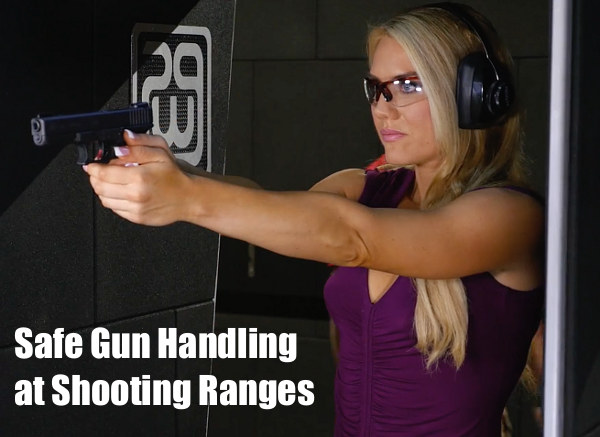
The National Shooting Sports Foundation (NSSF) has created a new Range Safety and Etiquette video. This 8.5-minute video is intended to promote safe practices, especially at indoor ranges. In the video, the moderator list the basic rules of gun safety, before covering key range etiquette topics such as range officer commands, how to uncase your firearm on the range when you first arrive, and what to do if a firearm is accidentally dropped. There are also safety tips specific to handling both semi-automatic handguns and revolvers.
BAD RANGE BEHAVIOR — What NOT to Do at the Range
Based on decades of shooting, indoors and outdoors, here are the five most problematic behaviors we’ve seen at indoor ranges.
1. Loading weapons BEHIND the firing line and then “sweeping” other individuals while approaching the indoor shooting bay.
2. Turning the handgun sideways while trying to clear a malfunction or insert/remove a magazine. This will point the muzzle at a fellow shooter. Or, after shooting a gun, the shooter fails to clear the weapon and then places the gun on a bench, chair, or range bag near the shooting station with the muzzle in an unsafe position.
3. Reacting unpredictably when firing a high recoil handgun. We’ve seen people take a second shot by accident with the muzzle way off target.
4. Not obeying range commands — in particular continuing to shoot during called cease-fires.
5. Poorly aimed shooting that hits target frames or carriers, causing ricochets.
Why This NSSF Video is Important
“More than ever, NSSF is focused on helping our industry better engage their customers. Paramount to that is ensuring all shooters have a pleasant and safe experience every time they head to the range for a practice session,” explained Zach Snow, NSSF Director, Shooting Range Services. “This is particularly important for those coming to firearms ownership and the shooting sports for the first time, and this video will go far to making that first time on the range safe and fun for everyone.”




 The first question you have to ask is whether the intended recipient can legally own the firearm where he or she lives. With more than 20,000 different gun laws on the books, even the kinds of firearms that law-abiding citizens can own vary from place to place. For example, juveniles (under age 18) generally speaking are precluded by law from possessing a handgun. Check out the
  Consider a Gift Card Instead of Direct Gift
 A number of interesting jobs in the firearms industry have become available in recent weeks. The NSSF maintains a regularly-updated listing of employment opportunities with gun-makers and shooting sports organizations. On the NSSF’s job board right now there are financial openings, account manager positions, engineering jobs, sales and marketing positions, and media/digital markeing opportunities. Here are some of the jobs we found this week posted on the NSSF Website.