|
|
August 11th, 2013
New shooters are the future of our sport. If we want to “stem the tide” and resist pressures to close gun ranges and limit firearms use, we need to get new people involved in the shooting sports. And the first step in that process is getting first-timers to the range. One of the most successful efforts for enlisting new shooters is the NSSF First Shots Program. First Shots is a free introductory program of NSSF that teaches newcomers firearms fundamentals, safety and local regulations in a classroom setting, followed by a live-fire session with certified instructors. Around the country, First Shot Seminars provide free instruction by trained firearms instructors, with guns and ammo provided at no charge to participants.

First Shots Hosts 200 New Shooters at Houston Ranges
Last weekend, Houston, Texas hosted a successful series of First Shots seminars, as part of the First Shots “Big City Tour”. Four ranges in the Houston area — The Arms Room in League City, Spring Guns and Ammo in Spring, American Shooting Centers in Houston and High Noon Indoor Pistol Range in Crosby — welcomed more than 200 new shooters for training and some fun shooting. “A big thank you goes out to all of the participating ranges who gave a Texas welcome to the participants and the First Shots team,” said Tisma Juett, NSSF’s First Shots manager. Next stop on the First Shots Big City Tour is planned for Atlanta, Georgia. If your shooting facility is located in that vicinity and you’d like to be a host for this event, please contact Juett at tjuett@nssf.org. To find a First Shots Seminar near you, visit the First Shots Online Calendar Webpage.
August 9th, 2013
While the mainstream media (and many politicians) call for new bans on firearms, ammunition, and magazines, not to mention further restrictions of Second Amendment rights, too little attention is being paid to the actual facts in the debate over gun control. Sponsors of new restrictions on firearms claim that gun crime is increasing. A majority of Americans also seem to believe that firearms-related crimes are on the rise. But is this really the case? You may be surprised….
 In fact, if you look at the hard facts, firearms homicides and other gun-related crimes have been decreasing for decades. That’s right — gun crimes are down significantly over the past twenty years. Since 1993, in the USA, the number of homicides committed with guns has dropped 39% even while gun ownership rates have increased. The number of “all other” crimes with firearms has dropped 69% in the same period. And the number of fatal gun accidents has declined 58% in the past two decades — that’s a big change. In fact, if you look at the hard facts, firearms homicides and other gun-related crimes have been decreasing for decades. That’s right — gun crimes are down significantly over the past twenty years. Since 1993, in the USA, the number of homicides committed with guns has dropped 39% even while gun ownership rates have increased. The number of “all other” crimes with firearms has dropped 69% in the same period. And the number of fatal gun accidents has declined 58% in the past two decades — that’s a big change.
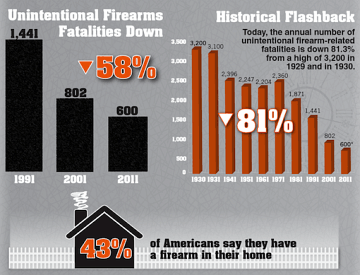
The numbers don’t lie — over the past twenty years, there has been a significant reduction in actual gun-related crime while gun ownership levels have increased. But despite all this evidence that gun-related crimes have declined precipitously in the past two decades, 56% of Americans have the mistaken notion that gun crime is on the rise. Could that be because mainstream media outlets conveniently ignore the facts?

Actual, verified gun crime trends (based on Federal crime statistics) have been presented in an interesting “infographic” chart prepared by the NSSF. Click on the illustration at right to see the full-size version with data charts.
July 27th, 2013
 Americans are buying more guns than ever. FBI NICS Gun Purchase Background Check data (as adjusted by the NSSF), shows that June 2013 gun sales are up 3.0% over the same period Last Year (See Chart 1). This marks the 37th straight month that NSSF-adjusted NICS figures have increased when compared to the same period the previous year. (This year’s January increase was even more dramatic — see Chart 2). What’s even more interesting, in June 2013, Americans purchased more than twice as many guns as they did a decade ago in June 2003 — roughly 870,000 vs. roughly 405,000. That’s a big difference. Americans are buying more guns than ever. FBI NICS Gun Purchase Background Check data (as adjusted by the NSSF), shows that June 2013 gun sales are up 3.0% over the same period Last Year (See Chart 1). This marks the 37th straight month that NSSF-adjusted NICS figures have increased when compared to the same period the previous year. (This year’s January increase was even more dramatic — see Chart 2). What’s even more interesting, in June 2013, Americans purchased more than twice as many guns as they did a decade ago in June 2003 — roughly 870,000 vs. roughly 405,000. That’s a big difference.
CHART 1 — Adjusted NICS Checks in Month of June

CHART 2 — Adjusted NICS Checks in Month of January

Understanding the Numbers
The June 2013 NSSF-adjusted National Instant Criminal Background Check System (NICS) figure of 872,025 is an increase of 3.0 percent over the NSSF-adjusted NICS figure of 846,437 in June 2012. The adjusted NICS data were derived by subtracting out NICS purpose code permit checks used by several states such as Connecticut, Illinois, and Utah for CCW permit application checks as well as checks on active CCW permit databases. Though not a direct correlation to firearms sales, the NSSF-adjusted NICS data provide a more accurate picture of current market conditions. For additional information on NICS or to view a complete set of the current monthly reports, please visit the NICS website.
June 30th, 2013
 A study commissioned by the National Shooting Sports Foundation (NSSF) reveals that most first-time gun buyers are active in one or more shooting activities and that women purchase their first firearm predominately for personal defense. The study is based on online surveys of consumers aged 22 to 65 who bought their first firearm during the spring of 2012. Key findings include: A study commissioned by the National Shooting Sports Foundation (NSSF) reveals that most first-time gun buyers are active in one or more shooting activities and that women purchase their first firearm predominately for personal defense. The study is based on online surveys of consumers aged 22 to 65 who bought their first firearm during the spring of 2012. Key findings include:
— The majority of first-time buyers (60.3%) tend to be active, using their gun once per month or more, with one in five reporting usage of once a week or more.
— Target shooting is by far the most popular shooting activity among first-time gun owners. 84.3% of respondents used their firearms for this purpose, followed by hunting (37.7%), plinking (27.4%), practical pistol shooting (17.3%) and clay-target shooting (14.6%).
— First-time gun owners who have participated in hunting (53.2%), practical pistol shooting (46.3%), clay-target sports (44.0%) and gun collecting (42.4%) said they want to increase their participation in these activities.
First-Time Buyers Acquire Guns for Defensive Use as Well as Sporting Use
The top-ranking factors driving first-time gun purchases are home defense (87.3%), self-defense (76.5%) and the desire to share shooting activities with family and friends (73.2%). Women, in particular, are highly focused on personal defense and self-sufficiency.
Fear of Gun Bans Motivates Older Buyers
Older first-time buyers–the 55 to 65 age group–indicated concern that firearms may no longer be available to them was one of many reasons for their purchase. [Note: The surveys were conducted in March and April of 2012, before the recent wave of anti-gun legislation. We expect that, if the survey was taken in 2013, all age groups would express concerns about restrictions on sales of firearms.]
Many Buyers Make Repeat Gun Purchases
Most first-time buyers purchased their guns through local gun shops (43.6%) and mass retailers such as Walmart and Cabela’s (33.6%). First-time gun buyers spent an average of $515 for their first gun and nearly as much as for accessories ($504). Apparently, one gun is not even for many buyers. Nearly a quarter of first-time buyers bought at least one more firearm within the first year after their first purchase spending more, on average, on the later purchase.
June 23rd, 2013
 Gov. Rick Perry of Texas and Gov. Dennis Daugaard of South Dakota visited Connecticut last week. The two Governors hoped to recruit manufacturers to re-locate operations to their more business-friendly states. Connecticut firearms makers are high on the list of businesses both Perry and Daugaard seek to bring to their respective states. Gov. Perry wants Connecticut gunmakers to relocate to the Lone Star State, while Gov. Daugaard hopes South Dakota can attract these enterprises. Gov. Rick Perry of Texas and Gov. Dennis Daugaard of South Dakota visited Connecticut last week. The two Governors hoped to recruit manufacturers to re-locate operations to their more business-friendly states. Connecticut firearms makers are high on the list of businesses both Perry and Daugaard seek to bring to their respective states. Gov. Perry wants Connecticut gunmakers to relocate to the Lone Star State, while Gov. Daugaard hopes South Dakota can attract these enterprises.
Larry Keane, Senior vice president and general counsel for the National Shooting Sports Foundation, provides a perspective on the recruiting effort. Keane suggests that economic growth in Connecticut is being stymied by official state policies. And Connecticut is no friend of the gun business, though firearms production has been one of Connecticut’s few growth industries in recent years:
The economic report card for the State of Connecticut is in and the results are not good.
The Bureau of Economic Analysis reports that Connecticut was last in the nation in economic growth in 2012, the only state where the combined value of goods and services produced (GDP) was lower than in 2011. In fact, total state GDP fell a quarter of a billion dollars last year, the same amount it fell in 2011.
On the heels of that report, the Manufacturing Alliance of Connecticut released the results of a survey that revealed Connecticut manufacturers predict a bleak outlook for the state’s economy and the health of their industries. The survey reported that a majority of the state’s manufacturers have been recruited to expand or relocate to another state and that they would consider doing so, most citing “government attitude” as the reason.
Connecticut’s firearms and components manufacturers have been the rare exception to the state’s dismal economic performance in recent years. Colt, Mossberg, Stag Arms, Ammunition Storage Components, to name four such companies, have added hundreds of jobs in recent years and, as a result, have contributed more in local and state taxes, even as other industries have cut back and moved facilities and jobs out of state.
We see a direct connection between the state’s nation-trailing GDP performance and the attitude of state government…. Gov. Perry understands all this. So he is coming to Connecticut. So too, is South Dakota Gov. Dennis Daugaard, who next week will also be recruiting these same manufacturers for his state. — Commentary by Larry Keane
June 11th, 2013
In order to promote safe and secure firearms storage, the National Shooting Sportz Foundation (NSSF) has launched its S.A.F.E. Summer Campaign. S.A.F.E. stands for:
- Secure your firearms when not in use.
- Aware of those around you who should not have unauthorized access to guns.
- Focus on your responsibility as a firearm owner.
- Educate yourself and others about safe firearm handling and storage.
NSSF has pledged $1 million to provide firearms safety kits (with a gun lock) to gun owners nationwide. Several lock-distribution events will be announced in the coming weeks. Safety information will be provided through social media and the Project ChildSafe website. NSSF reminds us that firearms owners have many ways to safely store their firearms when not in use. Here are some of your options:

June 3rd, 2013
 In late May, the U.S. District Court for the District of Columbia dismissed a lawsuit filed by the radical anti-hunting Center for Biological Diversity (CBD) and six other groups demanding that the EPA ban traditional ammunition containing lead components. NSSF filed a motion to dismiss the lawsuit last August. The court agreed with NSSF that EPA does not have the authority to regulate traditional ammunition under the Toxic Substances Control Act. EPA had already twice denied attempts by CBD to have the agency ban traditional ammunition, and the court had dismissed an earlier case brought by CBD seeking the same relief. In late May, the U.S. District Court for the District of Columbia dismissed a lawsuit filed by the radical anti-hunting Center for Biological Diversity (CBD) and six other groups demanding that the EPA ban traditional ammunition containing lead components. NSSF filed a motion to dismiss the lawsuit last August. The court agreed with NSSF that EPA does not have the authority to regulate traditional ammunition under the Toxic Substances Control Act. EPA had already twice denied attempts by CBD to have the agency ban traditional ammunition, and the court had dismissed an earlier case brought by CBD seeking the same relief.
Traditional ammunition (with lead elements) represents 95 percent of the U.S. market and is the staple ammunition for target shooters, hunters and law enforcement, with more than 10 billion rounds sold annually.
“We are gratified that the court has found this second frivolous lawsuit, which is essentially the same as the one dismissed last year, was equally without merit,” said Lawrence G. Keane, senior vice president and general counsel for the National Shooting Sports Foundation, the trade association for the firearms and ammunition industry. In addition to NSSF, the National Rifle Association and Safari Club International intervened in the case.
“No sound science [shows that] the use of traditional ammunition has harmed wildlife populations or that it presents a health risk to humans who consume game taken with such ammunition,” said Keane. “Banning traditional ammunition would cost tens of thousands of jobs in America and destroy wildlife conservation that is funded in part by an 11 percent excise tax on the sale of ammunition. The protection and management of wildlife is properly handled by the professional biologists in the state fish and game agencies, as it has been for over a hundred years.”
May 15th, 2013
 Thus far in 2013, the National Shooting Sports Foundation (NSSF) has distributed 31,000 firearm safety kits through Project ChildSafe. Through this program, NSSF helps prevent unauthorized access to firearms when they aren’t in use. The NSSF launched Project ChildSafe in 2003 to educate gun owners on their responsibility to keep their guns out of the wrong hands, and provide the tools to help them do so. Thus far in 2013, the National Shooting Sports Foundation (NSSF) has distributed 31,000 firearm safety kits through Project ChildSafe. Through this program, NSSF helps prevent unauthorized access to firearms when they aren’t in use. The NSSF launched Project ChildSafe in 2003 to educate gun owners on their responsibility to keep their guns out of the wrong hands, and provide the tools to help them do so.
Through partnerships with law enforcement the NSSF have distributed more than 36 million free firearm safety kits to gun owners throughout the United States. Notably, between 2000 and 2010, fatal firearm accidents dropped 22 percent. Firearms accidents are now less than 1 percent of all fatal accidents in the United States.
Message from Steve Sanetti, NSSF President
This year NSSF has committed $1 million to provide free gun safety kits, including a lock, in partnership with law enforcement agencies across the country, to gun owners, and educate gun owners about responsible firearm handling and storage. Success with this campaign relies on the participation of responsible firearm owners at the local level.
It only takes a few seconds for an accident to happen, and it takes just as few seconds to prevent one. Please join us in this important work.

May 10th, 2013
 The National Shooting Sports Foundation (NSSF), the trade association for the shooting industry, is severing its ties with British-based Reed Exhibitions. On May 9th, NSSF announced that it has reached an agreement with Reed Exhibitions to terminate the contract the parties had for the management of the SHOT Show. Accordingly, effective immediately, Reed Exhibitions will no longer be manager and producer of the SHOT Show. NSSF is now actively engaged in the process of identifying a new show management company to manage and produce the SHOT Show beginning with the 2014 SHOT Show in Las Vegas. The National Shooting Sports Foundation (NSSF), the trade association for the shooting industry, is severing its ties with British-based Reed Exhibitions. On May 9th, NSSF announced that it has reached an agreement with Reed Exhibitions to terminate the contract the parties had for the management of the SHOT Show. Accordingly, effective immediately, Reed Exhibitions will no longer be manager and producer of the SHOT Show. NSSF is now actively engaged in the process of identifying a new show management company to manage and produce the SHOT Show beginning with the 2014 SHOT Show in Las Vegas.
The NSSF stated: “Reed Exhibitions provided excellent service to NSSF and the customers of the SHOT Show for more than three decades, however, the company’s decision to restrict the sale of certain types of firearms this year at its consumer hunting and fishing show — an event unrelated to NSSF and the SHOT Show — was in conflict with NSSF’s mission to serve the shooting sports industry. As a result, both organizations decided it was in the best interest of the SHOT Show to end their relationship.”
Reed Exhibitions had banned AR-platform rifles and other semi-automatic, mag-fed firearms from the 2013 Eastern Sports and Outdoor Show (ESOS) in Pennsylvania. As a result, consumers complained and many exhibitors boycotted the show. Ultimately, the ESOS was postponed. (Related ESOS Story)
The SHOT Show — the Shooting, Hunting and Outdoor Trade Show — is owned and sponsored by NSSF. It is the largest and most comprehensive trade show for all professionals involved with the shooting sports, hunting and law enforcement industries. The 2014 SHOT Show will be held January 14-17 at the Sands Expo and Convention Center in Las Vegas.
April 7th, 2013
Over the objections of legions of Connecticut gun-owners, Connecticut enacted what has been called the “nation’s strictest gun laws” (Huffington Post). Along with new controls on semi-automatic rifles, magazine-capacity limits, and restrictions on ammunition purchases, Connecticut adopted a new system of background checks on all gun transfers. Apparently, the new legislation was so poorly drafted that Connecticut’s new gun laws do not comply with Federal NICS procedures.
The National Shooting Sports Foundation (NSSF), the trade association for the firearms and ammunition industry, issued the following statement: “Gov. Dannel Malloy … signed into law a package of gun-control legislation that was assembled in secret by a small group of state legislators and that never received a public hearing. Most legislators had little time to even read the actual bill language. The unfortunate results of this process… [are] that mistakes in [the] enacted law will have to be corrected.
For example, language in the new law specifies a procedure for licensed firearms retailers to perform mandatory ‘universal’ background checks on private party transactions that is not permissible based on federal law and regulations governing the National Instant Criminal Background Checks (NICS) system. As we read it, this mistake in lawmaking means that all private party transactions in the state now cannot be accomplished legally. We will be carefully studying all provisions of the law for possible challenge in the courts.”

 The new Connecticut gun-control laws are the main focus of this week’s Gun Talk® Radio show with Tom Gresham. Richard Burgess, President of Connecticut Carry, joins Tom this Sunday to discuss the latest anti-gun legislation passed this week by Connecticut legislators and signed into law by Governor Malloy. The new Connecticut gun-control laws are the main focus of this week’s Gun Talk® Radio show with Tom Gresham. Richard Burgess, President of Connecticut Carry, joins Tom this Sunday to discuss the latest anti-gun legislation passed this week by Connecticut legislators and signed into law by Governor Malloy.
The new legislation, among other things, adds more than 100 firearms to the state’s assault weapons ban and creates what is being called the nation’s first dangerous weapon offender registry, as well as a magazine ban and eligibility rules for buying ammunition. You can learn more about Connecticut’s passage of the new laws in a feature from the Litchfield County Times.
In its 19th year of national syndication, Tom Gresham’s Gun Talk Radio airs live on Sundays from 2:00 pm to 5:00 pm Eastern, and runs on more than 138 stations, plus on XM (Ch. 165) Satellite Radio. All Gun Talk shows can be downloaded as podcasts or accessed via Apple iTunes. To get more information, visit www.guntalk.com.
|


