|
|
January 15th, 2013
 At Media Day, we had a chance to try out a new Smith & Wesson Pro Series C.O.R.E. pistol in 9mm. Despite the wicked cold weather, we enjoyed shooting this pistol. It is accurate, comfortable, and has a decent trigger. At Media Day, we had a chance to try out a new Smith & Wesson Pro Series C.O.R.E. pistol in 9mm. Despite the wicked cold weather, we enjoyed shooting this pistol. It is accurate, comfortable, and has a decent trigger.
This M&P variant features a slide that has been milled to fit modern, compact red-dot optics. Six optic types will fit: Trijicon RMR, Leupold Delta Point, Jpoint, Doctor, C-More STS, Insight MRDS The slide cut positions the red dot optic (a Trijicon on our test gun) so that the conventional iron sites are still usable below the red-dot. That’s smart, because the front blade sight can still be used to steer the gun towards the target, and then, as you bring the muzzle down on target, the red dot appears. This is a very fast, efficient system.

This C.O.R.E. model, like other M&P series pistols, has a comfortable, ergonomic grip-shape that is far superior to the grip on Glock handguns in this reporter’s opinion. I also like the grip better than the blocky grip on my older H&K polymer .45 ACP. Grip angle feels “just right” (unlike the Glock), and the corners are rounded (an improvement on the blocky HK). Plus the M&P has three (3) optional backstraps, so the user can “fine-tune” the grip to his or her hand. For 2013 the stipling on the backstraps has been modified for better grip and comfort.

This is a nice, intelligent upgrade on a gun which was already very good. And even with the special “optics ready” slide, the gun remains affordable with a $729.00 MSRP (not counting optics).
January 6th, 2013

Nightforce Optics has created quite a stir in the tactical shooting community with the announcement of its new 5-25x56mm First Focal Plane scope, which it calls the “B.E.A.S.T.”. The news is in the numbers — this new scope offers a whopping 120 MOA of elevation travel, and you get a full 60 MOA travel with each rotation of the turret. That’s right — 60 MOA with one turn. With many modern cartridges you can get to 1200 yards (and maybe farther*) with a single revolution — that eliminates all sorts of user-error issues when dialing back-and-forth between yardages.

This is a first-focal-plane design, so the reticle stays constant relative to the target, allowing ranging at any magnification. The scope is offered with four (4) click-value choices: 1/4 MOA, 1/2 MOA, 0.1 Mil, and 0.2 Mil. Whether you chose MOA clicks or Mil-based clicks, you can get an appropriate reticle because Nightforce offers both the MOAR ranging reticle and the Mil-R ranging reticle. The three other reticle options are: MD2.0, TReMoR, and H59.


The new B.E.A.S.T. 5-25x56mm Nightforce has a mounting length of 5.92″ and weighs just 39 ounces. If you need illumination for low-light work, you’ll like the new B.E.A.S.T. scope. It offers external-control digital illumination with Unique i4F™ four-function brightness control. Other features are listed below.

 DOWNLOAD Nightforce PDF Spec Sheet for 5-25x56mm B.E.A.S.T. Scope. DOWNLOAD Nightforce PDF Spec Sheet for 5-25x56mm B.E.A.S.T. Scope.
Nice Scope with a Beastly Price
Nightforce says that “B.E.A.S.T.” stands for “Best Example of Advance Scope Technology” — some marketing guy’s bright idea we suppose. Perhaps “B.E.A.S.T.” better signifies “BEAST of a price”. This scope, with either MIL-R or MOAR reticles, costs an astounding $3,298.00! You can build a pretty darn good custom rifle, all premium components, for less than that!
*We used JBM Ballistics to plot the trajectory of a .308-caliber 168gr Berger Match Target BT launched with a 2800 fps muzzle velocity (sea level with 59° temp). Starting with a 100-yard zero, JBM calculates 52.5 MOA drop at 1200 yards and 62.6 MOA drop at 1300 yards.
November 18th, 2012
 In our articles collection, you’ll find a story of interest to varminters and game hunters. Choosing And Using Modern Reticles, by author John Barsness, reviews the many “hold-over” reticle options currently available for hunting scopes. The latest “hunting hold-over” reticles, such as Leupold’s Varmint Hunter Reticle, offer both vertical marks (for hold-over) and horizontal bars or dots (for wind compensation). The idea is to allow the shooter to move quickly from one target distance to another, without having to dial elevation changes with his scope turrets. Likewise, the horizontal wind-hold markings give the shooter reference points for winds of specific velocities. That makes the process of “holding-off” for wind much more predictable. In our articles collection, you’ll find a story of interest to varminters and game hunters. Choosing And Using Modern Reticles, by author John Barsness, reviews the many “hold-over” reticle options currently available for hunting scopes. The latest “hunting hold-over” reticles, such as Leupold’s Varmint Hunter Reticle, offer both vertical marks (for hold-over) and horizontal bars or dots (for wind compensation). The idea is to allow the shooter to move quickly from one target distance to another, without having to dial elevation changes with his scope turrets. Likewise, the horizontal wind-hold markings give the shooter reference points for winds of specific velocities. That makes the process of “holding-off” for wind much more predictable.
In the Barsness article, which originally appeared in Varmint Hunter Magazine, the author traces the history of ranging/hold-over reticles starting with the Mildot reticle. Barsness explains how to use the mildot reticle, noting how it is best used with a First Focal Plane scope design.
First Focal Plane vs. Second Focal Plane Designs
If nothing else, you’ll want to read this article just to improve your understanding of First Focal Plane (FFP) vs. Second Focal Plane (SFP) optics operation. If you want to use the markings on a reticle to range at various magnification levels, then you want the FFP design, preferred by the military. If, on the other hand, you prefer the viewed appearance of your reticle to stay constant at all power levels, then you’ll probably prefer the SFP design.

Barsness explains how the modern “Christmas Tree” design reticles, such as the Zeiss Rapid Z, evolved, and he explains how to use these reticles to adjust your point of aim for different target distances. These hold-over reticles can be very handy, but you must remember that the yardages which correspond to the stepped vertical markings are determined by the ballistics of your cartridge. Thus, if you change your cartridge, or even change your load significantly, your hold-over yardage values will change. You will then need to field-test to find the actual value of the reticle’s hold-over points.

Even if you are not a hunter, you can benefit from reading the Barsness article. For anyone shopping for a varmint scope, the article is a “must-read”. And Barness clears up some common misconceptions about FFP vs. SFP optics. Barsness also offers good, common-sense advice. We agree with Barsness when he says that some reticle designs have become too complicated. Barsness writes:
These days there are reticles with everything from a few extra dots along the vertical cross hair to reticles that cover the bottom third of the scope’s field of view, providing an aiming point for every blade of grass in North Dakota. Here we run into the basic fact that simpler reticles are easier to use, if not quite so versatile.
Personally, I particularly like simple reticles in shorter-range varmint rifles, whether rimfires or small centerfires such as the 22 Hornet. These aren’t likely to be used at extended ranges, or in any significant amount of wind. Hence, something like the Burris Ballistic Plex reticle provides about all the information we can realistically use — the reason there are Burris Ballistic Plex scopes on most of my rimfire or small centerfire varmint rifles.
CLICK HERE to Read ‘Choosing and Using Modern Reticles’, by John Barsness.
August 21st, 2012
 Now through September 2, 2012, you can save big bucks on “factory blemished” Leupold VX-3, VX-L, VX-7, and Rifleman series scopes at MidwayUSA. Prices are slashed by as much as $260.00, and MidwayUSA is offering free shipping as well. These scopes may have minor cosmetic blemishes (small scratches, dents or ring marks) which do not impair function or reliability. All these “blem” scopes still carry Leupold’s full lifetime transferrable warranty. Now through September 2, 2012, you can save big bucks on “factory blemished” Leupold VX-3, VX-L, VX-7, and Rifleman series scopes at MidwayUSA. Prices are slashed by as much as $260.00, and MidwayUSA is offering free shipping as well. These scopes may have minor cosmetic blemishes (small scratches, dents or ring marks) which do not impair function or reliability. All these “blem” scopes still carry Leupold’s full lifetime transferrable warranty.
The scopes on sale are mostly mid-power hunting scopes (2.5-10X, 3-9X, 3.5-10X, 4-12X etc.) with 1/4-MOA clicks. Savings can be substantial. For example, the 3.5-10x50mm VX-3L Rifle Scope was marked down to $519.99 from the regular $699.00 price — a $180.00 savings. If you want to take advantage of this special “factory blemished” Leupold scope sale, act soon — these are selling out quickly. The sale expires September 2, 2012.
Sale tip from EdLongrange. We welcome reader submissions.
July 22nd, 2012
 Do you have a nice scope mounted to a “safe queen” rifle that never gets used? Or maybe you have a set of premium binoculars you bought for that Alaskan hunting trip you never got to take? Do you have a nice scope mounted to a “safe queen” rifle that never gets used? Or maybe you have a set of premium binoculars you bought for that Alaskan hunting trip you never got to take?
Now you can convert those valuable optics into cash with the SWFA Trade-In Program. You can either sell your gear outright to SWFA, or trade your items in on new products. Just fill out an online appraisal form, upload a photo, and SWFA will evaluate your submitted product. You can designate whether you want to sell your item outright, or trade it in on new gear.
Trade Your Pre-Owned Optics or Firearms
While SWFA specializes in optics, you can also trade-in firearms, or even barter hunting holidays. SWFA says: “We gladly accept trades on just about anything of value (firearms of any type, scopes, binoculars, spotting scopes, hunts). You never know unless you ask!”
Note, you must submit an Online Appraisal Form for all items submitted for trade-in. In addition, SWFA needs a digital JPEG photo of each item, 400 pixels wide and 300 pixels high.
July 5th, 2012
Unlike benchrest shooters, hunters need to be able to make shots with significant up-angles or down-angles. That whitetail buck may be poised on a ridgetop above you, or in a valley below. When making an angled shot, the hunter faces a complex ballistic solution. This is because the angle of the shot alters the effective ballistic distance to the target. Whether you shoot up-angle or down-angle, you must adjust your elevation “clicks” as if you are shooting a shorter distance. See the diagram below. The drop of your bullet is a function of gravity, which remains constant. When you shoot at a steep angle, the actual bullet travel over the ground will be less than the sloped distance to your target.

But how do you determine the flat-line or “gravity-corrected distance”? There’s a simple tool that will do the job: the patented Angle Cosine Indicator (ACI®) invented by U.S. Army Veteran Ward Brien.
 When you aim your rifle at an angle, the ACI shows the cosine value of your intended shot by means of a highly visible index mark. You simply multiply the true, sloped distance to your target by the cosine value (as a percentage), to get the corrected, flat line distance to target, i.e. the bottom leg of the triangle. Then set your scope’s elevation accordingly. For example, if you range the line of sight distance to your target at 400 yards, and the ACI shows a cosine value of 0.87 (for 30 degrees), then your flat-line “gravity-corrected distance” is 400 x 0.87 = 348 yards. Now Dial your elevation for 350 yards (from your come-up table). When you aim your rifle at an angle, the ACI shows the cosine value of your intended shot by means of a highly visible index mark. You simply multiply the true, sloped distance to your target by the cosine value (as a percentage), to get the corrected, flat line distance to target, i.e. the bottom leg of the triangle. Then set your scope’s elevation accordingly. For example, if you range the line of sight distance to your target at 400 yards, and the ACI shows a cosine value of 0.87 (for 30 degrees), then your flat-line “gravity-corrected distance” is 400 x 0.87 = 348 yards. Now Dial your elevation for 350 yards (from your come-up table).
This simple multiplication method works well for typical 100-300 yard hunting distances, but it’s not perfect. For longer-range shots, out to 1000 yards, some other factors come into play. The most accurate method for long ranges is to input the cosine number into ballistic software, such as Exbal Ballistic Targeting Software, that runs on a PDA or smart phone. The software takes into account the fact that, during an angled shot, the bullet must still travel the full distance to target, and will have a longer time of flight than when covering the flat line distance. At very long ranges there can be as much as eight (8) MOA difference between the simple multiplication method and the solution generated by the ballistic software. NOTE: ACI Inventor Ward Brien has posted a Comment to this article which explains in greater detail why inputting the ACI value into a ballistics program is the “preferred method”.
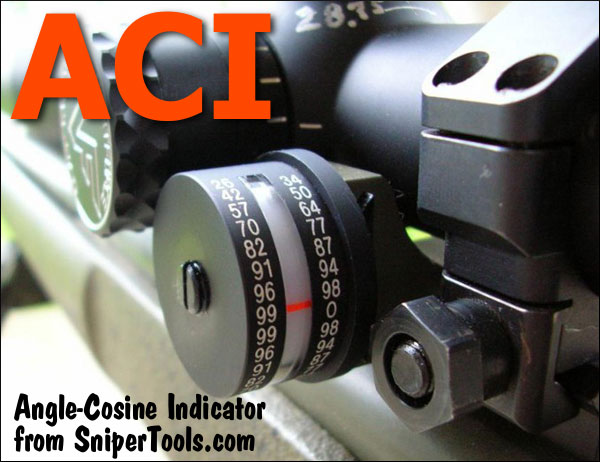
The Angle Cosine Indicator costs $145.95 from Sniper Tools. The ACI is made from aircraft grade aluminum, anodized flat black. Angles are laser-engraved onto the body in five (5) degree increments. The lens is water-resistant, shatter-proof, and shock-proof. Completely mechanical, there are no batteries or electronics to fail. For more info, visit SniperTools.com, or call (818) 359-0512.
 SniperTools.com also offers an Angle Degree Indicator (ADI) for $114.95 (Civilian model). This shows the actual angle from horizontal. If you have a mobile ballistics solver, you can simply input the angle and the ranged yardage and the solver will provide the flatline “gravity-corrected Distance”. Some shooters find it easier to think in terms of the actual angle deflection from horizontal. SniperTools.com also offers an Angle Degree Indicator (ADI) for $114.95 (Civilian model). This shows the actual angle from horizontal. If you have a mobile ballistics solver, you can simply input the angle and the ranged yardage and the solver will provide the flatline “gravity-corrected Distance”. Some shooters find it easier to think in terms of the actual angle deflection from horizontal.
There are several ways to mount an ADI or ACI. We prefer a 90° slotted mount attached to a Picatinny rail. SniperTools.com sells a Badger Ordnance ACI/ADI Rail Mount for $60.00.
July 3rd, 2012
Those of us over-40 types can use some help when shooting iron sights. As one gets older, your eyes lose the ability to rapidly adjust to different points of focus. In practice, when shooting a rifle, this means the target image may be sharp but the sights are blurry, or vice-versa. Or you may be able to see the target and front sight reasonably well, but the rear sight is a complete blurr. (That is this Editor’s problem when shooting a rifle, such as a Swedish Mauser, with a notched blade rear sight.) Even if you are using a rear peep sight, you may see a blurry rear circle (or two circles if you have astigmatism). Placing a diopter on your shooting glasses can help many people see open sights better, when shooting both handguns and rifles.

 Merit Corp. in Schenectady, NY, offers an adjustable metal diopter that attaches to shooting glasses with a rubber cup. Though primarily intended for pistol shooters, the Merit diopter can also be helpful when shooting rifles with open sights, such as military bolt actions. Priced at $65.00, the Merit device features a shutter-style adjustable aperture iris. Merit Corp. in Schenectady, NY, offers an adjustable metal diopter that attaches to shooting glasses with a rubber cup. Though primarily intended for pistol shooters, the Merit diopter can also be helpful when shooting rifles with open sights, such as military bolt actions. Priced at $65.00, the Merit device features a shutter-style adjustable aperture iris.
 Merit explains: “The human eye, whether or not prescription glasses are required, cannot focus on both sights and the target at the same time. The eye will constantly shift focus from the sights to the target trying to ensure proper alignment. Unfortunately, as we age, the eye loses the flexibility which allows it to do this; thus, sights and target begin to grow fuzzy. There is a simple way to combat this by increasing your eyes’ depth of field (range of focus). If you look through an aperture or pinhole of the correct size, you will be able to see both sights clearly, and the target will be clearly defined as well.” Merit explains: “The human eye, whether or not prescription glasses are required, cannot focus on both sights and the target at the same time. The eye will constantly shift focus from the sights to the target trying to ensure proper alignment. Unfortunately, as we age, the eye loses the flexibility which allows it to do this; thus, sights and target begin to grow fuzzy. There is a simple way to combat this by increasing your eyes’ depth of field (range of focus). If you look through an aperture or pinhole of the correct size, you will be able to see both sights clearly, and the target will be clearly defined as well.”
In addition to diopters for eyeglasses, Merit produces a variety of adjustable iris sight products for rifles, including the Variable Iris Aperature for AR15s. Visit MeritCorporation.com or call (518) 346-1420.
Cheaper Diopter from Lyman
If you can’t afford a Merit adjustable diopter, Lyman offers a similar all-plastic device for under $20.00. The Lyman Hawkeye Shooting Aid mounts directly to your eyeglass lens with a rubber suction cup. The diopter section is made of plastic, and aperture diameter is non-adjustable.

Though it is simple and inexpensive, the Lyman Hawkeye works for many shooters, if positioned properly. (Don’t think this is anything close to the Merit Diopter in quality though!) Currently, Cabelas.com has the Lyman Hawkeye on sale for just $12.88, item # IK-229094. MidwayUSA sells the Lyman Hawkeye for $18.99, item # 936878. One MidwayUSA customer reports:
“This thing really works! I have it on my shooting glasses, and it has made a significant improvement in my ability to keep the front sight and target in focus at the same time. If you are older and find that you are having a hard time keeping the target in focus over ‘iron sights’, then this may be the answer to your problem. Mine works equally well for both pistol and rifle, although I do have to change the device’s position on my shooting glasses when changing weapon types.”
June 25th, 2012
 Forum member Roy Bertalotto did a real nice off-set scope installation on a bolt gun to help a sight-challenged shooter. Roy explains: “A friend of mine shoots left-handed and has lost the sight in his left eye. I built him a scope mount so he can still shoot left-handed, but now use his right eye.” Roy’s fabrication work is impressive and we praise his efforts to help a fellow shooter stay in the game. Forum member Roy Bertalotto did a real nice off-set scope installation on a bolt gun to help a sight-challenged shooter. Roy explains: “A friend of mine shoots left-handed and has lost the sight in his left eye. I built him a scope mount so he can still shoot left-handed, but now use his right eye.” Roy’s fabrication work is impressive and we praise his efforts to help a fellow shooter stay in the game.
Roy bolted a plate to the existing scope rail on the top centerline of the Rem 700 action. This plate extends a few inches to the right. On the outboard end of the plate, Roy fitted a second scope rail, aligned with the bore. Weaver-based rings are then clamped to the outboard (right side) auxiliary rail.


Be Careful of Canting Issues with Offset Scope Installations
We’re pleased to see that Roy developed a solution for a shooter with an optical disability, but we want to stress that this is a specialized installation that can create some problems with point of impact shift if the gun is not maintained perfectly level. With the amount of horizontal offset (between the scope’s optical axis and the bore axis) built into this rig, if the rifle is canted, point of impact can shift rather dramatically. For a southpaw who is willing to adapt his/her shooting style, it may be better, in the long run, to learn to shoot right-handed if his/her right eye is the only good eye. Likewise, if a right-handed shooter can only see well through his left eye, he may benefit from learning how to hold the stock and work the trigger with his left hand. The shooter could still work the bolt with his non-trigger hand. Changing from right-hand to left-hand shooting (or vice-versa) may require a stock swap if the stock is not ambidextrous.
June 18th, 2012

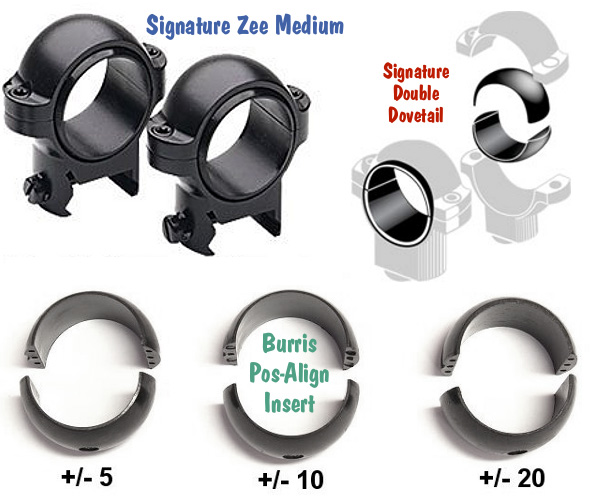
 Burris Signature Rings in Stock Again Burris Signature Rings in Stock Again
Because they allow you to mount a scope without markings, to “pre-load” elevation, and to correct for windage mis-alignment, Burris Signature Rings are extremely popular. So popular in fact that Signature Posi-Align Rings, particularly the “Zee” models for Weaver rails, have been back-ordered for months. Well, Signature Ring fans can now celebrate. Burris has recently shipped large supplies of Signature Rings, including the hard-to-find 30mm High Zees, to vendors across the country. If you’ve been waiting on these unique, affordable ring sets, get your orders in now.
A quick search of webstores shows that various models of Burris Signature Rings are available from all of the following vendors. NOTE: You may have to check with more than one vendor to get the exact size, height, and model you prefer. Inventories are subject to change on a daily basis. For example, Midsouth expects to get some more 30mm Signature Zee High rings in a couple days from now.
Bruno Shooters’ Supply: 1″ and 30mm Signature and Universal, 1″ Rimfire Signature Zee (Call for availability of sizes).
Eabco.com: Signature Zee 1″ and 30mm, Medium. (High — call for availability).
Midsouth Shooters Supply: Wide selection — 1″ and 30mm Signature Zee, Universal, Dual Dovetail, and 1″ Rimfire Signature Zee. (NOTE: 30mm Signature Zee High expected 6/19/2012.)
Sinclair International: 1″ and 30mm Signature Zee, Universal, and Dual Dovetail. (30mm High and Xtra-High Zees out of stock temporarily).
May 29th, 2012
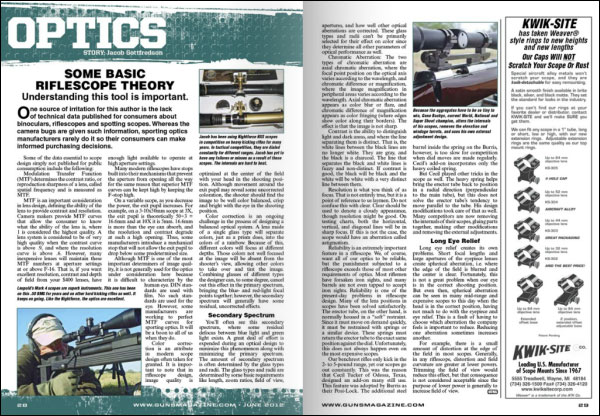
 The June Digital Edition of GUNS Magazine is now available for free online. Just click this link to view the June Edition. NOTE: When the log-in screen appears, simply click the “CONTINUE” button. You do NOT have to fill in your name or email address. You can also read previous monthly editions by clicking on the Archive Tab. The last three (3) years of GUNS Magazine can be accessed for FREE online. The June Digital Edition of GUNS Magazine is now available for free online. Just click this link to view the June Edition. NOTE: When the log-in screen appears, simply click the “CONTINUE” button. You do NOT have to fill in your name or email address. You can also read previous monthly editions by clicking on the Archive Tab. The last three (3) years of GUNS Magazine can be accessed for FREE online.
Articles by Jake Gottfredson in June Edition
The June Edition of GUNS Magazine contains two interesting articles by our friend (and AccurateShooter contributing writer) Jacob (“Jake”) Gottfredson. In the first article, Some Basic Riflescope Theory, Gottfredson identifies key principles of optics and shows how they apply to riflescope design and construction. He explains the term “Modulation Transfer Function” (MTF), and how this can be used to quantify both contrast and resolution. The author also explores the topics of color correction, chromatic aberration, and color fringing. Jake notes how color correction and focus precision are directly related. Jake also explains the difference between “clarity” and “resolution”. You can have a scope with good clarity but poor resolution or vice-versa. If a scope shows cloudiness it lacks clarity. If the scope can’t show a test grid in sharp focus, it lacks resolution. There are many other important insights Jake provides in this well-written article. We recommend you read the article and perhaps event print it out for future reference. If you are shopping for an expensive scope, Jake provides specific criteria by which you can judge a scope’s quality and repeatability.
600-Yard Playing Card Shoot — Tiny Target, Far Away
The second offering by Gottfredson in the June issue of GUNS Magazine, is an entertaining report about a 600-yard fun shoot using playing cards. Regular-sized 2.5″ x 3.5″ playing cards with a 3/4″ red dot are placed in the center of an 8.5″ x 11″ target sheet. To help aiming, the target sheets have a black ring about 5″ in diameter. After a sighter session, shooters are allowed 10 shots in 7 minutes from 600 yards. That’s a pretty tough challenge, but with a very accurate rifle, multiple card hits are possible. Jake reports that, at his “card shoot”, the two top competitors, Gary Chaney and Andrew Smith, each hit the card six (6) times, with Gary breaking the tie by hitting the 3/4″ red dot. If this sounds like fun, read the full story, and perhaps you can set up a similar match at your shooting club. Gottfredson even includes “10 Tips for Success” such as: “7. Shoot fast, trying to get all rounds downrange in the same wind. Stop when it changes and wait for it to return or hold off if it does not….”

In addition to two Gottfredson articles, the June Edition of GUNS Magazine has a helpful feature on the .243 Winchester by John Barsness. This provides a short history of the cartridge and Barsness discusses 6mm bullet options for hunters using the .243 to harvest game.
|


