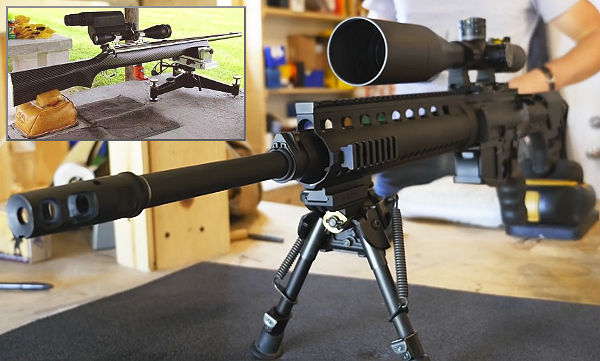
Do you know which one of your eyes is dominant? It’s easy to determine eye dominance with a simple exercise. Pick an object about 6-10 feet away (a light switch or door knob works well). Make an “OK” sign with your right hand (see photo) and hold that about 18″ from your face. Now, with both eyes open, look through the circle formed by your thumb and index finger. Center the circle on the object, so you can see the object in the middle.
Now, here’s the important part — while still holding your hand up, centered on the object, first close your right eye. If you don’t see the object anymore, then your right eye is dominant. If you still see the object, then repeat the procedure with the left eye shut and right eye open. If you don’t see the object when your left eye (only) is closed, then you are left-eye dominant.
The digital archives of Shooting Sports USA contain many interesting articles. A while back, Shooting Sports USA featured a “must-read” expert Symposium on Eye Dominance, as it affects both rifle and pistol shooting. No matter whether you have normal dominance (i.e. your dominant eye is on the same side as your dominant hand), or if you have cross-dominance, you’ll benefit by reading this excellent article. The physiology and science of eye dominance is explained by Dr. Norman Wong, a noted optometrist. In addition, expert advice is provided by champion shooters such as David Tubb, Lones Wigger, Dennis DeMille, Julie Golob, Jessie Harrison, and Phil Hemphill.
Top Rifle Champions Talk About Eye Dominance:
David Tubb — 11-Time National High Power Champion
I keep both eyes open, always. Some use an opaque blinder in rifle or shotgun shooting. If you close your non-dominant eye, you will not get as good a sight picture. If your aiming eye is not your dominant eye, you have even more of a problem to overcome.
Lones Wigger — World, National and Olympic Champion Rifleman
Shooters should try to use the dominant eye unless the vision is impaired and the non-dominant eye has better vision. You should always shoot with both eyes open since this will allow the shooting eye to function properly.
Dennis DeMille — National Service Rifle Champion
I close my non-shooting eye initially. Once I pick up my sight picture, it’s not something I focus on. For those that use a patch, I recommend that they use something white to block their view, rather than cover the eye.
Bruce Piatt — 2015 World Shooting Championship Winner
Some shooters, especially those with nearly equal or cross-dominance, will naturally find themselves squinting one eye. When anyone does this, you are also closing your dominant eye to some extent and adding stress to your face.
Everybody knows that powerful spotting scopes work best when mounted to a stable tripod or otherwise secured to a steady mount. Yet when most folks use binoculars, they never even think of using a tripod, despite the fact that tripod adapters are available for many premium binoculars. A serious hunter should learn how to glass with tripod support. With binoculars offering more that 8X magnification, you can really benefit from a steady mount. In this article, Mark Boardman of Vortex Optics, an experienced hunter, explains the benefits of using a tripod with high-magnification binoculars.
Editor: The following statement was released by Leupold & Stevens Inc. on August 3, 2016. We publish the statement as it was released, without modification.
Leupold® Files Lawsuit Against Nightforce Over Patent Violations
Leupold & Stevens, Inc., has filed a civil suit in the U.S. District Court of Oregon alleging patent violations by Lightforce U.S.A., doing business as Nightforce. In the suit, Leupold & Stevens, Inc., alleges that Nightforce is marketing and selling products that infringe on a variety of patents owned by Leupold & Stevens, Inc. and is seeking all available remedies.
The lawsuit is based on six patents for riflescope adjustments, internal optical mechanisms, and flip covers.
Leupold & Stevens, Inc., has been pioneering riflescope and sporting optics technology since 1947, when it developed a non-fogging riflescope charged with nitrogen. Today, Leupold® has been granted over 151 patents and design registrations in 18 countries, representing Leupold’s continued commitment to innovation and development of sports optics. For more information on Leupold products, please visit us at www.leupold.com.
Leupold & Stevens, Inc. is committed to protecting its intellectual property and the innovations developed by its engineering and design teams.
Founded in Oregon more than a century ago, Leupold & Stevens, Inc. is a fifth generation, family owned company that designs, machines and assembles its riflescopes, mounting systems and tactical/Gold Ring® spotting scopes in the USA. The product lines include rifle, handgun and spotting scopes; binoculars; rangefinders; mounting systems; and optical tools, accessories and Pro Gear.
Initial Response from Nightforce Optics
We contacted Nightforce Optics regarding the legal action commenced by Leupold. A spokesman for Nightforce provided this response: “We have investigated [Leupold’s] claims and we are confident there is no infringement. We look forward to full and fair competition with Leupold in the future.”
Tactical ace Zak Smith of Thunder Beast Arms employs a simple, handy means to store his elevation and wind dift data — a laminated data card. To make one, first generate a come-up table, using one of the free online ballistics programs such as JBM Ballistics. You can also put the information in an Excel spreadsheet or MS Word table and print it out. You want to keep it pretty small.
Above is a sample of a data card. For each distance, the card includes drop in inches, drop in MOA, drop in mils. It also shows drift for a 10-mph cross wind, expressed three ways–inches, MOA, and mils. Zak explained that “to save space… I printed data every 50 yards. For an actual data-card, I recommend printing data every 20 or 25 yards.” But Zak also advised that you’ll want to customize the card format to keep things simple: “The sample card has multiple sets of data to be more universal. But if you make your own data card, you can reduce the chance of a mistake by keeping it simple. Because I use scopes with MILS, my own card (photo below left) just has three items: range, wind, drop in MILS only.”
Once you have the card you can fold it in half and then have it laminated at a local office store or Kinko’s. You can keep this in your pocket, tape it to your stock, or tie the laminated card to your rifle. If you regularly shoot at both low and high elevations, you may want to create multiple cards (since your ballistics change with altitude). To learn more about ballistic tables and data cards, check out the excellent Practical Long-Range Rifle Shooting–Part 1 article on Zak’s website. This article offers many other insights as well–including valuable tips on caliber and rifle selection.
Scope-Cover Mounted Ballistics Table
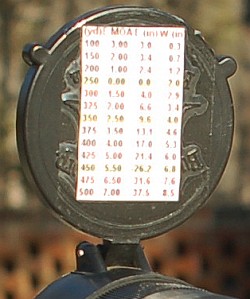
Another option is to place your ballistics card on the back of the front flip-up scope cover. This set-up is used by Forum member Greg C. (aka “Rem40X”). With your ‘come-up’ table on the flip-up cover you can check your windage and elevation drops easily without having to move out of shooting position.
Greg tells us: “Placing my trajectory table on the front scope cover has worked well for me for a couple of years and thought I’d share. It’s in plain view and not under my armpit. And the table is far enough away that my aging eyes can read it easily. To apply, just use clear tape on the front objective cover.”
At the request of our readers, we provide select “Deals of the Week”. Every Monday morning we offer our Bargain selections. Here are some of the best deals on firearms, hardware, reloading components, and shooting accessories. Be aware that sale prices are subject to change, and once clearance inventory is sold, it’s gone for good. You snooze you lose.
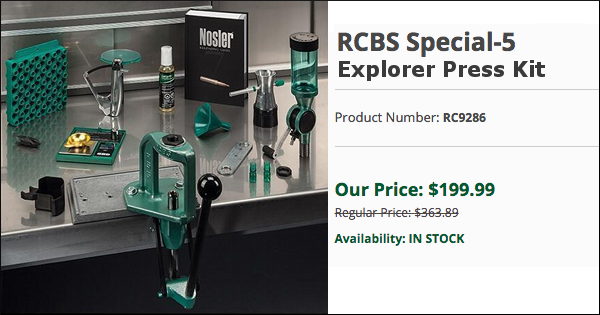
1. Natchez — Special 5 Reloading Press Kit, $199.99
This is an excellent entry-level reloading kit, which is on sale for $199.99 at Natchez Shooters Supply. We like the relatively compact Special 5 press for most reloading duties. Eventually you many want to add an additional large heavy press, but this will get the job done. This kit includes an RCBS Powder Measure, Digital Scale, Powder Trickler, Hand Priming Tool, Load Manual, Loading Tray, and more. It’s hard to beat this combination of tools for under $200.00.
2. CDNN Sports — Remington 597 for $149.99
Looking for a “first rifle” for a family member? Consider this semi-auto Remington 597. It currently retails for just $149.99. That’s right, for under $150 you can get a reliable, self-feeding rimfire rifle that will provide years of fun for a young shooter. The 597 has a stock that’s sized right for both youngsters and adults. Receivers are dovetailed for standard rimfire rings and are also drilled and tapped to allow mounting of Weaver-style bases.
3. Grafs.com — Forster Co-Ax Reloading Press on SALE
If you’ve been patiently waiting to acquire a Forster Co-Ax® reloading press, now’s the time to strike. Grafs.com has Co-Ax presses on sale this week at $289.99. That includes shipping charges (with one flat $7.95 handling charge per order).
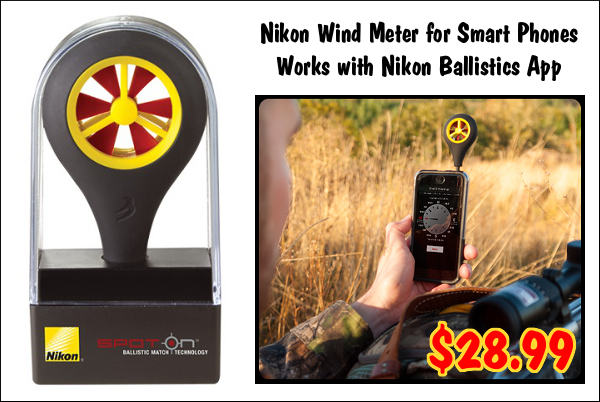
4. Grafs.com — NEW Nikon Wind Meter for SmartPhones, $28.99
Here’s a great new gadget for under $30.00. Nikon’s new Spot On™ Ballistic Wind Meter plugs directly into the headphone port on most popular smart phones. The Spot On Wind Meter reads both wind speed and direction and inputs the data directly into Nikon’s free Spot On Ballistics Mobile App (available for iOS and Android). This allows you to quickly determine and calculate wind drift corrections without needing a separate, dedicated wind meter. When not in use, the Nikon device easily fits in a pocket.
Everyone needs a good .22 LR rimfire handgun, and the Browning Buck Mark is a classic. This stainless, bull barrel version is marked down this week to $379.99. That’s a very good price. Buckmarks, with their excellent triggers and great ergonomics, are fun to shoot and VERY accurate. This is a pistol you can keep for a life-time and pass on to your kids. Browning says: “Every Buck Mark starts out as a solid piece of aircraft-grade 7075 aluminum alloy, and then is CNC machined to exacting tolerances. The crisp single-action trigger, hand reamed chamber, target crowned barrel and finely adjustable target sights mean the Buck Mark comes ready for fun straight from the box.”
This article appears courtesy Target Shooter magazine from the UK.
Field Target (FT) and Hunter Field Target (HFT) airgun disciplines are popular outdoor shooting sports that simulate the challenges of hunting small game. One of the unique aspects of FT competition is target range-finding using parallax and optical focus. (HFT is limited to lower power scopes, so this type of range-fiding is not used in HFT.) Range-finding is very important because the pellets shot by FT airguns drop rapidly once they leave the muzzle (pellets can drop roughly 5″ at 50 yards). If you don’t have your scope set to the correct distance, you’ll probably miss the target high or low.
FT competitors employ high-magnification (35-55X) scopes to sight targets placed from 10 to 55 yards (7.3 to 50m in the UK). Because these scopes have very short depth-of-field at high-magnification, the target will be out of focus unless you have the scope focus/parallax control set very precisely. But competitors can use this to their advantage — once the target is precisely focused, you have effectively established its distance from the shooter. FT scopes often have large-diameter wheels on the side parallax control so the focus can be set very precisely. You can then read marks placed on the scope to adjust the amount of elevation need to put the pellet on target.
To simplify the adjustment of elevation on FT rifles, competitors will place tapes on the windage knobs with marks that correspond to distances in 3-5 yard (or smaller) increments. These marks allow you to quickly spin your elevation to the setting matching the target range established with your focus/parallax control.
Field Target Accessories
There are a variety of specialized products for FT competitors that help you set up your scope for precise ranging. First, Compufoil offers a computer program, ScopeKnob, that lets you easily create accurate elevation knob tapes for your scope. ScopeKnob even comes with a built-in Ballistics Module that will calculate the pellet trajectory for you and plot range settings for your tape. Chairgun.com also offers ChairGunPRO, specialized airgun ballistics software that lets you simultaneously compare four different pellets, or different scope heights.
In the past, the A-Team offered replacement elevation knobs optimized for use with yardage marking tapes. These were offered in two versions, one which replaced the existing turret altogether and a second which clamped OVER the factory turret. Shown at right is the larger-diameter version in place over the factory turret. Unfortunately we don’t know a current source for this product, but this may help you crate something similar on your own.
Last but not least, Pyramid Air offers large-diameter parallax control wheels. According to Pyramid: “The enlarged sidewheel is the most popular FT scope accessory of all. It lets you put white artist’s tape around the rim to mark the actual distances at which the scope focuses”. A 6″ sidewheel provides over 18″ of space on which to inscribe yardage, and that means you can have a meaningful separation between 18 yards and 20 — where there is a huge parallax and trajectory difference. Though the ranges are already engraved on the rim of the wheel, field target competitors will measure them again on an actual range and write the markings on a strip of white artist’s tape.
Tips on Field Target Scope Set-Up
The creator’s of the A-Team knobs suggest taking your time when setting up a scope for Field Target competition: “We normally take from three to four hours preparing a scope to be mounted on a gun. We mark the scope in 1-yard increments from 9 to 40 yards, then to 55 yards by 3 or 5-yard increments depending on the scope being calibrated.”
Leupold now offers easy online ordering for custom riflescope dials for your elevation turrets. A custom CDS dial lets you simply “dial the yardage” to have the correct elevation at distances near to far. For example, as shown below, if your target is at 550 yards, you simply dial 5.5 on the turret index. This is possible because the dial has been customized with the particular ballistics of your rifle and your load.
“Leupold engineers do all the hard work in the lab, making sure it’s easy and fast in the field,” said Rob Morrison, Leupold’s global marketing VP. “All the shooter has to do is provide us with ballistic information. From this simple data, a custom-calibrated dial is laser engraved for that specific load.”
Order Multiple Dials for Different Bullet Types
Leupolds’ custom CDS dials are tailored to the exact load used. With the ability to quickly change dials, it’s easy to set up several loads in a single rifle with a single riflescope. Transition from coyote loads to big game cartridges with a simple change of the dial. Or you can get different dials for different cartridges if you move your optic from one rifle to another. To order a CDS dial, call 1-800-LEUPOLD or visit Customshop.leupold.com/custom-dials and click on the appropriate dial for your riflescope.
At the request of our readers, we provide select “Deals of the Week”. Every Monday morning we offer our Bargain selections. Here are some of the best deals on firearms, hardware, reloading components, and shooting accessories. Be aware that sale prices are subject to change, and once clearance inventory is sold, it’s gone for good. You snooze you lose.
1. Midsouth — Major Brand Blem Bullets (.204 to .50 Cal)
Right now Midsouth Shooters Supply is running a big sale on Major Brand Blem Bullets. You can save 50% or more on a wide variety of bullet types and calibers. Whatever your preference — Poly Tips, BT Hollowpoints, Soft-Points — you’ll find something on sale. In all 42 types of bullets, from .22 to .50 caliber, are deeply discounted. Here are just a few of the great deals we found:
.204 (20 Cal) 45gr SP, $17.06 per 100
.224 (5.56 mm) 55gr SP, $9.53 per 100
.243 (6 mm) 87gr BTHP, $15.08 per 100
.264 (6.5 mm) 120gr Poly Tip, $18.54 per 100
.308 (7.62 mm) 195gr BTHP, $22.96 per 100
.338 (8.58mm) 225gr Poly Tip, $27.22 per 100
2. Grafs.com — Magnetospeed Sporter $179.99
If you have been waiting to get a Magnetospeed… wait no longer. Priced at just $179.99 at Grafs.com, the Magnetospeed Sporter model costs less than half as much as Magnetospeed’s V3 models. This chronograph attaches directly to your barrel so you don’t have to go downrange to position tripods and set up skyscreens. For most people the Sporter Model contains all the features they need. Using Magnetspeed’s XFR adapter (sold separately), data can be transferred easily from the display module to your mobile device. READ Magnetospeed Sporter Review.
3. Bruno’s — Once-Used Nightforce Scopes, Save Hundreds
Bruno Shooters Supply currently offers six (6) Nightforce targets scopes that were used one-time-only at the Cactus Benchrest match. These were “previewed” for evaluation on a rifle but are virtually brand new. And yes they come with full factory warranty. Choose either the 15-55x52mm Comp model or the NEW fixed-power 42x44mm scope, with either Fine Cross Hair (FCH) or Target Dot Reticle. You can save some hundreds on these scopes. For example, the 15-55X scope is offered at $2125.00, compared to the $2352.00 normal price at other vendors. That’s a $227.00 savings.
4. CDNN Sports — Ruger American Ranch Rifle (Tan), $389.99
Here’s a nice little varmint rifle from Ruger with some nice features at a very attractive price, $389.99. This .223 Rem rifle features a 16.5″ hammer-forged barrel barrel threaded 1/2″-28 at the muzzle for brake or suppressor. The action, which features a 70° three-lug bolt, and Picatinny-style scope rail, sits in an aluminum bedding block. The crisp trigger adjusts down to 3 pounds. With a weight (before optics) of 6.1 pounds, this is a handy carry-around varminter.
5. Natchez — 300 Rounds .45 ACP in Can, $69.99 After Rebate
The classic .45 ACP is probably our favorite handgun cartridge for target work. Inherently accurate, the .45 ACP delivers big, easy-to-see holes on the target. Right now you can get 300 rounds of quality American Eagle 230gr .45 ACP FMJ ammunition for just $69.99 after the Federal Premium MFG Rebate. This Natchez .45 ACP Ammo Deal includes a rugged, lockable Federal Premium plastic Ammo Can.
6. Cabelas.com — Lyman Power Case-Prep Tool, $20.89
This Lyman cordless power tool is now just $20.89, marked down from $39.99. That’s a steal for a tool that handles most case-prep chores. The high-torque rechargeable driver runs at the correct speed for deburring and chamfering. The accessories have hex shafts that snap in and out of the driver (much like with a cordless screwdriver). The kit includes the power unit and seven (7) accessories: two case neck brushes, two double-ended primer pocket tools (large and small), an outside 45° neck-chamfer tool, an inside 30° neck-chamfer tool, and a combo standard/phillips screw-driver bit. Grab one for $20.89 at Cabelas.com.
7. MidwayUSA — Padded Scoped Rifle Case, $24.99
This 48″-long, thickly-padded gun case will hold most tactical-style rifles and hunting rifles. At a fraction of the cost of a big, cumbersome drag bag, this case may be all you need. The heavy duty padding is over 1″ thick on both sides to protect your rifle and optics investment from rough handling. A large pocket will hold a couple boxes of ammo and other accessories. We like this bag much better than the typical gun-store soft cases. It offers much better padding and more room for large scopes. It is on sale this week at MidwayUSA for just $24.99 in four colors: black, tan, OD green, and gray. In addition to the 48″ case shown, 40″ and 44″ versions are available.
8. Amazon — Two Rolls of 3″ Neon Target Stickers, $14.95
We like these bright Neon 3″ target stickers. They are big enough to see easily at 600 yards, giving you a 1/2 MOA target center at that distance. For $14.95 at Amazon.com, you get 250 3″-diameter self-adhesive centers (125 targets per roll) that stick to almost any surface The high-contrast fluorescent red/orange color provides an excellent HI-VIZ aiming point, along with good contrast for bullet holes that fall within the 3″ circle. To help line up your reticle cross-hairs, the target centers feature black markers at 3, 6, 9, and 12 0’clock.
Are you looking to improve your long-range shooting? Doubtless you’ve been thinking about upgrading your rifle or optics, but wonder what to buy (and how to get the best “bang for your buck”). In this video, Bryan Litz of Applied Ballistics offers “solid gold” advice on equipment selection for mid-level shooters (i.e. those who are somewhere between “newbie” and “Master of the Universe”). Bryan explains the logical first step is a barrel upgrade — a new tube from a top-barrel maker can make a huge difference. Then you should research the best factory ammo for your rifle, or get started in precision hand-loading. Bryan also offers advice on choosing a scope and optics accessories.
Equipment Upgrades: Barrel, Optics, Ammoby Bryan Litz
Every equipment element can be upgraded. You can run that factory rifle for a period of time, but the barrel eventually is going to be what holds you back. The twist rate probably won’t be fast enough to stabilize the high-BC bullets that you want to shoot at long range. So, the first thing you want to upgrade on your factory rifle is probably going to be the barrel. [With a new custom barrel] you’re going to get a fast twist rate, you’re going to get a chamber that’s optimized with a throat for your … bullet. And a good quality custom barrel is going to be easier to clean, won’t foul out as much, and it’s going to improve to overall accuracy and precision of your shooting. Barrel swaps are very common and routine thing for gunsmiths to do.
The next thing is improving your scope. If you don’t have a quality optic it’s going to hold you back. The job of the scope is to precisely and perfectly delineate [the target] within a half a degree (from 100 to 1000 yards is only a half a degree). The scope has got to put you on the money within that half a degree. So, it’s not a piece of equipment you want to go cheap on.
The other big factor is your ammunition. Getting into hand-loading is meticulous and it takes a long time to learn, but ultimately you’ll be making ammunition that is tailored for your rifle, and there simply won’t be anything better for your rifle than what you can develop through individual handloads.
So that’s typically the upgrade path: Get your factory rifle re-barreled, don’t skimp on a scope (or anything that attaches to it), improve your ammunition (whether by upgrading to better factory ammo or hand-loading on your own). All through this process is continuous learning… Once you have the best equipment (and it doesn’t get any better), the process of learning and education never ends. That is something you build on every single time you go to the range, and it’s what going to allow you to continually improve your skills.”
No matter what kind of rifle you shoot, whether it be an AR or a brenchrest rig, the principles are the same — develop a good load, learn the gun, hone your wind-reading skills, and practice in all conditions. Making a video of a practice session can help you identify and correct bad habits.
Bryan Litz says “don’t skimp on your scope”. Purchase a quality scope, rings, and scope level. Successful long-range shooting all begins with your view of the target.
Even with a top-of-the-line F-TR rig like this, you still have to practice diligently, putting in the “trigger time” needed to improve your game.
Looking for a very high-quality hunting scope that won’t break the bank? The German-crafted Zeiss Conquest DL has won many awards, yet it’s half the cost of super-premium European brands. For general performance, durability, and glass quality, many experts say the Conquest DL sets the “benchmark” for the “upper middle” end of riflescopes. Here is a very revealing review of the Conquest DL by British lady hunter Ginny Langton.
Ginny explains: “Even when the visibility has been bad, early in the morning, very cloudy and a bit foggy, the image is really clear and really bright… which has made for a much easier and clearer shot for me. I have found that using the [ASV bullet drop compensator] even when it’s bitterly cold is really straight-forward. Even when you’re fumbling around with gloves on, it’s very easy to find the buttons and the functionality of the scope is very, very good. The great thing about the DL scope is its versatility — I could use this scope all over the world.”
In a recent comparison review, gunwriter L.P. Brezny rated the 3-12x50mm Zeiss Conquest DL one of the best hunting scopes under $1000. Brezny states: “As a second option on my list of five top hunting scopes for big game that are under a grand stands the Zeiss Conquest DL Hunting Scope in 3x12x50mm. Here you have an illuminated reticle [extra cost], ultra-refined German glass, and a side focus knob with the Z-Plex reticle. In most cases what is in this optic, in terms of quality, is often found at a much higher price.” This German-made Conquest DL retails for $999.99 on Amazon.com (non-illuminated) or $1299.95 with illuminated reticle.
The entire Zeiss riflescope line is available from Europtic.com. Call (570) 368-3920 and ask for Jason Baney and request the best price. Tell Jason that AccurateShooter.com sent you.


 Do you know which one of your eyes is dominant? It’s easy to determine eye dominance with a simple exercise. Pick an object about 6-10 feet away (a light switch or door knob works well). Make an “OK” sign with your right hand (see photo) and hold that about 18″ from your face. Now, with both eyes open, look through the circle formed by your thumb and index finger. Center the circle on the object, so you can see the object in the middle.
 The digital archives of Shooting Sports USA contain many interesting articles. A while back, Shooting Sports USA featured a “must-read” expert Symposium on Eye Dominance, as it affects both rifle and pistol shooting. No matter whether you have normal dominance (i.e. your dominant eye is on the same side as your dominant hand), or if you have cross-dominance, you’ll benefit by reading this excellent article. The physiology and science of eye dominance is explained by Dr. Norman Wong, a noted optometrist. In addition, expert advice is provided by champion shooters such as David Tubb, Lones Wigger, Dennis DeMille, Julie Golob, Jessie Harrison, and Phil Hemphill.


 Scope-Cover Mounted Ballistics Table




 In the past, the A-Team offered replacement elevation knobs optimized for use with yardage marking tapes. These were offered in two versions, one which replaced the existing turret altogether and a second which clamped OVER the factory turret. Shown at right is the larger-diameter version in place over the factory turret. Unfortunately we don’t know a current source for this product, but this may help you crate something similar on your own.