Successful long-range shooters know that careful weighing of powder charges helps them achieve superior long-range accuracy. By maintaining powder charges within very narrow weight tolerances, hand-loaders can produce ammo with more consistent muzzle velocities from shot to shot. Low Extreme Spread (ES) and Standard Deviation (SD) numbers translate directly to reduced vertical dispersion at very long ranges (although velocity is not the only contributing factor to vertical spread). In pursuit of load weight uniformity, many of our top long-range aces have invested in the latest, high-tech magnetic force restoration (MFR) digital scales (such as the Sartorius GD503). These laboratory-grade MFR scales are extremely stable (with minimal drift) and they can reliably measure to .005 grain, that is five thousandths of a grain. That is less than the weight of one kernel of typical extruded powder. For example, with Varget, there are three to four kernels in one-tenth of one grain of Varget. That means each kernel weighs .025 to .035 grains.
With the capability of modern modern MFR scales to measure less than one-hundreth of a grain, we have a new frontier in precision reloading. You’ll note, in the preceding paragraph, we said that one-tenth of one grain of Varget is three or four kernels. Well, “which is it?” you might ask. The answer is that it might be three, or it might be four, depending on the size of the individual kernels. That’s a disturbing uncertainty that we simply had to accept… until now.
Powder Kernel Uniforming — A Breakthrough
We now have the tools and the methodology to resolve the inherent uncertainty in individual kernel weight. Using the new technique of powder kernel uniforming, first pioneered by German Salazar, we can now, for the first time, ensure that every kernel of powder that goes into a cartridge is virtually the same weight — the same, in fact, within 0.01 grain (one-hundredth of a grain) TOTAL spread.
For a reloader looking to achieve “perfect” load weight uniformity, powder kernel uniforming offers the ultimate control over powder weight. The method we devised to uniform individual kernels consists of kernel core-drilling. The propellant we chose for this kernel-uniforming test was a new prototype (not yet commercially available) EuroChemie RL “X” propellant. This was chosen because it offered relatively large, can-shaped kernels that could be drilled relatively easily.
Core-Drilling Kernels with Micro Drill-Bits
The center of each kernel was bored out with a micro-drill. But here’s the key. Before drilling, we first weighed each kernel. Then we selected a micro drill bit of appropriate diameter to achieve uniform weights. With the heavier kernels (in the 0.04 gr range) we used a larger micro-bit. With the lighter kernels (in the 0.02 range), we selected a smaller diameter micro-bit that removed less material from the center of the kernel. Obviously, many kernels were ruined while we perfected the drilling process. It required great patience and a very steady hand. But after a few dozen hours of drilling, we had a batch of uniformed kernels that were all within plus or minus .005 grains (.01 grain ES). Now we were ready to do some testing.
Proof That It Works
All this time-consuming work to drill holes in individual kernels would be pointless, of course, if it did not produce meaningful accuracy gains. The proof, as they say, is “on the target”. We were curious to see if our uniformed powder kernels would out-perform unmodified kernels, so we did some field testing. We prepared two batches of 6mmBR ammo in Lapua brass, with full case prep, and bullet base to ogive sorting (we wanted to eliminate as many variables as possible). Bullets were Lapua 105gr Scenar Ls, which proved to be some of the most consistent projectiles we’ve ever measured.
One set of rounds was loaded with a carefully-weighed charge of unmodified kernels. Case to case charge weight was held to .05 grain (half a tenth uniformity). Then we prepared a second batch of cartridges with uniformed kernels, using the exact same charge weight, also held to .05 grain (half a tenth) tolerances. We took these rounds to the range, and did a “round-robin” test at 800 yards, shooting one of each type in sequence (i.e. one uniformed on right, then one non-uniformed on left) until we had two 10-round groups. The test was done with a rail gun fitted with a 1:8″ twist, 28″ Krieger 0.236″ land barrel. The uniformed-kernel ammo was shot at the right diamond, while the non-uniformed rounds were shot at the left diamond. Conditions were good, so we simply “held center” on every shot. No attempt was made to correct for wind as our primary concern was vertical dispersion.
Ammo with Uniformed Kernels Shows Significantly Less Vertical Dispersion at Long Range
As you can see, the uniformed-kernel ammo out-performed the non-uniformed ammo. The difference is quite clear. The rounds with non-uniformed kernels (on the left) produced a 10-shot group with roughly 3.0 inches of vertical dispersion. On the right, our ammo with uniformed kernels produced a group with 9 of 10 shots showing roughly 1.75 inches of vertical dispersion (we did have one high flier among the uniformed-kernel rounds). Additionally, we had a lower 10-shot ES and SD with the uniformed-kernel ammo. We repeated this test two more times and the results were similar. The targets speak for themselves. If you are looking for ultimate long-range accuracy, powder kernel uniforming is a “new frontier” you may wish to explore. With all other factors held constant, we were able to reduce vertical dispersion by more than an inch at 800 yards by drill-uniforming our NitroChemie powder. That’s huge in the long-range game.
Yes, the kernel-uniforming process is incredibly time-consuming and tedious, and a set of micro-drills is not cheap. We also freely acknowledge that the process may be much less productive with narrow-kernel propellants that are hard to drill. (Also EuroChemie powders are preferred because the burn rate controlling compounds are impregnated throughout the entire kernel — not just the outside.) But the potential for significant accuracy gains is there. We proved that.
Is it worth the huge investment of time to drill your powder kernels? That’s a question each reader must ask himself. But if you know the competitor on the next bench over has uniformed his kernels, can you afford not to do the same? Sometimes the extra effort is worth it, just for the peace of mind you get knowing you’ve done everything possible to achieve “ultimate accuracy”.
Here’s a tip that can help you score higher at matches and get more predictable results when weighing loads with an electronic scale. Kelly Bachand, a top prone shooter and electrical engineering major at the Univ. of Washington, tells us that all digital scales can drift. Therefore Kelly recommends re-calibrating electronic scales often. In addition — and this is key — Kelly recommends that you shoot the ammo in the exact order in which it was loaded. Arrange your loaded ammo in a box in the order of loading and shoot it first-loaded to last-loaded. (Or, if you prefer, shoot it last-loaded to first-loaded.) The important thing is to maintain the order and not mix everything up. That way, if your scale drifts, the effect of drift on charge weight will be incremental from one loaded round to the next, so point of impact change should be negligible. Conversely, if you shoot your last-loaded round right after your first-loaded round, the effect of scale drift is at its maximum, so powder charge varience is maximized. And that can produce a different point of impact (POI) on the target.
Tips on Loading with Electronic Scales by Kelly Bachand
If you use a digital scale to measure powder charges, recalibrate the scale often. I like to do this about every 25 rounds or so. Additionally, most electronic scales rely on eddy currents for their precision. Eddy currents are easily disrupted by static electricity so keep a cloth or ground strap nearby to remove any static currents should the scale start acting up; I usually just use a fabric softener sheet that has gone through the dryer once.
Shoot Ammo in Order of Loading
I shoot my rounds in the same order or reverse order as I load them. If the charge weight varies due to scale drift during use, the difference will be gradual if I shoot in the same order as production (or reverse order). I should be able to adjust for the slight varience in charge weight without having any wildly high or low shots (see the charts below for a graphical demonstration). I usually load my ammunition just 100 rounds at a time. Give yourself plenty of time and remember that you will make your best ammunition when you are fully awake and alert.
This graph demonstrates the effect a .01% (that’s 1/100th of 1 percent) difference in scale measurement would have over the course of 100 rounds assuming the desired load is somewhere between 46 and 47 grains. The final round made would have almost 1% less (or more) powder than the first, that’s almost an 0.5 grain difference from the first. If shot back to back, these rounds will invariably have different points of impact on the target.
This graph demonstrates the same .01% difference in scale measurement but this time with a recalibration every 25 rounds. By recalibrating the scale every 25 rounds the furthest a weighed charge ever gets from the original is less than 0.25%. Again if the charge being weighed is between 46 and 47 grains then the 26th round made would vary from the 1st by .12 grains. Even that small difference would likely show on target.
Either way it is important to note that if the bullets are shot in the same (or reverse) order as they are made, the biggest difference from bullet to bullet in this example is less than .01 grains.
Here’s a good deal for you 50 BMG shooters. Wideners.com has NEW 8-lb jugs of military ball (spherical) powders on sale for just $39.00 per jug. That works out to just $4.88 per pound. Two types are offered at this price: WC867 and WC872. Both types are NEW never-loaded powders, not re-claimed or “pull-down” propellants. Wideners notes: “There is almost no difference between WC867 and WC872 powder and the same loading data is used for both. The slight differences will depend on the bullet used, the neck tension, whether you are shooting a bolt action or semi auto. Use loading data for AA8700, work loads up accordingly.”
While these powders are optimized for the 50 BMG, WC867 and WC872 can be used for other maxi-sized cartridges that require a very slow-burning propellent. To make this an even better deal, Widener’s will waive the Hazmat fee if you purchase six (6) 8-lb jugs: “Buy in Increments of 6 and we will pay the Hazardous Material Fee for you. That is 6, 12 or 18 Kegs etc.; if you buy less than 6, you will pay the Hazardous Materials Fees.” To order, visit Wideners.com or call 1-800-615-3006.
At SHOT Show, we had the chance to meet with German software engineer Hartmut Broemel, creator of QuickLOAD software. This software program, while not a substitute for conventional load manuals, allows shooters to evaluate a wide range of powders and bullets, comparing potential loads on the basis of predicted pressures, velocities, load density and projectile in-barrel time.
We took the opportunity, in the video below, to explain some of the fine points of QuickLOAD for our members. QuickLOAD, sold by Neconos.com, helps reloaders understand how changing variables can affect pressures and velocities. It can predict the effect of changes in ambient temperature, bullet seating depth, and barrel length.
In the video below we explain how to adjust the program for true case capacity, bullet seating into the lands, and other important factors. If you are a new QuickLOAD user, or are contemplating buying the $152.95 program, you should watch the video. The program isn’t perfect, but it can accelerate the load development process, and it can save you money by narrowing down the list of appropriate powders for your cartridge.
No other product currently available to serious reloaders offers as much predictive power as QuickLOAD, and you’ll find your money well spent just for the vast collection of data on bullets and cartridges. With a couple mouse-clicks you can instantly get the specifications of hundreds of bullets and cartridges. Likewise, in a matter of seconds, you can compare load density for a half-dozen powders, or compare the projected velocities of one cartridge versus another.
Hodgdon Powder has introduced a new spherical (ball) powder called CFE™223. Hodgdon claims that this new powder “greatly deters copper fouling” compared to other propellants. Originally developed for U.S. rapid-fire military systems, CFE™223 incorporates a proprietary chemistry named “Copper Fouling Eraser”. Based on tests with extended shot strings, Hodgdon claims that, by using CFE™223, match shooters, varmint hunters, and AR shooters can maintain accuracy for longer periods, with less barrel-cleaning time.
Load Data Now Available Online for CFE™223
Reload data for CFE™223 is available for 27 different cartridges with 147 loads. It is suitable for loading in many popular chamberings including: .204 Ruger, .223 Rem, 22-250, 6mmBR, .243 Win, 6.5 Creedmoor, .260 Rem, 7mm-08, and .308 Win. Maximum velocities are obtained in the .204 Ruger, .223 Rem, 22-250, and .308 Win with load data found at Hodgdon’s Reloading Data Center. CFE™223 is a spherical (ball) powder, so it meters well. The new powder will be available in one- and eight-pound containers starting in January, 2012. For more info, call (913) 362-9455 or write to: Hodgdon Powder, 6231 Robinson, Shawnee Mission, KS 66202.
Hodgdon® Powder Co. will release its 9th Annual Manual early next year. The 2012 Hodgdon Annual Manual features 100+ pages of rifle and pistol data with over 5,000 load recipes. The load data covers 30 Hodgdon, 19 IMR® and 10 Winchester® brand powders. New content this year includes: 300 AAC Blackout load data, and lead-free bullet recipes for 21 rifle cartridges. In addition, the new 2012 Manual spotlights Hodgdon’s new CFE™223 propellant. Tests of this new powder show that it can deter copper fouling in many cartridge types (“CFE” stand for “Copper Fouling Eraser”). The 2012 manual provides plenty of reloading recipes for the new CFE™223 — 147 loads for 27 cartridges.
Along with comprehensive load data, the 2012 manual offers seven authoritative articles by top gun and outdoor industry writers. One interesting article covers economical hand-loading with lead free “green” bullets. Both competitive shooters and hunters will find other articles of interest.
You’ll find the 2012 Hodgdon manual at newsstands and gun stores in early 2012, priced at $8.99. You can also order direct by visiting Hodgdon.com or calling (912) 362-9455. (Direct sales price is $11.99.)
Story tip by EdLongrange. We welcome reader submissions.
Here’s a good way to save $25.00 on your powder purchases. Grafs.com will waive the normal Hazmat fee if you purchase 32 pounds of in-stock reloading powder. If you don’t need that much yourself, get together with your shooting buddies and put together a joint order. NOTE: You may order up to 16 more pounds of powder or primers under the same free Hazmat (48 lbs. total). Shipping is normally included in Graf’s prices, but a handling/insurance fee still applies. Offer is for a limited-time only, and is limited to products currently in-stock.
In addition, Grafs.com has just released it’s 2011 Fall Flyer. If you’re not on Graf’s mailing list, you can still view the entire flyer (in a magazine-style format) at www.Grafs.com.
Hodgdon Powder has introduced a new spherical (ball) powder called CFE™223. Hodgdon claims that this new powder “greatly deters copper fouling” compared to other propellants. Originally developed for U.S. rapid-fire military systems, CFE™223 incorporates a proprietary chemistry named “Copper Fouling Eraser”. Based on tests with extended shot strings, Hodgdon claims that, by using CFE™223, match shooters, varmint hunters, and AR shooters can maintain accuracy for longer periods, with less barrel-cleaning time.
Load Data Now Available Online for CFE™223
Reload data for CFE™223 is available for 27 different cartridges with 147 loads. It is suitable for loading in many popular chamberings including: .204 Ruger, .223 Rem, 22-250, 6mmBR, .243 Win, 6.5 Creedmoor, .260 Rem, 7mm-08, and .308 Win. Maximum velocities are obtained in the .204 Ruger, .223 Rem, 22-250, and .308 Win with load data found at Hodgdon’s Reloading Data Center. CFE™223 is a spherical (ball) powder, so it meters well. The new powder will be available in one- and eight-pound containers starting in January, 2012. For more info, call (913) 362-9455 or write to: Hodgdon Powder, 6231 Robinson, Shawnee Mission, KS 66202.
Cabela’s is running a nice promotion now on its Cabelas.com website. Reloading components, including bullets, brass, powder, and primers, are now discounted 20%. Plus there are even great savings on some products listed in Cabela’s Bargain Cave. To see the discounted items, visit Cabela’s Reloading Components SALE Page.
Here are some of the hundreds of products currently On Sale at 20% Off:
Story Tip by EdLongrange. We welcome reader submissions.
Powder Valley Inc., one of our favorite vendors of powder, primers, and other reloading components, is offering a great Independence Day Deal. If you order online on the 4th of July, you will get 10% off the cost of your entire order. That’s right — 10% off everything you order. But note, this is a one-day deal only. Orders must be placed via the web on the 4th of July, between the hours of 12:00 AM and 11:59 PM Eastern Time.
Powder Valley 4th of July Sale
In celebration of our great nation and independence!!! 24 Hour Special Only — CLICK HERE
10% off entire order placed online on the 4th of July.
Order must be placed online between the hours of 12:00 AM and 11:59 PM EDT July 4, 2011. It is best to place your order using Internet Explorer. Only orders completed during these hours will receive a 10% discount. NO EXCEPTIONS! Note: this does not apply to Hazmat fees or shipping charges.


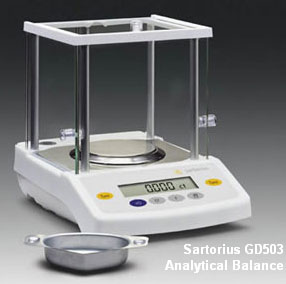 Successful long-range shooters know that careful weighing of powder charges helps them achieve superior long-range accuracy. By maintaining powder charges within very narrow weight tolerances, hand-loaders can produce ammo with more consistent muzzle velocities from shot to shot. Low Extreme Spread (ES) and Standard Deviation (SD) numbers translate directly to reduced vertical dispersion at very long ranges (although velocity is not the only contributing factor to vertical spread). In pursuit of load weight uniformity, many of our top long-range aces have invested in the latest, high-tech magnetic force restoration (MFR) digital scales (such as the Sartorius GD503). These laboratory-grade MFR scales are extremely stable (with minimal drift) and they can reliably measure to .005 grain, that is five thousandths of a grain. That is less than the weight of one kernel of typical extruded powder. For example, with Varget, there are three to four kernels in one-tenth of one grain of Varget. That means each kernel weighs .025 to .035 grains.
 For a reloader looking to achieve “perfect” load weight uniformity, powder kernel uniforming offers the ultimate control over powder weight. The method we devised to uniform individual kernels consists of kernel core-drilling. The propellant we chose for this kernel-uniforming test was a new prototype (not yet commercially available) EuroChemie RL “X” propellant. This was chosen because it offered relatively large, can-shaped kernels that could be drilled relatively easily.
 Core-Drilling Kernels with Micro Drill-Bits
 Proof That It Works
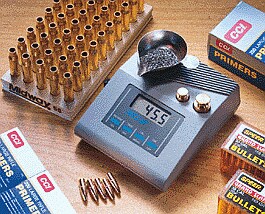 Here’s a tip that can help you score higher at matches and get more predictable results when weighing loads with an electronic scale. Kelly Bachand, a top prone shooter and electrical engineering major at the Univ. of Washington, tells us that all digital scales can drift. Therefore Kelly recommends re-calibrating electronic scales often. In addition — and this is key — Kelly recommends that you shoot the ammo in the exact order in which it was loaded. Arrange your loaded ammo in a box in the order of loading and shoot it first-loaded to last-loaded. (Or, if you prefer, shoot it last-loaded to first-loaded.) The important thing is to maintain the order and not mix everything up. That way, if your scale drifts, the effect of drift on charge weight will be incremental from one loaded round to the next, so point of impact change should be negligible. Conversely, if you shoot your last-loaded round right after your first-loaded round, the effect of scale drift is at its maximum, so powder charge varience is maximized. And that can produce a different point of impact (POI) on the target.


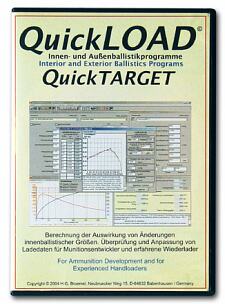 At SHOT Show, we had the chance to meet with German software engineer Hartmut Broemel, creator of QuickLOAD software. This software program, while not a substitute for conventional load manuals, allows shooters to evaluate a wide range of powders and bullets, comparing potential loads on the basis of predicted pressures, velocities, load density and projectile in-barrel time.

 Hodgdon® Powder Co. will release its 9th Annual Manual early next year. The 2012 Hodgdon Annual Manual features 100+ pages of rifle and pistol data with over 5,000 load recipes. The load data covers 30 Hodgdon, 19 IMR® and 10 Winchester® brand powders. New content this year includes: 300 AAC Blackout load data, and lead-free bullet recipes for 21 rifle cartridges. In addition, the new 2012 Manual spotlights Hodgdon’s new CFE™223 propellant. Tests of this new powder show that it can deter copper fouling in many cartridge types (“CFE” stand for “Copper Fouling Eraser”). The 2012 manual provides plenty of reloading recipes for the new CFE™223 — 147 loads for 27 cartridges.


 Powder Valley 4th of July Sale


