|
|
February 8th, 2019
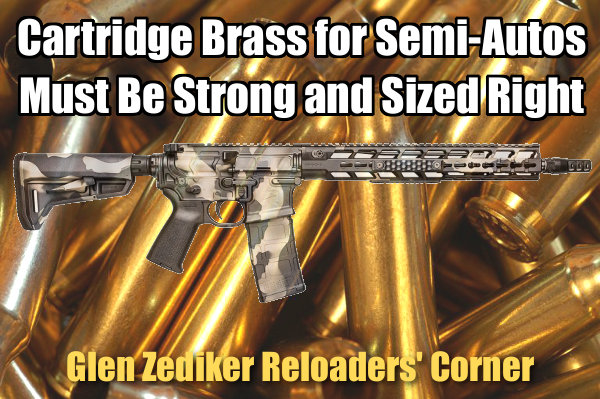
Here are highlights from an article Glen Zediker wrote for the Midsouth Blog. In this article Glen focuses on cartridge brass for semi-auto rifles, AR-platform guns in particular. Glen notes that semi-autos are tougher on brass than bolt-action rifles, so you need strong, durable brass, that has been full-length sized. And you need to be careful about neck tension, and primers. The article starts with Glen’s recommendations for tough, hard brass, and then includes the points outlined below.
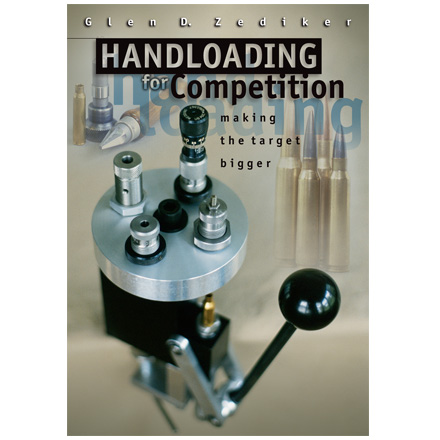
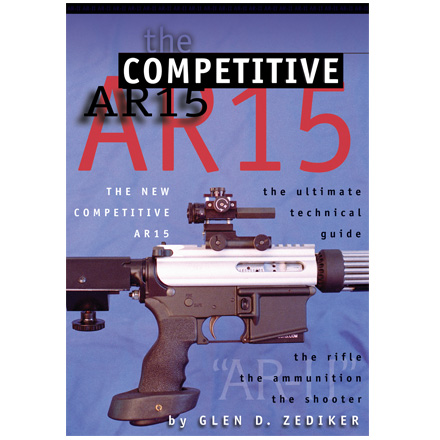
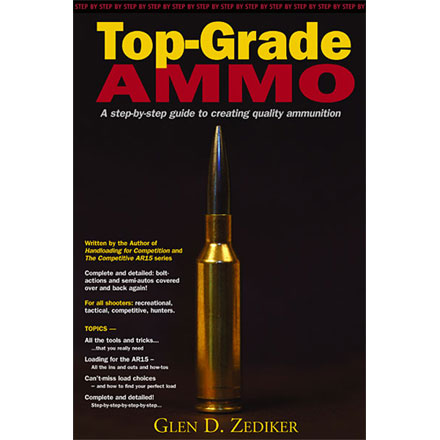
Glen is the author of many excellent books on reloading. This article is adapted from Glen’s books, Handloading For Competition and Top-Grade Ammo, available at Midsouth HERE. For more information about other books by Glen, visit ZedikerPublishing.com.
ONE: Full Length-Size Cases with Adequate Shoulder Set-Back
This is a huge source of debate… amongst my readers, but, since now I’m strictly speaking of semi-auto needs I doubt there will be much dissent: full-length resize all cases! Most cases from most semi-autos will emerge with a pretty well-blown case shoulder [taming down an excessively functioning gas system can reduce this]. Make double-sure you’re sizing the cases down to at least 0.003 clearance. If you don’t there are safety and function problems ahead.
TWO: USE Sufficient Neck Tension
The case neck [must be] reduced an adequate amount to retain the bullet. There should be a minimum net difference of 0.003 inches (three-thousandths) between sized outside case neck diameter and loaded round outside case neck diameter. [Editor — that means at least three thou of “grip”.] Reason: don’t take a chance of inadvertent bullet movement during the recoil and feeding cycles. That movement can be back or forward! It’s easily possible for a bullet to jump ahead when the inertia from the bolt carrier assembly chambers the next round.

THREE: Use Tough Primers
Choose a tough primer! There’s a floating firing pin on an AR15 (M1A also) that is supposed to be held in check but that system doesn’t always work! If you load and extract a round and see a little dimple in the primer, that’s from the firing pin tapping off of it (again, created by inertia of bolt closing). A combination of a high primer and a sensitive primer cup assembly can create a “slam-fire”. Brands? CCI has some mil-spec primers that work well, and I’ve had great success with Remington 7-1/2. Some of the well-respected “match” primers are a little thin. The CCI and Remington also hold up well to the (sometimes) greater firing forces working on the primer (again, from the quick unlocking).
Here’s what I use from Midsouth.
FOUR: Be Sure to Seat Primers Below Flush
And, finally, make double-sure that each and every primer is seated to below flush with the case head! That’s true for any firearm (because it also means that the primer is fully seated) but imperative for safety in a semi-auto. This is especially an issue for those who use a progressive-type loading press.
October 6th, 2018

Western Powders (which sells Accurate, Ramshot, and Norma powders) has published an article on case inspection and preparation. There are many tips in this article that can be useful to precision hand-loaders. For example, every time you open a new box of cartridge brass (particularly from domestic makers), you should inspect each case for flaws.
TIP ONE: Visual Inspection — Finding Flaws
Cases are mass-produced items and malformed ones are relatively common. Inspect each case carefully looking for obvious defects. A bench-mounted magnifying glass with light is a real help for the over-40 crowd. The main defects will be cracks in the neck or case body, crushed shoulders or deep creases in the neck. Next check the primer pocket. It is also fairly common to find flash holes that are damaged or, more rarely, not concentric to the primer pocket.

Imperfections like small dings in the case body, or necks that are not completely symmetrical do not have to be eliminated at this step. Damage of this sort is usually from loose packaging and usually has not seriously damaged the brass. [Running an expander mandrel in the neck] and fire-forming will iron out these largely cosmetic issues.
The Western Powder article also talks about primer pocket uniforming. We do NOT normally uniform the pockets for Lapua or RWS brass from the start. However, pocket uniforming can be beneficial with some other brands of brass, including Lake City, Remington, and Winchester. If you shoot milsurp brass, set time aside for pocket uniforming.
TIP TWO: Primer Pocket Uniforming
 Like flash holes, primer pockets are mass-produced and prone to small dimensional changes. A uniforming tool is used to make the depth of each primer pocket consistent. In turn this allows similar firing pin strike depths on the primer which creates more consistent ignition characteristics. Like flash holes, primer pockets are mass-produced and prone to small dimensional changes. A uniforming tool is used to make the depth of each primer pocket consistent. In turn this allows similar firing pin strike depths on the primer which creates more consistent ignition characteristics.
A good uniforming tool should have a shoulder, or another positive stop, that sets the cutter’s depth. Its use is pretty straightforward. The cutter is inserted into the pocket and turned clockwise several times until the stop in flush with the case head and no more brass is removed from the juncture of the pocket’s base and sidewall. This a job best done by hand. You will feel when the cutting is finished by a change in how smoothly the cutter turns in the pocket. Very little material is actually removed; usually just enough to square the radius at the bottom of the pocket.

October 5th, 2018

We are often asked “Can I get more velocity by switching primer types?” The answer is “maybe”. The important thing to know is that changing primer types can alter your load’s performance in many ways — velocity average, velocity variance (ES/SD), accuracy, and pressure. Because there are so many variables involved you can’t really predict whether one primer type is going to be better or worse than another. This will depend on your cartridge, your powder, your barrel, and even the mechanics of your firing pin system.
Interestingly, however, a shooter on another forum did a test with his .308 Win semi-auto. Using Hodgdon Varget powder and Sierra 155gr Palma MatchKing (item 2156) bullets, he found that Wolf Large Rifle primers gave slightly higher velocities than did CCI-BR2s. Interestingly, the amount of extra speed (provided by the Wolfs) increased as charge weight went up, though the middle value had the largest speed variance. The shooter observed: “The Wolf primers seemed to be obviously hotter and they had about the same or possibly better ES average.” See table:
| Varget .308 load |
45.5 grains |
46.0 grains |
46.5 grains |
| CCI BR2 Primers |
2751 fps |
2761 fps |
2783 fps |
| Wolf LR Primers |
2757 fps |
2780 fps |
2798 fps |
| Speed Delta |
6 fps |
19 fps |
15 fps |
You can’t extrapolate too much from the table above. This describes just one gun, one powder, and one bullet. Your Mileage May Vary (YMMV) as they say. However, this illustration does show that by substituting one component you may see significant changes. Provided it can be repeated in multiple chrono runs, an increase of 19 fps (with the 46.0 grain powder load) is meaningful. An extra 20 fps or so may yield a more optimal accuracy node or “sweet spot” that produces better groups. (Though faster is certainly NOT always better for accuracy — you have to test to find out.)
WARNING: When switching primers, you should exercise caution. More speed may be attractive, but you have to consider that the “speedier” primer choice may also produce more pressure. Therefore, you must carefully monitor pressure signs whenever changing ANY component in a load. Glen Zediker recommends decreasing your load ONE FULL GRAIN when changing to a different primer type, one that you haven’t used before.
December 26th, 2017

SFC Lance Dement as featured in CMP’s First Shot Online.
The U.S. Army Marksmanship Unit (USAMU) has published a great series of reloading “how-to” articles on its Facebook Page. This post covers key factors to consider when loading ammunition for Match Rifles and Service Rifles, with a particular focus on self-loading “gas guns”. Visit the USAMU Facebook Page each Wednesday for other, helpful “Handloading Hump-Day” tips.

We offer some “cardinal rules” to help new gas-gun handloaders with safety and efficiency. These address both Match Rifle and Service Rifle versions of the AR15, M1 Garand, M1A, and M110. However, they can also improve safe reloading for many other auto-loaders such as M1 Carbines, FALs, SIGs, etc. The author distilled these principles many years ago to help focus on the essential aspects of these rifles.
RULE ONE: Service Rifles Are Not Benchrest Rifles
Gas-guns require a relatively loose fit between ammunition and chamber (vs. bolt actions) for safe, smooth operation. Many techniques, such as neck sizing and keeping cartridge headspace quite tight, are popular in the extreme bolt gun accuracy realm. However, they are of little value with Service Rifles, and some could even be hazardous. Before adopting a specialized technique, seriously consider whether it is appropriate and beneficial in a gas-gun.
RULE TWO: Never Compromise Safety to Obtain Accuracy
Example: If choosing a brand of great, but ultra-sensitive match primers offers possibly better accuracy at the risk of slam-fires in your design of rifle, don’t do it! You are issued exactly two eyes and ten fingers (best-case scenario). Risking them trying to squeeze 0.25 MOA better accuracy out of an M1A, etc. simply isn’t worth it.
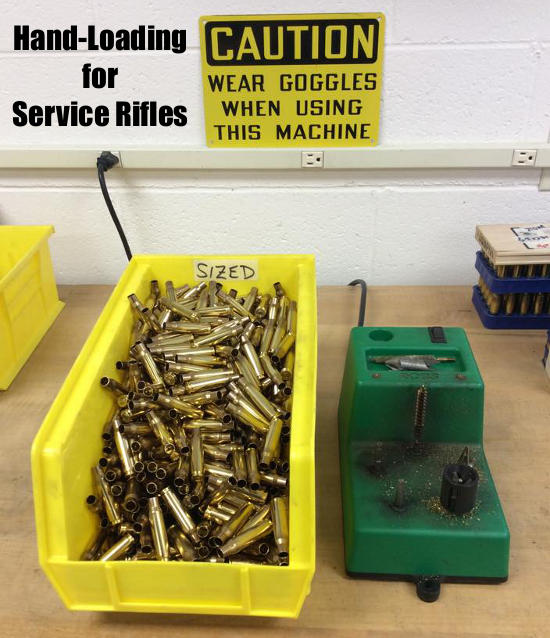
RULE THREE: Tailor the Precision to Your Individual Skill and Your Rifle’s Potential
This has been addressed here before, but bears repeating for newcomers. If you are struggling to break out of the Marksman Class, or using a CMP M1 “As-Issued,” then laboriously turning the necks of your 600-yard brass is a waste of time. Your scores will improve much faster by practicing or dry-firing. On the other hand, if the reigning champions anxiously check your scores each time you fire an event, a little neck-turning might not be so far-fetched.
Verifying Load Improvements — Accuracy hand-loading involves a wide variety of techniques, ranging from basic to rather precise. Carefully select those which offer a good return on investment for your time and labor. In doubt? Do a classic pilot study. Prepare ammo for at least three or four ten-shot groups with your new technique, vs. the same with your standard ammo. Then, pick a calm day and test the ammo as carefully as possible at its full distance (e.g. 200, 300, or 600 yards) to verify a significant improvement. A little testing can save much labor!
RULE FOUR: Be Your Own Efficiency Expert
Serious Service Rifle shooters generally think of ammunition in terms of thousands of rounds, not “boxes”, or even “hundreds”. Analyze, and WRITE DOWN each step in your reloading process. Count the number of times each case is handled. Then, see if any operations can be dropped or changed without reducing safety or accuracy. Eliminating just two operations saves 2000 steps per 1000 rounds loaded. Conversely, carefully consider any measurable benefits before adding a step to your routine.
RULE FIVE: In Searching for Greater Accuracy with Efficiency, Look for System Changes
For example, instead of marking your 300-yard rounds individually to differentiate them from your 200-yard ammo, would a simple change in primers work? If accuracy is maintained, using brass-colored primers for 200 and silver for 300 provides an indelible indicator and eliminates a step! Similarly, rather than spending hours selecting GI surplus brass for weight and neck uniformity, consider splurging on some known, high-quality imported match brass for your 600-yard loads. Results should be excellent, time is saved, and given limited shooting at 600 yards, brass life should be long.
RULE SIX: Check All Your Primers Before Packaging Your Loaded Ammo
This seems simple and even intuitive. However, many slam-fires (which were much more common when M1s and M1As were the standard) are due, at least in part, to “high” primers. Primers should be seated below flush with the case head. The USAMU has addressed this at length in a previous column, but each round should be checked for properly-seated primers before they are packaged for use.

December 24th, 2017

Here’a useful article by Sierra Bullets Media Relations Manager Carroll Pilant. This story, which originally appeared in the Sierra Blog, covers some of the more common ammo problems that afflict hand-loaders. Some of those issues are: excessive OAL, high primers, and improperly sized cases. Here Mr. Pilant explains how to avoid these common problems that lead to “headaches at the range.
I had some gentlemen at my house last fall getting rifle zeros for an upcoming elk hunt. One was using one of the .300 short mags and every 3rd or 4th round would not chamber. Examination of the case showed a bulge right at the body/shoulder junction. These were new cases he had loaded for this trip. The seating die had been screwed down until it just touched the shoulder and then backed up just slightly. Some of the cases were apparently slightly longer from the base to the datum line and the shoulder was hitting inside the seating die and putting the bulge on the shoulder. I got to thinking about all the gun malfunctions that I see each week at matches and the biggest percentage stem from improper handloading techniques.
One: Utilize a Chamber Gage
Since I shoot a lot of 3-gun matches, I see a lot of AR problems which result in the shooter banging the butt stock on the ground or nearest solid object while pulling on the charging handle at the same time. I like my rifles too well to treat them that way (I cringe every time I see someone doing that). When I ask them if they ran the ammo through a chamber gage, I usually get the answer, “No, but I need to get one” or “I didn’t have time to do it” or other excuses. The few minutes it takes to check your ammo can mean the difference between a nightmare and a smooth running firearm.
A Chamber Gauge Quickly Reveals Long or Short Cases

Size Your Cases Properly
Another problem is caused sizing the case itself. If you will lube the inside of the neck, the expander ball will come out a lot easier. If you hear a squeak as the expander ball comes out of a case neck, that expander ball is trying to pull the case neck/shoulder up (sometimes several thousandths). That is enough that if you don’t put a bulge on the shoulder when seating the bullet, like we talked about above, it can still jam into the chamber like a big cork. If the rifle is set up correctly, the gun will not go into battery and won’t fire but the round is jammed into the chamber where it won’t extract and they are back to banging it on the ground again (with a loaded round stuck in the chamber). A chamber gage would have caught this also.
 Oversizing cases also causes problems because the firing pin doesn’t have the length to reach the primer solid enough to ignite it 100% of the time. When you have one that is oversized, you usually have a bunch, since you usually do several cases at a time on that die setting. If the die isn’t readjusted, the problem will continue on the next batch of cases also. They will either not fire at all or you will have a lot of misfires. In a bolt action, a lot of time the extractor will hold the case against the face of the breech enough that it will fire. The case gets driven forward and the thinner part of the brass expands, holding to the chamber wall and the thicker part of the case doesn’t expand as much and stretches back to the bolt face. If it doesn’t separate that time, it will the next time. When it does separate, it leaves the front portion of the case in the chamber and pulls the case head off. Then when it tries to chamber the next round, you have a nasty jam. Quite often range brass is the culprit of this because you never know how many times it has been fired/sized and in what firearm.’Back to beating it on the ground again till you figure out that you have to get the forward part of the case out. Oversizing cases also causes problems because the firing pin doesn’t have the length to reach the primer solid enough to ignite it 100% of the time. When you have one that is oversized, you usually have a bunch, since you usually do several cases at a time on that die setting. If the die isn’t readjusted, the problem will continue on the next batch of cases also. They will either not fire at all or you will have a lot of misfires. In a bolt action, a lot of time the extractor will hold the case against the face of the breech enough that it will fire. The case gets driven forward and the thinner part of the brass expands, holding to the chamber wall and the thicker part of the case doesn’t expand as much and stretches back to the bolt face. If it doesn’t separate that time, it will the next time. When it does separate, it leaves the front portion of the case in the chamber and pulls the case head off. Then when it tries to chamber the next round, you have a nasty jam. Quite often range brass is the culprit of this because you never know how many times it has been fired/sized and in what firearm.’Back to beating it on the ground again till you figure out that you have to get the forward part of the case out.
Just a quick tip — To extract the partial case, an oversized brush on a cleaning rod [inserted] and then pulled backward will often remove the case. The bristles when pushed forward and then pulled back act like barbs inside the case. If you have a bunch of oversized case that have been fired, I would dispose of them to keep from having future problems. There are a few tricks you can use to salvage them if they haven’t been fired though. Once again, a case gage would have helped.
Two: Double Check Your Primers

Another thing I see fairly often is a high primer, backwards primer, or no primer at all. The high primers are bad because you can have either a slam fire or a misfire from the firing pin seating the primer but using up its energy doing so. So, as a precaution to make sure my rifle ammo will work 100% of the time, I check it in a case gage, then put it in an ammo box with the primer up and when the box is full, I run my finger across all the primers to make sure they are all seated to the correct depth and you can visually check to make sure none are in backwards or missing.

Three: Check Your Overall Cartridge Length
Trying to load the ammo as long as possible can cause problems also. Be sure to leave yourself enough clearance between the tip of the bullet and the front of the magazine where the rounds will feed up 100%. Several times over the years, I have heard of hunters getting their rifle ready for a hunt. When they would go to the range to sight in, they loaded each round single shot without putting any ammo in the magazine. On getting to elk or deer camp, they find out the ammo is to long to fit in the magazine. At least they have a single shot, it could be worse. I have had hunters that their buddies loaded the ammo for them and then met them in hunting camp only to find out the ammo wouldn’t chamber from either the bullet seated to long or the case sized improperly, then they just have a club.
Four: Confirm All Cases Contain Powder
No powder in the case doesn’t seem to happen as much in rifle cartridges as in handgun cartridges. This is probably due to more handgun ammo being loaded on progressive presses and usually in larger quantities. There are probably more rifle cartridges that don’t have powder in them than you realize though. Since the pistol case is so much smaller internal capacity, when you try to fire it without powder, it usually dislodges the bullet just enough to stick in the barrel. On a rifle, you have more internal capacity and usually a better grip on the bullet, since it is smaller diameter and longer bearing surface. Like on a .223, often a case without powder won’t dislodge the bullet out of the case and just gets ejected from the rifle, thinking it was a bad primer or some little quirk. For rifle cases loaded on a single stage press, I put them in a reloading block and always dump my powder in a certain order. Then I do a visual inspection and any case that the powder doesn’t look the same level as the rest, I pull it and the one I charged before and the one I charged after it. I inspect the one case to see if there is anything visual inside. Then I recharge all 3 cases. That way if a case had powder hang up and dump in the next case, you have corrected the problem.
On progressive presses, I try to use a powder that fills the case up to about the base of the bullet. That way you can usually see the powder as the shell rotates and if you might have dumped a partial or double charge, you will notice as you start to seat the bullet if not before. On a progressive, if I don’t load a cartridge in one smooth stroke (say a bullet tipped over sideways and I raised the ram slightly to reset it) Some presses actually back the charge back adding more powder if it has already dumped some so you have a full charge plus a partial charge. When I don’t complete the procedure with one stroke, I pull the case that just had powder dumped into it and check the powder charge or just dump the powder back into the measure and run the case thru later.
I could go on and on but hopefully this will help some of you that are having these problems cure them. A case gage really can do wonders. Stay tuned for Easy Easy Ways to Save Yourself Headaches at the Range Part 2!
December 12th, 2016

Are you feelin’ lucky? Well here’s your chance to win. Over the next twelve days (through December 23, 2016), Powder Valley is giving away a total of $20,000 worth of products from big name suppliers. That’s an average of $1,667 worth of product prizes every day. This is top-of-the-line stuff, including Powder from Accurate, IMR, Ramshot, and Vihtavuori, Bullets from Berger, Berry’s, Hornady, Lapua, and Sierra, Brass from Lapua, Hornady and Nosler, Ammo from Hornady, Nosler, Lapua, and Silver State Armory. Each day there will be a new set of prizes. Today’s prize is a Hornady reloading press.
It’s easy to qualify to win one of the Daily Giveaway prize packages. Simply visit Powder Valley’s Facebook Page, and make a comment on the featured Daily Giveaway Post. You don’t have to fill out any forms, but you must have a Facebook account so you can comment. Each day the folks at Powder Valley will select winners from among the visitors who commented. Today (Dec. 12th) there will be one winner of the Hornady Press. In days ahead there can be multiple daily winners — as many as 20 to 30 per day. NOTE: You can enter multiple times by commenting on multiple days, but sorry, if you win, you are no longer eligible.
Powder Valley Daily Giveaway
The Powder Valley 12 Days of Christmas promotion starts today, December 12th, 2016. To enter, you must visit the Powder Valley Facebook Page. Once there, scroll down to find the Giveaway of the Day. Today’s Giveaway is a Hornady Press. Look for the post shown below. You need to comment on that post to be entered. Winners will be selected by lottery from those who comment. Each successive day through December 23rd, there will be another product giveaway post.

To be entered in this Powder Valley Contest, you need to go to the Powder Valley Facebook Page and post a Facebook Comment for the Daily Prize story. The give-away for today, December 12th, is a Hornady Lock-N-Load AP Press. NOTE: You need to post your comment on Powder Valley’s Facebook Site, NOT HERE. And you need to comment each day to be entered in that particular day’s contest. To have repeat chances to win you need to comment on multiple days. Got it?
March 13th, 2016
Here’s a great search service that can help you locate hard-to-find ammunition and reloading components — while saving money in the process. Ammoseek.com monitors more than a dozen online vendors — checking current pricing and available inventory, for pistol, rifle, and shotgun ammunition. Need .45 acp ammo for your 1911? Just select “.45 ACP” from the “Quick Seek” list on the right. Likewise you can find .223 Rem and .308 Win Rifle ammo with one click.

Find .22 LR Ammo Quickly
Looking for hard-to-find .22 LR rimfire ammunition? Well AmmoSeek makes it easy — you don’t even have to enter any search words. Simply click on the highlighted links for AmmoSeek’s 22LR Page.
CLICK HERE for AmmoSeek.com .22 LR Ammo Search Results
Use Ammoseek.com to Find Reloading Components Too
Ammoseek.com also lets you search for reloading components, including powder, primers, brass, and bullets. This is a huge time-saver. You can instantly check a dozen or more vendors to see if a particular type of powder is in stock. Likewise, you can quickly check for primer availability. If you have a big match coming up and are short on primers — this could solve the problem.

Story Tip by Boyd Allen. We welcome reader submissions.
July 6th, 2014
 This holiday weekend, Grafs.com has been offering value-priced combos of powder and primers. AR guys and varmint hunters should like the combination of Hodgdon CFE223 powder and CCI 400 (small rifle) primers (item #July4combo01). This combo gives you six (6) pounds of CFE223 powder plus 5,000 CCI 400 primers for $265.99, plus a single $28.50 hazmat fee. This holiday weekend, Grafs.com has been offering value-priced combos of powder and primers. AR guys and varmint hunters should like the combination of Hodgdon CFE223 powder and CCI 400 (small rifle) primers (item #July4combo01). This combo gives you six (6) pounds of CFE223 powder plus 5,000 CCI 400 primers for $265.99, plus a single $28.50 hazmat fee.
If you prefer Winchester powder, you can get 6 pounds of Winchester 748 powder plus 5000 CCI 400 primers for $269.99 (plus hazmat). Lastly, if you prefer to purchase by the jug, Grafs.com is offering a combo pack (item #July4combo03) with one 8-pound jug of IMR4064 plus 5,000 CCI 400 primers for $299.99 (plus hazmat). Take your pick — these are all pretty good deals.

June 19th, 2014
 Need Primers? Midsouth Shooters Supply (Midsouth) has a large selection of primers in stock right now. Yes Midsouth has the hard-to-find CCI BR-4 primers, as well CCI 450s (small rifle magnum), CCI 200s (large rifle), and CCI 250s (large rifle magnum). Midsouth also has large quantities of Rem 6.5s and Winchester rifle primers. If you need pistol or shotshell primers, Midsouth has plenty of those right now as well. Need Primers? Midsouth Shooters Supply (Midsouth) has a large selection of primers in stock right now. Yes Midsouth has the hard-to-find CCI BR-4 primers, as well CCI 450s (small rifle magnum), CCI 200s (large rifle), and CCI 250s (large rifle magnum). Midsouth also has large quantities of Rem 6.5s and Winchester rifle primers. If you need pistol or shotshell primers, Midsouth has plenty of those right now as well.

Get ‘Em While They’re Hot — These are In-Stock Today at 11:00 am ET
Here is a screenshot of some of the more popular rifle primers that were in-stock today (6/19/2014) at Midsouth. If you need ‘em, don’t hesitate to place your orders. You snooze, you loose.

November 12th, 2013
 Got the “can’t find primer blues”? Well cheer up. Supplies of pistol and rifle primers are starting to arrive at vendors around the country. We checked with six leading shooting supplies vendors, and all had some primers in stock. Many of the harder-to-find varieties, such as CCI BR4s (small rifle benchrest) and CCI 450s (small rifle magnum) are now available again. In the chart below are the primer inventories we found today, November 12, at 11:00 am west coast time. Got the “can’t find primer blues”? Well cheer up. Supplies of pistol and rifle primers are starting to arrive at vendors around the country. We checked with six leading shooting supplies vendors, and all had some primers in stock. Many of the harder-to-find varieties, such as CCI BR4s (small rifle benchrest) and CCI 450s (small rifle magnum) are now available again. In the chart below are the primer inventories we found today, November 12, at 11:00 am west coast time.
Note, inventories are subject to change. In some cases, the primers were “low stock” items, which means they won’t last long. Word to the Wise: If more than one vendor has the primers you need, we suggest you comparison shop. We’ve seen prices vary by as much as $15.00 per thousand for the same item — so you definitely need to compare pricing before you place an order. Happy primer hunting boys and girls!
PRIMER Inventories Shown by Web Vendors on November 12, 2013:

(NOTE: Inventory subject to change. Availability of all these items can change by the hour.)
|