At the request of our readers, we provide select “Deals of the Week”. Every Monday morning we offer our Bargain selections. Here are some of the best deals on firearms, hardware, reloading components, and shooting accessories. Be aware that sale prices are subject to change, and once clearance inventory is sold, it’s gone for good. You snooze you lose.
1. Kelbly.com — 15% Off Discount on ALL Products (Today ONLY)
Looking for a Panda or Atlas action, or a complete match rifle? Here’s a great promotion from our friends at Kelbly’s. Through the end of the day today, December 5, 2016, you can get 15% of ANYthing on the Kelblys.com website. That includes rifles, actions, stocks, barrels, scope rings, muzzle brakes, Berger bullets, accessories and more. To save big, use code 15ALL at checkout. ACT NOW — Don’t delay — this offer expires at 11:59 pm on December 5, 2016!
2. Bullets.com — Bald Eagle Range Bags, $24.95 – $29.95
High-quality Bald Eagle Range Bags are now on sale at Bullets.com. These versatile bags are very well- made and durable. With thickly-padded slab sides and padded internal dividers, these bags hold their shape and don’t collapse like most range bags. We use the larger 20″ bag to transport our spotting scope and MagnetoSpeed chrono. The smaller 15″ bag will hold ammo, rangefinder, Kestrel, shooting glasses and all your miscellaneous gear. We have used these bags for years and endorse them. The Cordura nylon fabric is tough, and the zippers are high-quality. With these sale prices, $24.95 for the 15″ size and $29.95 for the 20″ size, you won’t be disappointed. A variety of colors are offered: Red, Black, Green, Camo, Navy (15″ only), and Pink (15″ only).
The 20″ Range Bag holds a spotting scope, small tripod, plus MagnetoSpeed in long pocket:
3. EuroOptic.com — Tikka T3 Liquidation Sale, Huge Discounts
Looking for a great price on an excellent hunting rifle? Here is the Tikka Deal of the Decade. EuroOptic.com has received nearly 3,500 Tikka T3 rifles, which will be sold at deep discounts as part of an inventory clearance program by Beretta, Tikka’s parent company. The Tikka T3 is a good, stout rifle with a smooth action, crisp trigger, and quality barrel. Accuracy is typically well under 1 MOA (for three shots). T3 barreled actions also are a good “core” for a tactical build. The strong T3 action handles detachable magazines, and fits a variety of third-party stocks.
4. CDNN Sports — 1911-Type .22 LR Target Pistol, $239.99
Everyone should have an accurate .22 LR target pistol. This German-made GSG 1911 22LR pistol shares the look, feel, and ergonomics of J.M. Browning’s classic model 1911 so it’s good for cross-training. We’ve tried this pistol and the trigger is pretty darn good — though don’t expect it be be as nice as a S&W Model 41. But consider that the GSG costs just $239.99. By contrast, MSRP on a new Model 41 is a steep $1369.00. For cross-training and target work the GSG is a very good value.
5. Midsouth — Burris Eliminator LaserScope with $100.00 Rebate
The Burris Eliminator III is an impressive piece of electro-optical technology. The built-in laser rangefinder senses the distance to your target and the scope’s “brain” calculates the required hold-over. The calculated aiming point is then displayed with an illuminated red dot on the vertical cross-hair. Just put the bright red dot on the target and make the shot. We’ve used this scope out to 600 yards on small steel targets and it worked flawlessly. Right now you can get a $100 Factory REBATE plus sale pricing from Midsouth. After rebate, the 3-12x44mm Eliminator III costs $1199.00. NOTE: The last day for purchases qualifying for rebate is December 21, 2016.
6. Natchez Shooters Supply — 325 Rounds .22 LR Ammo, $22.99
This Federal .22 LR ammo is just 7 cents per round — the kind of pricing on bulk rimfire ammo we used to see in the “good old days”. Act quickly, this $22.99 Federal .22 LR Ammo deal won’t last long. Each box contains 325 rounds — enough ammo for many sessions at the range. The bullets are 40 grains, solid lead.
7. Sportsman’s Guide — Frankford Arsenal Case Tumbler Kit
For just $69.99, this Frankford Arsenal Kit provides everything you need to clean brass: Vibratory Tumbler, Rotary Media Separator, Bucket, Corn Cob Media (3 lbs.), and Brass Polish. The Case Tumbler holds up to 600 9mm cases or 350 .223 Rem cases. The separator system is generous, with a 3.5-gallon bucket. NOTE: Sportsman’s Guide Buyers Club members can purchase for $62.99.
8. Amazon — Neiko Digital Calipers, $16.45
Even if you have a good set of calipers, you may want to get one of these Neiko 01407A Digital Calipers. The #1 best-selling digital caliper on Amazon.com, this Neiko tool features a large LCD Screen and measures up to 6.0 inches. With over 2300 customer reviews, this product has earned an overall rating of 4.4 out of 5 stars. It’s hard to go wrong for $17.74, even if you just use these as a spare set for measuring group sizes and case trim lengths.
At the request of our readers, we provide select “Deals of the Week”. Every Monday morning we offer our Bargain selections. Here are some of the best deals on firearms, hardware, reloading components, and shooting accessories. Be aware that sale prices are subject to change, and once clearance inventory is sold, it’s gone for good. You snooze you lose.
1. MidwayUSA — Black Friday Sale Starts Monday, 11/21/2016
Black Friday starts today — at least at MidwayUSA. Starting Monday, November 21st, you’ll find super bargains at MidwayUSA all week. Prices have been slashed on dozens of popular products. Above are six Black Friday bargains that caught our eye — check out the major price cuts on Leupold VX-6 scopes, and save 15% on Sierra bullets. This is just the tip of the iceberg — dozens of other products are on sale. Loaded ammo is deeply discounted and you can even get an NRA Life Membership for just $600.00. You’ll find these and scores of other super-deals on MidwayUSA’s Black Friday Sale Page. These prices are good through 11/28/2016 at 11:59 pm.
2. Natchez — Hodgdon Varget 8-lb Jugs, $186.49
If you’ve been looking for Hodgdon Varget powder in the large eight-pound (8 lb.) jugs, Natchez has this in stock, as of Monday morning, November 21st. If you want this powder, you better jump on this. Supplies are limited. Sorry, no H4350 in the big jugs, but Natchez does have Varget in one-pound containers for $25.99 per pound.
3. Natchez — Special 5 Reloading Press Kit, $199.99
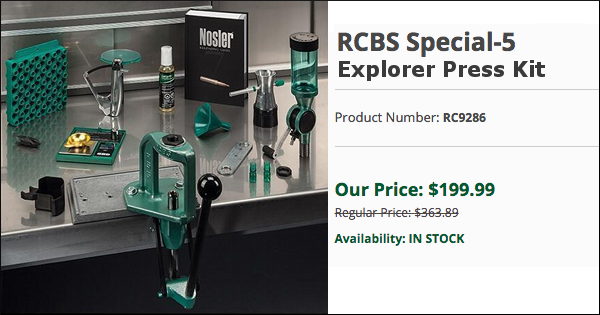
Looking for a great holiday gift for a family member getting started in metallic cartridge reloading? This RCBS Kit has everything a new reloader needs: single-stage press, powder measure, scale, powder trickler, priming tool, cartridge tray, “rocket” chamfer tool, case lube and more. This is an excellent entry-level reloading kit, on sale for just $199.99 at Natchez Shooters Supplies. We like the relatively compact Special 5 press for most reloading duties. Eventually you may want to add an additional, large heavy press, but this will get the job done. For the combined package, with all the tools one needs to hand-load quality ammo — this is a stunningly good deal at $199.99.
4. CDNN Sports — Ruger American .270 Win, $289.99
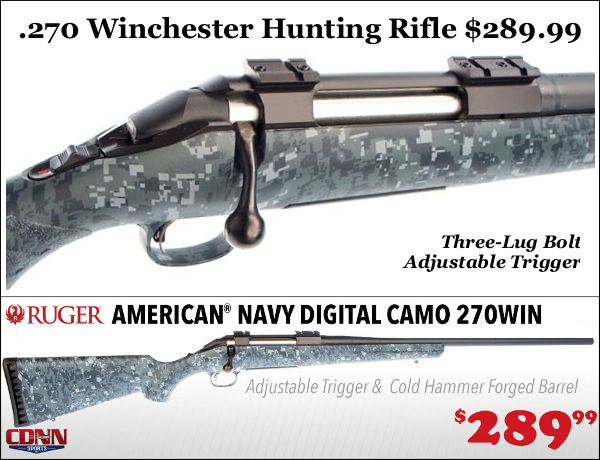
If you’re looking for a good deer-hunting rifle at a super-affordable price, check out this .270 Winchester Ruger American. It comes with a gray-blue digital camo finish that actually suits gray fall days pretty well. The long action sits in a integral bedding block, and features a three-lug bolt with 70° bolt lift. The 22″ hammer-forged barrel has a 1:10″-twist, so it’s capable of shooting the most popular .270-caliber hunting bullets. Ammo is held in a flush-fit rotary magazine. The Ruger American is a good, solid rifle — and this is a steal at $289.99. If you don’t like the finish, buy a $5.00 can of spray paint.
5. Brownells — GET $10 Off $75.00+ Orders plus Free Shipping
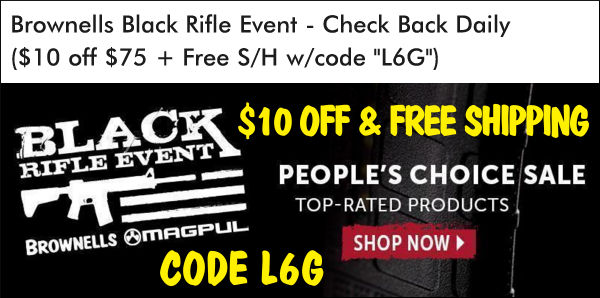
Brownells is the “go-to” source for firearms parts and accessories, and Brownells also offers a full range of reloading and gunsmithing tools. Now, with PROMO CODE L6G, you can save $10 off any order over $75.00, plus get FREE Shipping. That could easily save you twenty bucks or more on your next order. Note, this deal applies to online orders only, and you can only use one promo code per order. To qualify, insert CODE “L6G” during checkout.
6. J&G Sales — Eley Target .22 LR Ammo, $59.90 for 500 Rounds
Yellow Box Eley Target is excellent .22 LR ammunition that is plenty accurate for all but the most demanding rimfire disciplines. This is way more accurate than bulk ammo which might sell for $4.00-$5.00 per box at stores. With this special deal at J&G Sales you can get a 500-round brick (ten 50-rd boxes) for just $59.90. That’s a steal when you consider this ammo sells elsewhere (MidwayUSA) for $7.99 for a 50-rd box. So you can save two bucks a box with this deal. That’s a 25% savings.
7. Amazon — Frankford Quick-N-EZ Case Tumbler, $34.99
Look no further for a great deal on a reliable tumbler. We’ve used this very same machine to tumble both pistol brass and rifle cases. We like the see-through, transparent top and the large capacity — this will hold up to 350 .223 Rem cases. With 1000+ customer reviews on Amazon.com, this Frankford Quick-N-Easy Case Tumbler has earned a 4.5-star rating. If you need a tumbler, you might want to order soon — this is the best price we’ve seen in a while.
8. Midsouth — 17 HMR V-Max Ammo, $10.45 for 50 rounds
Need 17 HMR ammo for your varmint safaris? Then grab this Hornady V-Max ammo while you can at $10.45 for a 50-round box. This is a great price. Other vendors are selling the same Hornady ammo for as much as $15.00 per box. We’ve used this ammo and it was very accurate out of both semi-auto (Savage A17) and bolt-action (CZ 455) 17 HMR rifles.
9. Amazon — Leight MAX NRR33 Earplugs, $7.58 for 50 Pairs.
These Howard Leight NRR33 Max plugs are your Editor’s favorite foam earplugs. Between shooting, motorcycling and mowing lawns, I probably have Max plugs in my ears 2-3 days a week. This is a very good price for a bulk pack of 50 pairs. And if you act soon, you can get free shipping to boot.
Sinclair International has a helpful, three-part video series on Full-Length Sizing. The full-length sizing die performs multiple important functions: it resizes the case body, resizes the neck, and adjusts the headspace relative to the chamber (it can also eject the spent primer if that was not done previously).
While neck-sizing-only can work with moderate loads (for a couple firings), after repeated firings the case can stretch, becoming too tight to chamber easily. If you shoot cases with high-pressure, near-max loads, you will probably benefit from full-length sizing your cases each reloading cycle. When full-length sizing, you will want to move the shoulder back (i.e. “bump” the shoulder) to provide proper clearance in the chamber. A case that has grown too much will exhibit stiff bolt lift after firing and be hard to chamber if it is not FL-sized during the reloading process.
Sinclair recommends bumping cases .001-.002″ (one to two thousandths) for cases used in bolt-action target-shooting rifles, or .003-.005″ (three to five thousandths) for hunting rifles or semi-auto rifles. To move the shoulder back you screw the FL-sizing die downwards in the press once you’ve determined “just touching” on the shoulder. You don’t have to screw the die down very far! With a normal 14-pitch die, 1/8th turn (45° rotation) yields approximately 0.009″ of downward movement. So it doesn’t take much to add a few thousandths of bump.
Case Sizing Part One — Why We Full-Length Resize
Case Sizing Part Two — How to Set Up Your Sizing Die
Case Sizing Part Three — How to Use a Bump Gauge
NOTE: These FLASH videos may not display on some mobile devices.
Widener’s Reloading & Shooting Supply recently published a helpful introduction to reloading powders. Widener’s online Guide to Smokeless Powders shows the various types of powders, and explains how the differences in powder kernel/flake size and shape, and burn rate affect performance. We recommend you visit Widener’s website and read the Powder Guide in full.
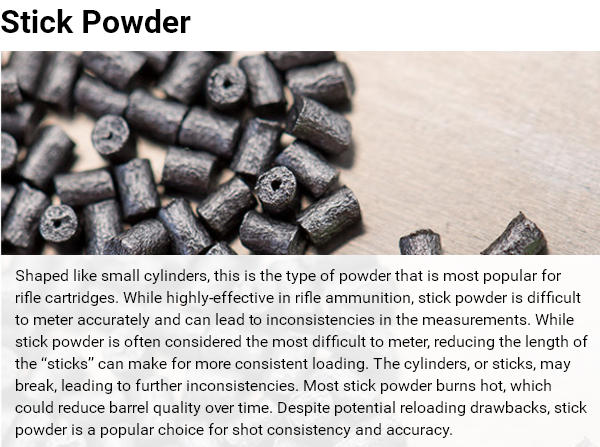
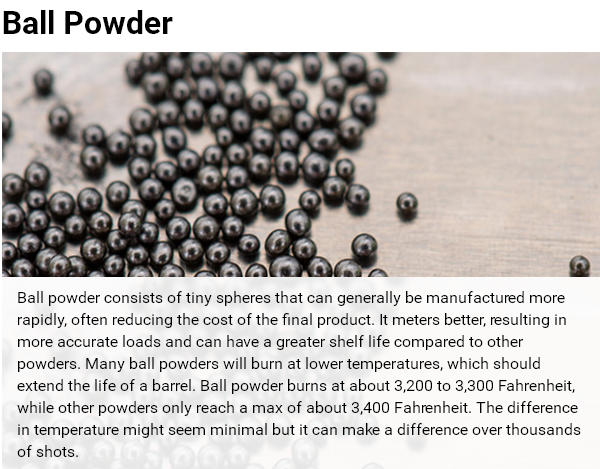
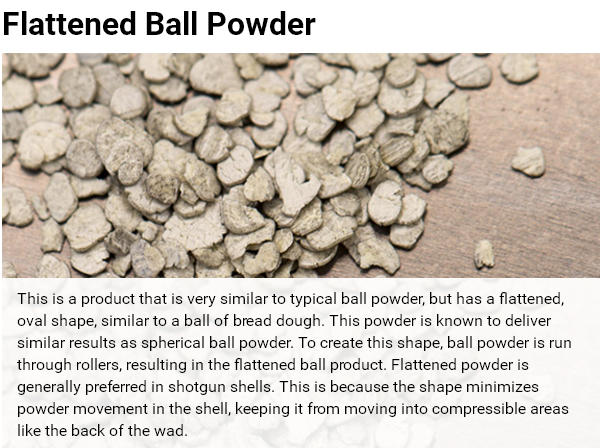
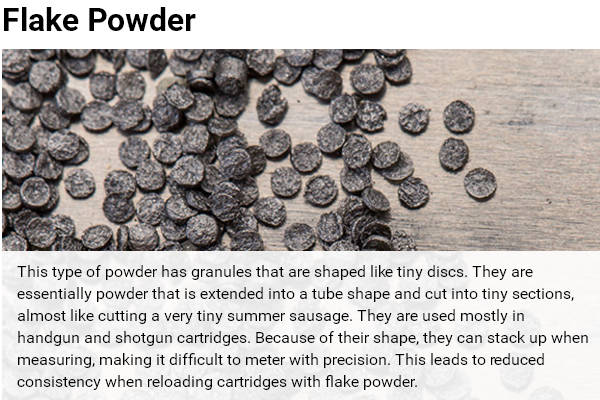
Take a close look at these illustrations which show the key differences between the four main powder types: extruded (stick) powder, ball (spherical) powder, flattened ball powder, and flake powder.
Burn Rate Basics
Widener’s Guide to Smokeless Powders also has a useful discussion of Burn Rate (a confusing topic for many hand-loaders). Wideners explains: “While a gun powder explosion in the cartridge seems instantaneous, if you slow it down you will actually find that each powder has a different ‘burn rate’, or speed at which it ignites.” This video shows powders with two very different burn rates. Watch closely.
Different burn rates suit different cartridge types notes Widener’s: “In general a fast-burning powder is used for light bullets and low-speed pistols and shotguns. Medium-rate powders are used for magnum pistols, while high-velocity, large bore rifle cartridges will need slow powders[.]
It should be noted that burn rate does not have a standardized unit of measurement. In fact, burn rate is really only discussed in comparison to other powders; there is no universal yardstick. Specifics will change by cartridge and bullet types[.]”
At the request of our readers, we provide select “Deals of the Week”. Every Monday morning we offer our Bargain selections. Here are some of the best deals on firearms, hardware, reloading components, and shooting accessories. Be aware that sale prices are subject to change, and once clearance inventory is sold, it’s gone for good. You snooze you lose.
1. Amazon — Howard Leight Electronic Muffs, $26.99
Act quickly — this is a DEAL of the DAY on Amazon! We’ve never seen a lower price on these popular electronic muffs, which are Amazon’s #1 seller in the category. The price goes back up tomorrow! Every shooter should own a pair of electronic muffs, even if you prefer shooting with earplugs and/or standard muffs. Electronic muffs are great when you are doing spotting duties or are working near the firing line. They allow you to hear ordinary conversations while still providing vital hearing protection. Right now Amazon.com has the Howard Leight Impact Sport Electronic Muffs on sale for just $26.99 (Deal of the Day). See All Price Options. NOTE: For regular, sustained shooting we recommend muffs and/or earplugs with a higher NRR rating.
2. CDNN Sports — Ruger American Ranch Rifle (Tan), $349.99
Here’s a nice little varmint rifle from Ruger with good features and performance at a killer price: $349.99. You could pay that much just for a barrel. This .223 Rem rifle features a 16.5″ hammer-forged barrel barrel threaded 1/2″-28 at the muzzle for brake or suppressor. The action, which features a 70° three-lug bolt, and Picatinny-style scope rail, sits in an aluminum bedding block. The crisp trigger adjusts down to 3 pounds. With a weight (before optics) of 6.1 pounds, this is a handy carry-around varminter. We like this rifle. For $349.99 it’s a steal.
3. Amazon — Caldwell Long Range Target Cam System, $329.49
Forum members have purchased this Caldwell Target Cam System and they’ve found that it works reliably, providing a clear signal to any WiFi-enabled mobile device (smartphone, iPad, Laptop). One member specifically tested the unit at 1000 yards and it functioned fine. NOTE: This system does NOT have a zoom camera lens, so you need to position the camera within 10 yards or so of the target. But if you place it to the side a bit, this shouldn’t be a problem. This system comes with a nice, fitted carrying case that holds camera, transceivers, antennas, and stands. You get a very capable system for under $330.00 (Amazon price includes free shipping for Prime members). You can also get this system from Midsouth for $357.02 (shipping extra).
Got patches? Here’s a great deal on 100% cotton flannel patches. There are many sizes available, starting at $8.99 for 800 one-inch “17 Cal” patches. For 6mm rifles, we actually like the 1.25″ round “22/223″ sized patches priced at $11.99 for 800. Choose either round patches or square patches in most sizes. We generally like round patches for use with spire-tip jags, but some shooters prefer to wrap their patches around a jag or brush and square patches work better for wrapping. The large, 2″-square .30 Cal patches cost $17.99 for 800.
5. Amazon — Frankford Quick-N-EZ Case Tumbler, $34.99
Look no further for a great deal on a reliable tumbler. We’ve used this very same machine to tumble both pistol brass and rifle cases. We like the see-through, transparent top and the large capacity — this will hold up to 350 .223 Rem cases. With 1000+ customer reviews on Amazon.com, this Frankford Quick-N-Easy Case Tumbler has earned a 4.5-star rating. If you need a tumbler, you might want to order soon — this is the best price we’ve seen in a while.
6. CDNN Sports — 45 ACP Ruger American Pistol, $399.99
At $399.99, this modern .45 ACP Ruger American Pistol costs hundreds less than premium polymer handguns from Europe. Compared to a Glock 21, it has better sights, a better trigger, and better ergonomics. Compared to an HK USP it has a lower bore axis and is way less expensive. FYI the Ruger’s low bore axis really does reduce felt recoil. The Ruger American pistol has interchangable grip panels so you can adjust the grip to your hand size. Controls are ambidextrous. Bottom line, this is a very good gun that gives up little to Glock, HK, and Walther. Buy American and save hundreds.
The RCBS Rock Chucker remains a classic — a big, strong, versatile press that can handle most reloading chores with ease. And now you can get a genuine Rock Chucker Supreme for $126.99 — a very good deal. The Rock Chucker offers plenty of leverage for case-sizing and the “O” is tall enough for long cartridges. The Rock Chucker has a very strong base and should last a lifetime. We’re not fans of the Rock Chucker’s priming system but most serious reloaders use a separate priming tool.
8. RCBS — Buy Green, Get Green Rebate
RCBS is running a very attractive Rebate Program currently. If you spend $300.00 on qualifying products you get a $75.00 rebate. Spend $50 and get a $10.00 Rebate. This program is limited to one (1) rebate redemption per calendar year, with a maximum of $75.00. CLICK HERE for more information. NOTE: To qualify, you must supply completed RCBS rebate coupon, original UPC barcodes from package, and original cash register receipt and/or dated, itemized sales invoice.
Need quality .22 LR rimfire ammo at an affordable price? Consider Norma. Most folks think Norma only produces centerfire ammo and cartridge brass. As a result, people haven’t been looking for Norma rimfire ammo. Their loss is your gain. Accurate, reliable Norma .22 LR ammunition is in-stock right now at leading online vendors. This is good quality ammo, made in Europe. Bullets.com has Norma Tac-22 ammo in stock at $5.25 per 50-rd box (SKU: BL7819). In addition, Bullets.com offers Norma Match-22 ammunition at $7.50 per 50-rd box (SKU: BL11887).
When we first ran this story a while back, it generated great interest among readers. By popular request, we’re reprinting this story, in case you missed it the first time around. — Editor
Precision shooters favor premium brass from Lapua, Norma, or RWS. (Lake City also makes quality brass in military calibers.) Premium brass delivers better accuracy, more consistent velocities, and longer life. Shooters understand the importance of good brass, but many of us have no idea how cartridge cases are actually made. Here’s how it’s done.
The process starts with a brass disk stamped from strips of metal. Then, through a series of stages, the brass is extruded or drawn into a cylindrical shape. In the extrusion process the brass is squeezed through a die under tremendous pressure. This is repeated two or three times typically. In the more traditional “draw” process, the case is progressively stretched longer, in 3 to 5 stages, using a series of high-pressure rams forcing the brass into a form die. While extrusion may be more common today, RWS, which makes some of the most uniform brass in the world, still uses the draw process: “It starts with cup drawing after the bands have been punched out. RWS cases are drawn in three ‘stages’ and after each draw they are annealed, pickled, rinsed and subjected to further quality improvement measures. This achieves specific hardening of the brass cases and increases their resistance to extraordinary stresses.” FYI, Lapua also uses a traditional draw process to manufacture most of its cartridge brass (although Lapua employs some proprietary steps that are different from RWS’s methods).
After the cases are extruded or drawn to max length, the cases are trimmed and the neck/shoulder are formed. Then the extractor groove (on rimless cases) is formed or machined, and the primer pocket is created in the base. One way to form the primer pocket is to use a hardened steel plug called a “bunter”. In the photos below you see the stages for forming a 20mm cannon case (courtesy OldAmmo.com), along with bunters used for Lake City rifle brass. This illustrates the draw process (as opposed to extrusion). The process of draw-forming rifle brass is that same as for this 20mm shell, just on a smaller scale.
River Valley Ordnance explains: “When a case is being made, it is drawn to its final draw length, with the diameter being slightly smaller than needed. At this point in its life, the head of the draw is slightly rounded, and there are no provisions for a primer. So the final drawn cases are trimmed to length, then run into the head bunter. A punch, ground to the intended contours for the inside of the case, pushes the draw into a cylindrical die and holds it in place while another punch rams into the case from the other end, mashing the bottom flat. That secondary ram holds the headstamp bunter punch.
The headstamp bunter punch has a protrusion on the end to make the primer pocket, and has raised lettering around the face to form the headstamp writing. This is, of course, all a mirror image of the finished case head. Small cases, such as 5.56×45, can be headed with a single strike. Larger cases, like 7.62×51 and 50 BMG, need to be struck once to form a dent for the primer pocket, then a second strike to finish the pocket, flatten the head, and imprint the writing. This second strike works the brass to harden it so it will support the pressure of firing.”
Thanks to Guy Hildebrand, of the Cartridge Collectors’ Exchange, OldAmmo.com, for providing this 20mm Draw Set photo. Bunter photo from River Valley Ordnance.
If you’re shopping for a heavy-duty, single-stage reloading press, there’s a new option you should consider. MEC, noted for its shotshell reloading machines, has just introduced an all-new, cast-iron press, the MEC Marksman press. This new single-stage press has features we really like. First, the beefy, cast-iron frame is strong enough for the toughest reloading jobs. Second, the MEC Marksman features an OPEN front — that smart design makes it easier to insert and remove cartridge cases during the reloading process. It also makes it much easier to place your bullets during the seating stage. This open-front design makes good sense — note that Hornady’s new LNL single-stage press also has an open-front layout for important reasons. Lastly the MEC Marksman has an innovative, self-centering shell-holder. This patent-pending design should help hand-loaders reload more efficiently.
MEC MARKSMAN
Manufacturer’s Product Description
The MEC Marksman is made from ductile cast iron for superior quality and durability. Our patent-pending self-centering shell holder provides greater accuracy and consistency to every reload. The MEC Marksman is compatible with all 7/8-14 thread dies to change calibers quickly. Reload .22 Hornet to .416 Rigby all with one convenient machine. The MEC Marksman single-stage metallic reloader and accessory products are made in the USA in Mayville, Wisconsin.
In addition to the MEC Marksman, MEC’s new Metallic line of products will include reloading accessories. Powder measure, powder trickler, scale, and calipers will be offered. An additional base is available for easy installation and is compatible with the MEC Jig Fixture mounting system. Case prep tools and components are also available.
We asked a few Sierra Bullets bulletsmiths “What is your favorite ‘don’t know how you ever lived without it’ piece of reloading equipment?” Along with the not-so-surprising “reloading press” responses, there are some interesting answers, including a reloading room, an annealing machine, a comparator, and a home-made tool for detecting incipient case head separation. Check out all the answers below. We would love to hear from you too, please share your response in the comments below.
What Is Your Favorite Piece of Reloading Equipment?
Ballistic Technician Carroll Pilant answered: “Dillon 550 and 650 presses.”
Ballistic Technician Rich Machholz answered: “My universal decapping die is as handy as a pocket on a shirt.”
Ballistic Technician Philip Mahin answered: “A comparator gauge to measure from the base of a case to the ogive of the bullet. This bypasses the tip of the bullet, so I can repeat the same seating depth the next time I visit a specific combination.”
Ballistic Technician Duane Siercks answered: “I don’t know that you would actually call this equipment, but the item that comes to mind would be my reloading room. I had always had to squeeze everything into a corner or even an unheated shed. After we bought our current house, I built a garage and placed it so that I had a window looking down a 250-yard range. I built a dedicated room with heat and A/C. It contains my reloading bench and a shooting bench. The shooting bench lets me slide open the window and shoot down the range. It is very handy to not have to load everything up to go to the range. It also makes load development a lot simpler and efficient. I don’t know how I ever got along without it.”
Ballistic Technician Paul Box answered: “The Lee hand priming tool.”
Former Ballistic Technician Robert Treece answered “My homemade dental pick. I use it to check incipient case-head separations. We all see the ‘bright ring’ down close to the case head, that’s natural, but after several firings could be starting to split apart. You could start by just straightening out a paper clip; flattening one end; sharpening and turning it 90 degrees, then bend if about 1/8″ long will even fit all the way down into .204″ cases. On the other end, bend about 3/4″ to 90 degrees also, in the same direction as the pick. That will give you a handle and also ‘points’” in the direction of the pick as you scrape along the side wall from down inside at the bottom upward along the side wall. If the pick hooks into a crevice — DON’T TRY TO SIZE THE CASE. It will pull apart in your die.”
Dan Blake answered: “My Annealing Made Perfect (AMP) annealer. With consistent neck tension being one of the largest contributions to small Extreme Spread on muzzle velocities, I believe this induction annealer is truly the best on the market.”
This manufacturer-produced video shows how the AMP annealing machine operates:
Production Toolsetter Brad Vansell answered: “Redding Ultramag single-stage reloading press for my rifle and my Dillon 650 for my pistol loading.”
Process Engineer David Palm answered: “Homemade case lube.”
Plant Engineer Darren Leskiw answered: “Beyond the normal equipment, I’d say my electronic scale. Using the beam balance for the past 9 years was ok, but nowhere as easy as using an electronic scale.”
There were many votes for the classic RCBS Rock Chucker single-stage press:
Ballistician Gary Prisendorf answered “RCBS Rockchucker Press, it’s built like a tank, and it will last me a lifetime.”
Production Manager Chris Hatfield answered: “RCBS single stage reloading press.”
Maintenance & Machine Shop Lead Craig Westermier answered: “RCBS Rock Chucker.”
Production Resource Manager Dan Mahnken answered “RCBS Rock Chucker! Buy one and it lasts a lifetime.”
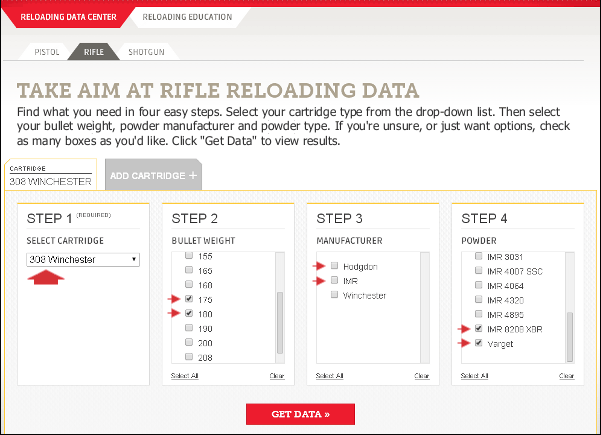
Hodgdon and IMR powders, including H4198, Varget, H4350, and IMR 4451, are some of the most successful propellants used by competitive shooters. If you want to find solid, reliable load data for these and other Hodgdon and IMR powders, we recommend you go right to the source — visit the Hodgdon/IMR Reloading Data Center, at www.HodgdonReloading.com. There you’ll find the latest, updated load recipes for pistol, rifle, and shotgun reloaders.
In the Data Center, you’ll find thousands of load recipes for pistol, rifle, and shotgun. Rifle shooters will find dozens of loads for their favorite Hodgdon, IMR, and Winchester powders such as H4198, Varget, H4350, and IMR 8208 XBR. And Hodgdon’s Reloading Center is now faster and easier to use. Navigation is simplified and the whole interface is more user-friendly.
Precise Search Results for your Cartridge and Favorite Powders
The online Reloading Data Center allows you to get precise search results for any listed cartridge. You can select your preferred powders and bullets. After choosing a cartridge, you can pre-select specific bullet weights and powder types. That quickly delivers just the information you want and need. You won’t have to scroll through scores of entries for bullets or powders you don’t use.
Data Center Works Well with Mobile Devices
Mobile users will notice Reloading Center is very “user-friendly” for smart-phone and tablet users. Controls have been optimized for touch-screens, and buttons are large and easy to use. Likewise the results are displayed in a large, easy-to read format.
Hodgdon tip from EdLongrange. We welcome reader submissions.
At the request of our readers, we provide select “Deals of the Week”. Every Monday morning we offer our Bargain selections. Here are some of the best deals on firearms, hardware, reloading components, and shooting accessories. Be aware that sale prices are subject to change, and once clearance inventory is sold, it’s gone for good. You snooze you lose.
1. Midsouth — 500 Rounds .22 LR Ammo with Sightron Scopes
Here’s a very attractive offer for rimfire shooters who are in the market for new optics. Right now Midsouth Shooters Supply is offering 500 rounds of Norma Tac-22 .22 LR ammo FREE with the purchase of qualifying Sightron scopes, which start at just $299.99. This Norma ammo is good stuff — very reliable in both bolt guns and auto-loaders. Sold separately, the 500 rounds of Norma ammo would cost you $62.58. The qualifying scopes are listed below; note that a variety of reticle options are offered for many of these models.
SII 36x42mm BRD
SIII 8-32x56mm LR
SIIISS 8-32x56mm LR
SIII 10-50x60mm LR
SIIISS 10-50x60mm LR
2. Amazon — Howard Leight Electronic Muffs, $37.43
Every shooter should own a pair of Electronic muffs, even if you prefer shooting with earplugs and/or standard muffs. Electronic muffs are great when you are doing spotting duties or are working near the firing line. They allow you to hear ordinary conversations while still providing vital hearing protection. Right now Amazon.com has the Howard Leight Impact Sport Electronic Muffs on sale for just $37.43, with free Prime Shipping. This is good deal — these NRR 22 muffs are currently Amazon’s #1 seller in the category. See All Price Options. NOTE: For regular, sustained shooting we recommend muffs and/or earplugs with a higher NRR rating.
3. Southern Shooters — 17 HMR Ruger American Rimfire
With ballistics far superior to a .22 LR, the 17 HMR is ideal for Prairie Dogs and small varmints out to 180 yards or so. We think every shooter should have a rifle in this rimfire chambering. Now you can get a reliable, name brand 17 HMR rifle for a very attractive price. That’s right, Southern Shooters is selling the 17 HMR Ruger American Rimfire, with 22″ barrel, for just $252.63. FFL required. For other vendors with this rifle, CLICK HERE.
4. Natchez — .45 ACP Ammo, 300 Rounds for $69.99 with Rebate
The .45 ACP is probably our favorite centerfire pistol cartridge. It is reliable, inherently accurate, and makes big, easy-to-see holes in paper. Here’s a good deal for .45 ACP shooters. Sportsmans Outdoor Superstore is selling 300 rounds of American Eagle .45 ACP 230gr FMJ ammo for $99.99 in a handy plastic ammo can. And with factory rebate, you can knock thirty bucks off that price, so your net cost is just $69.99! Through the end of 2016, Federal Ammunition is offering $30.00 cash back on this ammo. CLICK HERE for Rebate Form.
Fine Print: Maximum of $30.00 rebate. Purchase must be made before December 31, 2016. Coupon must be received by January 31, 2017. Consumer submits coupon with UPCs written and original cash register receipt and/or dated itemized sales invoice (photocopies not accepted). Please allow 6-8 weeks for delivery.
5. Amazon — Motorola Walkie Talkies, $48.98 per Pair
Walkie-Talkies are “must-have” items for long-range shooting. The 22-CH Motorola MH230R Two-Way Radio is Amazon’s #1 Best Seller in FRS/GMRS Handheld Radios. This under-$50.00 set offers 22 channels with a claimed range up to 23 miles (We’ve used them and they worked at 3 miles line of sight). The kit includes: 2 radios, 2 belt clips, 1 dual drop-in charger, 1 charging adapter, 2 NiMH rechargeable battery packs. Run-time is about 10 hours — plenty for a full day of shooting. There is also a newer version, the Motorola T260 for $58.99.
6. Midsouth — 17 HMR V-Max Ammo, $10.45 for 50 rounds
Need 17 HMR ammo for your varmint safaris? Then grab this Hornady V-Max ammo while you can at $10.45 for a 50-round box. This is a great price. Other vendors are selling the same Hornady ammo for as much as $15.00 per box. We’ve used this ammo and it was very accurate out of both semi-auto (Savage A17) and bolt-action (CZ 455) 17 HMR rifles.
7. Monmouth Reloading — 500 Lake City 5.56 Cases, $49.99
500 pieces of Lake City brass for under fifty bucks? Yep, that’s good deal for anyone who needs lots of .223/5.56 brass for varmint safaris and tactical comps. Monmouth Reloading is selling genuine, once-fired Lake City 5.56x45mm brass, thick-walled and sourced direct from the U.S. Military. Monmouth reports: “Our current stock of Lake City 5.56 looks to be all newer year Lake City head stamp but may contain a small percentage of other NATO headstamps. Lake City is a popular, reliable brass, normally capable of many reloads.” Monmouth includes 1% overage to account for any damaged brass. NOTE: Brass has crimped primers, so the pockets will need to be reamed or swaged prior to reloading.
8. Amazon — Leight MAX NRR33 Earplugs, $7.58 for 50 Pairs.
These Howard Leight NRR33 Max plugs are your Editor’s favorite foam earplugs. Between shooting, motorcycling and mowing lawns, I probably have Max plugs in my ears 2-3 days a week. This is a very good price for a bulk pack of 50 pairs. And if you act soon, you can get free shipping to boot.






 Precision shooters favor premium brass from


 MEC MARKSMAN

 Plant Engineer Darren Leskiw answered: “Beyond the normal equipment, I’d say my electronic scale. Using the beam balance for the past 9 years was ok, but nowhere as easy as using an electronic scale.”