S&W Model 617 now has a 10-round cylinder, but early models were six-shooters.
In recent years, the ranks of first-time gun buyers have grown dramatically. Millions of Americans have purchased their first-ever handgun. With so many handgun options (from derringers to Desert Eagles) many first-time buyers have trouble making a choice. What should those millions of new gun buyers have acquired first? Perhaps it should have been a rimfire revolver. Here is why…
The Argument for a Rimfire Revolver Some years back, a close relative contacted this Editor. Wanting to get started in handgunning, he sought my advice on purchasing his very first handgun. “Should I get a Glock?”, he asked. “No” was my response. “Well how about an M&P?” he inquired. “Better ergos” I said, “but ‘No’ is still my reply.” “OK, how about a KelTec, they’re cheap…”
“Absolutely not”, I replied.
I could tell he was getting annoyed, when he said “OK, Mr. know-it-all, so what handgun should I get?” Calmly, I replied: “Get a .22-caliber rimfire revolver. You will never out-grow it. You will learn sight alignment and trigger control. You can practice with inexpensive ammunition. A good .22 revolver will be considerably more accurate than 90% of the self-loading pistols you could buy. If you get a Smith & Wesson, you will keep the gun for the rest of your life and pass it on to your kids. If you or your heirs ever wear out the barrel or cylinder, Smith & Wesson will replace the parts for free, forever.”
This Editor’s first really accurate handgun was a .22 LR Smith & Wesson Model 617 that could easily stack ten shots in a dime at 10 yards. It remains my favorite and most-used handgun. What can we say about the Model 617? The single-action trigger pull is superb, and the accuracy surpasses most any semi-auto rimfire pistol, except for a few, very expensive target pistols. We like the 6″ version for the longer sight radius, but the 4″-barrel 617 is also very accurate, and it balances better.
You can learn all the fundamentals with this ultra-reliable handgun, shooting inexpensive .22 LR ammo. The model 617 is rugged, durable, and can give you a lifetime of shooting fun. Once you have mastered the basics of shooting with a .22 LR, you can move on to larger caliber handguns suitable for self-defense. Below is a slide-show illustrating a S&W model 617 ten-shot, with 6″ barrel. S&W also makes a 4″-barrel version of this revolver. (See: Shooting Demo Video with 4″ model 617.)
Another .22 Revolver Option, the Smith & Wesson Model 63
The current S&W Model 63 is a J-Frame .22 LR with 3″ barrel and fiber optic front sight. The Model 63 is compact enough for comfortable carry and well-balanced. The older Model 63, aka the “Kit Gun”, is an appreciating classic.
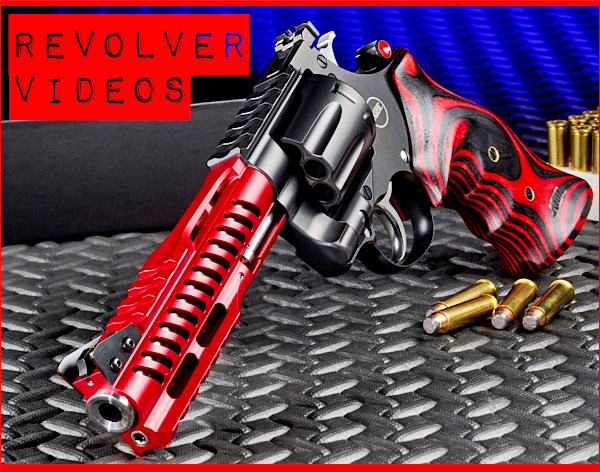
Today’s Saturday video showcase is a wheelgun extravaganza. We offer eight videos covering some of the most famous double-action revolvers in existence. Check out reviews of Colt, Smith & Wesson, Korth, Dan Wesson, Ruger, and other models, in a variety of chamberings, both centerfire and rimfire. We think every serious gun enthusiast should have at least two revolvers in his collection — one centerfire and one rimfire. This Editor owns a stainless, 10-shot .22 LR Smith & Wesson Model 617. It has probably shot more rounds than all my other pistols combined, and it is still performing flawlessly after two decades.
Multiple Revolver Line-up: S&W, Colt, Ruger, Taurus, Dan Wesson, Chiappa, Charter Arms, Webley and More
This 12-minute video provides a quick introduction to eleven interesting wheelguns: Smith & Wesson Model 29 (00:22), Colt Python (1:22), Ruger GP100 (2:25), Taurus Model 66 (3:40), Smith & Wesson Model 686 (4:38), Charter Arms Bulldog (5:41), Chiappa Rhino (6:32), Webley Revolver (7:27), Dan Wesson 715 (8:21), H&R Model 929 (9:59), Taurus Judge Public Defender (10:52). NOTE: This video also includes a review of the Bersa .380 which is NOT a revolver, so the video title is a little misleading. There are 12 handguns, but only 11 revolvers.
Colt Python .357 Mag 1000-Round Test
How well do modern wheelguns hold up to extended use? This video provides an answer. Honest Outlaw’s testers put 1000 rounds through a new-generation Colt Python chambered for the legendary .357 Magnum round. The Python showed outstanding accuracy, and the tester praised the trigger. Testing was done indoors and outdoors, both rapid-fire and slow-fire. After a couple hundred rounds, the Python needed a thorough cleaning of cylinder and barrel, but otherwise the revolver performed really well.
Hickok45 Shoots the New Colt Anaconda in .44 Magnum
Hickok45 is a respected YouTube video reviewer. In this detailed 19.5-minute video, Hickok45 reviews and tests a new generation Colt Anaconda revolver, chambered for the powerful .44 Magnum cartridge. This is one of the most popular wheelgun videos on YouTube, having logged over 1.4 million views.
Colt King Cobra Target .22 LR Revolver
This TFB Showtime episode examines the new .22 LR rimfire Colt King Cobra Target. The King Cobra Target .22 LR features a 10-shot cylinder, and the same adjustable target sights as the .357 Magnum version.
At the NRA Annual Meetings in 2022, Colt Manufacturing introduced an impressive rimfire revolver — the King Cobra Target .22 LR. Colt states: “From competition to plinking and small game hunting, this baby Cobra does it all and packs 10-rounds of .22 LR in its cylinder”. The King Cobra Target 22 LR is available with 4.25-inch and 6-inch barrel lengths, both with 1:16″ RH rifling twist. MSRP is $999.00.
The Massive Smith & Wesson 500 Magnum X-Frame
If bigger is better, then a Smith & Wesson 500 Magnum should be in your collection. This jumbo-size wheelgun shoots a huge 50-caliber cartridge, the .500 S&W Magnum. Even with compensator slots on the end of the barrel, the recoil is massive — enough so that we would NOT recommend this big revolver to novice shooters.
In 2003 the engineers at Smith & Wesson wanted to deliver maximum power for serious handgun hunters. The power they sought required an entirely new frame, the massive “X-Frame”. That became the basis for the new Model S&W 500, the most powerful production revolver in the world.
Colt vs. Smith & Wesson
Here’s a pretty informative video, with two qualified experts, Bill Wilson and Ken Hackathorn. This covers the basic differences between Smith & Wesson and Colt revolvers. This video explores the classic “Ford vs. Chevy debate” of the revolver world. Both S&W and the Colt revolvers have their die hard loyalists. In this episode, the Gun Guys weigh the merits of Bill’s Colt Shooting Master and Ken’s S&W Registered Magnum.
Korth Super Sport STS Revolver — $5,572.00 Wheelgun
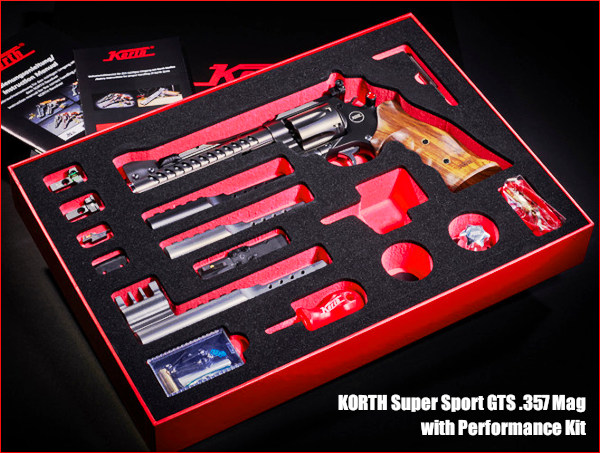
Germany’s Korth Arms makes some of the best revolvers on the planet. Korth’s machining tolerances are second to none. The triggers are superb and the accuracy is excellent. For high-end Bianchi Cup-type competition Korth offers a “badass” black heavy-barreled wheelgun, the Super Sport GTS Revolver. This features a full-length scope rail and vented sides. Note this video was originally in the French language so there is an English voice-over. NOTE: If the English sound-track doesn’t work on your platform, click the “Watch on YouTube” option and/or click the settings button and set the audio track to English.
You’ll need serious bucks to buy a Korth Super Sport GTS. Currently the GTS model in .357 Magnum with full multi-barrel performance kit sells for €4,730.00 Euros (about $5572.00 U.S.).
Smith & Wesson Model 648 in .22 WMR
We love Smith & Wesson rimfire revolvers. We have put thousands of rounds through S&W Model 617 revolvers, with 4″ and 6″ barrels. These stainless .22 LR handguns are accurate, superbly reliable, and they hold their value. In general we’ve found that Smith & Wesson rimfire revolvers may be less fussy with ammo, and more trouble-free than typical semi-auto rimfires. Bottom line, we feel that everyone should have an S&W rimfire wheelgun in their collection.
Along with its .22 LR wheelguns, S&W now offers another very impressive Rimfire Revolver option — the “revived” Model 648 in .22 WMR (Winchester Magnum Rimfire). This stainless Model 648 brings a more powerful cartridge to S&W rimfire revolver fans.
Here’s a helpful, time-saving tool for handgun owners. MidwayUSA’s online Holster Finder lets you quickly find the right holsters for virtually all popular makes and models of pistols and revolvers. The wide variety of carry styles, materials, and features can make finding the right holster difficult or confusing. Drawing on a database of over 125,000 gun/holster combinations, the MidwayUSA Holster Finder turns that complex task into an easy three-step process.
The selection process is simple: 1. Choose Pistol or Revolver; 2. Select Make and Model of Handgun (and barrel type/length); 3. Click to view results. Just choose your gun type, select your make, model and barrel, then view the results. All major holster types are included: Ankle, Belly Band, Belt (outside waistband), Chest, Competition, Drop Leg, Inside Waistband (IWB), Paddle, Pocket, and Shoulder. Check out the MidwayUSA Holster Finder at MidwayUSA.com/holster-finder.
One of our Forum members asked: “Are there any good books on pistol marksmanship? I’m looking for a book that covers techniques and concepts….” Here are six recommended titles that can make you a better pistol shooter. These books run the gamut from basic handgun training to Olympic-level bullseye shooting.
Good Guidebooks for Pistol Shooters
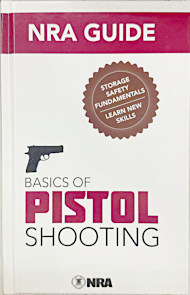
There are actually many good books which can help both novice and experienced pistol shooters improve their skills and accuracy. For new pistol shooters, we recommend the NRA Guide to the Basics of Pistol Shooting. This full-color publication is the designated student “textbook” for the NRA Basic Pistol Shooting Course.
Serious competitive pistol shooters should definitely read Pistol Shooters Treasury a compilation of articles from World and National Champions published by Gil Hebard. You could work your way through the ranks with that book alone even though it is very small. It is an excellent resource.
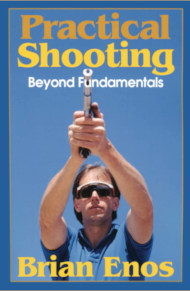
If you’re interested in bullseye shooting, you should get the USAMU’s The Advanced Pistol Marksmanship Manual. This USAMU pistol marksmanship guide has been a trusted resource since the 1960s. Action Shooters should read Practical Shooting: Beyond Fundamentals by Brian Enos, and Practical Pistol by Ben Stoeger. Brian Enos is a well-known pistol competitor with many titles. Ben Stoeger is a two-time U.S. Practical Pistol shooting champion. Last but not least, Julie Golob’s popular SHOOT book covers pistol marksmanship, along with 3-Gun competition. Julie holds multiple national pistol shooting titles.
Jessie Harrison is one of the greatest female pistol shooters on the planet. In the video below, Jessie offers smart tips on purchasing a handgun, and getting started in competition. Jessie covers caliber choice, handgun fit/ergonomics, concealability, holster options, and other key factors.
Are you in the market for your first handgun, for target use or for self-defense? The Winchester Blog has a good article for handgun buyers. This story, “Things You Should Know When Purchasing Your First Pistol”, provides many smart tips that can help you choose the right handgun, and save money in the process. In addition, the article explains how to train with your new pistol and handle it safely. READ Full Article.
If possible, you should test a variety of different pistols, to determine which works best for you. Check the feel, the ergonomics, the sight picture, and the controls. And, if possible, test the pistols with live-fire at a range which rents samples.
How do you know if your choice is right for you?
Once you’ve narrowed down choices, try to get time shooting the pistol(s) you are considering. You can usually rent guns at commercial ranges. This is an excellent way to “try before you buy.” NSSF has a list of places to shoot[.] When looking for a range that rents firearms, an online search and then a phone call to confirm what options are available is a solid plan. If you have friends and family who own a model you are interested in, ask if they will go to the range with you so that you can try it.
Take pistols for a test drive
First, dry-fire and manipulate the pistol. Can you easily lock the slide open? Are the sights suited to your vision? Then, fire a magazine or two of ammo [in a supervised range facility]. — Winchester Blog
The Winchester Blog article lists techniques that can help you get the “feel” for a particular firearm:
1. Practice the 4 Rules of Firearm Safety and make sure the gun is empty.
2. [After confirming the gun is empty] manipulate the slide, safety, magazine release, and dry-fire.
3. Perform a dry or empty magazine change — make sure you can hit the release and also reload a new magazine easily.
4. Perform a draw, or if you’re at a range where that is not allowed, simply pick the pistol up off the table and bring it up to your eye level and align the sights. Do this a few times. Can you acquire the sights quickly?
5. How does the backstrap fit your hand? Can you get both hands on the gun with enough “purchase” that you can really grip it well?
This Winchester Blog article is by Becky Yackley. Becky has competed in 3-Gun, Bianchi pistol, Service Rifle, NCAA air rifle, smallbore and air pistol events around the world since 1989.
Jerry Miculek is the best action revolver shooter who has ever lived. Miculek is also a true master with rifle and shotgun. This guy shoots hundreds of thousands of rounds every year in all types of firearms. Through that process, he has discovered common mistakes many shooters make. Those mistakes can harm the guns, or threaten the safety of the operator. Here Jerry offers some vital gun handling and safety advice in his “Never Do This” video series.
Jerry Miculek has won multiple revolvers championships, and has set amazing records for revolver speed shooting (with reloads). Yes Jerry, “Mr. Revolver”, knows a thing or two about wheelguns. In this video, Jerry explains how you can damage your revolver by using the wrong methods to open and close the cylinder and extract ammo. Jerry shows what NOT to do, and then he very carefully explains the proper procedure to release the cylinder, and swing it out of the frame. In addition, Jerry shows how best to swing a loaded cyclinder back into place. If you own a revolver, ANY revolver, you should definitely watch this video.
In this second video, Jerry explains common mistakes people make when handling and shooting three classic, semi-auto firearm types — the M1 Garand, the SKS carbine, and the M1911 pistol. Jerry shows handling faults that can cause out-of-battery detonation or early primer strikes, or cause jams in the Garand and SKS. Then Jerry explains why you should never release the slide on a M1911 pistol with a round already in the chamber. This is a must-watch video for Garand owners.
Here Jerry demonstrates of the most common jams that can happen with AR-platform rifles. Miculek reveals the cause of the issue and then shows how to prevent it. Jerry notes: “This is one of those malfunctions that you won’t see coming! I’ve seen it … on the range and it can be devastating to your time in a match. All ammo used in the video were dummy rounds and intentionally loaded for training without powder or primers.”
S&W Model 617 now has a 10-round cylinder, but early models were six-shooters.
In recent years, the ranks of first-time gun buyers have grown dramatically. Millions of Americans have purchased their first-ever handgun. With so many handgun options (from derringers to Desert Eagles) many first-time buyers have trouble making a choice. What should those millions of new gun buyers have acquired first? Perhaps it should have been a rimfire revolver. Here is why…
The Argument for a Rimfire Revolver
Some years back, a close relative contacted this Editor. Wanting to get started in handgunning, he sought my advice on purchasing his very first handgun. “Should I get a Glock?”, he asked. “No” was my response. “Well how about an M&P?” he inquired. “Better ergos” I said, “but ‘No’ is still my reply.” “OK, how about a KelTec, they’re cheap…” “Absolutely not”, I replied.
I could tell he was getting annoyed, when he said “OK, Mr. know-it-all, so what handgun should I get?” Calmly, I replied: “Get a .22-caliber rimfire revolver. You will never out-grow it. You will learn sight alignment and trigger control. You can practice with inexpensive ammunition. A good .22 revolver will be considerably more accurate than 90% of the self-loading pistols you could buy. If you get a Smith & Wesson, you will keep the gun for the rest of your life and pass it on to your kids. If you or your heirs ever wear out the barrel or cylinder, Smith & Wesson will replace the parts for free, forever.”
First Handgun Choice — Consider a .22 LR Wheelgun
A very good choice for a first handgun is a Smith & Wesson .22 LR revolver, such as the S&W Model 617. The model 617 is extremely accurate, with a crisp trigger and good sights. Choose either a 4″ or 6″ barrel. The current model has a handy, 10-round cylinder.
This Editor’s first really accurate handgun was a .22 LR Smith & Wesson Model 617 that could easily stack ten shots in a dime at 10 yards. It remains my favorite and most-used handgun. What can we say about the Model 617? The single-action trigger pull is superb, and the accuracy surpasses most any semi-auto rimfire pistol, except for a few, very expensive target pistols. We like the 6″ version for the longer sight radius, but the 4″-barrel 617 is also very accurate, and it balances better.
You can learn all the fundamentals with this ultra-reliable handgun, shooting inexpensive .22 LR ammo. The model 617 is rugged, durable, and can give you a lifetime of shooting fun. Once you have mastered the basics of shooting with a .22 LR, you can move on to larger caliber handguns suitable for self-defense. Below is a slide-show illustrating a S&W model 617 ten-shot, with 6″ barrel. S&W also makes a 4″-barrel version of this revolver. (See: Shooting Demo Video with 4″ model 617.)
Another .22 Revolver Option, the Smith & Wesson Model 63
The current S&W Model 63 is a J-Frame .22 LR with 3″ barrel and fiber optic front sight. The Model 63 is compact enough for comfortable carry and well-balanced. The older Model 63, aka the “Kit Gun”, is an appreciating classic.
Hornady sponsored shooter Jerry Miculek — Yamil Sued Photo.
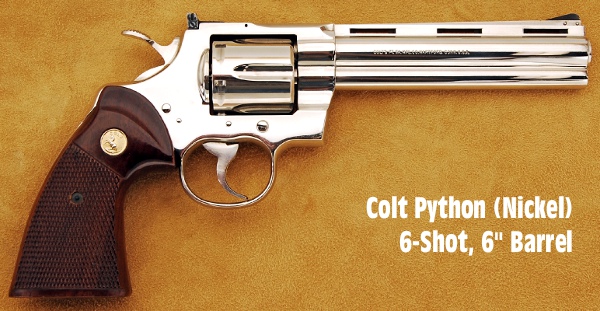
If you are considering acquiring a revolver for fun shooting, self-defense, or competition, you should definitely watch this YouTube video. In this 23-minute presentation, legendary shooter Jerry Miculek puts three .357/.38 SPL wheelguns through their paces. Jerry, one of the greatest revolver shooters in history, hosts a “Revolver Showdown” with three popular wheelguns: 1) S&W L frame (3″ bbl); 2) Colt Python (6″ bbl); and 3) Ruger Speed Six (2.75″ bbl).
Smith & Wesson Model 686 Plus, L-Frame, 7-rd .357 Magnum/38 SPL, 3″ Barrel.
Testing at 10 Yards and 50 Yards
In the video, Jerry shoots all three revolvers rapid-fire, double-action at 10 yards. Then he shoots the three guns single-action, slow-fire at 50 yards (starting at time mark 7:19).
After his range session, Jerry examines nine medium frame revolvers, comparing and contrasting design features. Jerry considers these factors:
1. Accuracy
2. Balance and Handling
3. Speed and Sureness of Trigger Return (watch video at 3:45″ re Colt.)
4. Reliability
5. Barrel Twist Rate
6. Strength of Construction/Durability
Each day, on Facebook, the NRA National Firearms Museum showcases something special from the Museum collections. A while back the Museum displayed a trio of snakes — three very special Colt Pythons. From bottom to top, these three prized wheelguns are: Colt Python serial number 2, number 3, and number 5. And yes, that is the original box for Python #2 (at bottom). The museum says such low serial number guns were typically produced for a company executive or key members of the gun design team.
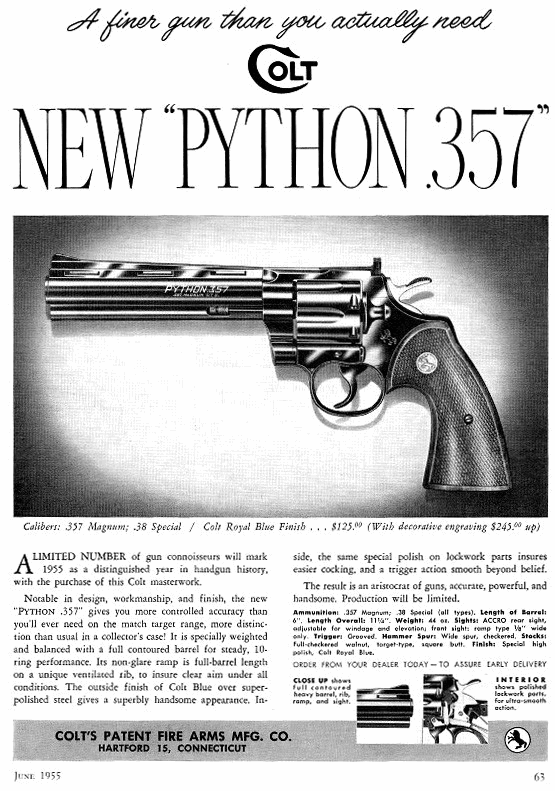
Loved for their beautiful finish, nice balance, and great trigger, Colt Pythons have proven to be excellent investments. Since the Colt Python was first introduced in 1955, Python prices have gone through the roof. A pristine, LNIB early-era Colt Python can now command very high values in the thousands. And these rare single digit examples might sell for over $15,000+, as estimated by the NRA museum. How much did a Python cost in 1955? You could purchase the Royal Blue model for just $125.00! Factory-engraved models started at $245.00, according to this Colt advertisement from June, 1955:
History and Design Evolution of Colt Python Revolvers
You can see hundreds of other interesting firearms on the National Firearm Museum website, www.NRAMuseum.com. Or, if you’re lucky, you can see the collections in person. The NRA now operates three Museum locations: the NRA National Firearms Museum in Fairfax, Virginia; the NRA National Sporting Arms Museum in Springfield, MO; and the Frank Brownell Museum of the Southwest in Raton, NM.
Each day, on Facebook, the NRA National Firearms Museum showcases something special from the Museum collections. A while back the Museum displayed a trio of snakes — three very special Colt Pythons. From bottom to top, these three prized wheelguns are: Colt Python serial number 2, number 3, and number 5. And yes, that is the original box for Python #2 (at bottom). The museum says such low serial number guns were typically produced for a company executive or key members of the gun design team.
Loved for their beautiful finish, nice balance, and great trigger, Colt Pythons have proven to be excellent investments. Since the Colt Python was first introduced in 1955, Python prices have gone through the roof. A pristine, LNIB early-era Colt Python can now command $4400.00 or more, more than 35 times the original price.
How much did a Python cost in 1955? You could purchase the handsome Royal Blue model for just $125.00! Factory-engraved models started at $245.00, according to this Colt advertisement from June, 1955:
History and Design Evolution of Colt Python Revolvers
You can see hundreds of other interesting firearms on the National Firearm Museum website, www.NRAMuseum.com. Or, if you’re lucky, you can see the collections in person. The NRA now operates three Museum locations: the NRA National Firearms Museum in Fairfax, Virginia; the NRA National Sporting Arms Museum in Springfield, MO; and the Frank Brownell Museum of the Southwest in Raton, NM.


Some years back, a close relative contacted this Editor. Wanting to get started in handgunning, he sought my advice on purchasing his very first handgun. “Should I get a Glock?”, he asked. “No” was my response. “Well how about an M&P?” he inquired. “Better ergos” I said, “but ‘No’ is still my reply.” “OK, how about a KelTec, they’re cheap…”



 If bigger is better, then a





 Good Guidebooks for Pistol Shooters



 Testing at 10 Yards and 50 Yards