This past week California Gov. Gavin Newsom signed legislation, AB 1127, which will ban Glock pistols (and some similar firearms) in California. This blatantly unconstitutional legislation is one of many anti-gun bills passed this fall in California, including a new law that requires background checks to purchase a rifle barrel (SB 704). The pretext for the ban on Glocks is that they could be converted to full auto, even though that is already illegal in all 50 states. Guns.com reports: “[AB 1127] targets semi-automatic pistols that can potentially be converted to full auto with a common aftermarket switch or chip, though it doesn’t specify ‘Glock’ by name. These switches are already illegal under the National Firearms Act unless registered, with individuals found with an unregistered switch risking 10 years in federal prison and a $250,000 fine[.]”
Under the new Legislation, which goes into effect next summer, current Glock owners are still allowed to sell their firearms in California without risking criminal penalties. According to CBS News: “The new law does not ban possession of Glocks, nor does it ban reselling used Glocks in California.” However, sale of new Glocks will be prohibited.
NRA, FPC, and SAF File Federal Lawsuit Challenging Glock Ban
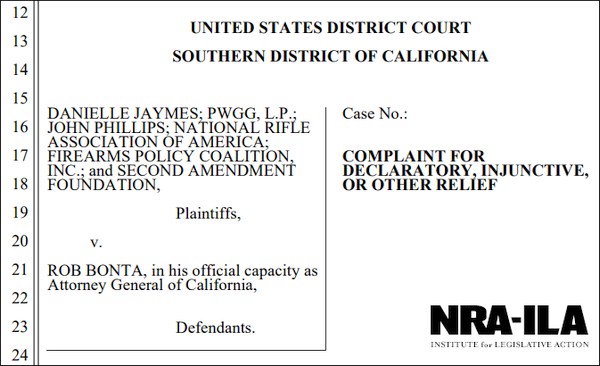
The NRA-ILA Reports: “The National Rifle Association — along with Firearms Policy Coalition (FPC), Second Amendment Foundation (SAF), Poway Weapons & Gear, and two NRA members — filed a lawsuit challenging California’s Glock ban.” The case, Jaymes v. Bonta, was filed in the U.S. District Court for the Southern District of California. The lawsuit argues that California’s ban on Glock-style handguns violates the Second Amendment. The U.S. Supreme Court has held that “common” arms cannot be banned, and moreover, that handguns cannot be banned.
Details of AB1127 Gun Bans
California Assembly Bill 1127, codified at California Penal Code § 27595(a) and scheduled to take effect on July 1, 2026, provides that licensed firearms dealers “shall not sell, offer for sale, exchange, give, transfer, or deliver any semiautomatic machinegun-convertible pistol.” That restriction would effectively ban sale of Glock and similar semi-auto pistols.
A “semiautomatic machine-gun convertible pistol” is defined as “any semiautomatic pistol with a cruciform trigger bar that can be readily converted by hand or with common household tools … into a machinegun by the installation or attachment of a pistol converter as a replacement for the slide’s backplate without any additional engineering, machining, or modification of the pistol’s trigger mechanism.” The law excludes, however, hammer-fired semiautomatic pistols and striker-fired semiautomatic pistols lacking a cruciform trigger bar. In effect, therefore, the ban applies to Glock-manufactured semi-automatic handguns and similar handguns built on a Glock platform.
Visit NRAILA.org for updates on NRA-ILA’s ongoing efforts to defend Americans’ Second Amendment rights.
California “1-in-30″ Firearm Ban Struck Down in Ninth Circuit Decision
The Ninth Circuit Court of Appeals has ruled that a California law restricting gun purchases to just one every 30 days is absolutely unconstitutional. With a unanimous 3-0 decision, a Ninth Circuit panel held that California’s “one-gun-per-month” gun ban law clearly violates the Second Amendment of the U.S. Constitution. The full Ninth Circuit ruling in Nguyen v. Bonta can be viewed at firearmspolicy.org/nguyen.
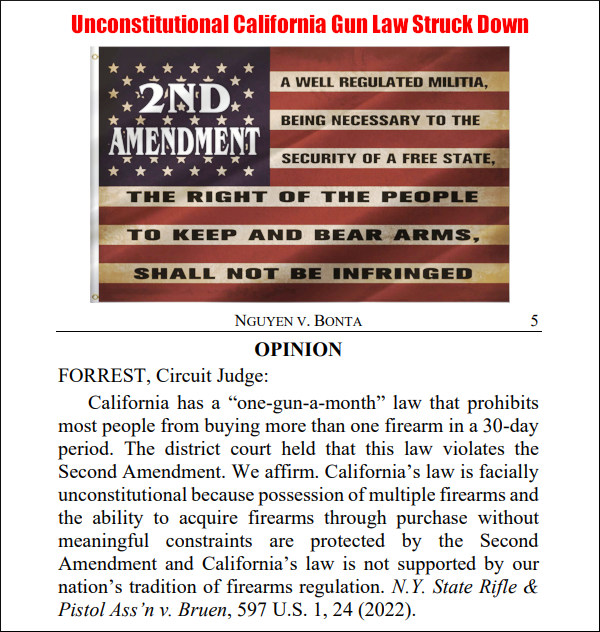
“California has a ‘one-gun-a-month’ law that prohibits most people from buying more than one firearm in a 30-day period. The district court held that this law violates the Second Amendment. We affirm. California’s law is facially unconstitutional because possession of multiple firearms and the ability to acquire firearms through purchase without meaningful constraints are protected by the Second Amendment and California’s law is not supported by our nation’s tradition of firearms regulation”, wrote Ninth Circuit Judge Forrest. At the end of the 24-page decision, Judge Forest added: “The Second Amendment expressly protects the right to possess multiple arms. It also protects against meaningful constraints on the right to acquire arms because otherwise the right to ‘keep and bear’ would be hollow.”
Plaintiffs in the case included two FFL gun dealers, the Firearms Policy Coalition (FPC), the Second Amendment Foundation (SAF), San Diego County Gun Owners PAC, and six private citizens including Michelle Nguyen, for whom the case is named.
The Nguyen v. Bonta lawsuit challenged the California statute that only allows for the purchase of one handgun or semi-automatic centerfire rifle, from a licensed dealer within a 30-day period. Plaintiffs secured a summary judgment win at the District Court, which California then appealed to the Ninth Circuit. The Ninth Circuit affirmed the District Court decision, striking down the gun rationing law as impermissible under the Second Amendment.
Firearms Policy Coalition Praises Result
“As this decision shows, the right to keep and bear arms cannot be limited by an arbitrary cap on the number of guns that can be acquired at one time”, explained FPC President Brandon Combs. “We have a right to buy more than one gun at a time just as we have a right to buy more than one bible at a time. FPC is proud to have secured the rights of peaceable people and will continue to fight forward until we eliminate immoral laws like this everywhere.”
Second Amendment Foundation Predicts Progress in Fighting California Gun Laws
“Today’s decision claws back a portion of Second Amendment rights stolen by California’s government”, said SAF Exec. Director Adam Kraut. “California’s one-gun-per-month law was in clear violation of the Second Amendment, as affirmed by the unanimous decision in the Ninth Circuit. This ruling is one step closer to liberating the people of the state from the totalitarian ideals of those in power who believe the right to keep and bear arms is a second-class right.”
“There was no doubt the one-gun-per-month restriction was put in place to circumvent the ability of citizens to exercise their full Second Amendment rights,” said SAF founder and Exec. V.P. Alan M. Gottlieb. “This ruling is a victory for all who believe in the fundamental right to keep and bear arms[.]”
Brownells hosts the 4th Annual 2A Day (Second Amendment Day) on February 22, 2025, a nationwide event dedicated to celebrating Second Amendment rights, advocating for their preservation, and strengthening the firearms community. On 2A Day, you can visit a participating range and take advantage of free firearm rental or limited free ammo. There are participating ranges in Scottsdale, Arizona; Johnston, Iowa; Ballwin, Missouri; Omaha, Nebraska; and Auburn, Virginia. And some other local ranges may offer free firearm rentals or limited free ammo. Or head to the range of your choice and shoot for fun.
With support from sponsors including CCI, Federal, Fiocchi, Henry, Hornady, Leupold, Magpul, Remington, Smith & Wesson, and Volquartsen, 2A Day provides multiple ways for firearm enthusiasts to participate:
CELEBRATE — Brownells is partnering with shooting ranges across the country to offer free range time and limited complimentary ammunition for participants.
ADVOCATE — Brownells encourages gun owners to actively support the Second Amendment by engaging with lawmakers at both the state and federal levels. The Brownells 2A Day webpage provides links to help individuals contact their elected representatives.
JOIN — Gun owners are encouraged to join national and state organizations committed to protecting gun rights, such as the 2nd Amendment Foundation (SAF) and the Gun Owners of America (GOA). Brownells will donate 4% of all sales from February 18-23 to 2A advocacy groups.
Second Amendment Day Official Target (Download for FREE)
“February 22nd is a day we, as a nation, can recognize, celebrate and do our part to secure one of the most important rights guaranteed by our Constitution – the right to keep and bear arms,” said Pete Brownell, Chairman of the Board at Brownells. “I hope Americans from all walks of life visit the range on this one day – 2/22 … and safely exercise their Second Amendment right, which is the underpinning of safety and security in America.”
The Second Amendment Foundation (SAF) has filed a federal lawsuit challenging restrictive gun control laws in Hawaii which discriminate against young adults, prohibiting them from acquiring, purchasing, and possessing firearms and ammunition, therefore violating their Second and Fourteenth Amendment rights. The lawsuit, which seeks injunctive relief, was filed in U.S. District Court for the District of Hawaii.
SAF is joined by Aloha Strategics LLC, JGB Arms LLC, and two private citizens, Juda Roache and Elijah Pinales. The case is known as Pinales v. Attorney General for the State of Hawaii. The defendant is Hawaii Attorney General Anne E. Lopez, named in her official capacity. SEE Court Filing HERE.
“Hawaii’s ban on the purchase and possession of firearms by adults in the 18- to 20-year age group makes it impossible for these citizens to exercise their constitutional right to keep and bear arms,” noted SAF Executive Director Adam Kraut. “Their rights have been assured by recent Supreme Court rulings, not to mention this nation’s history and tradition, and the Hawaii statutes clearly conflict with those decisions and the relevant history.”
“Hawaii has essentially decided the Second Amendment doesn’t apply in that state”, added SAF founder and Executive V.P. Alan M. Gottlieb. “Under the Fourteenth Amendment, no state shall make or enforce any law which abridges the rights guaranteed to citizens by the U.S. Constitution, and that includes young adults. These prohibitions simply cannot be allowed to stand.”
Hawaii Firearms Coalition Supports SAF Challenge
The Hawaii Firearms Coalition (HIFICO) supports the SAF lawsuit defending young adults’ rights to bear arms. On its Facebook Page HIFICO posted: “Let freedom ring — loud and clear! Hawaii Firearms Coalition has announced its support for the SAF’s groundbreaking lawsuit challenging Hawaii’s unfair ban on firearm ownership for adults under 21.”
HIFICO notes that: “This case takes aim at the state’s unconstitutional restrictions that stop responsible citizens from protecting themselves and exercising their rights. Imagine being old enough to serve in the military, vote, and pay taxes, but being told you can’t defend yourself or your family. Yeah, we don’t think so either! This lawsuit is about fairness, freedom, and upholding the Constitution. The Second Amendment doesn’t come with an age limit!
The lawsuit argues that Hawaii’s age-based restrictions on firearm ownership trample on the rights guaranteed by the Second and Fourteenth Amendments. This isn’t just about the plaintiffs — it’s about all of us. We stand with the young men and women who are fighting back. This case is about empowering law-abiding adults to exercise their rights. It’s about saying, ‘Hey, Hawaii! Follow the Constitution!'”
In the case of Nguyen v. Bonta, plaintiffs have been granted summary judgment in a federal challenge of California’s One-Gun-A-Month (OGM) purchase law. This is a major win for gun rights in California. Under current California law, even after passing multiple background checks, a California citizen may only purchase one firearm every 30 days. This violates the Second Amendment of the U.S. Constitution, argued plaintiffs lead by the Second Amendment Foundation (SAF). U.S. District Judge William Q. Hayes agreed, granting plaintiffs summary judgement, which is essentially a case victory based on legal principles. However, Judge Hayes, stayed his decision for 30 days to allow defendants to appeal. The case will probably be appealed by California to the liberal-leaning 9th Circuit.
In his 24-page decision, Federal District Court Judge Hayes wrote, “Defendants have not met their burden of producing a ‘well-established and representative historical analogue’ to the OGM law. The Court therefore concludes that Plaintiffs are entitled to summary judgment as to the constitutionality of the OGM law under the Second Amendment.”
“The state of California tried to justify the OGM law in part on the grounds that it is a lawful regulation imposing conditions on the commercial sale of arms,” noted SAF Executive Director Adam Kraut. “However, there is nothing in the Second Amendment remotely connected to limiting the number of firearms a person can purchase. This limitation is blatantly unconstitutional, and if this ruling is appealed by the State of California, we intend to defend the lower court’s correct decision.”
“This is a win for gun rights and California gun owners”, said Alan M. Gottlieb, SAF founder and Executive Vice President. “There is no historical justification for limiting law-abiding citizens to a single handgun or rifle purchase during a one-month period, and Judge Hayes’ ruling clearly points that out.”
SAF is joined by the North County Shooting Center, San Diego County Gun Owners Pac, PWGG, LP, Firearms Policy Coalition and six private citizens including Michelle Nguyen, for whom the case is named. They are represented by attorney Raymond M. DiGuiseppe of Southport, N.C. The case was filed in December 2020 and is known as Nguyen v. Bonta.
Image from Fox News. Click HERE for full story with video.
The Second Amendment Foundation has filed a federal lawsuit against New Mexico Gov. Michelle Lujan Grisham and four other officials on the grounds that the governor’s “emergency order’ prohibiting open and concealed carry in Albuquerque and surrounding Bernalillo violates the Second and Fourteenth Amendments of the U.S. Constitution.
Joining SAF are the New Mexico Shooting Sports Association, Firearms Policy Coalition and a private citizen, Zachary Fort, who resides in Bernalillo County. They are represented by Jordon George of Aragon Moss George Jenkins, LLP who has also filed a motion for a temporary restraining order and preliminary injunction. The lawsuit and motion were filed in U.S. District Court for the District of New Mexico.
Along with Gov. Lujan Grisham, defendants include: Patrick Allen, Cabinet Secretary for the New Mexico Department of Health; Jason Bowie, Cabinet Secretary for New Mexico Department of Public Safety, and W. Troy Weisler, chief of the New Mexico State Police. They are sued individually AND in their official capacities.
“Despite her claims to the contrary,” said SAF founder and Exec. V.P. Alan M. Gottlieb, “Gov. Grisham does not have the authority to ‘suspend’ the Second Amendment for an alleged public health emergency or any other reason. Neither do any of the other defendants, nor can they legally enforce such a suspension.”
“Evidently”, added SAF Executive Director Adam Kraut, “Gov. Lujan Grisham believes she can disregard the constitution to further her own political views. We’re taking action to stop this unconstitutional exercise of power in its tracks, because it is a flagrant violation of the right of individual citizens to carry firearms in public for personal defense.”
“Our motion for a temporary restraining order and preliminary injunction will prevent the state from further causing injury to the plaintiffs and other citizens under this unlawful order,” Kraut added.
The Governor of Washington state, Jay Inslee, recently signed radical new legislation, House Bill 1240, that outlaws AR-platform rifles and other semi-auto, mag-fed “modern sporting rifles” (MSRs). This new WA state law, which goes into effect immediately as an “emergency” measure, will be fought in Federal Court. Two lawsuits have been filed, both seeking to strike down HB 1240 as unconstitutional.
The Second Amendment Foundation (SAF) has filed a federal lawsuit against the state of Washington, challenging the constitutionality of the recently enacted HB 1240, which bans the manufacture, sale, import, and distribution of many semi-automatic firearms. The lawsuit, named Hartford v. Ferguson, was filed in the U.S. District Court for the Western District of Washington.
In addition, NSSF (National Shooting Sports Foundation) filed a lawsuit, Banta et al v. Ferguson, against Washington’s Attorney General Robert Ferguson and John Batiste, Chief of Washington State Patrol, seeking declaratory and injunctive relief from state authorities enforcing HB 1240, which bans modern sporting rifles. The lead plaintiff is Amanda Banta, a 2012 Team USA Olympian and 10-year member of the U.S. Rifle Team and resident of Spokane, Washington.
GunsAmerica Digest reports: “HB 1240 is part of a broader gun reform package signed into law that includes a 10-day waiting period, mandatory firearms training for prospective gun buyers, and a new legal pathway for the Attorney General and family members of shooting victims to sue gun makers who market their products to prohibited persons. These additional provisions take effect this summer. HB 1240 has exemptions for law enforcement and members of the military. Existing owners of black rifles are also grandfathered in — at least for now.”
NSSF challenges Washington’s MSR ban, arguing that it violates the Second and Fourteenth Amendment. The U.S. Supreme Court held in Heller that the Second Amendment protects the rights to keep and bear arms “typically possessed by law-abiding citizens for lawful purposes.” There are over 24.4 million MSRs in circulation today, more than there are Ford F-150s on America’s roads.
HB 1240 is very harsh. According to GunsAmerica Digest: “HB 1240 only allows 90 days for firearm dealers and manufacturers to sell or transfer their existing stock out of the state. Furthermore, the bill stipulates that violations will be considered a misdemeanor offense, which could result in a maximum penalty of 364 days in jail and a fine of $5,000.”
“NSSF will not stand idly by as politicians cleave away fundamental Constitutional rights from Americans,” said Lawrence G. Keane, NSSF Senior V.P. and General Counsel. “The right to keep and bear arms that are commonly owned belongs to law-abiding citizens. Politicians in Washington exceed their authority when they usurp those rights to mollify radical special-interest groups. These politicians violate their oaths to protect and defend the Constitution and the rights of the citizens they represent.”
SAF claims the new law — which took effect immediately — infringes on Second and Fourteenth Amendment rights and is seeking preliminary and permanent injunctions from the court.
SAF founder and Executive V.P. Alan M. Gottlieb criticized the state for putting politics above constitutional rights: “[Washington] has criminalized a common and important means of self-defense, the modern semiautomatic rifle. The state has put politics ahead of constitutional rights, and is penalizing law-abiding citizens while this legislation does nothing to arrest and prosecute criminals[.]”
SAF Executive Director Adam Kraut called out the authors and supporters of the legislation: “As we note in our complaint, the firearms that Washington bans as ‘assault weapons’ are, in all respects, ordinary semiautomatic rifles. To the extent they are different from other semiautomatic rifles, their distinguishing features make them safer and easier to use.”
New York state’s cynical response to the landmark NYSRPA v. Bruen case, which affirmed a Constitutional right to carry firearms, was to defy that decision completely. New York’s politicians, lead by authoritarian N.Y. Governor Kathy Hochul, passed legislation (S51001) that put nearly all of the state “off-limits” to persons with carry permits. The goal was to render New York CCW permits essentially useless because CCW use was geographically forbidden throughout the state. Thankfully, Second Amendment advocacy organizations FPC and SAF have now challenged these new restrictions in New York state.
The Firearms Policy Coalition (FPC) has filed a motion for preliminary injunction in Boron v. Bruen*, its lawsuit challenging New York’s “sensitive location” handgun carry bans in public parks, public transportation, and all private property without express consent. The motion can be viewed at FPCLegal.org. That new legislation, S51001, banned carry nearly everywhere, including public buildings, shopping centers, parking lots, train stations, parks, and countless other locations.
The FPC’s lawyers note: “Under S51001, ‘ordinary, law-abiding citizens’ … are again prevented from carrying handguns in public for self-defense in almost all corners of the State, except in what Governor Hochul said were, ‘probably some streets’.” The FPC’s motion to enjoin enforcement of the new law adds that: “S51001 makes a mockery of the Supreme Court’s holding in Bruen, which reaffirmed that personal security “emphatically extends to include ordinary, law-abiding Americans ‘outside the home’.”
“The New York Legislature appears to think that when the Supreme Court closed the door on New York’s may issue permit regime it opened a window for equally onerous location restrictions,” said FPC Director of Legal Operations Bill Sack. For more on FPC’s pro-Second Amendment initiatives, visit FPCLegal.org
About the Firearms Policy Coalition
Firearms Policy Coalition (firearmspolicy.org), a 501(c)4 nonprofit organization, exists to create a world of maximal human liberty, defend constitutionally protected rights, advance individual liberty, and restore freedom. FPC’s efforts are focused on the Right to Keep and Bear Arms and adjacent issues including freedom of speech, due process, unlawful searches and seizures, separation of powers, asset forfeitures, privacy, encryption, and limited government. The FPC works through litigation, research, scholarly publications, legislative and regulatory action, and other programs.
* On September 28, 2022, the original first-named plaintiff, John Boron, has been voluntarily dismissed from the action. Plaintiffs Brett Christian, Firearms Policy Coalition, Inc., and Second Amendment Foundation will continue in the case as plaintiffs. A motion to change the caption and short title of this action has been filed. If that goes through, the lawsuit may be re-titled “Christian et al v. Bruen”.
SAF, NRA File Appeal Brief in Federal Challenge of WA Gun Control Measure
Attorneys representing the Second Amendment Foundation, National Rifle Association, two Washington state gun retailers and three private citizens have filed an appeal brief with the U.S. Ninth Circuit Court of Appeals in their challenge of gun control Initiative 1639 (I-1639), a measure adopted two years ago in the Evergreen State. This appeal in the case of Mitchell vs. Atkins seeks to overturn I-1639’s ban on semi-auto rifle ownership for Washington citizens 18-20 years of age.
The lawsuit challenges the measure on the grounds that it violates the commerce clause by banning sales of rifles to non-residents, and that it unconstitutionally impairs the rights guaranteed by the First, Second and Fourteenth Amendments, and Article I Section 24 of the Washington State constitution by preventing the sale to otherwise qualified adults under age 21 of certain rifles.
The 45-page brief asserts that I-1639: “infringes the rights protected by the Second Amendment and enjoyed by law-abiding adults of all ages. The interstate sales ban violates the Interstate Commerce Clause”. A district court judge in Tacoma dismissed the case in August, and plaintiffs promptly filed notice of appeal with the Ninth U.S. Circuit Court in San Francisco.
The initiative prohibits young adults ages 18-20 from purchasing and owning so-called “semiautomatic assault rifles” — defined as literally ANY self-loading rifle, regardless of caliber. Tens of millions of semi-automatic rifles are in use today by law-abiding citizens of all ages for hunting, competition, predator and varmint control, recreational shooting and personal/home protection.
“We’re asking the Ninth Circuit to reverse a ruling by the lower federal district court, and remand this case back for further action”, said SAF founder/Executive V.P. Alan M. Gottlieb. “The constitutional rights of law-abiding citizens should never be subject to a popular vote, and we are hopeful the Appeals court agrees.”
Plaintiffs are represented by Seattle attorney Joel B. Ard and Spokane attorney David K. DeWolf. The case is known as Mitchell v. Atkins.
The Second Amendment Foundation (www.saf.org) is the nation’s oldest and largest tax-exempt education, research, publishing and legal action group focusing on the Constitutional right and heritage to privately own and possess firearms. Founded in 1974, The Foundation has grown to more than 650,000 members and supporters and conducts many programs designed to better inform the public about the consequences of gun control.
Despite the edicts of Democratic Party Governors shutting down gunshops and shooting ranges, the Second Amendment is still part of the U.S. Constitution. A successful lawsuit in Massachusetts demonstrated that. Hopefully the Governors of other states where gunshops were closed by executive order will take notice. In California, Marijuana dispensaries were declared “essential businesses” but not gun stores.
Injunction Granted against Massachusetts Governor’s Closure of Gun Stores
In response to the Coronavirus pandemic, Massachusetts Governor Charlie Baker, by executive order, shut down all the gun stores in his state. Well it turns out Baker’s action violated the U.S. Constitution. A U.S. District Court in Massachusetts has granted a preliminary injunction against Gov. Baker’s order shutting down gunshops in the state. The injunction was issued in McCarthy v. Baker*, a case brought by the Second Amendment Foundation (SAF), Firearms Policy Coalition, and Commonwealth Second Amendment.
In ruling for the plaintiffs, U.S. District Court Judge Douglas P. Woodlock declared: “We don’t surrender our Constitutional rights. These plaintiffs have constitutional rights that deserve respect and vindication, and it becomes necessary for a court to do that rather than the executive when the executive declines.” He added that the Governor’s lawyers did not show justification for the gun store closures: “I don’t have anything like a substantial fit between the goals of the emergency declared by the Commonwealth and the burdening of the Constitutional rights.”
Speaking from the bench during a virtual hearing, Judge Woodlock said, “There’s no justification here” for mandating the closure of gun shops. He specified that gun shops will be free to open at noon, Saturday, May 9. In allowing gun stores to open, the Judge did impose certain restrictions — gunshops should operate from 9 am to 9 pm, by appointment only, with maximum four appointments per hour. Social distancing must also be observed both inside and outside gun stores.
Plaintiffs argued that Gov. Baker’s emergency order eliminated “all lawful channels of access to constitutionally-protected arms and ammunition by mandating the closure of all businesses that sell firearms and ammunition to the consumer public. These actions amount to a ban on obtaining modern arms for personal defense in the Commonwealth of Massachusetts.”
SAF founder and Executive Vice President Alan M. Gottlieb praised Judge Woodlock’s decision: “Constitutional rights are never put on hold because of an emergency, including the outbreak of a virus. Too many elected officials think otherwise, and we’re having to deal with them one lawsuit a time….”
Gottlieb explained: “When Governor Baker lumped gun shops in with thousands of other businesses deemed ‘non-essential’, he obviously didn’t consider the exercise of a fundamental right to be essential. We can think of nothing that is more essential than exercising a right protected by the Constitution, especially during a declared state of emergency.”
A Federal judge on Thursday ordered that gun shops across Massachusetts can reopen this weekend, ruling that Governor Charlie Baker’s decision to shutter them along with thousands of other “nonessential” businesses infringed on people’s Second Amendment rights.
The decision from US District Judge Douglas P. Woodlock marked a rare rebuke of Baker and the broad emergency powers he’s wielded to fight the COVID-19 pandemic[.] — Boston Globe, 5/7/20
*In two lawsuits joined into the single case, Massachusetts citizens, gun shops and advocacy groups asked the court to force the state to let the shops resume sales. The cases are McCarthy et al. v. Baker et al., case number 1:20-cv-10701, and Cedrone LLC et al. v. Baker et al., case number 1:20-cv-40041, in the U.S. District Court for the District of Massachusetts.