Eurooptic vortex burris nightforce sale


teslong borescope digital camera barrel monitor


As an Amazon Associate, this site earns a commission from Amazon sales.


June 22nd, 2018

How to Improve Case Concentricity with Standard Seating Dies

USAMU Handloading Hump Day Seating Die Adjustment Stem TIR Concentricity Run-out

Each Wednesday, the U.S. Army Marksmanship Unit publishes a reloading “how-to” article on the USAMU Facebook page. This USAMU “Handloading Hump Day” article, the second in a series on improving concentricity, has many useful tips. If you use standard (non-micrometer) seating dies when loading some cartridge types, this article is worth reading. And visit the USAMU Facebook page next Wednesday for the next installment.

Once again, it’s time for USAMU’s “Handloading Hump-Day!” Last week, we addressed achieving very good loaded-cartridge concentricity (AKA “TIR”, or Total Indicator Runout) using standard, “hunting grade” reloading dies.

We explained how to set up the Full-Length Size die to float slightly when correctly adjusted for desired case headspace. We also cited a study in which this method loaded ammunition straighter than a set of [higher grade] match dies from the same maker. [One of the keys to reducing TIR with both sets of dies was using a rubber O-ring below the locking ring to allow the die to float slightly. READ Full-Length Sizing Die TIP HERE.]

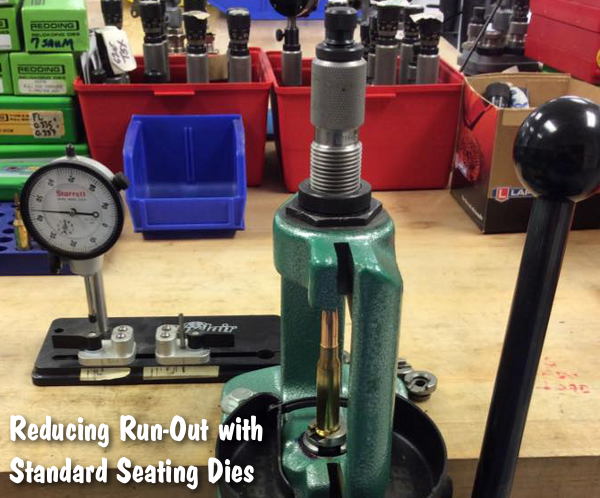
Now, we’ll set up a standard seating die to minimize TIR — the other half of the two-die equation. As before, we’ll use a single-stage press since most new handloaders will have one. A high-quality runout gauge is essential for obtaining consistent, accurate results.

Having sized, primed and charged our brass, the next step is bullet seating. Many approaches are possible; one that works well follows. When setting up a standard seating die, insert a sized, trimmed case into the shell-holder and fully raise the press ram. Next, back the seating stem out and screw the die down until the internal crimping shoulder touches the case mouth.

Back the die out one-quarter turn from this setting to prevent cartridge crimping. Next, lower the press ram and remove the case. Place a piece of flat steel on the shellholder and carefully raise the ram. Place tension on the die bottom with the flat steel on the shellholder. This helps center the die in the press threads. Check this by gently moving the die until it is well-centered. Keeping light tension on the die via the press ram, secure the die lock ring.

USAMU Handloading Hump Day Seating Die Adjustment Stem TIR Concentricity Run-out

If one were using a micrometer-type seating die, the next step would be simple: run a charged case with bullet on top into the die and screw the seating stem down to obtain correct cartridge OAL.

However, with standard dies, an additional step can be helpful. When the die has a loosely-threaded seating stem, set the correct seating depth but don’t tighten the stem’s lock nut. Leave a loaded cartridge fully raised into the die to center the seating stem. Then, secure the stem’s lock nut. Next, load sample cartridges and check them to verify good concentricity.

One can also experiment with variations such as letting the seating stem float slightly in the die to self-center, while keeping correct OAL. The runout gauge will show any effects of changes upon concentricity. However, the first method has produced excellent, practical results as evidenced by the experiment cited previously. These results (TIR Study 2) will reproduced below for the reader’s convenience.

TIR Study 2: Standard vs. Match Seating Dies

50 rds of .308 Match Ammo loaded using carefully-adjusted standard dies, vs. 50 using expensive “Match” dies from the same maker.

Standard dies, TIR:
0.000” — 0.001” = 52%;
0.001”– 0.002” = 40%;
0.002”– 0.003” = 8%. None greater than 0.003”.

“Match” dies, TIR:
0.000”– 0.001” = 46%;
0.001” — 0.002” = 30%;
0.002” — 0.003” = 20%;
0.003” — 0.004” = 4%.

AccurateShooter Comment: This shows that, with careful adjustment, the cheaper, standard dies achieved results that were as good (or better) than the more expensive “Match” Dies.

These tips are intended to help shooters obtain the best results from inexpensive, standard loading dies. Especially when using cases previously fired in a concentric chamber, as was done above, top-quality match dies and brass can easily yield ammo with virtually *no* runout, given careful handloading.

Permalink Reloading, Tech Tip 14 Comments »
October 4th, 2016

Toolmaker’s New Hammer — .284 Win F-Open Rig by Cigarcop

John Perkins 21st Century Shooting Cigarcop F-Open .284 Winchester

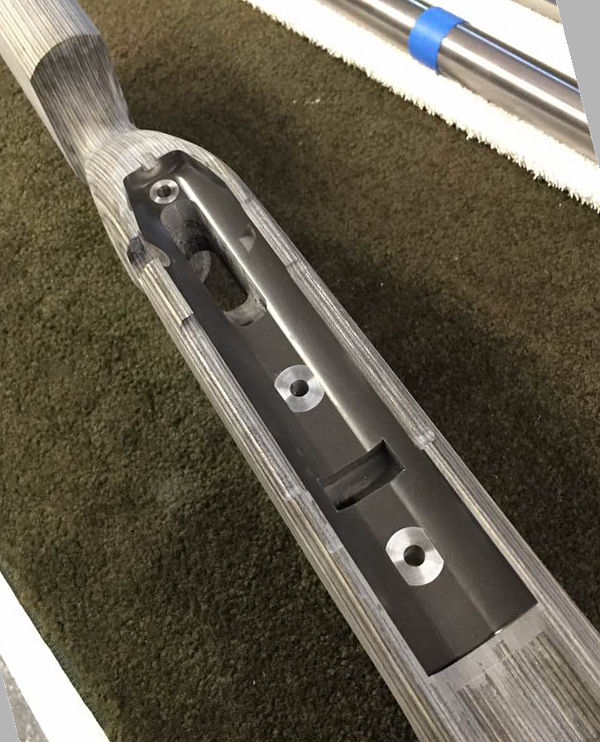
Forum member Keith W. (aka “Cigarcop”) is a talented riflesmith whose projects display outstanding finish work and attention to detail. Keith does some of the best bedding work we’ve ever seen. Recently Keith completed a rifle for tool-maker John Perkins, owner of 21st Century Shooting. John, who recently competed at the F-Class Nationals in Lodi, WI, wanted a new F-Open rifle with top-of-the-line hardware and a sweet-tracking stock. We think John will be impressed with this gun — and we bet it proves to be an tack-driving “hammer”. John will use the 21.5-lb rifle for F-Open competition and some mid-range and long-range benchrest competition in HG class.

This stock sports 12 coats of Urethane, wet-sanded between each coat.
John Perkins 21st Century Shooting Cigarcop F-Open .284 Winchester

This competition rifle features a melonited BAT “M” action (with Bix’N Andy trigger), a pair of 7mm Brux barrels chambered in .284 Win, and a Precision Rifle & Tool (PRT) Low-Boy stock. As you can see from these photos Keith posted in our Shooters’ Forum, this is a beautifully-finished rifle. If you have questions about this project, direct them to Cigarcop in this FORUM Thread.

Build Details for a Beautiful F-Open Rig
Keith reports: “The rifle is built on a PRT Laminated Low-Boy F-Class Stock with a Bat M Melonited Action, +20 MOA rail, Pillar bedded in Devcon 10110. After bedding and inletting I clear-coated the stock with 12 Coats of a 3-part Urethane finish which was wet-sanded between each coat and sanded out to 2000 before final polishing. John Perkins provided two Brux 1:9″-twist, 1.250″-contour barrels. They are both finished at 31″ and chambered in straight .284 Win with .313″ neck and .213″ freebore to shoot the 180gr Berger Hybrids.

Cigarcop does superb bedding work, as you can see…
John Perkins 21st Century Shooting Cigarcop F-Open .284 Winchester

John chose the Bix’N Andy trigger after sampling one of Erik Cortina’s rifles at the Berger SW Nationals. “I tried the BNA trigger on Erik’s gun and I was so impressed. It is very light but 100% consistent. After an injury I’ve lost some feel in my trigger finger and the BNA helps because it is so smooth. I would never go back to anything else.”

John Perkins 21st Century Shooting Cigarcop F-Open .284 Winchester

New Seating Die from 21st Century
While talking about his new rifle, John Perkins revealed that he has developed a very sophisticated new micrometer seating die: “This is something very new, and unlike anything else on the market. Each die is tailored to the dimensions and ogive curve of your particular bullet which we measure with an optical comparator. The customer provides fired, sized brass and sample bullets and we can produce a perfect match.”

John says his new seating dies produce ultra-consistent base-to-ogive load lengths along with exceptionally low run-out. “This new die produces incredibly straight ammo — there are some special features inside the die that help straighten the bullet during the seating process”. That delivers “truly superior concentricity” according to John. 21st Century Shooting will be taking orders soon for the new seating die. Call (260) 273-9909 for more information.

Permalink Competition, Gunsmithing 2 Comments »
September 19th, 2014

Tech Tip: Try Rotating Cartridge During Bullet Seating Process — This Might Reduce Bullet Run-Out

Redding Competition DieHere is a simple technique that can potentially help you load straighter ammo, with less run-out. It costs nothing and adds only a few seconds to the time needed to load a cartridge. Next time you’re loading ammo with a threaded (screw-in) seating die, try seating the bullet in two stages. Run the cartridge up in the seating die just enough to seat the bullet half way. Then lower the cartridge and rotate it 180° in the shell-holder. Now raise the cartridge up into the die again and finish seating the bullet.
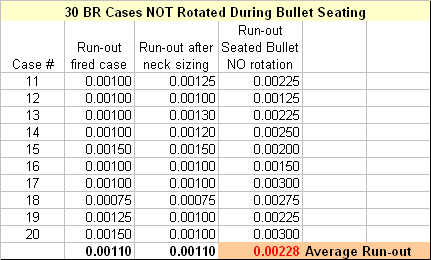
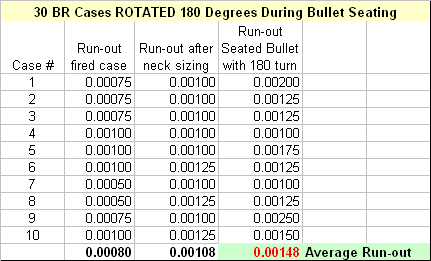
Steve, aka “Short Range”, one of our Forum members, recently inquired about run-out apparently caused by his bullet-seating process. Steve’s 30BR cases were coming out of his neck-sizer with good concentricity, but the run-out nearly doubled after he seated the bullets. At the suggestion of other Forum members, Steve tried the process of rotating his cartridge while seating his bullet. Steve then measured run-out on his loaded rounds. To his surprise there was a noticeable reduction in run-out on the cases which had been rotated during seating. Steve explains: “For the rounds that I loaded yesterday, I seated the bullet half-way, and turned the round 180 degrees, and finished seating the bullet. That reduced the bullet runout by almost half on most rounds compared to the measurements from the first test.”

run-out bullet

run-out bullet

Steve recorded run-out measurements on his 30BR brass using both the conventional (one-pass) seating procedure, as well as the two-stage (with 180° rotation) method. Steve’s measurements are collected in the two charts above. As you can see, the run-out was less for the rounds which were rotated during seating. Note, the change is pretty small (less than .001″ on average), but every little bit helps in the accuracy game. If you use a threaded (screw-in) seating die, you might try this two-stage bullet-seating method. Rotating your case in the middle of the seating process won’t cost you a penny, and it just might produce straighter ammo (nothing is guaranteed). If you do NOT see any improvement on the target, you can always go back to seating your bullets in one pass. READ Forum Thread….

Permalink Bullets, Brass, Ammo, Reloading 14 Comments »