The 2018 Western CMP Cup and CMP Games Event kicked off today at the Ben Avery Range in Phoenix, Arizona. The event runs through Monday, October 22, 2018. For 2018 the CMP takes over what were the Creedmoor Cup Matches, and all matches will now follow CMP High Power Rifle Competition Rules. Notably, this year the Cup and Games matches on the High Power range will be fired on the CMP’s electronic targets. That means less time in the pits, and faster cyeling of relay. Also new this year, the CMP will be adding more smallbore events at Ben Avery. Click HERE for full schedule of events.
The CMP Cup Matches include two CMP 1000 Aggregate Matches followed by a 4-Man Team Match and an EIC Service Rifle Match. Following the CMP Cup Matches will be the CMP Games Matches, which will include Small Arms Firing School (SAFS), Garand/Springfield/Vintage/Modern Military Matches, Carbine Match, Rimfire Sporter match and Vintage Sniper Team Match.
In past years, Dennis DeMille, former Creedmoor Sports General Manager, served as an instructor for the Small Arms Firing School at the Western Games. Below, Dennis shows a young competitor at the CMP Western Games how to adjust his leather sling.
Sling Shooting Tip — The Benefits of Leather
“Many shooters shy away from using a leather sling because they have never been taught how to use one. That’s unfortunate. A leather sling offers more support than a web sling, which is important when competing with the heavier than normal rifles.” — Dennis DeMille
The Benefits of Dry-Fire Training
Once you set up your sling properly, you’ll need practice. Dennis DeMille stresses the importance of dry-fire practice with sling and shooting coat. Dry-Fire training is essential to the sling disciplines. DeMille, a past National Service Rifle Champion, told us that, for every minute he spent in actual competition, he would spend hours practicing without ammunition. While in the USMC, Dennis would practice in the barracks, working on his hold and dry-firing:
“The most important thing is to spend time off the range practicing. Most of what I learned as a High Power shooter I learned without ammunition — just spending time dry firing and doing holding exercises. Holding exercises will really identify the weak parts of your position. The primary purpose of dry firing is to get you used to shooting an empty rifle. If you can shoot a loaded rifle the same way you shoot an empty rifle then eventually you will become a High Master.”
Dennis DeMille shows a young competitor at the CMP Western Games how to adjust his leather sling.
Setting-Up a Leather Service Rifle Sling for Competition
So you made the mistake of disassembling your leather service rifle sling, or are intimidated about how to use one? In this Creedmoor Sports InfoZone video, Creedmoor G.M. Dennis DeMille explains how to set up and use a sling. The covers the basics — Dennis starts with a totally disassembled leather service rifle sling and shows you how to set it up properly.
Tip: “Many shooters shy away from using a leather sling because they have never been taught how to use one. That’s unfortunate. In my opinion a leather sling offers more support than a web sling, which is important when competiting with the heavier than normal rifles.”
Configuring the Sling for the Standing (Offhand) Position
In this second in a series of Creedmoor InfoZone videos on the setup and use of the leather service rifle sling, Dennis DeMille details how to configure and best utilize the leather service rifle sling while shooting from the standing position.
Tip: “Putting the Frogs in different hole will change the amount of added elevation a sling provides.”
Looking at Sling Types — Comparing the Features
In this video Dennis showcases a large variety of shooting slings. He explains the strong points of each type so you can choose the sling best suited to your discipline and shooting style.
The Benefits of Dry-Fire Training
Once you know how to set up your sling properly, you’ll want to practice. Dennis DeMille stresses the importance of dry-fire practice with sling and shooting coat. Dry-Fire training is essential to the sling disciplines. Dennis DeMille, a national Service Rifle Champion, told us that, for every minute he spent in actual competition, he would spend hours practicing without ammunition. While in the USMC, Dennis would practice in the barracks, working on his hold and dry-firing:
“The most important thing is to spend time off the range practicing. Most of what I learned as a High Power shooter I learned without ammunition — just spending time dry firing and doing holding exercises. Holding exercises will really identify the weak parts of your position. The primary purpose of dry firing is to get you used to shooting an empty rifle. If you can shoot a loaded rifle the same way you shoot an empty rifle then eventually you will become a High Master.”
Each Wednesday, the U.S. Army Marksmanship Unit publishes a reloading “how-to” article on the USAMU Facebook page. A while back, the USAMU’s reloading gurus looked at the subject of case lubrication. Tasked with producing thousands of rounds of ammo for team members, the USAMU’s reloading staff has developed very efficient procedures for lubricating large quantities of cases. This article reveals the USAMU’s clever “big-batch” lube methods. For other helpful hand-loading tips, visit the USAMU Facebook page on upcoming Wednesdays.
Rapid, High-Volume Case Lubrication
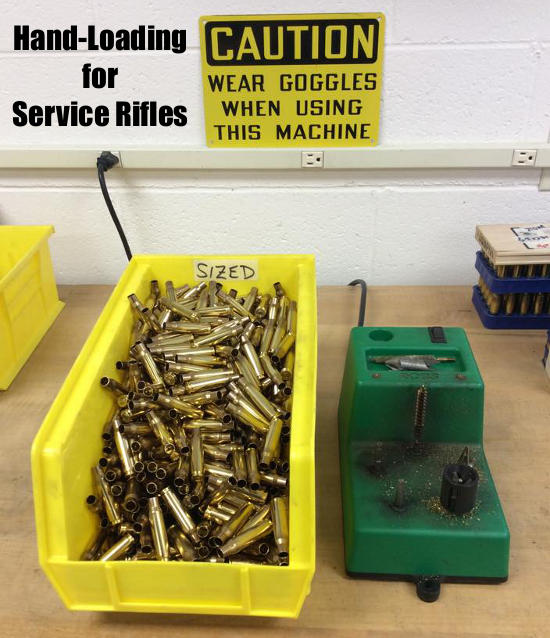
Today’s topic covers methods for quickly applying spray lube to cartridge cases prior to sizing. A typical order for this shop may be 25,000 rounds, so [speeding up] the lubrication process can be a real time-saver. While your ammunition lots probably aren’t this large, the efficient methods discussed here may help save a considerable amount of time over your handloading career. Our case lubrication rates range from 1500-1600 cases per hour, to 2400-2500 cases per hour, depending on caliber.
This shop uses virgin brass, whereas most home handloaders use fired brass, which necessitates some small changes at times. These will be discussed as they arise. Begin with fired brass that has been tumbled clean.
Ensure as much tumbling media as possible is removed from the brass, as when it gets into a size die, it can dent cases significantly. This is a good time to round out dents in the case mouths using a tapered tool to prevent damage from the decapping stem.
First, dump the clean cases into a large box or reloading bin. Shake the bin back and forth so that many cases are oriented with the mouths up. Next, pick up as many cases as is convenient with the mouths “up”, from natural clusters of correctly-oriented cases. With 7.62mm-size cases, this is usually 3-4, and with 5.56mm cases, this can be up to 8-10. Place the cases into the rack slots, mouth-up. Doing this in groups rather than singly saves considerable time. Once these clusters have been depleted, it will be time to re-shake the bin to orient more cases “up.”.
This photo shows a case lubrication rack made by a USAMU staffer.
Naturally, adjust the spacing to best fit the calibers you reload. We have found this size … convenient for handling through the various phases of case lubrication/transfer to progressive case feeders for processing. Note that the 1/2-inch angle does not cover much of the critical case area at the base, just forward of the extractor groove, where most re-sizing force will be exerted. As the USAMU uses virgin brass, less lubrication is required for our brass than would be needed for Full Length (FL) sizing of previously-fired brass.
NOTE: The amount applied using our rack is easily enough for our purpose. If using fired brass, be sure to adequately lube this base area to avoid having cases stick in the full-length sizing die.
Using a spray lube, coat the cases adequately, but not excessively, from all sides. Be sure to get some lube into the case mouths/necks, in order to reduce expander ball drag and case stretching/headspace changes. The spray lube this shop uses does not harm primers or powder, and does not require tumbling to remove after lubing.*
Take a close look at the photo above. The USAMU shop uses a common kitchen turntable, which allows the rack to be rotated easily. We place this in a custom-made box which prevents over-spray on to floors and walls.
Angled Box Method for Smaller Cases to be Neck-Sized
A refinement of the above method which especially speeds processing of 5.56x45mm cases is as follows. A small cardboard box which holds about 100 cases is fitted with an angled “floor” secured by tape. With the smaller 5.56mm cases, usually about 8-10 cases per handful can be picked up, already correctly-oriented, and placed into the box together. This prevents having to place them into the rack slots, saving time.
HOWEVER, note that this does not allow nearly as much lube access to the case bodies as does the rack. For our purposes — neck-sizing and setting neck tension on new brass, this works well. If using this procedure with fired brass, take steps to ensure adequate lube to prevent stuck cases.
As always, we hope this will help our fellow handloaders. Good luck, and good shooting!
*A two-part test performed here involved spraying primed cases heavily, while getting more lube into the case mouth/body than even a careless handloader would likely apply. The second part of the test involved literally spraying considerable quantities of the lube directly into the cases, drenching the primers. After a several-day wait to allow the lube to penetrate the primers, they were then fired in a test barrel. All fired normally; no unusual reports were noted. This bolstered confidence that normal amounts of the lube would not adversely affect our ammunition, and we have been pleased with the results over several years.
Next week, on August 2, 2017, the nation’s top Service Rifle Teams will compete in National Trophy Infantry Team (NTIT) Match at Camp Perry, Ohio. In this match, known informally as the “Rattle Battle”, six-member teams shoot at 200, 300, 500 and 600 yards with time limits — 384 rounds total. To win this match, the six shooters must work like a finely-tuned machine. This is a popular match with spectators as there is plenty of action in a short time span. SEE Camp Perry 2018 NM Schedule.
This video shows the winning 2011 NTIT team at Camp Perry. Six USAMU shooters started with a combined load of 384 rounds to be fired at 8 targets from 600 and 500 yards prone, then 300 yards seated, and finally 200 yards standing.
Last year, the USAMU-Barnhart Team won the title with a score of 1439, with the USMC Team seconed as 1406. The record for this match is 1466, set by the USAMU-Remily Team in 1996. 2017 Team Barnhart members included: SFC Shane Barnhart (coach), SFC Evan Hess (captain), SFC Brandon Green, SFC William Pace, SSG Cody Shields, SGT Joseph Peterson, SPC Lane Ichord, and PVT Forrest Greenwood. (U.S. Army photos by Michelle Lunato/released).
The National Trophy Infantry Team Match (NTIT) was first fired in 1922 and is part of the the CMP’s annual National Rifle Matches at Camp Perry. The NTIT is called the “Rattle Battle” because it emphasizes extremely fast, accurate fire.
Our friend Grant U., who runs the Precision Shooting Journal on Facebook, says the NTIT is a special match, a real “crowd-pleaser: “The National Trophy Infantry Team Match (Rattle Battle)… was always one of my favorite team events. It takes a hell of a lot more planning, practice, and precision than one might expect. You get one shot at it and the entire team had better be running on all cylinders because there are no alibis. Each team of six shooters is allocated 384 rounds and when the teams fire at 600 and 500 yards, it sounds like a war.”
SFC Brandon Green, one of the nation’s finest marksmen, won the 2018 NRA High Power Rifle Championship at Camp Atterbury, Indiana.
PHOTOS courtesy U.S. Army Marksmanship Unit. See more on USAMU Facebook Page.
AR-platform rifles are fun and versatile, but the standard, mil-spec triggers leave much to be desired. They tend to be gritty, with creep and heavy pull weight. One of the easiest, most effective AR upgrades is a trigger group swap. An improved fire control group makes a huge difference. There are many aftermarket trigger options for the AR platform rifles. Choose single-stage or two-stage, either standard trigger assembly or unitized “drop-in” trigger, such as those made by Timney or Triggertech.
When upgraded with a precision trigger and match barrel, AR-platform rigs work great in NRA High Power competitions (Photo from NRA Blog, at Camp Perry).
Two-Stage vs. Single-Stage Triggers
Two-stage triggers have two separate movements. The first stage offers a light, spring-loaded pressure that works against the shooter’s pull until stopping at the second stage – this is called “take-up”. If there is no spring pressure, it is known as “slack”. Should the shooter continue to pull the trigger once he’s arrived at the second stage, the mechanism will operate like a single-stage trigger from there until engaging the sear and firing the gun. Good trigger reset requires the shooter to keep pressure on the trigger, even during reset, to minimize movement of the muzzle.
Single-stage triggers feature no take-up or slack, as they begin engaging the sear as soon as the shooter begins pulling the trigger. Some competitive shooters prefer the two-stage trigger because of the feedback it provides during its first stage, while other shooters, including those using their rifle in tactical scenarios, may want the surety of a single-stage trigger, ready to engage and fire once their finger is inside the trigger guard. Regardless of preference, a good trigger will feature minimal creep and should be free of grittiness, providing a smooth, even break.
Drop-In Trigger Assembly vs. Standard Trigger Group
Once you decide between a single-stage or two-stage trigger, you can choose between standard and drop-in trigger groups. Standard trigger groups feature all the fire control group parts separated, and need to be pieced together and installed much like a mil-spec trigger, while drop-in trigger are pre-assembled and contained within a casing that simply drops in to the receiver and accepts the pins, hence the name.
After-Market Trigger Comparison
Some shooters prefer drop-in triggers due to the ease of installation, while others opt for standard groups so they can access the components individually for cleaning adjustment or replacement. If one piece of a drop-in trigger fails, you’ll need to either replace the entire unit or send it to the manufacturer for repair, whereas you may be able to simply replace the broken component of a standard trigger without needing a whole new trigger set.
Trigger Terminology — “Creep”, “Stacking”, “Overtravel”
“Creep” or “travel” is the distance the trigger moves between the end of take-up and when the trigger breaks to fire the fun. Too much creep can affect accuracy, but no creep can be unsafe, as the shooter may not be prepared to fire. “Stacking” occurs when the trigger weight actually increases during travel — this shouldn’t happen. Lastly, “overtravel” is the distance the trigger continues moving back after the gun fires.
This article is based on a longer story in the NRA Blog.
TALLADEGA, Alabama — The Annual D-Day Anniversary Matches will be held June 8-10, 2018, at the CMP’s Talladega Marksmanship Park in Alabama. The event commemorates the Anniversary of the Allied landing at Normandy in June, 1944. In 2015, the $20-million-dollar Talledega Park celebrated its Grand Opening with its first D-Day Match. That was a great success, and the 2018 D-Day Match promises to be even better. This has become a hugely popular event — last year there were over 250 competitors. For many, this match was their first opportunity to shoot on electronic targets. That speeds up the relays and nobody complained about not having to do pit duty.
It’s not too late to join the fun — there are still slots available for the event. You can register online. For more information, email shall [at] thecmp.org or phone 256-474-4408 ext. 414.
EDITOR: Worth Watching! Guys, this nicely-produced video shows multiple disciplines (including Service Rifle, Carbine, Pistol, and Vintage Sniper) and lets you see how the electronic targets work. We highly recommend you watch this video.
Electronic Targets + No Pit Duty = More Fun
Competitors will be firing all matches on electronic targets. The John C. Garand Range has a huge firing line with monitors at all shooting stations. These connect to three banks of electronic targets positioned at 200, 300, and 600 yards. Spectators can view the results in real time on large monitors.
INVITATION: The CMP’s John C. Garand D-Day Anniversary Match is a big event with many different competitions for rifle and pistol shooters. Along with the signature M1 Garand event, a Vintage Sniper Match, EIC Service Rifle Match, .22 Rimfire Pistol Match, EIC Service Pistol Match, and .22 Rimfire Pistol matches will be conducted.
State of the Art Shooting Facility in Alabama
The 500-acre CMP Talladega Marksmanship Park is one of the most advanced outdoor shooting facilities in the Western Hemisphere. The facility includes a 600-yard rifle range, a 100-yard multi-purpose range, and a 50-yard pistol range, equipped with Kongsberg electronic targets and scoring monitors that allow shooters on the firing line to review shots in a matter of seconds. Since the 54 targets at each line register hits and calculate the scores, no pit duty is required at Talladega.
State-of-the-art Kongsberg target systems are used at the CMP’s Talladega Marksmanship Park.
The 2018 CMP competition rules are now approved and posted on the CMP website. The 2018 CMP Highpower Rifle and Pistol Competition Rules and the 2018 CMP Games Rifle and Pistol Competition Rules can be downloaded on the CMP Competition Rules Page.
Evolution of CMP Competition Rules
There are a number of important CMP Rule changes for 2018 that are spelled out below. CMP Competition Rules have undergone major changes in the last few years that were aimed at modernizing the CMP competition program and promoting greater participation in rifle and pistol target shooting. In 2015, rule changes expanded the types of pistols that can be used in EIC and National Match Service Pistol events and introduced the immediately popular CMP 22 Rimfire Pistol Distinguished program. The most significant 2016 change was the authorization for Service Rifle shooters to use optical sights with 4.5X max magnification. 2017 saw the introduction of a new classification system, rules for electronic targets and the addition of rules for “Alternative Rifles” and “Match Rifles”.
Important Rules Changes for 2018
The biggest change in the 2018 Rules is the introduction of a two-track system for conducting CMP-sanctioned Highpower Rifle Matches. Highpower Rifle events can now be conducted as either traditional “National Trophy Rifle Events” where there are no sighting shots and competitors start rapid-fire series from standing or as “CMP Cup Match Events” where sighting shots are allowed before each stage and competitors start rapid-fire series in position. All EIC Rifle Matches and Camp Perry National Trophy Matches will continue to be conducted according to National Trophy rules, with no sighters and rapid-fire starting from standing. The CMP Cup Matches, which are scheduled at the beginning of the 2018 CMP Highpower Rifle Matches at Camp Perry on 23-25 July, and the CMP Cup Matches, which are included in the 2018 CMP Travel Games programs, will be conducted under Cup Match rules with sighters and rapid-fire stages starting in position.
The rules for CMP As-Issued Military Rifle and Pistol events and Rimfire Sporter Matches remain unchanged in this regard. These events typically allow sighters at the beginning of each course of fire. Competitors start rapid-fire series from standing, but any competitors who are 70 or over or who have physical limitations that prevent them from readily standing and getting back into position are allowed to start rapid-fire series in position.
Otherwise the 2018 CMP Games Rifle and Pistol Rules, which include Rimfire Sporter Rifle Rules, have only minor changes from the 2017 edition.
National Records — Rules providing for the official recognition of National Records in open and junior categories in CMP-recognized events were added for 2018. The CMP is compiling its first list of official records and will post it on the CMP website as soon as it is ready. To be recognized as National Records, scores must be fired in the National Matches or in competitions conducted by the CMP staff such as CMP Travel Games or National Range Matches.
CMP Smallbore Matches Coming to Camp Perry
Traditional smallbore rifle championships are returning to Camp Perry in 2018 and rules for those events are being drafted now. The 2018 National Matches Calendar features six days of CMP Smallbore Rifle shooting on 17-22 July. There will be two days of smallbore position and four days of smallbore prone shooting, along with one full day of Rimfire Sporter Rifle competition on 22 July. Provisional CMP Smallbore Rifle Rules will be released in the next few weeks.
Electronic Targets — A new section has been added to the CMP Rulebooks to help explain and clarify the CMP’s Electronic Scoring Target Rules. See Rule 7.0 in the CMP Competition Highpower Rifle and Pistol Competition Rules or Rule 9.0 in the CMP Games Rifle and Pistol Competition Rules.
In the 2016 President’s 100 Match, Match Winner Keith Stephens, runner-up SFC Evan Hess, and third-place Hugh Reich all used scopes, making for an All-Optics Podium. Both Stephens and Reich used the 1-4.5x24mm March.
Are you a Service Rifle shooter or would you like to give Service Rifle competition a try? The big news in this discipline is that magnified optics up to 4.5 max power can now be used. You can still use classic iron sights, but most serious Service Rifle competitors have moved to optics — and nearly all the “top guns” at major matches are running optics. Our friend Dennis Santiago, who is doing a long-term test of the Nightforce SR 4.5x24mm scope, says magnified optics are the future of the Service Rifle Game. If you want to win these days, you need glass.
Optics Options from $120 to $2400
You have many optics choices running all the way up to a 1-4.5x24mm March at $2338.00. But you don’t have to spend a fortune to get a good optic. Our Systems Admin, Jay Christopherson, will be trying the Konus XTC-30 1-4X24mm sold by Creedmoor Sports and the CMP. Priced at $495.00, the Konus has good glass and parallax set at 200 yards. And if you want the best deal going for a Service Rifle scope, right now Cabela’s offers the Vortex Crossfire II 1-4x24mm scope for just $119.88 with Free Shipping (Promo Code 2017FREE). That’s an incredible deal on a scope that can do double-duty on your hunting rifle. This same Vortex 1-4X optic sells for $188.88 on Amazon.
Super Deal — Vortex 1-4x24mm Scope for $119.88
Service Rifle Optics — How They Will Change the Game
Under NRA and CMP Rules first promulgated in 2016, Service Rifle competitors can use a scope with up to 4.5X magnification, and 34mm max objective. This rule revision to allow magnified optics will be a game-changer says Service Rifle shooter Dennis Santiago.
Dennis explains: “Per the 2016 Rulebooks of the CMP and NRA, today’s Service Rifle is now defined to include an M-16/AR-15 variant with an optical sighting system not to exceed 4.5X magnification. So, this optic-equipped rifle goes head-to-head with the match-tuned M-16A2/AR-15A2 iron sight guns in the same class. The rules were updated to take into account that some military branches no longer train service members to shoot iron sights as their primary marksmanship method and have switched to reliance on combat optics. The rules were debated and tried in 2015 and codified at the beginning of 2016. The 2016 Nationals were the first where the old and new generation guns compete side-by-side.
Here is my personal prediction: There will be improved scores by Expert Class shooters who figure out how to work with optics jumping into Master class. At the High Master level, there may be a slight rise in numerical scores but there will be a massive jump in X-Count. EICs will remain the all-out race they’ve always been; whoever makes the fewest mistakes wins the day.”
What to Look For in a Service Rifle Optic
by Johnny Fisher
2016 brought with it a long-anticipated rule change that allows for the use of optics in Service Rifle competition. Thus far, it seems the biggest concerns that Service Rifle shooters have when considering an optic are: quality, repeatability, parallax, reticle choices, and durability.
Parallax Considerations
The vast majority of Service Rifle Rule-compliant scopes currently on the market have a fixed parallax. That means there is no separate focus knob to adjust parallax to target distance. Accordingly, there has been much concern about the potential for parallax error over the three different distances in Across-The-Course competition. It is possible that the repeatably-indexed head position maintained while shooting a Service Rifle, along with a little extra emphasis on sight alignment to ensure that the shooter’s eye is directly behind the scope, can greatly mitigate the potential effects of parallax error. [Editor: However, we have talked with a number of Service Rifle shooters. Most would like adjustable parallax. If the parallax must be fixed, they would like it set at 200-300 yards. 100 yards is too close.]
Reticle Choices — Something to Consider
My Nightforce 1-4X scope has the IHR Reticle, which provides a very clear, unobstructed and simple sight picture. The IHR reticle for the NXS 1-4x24mm boasts an illuminated center cross-hair. Unfortunately, the red-color illumination is really only intended for low-light situations and is not bright enough to offer any aid to National Match shooters competing in broad daylight at stationary targets.
Editor: Unlike PRS competitors who (mostly) shoot bright-painted steel plates, Service Rifle competitors aim at traditional black bullseyes. The bullseye target design makes sense for iron sight shooters. With magnified optics you have some kind of black reticle that may not stand out at well against the black bull at 4.5 max power. You probably want to look through a number of different scopes to chose a reticle that works best for your eyes and aiming procedure.
The U.S. Army Marksmanship Unit (USAMU) has published a great series of reloading “how-to” articles on its Facebook Page. This post covers key factors to consider when loading ammunition for Match Rifles and Service Rifles, with a particular focus on self-loading “gas guns”. Visit the USAMU Facebook Page each Wednesday for other, helpful “Handloading Hump-Day” tips.
We offer some “cardinal rules” to help new gas-gun handloaders with safety and efficiency. These address both Match Rifle and Service Rifle versions of the AR15, M1 Garand, M1A, and M110. However, they can also improve safe reloading for many other auto-loaders such as M1 Carbines, FALs, SIGs, etc. The author distilled these principles many years ago to help focus on the essential aspects of these rifles.
RULE ONE: Service Rifles Are Not Benchrest Rifles
Gas-guns require a relatively loose fit between ammunition and chamber (vs. bolt actions) for safe, smooth operation. Many techniques, such as neck sizing and keeping cartridge headspace quite tight, are popular in the extreme bolt gun accuracy realm. However, they are of little value with Service Rifles, and some could even be hazardous. Before adopting a specialized technique, seriously consider whether it is appropriate and beneficial in a gas-gun.
RULE TWO: Never Compromise Safety to Obtain Accuracy
Example: If choosing a brand of great, but ultra-sensitive match primers offers possibly better accuracy at the risk of slam-fires in your design of rifle, don’t do it! You are issued exactly two eyes and ten fingers (best-case scenario). Risking them trying to squeeze 0.25 MOA better accuracy out of an M1A, etc. simply isn’t worth it.
RULE THREE: Tailor the Precision to Your Individual Skill and Your Rifle’s Potential
This has been addressed here before, but bears repeating for newcomers. If you are struggling to break out of the Marksman Class, or using a CMP M1 “As-Issued,” then laboriously turning the necks of your 600-yard brass is a waste of time. Your scores will improve much faster by practicing or dry-firing. On the other hand, if the reigning champions anxiously check your scores each time you fire an event, a little neck-turning might not be so far-fetched.
Verifying Load Improvements — Accuracy hand-loading involves a wide variety of techniques, ranging from basic to rather precise. Carefully select those which offer a good return on investment for your time and labor. In doubt? Do a classic pilot study. Prepare ammo for at least three or four ten-shot groups with your new technique, vs. the same with your standard ammo. Then, pick a calm day and test the ammo as carefully as possible at its full distance (e.g. 200, 300, or 600 yards) to verify a significant improvement. A little testing can save much labor!
RULE FOUR: Be Your Own Efficiency Expert
Serious Service Rifle shooters generally think of ammunition in terms of thousands of rounds, not “boxes”, or even “hundreds”. Analyze, and WRITE DOWN each step in your reloading process. Count the number of times each case is handled. Then, see if any operations can be dropped or changed without reducing safety or accuracy. Eliminating just two operations saves 2000 steps per 1000 rounds loaded. Conversely, carefully consider any measurable benefits before adding a step to your routine.
RULE FIVE: In Searching for Greater Accuracy with Efficiency, Look for System Changes
For example, instead of marking your 300-yard rounds individually to differentiate them from your 200-yard ammo, would a simple change in primers work? If accuracy is maintained, using brass-colored primers for 200 and silver for 300 provides an indelible indicator and eliminates a step! Similarly, rather than spending hours selecting GI surplus brass for weight and neck uniformity, consider splurging on some known, high-quality imported match brass for your 600-yard loads. Results should be excellent, time is saved, and given limited shooting at 600 yards, brass life should be long.
RULE SIX: Check All Your Primers Before Packaging Your Loaded Ammo
This seems simple and even intuitive. However, many slam-fires (which were much more common when M1s and M1As were the standard) are due, at least in part, to “high” primers. Primers should be seated below flush with the case head. The USAMU has addressed this at length in a previous column, but each round should be checked for properly-seated primers before they are packaged for use.
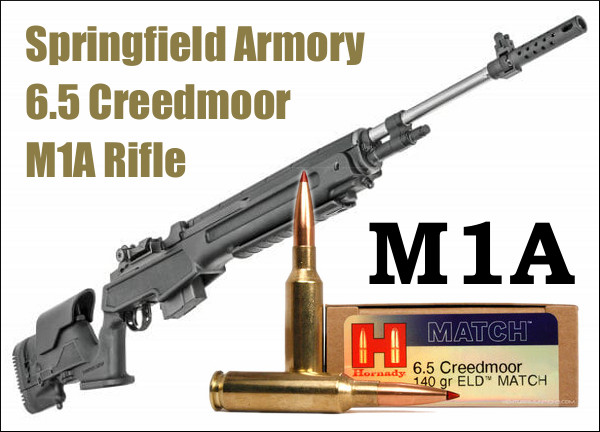
The 6.5 Creedmoor craze goes one step further. Soon you can buy a Springfield M1A chambered for this mid-sized cartridge popularized by PRS shooters. Both bolt-action and AR-platform rifles chambered for the 6.5 Creedmoor have been available for quite some time, but this is a new direction for the M1A, which has traditionally been chambered for the 7.62×51 NATO/.308 Winchester round. As chambered for the 6.5 Creedmoor, Springfield’s M1A should be easier on shooters’ shoulders. The 6.5 Creedmoor M1A has 28% less recoil than the .308 Winchester version.*
The new 6.5 Creedmoor M1A features a 22″ medium-contour, 1:8″-twist stainless barrel with factory muzzle brake. The rifle comes with iron sights: .062 post front sight and .0520 aperture rear sight adjustable for ½ MOA windage and 1 MOA elevation. Springfield ships the rifle with a 2-stage trigger tuned to 4.5 – 5 pounds. A Springfield Armory Optics mount is available to fit a magnified optic, but, to be honest, we haven’t been very impressed with that mount.
Two stock options are offered: a basic black polymer stock (not recommended — it’s weak and flexy) or a deluxe “precision” stock with adjustable cheekpiece and adjustable LOP. The deluxe precision stock, shown above, is much more rigid, and can be configured with front underside Picatinny rail (see video). Rifle Specs HERE.
With the basic polymer stock, the 6.5 Creedmoor weighs 11.4 pounds (unloaded) and has a $1985.00 MSRP. With the adjustable precision stock, the gun is a bit heavier and retails for $2045.00 in either matte black or Flat Dark Earth (FDE).
“Having a 6.5 Creedmoor caliber in the M1A lineup gives long-range shooters more choices with the precision and accuracy they require,” says Springfield Armory CEO Dennis Reese. “They can choose the round they prefer…”, i.e. .308 Win or the 6.5 Creedmoor. Excellent factory ammo is available for both chamberings.
Photo of 2009 M1A Match at Camp Perry. Shooter is Nick Till, 2007 Service Rifle Champion.
If you are looking for a robust semi-auto rifle that has an interesting legacy (the M1A was derived from the U.S. Military’s M14), this new M1A may suit your tastes. Every year at Camp Perry, Springfield Armory sponsors a very popular M1A match which attracts marksmen from around the country. We can’t say for sure that the 6.5 Creedmoor M1As will be allowed in M1A matches, but we would expect they will, though perhaps competing in a separate division.


 The Benefits of Dry-Fire Training