|
|
May 11th, 2016
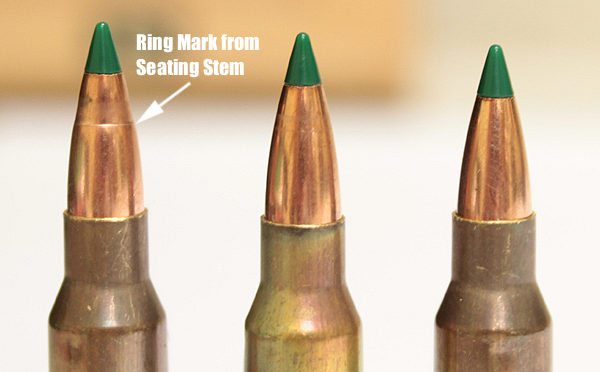
Here’s a helpful hint for hand-loaders from Sierra Bullets. While this article focuses on Sierra’s new Tipped Match-King bullets, the recommended solutions apply to other bullet types as well. The article explains how sharp edges on a seating stem can cause a ring to be pressed into the bullet jacket — especially with compressed loads that resist downward bullet movement. Here Sierra technician Rich Machholz diagnoses the problem and provides a solution.
Solutions for Ring Marks Caused by Seating Stems
by Sierra Bullets Ballistic Technician Rich Machholz
Now that the new Tipped MatchKing® (TMK) bullets are being shipped and shooters are putting them to use I have received several calls regarding marking on the bullet ogive from the seating stem.
The cause can be traced to one of several things.
In the .223 and especially with the long, 77 grain TMK seated at 2.250” or even 2.260” most loads of Varget® and Reloder® 15 are compressed loads, sometimes heavily compressed. This puts a great deal of pressure on the bullet through the seating stem. The result of all this pressure is a mark of varying depth and appearance on the ogive of the bullet. [Editor: We have seen this issue with a variety of other bullet types/shapes as well, including non-tipped VLDs. The solution is profiling the internal cone of the seating stem to match your bullet shape.]
Some older seating stems might even bear against the tip of the bullet which can make a slight bulge in the jacket just below the junction of the resin tip and the copper jacket in a compressed load. If this is the case there is not a ready fix other than calling the die manufacturer and requesting a new deeper seating stem.
Polish Your Seating Stem to Remove Sharp Internal Edges
If the seating stem is of proper depth the culprit most generally is a thin sharp edge on the inside taper of the seating stem. This is an easy fix that can be accomplished by chucking a spare 77 grain bullet in your drill, coating it with valve grinding compound or even rubbing compound or in a pinch even tooth paste.* Remove the seating stem assembly from the seating die. Turn the drill on and put the seating stem recess over the spinning bullet with the polishing compound to break or smooth the sharp edge that is making the offending mark. This might take more than one application to get the proper polish depending upon what you use, but the more you polish the better the blend of angles which will [ensure the stem matches the bullet contours, not leaving a sharp ring].

If the above is a little more than you care to tackle you might try very fine emery cloth twisted to a point that can be inserted into the mouth to the seating stem and rotated to polish the inside to eliminate any sharp edges that might be present.
Load Advice for 77gr TMKs in the .223 Rem
And last but certainly not least. Actually, even though we don’t say you need additional data for the TMKs, remember you are dealing with heavily-compressed loads in some cases because of the additional bullet length. Due to the additional length of these new bullets and in the interest of gaining some room in the case you might consider trying a slightly faster extruded powder like BenchMark or the 4895s or an even more dense powder like the spherical H335®, CFE223 or TAC. The extra room will allow for trouble free bullet seating also.
Good luck and remember we are no further away than your telephone: 1-800-223-8799.

May 7th, 2016

Ever wonder how (and where) Sierra tests its bullets? The answer is underground, in a 300-meter test tunnel located under Sierra’s factory in Sedalia, Missouri. The photo above shows the construction of the tunnel back in May, 1990. Like most bullet manufacturers, Sierra does live-fire bullet testing to ensure that Sierra projectiles perform as promised, with repeatable accuracy. Sierra’s 300-meter test range is the longest, privately-owned underground bullet test facility in the world. Sierra offers free tours of the test tunnel as part of Sierra’s Factory Tour Program.

Sierra Bullets tests every new bullet design and each lot of bullets. Sierra tells us: “When [we] change to a new bullet they are continually shooting them until they get the bullet properly set up and running and the range releases them to run (meaning the bullets shoot to spec). [Testers] are required to shoot at any lot change and periodically throughout the lot … even if it is just a press operator change. Lot sizes can vary from 5,000 to over 100,000 thousand. If anything changes — it is a new lot. When a new operator comes on — it is a new lot.”
Bevy of Barreled Actions for Bullet Testing
Sierra Bullets uses dozens of barreled actions for testing bullets. These barreled actions are clamped in stout, return-to-battery test fixtures. These heavy test fixtures provide near-perfect repeatability (with no human-induced holding or aiming errors). Each barrel has its own logbook to track the barrel’s usage. Interestingly, Sierra does not have a specific round count for barrel life. When a barrel starts “opening up”, i.e. showing a decline in accuracy, then the barrel is replaced, whether it has 800 rounds through it or 5,000.

Click Photo to Zoom
Sierra Bullets 10-Shot Groups at 200 yards
What kind of 200-yard accuracy can you get in an enclosed, underground test range? Would you believe 0.162 MOA at 200 yards with a .338? Check out these 10-shot test groups shot at the Sierra Test Range at 200 yards. Note that the numbers listed on each sample are actual measurements in inches. To convert to MOA, cut those numbers in half (to be more precise, divide by 2.094, which is 1 MOA at 200 yards). For example, the 0.340″ middle group works out to 0.162 MOA at 200 yards.

October 29th, 2015

High-BC 7mm bullets are favored by many of the top long-range and F-Class (Open) shooters. Now, thanks to Sierra Bullets, there is a new “heavy-weight contender” in the 7mm match bullet category. Sierra has just introduced an all-new 183 grain 7mm HPBT MatchKing, part # 1983. This impressive new projectile boasts a 0.707 G1 Ballistic Coefficient (at 2300+ fps), plus — get this — it comes “tipped” from the factory. The final meplat tipping operation ensures a higher, more uniform BC. Recommended barrel twist rate is 1:8″ or faster.

Sierra says its new 183gr 7mm MatchKing has a modern, low-drag shape: “A sleek 27-caliber elongated ogive and a final meplat reducing operation (pointing) provide an increased ballistic coefficient for optimal wind resistance and velocity retention. To ensure precise bullet to bore alignment, a unique bearing surface to ogive junction uses the same 1.5 degree angle commonly found in match rifle chamber throats.
The new 7mm 183gr HPBT bullets will be available in boxes of 500 bullets (#1983C) with MSRP of $256.34 per box and boxes of 100 bullet (#1983) with MSRP of $51.80 per box. NOTE: Sierra states that “MatchKing® and Tipped MatchKing® bullets are not recommended for most hunting applications.”
September 27th, 2015

Image by ModernArms, Creative Common License.
by Philip Mahin, Sierra Bullets Ballistic Technician
This article first appeared in the Sierra Bullets Blog
The ANSI / SAAMI group, short for “American National Standard Institute” and “Sporting Arms and Ammunition Manufacturers’ Institute”, have made available some time back the voluntary industry performance standards for pressure and velocity of centerfire rifle sporting ammunition for the use of commercial manufacturers. [These standards for] individual cartridges [include] the velocity on the basis of the nominal mean velocity from each, the maximum average pressure (MAP) for each, and cartridge and chamber drawings with dimensions included. The cartridge drawings can be seen by searching the internet and using the phrase ‘308 SAAMI’ will get you the .308 Winchester in PDF form. What I really wanted to discuss today was the differences between the two accepted methods of obtaining pressure listings. The Pounds per Square Inch (PSI) and the older Copper Units of Pressure (CUP) version can both be found in the PDF pamphlet.
 CUP Pressure Measurement CUP Pressure Measurement
The CUP system uses a copper crush cylinder which is compressed by a piston fitted to a piston hole into the chamber of the test barrel. Pressure generated by the burning propellant causes the piston to move and compress the copper cylinder. This will give it a specific measurable size that can be compared to a set standard. At right is a photo of a case that was used in this method and you can see the ring left by the piston hole.
PSI Pressure Measurement
What the book lists as the preferred method is the PSI (pounds per square inch or, more accurately, pound-force per square inch) version using a piezoelectric transducer system with the transducer flush mounted in the chamber of the test barrel. Pressure developed by the burning propellant pushes on the transducer through the case wall causing it to deflect and make a measurable electric charge.
Q: Is there a standardized correlation or mathematical conversion ratio between CUP and PSI values?
Mahin: As far as I can tell (and anyone else can tell me) … there is no [standard conversion ratio or] correlation between them. An example of this is the .223 Remington cartridge that lists a MAP of 52,000 CUP / 55,000 PSI but a .308 Winchester lists a 52,000 CUP / 62,000 PSI and a 30-30 lists a 38,000 CUP / 42,000 PSI. It leaves me scratching my head also but it is what it is. The two different methods will show up in listed powder data[.]
So the question on most of your minds is what does my favorite pet load give for pressure? The truth is the only way to know for sure is to get the specialized equipment and test your own components but this is going to be way out of reach for the average shooter, myself included. The reality is that as long as you are using printed data and working up from a safe start load within it, you should be under the listed MAP and have no reason for concern. Being specific in your components and going to the load data representing the bullet from a specific cartridge will help get you safe accuracy. [With a .308 Winchester] if you are to use the 1% rule and work up [from a starting load] in 0.4 grain increments, you should be able to find an accuracy load that will suit your needs without seeing pressure signs doing it. This is a key to component longevity and is the same thing we advise [via our customer service lines] every day. Till next time, be safe and enjoy your shooting.

September 17th, 2015

Barney M. Auston of Tulsa, OK with rifle he built to break NBRSA record and win $250 cash award from Sierra Bullets. (From cover of Precision Shooting magazine. May 1956).
Way back in 1955 Sierra Bullets offered a $1000 prize for anyone setting a new Aggregate benchrest record with a 6mm (or larger) bullet. At the time the .222 Remington ruled the roost, and Sierra wanted to promote the larger caliber. Sierra also offered a $250.00 prize for a record-breaking performance with any size caliber (including the .22s). Here is the story of how a Tulsa shooter claimed the $250.00 award with a world-record-setting Aggregate involving 10-shot groups at 100 and 200 yards.
Barney Auston’s record-setting rifle was built on an FN Mauser action with double set trigger, with a Hart stainless steel barrel, 30″ x 1 1/8″, chambered for the .222 Remington cartridge. The stock, made by Auston, has a hydraulic bedder as made by L. F. Landwehr of Jefferson City, MO. The scope is a 24X, 2″ inch Unertl. Mr. Auston shot 50gr bullets, custom made by W. M. Brown of Augusta, Ohio, with .705″ Sierra cups and soft swedged. His powder charge was 21 grains of 4198. The rifle rests, both front and rear, were also made by Auston.
Record-Setting Performance
On August 20, 1955, shooting at night in a registered shoot on the John Zink range near Tulsa, Oklahoma, Barney M. Auston of Tulsa broke the existing National Match Course aggregate record and, as the first to do that in 1955, won the Sierra Bullets $250 cash award. Here is the original Sierra Bullets prize offer from 1955:

10-Shot Groups at 100 and 200
Mr. Auston’s winning Aggregate for the National Match Course (five 10-shot groups at 100 yards and five 10-shot groups at 200 yards) was .4512 MOA. He also broke the 200-yard aggregate with an average of .4624 MOA, beating the .4801 match MAO record set by L.E. Wilson only a month earlier.
Barney Auston was a custom rifle maker in Tulsa who fabricated the rifles used by many of the leading benchrest competitors in the Mid-Continent and Guild Coast Regions. Auston was himself one of the top benchrest shooters in those regions during his shooting career.
Editor’s Note: Both of Mr. Auston’s records were broken before the end of the 1955 shooting season, but Auston was the first to win the Sierra Prize. Interestingly, in setting his record, Austin broke the existing Agg record by L.E. Wilson of Cashmere, Washington — yes, the same L.E. Wilson that now makes dies.
July 25th, 2015

What we now know as the “6mm Remington” was originally called the .244 Remington. The cartridge was renamed because it was not a commercial success initially, being eclipsed by the .243 Winchester. The .244 Remington and the 6mm Remington are identical — only the name was changed. Why was the .244 Remington an “also-ran” to the .243 Win? Sierra Bullets Ballistics Technician Paul Box provides some answers…
Was Anything Wrong With The .244 Remington?
by Ballistic Technician Paul Box for Sierra Bullets Blog
The year was 1955. A time of carhops, drive-in movies, and Buffalo Bob. It was also the year that Winchester introduced the .243 Win and Remington counter-punched with the .244 Remington (now more commonly known as the 6mm Remington). The .243 Win was based off the time-proven .308 Win case while Remington chose the old war horse, the 7×57.
We’ve all read countless times how Winchester chose the 1:10″ twist, while Remington adopted the 1:12″ twist for their .244 Rem rifles. The first complaint in the gun magazines of that era was how the faster twist Winchester could handle 100 grain bullets, while Remington’s [12-twist factory rifles were supposedly limited to 90 grain bullets].
The first complaint I remember reading was that the 100-grainer was better suited for deer-sized game and the 1:12″-twist wouldn’t stabilize bullets in this weight range. Now, let’s look at this a little closer. Anybody that thinks a 100-grainer is a deer bullet and a 95-grainer isn’t, has been drinking too much Kool-aid. In all honesty, it’s all about bullet construction and Remington had constructed the [90s] with light game in mind. In other words, Remington got it right, but due to a lack of knowledge at the time on both bullet construction and stability, the .244 never gained the popularity it deserved. At that time, Sierra had the 100gr SMP and Hornady offered a 100gr RN that would both stabilize in the slower 1-12″ twist. The .244 Remington provides another classic example of how the popularity of a cartridge suffered due to a lack of knowledge.
.244 Rem vs. .243 Win — What the Experts Say
Respected gun writer Chuck Hawks says the .244 Remington deserved greater acceptance: “The superb 6mm Remington started life in 1955, the same year as the .243 Winchester. It was originally named the .244 Remington. Although the 6mm lost the popularity contest to the .243, it is one of my favorite rifle cartridges, and much appreciated by reloaders generally. The .244 Rem and 6mm Rem cartridges are completely interchangable, and anyone with a .244 Rem rifle can shoot [6mm Rem] ammunition in complete safety (or vice-versa). Remington .244 rifles made from 1958 on can stabilize all 6mm bullets, while those made in 1955 through 1957 are limited to loads using spitzer bullets not heavier than 90 grains for best accuracy.”
Nathan Foster, author of The Practical Guide to Long Range Hunting Cartridges, states: “In 1963 Remington attempted to regain ground by releasing .244 rifles with a new 1:9″ twist to handle heavier bullets. The cartridge was renamed the 6mm Remington and new ammunition was loaded giving the hunter the choice of either an 80gr bullet for varmints or a 100gr bullet for deer. In comparison to the .243 Win, factory loads for the .244/6mm Remington are slightly more powerful while hand loads increase this margin further.”

Was the .244 Remington Actually Better than the .243 Winchester?
The .244 Remington (aka “6mm Remington”) has a velocity advantage over the .243 Winchester due to a slightly larger case capacity. The longer case neck of the .244 Remington is considered desirable by handloaders. We like the added capacity and long neck of the original .244 Remington. As renamed the “6mm Remington”, the cartridge HAS developed a following, particularly with varmint hunters looking for a high-velocity 6mm option. But it never achieved the success of the .243 Winchester for many reasons. As a member of the .308 family of cartridges, the .243 Winchester has certain obvious advantages. First, you can simply neck down .308 Win brass, which was available at low cost from many sources. Moreover, a .308 Win or 7mm-08 full-length sizing die could be used for body sizing. Still the .244 Remington (6mm Remington) presents an interesting “what if?” story…
July 5th, 2015

We know our readers are curious about the new Tipped MatchKings (TMKs) introduced by Sierra Bullets this year. Our friend Bill at Rifleshooter.com got hold of some of the .30-Cal 175-grain TMKs and tested them in his .308 Win rifle. He found the bullets were very consistent in weight. As for bearing surface, the SD was fairly low (.002″), but measurements varied from 0.400″ to 0.407″. Seven-thousandths extreme spread is more than we like to see, as it may affect accuracy. Therefore we recommend you sort by bearing surface length before loading these in match rounds.

June 22nd, 2015

The MOA Long Range Handgun Match was held June 18-20, 2015 near Sundance, Wyoming. This three-day event features handgun shooting at 500, 750, and 1000 yards. Shooters start at 500 on the first day, and then move to 750 on Day 2, and 1000 on Day 3. Sierra Bullets Media Relations Manager Carroll Pilant joined the action this year (as he has every year since the event’s inception). Here is his report…
May 9th, 2015
Following Sierra’s introduction of Tipped MatchKing (TMK) bullets, Bryan Litz of Applied Ballistics LLC has received many requests to determine the Ballistic Coefficient (BC) of these bullets through testing. Below are Litz’s findings for four out of the six bullets he has able to acquire and test so far.

As you can see from the above table, when Sierra’s G1 BC is averaged for all speed ranges (which is representative of long range shooting) the results closely match the Applied Ballistics’ measurements of the same bullets, averaged from 3000 to 1500 FPS. The G7 BC doesn’t suffer nearly the velocity sensitivity as G1 and should be used for modern long range bullets when possible. Bryan tells us: “When I get the .22 caliber 77gr, and the .308 caliber 168gr tested, I’ll update the table.”
How do these Tipped MatchKings compare to standard MatchKings? According to Bryan’s measurements, here are some comparisons:
- The 69gr TMK BC is +8% compared to the 69gr SMK
- The 125gr TMK BC is -5% compared to the 125gr SMK (Litz believes this SMK was ‘pointed’)
- The 155gr TMK BC is identical to that of the 155gr SMK (#2156, which is also pointed)
- The 175gr TMK BC is +10% compared to the 175gr SMK
Bryan provided this additional advice for users of Ballistics programs: “Sierra’s stated BCs are measured by live fire, and are typically pretty accurate if the velocity bands are properly observed (7mm being the exception). A common error is to look at the BC that Sierra gives for your MV and just use that. Doing so overestimates the performance of the bullets over long range, and will cause you to hit low compared to your trajectory predictions.”
April 23rd, 2015
Gunsmith Darrell Holland has invented an interesting upgrade to the RCBS Auto Bench Priming Tool. If your hand starts to hurt after priming dozens of cases with a hand-held, squeeze-type priming tool, you may want to consider Holland’s invention, which he calls the “Perfect Primer Seater” (PPS).
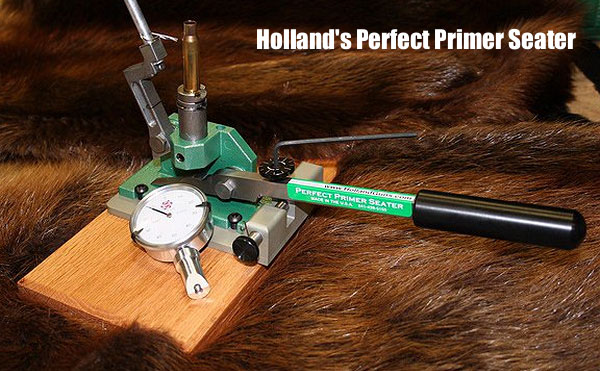
Holland basically has modified the RCBS lever, adding a precise crush control and a means of measuring depth with a gauge. He claims this gives “an EXACT primer seating depth based on primer pocket depth and primer thickness”. With Holland’s PPS, primer seating depth is controlled with a rotating wheel that limits lever travel in precise gradations. You can buy the complete priming system for $215.00, or, if you already own the RCBS Auto Prime tool, you can purchase an adapter kit (with base, arm, adjuster, and gauge etc.) for $120.00. To order, visit Hollandguns.com then click on “Reloading Equipment”.
|


