OK, you’ve paid the tax stamp and acquired your new suppressor (aka “silencer” or “moderator”). Do you still need to wear earplugs or muffs? Absolutely. Even with that expensive new “can”, your rifle could be generating over 140 decibels (dB) of noise — about the same as as an unmuffled 9mm pistol shot. That’s loud enough to create permanent hearing loss with repeated exposure.
Firearms Are Loud: 140 dB to 175 dB
Audiology group ASHA explains: “Exposure to noise greater than 140 dB can permanently damage hearing. Almost all firearms create noise that is over the 140-dB level. A small .22-caliber rifle can produce noise around 140 dB, while big-bore rifles and pistols can produce sound over 175 dB. Firing guns in a place where sounds can reverberate, or bounce off walls and other structures, can make noises louder and increase the risk of hearing loss. Also, adding muzzle brakes or other modifications can make the firearm louder. People who do not wear hearing protection while shooting can suffer a severe hearing loss with as little as one shot[.] Audiologists see this often, especially during hunting season when hunters and bystanders may be exposed to rapid fire from big-bore rifles, shotguns, or pistols.” Source: ASHA, Recreational Firearm Noise Exposure.
Suppressors, On Average, Reduce Noise Levels about 30 Decibels
In an article for Ammoland, gunwriter Sam Hoober says that you can expect about 30 decibels (dB) of noise reduction from the average suppressor: “Looking at a few different products, SilencerCo attests their suppressors reduce the sound pressure of a 9mm gunshot to anywhere from 125.7 dB to 131.5 dB, depending on the model. Advanced Armament Co, another popular supplier, attests a 23 dB to 33 dB reduction or down to 127 dB. Liberty Suppressors, another manufacturer, attests a reduction of 24 dB to 38 dB, depending on model and other factors. In short, we can presume something on the order of 30 dB of attenuation as an average.”
Using that 30 dB number you can quickly discern that you’ll still need hearing protection — good hearing protection — when shooting any suppressed firearm (even a .22 LR). “Spikes of 130 dB and more can result in permanent hearing damage instantly”. Source: NRA Blog.
The Myth of the “Quiet” .22 LR
The NRA Blog notes that “many rimfire shooters, particularly those using the beloved .22 Long Rifle cartridge, argue that the small .22 LR caliber doesn’t produce enough sound to damage your hearing”. So, is that really true. or is it a myth?
In fact, a .22 LR can be much louder than you think — a .22 LR pistol can produce sound levels of 134 dB. That’s well above the normal human pain threshhold.
Sound Levels for Common Noises:
9mm Luger pistol: 160 dB
Jet aircraft engine (near): 140 dB
.22 LR pistol: 134 dB
Normal human pain threshold: 120 dB
Noisy Nightclub: 110 db
Riding Motorcycle at 65 mph: 103 db
Power Lawnmower: 95 dB
Hearing damage possible: 85 dB (sustained for 8+ hours)
Ringing Telephone: 80 dB
Normal conversation: 60 dB
The Risk of Hearing Loss
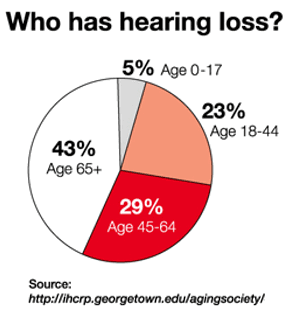
Hearing loss can be progressive and irreversible. If you are a shooter, this is serious business. As the NRA Blog cautions: “You may not even realize you’re harming your hearing. Hearing loss occurs gradually, and can go effectively unnoticed until symptoms become severe. By then, the damage is done.”
Nobody wants to go deaf. But we often see shooters without effective hearing protection when they are walking around a few yards behind the firing line. That’s bad — even if you are away from the firing line, gunshot noises can damage your hearing. You MUST use effective hearing protection every time you go to the range. Good foam earplugs costs mere pennies but they can prevent deafness in your later years. Many folks also wear muffs over plugs.
Here is a cool video that shows the entire production process for a SilencerCo Octane pistol suppressor start to finish. Beginning with the raw materials, this video shows a wide variety of cutting, milling, drilling, burnishing, fitting, metal bathing, surface finishing, and laser etching processes.
If you have any interest in production methods you’ll want to watch this video all the way through, and maybe a second time.
SilencerCo states: “From cutting metal to chemical baths, to extensive quality control every step of the way, our streamlined process is more than just a few steps.” We think you may be surprised by how many steps are involved in producing this silencer (aka “suppressor”).
The Octane is a user-maintainable, multi-caliber centerfire pistol silencer featuring a modular mounting system for use across a wide range of hosts. High strength, stainless steel CTA™ (Click Together Assembly) baffles are easily disassembled for cleaning. This design makes the Octane one of the most durable small-caliber suppressors on the market.
In its Octane 45 review, SilencerShop notes: “When it comes to ease of maintenance, the Octane 45 is probably the simplest .45 suppressor on the market. It uses the new click-together baffle system from Silencerco/SWR – which allows the suppressor to come apart like a monocore suppressor, while providing performance that is closer to a K-Baffle design.””
Watch this video to see how a sound suppressor (aka “silencer”, “moderator”, or “can”) is constructed, start to finish. It’s more complicated than you might expect — there are quite a few stages in the process. The video below shows the fabrication of a SilencerCo Octane 45 suppressor:
SilencerCo writes: “What, exactly, goes into making a silencer? It may be more than you’d expect. From cutting metal to chemical baths, to extensive quality control every step of the way, our streamlined process is more than just a few steps. Watch our newest video, HOW IT’S MADE: Octane 45, to catch a glimpse behind SilencerCo’s doors.”
How Loud Are Unsuppressed Rifles?
Firearms Are Loud — 140 dB to 175 dB. ASHA explains: “Almost all firearms create noise that is over the 140-dB level. Exposure to noise greater than 140 dB can permanently damage hearing. A small .22-caliber rifle can produce noise around 140 dB, while big-bore rifles and pistols can produce sound over 175 dB. Firing guns in a place where sounds can reverberate, or bounce off walls and other structures, can make noises louder and increase the risk of hearing loss. Also, adding muzzle brakes or other modifications can make the firearm louder. People who do not wear hearing protection while shooting can suffer a severe hearing loss with as little as one shot[.]” Source: ASHA, Recreational Firearm Noise Exposure.
How Much Does a Good Suppressor Really Reduce Firearm Sound Levels?
That depends on the rifle, the cartridge, and the effectiveness of the suppressor. American Hunter explains: “Suppressors retard the speed of propellant gases from the cartridge that rapidly expand and rush out of the barrel. It’s these gases that produce the loud boom that’s heard for miles. A suppressor’s series of internal baffles slows these gases so they are not all released at once, thereby muffling the sound.” Many good commercial suppressors can achieve 30-35 dB sound suppression. However, Zak Smith of Thunder Beast Arms says: “There are a bunch of manufacturers who publish values that are not reproducible, or use an ad-hoc test instead of a mil-spec test. In many cases we’ve tested the exact same suppressors they’ve advertised with 30-40 dB reductions and found they are actually in the high 20s instead.”
Again, for this reason, we recommend that hunters use ear protection, such as electronic muffs, even when shooting suppressed.
So you’re thinking of buying a suppressor (aka “moderator”, “silencer”). You can’t just get one off the shelf at Walmart. Acquiring a suppressor requires filling out paperwork and paying a Federal $200 Tax Stamp. Plus there is typically a pretty long wait. However, the good news is that suppressor ownership is now legal in 42 of the 50 American states — that’s 84%! For most American adults, getting a suppressor is legal, provided the buyer passes the required background checks (explained below). The 42 “suppressor-friendly” states are shown as RED in the illustration below.
States Where Suppressor Ownership is Allowed
These 42 states allow private ownership of suppressors: AL, AK, AZ, AR, CO, CT, FL, GA, ID, IN, IA, KS, KY, LA, ME, MD, MI, MN, MS, MO, MT, NE, NV, NH, NM, NC, ND, OH, OK, OR, PA, SC, SD, TN, TX, UT, VT, VA, WA, WV, WI, WY. Note: Even if you live in one of the states listed, you should still verify that owning a suppressor is legal in your area. Some states may have municipal- or county-based restrictions.
“Suppressor ownership [has] boomed in the 21st century. Thanks in part to companies like Silencer Central that streamline the purchasing process, the number of registered suppressors has grown from 285,000 in 2010 to over 2.6 million in 2020.” — GunsAmerica Digest
States Which Prohibit Suppressor Ownership
The eight states which prohibit suppressor ownership are: California, Delaware, Hawaii, Illinois, Massachusetts, New Jersey, New York, and Rhode Island. These states are shown in GRAY in the map.
Qualifications to Obtain a Suppressor
To legally obtain a suppressor, you must fill out Federal Forms and pay a $200 fee to the ATF. You must also pass BATFE background checks and otherwise comply with Federal and state laws. States can regulate suppressor ownership or use, so be sure to check the laws in your area. On the federal level, the process to acquire a suppressor is regulated under the National Firearms Act of 1934. According to the American Suppressor Association, to own a suppressor in the United States you must:
1. Be at least 21 years of age to purchase a suppressor from a dealer.
2. Be at least 18 years of age to purchase a suppressor from an individual on a Form 4 to Form 4 transfer (contingent on state laws).
3. Be at least 18 years of age to possess a suppressor as a beneficiary of a trust or as a member of a corporation (contingent on state laws).
4. Be a resident of the United States.
5. Be legally eligible to purchase a firearm.
6. Pass a BATFE background check with a typical process time of 8 to 10 months.
7. Pay a one time $200 Transfer Tax.
That fifth requirement, “be legally eligible to purchase a firearm”, involves a list of factors. The prohibitions are set forth in the “prohibited person” list found on ATF Form 4473.*
Some 39 of the 42 states that allow suppressors also permit the use of suppressors when hunting. However, three states which allow suppressor ownership DO prohibit the use of suppressors while hunting or shooting game. These states, all in the Northeast, are: Connecticut, Maryland, and Vermont.
There is an informative article on the NRA’s American Hunter website regarding suppressor use for hunting. The article, What Hunters Need to Know About Suppressors, answers common questions about licensing, tax stamps, and suppressor types. The article explains the history of the $200 tax stamp which must be paid when acquiring a suppressor:
“Why the Tax? In 1934 … the federal government, while battling gangsters such as Al Capone, heavily restricted silencers with passage of the first National Firearms Act. Hoping to gain an advantage on criminals that often had better weapons than cops, the Feds placed a mandatory ‘sin’ tax on silencers that was so high it would effectively ban their purchase by all but the wealthiest individuals. In 1934, $200 was the equivalent of $3,500 today. The $200 tax still stands despite no evidence that a simple metal tube is capable of causing crime.” — American Hunter
The American Hunter article also discusses how well suppressors actually reduce noise. User should be aware that the sound level of a large, centerfire hunting cartridge will still exceed 130 decibels (dB) on average, even with a typical suppressor (silencer) in place. For that reason, we recommend that hunters continue to wear ear protection even when they shoot suppressed.
Persons prohibited from acquiring a firearm, under Federal law, are those who fall into on or more of categories listed below. Prohibited individuals include any PERSON:
— Who was convicted in any court of a crime punishable by imprisonment for a term exceeding one year;
— Who is a fugitive from justice;
— Who is an unlawful user of or addicted to any controlled substance (as defined in section 102 of the Controlled Substances Act, codified at 21 U.S.C. § 802);
— Who has been adjudicated as a mental defective or has been committed to any mental institution;
— Who is an illegal alien;
— Who has been discharged from the Armed Forces under dishonorable conditions;
— Who has renounced his or her United States citizenship;
— Who is subject to a court order restraining the person from harassing, stalking, or threatening an intimate partner or child of the intimate partner; or
— Who has been convicted of a misdemeanor crime of domestic violence.
Read full story in GunsAmerica Digest for all 18 reasons to own a suppressor.
Do you own a suppressor yet? If you live in a state where silencers are allowed, there are many good reasons to get a modern suppressor. The process for acquisition has been streamlined. Vendors such as SilencerCo can now handle most of the legal paperwork required. And the choice of suppressors is greater than ever before.
Along with basic noise reduction, what are the key reasons to get a suppressor? There are actually many. True Pearce, Editor of the GunsAmerica Digest, has written an excellent article about the benefits of suppressors: Why a Silencer Might Prevent Dementia & 17 Other Reasons You Need a Suppressor. Here are FIVE of the 18 reasons outlined in the article. We recommend you read the full story to access ALL 18 reasons. That full article has worthwhile insights for anyone considering getting a suppressor.
Reason — Protect Your Hearing
Owning and using a suppressor helps prevent hearing loss. Hearing loss is a legitimate health concern that all firearms owners should be concerned about. Firearms are loud. The average firearm without a suppressor is between 140-165 dB and creates what is called an impulse noise (i.e. a noise that lasts for less than one second).
OSHA’s limit for impact/impulse noise is 140 dB…. Every time you fire a gun (including a .22 LR) without hearing protection or a suppressor, you can permanently lose hearing and it never returns. Surgery and hearing aids cannot restore the hearing you lose — it’s gone forever. Suppressors do not make your gun silent! However, they can make the impulse noise much less than 140 dB.
Reason — Reduce Muzzle Blast
A suppressor reduces or eliminates muzzle blast. Traditionally, we associate flinching with recoil, and while recoil can contribute to flinching, many shooters are finding that when using a suppressor on a caliber with no recoil they don’t suffer from the concussion, noise, and blast. As a result, they don’t close their eyes, flinch, or jerk the trigger.
Reason — Reduce Felt Recoil
A suppressor … reduces recoil or kick. Nobody that’s telling the truth enjoys getting punched in the shoulder, and that’s essentially what happens when you shoot a lightweight centerfire magnum rifle. Suppressors are very effective at slowing the recoil down or [reducing it significantly]. I personally observed a small (70-lb) 12-year-old boy shoot a 5.5-pound 6.5 PRC with a suppressor. After shooting he got up smiling and said, “That didn’t kick at all!”.
Reason — Reduce Muzzle Rise to Keep Your View on Target
Suppressors reduce muzzle rise and make it possible to stay on target through your shot [so you can watch the trace and impact]. This allows you to make your own wind calls and corrections.
Reason — Reduce Dust and Dirt Kicked Up from Muzzle Blast
Suppressors prevent snow, dust, dirt, or other debris from blowing up when you shoot prone. If you’ve shot much with muzzle brakes, you know this is a real thing.
SilencerCo’s new Harvester EVO is a lightweight suppressor designed for hunters and precision shooters. Evolved from SilencerCo’s Harvester 300, the new Harvester EVO suppressor is notable for its compact size and VERY light weight. Constructed with cobalt-6, inconel and 17-4 heat treated stainless steel, the new EVO weighs just 10.8 ounces (0.675 pounds) and retails for $680.00.
The Harvester EVO can work with chamberings from .223 Rem up to .300 Win Mag. Consumer feedback on the previous Harvester models led SilencerCo engineers to make the EVO shorter, lighter, and more affordable. The smaller size makes the Harvester EVO less likely to get caught on bushes and brush in outdoor environments.
Weighing just 10.8 ounces, the Harvester EVO is one of the lightest rifle suppressors you can buy. The EVO’s low mass and smaller size “gives the EVO an edge over other hunting suppressors” said SilencerCo Senior Product Development Specialist, Dewie Vieira. CLICK HERE for Harvester EVO product details.
EVO Suppressor Product Specifications:
● Rated for calibers ranging from .223REM/5.56NATO to .300 WIN
● Tubeless, light-weight design
● Weighs 10.8 ounces
● Measures 6.24″ in length
● Constructed with cobalt-6, inconel and 17-4 heat treated stainless steel materials
● Ships with both a Bravo ½ x 28 and Bravo ⅝ x 24 Direct Thread Mount
Curious about suppressors (aka “silencers”, “moderators”, or “cans”)? Below you’ll find an informative NSSF Infographic that covers the history, legal status, design, and operation of modern-day suppressors.
Here’s a cool video showing how suppressors work. This video features see-through rifle suppressors filmed with ultra-high-speed (110,000 frame per second) cameras. When played back in super-slow-motion, you can see the flame propagate through the suppressor and the bullet move through each baffle before it exists the muzzle. Check it out!
See Through Suppressor in Super Slow Motion (110,000 fps) — Click Arrow to Watch:
Suppressor Facts — What You Need to Know
In this infographic, the NSSF provides the history, specifications, benefits and uses of firearm suppressors. Don’t suppress your knowledge!
Suppressors reduce gunfire sound levels by using baffles that contain expanding gasses exiting a firearm’s muzzle when ammo is discharged. Suppressors are similar to car mufflers that were, in fact, developed in parallel by the same inventor in the early 1900s. Well-designed suppressors typically reduce the gun sound levels by 30-35 decibels (dB). Suppressors are becoming more popular even though it still takes many months to get approved. In fact, the number of suppressors registered with the ATF grew by over 1 million from 2011 to 2017. That’s a 355% increase.
Here is a cool video that shows the entire production process for a SilencerCo Octane pistol suppressor start to finish. Beginning with the raw materials, this video shows a wide variety of cutting, milling, drilling, burnishing, fitting, metal bathing, surface finishing, and laser etching processes.
If you have any interest in production methods you’ll want to watch this video all the way through, and maybe a second time.
SilencerCo states: “From cutting metal to chemical baths, to extensive quality control every step of the way, our streamlined process is more than just a few steps.” We think you may be surprised by how many steps are involved in producing this silencer (aka “suppressor”).
The Octane is a user-maintainable, multi-caliber centerfire pistol silencer featuring a modular mounting system for use across a wide range of hosts. High strength, stainless steel CTA™ (Click Together Assembly) baffles are easily disassembled for cleaning. This design makes the Octane one of the most durable small-caliber suppressors on the market.
In its Octane 45 review, SilencerShop notes: “When it comes to ease of maintenance, the Octane 45 is probably the simplest .45 suppressor on the market. It uses the new click-together baffle system from Silencerco/SWR – which allows the suppressor to come apart like a monocore suppressor, while providing performance that is closer to a K-Baffle design.””
Watch this video to see how a sound suppressor (aka “silencer”, “moderator”, or “can”) is constructed, start to finish. It’s more complicated than you might expect — there are quite a few stages in the process. The video below shows the fabrication of a SilencerCo Octane 45 suppressor:
SilencerCo writes: “What, exactly, goes into making a silencer? It may be more than you’d expect. From cutting metal to chemical baths, to extensive quality control every step of the way, our streamlined process is more than just a few steps. Watch our newest video, HOW IT’S MADE: Octane 45, to catch a glimpse behind SilencerCo’s doors.”
How Loud Are Unsuppressed Rifles?
Firearms Are Loud — 140 dB to 175 dB. ASHA explains: “Almost all firearms create noise that is over the 140-dB level. Exposure to noise greater than 140 dB can permanently damage hearing. A small .22-caliber rifle can produce noise around 140 dB, while big-bore rifles and pistols can produce sound over 175 dB. Firing guns in a place where sounds can reverberate, or bounce off walls and other structures, can make noises louder and increase the risk of hearing loss. Also, adding muzzle brakes or other modifications can make the firearm louder. People who do not wear hearing protection while shooting can suffer a severe hearing loss with as little as one shot[.]” Source: ASHA, Recreational Firearm Noise Exposure.
How Much Does a Good Suppressor Really Reduce Firearm Sound Levels?
That depends on the rifle, the cartridge, and the effectiveness of the suppressor. American Hunter explains: “Suppressors retard the speed of propellant gases from the cartridge that rapidly expand and rush out of the barrel. It’s these gases that produce the loud boom that’s heard for miles. A suppressor’s series of internal baffles slows these gases so they are not all released at once, thereby muffling the sound.” Many good commercial suppressors can achieve 30-35 dB sound suppression. However, Zak Smith of Thunder Beast Arms says: “There are a bunch of manufacturers who publish values that are not reproducible, or use an ad-hoc test instead of a mil-spec test. In many cases we’ve tested the exact same suppressors they’ve advertised with 30-40 dB reductions and found they are actually in the high 20s instead.”
Again, for this reason, we recommend that hunters use ear protection, such as electronic muffs, even when shooting suppressed.
Our friend Gavin Gear of UlimateReloader.com got a chance to visit a SilencerCo dealer, The Range LLC in Yakima, WA. During his visit, Gavin was able to test a number of suppressors (aka “moderators” or “silencers”) for both rifle and pistols. Gavin has released a lengthy article covering his experiences. If you are in the market for a suppressor, we highly recommend you read Gavin’s SilencerCo Products Overview on UltimateReloader.com.
Gavin was able to test three SilencerCo suppressors: the Omega 300, the Hybrid, and the Osprey 45. In addition Gavin was able to handle the Maxim 9, an integrally suppressed 9mm handgun.
Gavin reports the Omega 300, which is rated up to .300 Winchester Magnum, is a very popular “can”. According to Gavin, the Omega 300 has become the best-selling rifle suppressor in history for important reasons. First, it has an integral muzzle brake. Second, it can work for multiple calibers, from .223 up to .308. Third, “It is very tough — .300 Win Mag rated, and full-auto rated”.
SilencerCo lineup, from left: Omega 300, Hybrid, Osprey 45
Gavin says the Hybrid Suppressor is an interesting concept: “One suppressor that you can configure for multiple calibers, both rifle and pistol. This includes the ability to change out the threaded mount on the muzzle end, and you can also swap out end caps that will optimize sound suppression for different calibers. The Hybrid… is full-auto rated, and can handle rifle cartridges up to and including .338 Lapua Magnum! But this suppressor can also be used for pistol applications…from 9mm up to 44 ACP.”


 The Risk of Hearing Loss